The Latest from M.G. King!
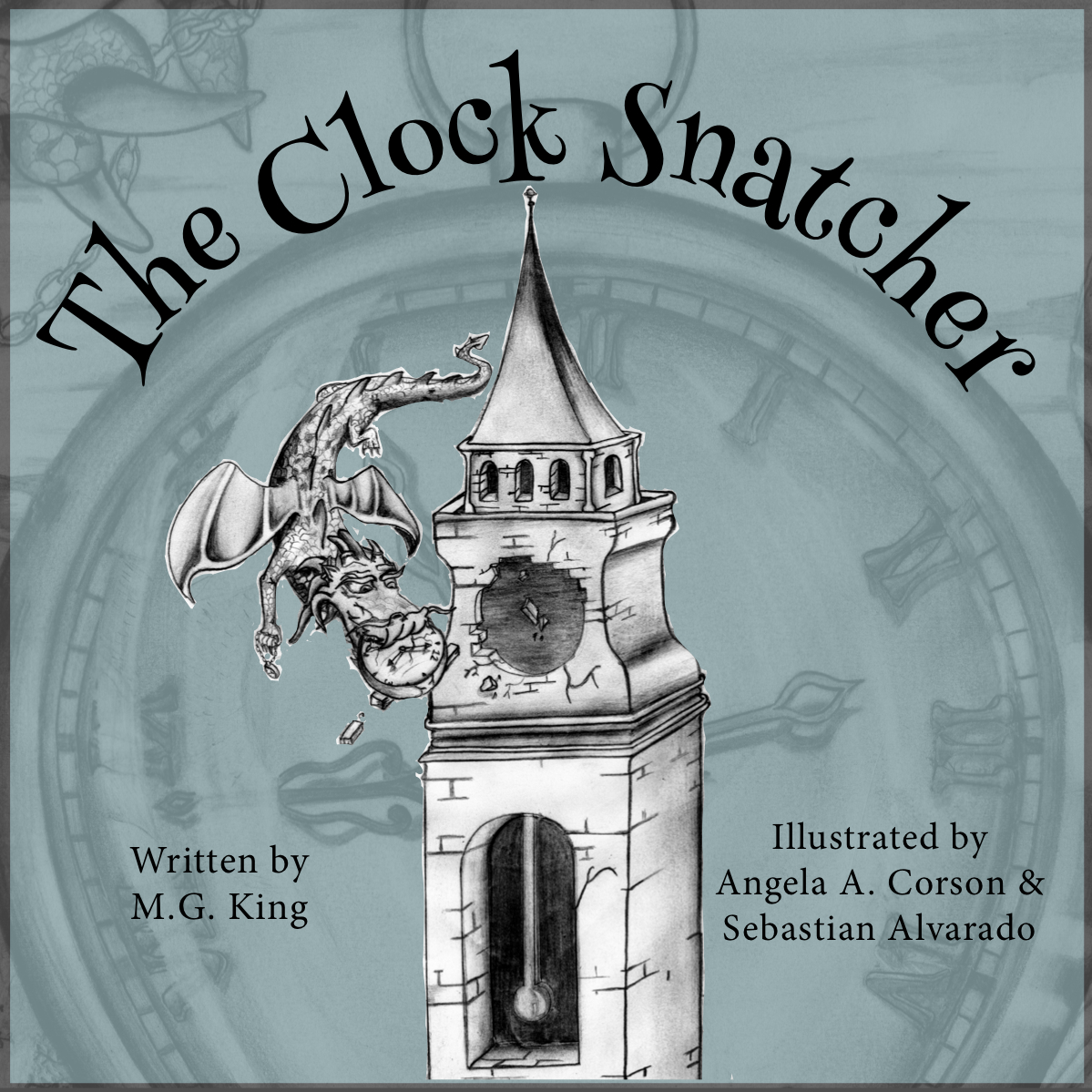
Title: The Clock Snatcher
Author: M.G. King
Illustrators: Angela A. Corson & Sebastian Alvarado
Genre: Children’s Picture Books
NOW AVAILABLE ON AMAZON!

Bartholomew the Dragon
When I heard M.G. King was writing another book, I was pretty excited. We love Librarian on the Roof! here at our house and I completely devoured Fizz & Peppers. Anything M.G. King touches, pretty much turns to gold in my opinion. She’s Texas’ very own Rumpelstiltskin.
This latest picture book is 47 pages long, with a lot of glorious black and white pictures. Think The Spider and the Fly when Tony DiTerlizzi did the illustrations – a myth to last the ages in combination with high quality sketches can’t go wrong.
Right now the book is only $3.99 on Kindle. Maybe if everyone buys one and supports our favorite local kid’s author there will be a hardback edition in our future. My bookshelves are already itching for a copy… I can hear them calling for it… this book belongs in every mother’s library… and child’s, and dragon lovers’, and clock collector, and art appreciator, and…
Teres – It’s About Time
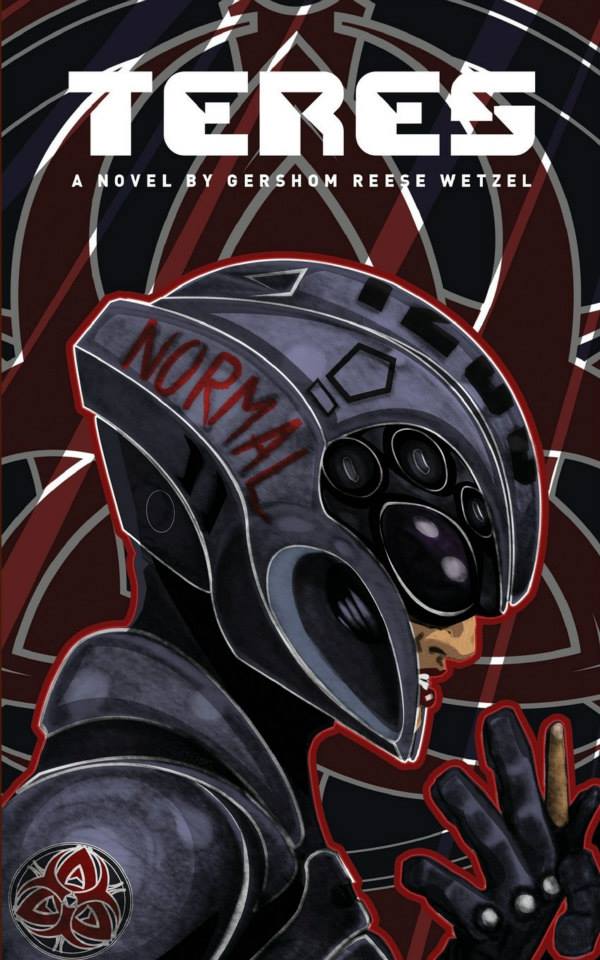 Title: Teres
Author: Gershom Reese Wetzel
Publisher: LucidBooks
Genre: Science Fiction
I read this book in April of this year (2013) when it was still a pdf file. Go back in time a few (or ten) years and I remember listening to Gershom (my dear friend) talk about his ideas regarding a character named Teres. I remember a very cool dinner party at Macaroni Grill with Teresa Noreen, who seemingly semi-inspired the character Wetzel invented in his mind.
She was stunning. So is the book.
I read the book in approximately three to four hours. I believe it’s 300 pages or so long. It was riveting, and I was doing a real time discussion as I read with the author, searching for mistakes. There really weren’t any that I recall.
I’ve been leery about posting a formal review on any of my typical sites (shelfari, goodreads, amazon, etc.) though. Not because I don’t like the book – I love it – but because I have the great honor of being mentioned on the back of the book and I don’t want any potential customer to feel duped or think my thoughts are self-serving or insincere.

I feel too close to write an unbiased review, but I am way too excited about Teres to leave my thoughts undocumented.
Teres is all action and go from start to finish. It’s glorious sci fi patterned stylistically after typical books of the genre, but with a depth that is not easily comparable in anything else I’ve read. Wetzel may not have intended on delivering such a moving message about life, government, and religion, but by nature he’s a wise messenger and that couldn’t help but come across in his writing.
As I mention in so many of my posts, I am a sucker for dystopian societies, and this one is right up there with the infamous Big Brother from 1984 and Libria from the amazing film Equilibrium.
What makes Wetzel’s work so engrossing is what a visual masterpiece he has created. He is first and foremost an artist, then a graphic designer and author. His writing is enhanced by the images his fingers itch to draw out on paper. It’s also really cool that he has the ability to do all his own cover and concept art.
I can’t wait to see more from this character – and her creator. I see sequels and graphic novels and films of the Aeon Flux caliber in Teres’ future.
Impromptu Post on Being Changed
There’s a little chain status going around on facebook that I recently participated in…
Completely off the top of my head, in about five minutes versus the fifteen offered, and in no particular order I wrote:
Soon after posting my version of the status update, conversation ensued. One of my friends posted his own list on my thread instead, Tanya Egan Gibson felt honored to be on the list (she is so beautifully humble and I just love her and her work, she tickles me), and a college buddy posted a query.
Andi, I’d love to hear more about your thoughts on how “Metamorphosis” was life-changing for you. I studied it, but would have never thought of that one, so I’d be interested to hear how it was, for someone unlike me. : )
I started to answer right there on facebook, but I thought it deserved a blog post instead.
 I read Metamorphosis first in… I’m not sure… 8th grade? I think it is best first experienced during puberty when you’re going through that everything creepy is wonderful phase. Young teens are always the ones who haunt the shelf where Edgar Allen Poe is; and for me it was Edgar Allen Poe, Franz Kafka, and Nathaniel Hawthorne. I identified greatly with Gregor, which if you read a Sparknotes’ character summary, try to think of a 13 year old geek who wouldn’t.
Gregor Samsa – A traveling salesman and the protagonist of the story. Gregor hates his job but keeps it because of the obligations he feels to pay off his father’s debt and care for his family. He has transformed into a large bug and spends the rest of his life in that state. Although hideous and unrecognizable to others, Gregor retains his some of his inner life and struggles to reconcile his lingering humanity with his physical condition. (-from Sparknotes)
 Obviously a teen is the protagonist of their own story, they hate their job (school) but keep going because of obligations (to their existence, their parents, and the government). Teens work their butts off seemingly for the sake of their family… chores, chores, more chores… honestly what 13 year old thinks they’re doing the dishes for themselves? And rarely do they actually think school is for themselves. I wanted to learn and I enjoy research, but ultimately I wanted to make sure my parents weren’t pissed off by my report card. Gregor is hideous and unrecognizable to others, and at thirteen who doesn’t feel gross and pimply – simultaneously invisible and on display to the world like a freak show. At thirteen you’re sub-human, neither child nor adult, and most of your life feels like it’s happening in your head.
Or, maybe that was just me.
To quote another post I wrote:
[…] I read The Metamorphosis over and over again, wrote a paper on it in high school and two more in college. I can’t count how many times I’ve read it, I just think its so wonderful. After reading The Castle and The Trial, however, I’m realizing that Kafka’s greatest skill is in writing the most frustrating scenarios a human being could be plopped into – alienation and bureaucracy. Whether it becoming a giant bug, living under mysterious and unfair authorities, or dying after a year long quest to discover what crime you have been accused of, Kafka has helplessness down to an art. I love Kafka!
I love him because his concepts are fascinating. He is the most wonderful creator of modern day myth that I’ve read. […]
(-from my review of The Trial)
When you read something that reminds you that you are not alone in your feelings, that even this great emaciated and pale world renown author could understand you, everything seems a little bit better. If a dude can turn into a giant cockroach, I can get through middle school – at least I’m not literally a disgusting bug.
I recommend that anyone re-read The Metamorphosis, but from the eyes of their 13 year old self. What do you think of it now? I remember feeling like my parents were repulsed by me. I remember feeling like every adult saw me as a liar and was distrusting of my existence. I remember feeling alone and wanting a friend. What do you remember?
Old Souls
 Title:Been There, Done That, Really!
Author: Paulette Camnetar Meeks
Publisher: Xulon Press
Genre: Memoirs/ Short Stories/ Christian Living/ Large Print
Length: 496 pages
Paulette Meeks stood at the table of books at the bookstore after her signing, “Pick one you think you’ll like.” She is in her seventies, has several titles out, and has recently become a writing machine though she’ll tell you, “I never thought I’d be a writer, but God gave me these stories.”

Paulette and her friends. (Ms. Meeks is on the far left.)
I looked over the books. One is fit for a Sunday School class, one looks fun and spunky featuring a nun zooming by on a motorcycle. I picked Been There, Done That, Really! It has an elderly couple, the sort you imagine have grown old together, looking off into the distance over what I presume is a cup of coffee (could be tea, but I’m partial to coffee drinkers). Obviously, this appeals to me.
I always thought there were two kinds of people in the world – those that prefer the very young and those who prefer the very old. I’m of the old variety. I love my child, but I’ve never been a natural nurturer to children. To me they are just little people who haven’t learned how to function well in society. They don’t yet look beyond their own noses, they are selfish and self-serving. Thanks to hormones and motherhood that view has changed a bit – my daughter is indeed a little person, but I can see the wise woman she will one day be. And the cute, snuggly factor helps.

This picture was taken about thirteen years ago, but I remember this woman vividly.
The elderly, though, have always intrigued me. Even as a very small child, I preferred white hair and wrinkles to the company of my peers. I learned to count by playing SkipBo with a woman who was born at the turn of the century – the 1899 to 1900 one, I realize I have to specify these days. In high school when I did community service projects, I always opted for cleaning homes for assisted living homes in low income neighborhoods over playground session with tiny people. I enjoyed the conversations. Then and now, I like hearing the stories.
If you’re one of those people too, the kind who likes to hear about a lifetime of adventures from someone interested in sharing them, Paulette Meeks’ collection of stories are for you. They are sweet, simple tales from people who just want to talk about their lives a little bit. I enjoyed it thoroughly.
My favorite story was Paulette’s own: Never Too Old to Be Smitten. There is a picture at the start of the story of Paulette and her husband Bill on their wedding day June 29th in 2001. I found the idea of finding love in your sixties so wonderfully sweet. Bill was a widower before Paulette, and I hope that if I die first, my husband finds someone to keep him company before he leaves this world. (We wives like to believe our men can’t live without us. ) More than anything, the word ‘smitten’ is a magical word and it is easy to get caught up in the romance of the meaning while you read the story of their first meeting and first date.
Reading through these stories reminded me of another book I’ve reviewed here before, Rich Fabric
Confessions
 I had great plans for the year 2013. I do every January. I make lists, I plan reading schedules. I try to join way too many book clubs. I set unreachable goals. More specifically, this year I wanted to read through Susan Wise Bauer’s Autobiographies and Memoirs list. It’s about 25 books long, I think, starting with St. Augustine’s Confessions. It is December. I am still reading Confessions.
I’ve read Confessions before in college. It’s not a difficult read, just an important one. It’s the book I save for early mornings as I watch the sunrise with my coffee. Sometimes I read it aloud to my daughter over breakfast, a lot of times I hunker down in the early light and keep it to myself.
I’ve been keeping a lot to myself over the past few years, which goes against the very core of my being… or the very core of who I am told I am. Throughout my life I have been compared to a babbling brook. Information, life experience, anything goes in… and out it babbles in the blink of an eye. I come off extremely extroverted to people who know me least. I find this ironic because I have so much that I don’t share. I am so back and forth with what feels the most natural (hold it in or spill the beans?) that I have a hard time deciding what teachings are right (hush up and keep it to yourself or Confess?).
After reading The Sparrow and re-reading Augustine’s Confessions in the same year – in the same month, really. You’d think I’d have something deep and eloquent to say about Confession. Or, perhaps, you’d think I’d spill out a confession of some kind in this blog post…
All I’ve got for you in the form of a confession is that the first time I read Confessions was during an all-nighter 12 hours before a test for my literature class at a Baptist college. Note the sarcasm when I tell you the experience was so enriching.
Instead of a true confession, I am reminded of a previous post in which I determined I was not very thoughtful. Instead, I sit here lamenting the fact that I have hardly accomplished anything I set out to do in January at all.
I console myself by saying, hey at least I got published this year! (Which seems very anticlimactic when your book is not a Steinbeck level masterpiece.) It might not be the stunning work of art I dreamed about writing since childhood, but people seem to like it and… there’s always next year!
Again, I say that every year. And thus starts the cycle all over again: A January list of books to read and goals to accomplish. Stepping stones that I believe will turn me into a scholar with at least half a brain. I have a feeling I will lie on my death bed at 105 and say to the heavens, “No, not yet! I’ve learned nothing! And I haven’t figured out how to be thoughtful!” We’ll see. Visit me when I’m 105 and I’ll let you know. Even though I’m a woman, I suspect I might have a beard like this guy by then…

My Favorite White Whale
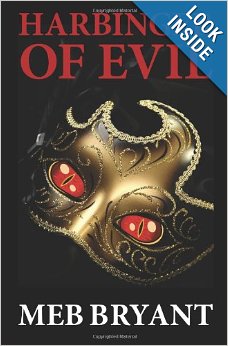 Title: Harbinger of Evil
Author: Meb Bryant
Genre: Crime Fiction/ Mystery
Length: 248 pages
I met Meb Bryant at her book signing at Half Price Books Humble in October. She’s a lovely lady, sweet, professional, wonderful conversationalist. She left with me a signed copy of her book to review for my blog.
I feel terrible that somehow the book ended up in my manager’s stash cube in the warehouse at the store (how completely unprofessional of me). Yes, a little bit terrible because I feel like I should have gotten a review ready for the author sooner – but mostly selfishly terrible because I denied myself this reading experience for two whole months! Words of wisdom, don’t do that… read Meb Bryant’s work NOW.
Between Dutton sending me Elizabeth George’s latest work, a very full Halloween month of book signings, and the general mood of my year – I’ve read a lot of crime fiction this year. A lot more than usual, anyway, I think. Bryant’s crime work is the best of 2013 – no exaggeration – and I’ve read some really good ones. John Oehler is excellent, Elizabeth George always nails character development, Pamela Triolo has a grip on a genre all her own (healthcare mysteries with a registered nurse solving the mysteries), but Meb Bryant blew me away.
I adore Richard Mobey, aka Mobey Dick, he’s my favorite white whale. I thoroughly enjoyed getting to know him, watching him build relationships with the other characters in the novel, witnessing his snotty banter, and finally experiencing him unravel the mystery and put all the puzzle pieces together.
I love the back drop of the novel, there’s no exaggeration with the tagline: New York Crime Meets New Orleans Voodoo. In all my reading history, this is my favorite ‘voodoo’ piece. I can’t think of a better novel set in the French Quarter.
If I had my way Detective Richard Mobey would have a series longer than Inspector Lynley’s, but I have a feeling I won’t be getting my way.
The Sparrow
 Title: The Sparrow
Author: Mary Doria Russell
Publisher: Ballantine Books
Genre: Literature/ Philosophical Fiction
Length: 431 pages
In 1996, 2019 must have seemed so far away. Now, in 2013, while reading Mary Doria Russell’s The Sparrow I am struck with the oddity of dates in science fiction novels and the disadvantage of time. Then again, Russell’s novel isn’t science fiction so much as philosophy and a study of human nature and peoples’ thoughts on God.
It is like 1984 that way, a study of the world as it is and always will be, not just one particular society. And like 1984, The Sparrow is timeless.
More than God and philosophy and all those huge thoughts I’m supposed to have about the book – you know, the ones you discuss in Book Club and during literature courses in college – I was stunned by the humanity of it all.
Quotes about relationships like,
“The antagonism he sensed but could not understand. And finally, ending at the beginning, the almost physical jolt of meeting her. Not just an appreciation of her beauty or a plain glandular reaction but a sense of… knowing her already, somehow.”
Russell’s work is full of those moments. Those gut reactions, nuances, and descriptions of sensations everyone has had at some point in their life – or if they haven’t, they will. Those epic feelings of “knowing,” the ones people adore having in movie-like surrealism, but are completely caught off guard and unprepared when they happen.
Russell has written something uniquely philosophical and thought provoking, but amidst aliens and Christian theology, atheism, Judaism… in space travel and anthropology, I was caught off guard by the sensation of understanding these characters so completely that I felt like they were my own. If not my own, a part of me… or maybe, just me.
I am riveted by the emotional anorexic. I am captivated by the seduction of doing God’s purpose. I am amazed by their choices.
More than that, I wish I could write something like this – something so thoughtful. But I suppose the reality of my life is that I am stubborn and obedient, curious and creative, but not thoughtful. No, I am not that.
I seem to be lacking the thoughtfulness and critical thinking skills, the ability to really pursue enlightenment. Instead, I find myself caught up in the safety and the dogma, and more than anything in the whole book, the innocent friendship between Sofia and DW – that was my favorite part. How simple of me to read something so profound and I just want to bask in a cozy friendship.
18 Things Everyone Should Start Making Time For Again
Yes! To all of it, YES!




 Anakalian Whims