Seashells, Gator Bones, and an Interview
Interview with Susan Adger
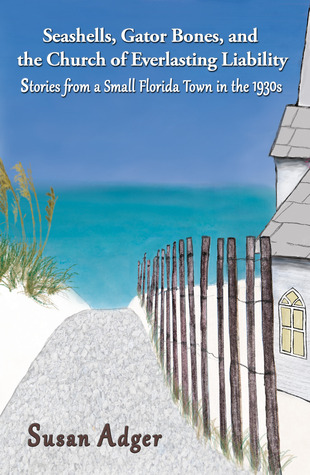 1. Seashells, Gator Bones, and the Church of Everlasting Liability. What a title! Can you tell us a bit about it?
Actually, my daughter Emily came up with the title, based on three of the stories in the book. Seashells are reminders of a girl’s first love, one of the characters makes jewelry out of gator bones, and the Church of Everlasting Liability is one of the town’s churches; the name came from the fact that the members are supposed to be “libel” for each other – to take care of each other – which means they have to know everybody’s else’s business.
2. What made you choose Florida as a setting?
My family has been in the Tampa Bay area for five generations, and the characters in the book are based on some of the old stories my Grandma Keathley used to tell us. When she was born in Mango, FL in 1891, the population swelled to thirty-eight people. Her mother was one of seven children, and her grandmother was one of eight, so there were plenty of crazy, I mean interesting, relatives out there to get ideas from. While everything in the book is fiction, my relatives will be able to tell you who some of the characters are based on.
3. Can you tell us a bit about your earlier work A Quiet Voice?
 The book was inspired by a man named Eugene Hairston, who grew up in grinding poverty, then to keep himself out of trouble – he thought – he enlisted in the army and ended up fighting in Vietnam. When he reported the rampant discrimination on the base, his sergeant pushed him out of a helicopter into Viet Cong territory. He survived almost by accident, when some American soldiers on patrol happened by a few days later and rescued him. After the incident was reported, Eugene was given the opportunity to return home, which he did. With untreated P.T.S.D., he became addicted to drugs and alcohol, spent almost two decades in jails and prisons, and lived on the streets of Tampa for eight long years.
In 1998 he changed his life. I met him a few years later and we started working on A Quiet Voice in 2005. It took us almost two years of meeting weekly to complete it. Today he is married, holds a responsible position at the Bay Pines Veterans Administration Medical Center in St. Petersburg, Florida, and is held in high esteem by hundreds of people who know him. The V.A. sends him to speak to veterans about his life at conferences nationwide, and he has received many incredibly heart-warming letters from readers. I’m very gratified to know that writing this book has helped him reach so many people.
4. Ray Bradbury once said, “You can’t learn to write in college. It’s a very bad place for writers because the teachers always think they know more than you do—and they don’t. They have prejudices.” What do you think about this statement?
Well, actually, I never studied writing in college, but for me it has been really important to read a lot, to learn from what others do, and to get feedback on my work. I’ve done this mostly with other writers; I’m in two critique groups and value their input. When I’m critiquing others, however, I always remind them that what they’ve written is their work, and while it’s good to listen to input, in the end it’s their creation.
 Initially, I was told that I should know my entire story inside and out before actually writing it; have my outline and character sketches completed and go from there. And heaven knows I tried to do that. But when writing fiction, the only way that seems to work for me is to have an idea about a character and then just watch to see what happens; when there’s a knock on the door in the story, I go along to answer it and we both see who’s there. Of course, I do a lot of editing that way, but it works for me.
I enjoy writing short stories, keeping it light. These days I can hardly bear to watch the news or read the paper; seems to me there’s plenty of negative out there and we could all use a laugh once in a while.
5. What were your educational experiences like? Do you think these experiences have influenced the kind of writer you have become?
I was never too wild about school and wasn’t a great student, partly because when I was growing up my family moved almost every year so I was always the new kid on the block. I remember in the second grade, looking out the classroom window and thinking I’d give anything to be outside with the guys trimming the hedge rather than sitting at my desk. But somehow I ended up with a B.A. in Sociology and a Master’s Degree in Education.
I’m sure everything I’ve experienced in my life has colored what I write. I don’t think any author can avoid putting themselves into their work, even if they want to. I spent a number of years working in child abuse and neglect, as well as with young children with behaviour/emotional problems or developmental delays, and their families. Being able to watch people work to make changes in their lives has been both rewarding and heart breaking. They all taught me a great deal.
6. What brought you to the writing world? What made you decide to write?
I am definitely a late starter. I first began writing when the last of my three children moved out. I remember coming home from work that day, sitting on the couch in an empty living room and listening to the quiet; nobody yelling that somebody stole her sweater (nothing was ever misplaced, it was stolen), no loud music competing with the television, no phone ringing off the hook. I felt let down, a little lonely. For about ten minutes. Then it occurred to me that after twenty-two years of raising kids, mostly as a single parent, I had a life of my own again and could do whatever I wanted. I started with family stories, and branched out from there.
7. Do you have future projects up your sleeve?
I’m in the middle of recording the Seashells book, in my grandma’s old Florida vernacular and hope to have it done this fall. (Why is everything harder than it looks?) And I have a number of stories completed for a companion book.
8. Who are your favorite authors? Do you have an author whose career you aspire to emulate?
Years ago I discovered Lee Smith, whose stories about poor families in Appalachia drew me in. While I haven’t intentionally used her as a model, she has unquestionably had an influence on my work.
9. I see on your facebook page that you do a number of public speaking events and lead group discussions on your books. What do these events involve? How do they work out for you?
I’ve been fortunate to be asked to give a number of book talks at local venues, and have been gratified to see how encouraging and supportive audiences have been. When I first started speaking, I found it quite challenging (read terrifying), but with practice, I no longer feel that I’ll have a nervous breakdown before it’s over.
I talk a little about how I got into writing and my Florida family’s background, read some excerpts from the book, and encourage listeners to record their family histories.
10. If there were one thing you would want your readers and fans to know about you, what would it be?
One of the reasons I thought to write this book was because of interviews I did with my Grandma Keathley. Years ago I sat down with her and recorded her reminiscences about growing up in Mango, and later raising her six children in Tampa. I had to kind of twist her arm to do it; she finally relented after I talked her into reciting poetry like she did to her kids when they were small, and singing a few hymns. Then I just kind of sneaked her into the interview by asking questions.
I love hearing her stories about growing up in Mango in her voice with the old Florida “southernisms” Sometimes when I’m feeling down, I’ll make myself the breakfast she’d always fix me, a fried egg on top of some buttered oatmeal, then listen to one of her interviews, and I feel better.
When I speak, I strongly encourage the audience to interview the older members of their families – these days it’s easy to videotape them – or write about their own histories. The little details are what I love most – knowing that the oxen my great-grandfather hooked up to the wagon to take his vegetables to market were named Red’en and George; and when my great-grandfather would pull my grandmother up on the horse with him so she could see the baby birds in their nest; and once, when my grandma was at a “Church Sing” with a new boyfriend, the horse took off with the buggy and when they found him he’d gotten stuck halfway over a fence. For me, details like that make my family history come to life.
And you can quote me on this: “There is NOTHING more interesting than families.”
Interview with Leo King
 Periodically, Anakalian Whims interviews authors and artists for the public. This blog having such a friendly relationship with Grey Gecko Press has allowed for more author interviews than I could have ever dreamed for, and here’s one more. Meet Leo King, author of the Sins of the Father
1. You have a 3.95 average rating on Goodreads for The Bourbon Street Ripper, sounds like people generally like it! (The first few pages creeped me out and I’m holding off until I can muster a non-scaredy cat reading mood out of myself to finish the book.) Tell us a little about your series Sins of the Father.
Sins of the Father is a genre-bending trilogy. While it’s thriller throughout, it starts as a a murder mystery and changes into what could almost be called urban fantasy. The voodoo culture undertones in the beginning become more prevalent as the three books go on.
2. What brought you to the murder/mystery/thriller genre? Is it merely what fit this story or is it your chosen genre?
My chosen genres are actually sci-fi, urban fantasy and epic fantasy. However, I’ve always wanted to write a trilogy that mutates genres in a seamless fashion. Most of this is because I want to show that it can be done. Put enough information in the story to inform the reader, and you can go from mystery to supernatural or fantasy to science fiction, etc. While it’s not recommended all the time (fans of one tend to favor it over the other), there are occasions when it can be very entertaining.
This is my only attempt at genre-bending. I will not do it again. I also will likely never write pure modern-day mystery. It’s not something I think I’d enjoy. I might try a hand at science-fiction mystery some time.
I love thrillers though, and will likely continue in the supernatural thriller and serial killer thriller genre in the future.
I think I kind of got away from your question. Sorry about that. The genres of Sins of the Father fit the story.
3. Who are your favorite books and authors? Ultimately whose writing career inspires you most?
American Gods by Neil Gaiman is my #1 favorite for modern authors. Otherwise, anything by Asimov for science fiction, Weiss and Hickman for fantasy, and Stephen King for thriller/horror. My favorite old-school novel is Lord of the Rings.
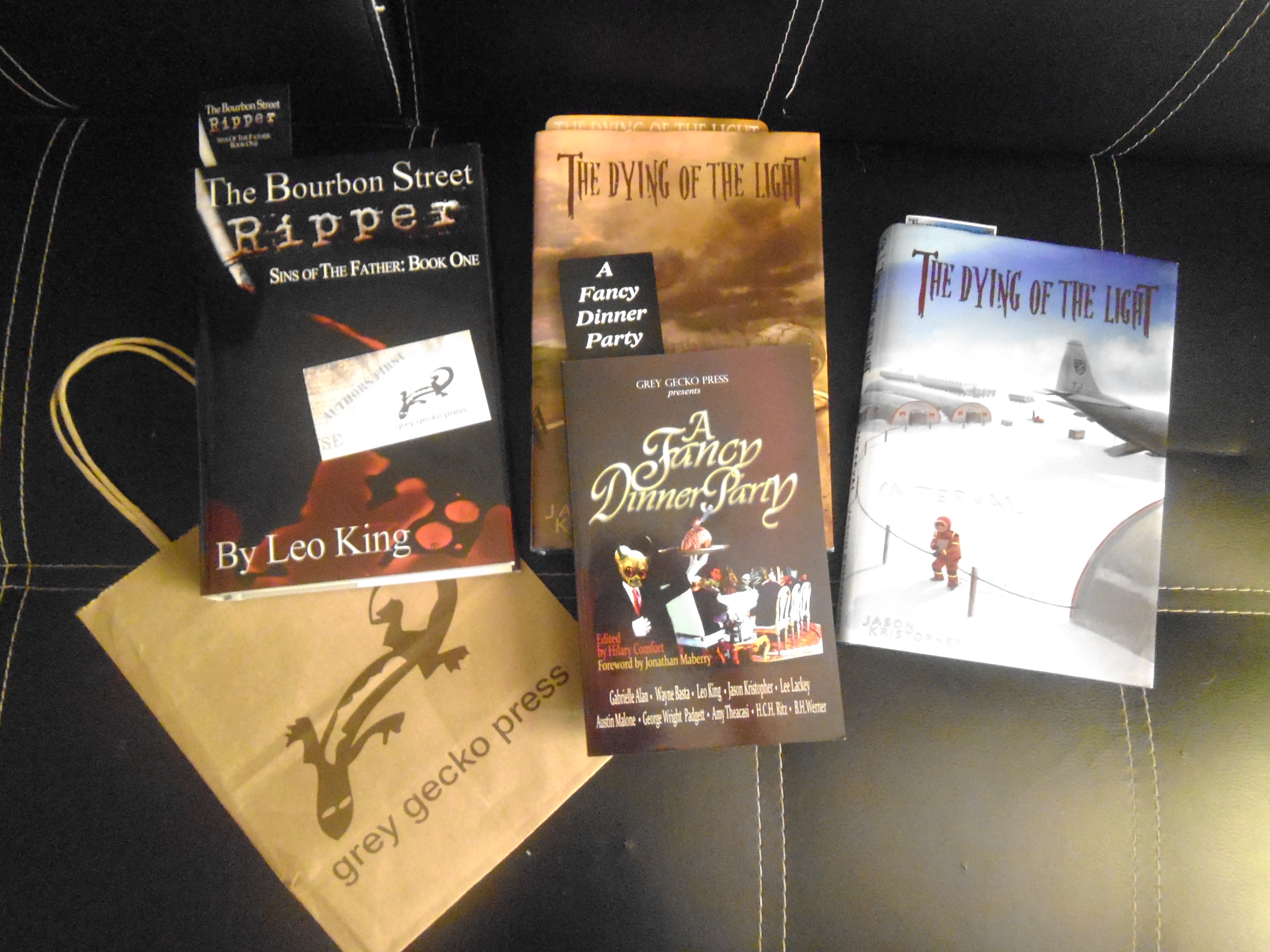 4. You’re published through Grey Gecko Press. How has that experience been for you?
I’ve enjoyed the freedom I get with GGP. They put the author’s desires first and foremost. I consider GGP a great starting place for any author.
5. Although you’re a Houston local, I see in your bio that you’re not a Houston native. How do you think your Louisiana roots and life experiences have affected your writing?
I grew up in New Orleans, the birth place of the modern romantic vampire (mostly thanks to Anne Rice). Because of that, I tend to blend romanticism with everything I write. I also try to give my locations and settings enough life for them to be considered a character themselves.
6. Your bio also says that you want your work to be controversial enough to make people think. What kind of thinking were you wanting to encourage with the Sins of the Father series? What kind of themes do you plan to pursue in future work?
If nothing else, I want to dispel stereotypes. Let me explain.
Every person, even the most deplorable, is still a person. Something made them that way. For example, some people in our society believe that anyone who is a terrorist is the epitome of evil and deserves no regard. But what drove that person to become that way? What hopelessness made them susceptible to their cause’s brain-washing? So many people do not ask those questions. They just brand and condemn. It disgusts me.
So I’ll create characters that the reader falls in love with, and then have them reveal something utterly horrible about themselves. Will my readers continue to love them? Will they condemn the actions instead of the person? Or will they suddenly hate the character and put the book down? What they do, and if they think before doing it, will say a lot about them.
I won’t apologize for anything I write, no matter how much it offends someone. Every human being has a story, and that story needs to be told.
7. You’re planning a Halloween release party for your next book. Ideally, what would that look like to you?
As this is my first launch party, I have no expectations. Something voodoo themed would be lovely.
8. Did you put any of your series to paper while listening to music? If so, what kind, which artists, what songs?
I write in silence.
9. Outside of your writing career what does your life look like? Do you have hobbies or interests that you’d like to share with your readership?
I am happily married to my wife of going on nine years. I work from home during the day and write at night. Sometimes I meet friends for coffee or beer, but never coffee and beer. That’s an important distinction!
My biggest out of office activity is my Writing Workshop. It’s a video workshop I started in 2012 and let stall out due to lack of equipment. I am thinking of setting up a Kickstarter campaign to get better equipment. It’s hard to teach writing techniques when you’re recording on an iPhone!
As for hobbies, I am an avid gamer. That’s both video games and role-playing games. I have a BS in Video Game Design that I’ve never used professionally, but I design game mods and develop indie games all the time. Yes, game development is a hobby for me. I love martial arts and am a sword collector.
10. If there were one thing you would want your fans/readers to know about you, what would it be?
Someone once expressed concern about my mental health because of some of the scenes in The Bourbon Street Ripper. I want to say that it’s just a book: I don’t endorse any of the horrible things my characters do!

Leo King, second from the left in the black shirt, interacting with fans at one of his book signings.
Do You Believe in Ghosts?
 Title: The Thirteenth Tale
Author: Diane Setterfield
Length: 406 pages
Publisher: I read from the Atria Books Book Club Edition
The first time I read this book it was July of 2011. I was no longer on maternity leave, but my daughter still seemed very, very small. We were a sleepy household then, despite her running around long before her playmates and peers had begun taking their first steps. I remember mostly listening to this book on audio because I had a hard time keeping my eyes open when I was home – but I wasn’t actually napping ever. It was excellent and I adored it. That’s why I encouraged the HPB book club to read it for our August discussion that will take place tomorrow night (August 4th, 2014).
One of my fellow clubbers emailed me already, saying he only gave the book a 5.5 out of 10. He had questions I can’t repeat in a review due to spoilers. I had meant to take this month off and discuss from memory, but his questions and low rating for a book I remember describing as the perfect tale forced me to pick it up and read it again.
And I discovered that I disagree with him…
I feared I would have my mind changed by time and growth. I feared I would have read so many wonderful things since my first reading that somehow the magic wouldn’t shine to brightly and mysteriously the second time around. I feared the ghost story wouldn’t feel so ghostly, knowing the ending.
But my fears were unwarranted, because I still loved it. I loved it all.
“There is something about words. In expert hands, manipulated deftly, they take you prisoner. Wind themselves around your limbs like spider silk, and when you are so enthralled you cannot move, they pierce your skin, enter your blood, numb your thoughts. Inside you they work their magic.” – pg. 9
 Diane Setterfield has expert hands. She manipulates words deftly. She takes a reader prisoner with her storytelling. Vida Winter winds herself around your limbs like spider silk and will enthrall you. Charlie will render you so terrified you will not move, except to turn the page; Adeline March will pierce your skin, and become a knot stuck in your throat; Isabelle will enter your blood and startle you; Emmeline will numb your thoughts. It is the best, most believable ghost story I’ve ever read.
Also this week, I’ve watched the BBC screen version of the story. Yes, there were a few things changed, much left out, but overall I was pleased with the production. We were able to watch it on youtube.
First of all, it was brilliantly cast with Vanessa Redgrave. I adore her and she is exactly how I imagined someone like Vida Winter to be. She appears in so many of my literature to film favorites, like Atonement, Howards End, and Mrs. Dalloway. She’s such a classy lady. I must say, too, that I think she looks fabulous with Vida’s red hair.
Some people express a distaste for the “name-dropping,” the characters discussing books and how they shaped their lives. There are a lot of Jane Eyre references. If you’ve read my book (The Bookshop Hotel) you’d know that I am not one to find this unfavorable. In fact, that is my favorite sort of book, and it is in this fashion that I have discovered my most cherished reading experiences: from characters who pointed me in the right direction. Characters always have more impact on me than real people. They have no stake in it, I can trust them, they gain nothing by convincing me or failing to convince me to choose a certain book or behave a certain way. For this I love them. For this I respect them more than the living and breathing.
Only a character could get me to listen to a ghost story with an open mind. Only a character can bring to life the fantastical, the magic, the mystery, and the excitement of a ghost story. Only a character could make me see and understand a ghost.
Do you believe in ghosts? No? Read The Thirteenth Tale and Vida Winter might change your mind.




 Anakalian Whims