Ryan Swindoll Interview

You did the cover art for Lost Legends, it’s beautiful. Have you designed other book covers?
I’ve designed a handful of covers, yes! I got my start in print design for Grafted Life Ministries, branding the books in their catalog. When our fearless anthologist Adam D. Jones’ recruited me for The Lost Legends, I took the plunge into fiction, so you might say this is my genre debut.

With The Lost Legends, it delighted me to explore the classy aged appeal of art deco in the unusual visual context of folk magic. I think the cover evokes the same eclectic feel that characterizes the stories inside.
I’d be remiss if I didn’t plug Adam’s newly released novel Marshal Law, which I also designed. The cover takes inspiration from science fiction westerns, but without the photorealism or lonely protagonist look so common in the genre. We wanted a fresh direction for the cover that provoked the imagination.

As a writer, I’ve heard you usually prefer writing science fiction; what inspired the The Problem With Elves and Tavernfall?
One of the boons of writing science fiction is that it need not be future-specific. When Adam approached me about contributing to his fantasy anthology, I saw a personal challenge to blend the setting of medieval magic with stories of alien encounters.
“Tavernfall” was born of a simple thought experiment: what would a medieval era conspiracy theorist have looked like? Not (merely) the town drunk or the madman in stocks, but the scholarly type. What could they have said to convince you that, say, all of human history was secretly the plot to the Lord of the Rings? I pulled out my old college notes in history and theater, and the story practically wrote itself.
I found writing “The Problem with Elves” more difficult. It began with a literal dream I had about an alien abduction, wherein they forced me to listen to a timeshare presentation. It was hilarious, but lacked substance. When I stumbled upon Grandmother’s mysterious epitaph, “Never throw out a rotten egg–I never did,” the whole story opened up. I was able to follow the protagonist’s relationship with Grandmother to its unconventional end. And we got fart magic out of the deal. Sweet.
You have two short stories included in Lost Legends, do you find short stories to be easier or more difficult to write than longer fictions?
I do find short stories easier, but all of writing is difficult. It just takes a long time.
What other things do you have publication?
Nothing yet! But working on a science fiction novel about an alien family that crash lands on a robot world, and the trouble that ensues because the robots don’t know the first thing about children, biology, or toilets. I have no idea how I’m going to market it.
You have a great sense of humor, have you always been clever and funny, or is it a skill honed over time? What were your favorite books as a child and how do you think they contributed to your wit?
I’ll never forget reading The Boxcar Children and getting far enough into the book series that the primary author changed–and all of a sudden, characters were “chuckling.” I remember reading on the toilet and thinking, “These people never chuckled before, and now they’re chuckling twice per page.” I never read another boxcar child after that.
I’m sure that answers your question.
Stephen King wrote in On Writing that writers should read a lot to keep their technical and creative tool box full. What are your favorite “tool box” books?
I enjoy James Scott Bell’s book The Art of War for Writers: Fiction Writing Strategies, Tactics, and Exercises. Easy to scan, read, or dive in.
Of your stories in the anthology, are there any you anticipate seeing spin off into other work?
I’ve heard rumors. If I could wish feature-length stories out of the anthology, I’d want to see more of the world in “The Luck Stone,” “Death of a Young Mage,” “The Door,” and “The Candlemaker.” Each story felt like a peep into a much larger world.
If The Lost Legends were to become a Netflix Original or Amazon Prime series, who would your ideal cast be for The Problem With Elves?
Gaten Matarazzo of Stranger Things fame would be a ringer for our fourteen-year-old protagonist. Grandmother is more difficult, but for some reason I like the idea of Octavia Spencer in the role. Good with her eyebrows, I think.
With your obvious artistic ability and creativity, do you plan to create bookmarks or other such “swag” to go with copies of the book that fans could buy?

At our release party, I distributed limited edition “I survived The Lost Legends release party” bookmarks, with quotes from the book attributed to the after-party, like “We were lit, all of us, and especially me.” If fans want to buy swag, I see no reason to deprive them.
What are you thankful for this week and how are you celebrating the holidays?
I am certainly thankful for my health, which falls under constant threat from having young boys. I’m also thankful for said boys and the endless inspiration of their wonder. And my wife, who listens to my monologuing. And my God, who also listens to my monologuing, and surprises me with a treasury of meaningful discoveries when I write.
I think I’ll be celebrating the holidays with a dismembered turkey, a nap, and a writing deadline. Should be fun!
Justice Gone
Justice and police dramas have been hot topics for what seems to be my entire life. From Law and Order being popular on television, to John Grisham being all the rage for most of my adolescence; and now, in my adulthood, police brutality and Blue Lives Matter is constantly on the news. So it’s not surprising that a crime novel about the judicial system and police murders would win awards.
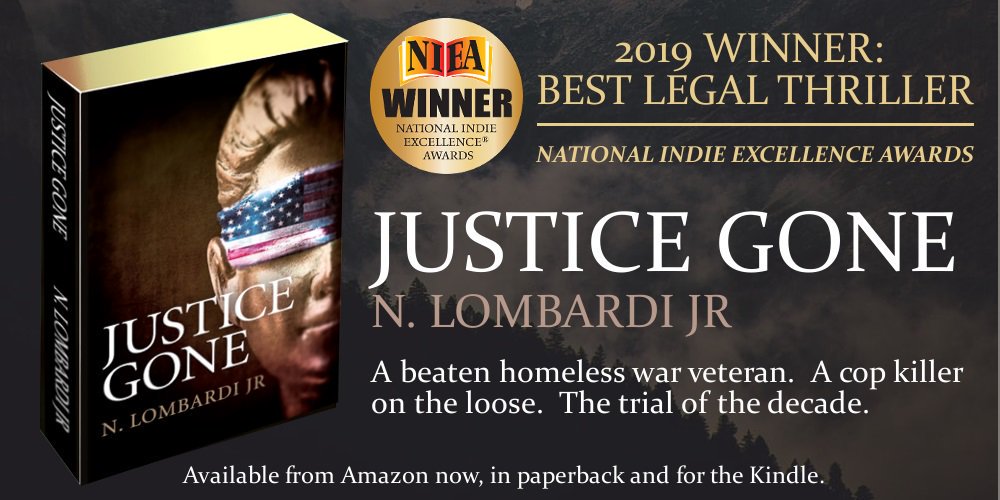
N. Lombardi Jr. is the author of Justice Gone, a courtroom thriller published on February 22, 2019 (which just so happens to be mine and George Washington’s birthday). After some googling, I discovered that Lombardi “has spent over half his life in Africa, Asia, and the Middle East, working as a groundwater geologist. Nick can speak five languages: Swahili, Thai, Lao, Chinese, and Khmer (Cambodian).” (Noveldelights.com)
Within mere months of publication, Justice Gone had already won three awards:
- National Indie Excellency Award
- American Fiction Awards
- Silver Medal Winner, Readers’ Favorite
And most recently added the New York City Big Book Award to its lengthy honors.
That’s pretty impressive. And reading the book, it’s obvious why Justice Gone has received so much attention. Lombardi has tackled the genre with the same fast-paced finesse that intrigued readers all over the world in 1989 with A Time to Kill.
The first in what will possibly be a series featuring the character Dr. Tessa Thorpe, Justice Gone reminded me a bit of Elizabeth George’s Inspector Lynley books, primarily regarding my stress level while reading. Books like this are emotionally intense, and must be tackled in the right mood for someone like me who has moved on from voraciously reading the bloody suspense of Nelson Demille (between the ages of 12 to 22) to cozy mysteries featuring crochet, coffee, and craft shops at the ripe old age of 35 (complete with fuzzy socks and glasses sliding down my nose).
Justice Gone would be excellent fodder for a feisty book club: homelessness issues, the criminal justice system, thoughts on PTSD, even addiction and recovery methods… there are so many rabbit trails of heated debates waiting to happen. Have the wine ready and let the rabid discussions begin!
Marshal Law Hits the Shelves
Marshal Law is live on Amazon as a paperback, an e-book, and for anyone with Kindle Unlimited… Check it out.

This is a fantasy novel…but it’s a little different. Tell us about that.
Marshal Law is a fantasy story, but it looks like a western. It takes place on a world with two suns, which makes most of the planet a dry desert. So it’s a magic story set in a frontier world.
How does magic work in this frontier world?
Strange stones can be found deep underground, and there are various ways to coax power out of them. Some use these stones to build powerful machines, but there are rumors of men using them to perform wondrous deeds.
What’s your favorite part of Marshal Law?
The characters. I love the setting, the picturesque western scene, the dual suns and endless deserts, but the characters who fill the story really stole my heart. Early on, our hero meets a scientist named Dawn who’s run away from the Republic. She’s a genius who can turn the villain’s machines around and make concoctions that do amazing things. Really fun character. Then they meet a boy named Raine who’s on the verge of a breakthrough. His whole life he’s believed he could revive the old magic, even though no one’s ever taken him seriously.
Tell us about your protagonist, Marshal.
He just wants to enjoy his quiet life with his wife and kids, but good stories never let anyone get away with that, do they? Marshal has to leave his family to fight the war, but he ends up playing the role of a father figure to the motley crew that gathers around him, holding them together while they battle to save the frontier.
Is Marshal Law the start of a series?
I’ve got three books planned. The sequel, “Desert Raine,” should be available in the spring. It’s coming along great. Marshal Law does a good job of setting the stage, so in the sequel our characters can further explore the magic and the machines and really push the boundaries of what they know about their world.
Sounds like Marshal Law is a story with a unique setting. Is it similar to any other books?
Anyone who likes Stephen King’s Dark Tower series should find themselves right at home. Same goes for Sanderson’s Alloy of Law. It’s fun to writing at a time when fantasy stories are finding new settings, because, even though there’s plenty of steampunk books with magic thrown in, I can feel like I’m writing something new and not always following another author’s trail.
Did you have to do any research to write about this new world where your story takes place?
A little. Most fantasy stories don’t require research since we just tend to make up whatever we want, but I really loved the idea of planet with twin suns. I did just enough research on binary star systems to make sure the idea would work. Apparently, two suns would probably make the planet a very dry place, so most of Marshal Law takes place in a desert environment. Only a few spots on the continent benefit from nicer weather. Grass and trees are a rarity enjoyed by the wealthy and elite, but Marshal’s revolution may change all that.





 Anakalian Whims
Our Secret Country
November 16, 2019 at 4:47 am (Education, Reviews) (allegory, books, c.s.lewis, children's books, Christianity, fantasy, homeschooling, Laura Miller, literary commentary, literary criticism, Narnia, neil gaiman, party planning, reviews, The Chronicles of Narnia, turkish delight)
“Most of us, I suppose, have a secret country but for most of us it is only an imaginary country. Edmund and Lucy were luckier than other people in that respect,” C. S. Lewis wrote in The Voyage of the Dawn Treader.
The thing is, the thing that C. S. Lewis as narrator doesn’t address, is that everyone who has ever read the Chronicles of Narnia series *does* have that country. We all visit some version of Narnia in our minds once we’ve been there once. And as it says in The Lion, the Witch, and the Wardrobe, “Once a king or queen of Narnia, always a king or queen of Narnia.”
So here I am, thirty-five, living in the magical world of Narnia as my daughter reads through the series for about the third or fourth time, but this time we’re reading it alongside our homeschool co-op. It is such a treat watching children enjoy the magic of Narnia, and furthermore bask in its magical glory with them.
The Chronicles of Narnia is a well known allegory of the Christian faith set in a fantasy world. Good and evil are clearly define, deadly sins and how they creep into our psyche, how unchecked they fester and change who we are. The stories enthrall children and adults alike, who have a thirst for the eternal, who long for the otherworldly aspect of our universe, the spiritual war that goes on every day unseen to the naked eye, but experienced in living color when you step through the Professor’s “Spare Oom where eternal summer reigns around the bright city of War Drobe.”
We’ve been reading the books together and discussing them book club style with children ranging from 7 to 13 and moms from 27 to 50. At the close of book two, we took a Narnia party break, complete with homemade snowflakes (the kids got to learn about hexagonal snowflake patterns and how to recreate them with computer paper and a pair of scissors), try Turkish delights for the first time (and marvel at why Edmund would basically sell his soul for such an awful dessert), and pose in costume under a welcoming Narnia sign and the iconic lamppost (artistic cardboard craftsmanship compliments of my impressive fiancé, kiddo spray painted it black herself).
Of course, in my typical fashion, I had to read “grown up” books in addition to re-reading the original stories. Because C. S. Lewis made such an imprint on society, there are more literary criticism books about Narnia than there are Narnia books. Most of them written by Christians. However, I found one written by a non-Christian which greatly intrigued me.
The Magician’s Book is an in-depth critical analysis of the Chronicles of Narnia. As much memoir in content as literary analysis, Miller chronicles her own relationship with Narnia and includes insightful conversational commentary by other big name writers of many faiths (Neil Gaiman being one of my favorites). I enjoyed her perspective a great deal and though I was saddened that Aslan the lion did not aid in her understanding the nature of Christ, that she did not come to understand God’s love through Lewis’s fantastical depiction of it.
Still, reading Miller’s work led me down a rabbit trail I’m happy to tumble through, and I’ve already lined up all sorts of other books regarding C. S. Lewis and Narnia to read during the rest of our Narnia journey. Join us. We start Horse and His Boy next and are reading The World According to Narnia by Jonathan Rogers as we go. We plan to finish all seven Narnia books by the end of the school year.
Permalink Leave a Comment