Homeschooling Chemistry and Physics
This year at Atrium (my kiddo’s co-op), I’ve been teaching science with a bit more purpose than I did last year. Last year consisted of a lot of impromptu science articles and activities… when we were studying the bubonic plague in history, I covered fleas on rats, the plague, what modern day scientists said about it, and played a song from YouTube about it set to the tune of Hollaback Girl. In the spring we covered lots of random pollinator things, talked about bees and butterflies and the anatomy of a flower. We did black out poetry over articles I had printed. At some point in the year, I brought roly polies and we talked about crustaceans and literally played with bugs in the driveway. We made terrariums. It was a hodge-podge of whetting the group’s appetite for the idea of studying science seriously, but was mostly exactly what you’d expect homeschool science to be: nature studies, crafts, songs, and critters.
The 2020-21 school year I was determined to do different—to do better.
Naturally, I started teaching what I consider the most difficult science of all the sciences: Chemistry & Physics. To a group of children that range between 5 and 13.
If you’re going to get serious about science, the studies of matter and energy are the way to go, right? Every time I prep for class I’m two parts terrified and one part giddy.
But today, I realized, I’m not failing them. And more than that, they seem to be enjoying themselves.
In our first two lessons, we covered matter. We talked about properties and how scientists use properties to describe matter. I started by describing that matter is anything that has volume and mass, but to say that then I had to describe what volume and mass are. I sent them home with a white bread recipe. One of the fourth graders actually baked it over the weekend and was able to tell me all about how cool it was that the same ingredients can create something with a different amount of volume. I was so pleased. If only this one child understood volume because of a white bread recipe, then I felt I was already winning.
During that same first lesson I taught them about displacement and was delighted when my classically educated group of kids were able to participate in a retelling of Archimedes and the Goldsmith. Several kids shouted “Eureka!” along with me. If I wasn’t already sold on the trivium, that moment would have done it.
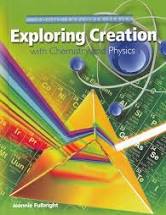
Density was when it got really fun. In Exploring Creation with Chemistry and Physics I found a lab with salt, water, two eggs, and two cups. Fill both cups with water about halfway. Dissolve a quarter cup of salt into one of the glasses. Have the kids announce their hypothesis on what might happen, then drop the eggs in their own glass. The egg in the salt water will float because the water is more dense than the egg when there is salt there, but the egg in the regular water will sink because the egg has more density. One of the kids was convinced it was because one of the eggs was bad and one of them was good, so another mom swapped them. The experiment won out!
After that we talked about buoyancy and made aluminum boats. (This lab was also found in Fulbright’s textbook.) Everyone had brought a casserole pan where we had blue dyed salt water and pennies sprinkled at the bottom of each. The goal was to make a boat that could float the most pennies without sinking. The kids loved playing pirates and stole each other’s pennies a lot in a spirit of imagination and fun. Our best ship held 176 pennies. Runner up had 173 before the ship started taking water. The take away: surface area helps.
On day two, the following week, we talked a lot about gold versus pyrite, how luster and hardness helps you identify matter.

The kiddo and I made playdough the day before and at the start of the lesson I put pieces of tree limbs, various garden and river rocks, aluminum foil, and the play dough out on the table. There were plenty of sensory aids for everyone to have their hands on something. Nearly everyone squished play dough in their hands for the duration of the lesson, which I thought was perfect as it helped explain the concept of malleability to the littlest ones and kept hands busy so their brains could focus.
My new, very involved husband sent me to class with a giant magnet and we also discussed how magnetism can help you identify different materials. Everyone got a turn choosing a piece of junk I’d collected from around the house to try against the magnet.
Finally we wrapped up the day with a Mel Science Lab. I’m obsessed with our subscription and it was pretty cool seeing the kids get to do a more intense lab. I had the oldest kids in the group do work, two boiled water and we talked about the “rapid vaporization of a liquid using heat” because I love defining things while two others mixed up the chemicals and dropped in the pyrite samples. Fifteen minutes later, we had a small sample of Prussian Blue!
All in all, I’m pretty pleased how our class is going and I can’t wait to map out next week’s adventure. Because of the broad age range of kids and the desire to keep them all engaged and learning, I’m trying to maintain at least one craft oriented activity, some sensory aids, and a Mel Science Lab per gathering. If you have any ideas or advice, please leave a comment, I’d love to hear from the more experienced.
Vikings!
Kiddo is studying Early American History at co-op this year. So, naturally, we’re already super into it.
I thought we’d be diving into the Pilgrims or the Revolutionary War at the start, but the tutor has wisely chosen to go back and lay the ground work for the Americas with ALL the early explorers. At home, we study all the world’s history chronologically so we love that the course is being tackled this way, despite the fact that it means we’re back pedaling over things we studied this last year. Repetition is good, anyway.
Her homework was to read D’aulaire’s Leif the Lucky. We collect all D’aulaire’s work so both of us were pretty pleased with the assignment. Although we did get distracted and took a detoured into studying the Northern Lights, why they occur, what they look like, and why Leif might have thought he saw Odin riding a chariot through the sky.

We read the assigned pages, and then looked for more… we highly recommend listening to some Danheim while you study. I’m loving Janeway’s fictional depiction of Eric the Red and Leif Ericson, and Landmark books have never steered us wrong.

Click here for additional resources if you want to study this subject as well.
Homeschooling During Covid
We’ve always homeschooled, thank God. Educating this way has been the biggest blessing of our lives. Post-divorce, during single motherhood, it was the easiest way to spend the most amount of time with my kid while staying on top of her education. In homeschooling, a little bit of time goes a long way. As a public school graduate, the public system always seemed like for every second of education occurring, there were hours of waste. Homeschooling is efficient, we cover a lot of ground in less time.
“Play is the work of childhood,” and I want my kid to have lots of play time.
During the chaos of sheltering in place, school getting canceled, and whatnot, the only thing that changed for us was me going to work (I got laid off a few months before I was planning to quit), and attending our extra curricular activities. A good chunk of our daily lives looked the same, just more relaxed. Way more relaxed.
Now, in the midst of so many of our friends dealing with school district uncertainty, virtual public schooling, Zoom courses, and a plethora of other dramas–we’re going on with life business as usual. Our co-op is so small and cozy, and several members already recovered from Covid, so we still get to meet as usual.
So what does our Classical Homeschooling life look like?
At Home:
We started a formal Spelling curriculum last year, just using McGuffey’s Speller and memorizing wasn’t cutting it for us. The Workout Spelling books are fantastic and I highly recommend them.
We’re flying through Math-U-See Delta and using Singapore 3A on review days to keep all those math skills sharp. (We do math every day, year round: Math-U-See we maintain her appropriate grade level and Singapore we do the year before. She tested above grade level on her end of year CAT last year, so we think this routine works for us.) We finished the Mensa K-3 reading list this summer and have been plugging away at the 4-6 list and loving it.
As a family, we’re making a point to learn more recipes in the kitchen. I quit buying bread at the grocery store this month and am officially baking all our bread myself. Something I’ve always loved to do, but not had the time and energy to maintain doing it regularly. Now we both have a routine and baking and cooking has been a magical experience instead of a stressful one. She has to help with a minimum of one meal a week, next semester I’m increasing it to three. Hopefully by next year she’ll be making more things on her own, but as it stands if she goes to college with only what she knows now, she’ll be eating a lot of waffles and french toast.
She’s still working through the Botany science curriculum she started this summer in addition to helping me prep for the Introduction to Chemistry and Physics science class I teach at the co-op. We have a stockpile of MEL Science kits we can’t wait to dig into.
At Atrium:
The kid’s course load isn’t light, by any stretch of the imagination, but so far she’s loving it… Early American History, Critical Thinking & Logic, Introduction to Chemistry & Physics, Poetry, Writing & Rhetoric: Fables, Fix It Grammar, Song School Latin 2, Art, Kung Fu. (I’m teaching two Latin classes, the science class, and Kung Fu. Course load sharing with other moms is so fun, as every morning I get a well deserved coffee break while the other moms are “on deck.”)
Extra-curriculars:
So swimming was a great choice for us for 2020. Dipping kids in chlorine seems like a pretty safe choice and the kid swims like a fish now!
I’m not going to lie, I’m a tad envious of her piano lessons. She’s rocking them and composing music like there’s no tomorrow. She graduated the Let’s Play Music program amidst a pandemic and it was worth every penny and then some.
So, if you’re homeschooling this year for the first time ever and need help, message me. If you have ideas for things we’re covering, please share them! (Your favorite DIY science labs and dinner recipes are welcome!)





 Anakalian Whims