The Brain Station and little Italian Conductors
An Essay of the Mind
by: A.Z.K.R.
The “Train of Thought” is a very common expression, that I’ve discovered is (at least for me) very helpful in visualizing and understanding my AuDHD mind, as long as you remember, it’s a whole train station and not just one train.
“The Brain Station” first came to mind when I was trying to explain why (I think) I tend to repeat myself and have the same kind of conversations over and over.
I picture a topic like a train car. When several topics/stories/memories/thoughts or ideas are connected in a way, probably not by one grand picture, but like how Spot It cards all have one thing that they share with each other Spot It card, they get hitched together on the same train, and most likely stay on that train together for a while—or indefinitely—so that if something gets brought up that triggers a need for one of these cars, the little conductor just brings the whole train in and unloads the information accordingly.
This idea came back to me when I was getting stuck in logic puzzles and geometric proofs. My mom said that based off of how I described “The information just being there or not” (and how she observed me staring off into space until an answer came to me) it seemed that, as opposed to just being incredibly stupid (my conclusion) I was just so smart that I was used to having answers come to me and not using my thinking muscles. So when I actually needed to think, those thinking muscles had atrophied. Now I understood what she said, but it didn’t quite ‘click’ in the right way until a specific proof in my geometry book about parallel lines. I was able to articulate that I understood the proof just fine, but on my own, I would have never been able to come up with and break down the steps to explain why the given was true, because it just obviously was true based on the definitions on the previous page. (Now the reasons for the proof were all, ‘because of this definition’ but I wouldn’t have realized I was supposed to write that.) Mom connected this scenario to the proofs and logic puzzles I had been doing and I was able to understand my struggle, which I explained to myself first through how reading works, and from there, to train cars.
I realized that my problem was like learning to read. In the early stages you learn phonics and sounding out. But once you’ve learned to read proficiently, you don’t need to sound out every word anymore. So, in my case, if for some reason I needed to sound a word out now, it would be as if I have completely lost the information of how because I haven’t in so long. (I can sound out words, but not with a very high success rate. I can read at a college level… and spell like a fifth grader. I might be being generous with myself on the spelling part.) Now we bring in the Italian Conductor.
You’ve learned to read, or maybe you can come up with a more suitable example, but you no longer need the basic, rudimentary, information for your topic of choice.
It is tedious to the little conductor to have the “phonics” and “sounding out” train car on the train of information responsible for every time you read. There are probably several of these reading trains depending on how much you compartmentalize school subjects; so to be more accurate, it is tedious to the little conductor to move these cars back and forth from each needed train. There’s probably a more useful car he needs to put in that spot, like word definitions that keep getting lost. (Let’s face it, if the words are in a bin like a coal car, the new ones will fly off the top anyway.) So, he unhooks the “phonics,” and “sounding out” train cars, and leaves them in the “Graveyard of Information” to rust.
Then, inexplicably, one day, you need that information. But it isn’t on the train. The little conductor goes to the graveyard, but he cannot find the lone rusted train car among many similarly rusted train cars he had thought wouldn’t be need anymore. On top of that, they’ve accumulated even more things that he’s forgotten for you, as you were learning more things. So, it’s lost. He’s missplaced this outdated information. He scratches his head.
“Eet-a ees-a not-a here.” (This is why he’s Italian.) So he shrugs and moves on. He has better things to do than check the faded label of every rusted train car to find one among thousands.
But, “Eet-a ees-a not-a here” obviously isn’t enough for your parents, or teachers, or what have you.
(No, for real, it’s not enough. My mother made me look up the translation for “It’s not here” in Italian. So, my little Italian Conductor cartoon in my head should be saying: “Non è qui.” Thank you Google translate.)
“But we taught you this! It has to be there!”
And they’re right, of course, it is there. You just don’t know how to remember it. You can’t talk to the conductor as far as you know. His telegraph machine is probably broken.
The even more irksome part is that if the memory of actively learning the information is connected to the information itself, (who am I kidding? it absolutely is!) then when Mr. Italian Conductor unlatches ‘unnecessary’ information he probably left the memory of learning it in the first place, also in the “Graveyard of Information,” still hooked to “phonics” and “sounding out.” Which means that you might only remember the parts of learning that are actively connected to still-relevant information. Which could just be a funny story you like to tell, or a particular lesson you loved for any given reason, which leaves huge gaps in your memory that annoys everyone. Especially your mom.
Sir Arthur Conan Doyle has a quote he wrote for Sherlock Holmes, along the lines of this: Everyone’s brain is an attic that must be furnished with the necessary information of getting through life. He says that this attic does not have rubber walls and can’t be stretched to accommodate information you don’t need. Which is why, he argues to Watson, that as a detective, facts about the solar system are a clutter to him, and he doesn’t need to know who orbits what, or how many planets there are, in order to solve crimes.
I think Sherlock is wrong on the part about not stretching our attic walls. We can, he’s just lazy. The answers come to him.
Maybe people have different consistencies of rubber, but I think you can stretch it. Like my mom said, it’s like a muscle. The part he is right about is clutter and furniture. While we work on stretching the rubber attic muscles, we still have a lot of crap to sort through and keep track of. That’s what the train station is for, to bring information in and out of the crowded attic, or across parts of it, you pick. Our problem? It’s this: The person in charge of maintaining and organizing the attic? He’s just as confused as your are, because he’s a just little cartoon Italian Train Conductor. And his English ees’a not’a too good.
(Mom is an Amazon affiliate, so she might earn something if you click through and buy that Spot It game.)
The Timon and Pumbaa Method
by A.Z.K.R.
Personality wise, my mother is always that tired, sarcastic, babysitting/parental figure in kids stories. She embodies the fish from The Cat in the Hat, Sebastian, from The Little Mermaid, and Zazu from The Lion King. But the other day, I didn’t compare her to Zazu, I compared her to Timon and Pumbaa.
She wrinkled her nose.
“Timon and Pumbaa? I’m both of them? The essence of two?”
While it sounds weird put like that, my point was how she acted in the homeschool community and within and outside of mom groups. She is the Pimon. The Tumbaa. However you want to say it. She lives outside of other people, she does her own thing. She chose not to be part of the public school system, why would she conform to a system set by anyone else? She isn’t someone else. She is the wild, bug-eating mom who adopts any floundering homeschool family that comes her way. Sure, she acts more like Zazu or Sebastian in the “someone needs to nail that girl’s fins to the floor” mentality, but when it comes down to her own lifestyle, she won’t let her fins be nailed to the floor. Not to be where the people are. Never to be where the people are, but to live in her own, private, homeschool jungle, eating grubs and educating the passing Simbas of the world.
Timothy and the Dragon Defenders, Part Three
A Short Story from the Archives of A.Z.K.R., author of Tales of Porcelain Thrones: Middle School Edition
[To read Timothy’s adventure from the beginning, click here.]
Once the commotion of a moving dragon—scales against underbrush, plodding, heavy, footfalls, claws scratching against pebbles—all came to a halt, Timothy began to actually hear the sounds of the forest around him. A myriad of bird calls, most of which he didn’t recognize and sounded rather otherworldly, filled his ears. The wind rushed through the tops of strange trees and under it all, a distant melody, akin to a flute, danced with the leaves. The melody grew louder and Timothy looked about in curiosity.
“Who’s playing music in the woods?” He wonder aloud. And will I remember what it sounds like when I wake up? Beside him, Galen’s ears twitched in the breeze. Until he saw them move in this way, Timothy had thought they where some kind of developing horns.
Galen looked in each direction before starting down a path to Timothy’s right. It was faint and covered in soft grasses. Orange and white flowers waved, tickling the companion’s ankles as they headed to the ever swelling song. Then the music suddenly stopped, as did Galen, who then looked at Timothy and did the twitch with his shoulders that Timothy had decided to interpret as a human shrug.
The two stood there, wondering what to do next, when a small man half Timothy’s size materialized in front of them. He was a fawn, Timothy saw, but he had very little hair. Timothy’s thoughts flickerd again to Narnia as he laughed.
“I said I have no time for tea!” Timothy said, half to Galen, half to himself.
The fellow’s pointy hat slipped back on his bald head and flopped to the side. He scowled at the boy and his dragon.
“What are you two doing in my forest?” The little man demanded.
“Walking. It’s not like we knew it was yours. Or, I didn’t know.”
Galen burped.
“Are you here to smash my house?” This question was directed at Galen, who in turn, burped.
“What do you think you’re doing alone with a dragon, boy? Twelve year old civilian and taking such blatant sides in the war?”
“No, we don’t smash houses.” Timothy said. Then eyeing Galen, demurred, “I don’t think. How did you know I was twelve?”
The gnome-fawn-whatever he was, looked him up and down. “You look to be Twelve,” he said dismissively, arighting his hat as he did.
“You raised by Clubs?” He asked Galen.
Burp.
“What are Clubs? What war?” demanded Timothy.
“Clubs, my boy, are big, mean, and blue. They belch the foulest smells, as they are known to eat garbage, and they have a habit of smashing things. I was in fear of my house, based on the noise and smell. I tried to warn you away with my flute, but it seems you don’t understand music messages and came nearer instead. Dragons, however, are less foul. This one must have been raised by a Club Clan. They’re known to hoard dragon eggs under threat.”
“What war?” Timothy repeated.
“No time to discuss politics on the outside. Get in before we’re seen and I’ll give you your belated history lessons, and—well—news.”
“Seen?” Timothy looked around, then up.
“Not you, The dragon. They’re an illegal species in Zentop, by order of Lord Lucius of Romodore.”
He glanced at the dragon’s tatooed wing, and said “Come along Galen, son of Clubbers.”
Galen, of course, answered, with a burp.
[To Be Continued…]
Jane Austen’s Use of Satire In Northanger Abbey
by: A.Z.K.R., from Tales of Porcelain Thrones: Middle School Edition
Jane Austen was an author in Regency Era England. She wrote satirical novels and enjoyed mocking the frivolities of English society and “the Novel” itself. Satire as defined by Webster’s New Word Dictionary is a literary work in which vices and follies are held up to ridicule, satire doesn’t have to be funny, but Austen’s work definitely is.
Jane Austen was born nine months after the beginning of The American Revolution, she had several brothers, and one sister (Leithart 1). Austen was an avid reader and loved novels, but she still found them a little ridiculous. Austen wanted her books to reflect the real world, showing real dangers. Instead of writing about bandits and murderers, Jane’s villains included liars and social climbers. Jane Austen was fighting against stereotypical heroines, bizarre and dangerous social expectations, and the problems of treating novels like real life. Yet, ironically, Jane Austen’s novels were realistic, which was sort of the point. Jane Austen wrote about real problems in a funny way. Even for someone who does not live in Regency Era England, Austen’s characters represent real types of people and can help give young women the wherewithal to avoid the Big Bad Wolves (John Thorps) of the world and find their very own Prince Charming (Henry Tilney).
Austen starts her book Northanger Abbey with a mockery of a novel’s heroine. Austen does this by describing her heroine, Catherine Morland, as normal, and “almost pretty,” emphasizing her normality by saying her family was neither rich nor poor, her father was a clergyman, neither of her parents were abusive, and her mother was—unfortunately—alive. Catherine loves reading novels, but not history books. These are all in direct contrast to the kinds of heroines Catherine herself reads about over the course of the book, stories such as Ann Radcliffe’s The Mysteries of Udolpho where the heroine, Emily St. Aubert, is beautiful, orphaned, and well versed in the arts. Catherine’s neighbors, the Allens, a childless couple of some fortune, decide to take sixteen year old Catherine to Bath. Bath is a tourist destination in England, complete with spas, parties, and shopping centers, which served many as a ‘coming out’ excursion (Cunliffe 41). Austen was able to write about Bath well because she lived there. Even while making fun of novels, Austen used some of their troops to her advantage, such as having a relative or family friend taking a young heroine on a coming out trip.
In English society one couldn’t just walk up to someone and talk to them, you had to be introduced by someone you already knew, forcing everyone to rely on family, family friends, other acquaintances, or the master of ceremonies. At Catherine’s first ball Mrs. Allen laments constantly that they don’t know anyone of consequence, while Catherine wishes they knew anyone at all (Austen 30).
At Catherine’s second ball, the master of ceremonies introduces her to Henry Tilney. Halfway through a conversation that they were having, Tilney interrupts by saying, “I hitherto have been very remiss, madam, in the proper attentions of a partner here; I have not yet asked you how long you have been in Bath.” Jane Austen mocks polite society through Henry Tilney’s comical performance of asking Catherine all the ‘right’ questions, such as ‘how long have you been in Bath,’ ‘do you enjoy Bath,’ ‘Is this your first ball,’ et cetera. Tilney, although he thinks society is silly, still follows its rules, and remains a respectable young man.
Jane Austen uses Catherine’s naivety to point out how unspoken rules can be extremely problematic, and even dangerous. The real dangers of society were people like the Thorps, social climbers and narcissists, who used these unspoken expectations to put other people in sticky situations. The Thorps, through a series of blunders, suppose that the Morlands have lots of money. They had already met Catherine’s older brother, James, at Oxford. Upon meeting Catherine with Mrs. Allen, they supposed that she would receive the Allen’s fortune due to the kind way the childless Allens were treating her. They catch their mistake when Isabella Thorp becomes engaged to James Morland and she receives a letter about James’s future income, one that sounds reasonable to the Morlands, but is disappointing to the gold digging Thorps. Isabella attempts to break off the engagement to run off with Henry Tilney’s older brother, Captain Frederick Tilney, but this proves to be her downfall. Captain Tilney, unlike his brother, is a rake, he doesn’t care about any of societies rules, and breaks the social customs that were actually worth keeping.
Because the Thorps thought Catherine so rich, and John Thorp planned to marry her, and they gossiped about her wealth in order to make themselves look better. At a theater, they brag to General Tilney, Henry’s father, who then wished to have Catherine married to his son. In order to empress her he invites her to stay at his home, Northanger Abbey for a holiday. Catherine is naive and unaware of the Thorps deceptions until she receives a letter from her brother explaining Isabella’s behavior. She is totally unaware that money is the reason General Tilney is interested in her alliance. Henry however is aware that his father cares a great deal about money, and isn’t sure why he is interested in having Catherine for a daughter-in-law. With these events Jane Austen is showing us the true the ‘villains’ of society, and how Catherine was totally oblivious to their presence. She was so caught up in the idea of bandits and mysterious murderers that she could not see the danger at the end of her nose.
‘The Novel’ becomes increasingly important in this part of the story, as it leads to Catherine’s embarrassment several times over the course of her stay at Northanger Abbey. Catherine’s preconceived notions about abbeys, established while reading gothic romances, leads her to disappointment when discovering modern renovations inside the home of her hosts. She fails to find secret passages, or incriminating letters, as the heroine Adeline did in Radcliffe’s Romance of the Forest, in her guest room and, worst of all it leads to a terrible confusion regarding the cause of Henry’s mother’s death. General Tilney is harsh, but not villainous. He takes good care of his servants and his estate, hence the renovations. He wants his children to marry well, thus his interest in Catherine’s supposed inheritance. General Tilney’s stony demeanor, combined with Catherine’s overconfidence in the reality of novels, leads her to make the worst of blunders: she makes assumptions. She speaks briefly to Miss Tilney, Henry’s sister, and finds she was not at home when her mother died, leading Catherine to assume no one was at home when Mrs. Tilney died. Catherine suspects foul play. Her blunder is discovered when she sneaks into Mrs. Tilney’s old room and is discovered by Henry. When she admits her thoughts, he admonishes her. He and his brother had been home when his mother had died, and she had perished of sickness rather than ill treatment. General Tilney’s behavior had nothing to do with skeletons in a closet. Catherine’s gothic fantasies stop here; she has learned and grown. The dangers are not ended, though.
The Thorps, angry due to their hurt pride, speak to General Tilney again and tell him not only that the Morlands are not rich, but that they were exceedingly poor, projecting their own flaws onto Catherine. General Tilney, in a rage, comes home and sends Catherine off in the middle of the night without a chaperone or money. The situation is quite unforgivable, but Catherine doesn’t yet understand and cannot fathom what she has done to displease General Tilney. Henry later comes to her house to explain and offer his hand in marriage, not just because he loves her, but because he feels responsible due to his father’s behavior. General Tilney, of course, does not approve.
Jane Austen, for all her realism, never leaves her stories with sad endings. Henry’s sister, previously forbidden, marries the man she loves, and by a novel twist of fate, now financially outranks her father. She demands that General Tilney allow Catherine and Henry to marry, and her will is done. Jane Austen defends the ending of her own book, at the beginning of the story, while talking about novels in chapter five. “For I will not adopt that ungenerous and impolitic custom so common to with novel-writers, of degrading by their contemptuous censure the very performances, to the number of which they are themselves adding— joining with their greatest enemies in bestowing the harshest epithets on such works, and scarcely ever permitting them to be read by their own heroine, who, if she accidentally take up a novel, is sure to turn over its insipid pages with disgust. Alas!” (Austen 42) Jane Austen is talking about Catherine’s own habit of consuming dramatic stories, but she’s also explaining here, that despite her book calling out the faults in these stories, its still a novel its self.
The story is funny, you can’t help but laugh when Catherine finds not evidence of murder, but instead laundry receipts in the cabinet. This is not was makes it satire however, Jane Austen books are satire because of exactly how it is funny: elements of the story mock society, and express its difficulties, she’s calling to attention problems regarding expectations when they are appropriate and when they are silly. We’re lucky to have Jane Austen doing this is a humorous manner as opposed to long dry articles listing the problems of society like a grocery list. Not all satire is presented in a comical fashion, but a point is better made when it provokes some kind of emotion, either anguish, or in Jane Austen’s case, joy.
Works Cited
Austen, Jane. Northanger Abbey. Signet Classic, 1996.
Cunliffe, Barry. The Roman Baths at Bath: Authorized Guide Book. Bath Archeological Trust, 1993.
Leithart, Peter. Jane Austen. Thomas Nelson, 2009.
Radcliffe, Ann. The Mysteries of Udolpho. Penguin Books, 2001.
Radcliffe, Ann. The Romance of the Forest. Oxford University Press, 1988.
Timothy and the Dragon Defenders, Part Two
A Short Story from the Archives of A.Z.K.R., author of Tales of Porcelain Thrones: Middle School Edition
[To read Timothy’s adventure from the beginning, click here.]
The purple dragon roared fiercely. A river rushed behind it, the sun made the water glisten, peeking over what almost looked like pines. The sudden brightness pierced Timothy’s eyes and all his senses were overwhelmed at once. He was grateful for the warmth, but the sun beat down harshly on his skin.
“Good thing the basement wasn’t a wardrobe and this place isn’t Narnia,” Timothy said to the dragon. “I’d be freezing and I’ve no time for tea with Mr. Tumnus, I have a test tomorrow.”
The dragon roared. And burped. Bits of Mrs. McCracken’s jelly still lingered on the corners of its mouth.
“So you are?” Timothy asked.
The dragon burped again.
“Ok, then. I’ll call you Burp.”
The dragon shook his head no.
“Belch?”
It shook its head again, then fluttered its wings. The right wing featured a brand, or tattoo, and when they came to rest against the beast’s back again, Timothy saw the name, “Galen” etched into the dragon’s flesh.
“Galen?”
The dragon danced, a bit like the McCracken’s golden retriever puppy when someone dropped bacon on the breakfast room floor.
“Like the Greek physician?”
The dragon danced again.
“So where are we, Galen?”
Galen belched another round, evicting all the glass from the crunched Mason jars into the river as he did.
“Ew.”
The dragon seemed to shrug and began walking away.
“Hey, wait!” Timothy followed. Pebbles from the riverside massaged his bare feet, not so unpleasantly. “Seriously, wait!”
He caught up to the bumbling dragon, “So where are we, anyway?”
Galen burped, then stopped abruptly, and Timothy bumped into a tree to avoid running into him.
Timothy and the Dragon Defenders, Part One
A Short Story from the Archives of A.Z.K.R., author of Tales of Porcelain Thrones: Middle School Edition
Timothy McCracken was having a hard time. He was supposed to be sleeping, but instead of counting sheep, he was counting the taps he heard coming from the basement across the hall. Timothy’s bedroom was downstairs near the kitchen, apart from his siblings and parents who slept on the second story of the house. This suited him fine because it meant he didn’t share a room with his brother Dean, who snored like a freight train. It was also great when he wanted peanut butter sandwiches at midnight, but not so much when the dog whined at the rustling noises coming from the basement.
What was down there besides Mom’s canning jars and Christmas decorations? Did the house have mice? Were ghosts walking around in old shoes discarded in the donate bin? One could never tell after the sun went down and the moon cast shadows through the window.
He pulled his feet from under under his flannel sheets, his yellow gym shorts reflected neon stripes from the moonlight. As soon as his feet hit the cool, wooden floors, he heard a crash from below. Instinctively, he rushed to the sound, accustomed to rescuing younger siblings from their messes and broken things. The crashing of his mother’s preserve jars rang in his ears as he crossed the hall to the basement and took the stairs two at a time. He stopped abruptly at the last step, worried his bare feet might catch glass.
Curling his toes around the edge of the landing, he paused a moment for his eyes to adjust to the darkness. As he stood there, the scent of cinnamon and peaches wafted against his nose, goosebumps pimpled his arms from the cold, but a breath of hot air pressed against his forehead.
“What?”
Slowly, his pupils caught up to the rest of his body and revealed large nostrils flaring in front of him. Purple scales pulsed as the warmth puffed against Timothy’s face. The beast turned and scurried behind the shelves of Mrs. McCracken’s jars, tongue lapping three of them in one gulp, glass and all. TImothy heard a belch and caught a whiff of strawberry currant jam.
“You like Mom’s jam?” he asked the beast, stepping closer. Surely it was safe to follow it, this must be a dream. After all, dragons aren’t real.
In a flash of light, the creature was nearly gone, a tail slithering out a door Timothy had never seen before. The door was heavy and wooden, thicker and shorter than any other in the house. The knob was made of tarnished silver. A bit of light glowed from behind the door–enough so Timothy could see that the knob was spherical and engraved to look like a globe, but with land masses he did not recognize.
As he reached for the knob, heat radiated from behind the threshold and in an instant, Timothy was no longer in his Mom’s basement.
[Come back next week to see where Timothy has found himself!]
Totalitarian Caste Systems in Dystopian Fantasy
A Guest Blog Post by: A.Z.K.R., author of Tales of Porcelain Thrones: Middle School Edition
Totalitarianism is a system of government that is headed by an absolute dictator who supports themselves with some kind of violent force. In a totalitarian country there is no freedom of the people. One example of totalitarianism can be found in Brandon Sanderson’s Mistborn. The Final Empire is headed by the Lord Ruler, who uses emotional manipulation against the populous. They are required to believe only what the Steel Ministry tells them and treat the Lord Ruler as god. The Final Empire is also a caste system. A caste system is a system of government in which people are divided into sections based on race and or job description. The Final Empire is not an exact Caste System sine the Garrison and a few merchants come from the Skaa population.
A better example of a Totalitarian Caste System is Suzanne Collins’s series Hunger Games. In Hunger Games President Snow represents the the absolute ruler and the Hunger Games themselves serve as the violent force. The caste system in Panam is much stricter than the one in the Final Empire. The people are confined to geographically separated districts that are each in charge of one resource that is distributed across the whole country, such as coal lumber, and technology. District Thirteen is the rebel district, their Mistborn counterparts would be the thieving crews. In both dystopian societies the government mostly ignored the rebels, avoiding conflict and keeping the peace. Up until the nineteen forties India was a real life example of a totalitarian caste system. The noblemen and Garrison plus the District two and the capital are equal to the Kshatriyas. Likewise the Chandles are similar to the thieving crews or district thirteen.
Totalitarian caste systems are terrible for everyone except the people on top. Even now as a democracy India is a miserable place still scarred by its past government. On the flip side, the opposite of a totalitarian caste system would be a world with no ruler or government system at all. You may note that in the United States religious freedom only goes as far as it can without infringing on other peoples’ rights. Or it was supposed to anyway. Both extremes are bad. People need guidance, not total dominance. Rules, not oppression.
From a Book Lover
An unnamed Guest Blogger allowed me to share this…
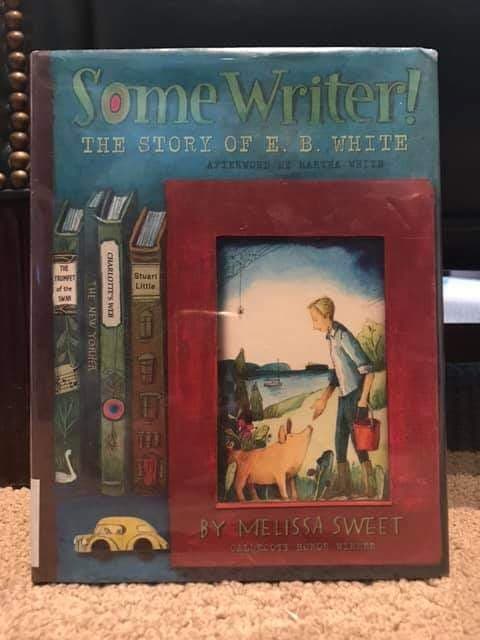
I have always been a fan of EB White’s children’s books. This is a great biography of him and is beautifully illustrated, too. EB White truly respected children as persons. Here is one of my favorite passages from the book:
“Much of what he wrote was not for children, yet many consider Charlotte’s Web not only White’s magnum opus but one of the best children’s books ever written. Did EB White ever wish he’d written a masterpiece for adults? His stepson Roger Angell said that the thought would not have occurred to him. Andy (EB White) once said, “Anyone who writes down to children is simply wasting his time. You have to write up, not down. Children are demanding. They are the most attentive, curious, eager, observant, sensitive, quick, and generally congenial readers on earth….. Children are game for anything. I throw them hard words and they backhand them over the net.”
Dear Duncan Jones…
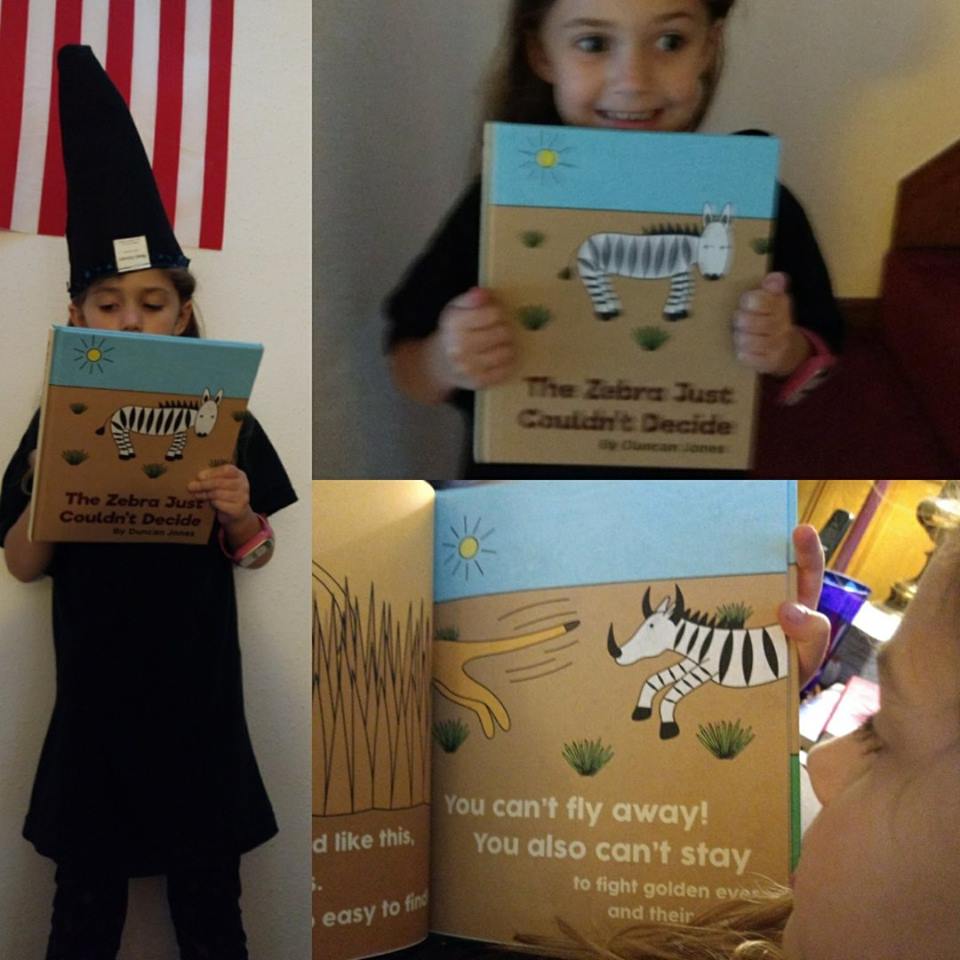
Title: The Zebra Just Couldn’t Decide
Author/ Illustrator: Duncan Jones
We had the pleasure of receiving a new Duncan Jones picture book in the mail. Years ago, we were privy to his first book. My kiddo attended a book signing of his at Half Price Books in Humble. She has been wearing t-shirts he designed ever since. Needless to say, she was pretty thrilled to discover he had sent her a NEW book.
“Dear Duncan Jones,
I think it’s a silly a book because every single animal wants to be the color that they already are. The flamingo wants to be pink and the flamingo IS pink. All rhinos are gray, people know that. The green snake already is a green snake. The wildebeest wants to be brown like the ground and he already is brown like the ground. The zebra just can’t decide and I’m kinda glad he can’t decide, because if he chose the color that he already was, he’d be as crazy as the others. I don’t know why the others want to be the color they already are. I think it’s a pretty silly book, but I like it. And thank you for writing it.
Love, silly me” [Ayla, age 6]
The Ocean at the End of the Lane
Title: The Ocean at the End of the Lane
Author: Neil Gaiman
Review by Guest Blogger Elis abeth K. Simmons
There’s no right way to love a book. For me, there are books I am in love with because of their story and there are books I am in love with because of the figurative and literal places in my life I ended up reading them. The Ocean At The End Of The Lane is brain-fluff wrapped up in too many truths about growing up. Because of that paradox, and the fact that I’m currently ignoring that I am technically an adult, I fell in love with it immediately.
The week I found it was one of the longest weeks of my new adult life. I worked 30 hours in closing shifts at work in six consecutive nights on top of going to school four days in a row and all the homework that comes with it. I was in no way looking for something to occupy my time. There was none to spare.
In between class and work, I walked into Book People in Austin just a couple blocks down from my campus. This two-story bookstore has become my new happy place in between responsibilities since it is large enough to wander and contains hundreds of books to leaf through. Usually I pick a book at random, read a couple chapters and put it back on the shelf when I leave. I haven’t wasted my time and a book gets to feel loved.
On my second day of work, I wanted something easy. I didn’t want to wander, I just wanted to hide. In this particular bookstore, Neil Gaiman’s works have their own shelf and almost every book, its own personal review by the booksellers. Without pausing to even read the synopsis of The Ocean At The End Of The Lane, I grabbed it and rushed to hide in the chair resting up against the classics section with a cup of coffee.
And I disappeared.
Gaiman has this magical simplicity to his writing where a 19-year-old college student can cancel out the constant foot traffic of a busy bookstore and be emotionally invested in the life of a 7-year-old boy who grew up suddenly and quickly after he met the strange Lettie Hempstock at the end of the lane with her ocean. The story is told in a flashback of a middle-aged man who you can tell never quite felt young. Innocent maybe, but he didn’t know that until he no longer was.
When I came back to reality an hour later, I decided this book was what I needed that week. I couldn’t have even told you why, but there wasn’t any way I could’ve left without it.
I didn’t pick it up again for several days. Work and school got the better of me and I might have gone insane a few times over the course of the weekend. Sunday night was night 6 of 6 of closing and after serving angry people their coffee, I had an insane craving for diner food. I wanted coffee and waffles and the kind of food coma that comes shortly after. And I wanted a place to read my magically simple book and not worry about having to leave.
So Magnolia’s it was. A 24 hour diner in the middle of Austin with omelets and giant pancakes sounded wonderful at 9 pm on a Sunday. Little did I know that the last day of the Austin City Limits music festival was just letting out.
As I pulled into the parking lot, I looked behind me and saw the multitudes waiting to cross the street and wait for hours for the same pancakes and omelets. My mission then changed from finding diner food to racing the masses for a table. They had won Magnolia’s, but there was the 24 Diner off of 6th Street that they wouldn’t have time to walk to. I raced to the heart of downtown Austin and beat the majority of the masses.
After saying it was just me, the hostess smiled at me and said there were several spots open on the bar if I wanted to eat immediately. I had beaten the swarm people. I had my spot. And I was not moving. Busy people behind the bar gave me menus and I told the waitress I just wanted a cup of black coffee and a waffle. 10 minutes later, I had a giant waffle in front of my face and the ACL crowd had begun to take over, yelling drink orders over my shoulder and squeezing in the 6 inches of air available at the bar. I did not care. I had my spot. I was not moving.
I opened my book and disappeared again. I met the villainous Ursula Monkton and her twisted desires and methods of making everyone happy. She was a Dolores Umbridge-like character that you hated simply because there are too many controlling, manipulative, and oppressive people like her in real life. I got to know the Hempstocks better and found out they were the family everyone wishes they had as friends growing up. The kind that just took care of things and knew enough to make you think they knew everything.
I was vaguely aware people being replaced with more people on my left and on my right, but I couldn’t tell you how many. The bartenders ignored me entirely, leaving my sticky plate as a marker that I deserved to sit there, only interrupting me to ask if I wanted more coffee. I looked up and it was 11:15. Neil Gaiman had done the impossible and canceled out a swarm of ACL attenders.
The next day, I had no brain function. I went to class and stumbled through the day just waiting for when I could disappear again. I made it to Mozart’s on Lake Austin and fought my way through the line of fellow Austinites to buy a bottomless cup of coffee and made my plan to disappear.
I discovered that oceans can be put in buckets, if you ask nicely enough, and that there are some people whose hearts just need more time to grow back. Different people remember events in different ways and some things are best forgotten.
And then it ended.
I felt like I had gotten pulled out of a dream by having a bucket of ice water dumped on my head. I had not planned on it ending and now that it had I was a little lost. The only thing I could think to do was write a thank you note to Neil Gaiman and share it with everyone. Whether he will ever see it is anyone’s guess, but anyone who can make a week like mine slightly less defeating deserves some recognition.




 Anakalian Whims