Traditions! (Hallelujah!)
A few years ago we started the tradition of celebrating Advent using Cindy Rollins’ Hallelujah! study of Handel’s Messiah and I absolutely love it. Celebrating Advent has been a new and gradual practice for me. About eight years ago. the church I was attending was lighting weekly candles at the front of service, but not spending much time explaining it and it provoked me to start doing some research in conjunction with learning about liturgical practices in the home.
As we settle into using Hallelujah! to enrich our family life, we’re adding in some of the things from the appendix slowly. This was our first year doing St. Nick shortbread cookies and I was pretty excited. Despite a few hiccups, we were pleased with our efforts. My oldest has been learning to decorate cakes off and on for the last five years, and she made icing and turned the cookies into little Christmas wreaths for an event the following week as well. We didn’t celebrate St. Lucia’s Feast Day this year, but little by little we’re adding traditions to our holiday season that line up with the Christian calendar.
In order to do that, I’ve been having to learn about the Christian calendar in general. I was not raised in a church that followed it other than Christmas and Easter. I knew nothing of Advent or Lent. I still don’t fully understand Lent, but I used Living the Christian Year by Gross as a starting point. It didn’t answer the questions I had, which as usual are questions I’m not even sure how to articulate yet, so I donated it to our church library hoping it will help someone else. I hoped to find more clarity by adding The Sacred Sacrifice to our Lent and Easter season, I read it last year when it first came out and plan use it again with my children during our morning basket time again this year.
It’s interesting because despite my children all loving classical music, my son used to beg to listen to Mozart as a toddler, they are fairly indifferent about these family traditions surrounding the Christian holidays and classical pieces. I’m curious to see how they feel about it the older we get as it becomes nostalgic and part of their family memories. When we first added the tradition of getting a live Christmas tree at a family owned Christmas tree farm, my oldest was also indifferent. But now they all beg to go to the farm as soon as Thanksgiving passes. They love the petting zoo feature, there are sure to be baby goats and tortoises. They love the outdoors and the bees and hunting down the perfect tree. They love getting subpar hot cocoa in Styrofoam cups (my husband makes amazing hot cocoa from scratch at home) and pumping Christmas themed rubber ducks down the PVC pipe racing shoots… these things have come to mean the beginning of the Christmas season to them and I love that.
Another tradition we have added to our lives is listening to The Dark is Rising BBC World Service production: https://www.bbc.co.uk/programmes/w13xtvp7. The Dark is Rising book (and podcast) starts on the winter solstice, December 20th, and it’s fun to listen to the events of the story alongside the events of our own corresponding days.
What does your family do as a household tradition?
(As an Amazon affiliate I earn from qualifying purchases.)
The Camera My Mother Gave Me
I am buying my childhood home. My mother has passed and my father has remarried a wonderful woman for whom he bought a new place, a place for them to make their own. It is good for him to leave walls saturated with memories of my mother and her influence, but I didn’t want the house my parents built in 1986 gone forever. My dad packed the things that were most important to him and is leaving behind things that were just filler (I’m getting a new comfy couch from my Bonus Mom I’m super excited about). My mom had a lot of filler.
Since I’m the book lady, he left me most of their books as well. I already have well over 5,000 volumes in my house (I quit counting long ago and just focus on making sure they all have a place to live) and I have four children that I will be moving into a home built for a family of four total (it’s the same size as my current home, but actually has one more room, there was a lot of wasted space in these 1995 builds). So as I go through books, determining what to keep and what to purge, I’m stumbling through decades of reading–my mother’s reading, and my own.
The Christian prairie romances went first. I’ve never been interested in that genre, but it was my mother’s primary reading (I added some to the church library and sent some to be sold at Good Oil Days). I’ve gotten rid of most of the Christmas books, she loved anything Christmas. My church does a holiday market every year where they sell Christmas crafts, decor, and gifts to raise money for various things we cannot afford to do as a congregation. This last year we replaced the doors. The old building was desperate for functioning doors with no cracks or blemishes and the Christmas market afforded us beautiful, but simple, wooden doors to invite the public into our home away from home. My mother would be pleased that she contributed to that. I’m excited to keep the antiques, they aren’t valuable but they are titles we will read and share with our children. There’s a set of Mark Twain I remember well that I’ll “inherit.”
With all this sorting and purging going on at my Dad’s house (soon to be my house), I’m sorting and purging from my own home as well. Books I loved in my twenties just don’t mean the same to me now that I am a mother of four. When we first moved to this house my goal was to make sure there were never stacks of books anywhere (I failed), that every book had its own place on the shelf (I failed big time). I spent the last four years donating anything I read that I had no intention of reading again, mostly books I had acquired for free or cheap over the years that upon finally reading didn’t live up to my latest standards. But now, I’m getting rid of books I loved and just don’t need or want lying around for children to encounter.
So this week I donated The Camera My Mother Gave Me and Girl, Interrupted (and four bags of other things I can’t recall). I loved Girl, Interrupted when I first read it. I think I was nineteen at the time. Susanna Kaysen fascinated me with her angst, her institutionalization, her ambivalence, and finally her resolve… to not be crazy. I respected her final conclusion. At forty-one, I just don’t need that affirmation from her anymore… that we can be surrounded by insanity and decide to not allow ourselves to go insane (mental illness is real, but there are also some who drive themselves nuts out of selfishness and conceit, or giving in to their environment).
Later, when I was running the sociology section at Half Price Books, I stumbled across The Camera My Mother Gave Me. It is a bizarre memoir about Kaysen’s vagina. I was shocked, baffled, and completely riveted by the book. I remember being appalled that I couldn’t put it down. I probably would have kept it forever and maybe read it again years from now because I don’t remember much of it, but I don’t want my sons plucking it off the shelf as emerging readers. It would make an interesting story for a stand-up comedy routine–or their future therapist–so off to the Friends of the Library it went.
I have donated nearly 1,000 volumes every time I have moved. Often it’s a simple Marie Kondo moment, happily removing piles of things accumulated that I’m now happy to give away. This move hits different. Instead of just not wasting some box or storage space, I’m more focused on refining my library. I am actively curating a specific environment to nurture my children.
What books do you enjoy that you still choose not to keep?
Colonel Shaw


I’ve been spying these daily writing prompts in the corner of my dashboard the last few days, wondering if they were something I would ever care to utilize. This evening as I was considering what to post for tomorrow, I saw “Have you ever performed on a stage?” and immediately had a flashback to 1995 and my performance as Colonel Shaw in the play Glory. I’m assuming it was severely abridged for fifth graders. I do know it was shortly after we had read the book Shades of Gray by Carolyn Reeder. I remember my costume smelled funny. I do not recall where that costume was acquired or where it went when I was done wearing it. I think it was meant to teach us an important part of history, but I was not thinking about Lincoln’s War Between the States when I was barking out my Colonel Shaw lines, I was thinking about how I was the shortest girl in the class playing a man in charge of stuff. For the record, I’m a terrible actress and I have no idea how or why I was awarded this role in whatever fifth grade extravaganza was occurring.
Fifth grade was an awkward time when the man I thought would be my favorite teacher ever got deported–to Canada–for an expired Visa, and in return we got the “new” lady. She hated me, got in arguments with my mom, and I still (in my 40s) think she was a moron. Time did not grant me more grace for her, although I do credit her for having Tolkien’s The Hobbit and Field’s Hitty, Her First Hundred Years in her classroom library. Both of which I loved. She’s also the teacher who read Bridge to Terabithia out loud every afternoon until she had her entire class bawling. So, she was either awesome for introducing us to a great book, or a little sadistic for emotionally traumatizing us all. Who knows?
My track record with teachers wasn’t great. In sixth grade I got an amazing GT language arts teacher I will adore forever and we got her again for seventh grade GT, and then she died. Once again, our class got the “new” lady. A fresh out of college gal the boys tormented by just calling her Wendy. She looked like Wendy from Peter Pan, her name was Wendy for real, I still don’t remember her last name because no one ever respected her enough to use it. She lived in my neighborhood with her parents, talked about her boyfriend (who couldn’t spell) a lot, and in hindsight I wonder how any twenty-two year olds enter their classrooms for their first year without having a panic attack. I think that was the year I played a dead girl in theatre and laughed through the entire play. My theatre teacher told me she loved me, but she didn’t want me on her stage again. We laughed. We hugged. When I was in Oklahoma! in high school, I was a chorus girl who happily sat in the barn close to the shotgun mic. I’m not a great dancer either, but I love to sing. Too bad Colonel Shaw didn’t have any singing lines. I’d definitely watch Glory as a Broadway musical, they could still use Matthew Broderick and everything.
Burgess, Beatrix, and Our Favorite Bear
One thing I didn’t expect to be doing in my forties was re-reading all the books of early childhood. I was a mom of only one for nearly eleven years and thought surely I wouldn’t revisit Thornton Burgess, Beatrix Potter, and Winnie-the-Pooh until I was a grandmother. But then I had three more babies.
I started reading Thornton Burgess out loud to my oldest and two of my niblings when there was a family crisis and I absorbed a niece and a nephew into my household for two months while my second child was two months old. Thornton Burgess always brings calm to an afternoon when you need it. He’s gentle, like Mr. Rogers, and tells you all about the animals the way Bob Ross tells you all about painting. During this season of chaos, we read The Big Book of Burgess, the pale green front board and back board matched my bedroom walls and put us all in a soothing nap-like mood. We usually read over elevenses or afternoon tea, the sunlight from my east facing living room windows often cascading over my shoulders while the baby kicked in the bouncer and the older kids settled in to watch the oak tree’s leaves dance across the area rug and faux hardwood flooring. What I learned then while the fifth graders sat restfully (the only time of day they were restful) and listened, is that I would never stop reading Burgess ever again. Never. Now, we always have a Burgess book going. I read bits of the Adventures of… series to my toddler, Lightfoot the Deer and Bowser the Hound when I had a teenager, a preschooler, and a toddler, and even now with a highschooler, preschooler, toddler, and newborn, we are reading Blacky the Crow. Burgess writes delightful little chapter books every age can enjoy, but…
Beatrix Potter’s work are picture books. I definitely didn’t expect to be reading The Tales of Peter Rabbit nearly every day for another decade. Even more, I didn’t expect to not get tired of them. Jeremy Fisher doesn’t stop being exciting, if anything I think he’s more exciting now that I have a little boy obsessed with fishing. Two Bad Mice is especially amusing with two precocious little human partners in crime scurrying about my home.
Last, I’ll never forget the first time I picked up the Winnie-the-Pooh collection to read to my second born. He was pudgy and snuggly and the lamplight was low and my voice fell into the patterns that my oldest calls my Winnie-the-Pooh voice and I thought, “Oh I get to do this again. How lovely.” The book smells like vanilla and baby powder, the spine reassuring in my palm. Winnie-the-Pooh of the Hundred Acre Wood, floating up to steal honey like a rain cloud really never gets old. It might be my favorite bedtime book.
(As an Amazon affiliate I earn from qualifying purchases.)
Hard Roads to Cultural Literacy
In May of 2019, I read a book called Hard Road West: History and Geology Along the Gold Rush Trail by Keith Heyer Meldahl. I remember it being riveting. When I logged it on Goodreads all I wrote was, “Excellent and fascinating.” I was dating my now husband at the time and I remember sharing with him sections I thought he would enjoy, as we both like geology and one of our dates was to the HMNS gemstone exhibit. At one point I laughed out loud at something clever Meldahl wrote (I don’t recall what it was) and my husband commented that it is a rare geology book that causes one to laugh in pleasure.
Naturally, I thought this would make excellent assigned reading for my homeschooled highschooler. But one chapter into it she was struggling. It wasn’t the reading level, she has a collegiate reading level and has had one for a few years now. I was certain it couldn’t be the science as she had been perusing geology books since childhood and had done a whole geology curriculum with a friend as part of their own little science club they created. Nerds. I went over the science with her and she kept reading. It became less of a struggle, but she is not laughing out loud with pleasure from her geology book.
Then I started reading Cultural Literacy by E. D. Hirsch and things became clearer. In Cultural Literacy Hirsch talks about a study done on the results of seven year olds who took a reading assessment test. In the test the children were asked to read a story about a spider. The children who had more prior knowledge about spiders scored higher on the reading comprehension questions about the story (which did not require special knowledge about spiders) than those who did not know much about spiders.
I shared this with my oldest daughter, as we often study together while the younger kids are playing. We discussed it and determined that it makes sense to not get hung up on something being mentioned in passing because you already know a lot on a topic and can picture it in your mind with little effort, but to struggle to retain what something is about if it mentions a lot of things you’re trying to picture because you’re not as familiar with them. Perhaps it is easier to envision Charlotte in Charlotte’s Web if as a child you also have watched a real spider build its web, perhaps it is easier to remember the story if you’ve seen or read about how baby spiders hatch. Or, if you’ve had Charlotte’s Web read to you as a child, maybe a technical book on pig husbandry would be easier to retain as an adult. Hirsch includes an example of college students reading a paragraph about Ulysses S. Grant and Robert E. Lee and struggling because they had no prior knowledge of who they were and how they related to the Civil War (shocking because these were college students out of Virginia).
I was reminded about a public schooled girl I was working with who had failed her reading portion on her standardized tests. Her phonics were impeccable, but where she struggled was comprehension. When I worked with her, almost every time she struggled to read something it was because she had never heard the word. She didn’t have the vocabulary to support her phonics skills. I advised the family to listen to audiobooks, read stories together at night, talk to each other more, look words up in the dictionary. Children learn the meanings of words by hearing them, then when they see them on paper for the first time while sounding it out… they have a picture in their mind of what that word means, feels like, or how it can be used in different sentences. Kids should always have access to stories above their reading level, so that they can learn grammar structures and vocabulary words organically. Hirsch drives home the idea that you can know how to read and still be illiterate if you don’t know anything about what you’re reading.
I told my daughter how this was interesting to me because my husband had said he thought she didn’t know enough geology to read Hard Road West smoothly, even though I thought it was a very approachable book and that she had a strong foundation in geology. She and I laughed over the time a volunteer at the museum asked her what a specific rock smelled like and the big reveal fell flat when she answered, “Sulfur.” Poor guy deflated and said, “Yes, it’s Sulfur. You must be homeschooled.” Apparently the public school kids her age on field trips liked to shout “Farts!” She was about seven at the time and it is one of her favorite museum memories. (I’m not going to lie, even if I knew it was sulfur at seven, I’d probably have shouted “Farts!” too, but I went to public school.)
“So, why, if you’ve read all the same geology books we read as children, is this geology book difficult? Because I genuinely don’t think it would have been difficult for me at fifteen.” That is when she confessed that the geology books we owned and had spent hours reading… she hadn’t actually been reading them: “I was looking at the pretty rocks. I could tell you the page numbers where all my favorite rocks are, all the prettiest ones, I didn’t read all the stuff…” We genuinely laughed together, two wildly different personalities approaching children’s geology books in wildly different ways. As Charlotte Mason said, “Children are born persons.” But for every moment, like this geology one where she struggles because maybe she didn’t pay as much attention to what was put before her in the past, she has so many where she shines. She catches every Shakespeare reference. Every time. (Hirsch writes a bit about how Shakespeare allusions used to be quite common in all kinds of writing, including business memos, but as of the publication of his book in 1987, that was no longer the case.)
Hirsch’s argument for cultural literacy was never meant to be for homeschool parents to refine the presentation of their educational feasts, his goal is educational reform in the public sector. There is extensive discussion in his book about the struggle to properly regulate education in that if you mandate that schools teach at least two Shakespeare plays there will always be arguments about which two should be selected and that no two districts will choose the same two, therefore knowing who Shakespeare is might be universal, but catching Shakespeare references will vary. (I vote for all the Shakespeare. Every play! All the sonnets!) But I did feel like Hirsch’s essay very much affirmed the education I am providing. Maybe my oldest gets a little bogged down in this particular geology book, but to be fair, it could easily be assigned in a college course, most high school students wouldn’t be reading it between their Homer and Geometry lessons. The paragraph that boggled the minds of the Virginian community college students in the 1980s didn’t phase her, and for that I have hope.
Additional affirmation came when I realized I had owned other books by Hirsch in the past. He’s the one that wrote the series Everything Your ___Grader Needs to Know. My first two years of formal homeschooling (first and second grade), I had read those books out loud the last month of the traditional school year to see if we were covering everything. What I learned was reading those books out loud was a waste of time because a classical Charlotte Mason education is thorough and she not only knew what she needed, but she knew richer versions than the sad paragraphs presented. That was the final nail in the coffin on us ever relying on textbooks. Cultural literacy can be gained from textbooks, but it’s boring and far less effective. The better road to true literacy, in my opinion, is living books. I donated Hirsch’s other books, but I’m keeping Cultural Literacy.
One whole day after finishing Cultural Literacy, I went to our local library to donate a bag of books I was purging from my collection. There on the shelf next to the library bookstore register was E. D. Hirsch’s Dictionary of Cultural Literacy, a compilation of all the things the average American graduate should know, for $2. Of course I bought it.
“Also unrealistic is the pragmatist emphasis on individuality, at least as the idea has been institutionalized. The best teaching does accommodate itself to individual differences in temperament, but a child’s temperament does not come freighted with content. To learn a culture is natural to human beings. Children can express individuality only in relation to the traditions of their society, which they have to learn. The greatest human individuality is developed in response to a tradition, not in response to disorderly uncertain, and fragmented education. Americans in their teens and twenties who were brought up under individualistic theories are not less conventional than their predecessors, only less literate, less able to express their individuality.” – E. D. Hirsch, Cultural Literacy, pg. 126.
Getting to Know Charlotte
A Homeschool Life…
When I was first sold on homeschooling, I was smitten with the classical model. I learned later that most “classical” models being advertised in the United States are actually “neo-classical” in practice. They have taken an essay written by Dorothy L. Sayers on the Trivium and pigeon-holed it into something it wasn’t exactly meant to be. The neo-classical model sort of married the United States educational “ideal” and pushes intense academia early, limits the elementary school years to a lot of memorization (the grammar stage), and taken to the extreme (like anything taken to an extreme), steals joy from students and teachers alike.
If you have followed my blog for the last fifteen years, you might remember me “homeschooling” my toddler. (FYI, pre-school is just parenting, not homeschooling. It’s literally PRE school.) Pressured by a narcissistic ex who demanded that my then three year old be able to read already (it’s not developmentally appropriate to force formal reading lessons on children under six), be able to copy out poems (it’s not developmentally appropriate to force small children to write, look up x-rays of their hand bones), and wanted her to be trained as some government super spy assassin (I am a third degree black belt in Kung Fu, but some people have watched too many movies and have no sense of reality and I used to be married to “some people”). Homeschool regret #1: giving into the pressure of my ex to do formal reading lessons because she was bright and could do it and I was hyperlexic and was reading at age three despite knowing that educational studies have long stated that formal lessons shouldn’t begin until six. Homeschool regret #2: ever handing her a worksheet in kindergarten, which wasn’t often, but still…
The things I am proud of, however, is that despite all this pressure, we always focused on living books above all else and I encouraged verbal narrations for years. I do not regret the neo-classical homeschool co-ops we joined (and left), they held an important role in our lives at the time and I met some cherished and beloved friends there even if I was regularly told: you’re not very classical, you’re too Charlotte Mason. The first time I heard that, I started doing some research…
I learned that Charlotte Mason was very classical, and what calls itself classical these days just isn’t. Honestly, it doesn’t really matter, what matters is that I still very much subscribe to both tactics of education and as my oldest is now in highschool and I have three more children with one creeping up on kindergarten (FYI: kindergarten is also PRE- school), I’ve been doing even more reading and research and want to share my favorite resources… the ones I don’t regret.
First: if you’re new to homeschooling or not loving your current homeschool rhythm, this is my favorite link to send parents: The Five Flavors of Homeschooling. I like to share this link so much, I have gotten restricted on Facebook as a potential scammer, despite not having violated the group rules in any of the places I posted it. Knowing your “flavor” can save you a lot of money on homeschool pursuits, and I definitely feel like (having been a single homeschool mom who wasn’t receiving child support that was owed) Charlotte Mason and Unit Studies are the easiest to accomplish for FREE.
Which brings me to my next two resources: Ambleside Online (not an online school) and Well Educated Heart, two curricula that are totally FREE. Ambleside Online is named “online” so as to not confuse it with the Christian private school based on Charlotte Mason’s philosophy still operating in the UK. It’s a full “scope and sequence” and any time you can’t find a title for free or a price you can afford, you can usually access it on Project Gutenberg or substitute it with something suitable. The focus is having the students read real books and source documents, narrating those books, and embracing the idea that Education is the Science of Relations by making connections to things they have studied and the world around them. Well Educated Heart is very similar, but clusters the material into something like unit studies, despite Charlotte Mason discouraging unit studies (because she wanted the children to make the connection, not have the teacher present the ideas already connected). Well Educated Heart offers their curricula for free and the feature I like most is that the audio files are also available on their site for… wait for it… FREE.
But wait, what is narration? That brings me to my third resource that I like to send people: Episode 7 of Cindy Rollins’s podcast The New Mason Jar. I had already read Karen Glass’s book Know and Tell (as well as Charlotte Mason’s original Home Education series) when I stumbled across the podcast episode and I think the podcast is a more approachable way for people to access the road to narration because (Gasp!) a lot of people don’t want to read the books (it actually drives me nuts, but I kind of get it: people are busy, especially mothers). The beauty of pursuing the art of narration isn’t just in the brain development aspect (which is phenomenal), it’s also the price tag… narration is… you guessed it… FREE. No fancy writing programs, no workbooks checking reading comprehension, no drama. A verbal narration costs nothing but the work of a brain muscle and a listening ear plus time. As the students get older a composition book and pen will do the trick. Charlotte Mason educations are truly thorough and affordable. I still teach essay writing, Charlotte Mason purists say they don’t, but a narration is basically an expository essay written beautifully. I still don’t use curricula to teach essay writing, we use narrations and read a lot of well written essays (and sermons) and writing memoirs. My oldest loved Zen in the Art of Writing by Bradbury (after reading Fahrenheit 451) and Zinsser’s On Writing Well. Her seventh grade year also included Annie Dillard’s Pilgrim at Tinker Creek and Writing Life. I think the inspiration of her favorite authors talking about their writing lives was the most effective writing tutor I could have ever received.
Other things I’m pleased I did, but will definitely do more of with the younger ones:
- Fairy Tales: read all the fairy tales
- Music: classical music, folk songs, sea shanties, hymns… studying music throughout history and enjoying it in passing has done nothing but enrich our lives and our studies. My oldest plays the tin whistle, piano, clarinet, violin, and pretty much any instrument she can get her hands on. She also enjoyed two years of choir.
- Scripture Memory Box
- Poetry: we added a memory box just for poetry and the kids are loving it. Instead of being set up the way it is for the scripture memory box as described in the YouTube video I linked, it only has month tabs and we read a poem every day that month. This is in addition to the poetry we study for language arts.
- Picture Study: I want to be more intentional about this in the future, but currently we just decorate our home with real art. Paintings we find at Goodwill or garage sales plus a few John William Waterhouse prints I have always loved.
- Classical Conversations songs: they’re neo-classical, they’re expensive, but my goodness if you can find the CDs used somewhere or splurge on their overpriced app, the kids love and remember their awful songs! The Timeline song has been an atrocious gift that keeps on giving and I’m so happy it was and is a part of our lives.
This semester (Fall 2025), the oldest and I have been reading Charlotte Mason’s Ourselves. One of the fun things about homeschooling in the teen years is that as they grow and reason and read for themselves they really start to see the light regarding the choices you have made as a parent and educator over the years. Ourselves isn’t her favorite book, she didn’t catch right off the bat that Mason was alluding to Prudentius–She hasn’t read Prudentius. I’m 41 and have only read some of his work and The Fight for Mansoul just happened to be one of them because I’m a ‘buy all the Latin texts I can afford’ junkie.–But she is having thoughtful conversations with me about it and understands the value of it having been assigned. She can describe the Trivium and how it is needed when learning something new… you always start with the grammar stage (memorizing new facts, acquiring basic knowledge on a subject), move to a logic and dialectic stage (when you can understand and reason through the ideas presented in the subject at hand), and finally rest in a state of rhetoric (being able to express the ideas persuasively), and that these stages will be repeated throughout your whole life as you pursue new things to learn because education is a lifetime pursuit. It’s exciting to be here, even though she’s only in 9th grade, only fifteen years old, even though she wanted to start college courses several years ago and won’t be actually starting one until next semester, it is so exciting to be here and the teen years are absolutely my favorite… and I think Charlotte Mason (and more importantly God) has had a lot to do with that.
(As an Amazon affiliate I earn from qualifying purchases.)
A Life With Anne
When I was a child I adored the Anne of Green Gables series. I still do. But the height of me reading through the series was between the ages of 7 and 10, when I knew I could read all eight books in the 19 hour drive from Houston to Denver. I was an avid and precocious reader back then. Now I’m just avid. So color me surprised when I tried to introduce my oldest daughter to Anne during her elementary school years and the book fell flat for her. What we discovered, now that she is totally smitten with the series, is that she didn’t understand the appeal in a character who just sounded exactly like herself. For real, people have commented on how much my kid reminds them of Anne her whole life, but this year is the first year my darling girl has truly delighted in it.
I, apparently, had introduced my dear girl to Anne too soon which was mistake number one regarding my favorite auburn haired heroine (and my life for that matter, despite her being called my mini-me all the time, she is not–in fact–very much like me at all). Mistake number two was assuming everyone else I knew was thoroughly acquainted with her. So when we decided to choose Anne of Avonlea as our first San Salvatore Book Club pick, we were shocked to learn that these women we love and admire had actually never read Anne of Green Gables (some, not all, had watched the Megan Fellows series).
Naturally, I began to approach it as I do teaching. Having been raised on Anne’s beloved Miss Stacy being presented as the ideal teacher (which grew into a love of most things Charlotte Mason as I researched homeschool options), my notes always either begin or end with these questions: What did you notice? What did you wonder? What did you discover? What, if anything, did you find good, true, or beautiful about this book? Are there any other stories you’ve heard or know or read that are echoed in this story?
This post, specifically, is on the first two books and the things I noticed reading the Anne books as a woman in my forties instead of as a girl with a wild imagination.
I love how L. M. Montgomery begins both books with an exotic character. In the first, Anne is the exotic, and in the second Mr. Harrison is our foreign, otherworldly character. He is from elsewhere, new to the neighborhood, and comes with an unruly parrot named Ginger, who reminded me of my Uncle’s macaw, Chicken. Just as Anne asked to called Marilla her aunt in the first book, the opening sequences of Anne of Avonlea includes Mr. Harrison mistakenly calling Marilla Anne’s aunt. In Green Gables, Marilla shuts it down as a falsehood, and in Avonlea, Anne does the same. Harrison and Anne’s exchange regarding the cow invasion mirrors Anne’s first meeting with Rachel Lynde. In the first book, Anne is the outsider throwing a temper tantrum, in the second Anne is established as a true citizen of Avonlea as she suffers a newcomer’s temper tantrum. Montgomery’s alluding to her previous work is beautifully done.
As an adult, I also delighted in Harrison’s stab at Anne’s reading “yellow-jacket” novels. As a child I could visualize the novels perfectly because I grew up haunting antique stores and their book corners. Often, as a child, books were not worth my notice unless they were old, dusty, and had a faint smell of vanilla and moth balls (bonus points if there was a lingering odor of pipe tobacco). As a retired bookseller, this portion hit a bit differently and I laughed out loud. Yellow-jacket (“yellowback”) novels were “railway novels.” They were the equivalent of NY Times Bestselling thrillers or romances perched in a kiosk at an airport terminal (I’d say “today” but I really don’t fly much and I don’t know if people buy airport books these days). They were sensational fiction, much like dime novels, brightly colored (usually yellow) with ads on the back to cover the costs of the printing. Often they were simply cheaper reprints of already popular books. They were in direct competition with the “penny dreadfuls” G. K. Chesterton discusses in his essay A Defense of Penny Dreadfuls. Dracula was one such publication.
I also noticed, diving into the series as an adult, how much the Anne series had saturated the corners of my brain. In my late twenties I wrote two books in what is called The Bookshop Hotel series (book three was written just after I turned thirty, books four and five are still sitting unpublished on my computer). I wrote them under duress and my brain was completely fried, grasping at straws. One of my character’s names is Maud Montgomery. A few years ago I was asked by a reader if I had done that on purpose. I can firmly say, no, I did not. But reading now, I see how my mind had pulled something from a dark corner, something it had known and forgotten, and ran with it. L. M. Montgomery (Lucy Maud), called Maud by her friends, was a deeply religious person who functioned as a caretaker for her mentally ill husband. I can see in hindsight why my mind pulled this name out of the abyss during that time, as I thought I was the caretaker to a mentally unstable alcoholic husband myself. (Turns out, I was wrong, I was actually just a narcissist’s favorite toy. Thank God, that part of my life has passed.) The thread that holds so many of these episodic adventures in Avonlea is often the nuggets of wisdom and religious belief that seep through the pages, the empathy and compassion, the search for the divine, the delight in creation and whimsy.
Another strange moment for me was when I read in Anne of Avonlea:
“I think an old, deserted house is such a sad sight,” said Anne dreamily. “It always seems to me to be thinking about its past and mourning for its old-time joys.”
Leave it to my exhausted brain to also personify a house in my Bookshop series. What we read in childhood truly shapes the way we think.
I was amused to discover how much my parenting seemed to mimic Marilla’s and startled to get to know Miss Stacy as an adult reader. I have been homeschooling my children from the beginning. Public school was never going to be an option for us for many reasons, but as I was reading about Anne’s favorite teacher, whom I had read about hundreds of times in second and third grades, I realized that she embodies all my favorite elements of classical British educators during the turn of the century. More specifically, she has so many qualities Charlotte Mason hailed as correct.
Charlotte Mason lived from 1842-1923 and was known as a turn of the century educational reformer. She established the House of Education in Ambleside in the late 1800’s, which focused on teaching classically but with the added emphasis that “children are born persons.” She wrote a Home Education series I have read several times. When I was using Classical Conversations as a co-op opportunity for my oldest, people often told me I was too “Charlotte Mason.” (Classical Conversations is a nationwide neo-classical homeschool organization based out of North Carolina. There are things I love about their curriculum and things I could do without.) When we tried to connect with Charlotte Mason homeschoolers, die-hard AmblesideOnline families, we were often told we were “too neo-classical.” I now see the truth: we were never Classical Conversations people, nor were we Charlotte Mason followers… my aim has always been Miss Stacy. We are Miss Stacy homeschoolers! We do nature studies, literature based learning, Euclidean geometry. I still use McGuffey’s Readers and Susan Wise Bauer material, while adhering to a lot of AmblesideOnline’s schedules. We have always narrated, as advised by Cindy Rollins and Karen Glass. But in all these details, what I chose to use and what I have discarded, I have shaped my entire homeschool culture off a picture in my mind of the perfect educator–Miss Stacy!– and I wasn’t even aware I was doing it.
My daughter and I read Anne of the Island together, and we will resume the rest of the series soon, but took a break to focus on Homer’s Iliad. I am looking forward to seeing how Anne of Windy Poplars measures up to my memories of it being the best in the whole series, and what other things I notice and wonder, as someone who has been noticing and wondering for a much longer time than when I read it last. I’m excited to see what my real life Anne-girl thinks of her literary counterpart as she reads each book hereafter for the first time as well.
(As an Amazon Associate I earn from qualifying purchases.)
One More Year of Reading
It has been a year since I last wrote a blog post. The choir girl in me starts humming “Five hundred twenty-five thousand six hundred minutes” as soon as I think the words “a year.”
I don’t measure my years in daylights or sunsets or cups of coffee, although I observe, draw, and inhale many of them. This last year was measured in inches grown by my thirteen-year-old, new words spoken by my two-year-old, and the birth of a new baby… and, as always, a lot of books.
After my last post, I re-read the Hunger Games series. I still like it. I hated the prequel fourth book. Naturally, after spending a lot of time discussing totalitarian governments with my middle schooler, I read Larry Correia’s In Defense of the Second Amendment. Everyone should give that one a go. Correia is great.
I read a lot of crap while I was pregnant, at least in the barfing phase. I started purging my shelves of things that I had accumulated for free or cheap over the years but never read. If you haven’t been in the mood to read it in a decade, four moves, and as many 1,000 volume plus purges… you probably don’t want to read the book. I’ve been reading a lot of those books, and giving them away. I’ve donated about a box of books per month this last year, and I plan to keep going. We have exactly the number of bookshelves we will ever have in this house and they are beyond full. Now I curate. I replace the chaff with the gold. I have a lot of “gold” already, I have already decided I do not have the time, patience, or meanness left to write all the bad reviews I have floating in my head. This is not the season of cotton candy fiction, and it shows in my star ratings. This is a season of meat, the books I never want to let go. Still, I’m alternating between reading things I might want to let go with things I know I never will, and organizing my overcrowded shelves of chaos as I do.
In July, two months before I had my third baby, I discovered The Literary Life Podcast. I also discovered that the majority of the books they cover I had either already read before or already owned. I started listening to the podcast voraciously. Around the third trimester of all my pregnancies, my mind begins to “itch,” I start studying anything and everything. My mind can’t be still. I have to learn when there is a baby on the way. The truth is, I’m perpetually desperate for a book club or to go back to school and earn a few useless degrees, and the Lit Life group is the next best thing.
I loved Gaudy Night by Dorothy L. Sayers. It was not one of the Lord Peter Wimsey’s that I had read before the podcast, so that was a real treat. I started re-reading all my G. K. Chesterton titles because they talk about him quite a bit. I was teaching Saint Francis of Assisi, so I read Chesterton’s biography. Surprised by Oxford by Weber came up, so I had to read that one as well. I still haven’t seen the movie, but I would like to. I moved all my Inklings-related titles to my bedroom, so they’d be closer to me when I was nursing. I’ve now listened to over a hundred podcast episodes.
The baby came nearly a month before she was due. She’s perfect. She’s an infant wrapped in a blanket of E. M. Forster stories, C. S. Lewis essays, and Shakespeare plays. My oldest helps set the tone of our homeschool as we study together, and the two-year-old interrupts to have us read to him as well. We are a house of books, and it is my dream come true. I’ve been reading something by Madeleine L’Engle at all times and decided to do it until I’ve read all her work.
I bought Cindy Rollins’s Morning Time book, and have implemented a more consistent and orderly way of doing ours. Her thoughtful reminders and lists have been a blessing. That led to us also using her Hallelujah book for advent. It’s truly lovely and I have enjoyed incorporating fine arts into our worship this way, as I always thought they should go hand in hand.
I will try to write more than once a year. As it is, this post is hardly about anything at all, other than I noticed it was February 15th and that I hadn’t written one since last February 15th. I will try to write something thoughtful about the books I have read another day, but I will admit it isn’t my priority these days. I keep this blog because I have always kept it, but my children are in my care for only so long and I am a homeschool mom. We have reading to do. When I remember, I will share it with you.
Cross-Denomination Book Club
One of my favorite things is how the Body of Christ works in many places at once. I love when four or five churches in a community are moving to do the same thing at the same time. I love when men and women of God are studying and praying over the same topics, separately but together. I love pondering the idea that the Lord never does just one thing at a time and He instills passions into His people in ways that work together for His purpose, even if we’re not paying attention.
These are the things I enjoy paying attention to most.
Several years ago, this point was driven home to me when my church studied Blackaby’s Experiencing God. It is one of my favorite studies to recommend to people of all ages, and it was the first one my current husband and I walked the children through when we first began the habit of family bedtime bible study. (Training up our children in the way they should go is very important to me and I am so grateful to have a husband who leads us, rather than one who abuses.) Prior to my remarriage, even when married to my first husband, bible study was an activity kiddo one and I did alone. This “new” habit (two years and counting) has been refreshing.
But while we study as a family, I also find it encouraging to study with other women, both from my church and others. I enjoy being a part of online book clubs, but even more I enjoy discussing rich books with my personal friends. I’m not talking about sitting in a circle drinking wine and arguing over literary merits. I’m talking about each family reading a book, finding biblical truths in it, and sharing those truths with their friends. I’m talking about Christians who go to Baptist churches, Catholic churches, Lutheran churches, and more, all discussing God’s Word and books that point us to bits of God’s Word we may have missed.
My desire to write this particular blog post was born of two books and a series of interwoven events.
A woman at church passed me a note suggesting I read a book by Rosaria Butterfield called The Gospel Comes With a House Key. I got home from church, looked it up on Amazon, saw that it was backordered but hit the button anyway and largely forgot about it.
Then, The Other Half Of My Brain, as I call her (my college roommate) was reading Habits of the Household by Justin Whitmel Earley with a group of women in her town five hours north of me. She messaged me saying she was pleased with the contents, I should check it out. She had also shared it with her sisters, who all live elsewhere. I read it, I loved it! When I shared it with my friends, I told them what The Other Half Of My Brain had expressed to me: It’s full of fantastic tidbits that you can implement into your life with 45 spare seconds. Most self help books are all about waking up an extra 45 minutes here, or take an hour and add this to your week, etc. Earley, on the other hand, wrote a book full of biblical truths and household wisdom for tired, busy people.
“My greatest hope,” Earley writes, “is not that you sit down in a quiet place and read this book alone. […] rather, that you read snatches of it between toddler fits and soccer trips. I hope that you nod off during a chapter because the baby was up last night, and get distracted at a good part because your twelve-year-old drops a surprise question about sex.”
He goes on to say that he hopes you read it with your spouse, that you skip around, that you use what you can and ditch what doesn’t work. Make notes in it, spill coffee on it, etc. This book is truly a tool, something that I try to remind everyone about all books. It’s about raising kids to follow God in the midst of a chaotic life.
The thing that struck me most is how useful it could be for grandparents as well, even though it isn’t marketed for them. My mother-in-law proved this point without even knowing when shortly after I finished reading this book she added to the Sunday lunch liturgy for the children. Later that week I shared with other grandparents I knew, and slowly more people in my extended circle were reading the same material and implementing elements of Earley’s recommendations in their daily lives.
In Earley’s book he includes lists of additional resources. Lo and behold, one of the books he refers his readers to is The Gospel Comes With a House Key. I was still waiting on my copy when another friend of mine was toying with starting a book club at her church and one of the potential members recommended it as the first book. I was so excited, “I have that book on the way to my house, I’ll read it with you!” In the meantime, I discovered some friends from a completely different circle of people who had also already read Earley’s book.
Aside from an actual marketing campaign, these two books are making the rounds in the Christian communities I’m associated with and this excites me––not in a part of the in-crowd or bandwagon way. I think when books are leapt upon as more useful than the bible by church groups, trouble follows (think the 1990’s and I Kissed Dating Goodbye.) I don’t think anyone should pounce of Earley’s or Butterfield’s books and put them on pedestals above or even alongside their bibles. However, reading the books with fellow Christians, praying about truth revealed, and discussing the merits and flaws of each idea presented is an exciting activity, especially when it’s not even happening in a formal way. There is no “gather in the library at six, password candles,” happening here. It’s just people reading and casually discussing the books that have impacted their lives that week in passing. You’re welcome to join the club.

Thornton Burgess Nature Stories
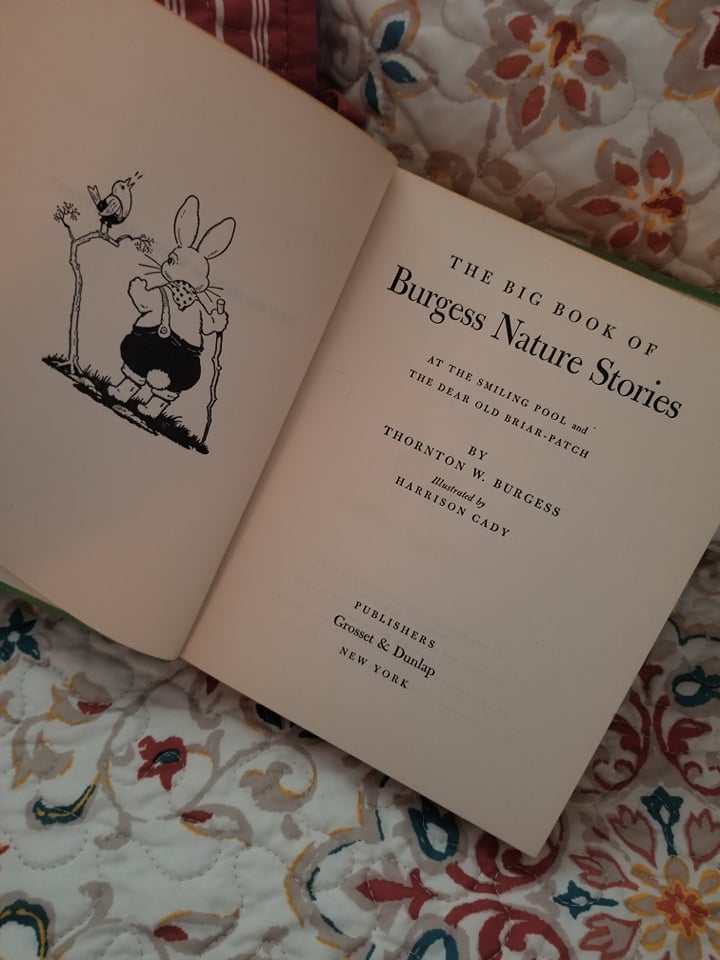
A year ago today, I was reading Cinnabar the One O’Clock Fox by Marguerite Henry with my daughter. We were in the middle of studying American History and what better way to fit in a nature story for “school” than to add it to your history lessons. George Washington’s crafty fox was a good excuse, especially in February as Washington’s birthday lands on the 22nd. This year, we’re studying ancient history again, and while Kiddo tackles Herodotus, I’ve been reading The Adventures of Reddy Fox by Thornton Burgess to my son. (What foxy title will I be reading next February, I wonder?)
Since last year, I had a baby, bought a new house, my mother died, my niblings came to stay for two months, and though we kept on schooling––as homeschoolers are apt to do––we needed some calm. Calm came in the form of Thornton Burgess, an old childhood favorite of mine.
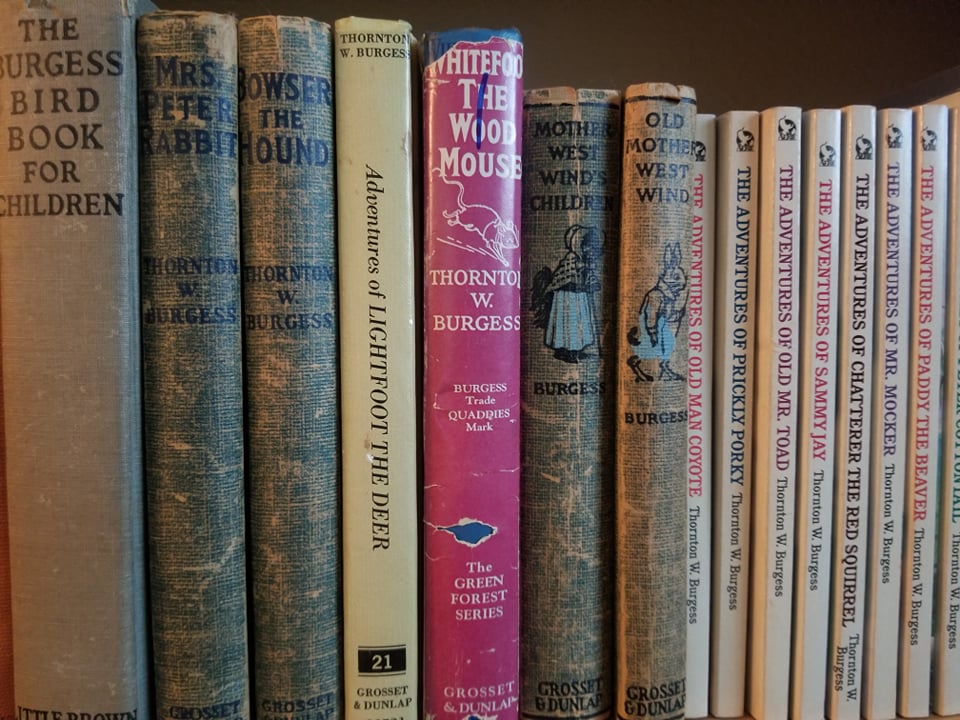
I grew up on little pocket paperback two-for-one-dollar deals from good ol’ Wally World. Most of those now sit on my kids’ shelves, being enjoyed by the next generation of bibliophiles. Among those paperbacks were Thornton Burgess Bedtime Stories. Each little paperback following the tales of a new anthropomorphized character: The Adventures of Old Man Coyote and The Adventures of Prickly Porky, to name a few.
Imagine my glee when I found a Thornton Burgess Nature Stories, short tales from the Smiling Pool where Grandfather Toad spends his days. Thoughtful anecdotes that teach children about different kinds of birds and how they nest, through stories about mischievous rabbits trying to spot them. Eels with wonder lust, who find romance… These stories are the perfect medicine for children who have lost a grandmother, a breath of fresh air when it is too sweltering to go to the park, a cozy ray of sunshine when it’s actually the dead of winter. I am determined to collect them all and read every single one of them to my children, even after they have grown too old. They are simple, there is no mistaking them for great literary works. But they are beautiful. Sometimes we all just need a little more of what is beautiful.
If you haven’t read these little gems to your children or grandchildren, the entire collection is free on kindle. As for me, I like collecting the old copies.



 Anakalian Whims