Burgess, Beatrix, and Our Favorite Bear
One thing I didn’t expect to be doing in my forties was re-reading all the books of early childhood. I was a mom of only one for nearly eleven years and thought surely I wouldn’t revisit Thornton Burgess, Beatrix Potter, and Winnie-the-Pooh until I was a grandmother. But then I had three more babies.
I started reading Thornton Burgess out loud to my oldest and two of my niblings when there was a family crisis and I absorbed a niece and a nephew into my household for two months while my second child was two months old. Thornton Burgess always brings calm to an afternoon when you need it. He’s gentle, like Mr. Rogers, and tells you all about the animals the way Bob Ross tells you all about painting. During this season of chaos, we read The Big Book of Burgess, the pale green front board and back board matched my bedroom walls and put us all in a soothing nap-like mood. We usually read over elevenses or afternoon tea, the sunlight from my east facing living room windows often cascading over my shoulders while the baby kicked in the bouncer and the older kids settled in to watch the oak tree’s leaves dance across the area rug and faux hardwood flooring. What I learned then while the fifth graders sat restfully (the only time of day they were restful) and listened, is that I would never stop reading Burgess ever again. Never. Now, we always have a Burgess book going. I read bits of the Adventures of… series to my toddler, Lightfoot the Deer and Bowser the Hound when I had a teenager, a preschooler, and a toddler, and even now with a highschooler, preschooler, toddler, and newborn, we are reading Blacky the Crow. Burgess writes delightful little chapter books every age can enjoy, but…
Beatrix Potter’s work are picture books. I definitely didn’t expect to be reading The Tales of Peter Rabbit nearly every day for another decade. Even more, I didn’t expect to not get tired of them. Jeremy Fisher doesn’t stop being exciting, if anything I think he’s more exciting now that I have a little boy obsessed with fishing. Two Bad Mice is especially amusing with two precocious little human partners in crime scurrying about my home.
Last, I’ll never forget the first time I picked up the Winnie-the-Pooh collection to read to my second born. He was pudgy and snuggly and the lamplight was low and my voice fell into the patterns that my oldest calls my Winnie-the-Pooh voice and I thought, “Oh I get to do this again. How lovely.” The book smells like vanilla and baby powder, the spine reassuring in my palm. Winnie-the-Pooh of the Hundred Acre Wood, floating up to steal honey like a rain cloud really never gets old. It might be my favorite bedtime book.
(As an Amazon affiliate I earn from qualifying purchases.)
Hard Roads to Cultural Literacy
In May of 2019, I read a book called Hard Road West: History and Geology Along the Gold Rush Trail by Keith Heyer Meldahl. I remember it being riveting. When I logged it on Goodreads all I wrote was, “Excellent and fascinating.” I was dating my now husband at the time and I remember sharing with him sections I thought he would enjoy, as we both like geology and one of our dates was to the HMNS gemstone exhibit. At one point I laughed out loud at something clever Meldahl wrote (I don’t recall what it was) and my husband commented that it is a rare geology book that causes one to laugh in pleasure.
Naturally, I thought this would make excellent assigned reading for my homeschooled highschooler. But one chapter into it she was struggling. It wasn’t the reading level, she has a collegiate reading level and has had one for a few years now. I was certain it couldn’t be the science as she had been perusing geology books since childhood and had done a whole geology curriculum with a friend as part of their own little science club they created. Nerds. I went over the science with her and she kept reading. It became less of a struggle, but she is not laughing out loud with pleasure from her geology book.
Then I started reading Cultural Literacy by E. D. Hirsch and things became clearer. In Cultural Literacy Hirsch talks about a study done on the results of seven year olds who took a reading assessment test. In the test the children were asked to read a story about a spider. The children who had more prior knowledge about spiders scored higher on the reading comprehension questions about the story (which did not require special knowledge about spiders) than those who did not know much about spiders.
I shared this with my oldest daughter, as we often study together while the younger kids are playing. We discussed it and determined that it makes sense to not get hung up on something being mentioned in passing because you already know a lot on a topic and can picture it in your mind with little effort, but to struggle to retain what something is about if it mentions a lot of things you’re trying to picture because you’re not as familiar with them. Perhaps it is easier to envision Charlotte in Charlotte’s Web if as a child you also have watched a real spider build its web, perhaps it is easier to remember the story if you’ve seen or read about how baby spiders hatch. Or, if you’ve had Charlotte’s Web read to you as a child, maybe a technical book on pig husbandry would be easier to retain as an adult. Hirsch includes an example of college students reading a paragraph about Ulysses S. Grant and Robert E. Lee and struggling because they had no prior knowledge of who they were and how they related to the Civil War (shocking because these were college students out of Virginia).
I was reminded about a public schooled girl I was working with who had failed her reading portion on her standardized tests. Her phonics were impeccable, but where she struggled was comprehension. When I worked with her, almost every time she struggled to read something it was because she had never heard the word. She didn’t have the vocabulary to support her phonics skills. I advised the family to listen to audiobooks, read stories together at night, talk to each other more, look words up in the dictionary. Children learn the meanings of words by hearing them, then when they see them on paper for the first time while sounding it out… they have a picture in their mind of what that word means, feels like, or how it can be used in different sentences. Kids should always have access to stories above their reading level, so that they can learn grammar structures and vocabulary words organically. Hirsch drives home the idea that you can know how to read and still be illiterate if you don’t know anything about what you’re reading.
I told my daughter how this was interesting to me because my husband had said he thought she didn’t know enough geology to read Hard Road West smoothly, even though I thought it was a very approachable book and that she had a strong foundation in geology. She and I laughed over the time a volunteer at the museum asked her what a specific rock smelled like and the big reveal fell flat when she answered, “Sulfur.” Poor guy deflated and said, “Yes, it’s Sulfur. You must be homeschooled.” Apparently the public school kids her age on field trips liked to shout “Farts!” She was about seven at the time and it is one of her favorite museum memories. (I’m not going to lie, even if I knew it was sulfur at seven, I’d probably have shouted “Farts!” too, but I went to public school.)
“So, why, if you’ve read all the same geology books we read as children, is this geology book difficult? Because I genuinely don’t think it would have been difficult for me at fifteen.” That is when she confessed that the geology books we owned and had spent hours reading… she hadn’t actually been reading them: “I was looking at the pretty rocks. I could tell you the page numbers where all my favorite rocks are, all the prettiest ones, I didn’t read all the stuff…” We genuinely laughed together, two wildly different personalities approaching children’s geology books in wildly different ways. As Charlotte Mason said, “Children are born persons.” But for every moment, like this geology one where she struggles because maybe she didn’t pay as much attention to what was put before her in the past, she has so many where she shines. She catches every Shakespeare reference. Every time. (Hirsch writes a bit about how Shakespeare allusions used to be quite common in all kinds of writing, including business memos, but as of the publication of his book in 1987, that was no longer the case.)
Hirsch’s argument for cultural literacy was never meant to be for homeschool parents to refine the presentation of their educational feasts, his goal is educational reform in the public sector. There is extensive discussion in his book about the struggle to properly regulate education in that if you mandate that schools teach at least two Shakespeare plays there will always be arguments about which two should be selected and that no two districts will choose the same two, therefore knowing who Shakespeare is might be universal, but catching Shakespeare references will vary. (I vote for all the Shakespeare. Every play! All the sonnets!) But I did feel like Hirsch’s essay very much affirmed the education I am providing. Maybe my oldest gets a little bogged down in this particular geology book, but to be fair, it could easily be assigned in a college course, most high school students wouldn’t be reading it between their Homer and Geometry lessons. The paragraph that boggled the minds of the Virginian community college students in the 1980s didn’t phase her, and for that I have hope.
Additional affirmation came when I realized I had owned other books by Hirsch in the past. He’s the one that wrote the series Everything Your ___Grader Needs to Know. My first two years of formal homeschooling (first and second grade), I had read those books out loud the last month of the traditional school year to see if we were covering everything. What I learned was reading those books out loud was a waste of time because a classical Charlotte Mason education is thorough and she not only knew what she needed, but she knew richer versions than the sad paragraphs presented. That was the final nail in the coffin on us ever relying on textbooks. Cultural literacy can be gained from textbooks, but it’s boring and far less effective. The better road to true literacy, in my opinion, is living books. I donated Hirsch’s other books, but I’m keeping Cultural Literacy.
One whole day after finishing Cultural Literacy, I went to our local library to donate a bag of books I was purging from my collection. There on the shelf next to the library bookstore register was E. D. Hirsch’s Dictionary of Cultural Literacy, a compilation of all the things the average American graduate should know, for $2. Of course I bought it.
“Also unrealistic is the pragmatist emphasis on individuality, at least as the idea has been institutionalized. The best teaching does accommodate itself to individual differences in temperament, but a child’s temperament does not come freighted with content. To learn a culture is natural to human beings. Children can express individuality only in relation to the traditions of their society, which they have to learn. The greatest human individuality is developed in response to a tradition, not in response to disorderly uncertain, and fragmented education. Americans in their teens and twenties who were brought up under individualistic theories are not less conventional than their predecessors, only less literate, less able to express their individuality.” – E. D. Hirsch, Cultural Literacy, pg. 126.
All About a Face That Launched 1000 Ships
…And a Book That Launched 1000 Rabbit Trails…
Fall of 2025 has been the semester in which my 9th grader has been reading the complete and unabridged Iliad for the first time. We have read picture books, chapter books, and abridged works over the years (Sutcliff’s Black Ships Before Troy, beautifully illustrated by Alan Lee, was probably my favorite), but now we’re nearly in the big leagues (the real big leagues would be reading it in Greek, maybe one day…).
I have maintained my habit of reading something new alongside teaching something old to me over the years, and while re-reading Homer’s Iliad (and listening to the Ascend podcast episodes with the kiddo) I decided to meander through Helen of Troy: Goddess, Princess, Whore by Bettany Hughes. Meander is the most appropriate word because, like my blog, Hughes’s work frolics about joyfully and a little chaotically. It’s entertaining though repetitive, it’s amusing and long-winded.
Czarney Pies, a Goodreads user, reviewed:
“Helen of Troy: Goddess, Princess, Whore” is a scatter-gun, scatter-brained work that is nonetheless highly entertaining. Reading it is something like inviting your friends from your undergraduate years over for dinner, plying them generously with alcohol and letting them rant on about whatever literary or artistic idea comes into their minds. History students will express themselves on Beethoven. English lit graduates will give you their opinions on Rabelais while philosophy students will tell you what they think the Federal Reserve Board should do about interest rates. The cacophony is as joyous as it is incoherent. As Hughes herself notes at one point that she may be presenting “a mangle of literary and social references (with a sprinkling of fanstasy [sic]) rather than historical fact.” (pp. 285- 286)
Quite frankly, that is the best description of Hughes’s work that could ever exist, in my opinion. I love this paragraph from Czarney Pies’s review so much I copied it –TWICE– into my commonplace journal. (I didn’t realize I was copying it for a second time until I was halfway through doing it and had a déjà vu moment.)
Pies makes you want to go to that party, and Hughes takes you there. Whether she intended it or not, her Helen magnum opus would be served best over a bottle of wine and a group of chatty nerds. While reading I found myself looking up a lot of paintings I had never seen and re-reading plays I hadn’t touched in decades.
My first rabbit trail was a quote on the top of page eight from Euripides, and I immediately stopped and read Medea and Other Plays from the Oxford University Press World’s Classics series. Translated by James Morwood, the collection highlights the flaws and follies of Grecian women in mythology and includes the plays Medea, Hippolytus, Elektra, and of course, Helen. I had read Medea before and knew about the Lilith/Lamia fashioned child-killer, but Euripides’s depiction of Helen of Troy was new to me. In this version, the adulteress of Troy is presented as a more palatable character who was squirreled away in Egypt for an entire decade long war and was never with Paris at all. The Helen we see in Troy was a phantom Helen created by the gods, and is a victim of circumstance.
Hughes pulls out every myth, legend, play, painting, poem, and tapestry ever known throughout history and discusses them thoroughly. She talks about the things most culturally literate people know off hand and things that only die-hard ancient literature or history buffs have researched. Sometimes treating Helen like a real person, the book takes on a biographical form. Sometimes Hughes detours into fictional fandom and muses on possibilities with whimsy. At all times I can picture Pies’s fictional party spitballing ideas about Helen of Troy, gossiping like pick-a-little-ladies and debating like Mensa meeting attendees.
(As an Amazon Associate I earn from qualifying purchases.)
A Life With Anne
When I was a child I adored the Anne of Green Gables series. I still do. But the height of me reading through the series was between the ages of 7 and 10, when I knew I could read all eight books in the 19 hour drive from Houston to Denver. I was an avid and precocious reader back then. Now I’m just avid. So color me surprised when I tried to introduce my oldest daughter to Anne during her elementary school years and the book fell flat for her. What we discovered, now that she is totally smitten with the series, is that she didn’t understand the appeal in a character who just sounded exactly like herself. For real, people have commented on how much my kid reminds them of Anne her whole life, but this year is the first year my darling girl has truly delighted in it.
I, apparently, had introduced my dear girl to Anne too soon which was mistake number one regarding my favorite auburn haired heroine (and my life for that matter, despite her being called my mini-me all the time, she is not–in fact–very much like me at all). Mistake number two was assuming everyone else I knew was thoroughly acquainted with her. So when we decided to choose Anne of Avonlea as our first San Salvatore Book Club pick, we were shocked to learn that these women we love and admire had actually never read Anne of Green Gables (some, not all, had watched the Megan Fellows series).
Naturally, I began to approach it as I do teaching. Having been raised on Anne’s beloved Miss Stacy being presented as the ideal teacher (which grew into a love of most things Charlotte Mason as I researched homeschool options), my notes always either begin or end with these questions: What did you notice? What did you wonder? What did you discover? What, if anything, did you find good, true, or beautiful about this book? Are there any other stories you’ve heard or know or read that are echoed in this story?
This post, specifically, is on the first two books and the things I noticed reading the Anne books as a woman in my forties instead of as a girl with a wild imagination.
I love how L. M. Montgomery begins both books with an exotic character. In the first, Anne is the exotic, and in the second Mr. Harrison is our foreign, otherworldly character. He is from elsewhere, new to the neighborhood, and comes with an unruly parrot named Ginger, who reminded me of my Uncle’s macaw, Chicken. Just as Anne asked to called Marilla her aunt in the first book, the opening sequences of Anne of Avonlea includes Mr. Harrison mistakenly calling Marilla Anne’s aunt. In Green Gables, Marilla shuts it down as a falsehood, and in Avonlea, Anne does the same. Harrison and Anne’s exchange regarding the cow invasion mirrors Anne’s first meeting with Rachel Lynde. In the first book, Anne is the outsider throwing a temper tantrum, in the second Anne is established as a true citizen of Avonlea as she suffers a newcomer’s temper tantrum. Montgomery’s alluding to her previous work is beautifully done.
As an adult, I also delighted in Harrison’s stab at Anne’s reading “yellow-jacket” novels. As a child I could visualize the novels perfectly because I grew up haunting antique stores and their book corners. Often, as a child, books were not worth my notice unless they were old, dusty, and had a faint smell of vanilla and moth balls (bonus points if there was a lingering odor of pipe tobacco). As a retired bookseller, this portion hit a bit differently and I laughed out loud. Yellow-jacket (“yellowback”) novels were “railway novels.” They were the equivalent of NY Times Bestselling thrillers or romances perched in a kiosk at an airport terminal (I’d say “today” but I really don’t fly much and I don’t know if people buy airport books these days). They were sensational fiction, much like dime novels, brightly colored (usually yellow) with ads on the back to cover the costs of the printing. Often they were simply cheaper reprints of already popular books. They were in direct competition with the “penny dreadfuls” G. K. Chesterton discusses in his essay A Defense of Penny Dreadfuls. Dracula was one such publication.
I also noticed, diving into the series as an adult, how much the Anne series had saturated the corners of my brain. In my late twenties I wrote two books in what is called The Bookshop Hotel series (book three was written just after I turned thirty, books four and five are still sitting unpublished on my computer). I wrote them under duress and my brain was completely fried, grasping at straws. One of my character’s names is Maud Montgomery. A few years ago I was asked by a reader if I had done that on purpose. I can firmly say, no, I did not. But reading now, I see how my mind had pulled something from a dark corner, something it had known and forgotten, and ran with it. L. M. Montgomery (Lucy Maud), called Maud by her friends, was a deeply religious person who functioned as a caretaker for her mentally ill husband. I can see in hindsight why my mind pulled this name out of the abyss during that time, as I thought I was the caretaker to a mentally unstable alcoholic husband myself. (Turns out, I was wrong, I was actually just a narcissist’s favorite toy. Thank God, that part of my life has passed.) The thread that holds so many of these episodic adventures in Avonlea is often the nuggets of wisdom and religious belief that seep through the pages, the empathy and compassion, the search for the divine, the delight in creation and whimsy.
Another strange moment for me was when I read in Anne of Avonlea:
“I think an old, deserted house is such a sad sight,” said Anne dreamily. “It always seems to me to be thinking about its past and mourning for its old-time joys.”
Leave it to my exhausted brain to also personify a house in my Bookshop series. What we read in childhood truly shapes the way we think.
I was amused to discover how much my parenting seemed to mimic Marilla’s and startled to get to know Miss Stacy as an adult reader. I have been homeschooling my children from the beginning. Public school was never going to be an option for us for many reasons, but as I was reading about Anne’s favorite teacher, whom I had read about hundreds of times in second and third grades, I realized that she embodies all my favorite elements of classical British educators during the turn of the century. More specifically, she has so many qualities Charlotte Mason hailed as correct.
Charlotte Mason lived from 1842-1923 and was known as a turn of the century educational reformer. She established the House of Education in Ambleside in the late 1800’s, which focused on teaching classically but with the added emphasis that “children are born persons.” She wrote a Home Education series I have read several times. When I was using Classical Conversations as a co-op opportunity for my oldest, people often told me I was too “Charlotte Mason.” (Classical Conversations is a nationwide neo-classical homeschool organization based out of North Carolina. There are things I love about their curriculum and things I could do without.) When we tried to connect with Charlotte Mason homeschoolers, die-hard AmblesideOnline families, we were often told we were “too neo-classical.” I now see the truth: we were never Classical Conversations people, nor were we Charlotte Mason followers… my aim has always been Miss Stacy. We are Miss Stacy homeschoolers! We do nature studies, literature based learning, Euclidean geometry. I still use McGuffey’s Readers and Susan Wise Bauer material, while adhering to a lot of AmblesideOnline’s schedules. We have always narrated, as advised by Cindy Rollins and Karen Glass. But in all these details, what I chose to use and what I have discarded, I have shaped my entire homeschool culture off a picture in my mind of the perfect educator–Miss Stacy!– and I wasn’t even aware I was doing it.
My daughter and I read Anne of the Island together, and we will resume the rest of the series soon, but took a break to focus on Homer’s Iliad. I am looking forward to seeing how Anne of Windy Poplars measures up to my memories of it being the best in the whole series, and what other things I notice and wonder, as someone who has been noticing and wondering for a much longer time than when I read it last. I’m excited to see what my real life Anne-girl thinks of her literary counterpart as she reads each book hereafter for the first time as well.
(As an Amazon Associate I earn from qualifying purchases.)
Dracula
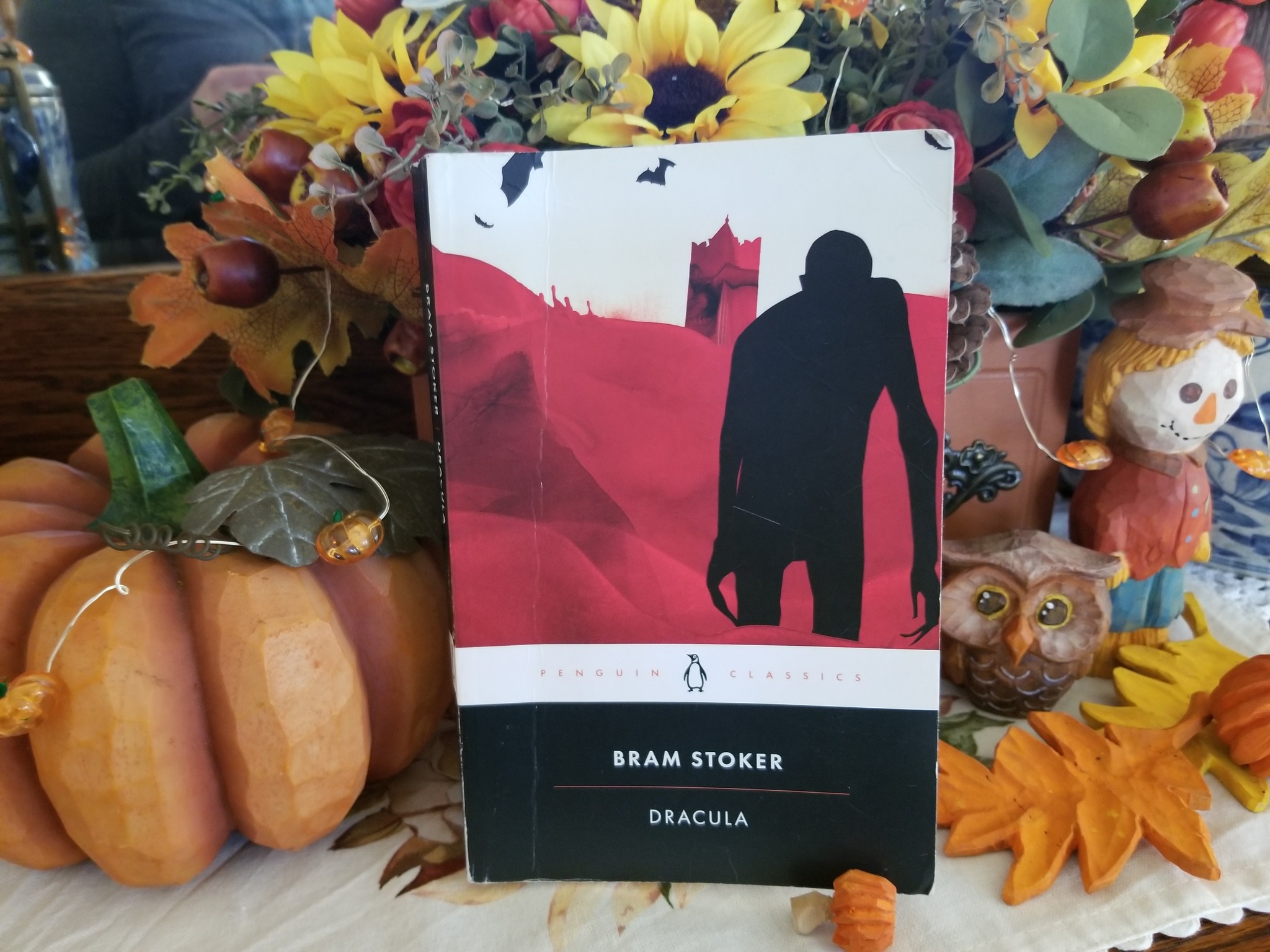
I walked my fifteen year old through Bram Stoker’s Dracula this October. I thought it would be a fun way for a ninth grader to celebrate Halloween. I also thought it would be a neat one to cover with my newly developing book club: The San Salvatore Book Club, primarily made up of my older mentors in my Baptist church. There were gasps of “Are you sure?” and polite “I think I’ll bow out of that one” to which I promptly said, “Why? It’s such a beautiful Christian allegory!”
Side note: I’ve been listening to the Literary Life Podcast with Angelina Stanford for about two years now, caught up on most the episodes and sometimes use them to supplement my home school when I need to be doing something other than teaching literature. My number one complaint to my husband is, “they act like no one knows this and everyone knows this!” to which I am learning every day that, actually, no Angelina Stanford is right: not everyone knows this. I’m not always claiming to have the correct most perfect reads, but I have been shocked to learn I have been reading differently than mainstream society since childhood. So my Angelina Stanford grumbles have ceased now that I know she is operating from the experience of people genuinely not knowing about the material she shares and I’ve been operating under the experience of not sharing because I thought everyone knew. That being the case, my apologies if some of what I share simply sounds like it came from her podcast. It is unintentional, though, yes I listened to her Dracula episodes back in February to make sure when we discussed it in October, I would not have skipped over anything that I assumed “everyone already knew.”
While I was teaching Dracula, I realized I had never written about Dracula on my blog. My blog began, I think, during the height of the Twilight series and I spent so much time focusing on how we shouldn’t be romanticizing vampires with chests that sparkle and misplaced teenage angst, I forgot to write about the roots of vampire lore and my love for Stoker’s classic work, which is in fact a Christian medieval quest to kill a dragon disguised as a techno-thriller. I also realized that I don’t remember what of my essays, stories, and discussions over the years ended up in my journal or my blog, or was relegated only to bookstore employee discussions as we cleaned the store each night. I have spent years reading C. S. Lewis, G. K. Chesterton, George MacDonald, all the classics, yet my blog is mainly limited to home school material and book reviews sent to me by authors and publishers. Therefore, as I begin to teach high school literature to my oldest, I imagine there is a lot of who we are as readers not documented on Anakalian Whims.
To read Dracula well, I think you need a foundation in Genesis, specifically 1:26-4:16. It’s important to read John 1 where the New Testament is clear that Jesus is the Word. It’s important to know a little bit about Jewish and Mesopotamian mythology regarding Lilith, who was a demon and seductress, the disordered first wife of Adam who feeds on children and relishes in child sacrifice as opposed to feeding and nurturing children from her own body as God designed. “Lilitu” was a “night monster.” In my teaching notes, I recommend re-reading the book of Revelation (so you can remember how the bible used imagery of dragons and oceans) and Beowulf. While reading Dracula, you might need to recall stories like Hansel & Gretel, Bluebeard, Homer’s The Odyssey, Dante’s Divine Comedy, Spenser’s The Faerie Queene, and Shakespeare’s Hamlet. It’s easy to enjoy Stoker’s work without these tales fresh on your mind, but it might also be easy to fall victim to Freudian false interpretations if you’re not reading from the framework that Stoker was actually writing during the Gothic revival of the 1800’s. You’ll be limited to the Victorian techno-thriller, which is still awesome, and see all the wrong “imagery” of suppressed sex, which is inaccurate and not awesome.
You have to keep in mind the quote from Devendra Varma: “During the period when the forces of Christianity were nearly spent and materialism had dislodged spiritual values, the Gothic novelists planned their novels with an awareness of the Deity and the consequences of a just fate. The villains learn in due course that the wages of sin is death.”
With that in mind, we enter a world where the monster in the night is indeed an evil to be vanquished, not to be loved for his sparkly chest and undying devotion to trying to get the girl. Traditionally, the villain in these stories is a symbol for Satan, a metaphor for evil itself. We see these villains portrayed as witches, monsters, vampires, and werewolves, who modern literature is now conflating with handsome boys who just need more hugs. Since the dawn of time, human beings have suffered from an evil that must be conquered, and in Stoker’s Dracula we have a group of Christians on a quest to conquer that evil… the “Son of the Dragon” or “Son of the Devil” named Dracula. The best literature will always remind us that the ultimate battle is between the Dragon (the monster) and the Savior (Jesus), and the Savior has already won. That is exactly what makes Dracula one of the best pieces of literature. The monster is the problem, the monster is not the love interest. As C. S. Lewis said, “Who is the witch? The witch is Lilith. The witch is Circe. Every child is born knowing who the witch is.” As Angelina Stanford said, “The monster is not the wounded person, the monster is the [cause of the] wound.”
I don’t want to repeat all the information already available to the public for free on The Literary Life Podcast, but I do want to share some of my favorite parts of the novel that get my skin all tingly when I read them. I’ll try not to repeat too much of what they focus on in the podcast.
In chapter two, we walk through an octagonal room. In Babylonian culture, the eighth realm is the realm of the gods, a realm where for Christians, false gods, fallen angels, and demons congregate. Eight, therefore, is often considered a number affiliated with the occult. Charlemagne’s Aachen Cathedral, where his tomb resides, is an octagonal shape believed to be a mesh of where God meets the secular as it is a circle with straight lines and points. I ask my students what they think Stoker is trying to tell us by Harker walking through an octagonal room as he enters Dracula’s residence, just after a wild carriage ride that resembles a descent into Hades.
Later in this chapter, Dracula throws a mirror out the window. It is absolutely chilling as the mirror in medieval tradition is a symbol of divine truth. It doesn’t matter how many times I read Dracula, the Adversary both literally and figuratively throwing Divine Truth out the window gives me chills every time.
The setting of Whitby, which has a castle or abbey with an extensive graveyard by the sea sets itself up for so much intense imagery and meaning. We have our Gothic trope intermingled with the real history of the Synod of Whitby, where two traditions were ended. Meanwhile Dracula is asking Harker if a man of England can have two solicitors or more? Stoker is tossing around ideas of can man serve two masters? Who will man choose? Dracula is basically asking, how can I trick England into abandoning God and worshiping me? Whitby Harbour had a history of ships crashing, which will offer up opportunities for both Tempest and Rime of the Ancient Mariner allusions.
Stoker offers layer after layer of symbolism with the names and social positions of the characters as well. The podcast talks extensively about the roles of women in Victorian society and how Stoker played with Lucy being the “Light of the West” and “angel of the house” and Mina being the modern woman (I’m not sure if they covered the meaning of her name which sums up to be “Resolute Protection of the Lord”), but my favorite is actually the role of the men in this allegory. We have a fellowship of knights on a quest, all devoted to one woman (Mina), headed off to kill a dragon (Dracula), interwoven with Aristotle’s classical elements: Abraham Van Helsing, the professor (Merlin/ father figure, fire); Arthur Holmwood, the future Lord Gadalming (nobility whose name means “Of God-helm” in the Surrey Kingdom where there is a village called Thursley, near Hammer Pond and Thor’s Stone… King Arthur/ Thor, thunder, or air); John/ Jack Seward, whose name means “Guardian of the Sea,” is a doctor and scientist (a knight on our quest, water); Jonathan Harker, Mina’s husband whose name means “The Lord has Given” (earth); and our fifth man Quincey Morris, a cowboy from Texas (the fifth element) and (spoiler alert) our “Good boy. Brave boy. […] all man.”
From a book review standpoint, Dracula is hands-down a five star book. Above I shared my favorite pieces of a very complex allegory, but there’s so much more to it covered in the series of episodes of the Literary Life Podcast, and even more in my teaching notes, imagery that covers the Eucharist, Anti-Eucharist, Passover, John the Baptist and Anti-John the Baptist imagery. The story is one of wars to fight devils and ends on All Saint’s Day, celebrating rebirth in Christ and the achievement of Heaven. If you’re not seeing these metaphors for yourself when you read please go listen to the podcast episodes so that you can enjoy this beautiful work of fiction (and truth) for yourself.
(As an Amazon affiliate I earn from qualifying purchases.)
John Oehler, Bringer of Fire

Title: The Bringer of Fire: An Outback Thriller
Author: John Oehler
ISBN: 9798334925120
Genre: Fiction/ Thriller
Pages: 298
In late January, John Oehler’s wife, Dorothy, contacted me about sending John’s latest book for review. I’ve read and reviewed everything he’s published, and with pleasure, I agreed to do the same for The Bringer of Fire.
The Bringer of Fire is what I would call an environmental activist thriller. The main character, Yara, is an assassin for an organization hell bent on protecting the Amazon. She is sent on a mission to Australia with her partner and lover, Elena in pursuit of a rare diamond that will help her organization negotiate protection for their beloved land.
The book opens with a murder, quickly moves to Yara and Elena’s relationship (which all occurs tactfully behind closed doors), and onto their mission. The heist by seduction scene is by far the most sexually graphic and does not set the tone for the entire novel, just puts all the plot points in motion. From there, the novel progresses into what Oehler does best: show us settings he has seen in person that we, the readers, have not. Suddenly, we’re traipsing through the Outback with Yara, two Australians, the weather, the crocs, the budgies, and more. The story could easily be put into a screenplay and I would love to see my favorite parts (flash floods and landscapes) on the big screen, as Oehler describes them beautifully.
In 2019, I wrote: “Oehler writes adventures for people who want to travel, his books are rich with globetrotting and exotic locations. For someone who rarely leaves my armchair, that’s a big part of my reading experience desires, and for this reason Papyrus is probably my favorite of his work.”
After going to France in Aphrodesia, to Egypt in Papyrus, to Venezuela in Tepui, and to Prague in Ex-Libris, Oehler did not disappoint when whisking me away to Australia via The Bringer of Fire. In real life, according to an interview in 2014, Oehler has visited 50-60 countries and lived in 6 of them, and this knowledge of the world bleeds through his writing as he takes his readers on foreign adventures as well. “If you’re going to take a reader someplace exotic,” he says, “I believe you have a duty to make that place as real as possible. And not just visually. What does it smell like? What sounds do you hear? How does the food taste? What textures do you feel? Those details help the reader feel ‘there.'” He truly nailed it with the food in this one. Every chapter left my stomach growling for a taste of Australian cuisine and barbecue.
I enjoyed The Bringer of Fire and will continue to look forward to each new book Oehler delivers to the world. I love the chance to see things he has seen and go where he has gone, even if it’s just from my living room.
Content Considerations: LBG content, non-graphic backstory of sexual abuse/sex work, somewhat graphic heist by seduction, extra-marital affair at the expense of a spouse and child, graphic depictions of violence, adult language.
Raising Grateful Kids…
Raising Grateful Kids in an Entitled World: How One Family Learned That Saying No Can Lead to Life’s Biggest Yes by Kristen Welch
My rating: 3 of 5 stars
When I first finished reading the book, I wasn’t quite sure how I was going to approach a review. There were snippets and pages here and there where I shared snapshots of a page with friends. They were GOOD and I said as much. But the whole of the book was underwhelming and not useful for my household.
I’m a Christian who lives not far from the area the author lives, yet I still could not relate to many of her examples. There are beautiful truths peppered throughout a series of disjointed stories about her children, but I find much of the advice is for a very specific target market. I have not struggled with what high-end preschool to send my children to (we homeschool and I homeschooled as a destitute single mother as well). I have never been in a position to decide whether my eight-year-old needs a smartphone, buying a $1000 device for an elementary student would never occur to me because I couldn’t even buy those sorts of things for myself. I’m also blessed, I suppose, to have a tween who has never asked me for a three-hundred-dollar purse. If she did ask such a thing, it would likely be sarcasm and we would both laugh at the absurdity. We’ve lived in a world of hand-me-downs and used everything and have always been quite content to do so. We save when we have something we have decided is a big-ticket item and a luxury, we’re aware big-ticket means different things in different households. I read the book because it was recommended and we do have gratefulness and entitlement issues here and there, but more when it comes to things like making something bigger and grander (within the budget) just because you got a good deal or managed to do it yourself at no cost. Ie: Just because you can do something for free or make it happen with your own hard work, should you? This book didn’t help with that, it’s still focused back on the getting your kids to work for what they have, that’s not our struggle.
I am not the target market. I’m sure it’s very helpful for people in the target market, but I feel that the target is relatively small and limited to very affluent neighborhoods. (Of course, they need self-help books too!) We’re currently middle class, living in an upper-middle-class neighborhood with no debt but our mortgage, I grew up fairly well off, and still every example in this book is too rich for my blood. Trips to Kenya, to serve, which is beautiful, but hopping on planes to other countries isn’t exactly something my family is in a position to struggle about. Giving their fourteen-year-old the power to choose where they spin their time while in Europe for a few days is an awesome idea if I were ever in a position to leave the country. We’re pretty pleased to be able to fill up our gas tank without pinching pennies… once upon a time, I couldn’t do that.
She does a good job reminding parents that gratefulness starts with the parent. Me longing for a larger yard one day is a slap in the face to those who don’t have yards at all, my kids hear the desire for more in us when we’re chasing the next thing. It all must be balanced with saving for the desires we have and not done in a spirit of crapping on the things we just got.
Additional aside: a lot of people on Goodreads are complaining about the shock of it being a Christian book. Their surprise took me by surprise. My copy is printed by a Christian publishing house, states clearly on the back jacket about the author’s desire to raise her children to follow God, and at no point in time was I ever given the impression (from marketing alone) that this was anything other than a Christian/Parenting book (also stated clearly above the bar code). Therefore, I was not surprised by her beliefs being clearly presented in the early chapters. She was writing for Christian parents. As Christian parents we do teach our children not to murder, to care for those less fortunate, to assist and serve where there are needs and we can help, and that we were made as God intended. Some readers are bothered by this. That particular stance had no bearing on me not giving the book 5 stars.
View all my reviews
Cross-Denomination Book Club
One of my favorite things is how the Body of Christ works in many places at once. I love when four or five churches in a community are moving to do the same thing at the same time. I love when men and women of God are studying and praying over the same topics, separately but together. I love pondering the idea that the Lord never does just one thing at a time and He instills passions into His people in ways that work together for His purpose, even if we’re not paying attention.
These are the things I enjoy paying attention to most.
Several years ago, this point was driven home to me when my church studied Blackaby’s Experiencing God. It is one of my favorite studies to recommend to people of all ages, and it was the first one my current husband and I walked the children through when we first began the habit of family bedtime bible study. (Training up our children in the way they should go is very important to me and I am so grateful to have a husband who leads us, rather than one who abuses.) Prior to my remarriage, even when married to my first husband, bible study was an activity kiddo one and I did alone. This “new” habit (two years and counting) has been refreshing.
But while we study as a family, I also find it encouraging to study with other women, both from my church and others. I enjoy being a part of online book clubs, but even more I enjoy discussing rich books with my personal friends. I’m not talking about sitting in a circle drinking wine and arguing over literary merits. I’m talking about each family reading a book, finding biblical truths in it, and sharing those truths with their friends. I’m talking about Christians who go to Baptist churches, Catholic churches, Lutheran churches, and more, all discussing God’s Word and books that point us to bits of God’s Word we may have missed.
My desire to write this particular blog post was born of two books and a series of interwoven events.
A woman at church passed me a note suggesting I read a book by Rosaria Butterfield called The Gospel Comes With a House Key. I got home from church, looked it up on Amazon, saw that it was backordered but hit the button anyway and largely forgot about it.
Then, The Other Half Of My Brain, as I call her (my college roommate) was reading Habits of the Household by Justin Whitmel Earley with a group of women in her town five hours north of me. She messaged me saying she was pleased with the contents, I should check it out. She had also shared it with her sisters, who all live elsewhere. I read it, I loved it! When I shared it with my friends, I told them what The Other Half Of My Brain had expressed to me: It’s full of fantastic tidbits that you can implement into your life with 45 spare seconds. Most self help books are all about waking up an extra 45 minutes here, or take an hour and add this to your week, etc. Earley, on the other hand, wrote a book full of biblical truths and household wisdom for tired, busy people.
“My greatest hope,” Earley writes, “is not that you sit down in a quiet place and read this book alone. […] rather, that you read snatches of it between toddler fits and soccer trips. I hope that you nod off during a chapter because the baby was up last night, and get distracted at a good part because your twelve-year-old drops a surprise question about sex.”
He goes on to say that he hopes you read it with your spouse, that you skip around, that you use what you can and ditch what doesn’t work. Make notes in it, spill coffee on it, etc. This book is truly a tool, something that I try to remind everyone about all books. It’s about raising kids to follow God in the midst of a chaotic life.
The thing that struck me most is how useful it could be for grandparents as well, even though it isn’t marketed for them. My mother-in-law proved this point without even knowing when shortly after I finished reading this book she added to the Sunday lunch liturgy for the children. Later that week I shared with other grandparents I knew, and slowly more people in my extended circle were reading the same material and implementing elements of Earley’s recommendations in their daily lives.
In Earley’s book he includes lists of additional resources. Lo and behold, one of the books he refers his readers to is The Gospel Comes With a House Key. I was still waiting on my copy when another friend of mine was toying with starting a book club at her church and one of the potential members recommended it as the first book. I was so excited, “I have that book on the way to my house, I’ll read it with you!” In the meantime, I discovered some friends from a completely different circle of people who had also already read Earley’s book.
Aside from an actual marketing campaign, these two books are making the rounds in the Christian communities I’m associated with and this excites me––not in a part of the in-crowd or bandwagon way. I think when books are leapt upon as more useful than the bible by church groups, trouble follows (think the 1990’s and I Kissed Dating Goodbye.) I don’t think anyone should pounce of Earley’s or Butterfield’s books and put them on pedestals above or even alongside their bibles. However, reading the books with fellow Christians, praying about truth revealed, and discussing the merits and flaws of each idea presented is an exciting activity, especially when it’s not even happening in a formal way. There is no “gather in the library at six, password candles,” happening here. It’s just people reading and casually discussing the books that have impacted their lives that week in passing. You’re welcome to join the club.

Instilling Financial Wisdom

Title: Stock Market Investing For Teens
Author: Myles West
ISBN: 9798416564322
Pages: 149
Theme Music: The FatRat Warrior Songs: Reminiscence
Ok, maybe the Theme Music was a little much, but I mainly listened to this while I read Myles West’s investment guide for teens and planned kiddo’s future. According to West, only 35% of kids 12-19 (as of 2021) had ever had a savings account, and though I agreed to read this book and leave an honest review in exchange for a free copy, I definitely sat and patted my back for having savings accounts for both my kids and choosing this particular title to review. I have always assumed helping children plan for their financial future was the norm, I did not realize how in the minority I was until this book.
While married to my oldest’s father, we suffered a lot of hardships, many that began and ended with financial irresponsibility and abuse. It was during those years that I realized how important it was to not just “agree” about money, but to understand when you are and are not speaking the same language when discussing money topics. It’s not enough to agree that it is “good to save,” questions like “how do you plan to save?” must also be answered accurately. Newsflash: “Win the Lottery” is not a good answer. Spending is a touchy subject too. Agreeing that bills should be paid on time is not the same thing as someone actually paying their bills on time, or even prioritizing those bills over their vices. And although I am grateful for the skills I learned while foraging for food in the woods when he kept grocery money from us so he could buy beer, that’s obviously not the place I want my kids to be in life. Ironically, I was reviewing financial books even then. I knew the “right” answers, but I didn’t know how to help my then spouse make the right choices. The new goal is to simply help my kids learn to make the right choices before they are married so they don’t find themselves acting like or married to someone who tackles money like my ex.
It’s not just enough to start a savings account, though, although that’s a great start. We talk a lot of about being a good steward of our finances in our house. As a homeschool mom, I have the opportunity to teach my kids all the inner workings of household management throughout the day while we tackle math, reading, history, and science. My oldest can now budget out and cook dinner once a week as part of her home economics, she’s eleven. She has been taught to save money for pets and their care and upkeep. We have a two year old puppy, a seven year old hermit crab, one year old Australian tree frogs, and she has set up a freshwater aquarium for a betta fish whose extra plant features she has to earn by doing the dinner dishes every night.
Even this is not enough.
Around 8th-9th grade I plan to add the Math-U-See Stewardship curriculum to our school days. When that happens, I’m also going to add West’s investing book to the required reading list.
As an adult, I’m familiar with most of what was discussed for Americans (West’s book also tackles actions available for Canadian citizens), so I read through the 149 page book in one sitting as soon as I took it out of its package. A teenager being exposed with the terminology and ideas for the first time will have to peruse it more thoroughly. Although West does an excellent job defining terms and laying out a thorough getting started guide, I would consider it just that––a guide to get started. A teen would (and should) take a great deal longer than a nine month old’s nap time to digest this book. It’s good stuff.
In addition to the well rounded and systematic way West approaches investing for the first time, I love how he also touches on volatile markets. Many adults pushing kids to invest don’t properly address the risk factor, but I think West handles it well. The risk is real, but these are things you look for…
The best part, West doesn’t act like his book is the end all be all of everything. In a household where our mantra continues to be “Education is a lifetime pursuit” you bet your britches I was delighted to read West write,” The more you know, the less likely you are to make mistakes. Your reading and thinking may also lead to improved investing techniques and performance.” He then continues to encourage his readers to learn about successful investors and firms as well as those who have failed. “[…]there is always more to learn…”

Thornton Burgess Nature Stories
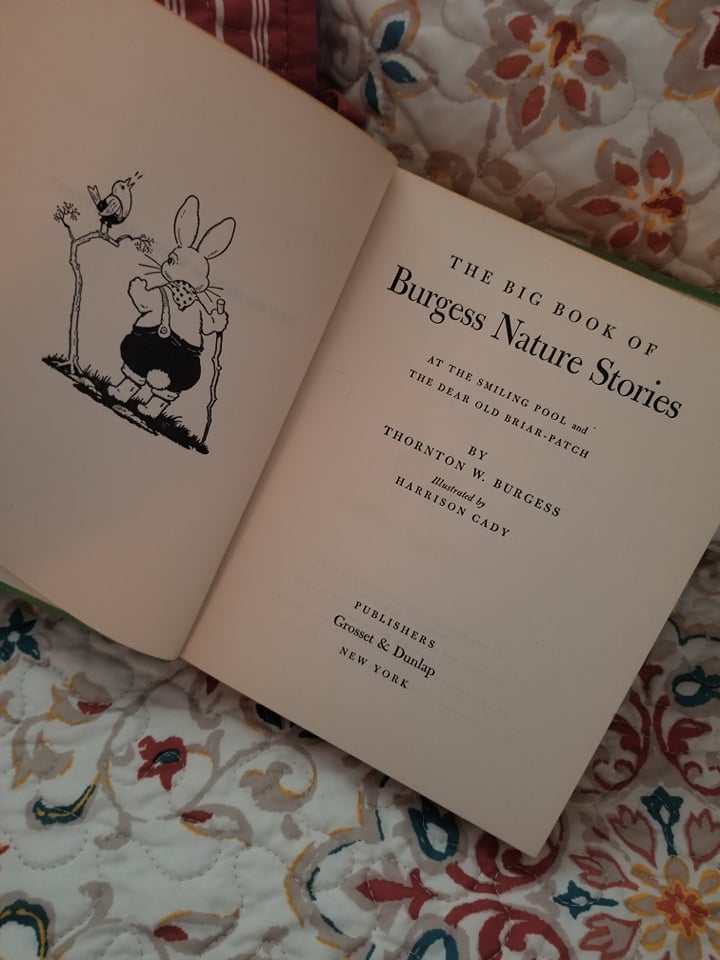
A year ago today, I was reading Cinnabar the One O’Clock Fox by Marguerite Henry with my daughter. We were in the middle of studying American History and what better way to fit in a nature story for “school” than to add it to your history lessons. George Washington’s crafty fox was a good excuse, especially in February as Washington’s birthday lands on the 22nd. This year, we’re studying ancient history again, and while Kiddo tackles Herodotus, I’ve been reading The Adventures of Reddy Fox by Thornton Burgess to my son. (What foxy title will I be reading next February, I wonder?)
Since last year, I had a baby, bought a new house, my mother died, my niblings came to stay for two months, and though we kept on schooling––as homeschoolers are apt to do––we needed some calm. Calm came in the form of Thornton Burgess, an old childhood favorite of mine.
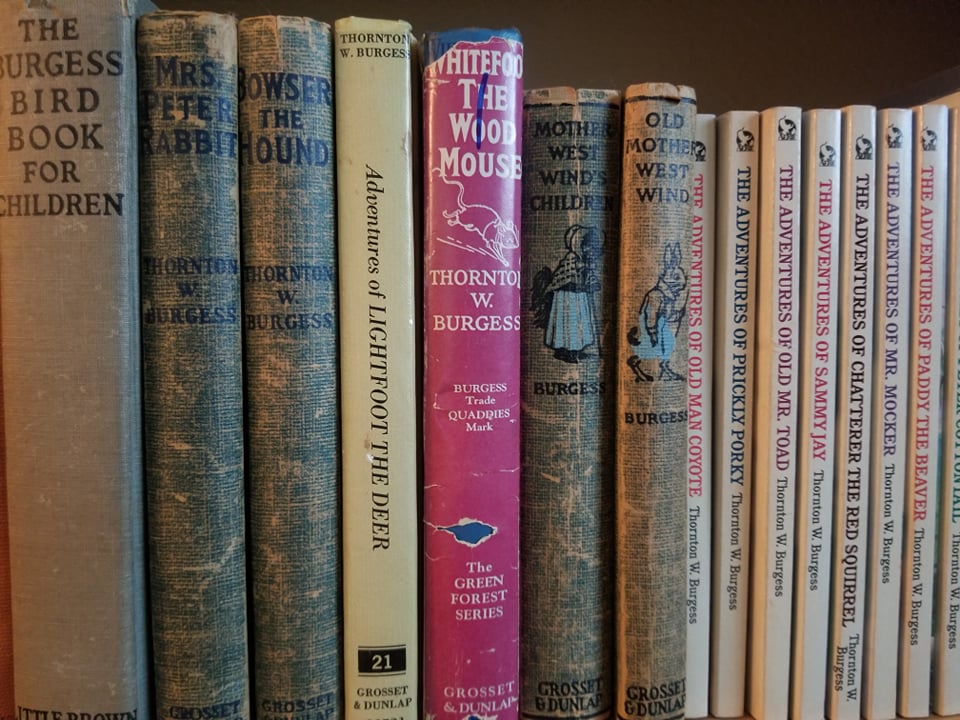
I grew up on little pocket paperback two-for-one-dollar deals from good ol’ Wally World. Most of those now sit on my kids’ shelves, being enjoyed by the next generation of bibliophiles. Among those paperbacks were Thornton Burgess Bedtime Stories. Each little paperback following the tales of a new anthropomorphized character: The Adventures of Old Man Coyote and The Adventures of Prickly Porky, to name a few.
Imagine my glee when I found a Thornton Burgess Nature Stories, short tales from the Smiling Pool where Grandfather Toad spends his days. Thoughtful anecdotes that teach children about different kinds of birds and how they nest, through stories about mischievous rabbits trying to spot them. Eels with wonder lust, who find romance… These stories are the perfect medicine for children who have lost a grandmother, a breath of fresh air when it is too sweltering to go to the park, a cozy ray of sunshine when it’s actually the dead of winter. I am determined to collect them all and read every single one of them to my children, even after they have grown too old. They are simple, there is no mistaking them for great literary works. But they are beautiful. Sometimes we all just need a little more of what is beautiful.
If you haven’t read these little gems to your children or grandchildren, the entire collection is free on kindle. As for me, I like collecting the old copies.



 Anakalian Whims