An Autistic History
 Title: Not Even Wrong

Author: Paul Collins
Publisher: Bloomsbury
Genre: Memoir/ Psychology
Length: 245 pages
I’ve journaled nearly twenty pages of commentary on this book. Now, having finished it, I’m not sure what I should share and what should be kept to myself.
Collins does a spectacular job sharing memoir with known history, diving into tales from the world and mixing it with tales from his personal world. The first few chapters are dedicated to his pursuit of Peter the Wild Boy and an existing desire to write a biography on the mysterious boy who was ‘rescued’ by King George. (Reference to the boy made in Notes and Queries, of course.) Collins later discovers his son is autistic.
The entire book is an ode to his son and his autism. An ode to their life, their relationship, the world of Autists.
Therefore a lot of information is shared regarding what that means. A lot of reflection on the gene pool it takes to cook up such a neurological anomaly that is an essential part of humanity as a whole. The trifecta being science, art, and math.
Collins writes on page 96:
Apparently we have been walking around with the genetic equivalent of a KICK ME sign:
my father: mechanical engineer
jennifer’s father: musician, math major
my brother: phd in computing
jennifer: painter
me
At this point, I remember taking my own personal inventory. My father is a civil engineer, not only that he was a musician and painter, and suffers from what I think is undiagnosed and extremely mild tourettes (also discussed in Collins’ book). My immediate cousins and family members on that side of the family are musicians and scientists. Some work in labs, some in an engineering field. Although I’ve been an English and History girl my whole life, much to my father’s chagrin, I was raised by and around extremely scientific minds. I think I get all the feelings and other eccentricities from my mother’s side. But in a parallel universe, had I somehow procreated with people I had dated in college rather than the love of my life whom I married – musicians, computer geeks, Synesthesiacs (also discussed in Collins’ book) – I think I was very close to wearing that KICK ME sign as well.
Looking at the world through the eyes of Collins’ research, I think many people have been close to wearing that sign. I think everyone should read through this book and see just how close. It’s enlightening. It’s scary. It’s beautiful.
There are so many amazing people through out history who have changed the face of humanity – the way we work – integral parts of society and science… and they were very likely autistic. Albert Einstein, Isaac Newton, Glenn Gould, Andy Warhol, Paul Erdos. These people are essential to who we are as a species today. These people have made our world more beautiful, even though they are very likely to be the same people described on page 109: “Imagine if you tried to pretend to understand people, but didn’t really. So you rehearse it all in your head: taking notes, analyzing every social action, trying to connect it all together.” I don’t have to imagine. I may not be a genius like Albert Einstein, I may not be as clever as Glenn Gould, and I’m certainly not nearly as eccentric as Andy Warhol – but I know all about rehearsing, taking notes, analyzing, and still feeling quite out of the loop. A little bit of understanding from the rest of the world goes a long way in my book – even though I’m not so good at understanding the rest of the world, I’m trying to be better about it.
“You know, it used to be that when I saw someone acting or talking strangely, or just being odd on the bus, I’d think to myself: What’s his problem? I still have that reaction. But now I stop, pause, and have a second thought: No, really, what is that man’s problem? There is a decades-long chain of events that created the person who are seeing.” – pg. 213
Paul Collins brings a little bit of humanity and the importance of curiosity and empathy into ALL his work. For that I adore him, and will always adore him, forever.
On that note, I want to check out the artwork of his wife. I love art. I love paintings. I am the CMO of an art company called Aoristos and I’m curious to see the style of art the spouse of my favorite author paints. If anyone knows and can provide reliable links – please do.
Literary Journal Monday
 Today, I picked up The Arizona Quarterly. It was Volume 37 from the Winter of 1981, Number 4. The ISBN is 004-1610. I chose this one for the first essay listed on the cover – one on Montaigne, Melville, and The Cannibals. It’s by one Gorman Beauchamp (what a name) and spells out what I now realize it is that keeps me coming back to Melville time and time again, even though I’m always slightly dissatisfied with his work.
“[…] being a work of intrinsic interest and inventiveness as fiction-autobiography-anthropology-travelogue […]”
Beauchamp identifies all my favorite subjects and genres, then attributes them to Melville. Ah, I see now.
This entire installment is dedicated to Melville – every essay. A poem by a Housman piqued my interest, briefly, but it wasn’t A.E., it was another Housman.
If I were to purchase this (roughly $5), I’d house it next to The Secret of Lost Things so the Melville cronies can bond… so it can be near something else that reminds me to tackle Melville with more zeal. After all, it is something to revisit once I have tackled Melville more thoroughly.
Until then, I’ve tucked it back on the shelf at Good Books in the Woods – with the rest of the A’s in the Literary Journal area in the back of the Gallery – to be revisited as long as it remains there while my child frolics in the rock garden out back.

The Big Book for Peace
A Weekly Low Down on Kids Books

This picture is from BookMine – the one I took at GBITW didn’t take.
Title: The Big Book for Peace
This is where I normally list the authors and illustrators of a book… there were so many involved with The Big Book for Peace that I opted to take a picture of the title page instead:
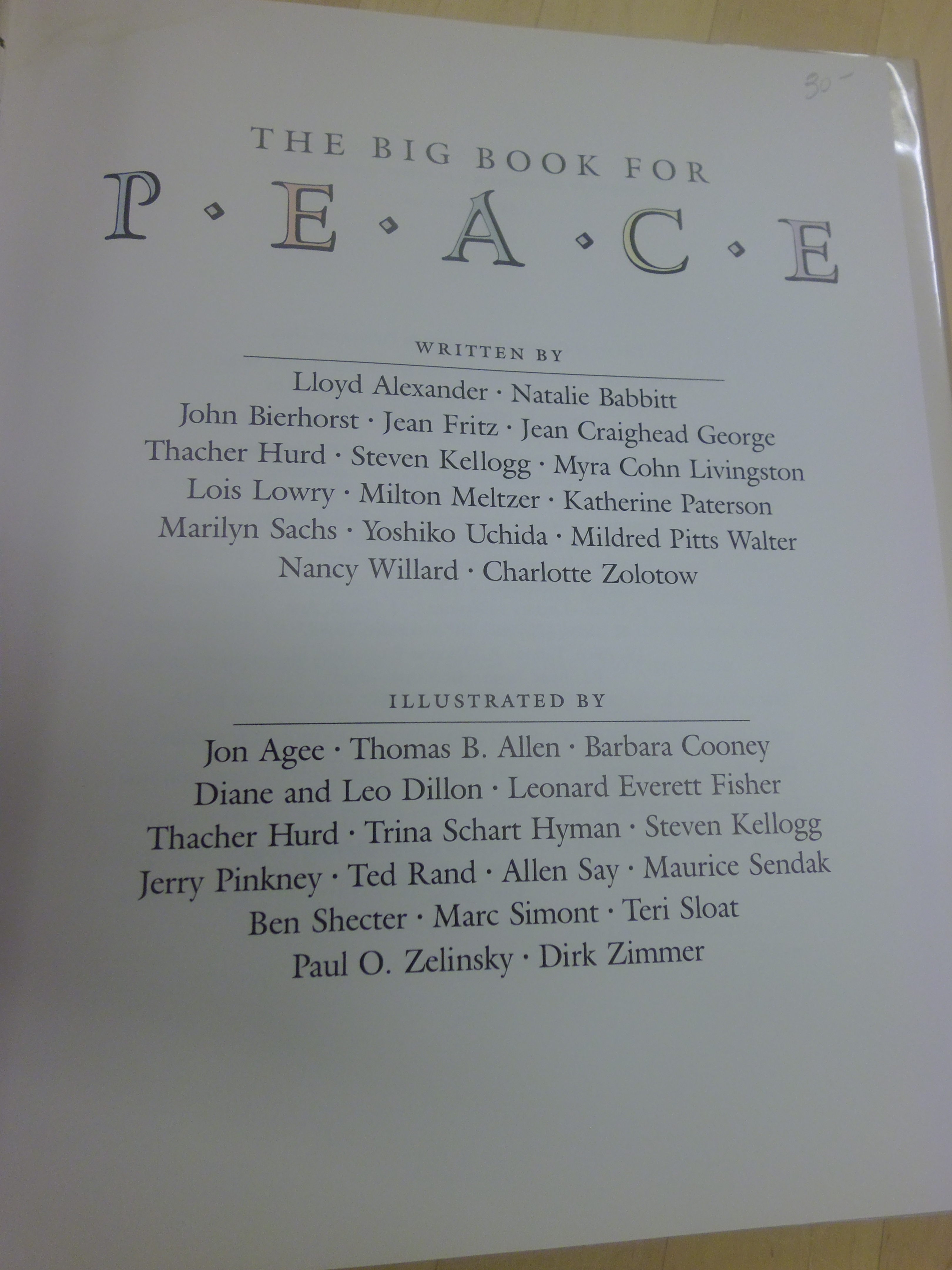
I’ve been eying this for awhile now. It’s been perched on display in the kid’s section at Good Books in the Woods for months now. Why has no one picked it up? Why is no one buying this. It’s in a nice slip cover, it’s been taken care of. There’s some slight water damage that – as a book collector – I see no problem with, it’s ever so slight and does not take away from the magic of the book. It’s a nice, clean copy. It’s only $12.
I know why I haven’t purchased it – I’m completely overloaded with books AND have NO money.
But that doesn’t mean I’m not going to read it until someone else does decide to take this treasure home.
So today, I sat down with the kiddo, in a bookstore, in another person’s home – and my home away from home – and read her the first story in the book.
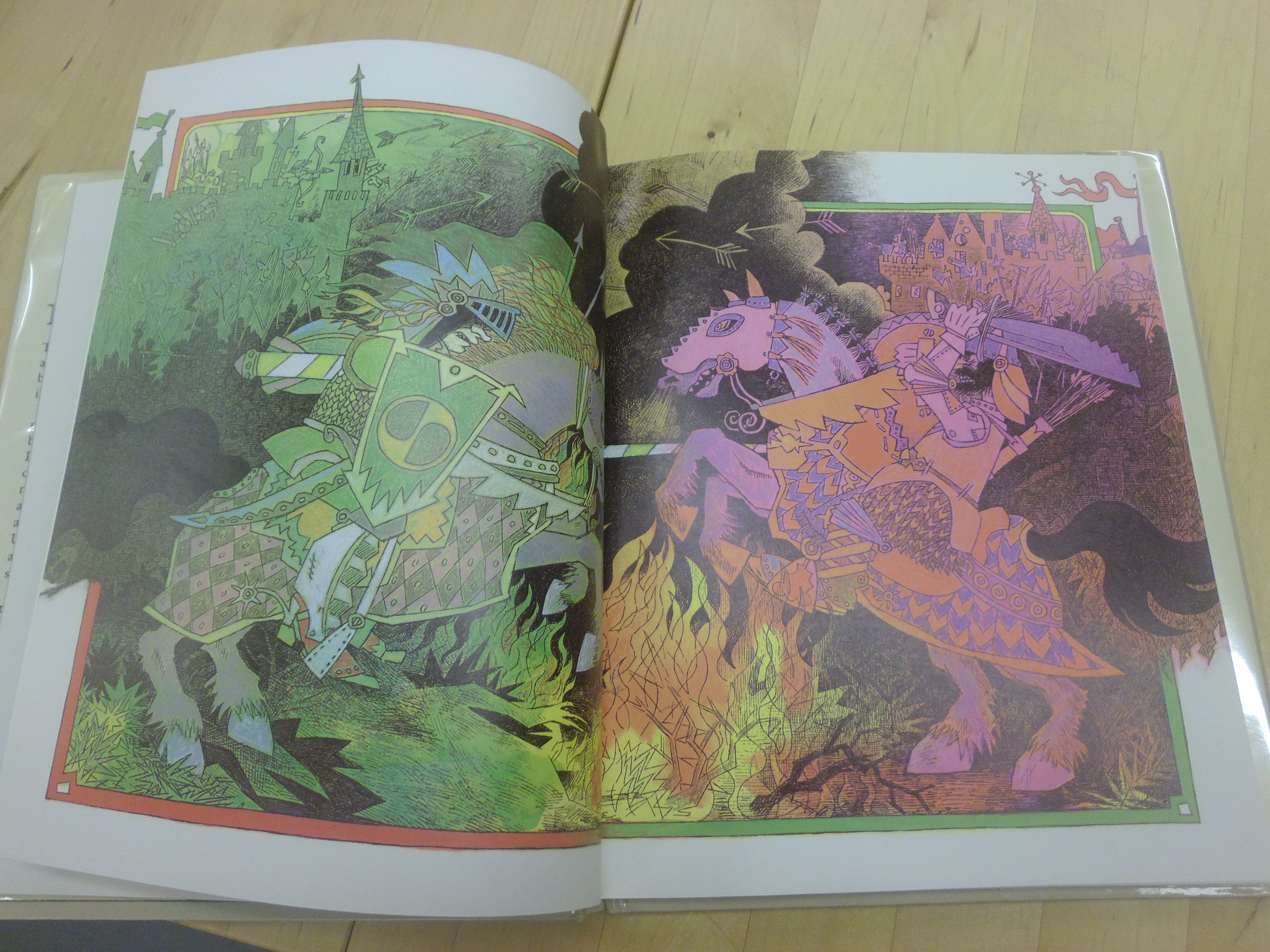
 Filled with castles and kings as any good Lloyd Alexander story should be, The Two Brothers follows a tale of two men who split the kingdom their father left them in half. From the rubble of the fortress they grew up in, they build two separate castles. What begins as a sweet story between the kindest brothers ever evolves into a competition of who can build the better kingdom, each man filled with greed and a medieval ‘keeping up with the Jonses’ mentality.
So many times, the reader can see where each brother makes an unwise choice, continuing the bitterness. Until we arrive at this lovely illustration, which my camera has done little justice:
This story was kiddo approved (she’s three, but it is a nice tale for any age). I look forward to the next chapter of The Big Book of Peace.
In Response to Book Riot – A Bella Swan Post

Kristen Stewart, actress, as Bella Swan in the Twilight Saga movies
Many moons ago, I posted this.
Today, I read this.
Of course, I have something to say about it all… of course.
So here it goes:
Of course we envy Bella’s apathy. Of course we wish we could float through life allowing everyone else to make decisions for us. Of course. Why? Because it’s simple. It’s easy. You are not responsible for your actions if you’re merely a reactor, if you function by being completely nonfunctional – always being taken care of.
Ruminate on that thought. Embrace it. Now revisit Bella’s story…
What if Edward had become an abusive drunk? What if her friends were not so nice or trustworthy? What if all these fabulous adventures she just allowed to happen to her throughout the series, what if all this apathy, had come back to bite her in the butt? Being a helpless twat doesn’t sound so awesome anymore, does it?
Ultimately, we like Bella Swan because everything worked out for her. Her personality and choices are acceptable because there is a happy ending. Put the same traits on someone with a not-so-happy ending and we’d blame them, shake our finger at her blatant disregard for taking care of herself and heeding wise council.
I appreciate this Book Rioter’s post about changing thoughts and opinions on a character. I appreciate that she identifies with Bella Swan, that she envies her in some ways. That’s her right and the beauty of books – everyone gets a little something – take what you like and leave the rest.
 But me as a teenager, I think, would have found Bella just as repulsive a character as I found when I read it as a married adult. Mainly because she was disobedient, a poor student, and was relying on the love of her life to scoop her up. All things that a teenager probably *wants* to do, but as a teenager (more so than as an adult), I did not allow this line of thinking in myself because I saw time and time again in others how self-destructive it could be when life spun out into the wrong direction.
I was blessed enough to actually marry the boy I loved in high school – a lot of people I knew did – but I wasn’t counting on this. There is nothing wrong with being in love. There is no shame in the desire of your heart to ultimately be a wife and mother. I don’t knock that one bit. But please, please, prepare for another scenario.
Be the best student you can be. Train for something – learn a trade. Be capable of paying your own bills and keeping a roof over your own head. That is something that I didn’t get from Bella Swan, not in the slightest, not one bit. Bella Swan expected her fantastical boy to sweep her off her feet and had no secondary plans. This, ladies and gents, disturbs me, no matter how much I, too, may envy her apathy at times.
You don’t have to be a control freak to take control of your life and your future; and you don’t have to be apathetic to fall into the desires of your heart.
Literary Journal Mondays

Remember the zine movement? (No? Visit Snapdragon Zine Fair) Ah, the 90’s and early 2000’s. Except that’s not where it started. No, it began long ago, and still goes on, in Literary Journals.
 McSweeney’s Quarterly Concern comes to mind.
But do you remember Granta? (or Paris Review, or Soho Square, or The Quarterly, or countless others?)
My eyes tend to rest on Granta when I’m in a bookstore. Such colorful spines… printed by Penguin.
Today, #24 Inside Intelligence pops out at me… “Her Majesty’s Government does not want you to know about the life of Anthony Cavendish,” the cover reads. There’s a huge circular stamp in the bottom right corner: BANNED IN BRITAIN. How do you pass that up?
What follows is a spirited and creative journalistic effort to share news in the form of intelligent literature. Photographs and interviews you wouldn’t get in a newspaper, writing worthy of Pulitzers (and sometimes even written by Pulitzer winners). Just in Granta #24 alone, Philip Roth, Peter Carey, Tobias Wolff, Bruce Chatwin, and E.L. Doctorow all grace us with their presence.
The world of literary journals is a fascinating and amazing one that goes back centuries.
 Paul Collins wrote an essay called “121 Years of Solitude” for Bookmark Now about his own journeys through a literary journal called Notes and Queries: A Medium of Intercommunication for Literary Men – a weekly magazine from the Victorian era. Collins’ memoir-like essay of his time spent in the Portland, Oregon library is one I dive into regularly, envious of his access and ability to take time to develop a daily library routine. Bus rides downtown, coffee, grand staircases, Notes and Queries, the entire endeavor sounds heavenly to me.
I don’t have time in my life – or the ability, as a mom of a three year old – to replicate a similar endeavor right now. But, the idea of taking an extra 30 minutes to an hour each Monday to peruse a literary journal that graces the shelves of my existing Monday routine (Good Books in the Woods) sounds plausible.
So here’s to Literary Journal Mondays – may they be more consistent than my Weekly Low Down of Kids Books (which happens sporadically throughout most months instead).
Finally, Part Three

Yep, still talking about this.
I finished Committed last night just before bed. I let it settle in my mind. I avoided circular obsessive thoughts about it – circular, obsessive thoughts are usually how I handle most things from something someone said that day to mortgage payments to the last few sentences of whatever book I have just read (thank you, Codependent No More).
Amazing how I was able to sleep when I took some deep breaths and let it go. I’ll think about it tomorrow. I never tell myself I’ll think about it tomorrow. I always just think about it until tomorrow. This typically evolves into some kind of extreme emotion by morning – what Gilbert quotes the Gottman’s as calling “flooding.”
That being said, I don’t have any stunning perspective or revelation now that I have finished the book. I merely have some quotes that struck me as notable. So notable that I didn’t just underline them in the book like a maniac, I actually copied them down into my journal.
“My mother herself had probably given up long ago trying to draw tidy ultimate conclusions about her own existence, having abandoned (as so many of us must do, after a certain age) the luxuriously innocent fantasy that one is entitled to have unmixed feelings about one’s own life.” – pg. 201, Committed
Me of excessive and obsessive thought who feels passionately one way or another on almost EVERY topic found this relieving. Lately, I have felt passionately about opposing thoughts – as in I feel BOTH sides passionately and have felt that this means there is something wrong with me. Apparently what I have seen as the ultimate sin – a conflict of beliefs and ideas and feelings – are just the growing pains of adulthood.
“If there is one indignity I shall never endure gracefully, it is watching people mess around with my most cherished personal narratives about them.” – pg. 206, Committed
Yes! This enrages me! And that is ridiculous. Gilbert may profess to never endure it gracefully, but that is definitely an aspect of my character I want to learn to change. It was roughly around this point of my reading that Annie Lennox started singing “Fool on the Hill” with Paul McCartney in the front row of the audience on TV and I decided that there will be sins I can’t kick, feelings I can’t change, that I will take to my grave. But enduring other people being themselves, even if it is not how I view them, gracefully is something I would like to be able to do sometime. The thoughts and the song and Annie Lennox may be unrelated, but forever in my mind they will be synonymously seared into my brain… don’t be a fool, summon your grace.
There was also a bit about porcupines that intrigued me. It’s a blurb Gilbert writes about another author’s work, Deborah Luepnitz’s Schopenhauer’s Porcupines:
“[…] Arthur Schopenhauer told about the essential dilemma of modern human intimacy. Schopenhauer believed that humans, in their love relationships, were like porcupines out on a cold winter night. In order to keep from freezing, the animals huddle close together. But as soon as they are near enough to provide critical warmth, they get poked by each other’s quills. Reflexively, to stop the pain and irritation of too much closeness, the porcupines separate. But once they separate, they become cold again. The chill sends them back toward each other once more, only to be impaled all over again by each other’s quills. So they retreat again. And then approach again. Endlessly. ‘And the cycle repeats,’ Deborah wrote, ‘as they struggle to find a comfortable distance between entanglement and freezing.’ ” – pg. 223, Committed
I read that and immediately thought of heroine and addiction. No, I’m not a heroine addict. But I’ve seen them in action. And if I’m to be honest I have a tendency to feel like one in regards to the people I care about the most – all of whom I can count on fewer fingers than I have on one hand.
Gilbert’s book is lovely. I’m sorry I sharked her memoir and made it all about me. I hope if she ever stumbles across this blog, she will take it with a grain of salt and not see me as a pirate of some kind. I recommend reading this book, regardless of what you thought about the more famous Eat, Pray, Love.
If I’m to get one over all message from ALL of my reading this weekend/ week, it is this:
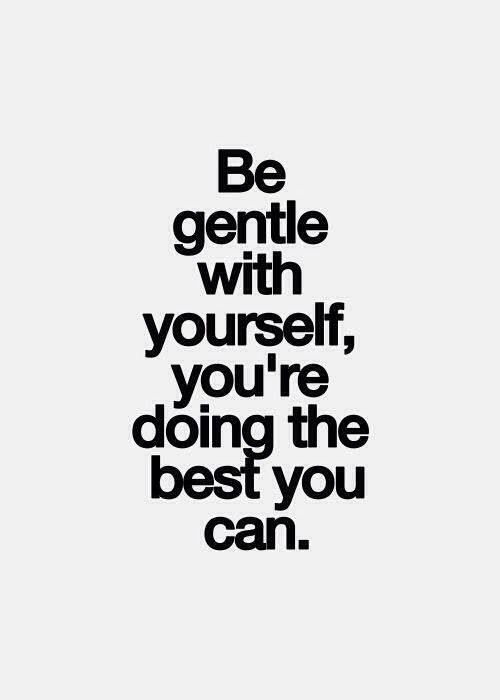
I really needed to get this message.
Things I Learned in a Weekend…
… But will take longer to undo.
This is a Part Two post to my review of Committed as well as a response to Codependent No More.
Saying “I am not in control of that” is not the same as being helpless.
Counting is not productive.
Trying harder sometimes doesn’t offer results, but rather drives you a little nuts.
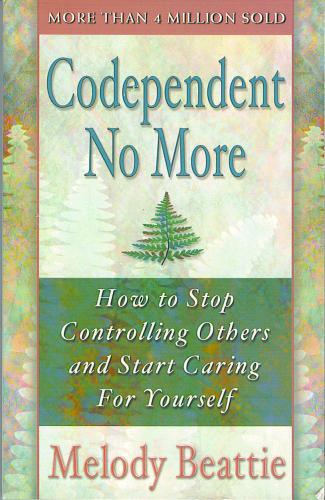 I am allowed to have contradicting feelings as long as I am honest about both and do not bury the less favorable/ moral one. A feeling is not a decision. But bottling feelings and under-reacting to things that hurt your feelings can turn into a very foolish and very public behavioral issue similar to a train wreck or a volcano that kills an entire village.
“What am I to conclude when my grandmother says that the happiest decision of her life was giving up everything for her husband and children but then says – in the very next breath – that she doesn’t want me making the same choice? I’m not really sure how to reconcile this, except to believe that somehow both these statements are true and authentic, even as they seem to utterly contradict on another. I believe that a woman who has lived as long as my grandmother should be allowed some contradictions and mysteries. Like most of us, this woman contains multitudes. Besides, when it comes to the subject of women and marriage, easy conclusions are difficult to come by, and enigmas litter the road in every direction.” – from Elizabeth Gilbert’s Committed.
I can’t control other peoples’ thoughts and feelings. Nor, if I’m to be honest do I want to. What I decide for them takes away from me making healthy decisions for myself.
Other people making a decision I do not like is not a slight on me as a human. I am still in tact. I can say my piece in peace without expecting them to bend to my will. In fact, I want to enjoy the freedom of talking out my feelings knowing that it does not change the outcome of life. My words won’t make or break the world and the people in it. I am not that powerful. I don’t want to be that powerful. I want other people to feel comfortable making their decisions based on what they need. Would I like for them to consider my feelings when they choose to follow that decision? Yes. Do I want my feelings to be the basis of their decision? No. God, no.
What I want and what I need are allowed to be out of sync sometimes, as long as I take time to process my wants and needs in a calm manner without panic – without drama – and without superfluous descriptions. As a writer I am apt to take a small situation and find the epic, extraordinary, or devastation in it. As a survivor I take big things that may actually be epic, extraordinary, or devastating, and belittle them – act as though they are nothing. (Someone dies, I roll with the punches. Someone says something irritating, I come out swinging. It doesn’t make sense. It has been a long running joke among many of my friends that I’m the girl you need at a funeral. I’m the girl you need in a physical crisis, on the battlefield even. Put me in a room of people having a good time, and suddenly I’m twitchy.)
These are things I used to know, and for various reasons, I have lost sight of. These are things that I need to remind myself daily, if not hourly.
So my newest truth above all – there is no shame in reading self-help books and memoirs by people who have a very different world view from yourself. There is no shame in believing that, “this woman should not be condemned or judged for wanting what she wants.” In fact that’s a very beautiful belief.
Finding balance is the hard part. When does what you want step on what someone else wants and needs? When does what you want need to be suppressed and when does it warrant being spoken? My understanding of this balance is erratic at best.
Making a very open attempt to find this balance has been interesting too (I say this as though I’m well seasoned at the effort that I’ve been making for a whole of four days). I am diving into all this for myself. Go back a few blog posts and you may notice my sanity attempting to escape me. Yet, it hasn’t just begun to calm me, it’s helped me stop and smell the roses.
Roses that, though not real physical red petals and thorny stems, are more present than I supposed.
Roses like: I actually get more done when I am busy acting instead of busy reacting. Roses like: when I attempt to be as direct as I once was my husband attempts to woo me like he once did. This is nice. I’ll take that rose. Yet, I am not being direct so that he will woo me, I am being direct because I need to be, the wooing is just a happy accident. And, for once, wanting to be wooed doesn’t sound like an act of selfishness – it sounds like an act of being feminine. Yes, I’ll admit that typing those words were difficult, that in that admission I nearly panicked.
I don’t have all the answers. In fact, I have pretty much no answers. The only answer that I do have is that I hope to be less self-destructive this year than last year. I hope to be more open, but less vulnerable.
This year, I plan to internalize something that’s been hanging in my own Grandmother’s kitchen my whole life…
God grant me the serenity To accept the things I cannot change
Courage to change the things I can
And wisdom to know the difference.
Be patient with me, God is not finished with me yet. And, I’m not done reading this book!
Committed – Part One
Title: Committed
Author: Elizabeth Gilbert
Genre: Non-fiction of some kind. In a bookstore it would go in the memoir section, I’m sure – but it’s so much more than that.
I’m aware that when one decides to follow a book reviewing blog, they don’t expect the posts to start turning into self-aware sob stories. However, I cannot fully digest a book without it becoming part of me and my psyche and putting a little bit of pressure on my world view and myself.
When I read Eat, Pray, Love a few years ago, you may or may not remember my indignation. I was so irritated. This woman was so flippant! How dare she walk out on her marriage and go gallivanting and call that spiritual growth! I loved Gilbert’s writing style, I loved her way with words, but all I could think was, “What a selfish whore.”
That was unfair. I see that.
I’m reading Committed now. A friend had told me Gilbert would redeem herself in my eyes in this book. I was skeptical. How could I ever see eye to eye with this woman?
But that’s the thing. I don’t see eye to eye with her. But now, I’m ok with that. Not because of this book, though, I’m sure that helps; but because of me. I’ve come to realize some things about myself in the very short time that it has been 2014.
I have a very intense moral code. So intense, it is probably filled with much higher expectations for life than is humanly obtainable. Stepping outside of this moral code in the past has left me trembling. It terrifies me, because, simply:
I fall short. It is impossible to live up to it.
I expect others to live up to it. If we all strive to live up to it then maybe we can have a chance in hell of making it.
We don’t.
I see this now.
Yes, that makes me a hypocrite, I suppose. Often.
Yes, that means that deep down I hate myself for not being able to live up to my beliefs. Even saying this is in contradiction with my beliefs… I believe the whole bible to be true and even the bible says that we all fall short of the glory of God. I believe in being a strong, independent, secure human. Both of those things are in contradiction with me hating myself for falling short.
You see, it’s not just me being unforgiving of others. I am completely unforgiving with myself too. Especially when what I perceive as truth, and what I believe is right, is the polar opposite of what I want.
I was taught that my wants were frivolous nuisances to be disregarded. Bury them. Pretend they’re not there. Doing what you *should* do is far more important than doing what you want. Wants are things that destroy people, families, cities, empires. Look at history – use your brain. Don’t feel, use logic.
Somewhere in that teaching, there’s a logical fallacy. Like Gilbert’s ice cream purchases correlating with drownings example – which made me laugh out loud. (Statistically where there are higher ice cream purchases, there are more drownings. Obviously, this does not mean that buying ice cream will increase your chance of drowning yourself, that would be a logical fallacy – yet, that’s exactly the kind of logic that has been ingrained in me.)
Now, 10 days away from 30, I feel a strong urge to fix this problem.
This is not something that can be fixed in 10 days.
Shockingly, despite my looming 10 day notice, I find myself a little at peace while reading Elizabeth Gilbert – author whose views I have previously found revolting – has spent page after page talking about forgiveness.
Things I have always been really cranky about – HOW does someone behave THAT way – she spells out. Instead of just saying, “It happens,” she takes great descriptive pains that only an eloquent writer could take to tell me how. To explain. Pages 108-110 left me in tears. Finally, I see why people have been so angered by my judgement. Finally, I see why I have no right to judge.
I was wrong. I’m sorry.
I’m not sure how this will effect my future decisions. But at least I can start to not hate myself, whatever they might be. Yay for mid-life crisis number two (and I’m not even mid-life yet, am I?).
I’m not finished reading yet, but I’m sure I will be soon. I have so much to say and think about this book and there will be a second post on it in the future.
Scoffing No More
Title: Codependent No More
Author: Melody Beattie
Publisher: Hazelden
Genre: Self Help/ Addiction & Recovery
Length: 250 pages
When I worked in the bookstore full time, shelving, there was a brief few months that I ran the psychology section. I had become territorial over the fiction/literature section – my dream job if I’m to be honest with the world, despite the simplicity that infers – and this was an exercise my boss had to help me let go. To learn something out of my comfort zone. The psychology section was waaaaaaaay out of my comfort zone.
Being raised a Christian, there were some very un-Christ-like biases and stigmas surrounding that section. These biases were mostly self-righteous scoffing. Especially towards titles exactly like Codependent No More. I remember thinking, people should just stop being selfish whores and everything would be fine in the world.
Pretty sure, in hindsight, this was some very codependent thinking.
Whether you are a traditional codependent tied to a substance abuser in some way, an author looking for some insight into people and character development, or simply a breathing human – this book should be read. It opens your eyes to problems you might not know you have. It opens your eyes to problems I’m sure someone you know has – even if that someone is a psycho you wrote off ages ago.
Whatever your situation, whoever your person, this book is about peace. This book is about calming the anxiety and the panic and the anger issues. I wish I had read it much sooner rather than scoffing at it on the shelf.
Still Life
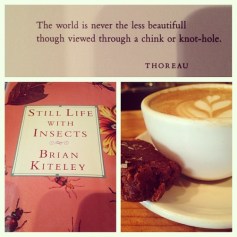 Title: Still Life With Insects
Author: Brian Kiteley
Publisher: Ticknor & Fields
Genre: Fiction
Length: 114 pages
“The narrator in this lovely novel may have set some kind of record for the longest, sweetest, fastest life ever lived. There are books twice as long as this one that do not tell us half as much about life’s wonder.” – Rick Bass
The thoughts I shared on Goodreads:
1. There are more reviews of this book under a misspelling of the author’s name. I have a first edition hardback from 1989 and wanted to honor the by line with the spelling that matched my book. So no, I did not read the e-book, but I do recommend purchasing it if you have an ereader.
2. I love his style. I will re-read this book because I feel like I should think it is amazing, but at this point in time with my first reading, I just liked it a lot. I think my amazement will come with another read through.
3. Something about the story Kiteley chose to tell reminds me of John Banville’s The Sea. The Sea won a Man Booker Prize and Banville is incredible. This should tell you something about Kiteley that (though an great writer in his own right) I will be filing him away on the same side of my brain.
Things I wanted to share here:
1. I’m really pleased with my first edition hardback. It was purchased for me as a gift by the wonderful Miss Golightly who I took shopping at Good Books in the Woods. I thought it was shockingly appropriate that they had so many first editions of Still Life With Insects, given the woodsy vibe of the whole store.
2. I look forward to collecting more of Kiteley’s work and I’d love to take a creative writing class under his teaching. I’ve been an aspiring novelist my whole life. I have my own novella currently out and a publisher wanting my next pieces. I’ve never taken a creative writing class and given the flaws in my novella, I think I would benefit from one greatly.
3. I’d love to re-read this book, as I stated in my Goodreads notation, but I’d love to read it for a book club. I think it would be well served in a group discussion among friends.


 Anakalian Whims