The Further Adventures of Mac McClellan!
 Title: Deadly Ruse
Author: E. Michael Helms
Publisher: Seventh Street Books
Genre: Mystery/ Suspense
Length: 237 pages
Retired marine, private eye, sexy girls, whiskey, drugs, diamonds, casinos, the good ol’ South… what more could you ask for in a genre crime novel?
I enjoyed my second adventure with Mac McClennan. Despite the self-depricating B-movie references to its own plot points, closing a Mac McClennan book always leaves me wanting more Mac.
Of course, Mac has women fawning over him and his older gentleman charm. His girlfriend can take care of herself, but still finds it in herself to swoon into a faint in the opening chapters. Our heroes tote guns, our villains are scum. It’s all around good, fast-paced fun set in the sun, with just the right amount of danger.
I look forward to Mac’s next adventure, since he’s on the verge of being an official P.I. now…
Work For My Words
 A Coffee Chat
After my phone call was declined:
I love you but every single human in my life is asleep right now I am not answering the phone and chancing a mass awakening hahaha.
My internet keeps crapping out and every other message I’m holding my laptop up to the mysterious signal like Rafiki lifting Simba to the sun on Pride Rock.
HAHAHA
I am a half a step away from chanting in Afrikans.
My words are worth it.
WORK FOR MY WORDS!
Kids Books You MUST Check Out
We’ve been spending more and more time at the library than usual. About 2-3 hours A DAY. Before it was every few days, but with this rain – in the tradition of Noah – occurring in the northern Houston area the past few weeks, we’ve been trapped indoors.
So these are our top favorites for the week:
1. Snippet the Early Riser – Bethanie Deeney Murguia (http://amzn.to/1cxqz9Z)
We adore the illustrations in this tail of a snail that wakes up long before his family is ready to start their day. In the book, you’ll meet a ton of different insects, and then finally discover the source of this family’s plight – Snippet just goes to bed way too early. It’s a common hazard in family’s with small children and I think most kids and adults alike will be able to relate.
2. When a Dragon Moves In – Jodi More (http://amzn.to/1cxqsew)
Again, the illustrations are fantastic! Kiddo loves the beach setting and the fact that dragons are actually moving into the kid’s sandcastle. She hasn’t yet caught the nuance that it’s this little dude’s epic imagination at work, but kiddo is – after all – only four.
3. When Rain Falls – Melissa Stewart (http://amzn.to/1bPVhdO)
This is soothing. And completely appropriate for our current household situation. So much rain and so many days when it merely threatens to rain, it was nice to read through how rain effects everyone and everything. We read this right before bed and in the middle of the afternoon several times. Lovely, lovely, book.
4. Freckleface Strawberry – Julianne Moore (http://amzn.to/1cxsknL)
This isn’t just one title, this is a series of which we have read two. Freckleface Strawberry is an adorable little girl with flaming red hair, completely covered in freckles. I relate to these books so well because I was the freckle-faced short kid in my class. Kiddo loves her “because she has so many freckles. And you know what I like best of her? She has a nickname!” Kiddo loves nicknames. Her cousins call her “Fruitcake,” her daddy calls her “Booger,” her tia Danielle calls her “Nugget.” I call her heathen, but that’s besides the point. Not really, I call her “Nugget” a lot too.
Justified
Title: Ape and Essence
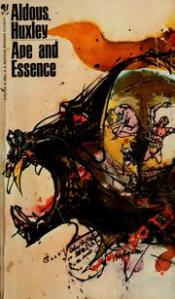 Author: Aldous Huxley
Genre: Fiction/ Literature/ Allegory
Length: 152 pages
Of the four Aldous Huxley books included on the 1001 Books You Must Read Before You Die list, is not one of them.
With good reason.
While I was reading I kept thinking, I like the concept, but I am aghast that this is the man famous for a book that millions are required to read for school. Not because there is anything bad about it… it’s just… really? This is the kind of stuff we want to force teenagers to read? It’s disjointed, surly, and… dare I say… a little boring.
The best moment, by far, was when I read:
‘Give back that ring.’
‘Which ring?’ the man falters.
At which point my nerdy self said to my book: “The one that will rule them all, duh!”
To be fair, the book that is typically required reading for students is Brave New World, not Ape and Essence. So, naturally, I had to do a bit of research before considering reading Brave New World, giving Huxley a chance to prove himself in my eyes. If I can’t stomach 152 pages of the man, why would I submit myself to more?
I feel justified in my disappointment, because as my kid sat and worked through a literacy program on the computer at the library, I consulted the Concise Dictionary of Literary Biography: Volume 6: Modern Writers 1914-1945, and read up on Huxley and this piece of drivel I had just plowed through.
There I read, “Aldous strained to pile horror upon cross horror… the book, it always seemed to me, achieves a high degree of unbearableness.”
There I also read, “most the characters and ideas come from a discount Huxley warehouse.”
Deep sigh of exasperated relief. I don’t have to like this book. Thank God.
Mikhaul Bakhtin described Huxley’s work as the “Canivalesque Novel.” Others in this category would be Rabelais’ Gargantua and Cervantes Don Quixote. These novels are known for “emphasizing inclusion rather than selection” and are “structured like a ‘plate of mixed fruit.’” They are known as the anti-novel.
Sheldon Sacks, on the other hand, considered Huxley’s work as apolgoues, like More’s Utopia, Voltaire’s Candide, and Johnson’s Rasselas… fictions structured as persuasive arguments. (For the record, I am basically paraphrasing – and point blank quoting – the CDBLB!)
The title for Ape and Essence was taken from Shakespeare’s Measure for Measure, when Isabella says:
Could great men thunder
As Jove himself does, Jove would ne’er be quiet,
A sFor every pelting, petty officer
Would use his heaven for thunder;
Nothing but thunder! Merciful Heaven,
Thou rather with thy sharp and sulphurous bolt
Split’st the unwedgeable and gnarled oak
Than the soft myrtle: but man, proud man,
Drest in a little brief authority,
Most ignorant of what he’s most assured,
His glassy essence, like an angry ape,
Plays such fantastic tricks before high heaven
As make the angels weep; who, with our spleens,
Would all themselves laugh mortal.
Again, I have not read Brave New World, but I come away with the overpowering sense that perhaps it is easier to digest because, like the CDBLB says, Brave New World is about what could happen; Ape and Essence is presented as something that probably will. Ape and Essence leaves you with nothing to hope for, and in a world full of agony – hope is vital. The whole book is about how “faith in progress has led to outright regression,” and the book ends with an egg being cracked over a gravestone.
A society so driven by perfection and stamping out rebellion and evil that they have destroyed everything. They do not have the hope and insight of Steinbeck when he wrote in East of Eden, “And now that you don’t have to be perfect, you can be good.” Instead, everyone strives for perfection until they’ve essentially destroyed themselves and everything around them. They’ve destroyed the world’s ability to think and grow.
Ape and Essence is the most depressing piece of near-satire I’ve ever encountered.
The man himself, however, had some awesome things to say on the nature of writing. Many people read his novels and were irritated by finding mirror images within some of his characters. After a few lost friends he responded,
“Of course I base my characters partly on people I know – one can’t escape it – but fictional characters are oversimplified; they’re much less complex than the people one knows. There is something of (John Middleton) Murry in several of my characters, but I wouldn’t say I’d put Murry in a book.”
I could not say it better myself. Characters may seem a bit like this person or that, but never, never is any fiction that I write in any way biographical. So even though I did not care for Ape and Essence, I came away from researching Huxley fulfilled – and justified.
The Best Dystopian Novels Written Before Orwell’s 1984
What an awesome list!

10 interesting works of dystopian fiction that predate George Orwell’s Nineteen Eighty-Four
George Orwell’s Nineteen Eighty-Four (1949) is perhaps the most famous dystopian novel in the world, with the adjective ‘Orwellian’ being listed in the Oxford English Dictionary and the phrases ‘Big Brother’, ‘thoughtcrime’, and ‘newspeak’ being part of the language. But Orwell’s classic novel didn’t arise in isolation, and there were a number of earlier dystopian novels written before Orwell put pen to paper (or finger to typewriter). Here is our pick of the ten best early dystopian novels worth checking out. Okay, so they’re not all novels – there are a couple of short stories in here too. But then variety is the spice of life…
View original post 1,092 more words
A Fragrant Universe
 Title: Pheromones and Animal Behavior
Author: Tristram D. Wyatt
Publisher: Cambridge University Press
Genre: Science / Animal Communication
Length: 391 pages
“[…] one doesn’t realise how much ‘savor’ is smell. You smell people, you smell books, you smell the city, you smell the spring – maybe not consciously, but as rich unconscious background to everything else. My whole world was suddenly radically poorer.” – O. Sacks, The man who mistook his wife for a hat
So completely fascinated with the human scent and sense of smell this month, I picked up a textbook on pheromones at the public library.
What I’ve learned is that I can read up on everything there is to know scientifically about ones sense of smell and how they use it, but I still won’t completely understand all the nuances of how that affects interpersonal communications. Correction – I understand how, but not why it affects us so completely.
Having this knowledge of the how should enable me to shut it off when it does not suit my emotional well being, right? After all, knowledge is power.
No. We, as humans, are too complex for that. (Or simple, depending on how you look at it.) Our emotions can even heighten our perception of these smells, tie that to menstrual cycles and memory and we’re pretty much screwed to always have knee jerk reactions to certain scents whether we like it or not.
Even Wyatt states in the closing chapter of his textbook:
“One of the major challenges to human pheromone research is that of designing rigorous experiments that eliminate other cues and variables. As well as the complexity of odour that being a mammal brings, humans are also complex emotionally. This makes us doubly difficult as experimental subjects.”
I absolutely adore the smell of a well cared for old book. But the effect that beautiful freshly cut grass mixed with vanilla, a tinge of dust, and leather has on me can be overwhelming or something I barely note in passing, depending on the mood I’m already in.
All this sensory awareness just reminds me of a John Oehler book I read awhile back, Aphrodesia – and led me to finally committing to pick up the book Perfume by Suskind (which I haven’t done just yet, but will soon). People have been talking about it for years, I’ve been shelving copies of it at the bookstore in droves for as long as I’ve worked there. It’s even on the 1001 Books to Read Before You Die list, but I don’t read the books on that list merely because they are on it – I try to let those titles come to me organically via other means of gathering more books for my TBR pile. All of these things in Suskind’s favorite, but his work never really moved me until now.
Fibonacci
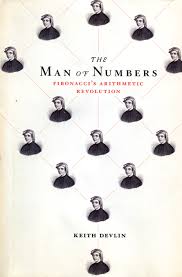 Title: The Man of Numbers
Author: Keith Devlin, PhD
Publisher: Walker & Company
Genre: Math History
Length: 183 pages
Swirl by Swirl – a child’s picture book – is where it started. We checked it out from the library once, then twice, and finally again and again. It’s about the Fibonacci sequence found in so many spirals in our natural world. We love it. Of course, it has a bit in the back about the Fibonacci sequence and the math involved, and that’s cool too, something to instill in young minds so that the re is familiarity with the topic before they begin Algebra in their tweens.
Of course, at some point I picked up The Pythagorean Theorem, and there Posamatier mentions Ptolemy and his great work The Algamest as well as Fibonacci’s Liber Abaci. Naturally, I requested these at my local library. “There’s a book about Fibonacci called The Man of Numbers that’s here if you want to read that while you wait for the others to come in,” she told me. Yes, yes, I would like to read that while I wait for the others.
I checked it out.
I ended up starting and finishing it, however, in one sitting while my kiddo made use of the sixty minute literacy computer session I allow her if she’s been good prior to coming to the library that day. It was good. Quick. Informative. And of course, just made me want Liber Abaci even more.
Devlin gives you all the necessary history in the concise nature of a mathematician. He even laments how most mathematicians are concerned about the math and the theorems and not necessarily who originally came up with them or their history, causing much of the history surrounding mathematical ideas to be lost or misconstrued. Who cares? It’s about the numbers.
I care. Historians care. We don’t care as much about the numbers as we do about the theory, the philosophy… we care about math’s heritage more than the practice of being all mathy. At least that’s how I feel. I’ll leave number crunching to my husband and daughter – I’ll just be able to tell them who came up with that particular way to crunch.
With all this caring comes the discovery that Fibonacci’s name wasn’t even Fibonacci. Devlin recounts the fact that the man’s name was Leonardo and he hailed from Pisa. Leonardo Pisano, as the people of that time and culture would say. But he referred to himself as fillies Boracic, “son of Bonacci.” Yet, his father’s name wasn’t Bonacci, so people assumed he meant that he was of the family Bonacci… the Bonacci family evolved and later historian Guillaume Libri coined the name Fibonacci. Hundreds of years later. Leonardo was renamed Fibonacci in 1838.
Fibonacci also referred himself as Leonardo Bigolli… a named once translated would be “Leonardo Blockhead.” Though, Devlin asserts, it’s doubtful that Fibonacci was calling himself a blockhead.
 That brings us to our latest picture book selection… Blockhead: the life of Fibonacci. This delightful picture book was written by Joseph D’Agnese and was illustrated by John O’Brien. Even though there’s a lot we don’t know about Fibonacci’s real life or how he came to discover his mathematical findings the way he did – it’s fun to imagine what his life was like and where he might have come up with his self-proclaimed nickname “Bigolli.”
For good measure, we re-read Swirl by Swirl afterward and are looking forward to memorizing a few things in the upcoming months.
The first is from Brahmagupta (quoted in Devlin’s book):
“A debt minus zero is a debt.
A fortune minus zero is a fortune.
Zero minus zero is a zero.
A debt subtracted from zero is a fortune.
A fortune subtracted from zero is a debt.
The product of zero multiplied by a debt or fortune is zero.”
The second are the first ten numbers in the Fibonacci sequence: 1, 1, 2, 3, 5, 8, 13, 21, 34, 55.
The Curious Origins of Tweedledum and Tweedledee
I love factoids like this!
Interesting facts about the surprising history of Tweedledum and Tweedledee
Who is being described? Born in the north-west of England near Manchester, he was a literary man who was also noted in his day for his interest in science and mathematics. In terms of physical appearance, he was known for being particularly tall, considerably taller than average. He gave us Tweedledum and Tweedledee, pioneered a system of code-writing, wrote one of his most famous works for a young girl, and appears to have had an interest in the occult.
The above may sound like a description of Charles Dodgson, better known as Lewis Carroll, but in fact
View original post 518 more words
Adventures in Freelancing
I was scouring the internet looking to see what Cosmo was all about. I’m a freelance writer, I should know these things. Also, I was submitting an article to them after receiving an ad for blog contributors. Of course, I had to consult my college room mate, that’s what gal pals are for, right? “I have no idea what I’m doing…” She read what I wrote, checked it for grammar, and helped me pick my already published content to include on my Cosmo tailored resume.
After I hit send I messaged her, “I did it. I sent it. That would be cool if they picked that up.”
“Agreed,” she responded, “Then I could finally learn YOUR 19 Top Secrets To A Hands-Free Female Orgasm.”
- Like the person you are having sex with – or don’t, sometimes that helps too.
“Both work with my husband,” she piped in.
2. Take a bath and shave your legs. This is an important step to remember when you are over 30 and have children. Or, you know, don’t – if you’re a dirty hippie, get off on the smell of human grease, and think hair friction will truly light your fire.
“Hair friction can help at times, yes. Continue…”
3. Despite all your favorite chick-flicks – don’t order Chinese food in advance. All that fried goodness, fried rice, and MSG will just make you feel gross. You will not have the appeal of a genetically blessed tiny acrobatic Asian after you order Chinese food. You will instead have sweet and sour sauce drippage down your right boob from where you almost lost the chop sticks. You will feel fat and bloaty after *so much* rice, and, to top it all off, you’ll smell like shrimp rolls and crab puffs.
4. Make sure all the children are asleep, or completely preoccupied. Nothing is worse than that ten minute quickie turning into, “But mommy, why can’t I come in? Mommy, I need another fruit pouch. Mommy…” Knock. Knock. Knock. “Mommy…”
“Basically,” my husband says as he reads over my shoulder, “You’re saying people should have sex with somebody.”
“Yes. Of course.”
5. Have sex with a human.
“Yes, hands free otherwise implies non-masturbatory. You’re welcome, Jonathan,” my Emily says to my husband.
“This article is not Cosmo material. You’re supposed to be talking about leading people in the direction of using hands-free toys. Like using a sub-wolfer. Or, rubbing your vagina against a fence post,” my husband continues to say.
I have no idea what he is saying to me right now. I don’t want to get off on a radio… I want to have sex with a person.
“Number six needs to be drive a shitty car with old shocks down a shitty road,” he tells me.
I’ve done that. That works. It was accidental of course.
6. Drive a poorly maintenanced junker.
“Does hands free include my hands? I’m just wondering what your requirements were for hands free,” my husband is way too into this.
7. Use someone else’s hands.
We can explore all our options later…
Pythagoras, History , Music, and Reality
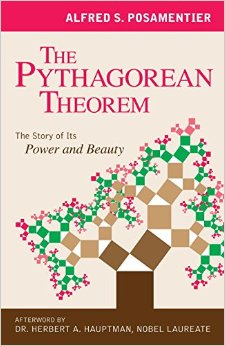 Title: Pythagorean Theorem
Author: Alfred S. Posamentier
Genre: Mathematic History
Publisher: Prometheus Books
Length: 320 pages
I’m not sure why I picked it up. I didn’t even particularly care for math in school. Geometry was not my strongest suit – but it was fairly easy math that I slithered through with the least possible amount of effort of any of my math courses. But I was at the library one day and this geometric tree design was staring at me – I’d been collecting everything I could on trees because I am determined to become a certified arborist by the time I turn 40 – and upon impulse I through it in my “shopping” bag.
It might have been because I saw that it was about the Pythagorean theorem, and just a few years ago I attended a MENSA meeting where Andy Tang spoke on the topic. The lecture was riveting, the discussion entertaining, and the wine pretty great for free stuff. The event coordinator in me wanted to host his art exhibit at one of the bookstores I work with. This didn’t happen, but there was such an exhibit led by him in Austin:
The community art exhibition “Pythagoras (and Austinites) Discovering the Musical Intervals” invites you to discover the story of what Pythagoras heard at the blacksmiths’ workshop. Continuing the tradition of passing down this ancient tale, this art show showcases Austin-area artwork through interactive, musical, and visual interpretations. (https://www.facebook.com/events/308042019293116/)
Whatever it was that possessed me, I picked up the book. I read the book. I enjoyed the book – a lot. More than I could have thought I would enjoy a math book.
Although, let’s be honest, I enjoyed it for the philosophy and history, not so much for the endless diagrams and presentations on how the theorem works. Yeah, yeah, yeah, I took that math class, I get it, and it’s cool, but I was really into the book for the tidbits about Fibonacci and then later, Bosman. Bosman, by the way, is the guy that came up with the Pythagorean tree featured on the front cover.
I read this book for the whole chapter on music – that ties into that Andy Tang lecture I loved so much. I read this book because I was a “Choir Queer” in high school and loved chamber music and found it completely fascinating how much math and music were so intertwined. And of course, any one who does math and attempts music theory ends up asking the same questions:
“[…] do we simiply measure the distances between pitches or do we seek some measurable property of the pitches themselves that allows us to determine their relationships to other pitches […]”
Pythagoras had an answer. And he’s an old, dead dude, and I love reading ancient history and things on or by old, dead dudes. Except, naturally, Pythagoras was a top secret kind of guy and left no writings of his own behind and everything we know about him is second hand at best.)
Which leaves me diving into Philolaus, Plato, and Aristotle, and itching to get into Xenophon and see if anything is mentioned there because Herodotus didn’t spend nearly enough time on him.
I read this book thinking about Alyssa Martin’s Pythagoras cake bust. She owns The Martin Epicurean – and cake that looks like a face – how cool is that?
I read this book because I will pretty much read anything, but especially because I love science more than my student transcripts could possibly portray – mostly because I avoided science courses like the plague. I like the philosophies of science and concepts… I don’t care for the formulas and the math, but I’ll learn them ok if there isn’t any testing. Oh God, my test taking anxiety is insane… but reading up on it all, I love that. After all, it suits my passions:
“Science is the discipline that attempts to describe the reality of the world around us, including the nature of living organisms, by rational means.” – Dr. Herbert A. Hauptman, Nobel Laureate
This one is a keeper. I checked it out from the library, but I plan to purchase it when it comes time for kiddo to read it. It’s an educational must-have.





 Anakalian Whims