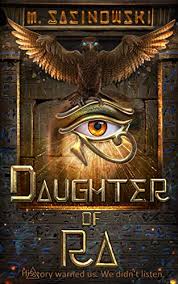
Heir of Ra – Book Review

Ancient Egyptian artifacts, conspiracies, 10,000 year old biological nanotechnology… hand me my tin-foil fedora and “follow me, I know the way!” This book is FUN.
Heir of Ra is an action packed thriller, merging archeology, science fiction tech, and the mysteries of ancient Egypt. As an amateur historian (without a degree in the field to speak of) and wanna-be Egyptologist, the premise excites me to no end; but I’m not going to lie, I kept wanting to picture various characters as the “hair guy” with the bad tan on Ancient Aliens. In the end, though, Sasinowski’s writing shines through and doesn’t allow for that.
Although the book is categorized as young adult, the gentle nods to Edgar Cayce and vague feel of Frank Herbert’s White Plague, it seems like something more suitable for older, tired, adults with an hour or two to kill. Sure, the driving relationship is between a father and her young adult daughter, but I’m hesitant to restrict this title to the younger corner of a bookstore. Instead I want to share it with the Amelia Peabody and Lara Croft fan bases – which in theory should not be the same people, but there’s a Venn diagram for everything and Heir of Ra lands in this one’s center.
Still, it’s quick to draw in mythological sources to a modern day page turner, laced with a twinge of humor – not too far off base from a Rick Riordan series, just a little more grown up while staying appropriately clean.
I look forward to the inevitable screenplay and movie release.
To purchase: https://www.amazon.com/Heir-Ra-Blood-Book-One-ebook/dp/B07GDSK23D
P.S. The sequel was just released in June!
Gilgamesh
If you’re studying ancient history in chronological order, sometime after you’ve read the Book of Genesis, it’s really fun to dive into Gilgamesh. Gilgamesh is an epic poem most kids have to read in high school or early college for literature classes, originally written in Akkadian. It’s a mythological adventure about a real Sumerian king documented in history, who, like many kings of old, became a legend passed down through the ages, the truth of his life distorted and lost to deification.
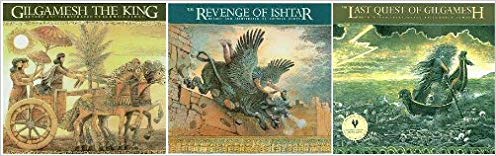
Ludmilla Zeman has a fantastic children’s picture book trilogy that I find to be the best starting point for learning about Gilgamesh. It is consistent with most translations and full of beautiful illustrations. When kiddo was small and we were studying ancient history the first time around, we checked these out from the library over and over again. She loved them. This time I bought them, brand new. They’re worth every penny.
I picked up used copies of the epic for myself. I was disappointed to discover that every translation available was a translation of a translation. I know its ignorant to expect to read direct translations of the Old Babylonian tablets when you pick up a Penguin trade paperback, but I did. I went back to the store after reading through David Ferry’s pretty version and N.K. Sandar’s better translation, looking for something closer to Andrew George’s 2003 version – or better yet, George Smith’s 1870’s version! To no avail. Everyone wants new and better more modern ways to tell the tale, while I bemoan my inability to read archaic clay tablets I’d never get my hands on anyway.
I was hoping to find a cool cartoon on the tale for us to watch together, desiring a repeat of the experience we had when we studied Beowulf in 2016 (YouTube had an amazing cartoon rendition of Beowulf featuring the voice of Joseph Fiennes at the time…). All I found were some not so kid friendly “cliff notes” style videos of people walking students through what it was all about so they wouldn’t have to read the book themselves.
Attention all animators: Please provide a kid appropriate Gilgamesh cartoon, featuring an oddly famous actor of the 90’s of my choice. Thanks.
Gilgamesh is neat. I love the beautiful picture books we own. I will be the parent that makes sure she reads poem and doesn’t watch internet video summaries when she’s older. But I’m not in love with it the way I am with The Iliad and Beowulf. I think it may be the insincerity of it all. It feels obvious that it was a legend born of puffing up the ego of a king and his people. It takes Noah’s ark and twists it, I love reading confirmation that many regions of the world had a major flood, I’m saddened when the details are distorted and inconsistent, making heroes of those who weren’t and forgetting the one man who did obey.
Maybe I’ll love it when I finally get my hands on one of the George translations…
Hammock University

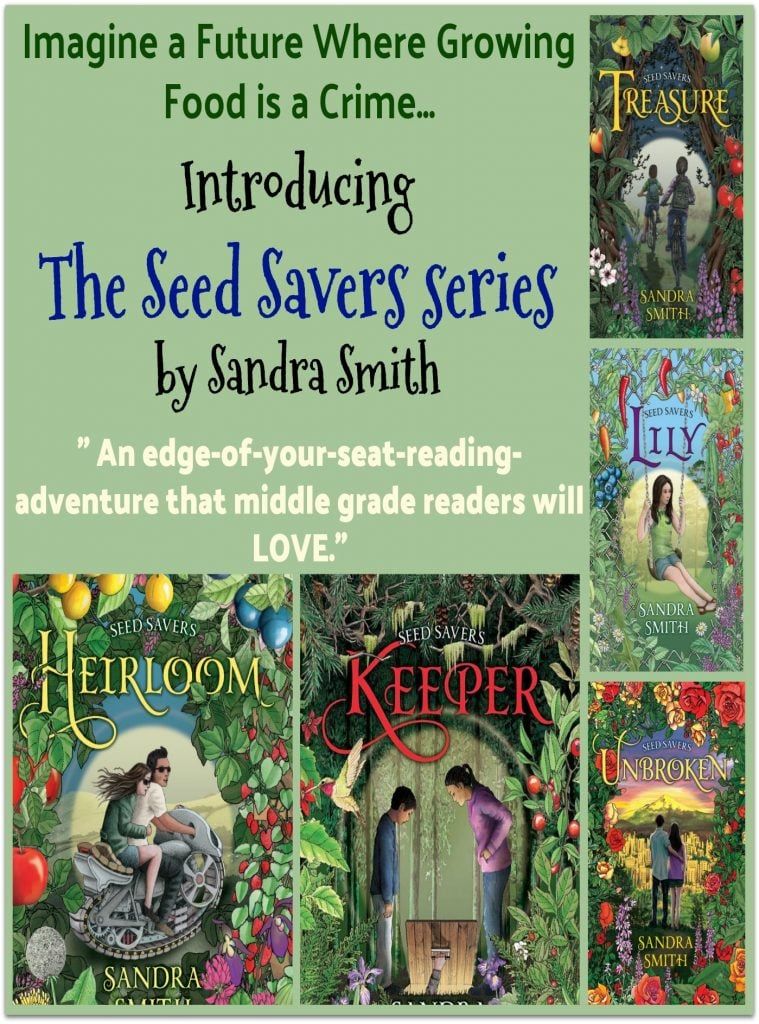
Seed Savers – Unbroken
Title: Unbroken

Author: Sandra Smith https://authorssmith.com
Genre: Teen/ Young Adult
Length: 339 pages
“Had Smith been right? Was the U.S. headed for disaster?”
This line in Sandra Smith’s latest installment of the Seed Savers series made me laugh out loud. In Unbroken, Caleb Smith is a whistleblower who sent the government a 23-page letter regarding the impending doom of monocultures. In the real world, Sandra Smith has written a riveting series that gets kids thinking about where their food comes from, who controls the sources, and who should control the sources. This one line in the book could sum up the entire series.
I’ve had the pleasure of reading each of the Seed Savers books as they come out, in advance reader copy formats. I’ve seen characters grow, I’ve witnessed Smith’s writing change and develop, and I’ve gotten to be excited with her (via email) over the much anticipated dream covers.
This series has been with me as I raise my daughter and I’ve loved having it as a reminder of why we garden, forage, and go back to the dirt and the seeds every season. We would have always gardened, but Smith’s books took it up a notch. It has always kept me true to my desire to sit with my kid and show her how to harvest a seed from a plant, or even produce from the grocery store.
Much of Unbroken concerns an ever looming food shortage in a society where food is no longer grown. Because of food shortages in my own life, I can’t express enough how much the message of this book, seed saving being the key to ensuring the world can eat, moves me. Having tomatoes planted every summer makes a huge difference for a hungry family. Being able to harvest Creeping Cucumbers, wild garlic, dewberries, grapes and grape leaves, and plant indigenous seeds in my yard for easy access, makes it that much easier to get by when faced with an over stretched budget. The books also open the door to discussion about ethics and politics, and most of all, where our belief in God and our responsibility to be good stewards of the earth overlap.
Like the Harry Potter books, the series starts out geared toward one age level and evolves into something for an older crowd. I think this is good for young adult series so that kids can have characters who grow up with them. An eight year old could thoroughly enjoy Treasure, but I wouldn’t hand Unbroken (book five) to an elementary student. With that in mind, I only read the first few books out loud to my kiddo, and the rest of the series will come later. That simply means I’ll have the pleasure of enjoying Smith’s books twice.
Wicked Histories
While reviewing all the books of years past, it’s impossible to avoid children’s history books, audiobooks, picture books, and a great many of odd resources. As mentioned many times before, I homeschool, so most my reading material reflects that.

We stumbled across the Wicked Histories series a few years ago, and I find the series extremely helpful when trying to find biographies on people who helped shaped the world but aren’t typically doted upon in children’s literature. From this series, last July while studying the 1700’s-1800’s we read Catherine the Great: Empress of Russia by Zu Vincent.
One thing I love about the Wicked Histories is that it has been an excellent tool for walking my kid through discernment practices. How do you identify bad people? What makes someone a safe person? People can be evil and still do good things. People can be good and still do bad things. It’s what they do longest, it’s the legacy they leave behind, that tends to define them. Most people, as researchers and biographers know, have a running theme for their life. The “theme,” so to speak, is often the best judge of their heart. They can say a few nice things, but if their legacy was that of slaughtering people in the street, could you truly call them good? Maybe they were known to love their family, but if all their political policies doomed their nation, what then? I like that Wicked Histories isn’t afraid to have these discussions with children. I also like that they never give a straight answer, the authors leave the conclusion up to the children.
Because these books are so full of moral nuance, I don’t have her read these alone, even though she could. I read all the Wicked Histories aloud as part of our school day and we discuss. Some of our most riveting discussions came while reading Cixi: Evil Empress of China? by Sean Stewart Price and Grigory Rasputin: Holy Man or Mad Monk? by Enid A. Goldberg. It’s helping her see that she has the power to pursue what is good and just in the world, or choose personal glory, fame, and power which tends to corrupt. These stories are helping her see that what you make your priorities matters, who you put your trust in matters. Alexandra Romanov, as well as many other Russian women of the time, were deceived by Grigory Rasputin. How do you watch for deceit while maintaining your positive attitude toward other human beings. I think these are important and healthy lessons to learn. We learn these lessons best by reading God’s word, yes, but also by and knowing our history.
Education is a Lifetime Pursuit
“Education is a lifetime pursuit.” I tell my daughter this constantly. It is our household motto, so much so, I would not doubt if I had already posted something with the same title before. I even hope that my readers already have read this phrase.
I am a homeschool mother. I am, in the deepest parts of my soul, a teacher. I always have been, and have been overzealous about it since I discovered the classical model. What I have loved about the classical model most is the ease in which I can continue my own education while I educate my daughter. She memorizes facts and dates in the grammar stage and not only do we supplement with rich literature to help her remember, but I get to pluck out related reading material for myself. Individually, I learn and teach the classical model… as a household, we are constantly involved in “unit studies” that are structured chronologically throughout history.
While she was memorizing history sentences about Christopher Columbus, the Pilgrims, and eventually the colonists dumping tea into the Boston Harbor, I was reading Changes in the Land: Indians, Colonists, and the Ecology of New England by William Cronon.
First published in 1983, Changes in the Land is the earliest book I know of written directly about environmental history, not part of a political movement. Everything I’ve read published prior to this book are either beautiful transcendentalist nature essays (Emerson, Thoreau, Bronson Alcott, etc.), geological science books (Lyell, Stenson, etc.), or solely activist tree-hugger type stuff. In fact, I think it paved the way for books like the one I read recently (and thoroughly enjoyed) while she learned about the gold rush called Hard Road West: History and Geology along the Gold Rush Trail, whose author also crossed genres by highlighting the land, and all the things that make it what it is and the men who mar it, as the main character in the book’s story.
The biggest thing the two books have in common, for me, is at the end of each I thought, “This must be required reading for high school students.” After all, how do you learn history of a place without comprehending the blood, sweat, and tears, that was shed on it and ALL the reasons why, not the just the wars, but trails cut, deforestation, farms, dustbowls, mining… and not just focus on what it did to the people, but what it did to the land and how all that affects us today. Books like these are a beautiful marriage of history, social science, science, and more.
I love finding these gems as I sort through piles and piles of potential reading material, planning out lengthy lists of things to shape my kiddo’s mind. I love that my mind is also being shaped. I love that I am 35 and never done studying. I love that, in addition to growing my relationship with Jesus Christ and my daughter, education is my lifetime pursuit.
Captains Courageous
Title: Captains Courageous
Author: Rudyard Kipling
Length: 129 pages
Almost everyone hears the name Kipling and immediately thinks of The Jungle Books, myself included. I read all of The Jungle Books as a child, watched the various movie adaptations, and continue to enjoy them as new ones continue to be made. However, I honestly cannot recall if I had Captains Courageous as a child. I think I did, but the idea is so vague in my mind I cannot trust it.
So I read it as a 34 year old, just to make sure, joining the adventures of the overly privileged fifteen year old Harvey Cheyne as he grows into something that resembles a responsible man, denying his previous existence as a turd.
Published in 1897, it is full of nautical adventure, Victorian era Americanism, and all the qualities that Teddy Roosevelt would applaud – and he did applaud the book, vigorously.
Captains Courageous is a commonly overlooked classic. I can say this with authority having worked in a bookstore for 12 years being able to count on my right hand the number of times I’ve sold a copy. There are some books I’d run out of fingers in one day, so to get through 12 years with one hand tells me its rather neglected. Don’t be that reader, don’t neglect Captains Courageous. It’s too good to be forgotten.
Cozy 2018 Summer
No, I did not type the date wrong. I took a very long break from consistently reviewing books and blogging, and now I have returned. I’m easing myself back into the practice by logging all the titles my blog missed each Thursday until I am caught up. So welcome to Throwback Thursday (or Flashback Friday, because I’m even warming up to the idea of easing myself in).
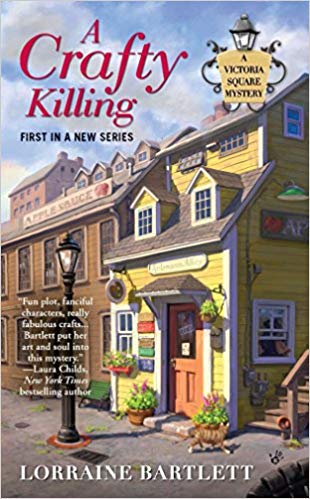
Title: A Crafty Killing
Author: Lorraine Bartlett
When I first read this book in June of last year, I uploaded the following review to my Goodreads account:
“Exactly what you’d expect from a cozy. I had a harder time relating to Katie than I have with other leading ladies of the genre, however.”
I gave it 3/5 stars.
That assessment holds true nearly one year later. Katie may not be my favorite, honestly I don’t remember a thing bout her, but Artisan’s Alley and the Victoria Square, are definitely memorable. Ironically, the victim of the crime had a bit of personality too. I do so enjoy getting to know characters “off screen,” so to speak, in everyone else’s memories of them and zero direct contact. I look forward to reading book two when the mood strikes me because I want to see what happens to the business Katie is building. I have a degree in Entrepreneurship, work retail, and wrote The Bookshop Hotel series, so clearly in regard to fictional businesses, I’m biased.
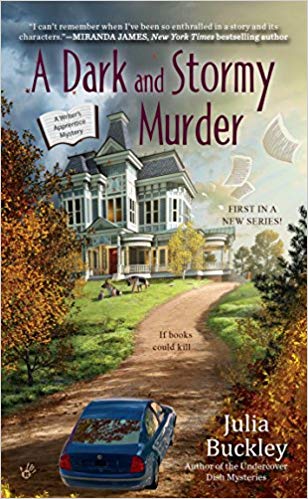
Title: A Dark and Stormy Murder
Author: Julia Buckley
Despite my 2/5 star rating on A Dark and Stormy Murder, I probably enjoyed my reading experience of Buckley’s work more simply because my boyfriend read it to me while I crocheted my daughter’s comforter set. This book was utterly ridiculous, but the voice of the one reading was so marvelous I was thoroughly amused.

Turning my “old lady” vibe up a notch last year, I didn’t stop at reading cozy mysteries, I taught myself to crochet on youtube and am now a full fledged crochet hobbyist. I’ve begun listening to more audiobooks via Scribd, an app/website that I refer to as Netflix for books: https://www.scribd.com/ga/7adrgu
There is something truly amazing about the monotony of crocheting endless rows for the most ridiculously huge blanket ever. I enjoyed every minute of it. Since then, I have also made hats and scarves and am less than 1/4 through another large project and I cannot recommend learning to crochet enough. It has calmed me during a time when I needed to bask in calm and solace. It has added an extra depth to my pursuit of cozy.






 Anakalian Whims