Dracula
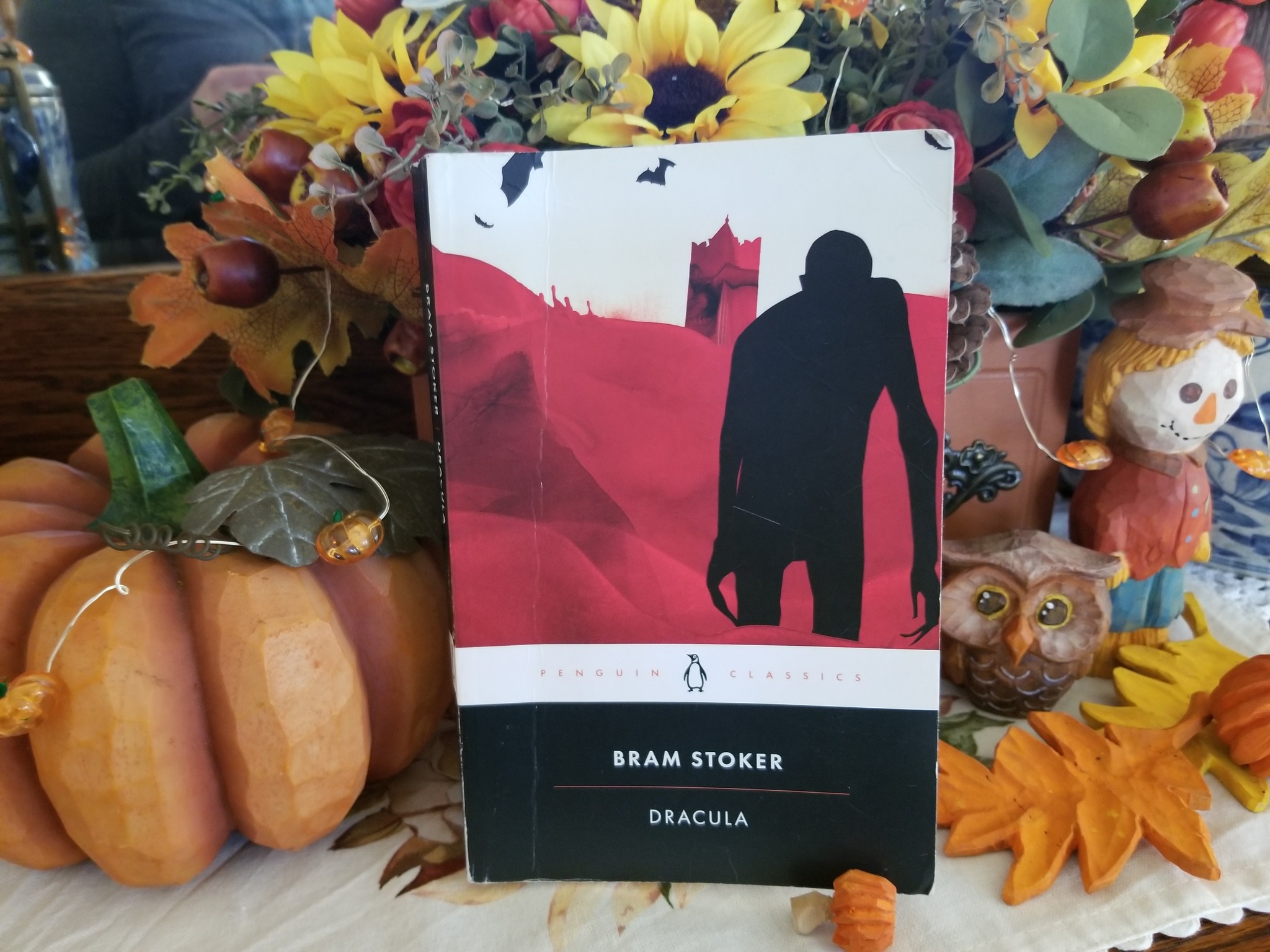
I walked my fifteen year old through Bram Stoker’s Dracula this October. I thought it would be a fun way for a ninth grader to celebrate Halloween. I also thought it would be a neat one to cover with my newly developing book club: The San Salvatore Book Club, primarily made up of my older mentors in my Baptist church. There were gasps of “Are you sure?” and polite “I think I’ll bow out of that one” to which I promptly said, “Why? It’s such a beautiful Christian allegory!”
Side note: I’ve been listening to the Literary Life Podcast with Angelina Stanford for about two years now, caught up on most the episodes and sometimes use them to supplement my home school when I need to be doing something other than teaching literature. My number one complaint to my husband is, “they act like no one knows this and everyone knows this!” to which I am learning every day that, actually, no Angelina Stanford is right: not everyone knows this. I’m not always claiming to have the correct most perfect reads, but I have been shocked to learn I have been reading differently than mainstream society since childhood. So my Angelina Stanford grumbles have ceased now that I know she is operating from the experience of people genuinely not knowing about the material she shares and I’ve been operating under the experience of not sharing because I thought everyone knew. That being the case, my apologies if some of what I share simply sounds like it came from her podcast. It is unintentional, though, yes I listened to her Dracula episodes back in February to make sure when we discussed it in October, I would not have skipped over anything that I assumed “everyone already knew.”
While I was teaching Dracula, I realized I had never written about Dracula on my blog. My blog began, I think, during the height of the Twilight series and I spent so much time focusing on how we shouldn’t be romanticizing vampires with chests that sparkle and misplaced teenage angst, I forgot to write about the roots of vampire lore and my love for Stoker’s classic work, which is in fact a Christian medieval quest to kill a dragon disguised as a techno-thriller. I also realized that I don’t remember what of my essays, stories, and discussions over the years ended up in my journal or my blog, or was relegated only to bookstore employee discussions as we cleaned the store each night. I have spent years reading C. S. Lewis, G. K. Chesterton, George MacDonald, all the classics, yet my blog is mainly limited to home school material and book reviews sent to me by authors and publishers. Therefore, as I begin to teach high school literature to my oldest, I imagine there is a lot of who we are as readers not documented on Anakalian Whims.
To read Dracula well, I think you need a foundation in Genesis, specifically 1:26-4:16. It’s important to read John 1 where the New Testament is clear that Jesus is the Word. It’s important to know a little bit about Jewish and Mesopotamian mythology regarding Lilith, who was a demon and seductress, the disordered first wife of Adam who feeds on children and relishes in child sacrifice as opposed to feeding and nurturing children from her own body as God designed. “Lilitu” was a “night monster.” In my teaching notes, I recommend re-reading the book of Revelation (so you can remember how the bible used imagery of dragons and oceans) and Beowulf. While reading Dracula, you might need to recall stories like Hansel & Gretel, Bluebeard, Homer’s The Odyssey, Dante’s Divine Comedy, Spenser’s The Faerie Queene, and Shakespeare’s Hamlet. It’s easy to enjoy Stoker’s work without these tales fresh on your mind, but it might also be easy to fall victim to Freudian false interpretations if you’re not reading from the framework that Stoker was actually writing during the Gothic revival of the 1800’s. You’ll be limited to the Victorian techno-thriller, which is still awesome, and see all the wrong “imagery” of suppressed sex, which is inaccurate and not awesome.
You have to keep in mind the quote from Devendra Varma: “During the period when the forces of Christianity were nearly spent and materialism had dislodged spiritual values, the Gothic novelists planned their novels with an awareness of the Deity and the consequences of a just fate. The villains learn in due course that the wages of sin is death.”
With that in mind, we enter a world where the monster in the night is indeed an evil to be vanquished, not to be loved for his sparkly chest and undying devotion to trying to get the girl. Traditionally, the villain in these stories is a symbol for Satan, a metaphor for evil itself. We see these villains portrayed as witches, monsters, vampires, and werewolves, who modern literature is now conflating with handsome boys who just need more hugs. Since the dawn of time, human beings have suffered from an evil that must be conquered, and in Stoker’s Dracula we have a group of Christians on a quest to conquer that evil… the “Son of the Dragon” or “Son of the Devil” named Dracula. The best literature will always remind us that the ultimate battle is between the Dragon (the monster) and the Savior (Jesus), and the Savior has already won. That is exactly what makes Dracula one of the best pieces of literature. The monster is the problem, the monster is not the love interest. As C. S. Lewis said, “Who is the witch? The witch is Lilith. The witch is Circe. Every child is born knowing who the witch is.” As Angelina Stanford said, “The monster is not the wounded person, the monster is the [cause of the] wound.”
I don’t want to repeat all the information already available to the public for free on The Literary Life Podcast, but I do want to share some of my favorite parts of the novel that get my skin all tingly when I read them. I’ll try not to repeat too much of what they focus on in the podcast.
In chapter two, we walk through an octagonal room. In Babylonian culture, the eighth realm is the realm of the gods, a realm where for Christians, false gods, fallen angels, and demons congregate. Eight, therefore, is often considered a number affiliated with the occult. Charlemagne’s Aachen Cathedral, where his tomb resides, is an octagonal shape believed to be a mesh of where God meets the secular as it is a circle with straight lines and points. I ask my students what they think Stoker is trying to tell us by Harker walking through an octagonal room as he enters Dracula’s residence, just after a wild carriage ride that resembles a descent into Hades.
Later in this chapter, Dracula throws a mirror out the window. It is absolutely chilling as the mirror in medieval tradition is a symbol of divine truth. It doesn’t matter how many times I read Dracula, the Adversary both literally and figuratively throwing Divine Truth out the window gives me chills every time.
The setting of Whitby, which has a castle or abbey with an extensive graveyard by the sea sets itself up for so much intense imagery and meaning. We have our Gothic trope intermingled with the real history of the Synod of Whitby, where two traditions were ended. Meanwhile Dracula is asking Harker if a man of England can have two solicitors or more? Stoker is tossing around ideas of can man serve two masters? Who will man choose? Dracula is basically asking, how can I trick England into abandoning God and worshiping me? Whitby Harbour had a history of ships crashing, which will offer up opportunities for both Tempest and Rime of the Ancient Mariner allusions.
Stoker offers layer after layer of symbolism with the names and social positions of the characters as well. The podcast talks extensively about the roles of women in Victorian society and how Stoker played with Lucy being the “Light of the West” and “angel of the house” and Mina being the modern woman (I’m not sure if they covered the meaning of her name which sums up to be “Resolute Protection of the Lord”), but my favorite is actually the role of the men in this allegory. We have a fellowship of knights on a quest, all devoted to one woman (Mina), headed off to kill a dragon (Dracula), interwoven with Aristotle’s classical elements: Abraham Van Helsing, the professor (Merlin/ father figure, fire); Arthur Holmwood, the future Lord Gadalming (nobility whose name means “Of God-helm” in the Surrey Kingdom where there is a village called Thursley, near Hammer Pond and Thor’s Stone… King Arthur/ Thor, thunder, or air); John/ Jack Seward, whose name means “Guardian of the Sea,” is a doctor and scientist (a knight on our quest, water); Jonathan Harker, Mina’s husband whose name means “The Lord has Given” (earth); and our fifth man Quincey Morris, a cowboy from Texas (the fifth element) and (spoiler alert) our “Good boy. Brave boy. […] all man.”
From a book review standpoint, Dracula is hands-down a five star book. Above I shared my favorite pieces of a very complex allegory, but there’s so much more to it covered in the series of episodes of the Literary Life Podcast, and even more in my teaching notes, imagery that covers the Eucharist, Anti-Eucharist, Passover, John the Baptist and Anti-John the Baptist imagery. The story is one of wars to fight devils and ends on All Saint’s Day, celebrating rebirth in Christ and the achievement of Heaven. If you’re not seeing these metaphors for yourself when you read please go listen to the podcast episodes so that you can enjoy this beautiful work of fiction (and truth) for yourself.
(As an Amazon affiliate I earn from qualifying purchases.)
Justified
Title: Ape and Essence
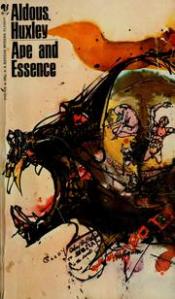 Author: Aldous Huxley
Genre: Fiction/ Literature/ Allegory
Length: 152 pages
Of the four Aldous Huxley books included on the 1001 Books You Must Read Before You Die list, is not one of them.
With good reason.
While I was reading I kept thinking, I like the concept, but I am aghast that this is the man famous for a book that millions are required to read for school. Not because there is anything bad about it… it’s just… really? This is the kind of stuff we want to force teenagers to read? It’s disjointed, surly, and… dare I say… a little boring.
The best moment, by far, was when I read:
‘Give back that ring.’
‘Which ring?’ the man falters.
At which point my nerdy self said to my book: “The one that will rule them all, duh!”
To be fair, the book that is typically required reading for students is Brave New World, not Ape and Essence. So, naturally, I had to do a bit of research before considering reading Brave New World, giving Huxley a chance to prove himself in my eyes. If I can’t stomach 152 pages of the man, why would I submit myself to more?
I feel justified in my disappointment, because as my kid sat and worked through a literacy program on the computer at the library, I consulted the Concise Dictionary of Literary Biography: Volume 6: Modern Writers 1914-1945, and read up on Huxley and this piece of drivel I had just plowed through.
There I read, “Aldous strained to pile horror upon cross horror… the book, it always seemed to me, achieves a high degree of unbearableness.”
There I also read, “most the characters and ideas come from a discount Huxley warehouse.”
Deep sigh of exasperated relief. I don’t have to like this book. Thank God.
Mikhaul Bakhtin described Huxley’s work as the “Canivalesque Novel.” Others in this category would be Rabelais’ Gargantua and Cervantes Don Quixote. These novels are known for “emphasizing inclusion rather than selection” and are “structured like a ‘plate of mixed fruit.’” They are known as the anti-novel.
Sheldon Sacks, on the other hand, considered Huxley’s work as apolgoues, like More’s Utopia, Voltaire’s Candide, and Johnson’s Rasselas… fictions structured as persuasive arguments. (For the record, I am basically paraphrasing – and point blank quoting – the CDBLB!)
The title for Ape and Essence was taken from Shakespeare’s Measure for Measure, when Isabella says:
Could great men thunder
As Jove himself does, Jove would ne’er be quiet,
A sFor every pelting, petty officer
Would use his heaven for thunder;
Nothing but thunder! Merciful Heaven,
Thou rather with thy sharp and sulphurous bolt
Split’st the unwedgeable and gnarled oak
Than the soft myrtle: but man, proud man,
Drest in a little brief authority,
Most ignorant of what he’s most assured,
His glassy essence, like an angry ape,
Plays such fantastic tricks before high heaven
As make the angels weep; who, with our spleens,
Would all themselves laugh mortal.
Again, I have not read Brave New World, but I come away with the overpowering sense that perhaps it is easier to digest because, like the CDBLB says, Brave New World is about what could happen; Ape and Essence is presented as something that probably will. Ape and Essence leaves you with nothing to hope for, and in a world full of agony – hope is vital. The whole book is about how “faith in progress has led to outright regression,” and the book ends with an egg being cracked over a gravestone.
A society so driven by perfection and stamping out rebellion and evil that they have destroyed everything. They do not have the hope and insight of Steinbeck when he wrote in East of Eden, “And now that you don’t have to be perfect, you can be good.” Instead, everyone strives for perfection until they’ve essentially destroyed themselves and everything around them. They’ve destroyed the world’s ability to think and grow.
Ape and Essence is the most depressing piece of near-satire I’ve ever encountered.
The man himself, however, had some awesome things to say on the nature of writing. Many people read his novels and were irritated by finding mirror images within some of his characters. After a few lost friends he responded,
“Of course I base my characters partly on people I know – one can’t escape it – but fictional characters are oversimplified; they’re much less complex than the people one knows. There is something of (John Middleton) Murry in several of my characters, but I wouldn’t say I’d put Murry in a book.”
I could not say it better myself. Characters may seem a bit like this person or that, but never, never is any fiction that I write in any way biographical. So even though I did not care for Ape and Essence, I came away from researching Huxley fulfilled – and justified.




 Anakalian Whims
Our Secret Country
November 16, 2019 at 4:47 am (Education, Reviews) (allegory, books, c.s.lewis, children's books, Christianity, fantasy, homeschooling, Laura Miller, literary commentary, literary criticism, Narnia, neil gaiman, party planning, reviews, The Chronicles of Narnia, turkish delight)
“Most of us, I suppose, have a secret country but for most of us it is only an imaginary country. Edmund and Lucy were luckier than other people in that respect,” C. S. Lewis wrote in The Voyage of the Dawn Treader.
The thing is, the thing that C. S. Lewis as narrator doesn’t address, is that everyone who has ever read the Chronicles of Narnia series *does* have that country. We all visit some version of Narnia in our minds once we’ve been there once. And as it says in The Lion, the Witch, and the Wardrobe, “Once a king or queen of Narnia, always a king or queen of Narnia.”
So here I am, thirty-five, living in the magical world of Narnia as my daughter reads through the series for about the third or fourth time, but this time we’re reading it alongside our homeschool co-op. It is such a treat watching children enjoy the magic of Narnia, and furthermore bask in its magical glory with them.
The Chronicles of Narnia is a well known allegory of the Christian faith set in a fantasy world. Good and evil are clearly define, deadly sins and how they creep into our psyche, how unchecked they fester and change who we are. The stories enthrall children and adults alike, who have a thirst for the eternal, who long for the otherworldly aspect of our universe, the spiritual war that goes on every day unseen to the naked eye, but experienced in living color when you step through the Professor’s “Spare Oom where eternal summer reigns around the bright city of War Drobe.”
We’ve been reading the books together and discussing them book club style with children ranging from 7 to 13 and moms from 27 to 50. At the close of book two, we took a Narnia party break, complete with homemade snowflakes (the kids got to learn about hexagonal snowflake patterns and how to recreate them with computer paper and a pair of scissors), try Turkish delights for the first time (and marvel at why Edmund would basically sell his soul for such an awful dessert), and pose in costume under a welcoming Narnia sign and the iconic lamppost (artistic cardboard craftsmanship compliments of my impressive fiancé, kiddo spray painted it black herself).
Of course, in my typical fashion, I had to read “grown up” books in addition to re-reading the original stories. Because C. S. Lewis made such an imprint on society, there are more literary criticism books about Narnia than there are Narnia books. Most of them written by Christians. However, I found one written by a non-Christian which greatly intrigued me.
The Magician’s Book is an in-depth critical analysis of the Chronicles of Narnia. As much memoir in content as literary analysis, Miller chronicles her own relationship with Narnia and includes insightful conversational commentary by other big name writers of many faiths (Neil Gaiman being one of my favorites). I enjoyed her perspective a great deal and though I was saddened that Aslan the lion did not aid in her understanding the nature of Christ, that she did not come to understand God’s love through Lewis’s fantastical depiction of it.
Still, reading Miller’s work led me down a rabbit trail I’m happy to tumble through, and I’ve already lined up all sorts of other books regarding C. S. Lewis and Narnia to read during the rest of our Narnia journey. Join us. We start Horse and His Boy next and are reading The World According to Narnia by Jonathan Rogers as we go. We plan to finish all seven Narnia books by the end of the school year.
Permalink Leave a Comment