A Fragrant Universe
 Title: Pheromones and Animal Behavior

Author: Tristram D. Wyatt
Publisher: Cambridge University Press
Genre: Science / Animal Communication
Length: 391 pages
“[…] one doesn’t realise how much ‘savor’ is smell. You smell people, you smell books, you smell the city, you smell the spring – maybe not consciously, but as rich unconscious background to everything else. My whole world was suddenly radically poorer.” – O. Sacks, The man who mistook his wife for a hat
So completely fascinated with the human scent and sense of smell this month, I picked up a textbook on pheromones at the public library.
What I’ve learned is that I can read up on everything there is to know scientifically about ones sense of smell and how they use it, but I still won’t completely understand all the nuances of how that affects interpersonal communications. Correction – I understand how, but not why it affects us so completely.
Having this knowledge of the how should enable me to shut it off when it does not suit my emotional well being, right? After all, knowledge is power.
No. We, as humans, are too complex for that. (Or simple, depending on how you look at it.) Our emotions can even heighten our perception of these smells, tie that to menstrual cycles and memory and we’re pretty much screwed to always have knee jerk reactions to certain scents whether we like it or not.
Even Wyatt states in the closing chapter of his textbook:
“One of the major challenges to human pheromone research is that of designing rigorous experiments that eliminate other cues and variables. As well as the complexity of odour that being a mammal brings, humans are also complex emotionally. This makes us doubly difficult as experimental subjects.”
I absolutely adore the smell of a well cared for old book. But the effect that beautiful freshly cut grass mixed with vanilla, a tinge of dust, and leather has on me can be overwhelming or something I barely note in passing, depending on the mood I’m already in.
All this sensory awareness just reminds me of a John Oehler book I read awhile back, Aphrodesia – and led me to finally committing to pick up the book Perfume by Suskind (which I haven’t done just yet, but will soon). People have been talking about it for years, I’ve been shelving copies of it at the bookstore in droves for as long as I’ve worked there. It’s even on the 1001 Books to Read Before You Die list, but I don’t read the books on that list merely because they are on it – I try to let those titles come to me organically via other means of gathering more books for my TBR pile. All of these things in Suskind’s favorite, but his work never really moved me until now.
One Woman Everything
Title: One-Woman Farm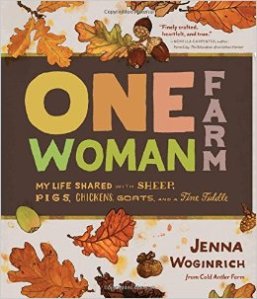

Author: Jenna Woginrich
Genre: Memoir / Farming
Length: 207 pages
I’m in research mode. I’m elbow deep in tree and herb encyclopedias. I’ve been reading every homesteading and nature memoir I can get my hands on. I’m scouring the fields, ditches, and woods for new specimens of plant life to identify, and I just helped my mother-in-law build a compost bin.
One-Woman Farm was one of the recent memoir selections, and it was a breeze to get through. Daily journal entries, basically, of farm life through out the year, the author’s quest for a Fell pony, and to learn to play the fiddle.
I enjoyed reading Woginrich’s book mostly because I want to homestead… but I don’t want what she has. She’s too far north. I want more plants and fewer animals. I want the freedom to get up and travel when the inevitable wonderlust kicks in. I don’t want to be a one-woman farm, I simply want to do EVERYTHING, and also not quite that much. But it was nice to live a year in her shoes for a bit, and I would like to select baby chicks and hold a baby goat. I would love to have fresh milk in the mornings…
The book is full of sweet illustrations as well, which made it spunky. Her talk of pigs felt more in depth with a pencil sketch of a pig sharing the page. Faux paperclips in the margins, like a well-worn guide book to life. Typed recipes and quotes added a richer flow to her sparse text.
Now on to the next… I’m reading The Last Great Walk by Wayne Curtis and The Quarter-Acre Farm by Spring Warren.
If I Were a Frog… or a puppy…
A Weekly Low Down on Kids Books
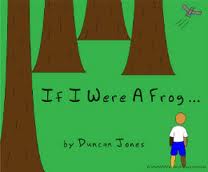 Title: If I Were a Frog
Author: Duncan Jones
If I Were a Frog is cute and clever. A detailed journey of constantly trying to see the world as another animal who is wishing to be another animal, Jones teaches children the concept that the grass may seem greener on the other side but only because you’re seeing it from far away – up close it’s still just grass.
The kids at the Half Price Books Humble story time really enjoyed this one. They caught on really quickly that the animal in the background was soon to be the featured subject and they couldn’t wait to find out about the the Lion King and the Bear.
I’m proud to have this as a part of my child’s library. She already picks it up from the stack and asks to have it read. We cheated and have been reading it every day this week before story time, even though the author specifically sent it for us to read AT story time… it was too good to resist.
 Title: Tell Me How You Say Goodnight
Author: Teddy O’Malley
Photographer: Angie Dickens
This was another we received from the author this last week to read at Half Price Books Humble story time. The kids could not stop gushing about puppies and how cute they were. Obviously, using puppies to get a kid to go to sleep while teaching them how to say goodnight in languages around the world was a good call!
Kids love practicing saying new words and phrases just as much as they love playing with tiny puppies and snuggling things that are soft. What a cool way to document the lives of a litter of puppies! Have them be household names and teachers to children around the world.
I find it is the simplest books that are the most appealing to kids. My kiddo sees me flipping through ‘the puppy book’ and immediately dictates: Read it again, read it again!
Weekly Low Down on Kids Books – Baby Bear
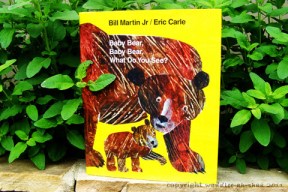 Title: Baby Bear, Baby Bear, What Do You See?

Author: Bill Martin, Jr.
Illustrator: Eric Carle
Publisher: Puffin
The Kiddo has definitely picked her favorite for the week, and Oh-My-Lands, if I never have to read this book again it would be too soon! It’s actually not that bad, I’ve just read this book about seven times a day for a week straight, and that’s at a minimum. She’s at the age where she likes familiar, predictable, and oh so repetitive things.
She likes being able to tell me, “This Red Fox,” except fox sounds like something else entirely, something unprintable and disconcerting coming out of your two year old. The x sound is not her forte. She’ll get there, after all, she hears it enough.
Her favorite animal is the Striped Skunk. I’m not sure if it’s the stark black and white contrast of the picture or the way the phrase sounds, but that’s definitely the page we go back to over and over again.
She likes to explain to me that the Mule Deer and the Striped Skunk are like Bambi and Flower. That is important to her, knowing that I know that she recognizes that these are similar but not the same thing.
I like that book goes through one particular region. When you open the book, the first thing you see, even before the title page, is that Carle has painted a forest. It seems insignificant, but I think it’s a nice touch that sets the tone for the animals to come. It says, “this is where you are going, the animals you discover live here…” Then we start meeting them and it’s like taking a trip to Colorado without even leaving her bedroom.
One day, I’d like for us to build a Baby Bear diorama. I think she would really like reciting the book while sliding a paper doll of baby bear past all his friends and on towards his mother.
Polar Bear, Panda Bear, and every other Bear book by Bill Martin are definitely on our To Buy list. If you’re still on the fence, check out this other reviewer’s take on it: http://www.daddyfiles.com/baby-bear-baby-bear-what-do-you-see/
Masson Tries to Make You Weep…
 in When Elephants Weep
I enjoyed the anecdotes quite a bit, this parrot learns to say this, that elephant painted that, this species is documented as feeling empathy towards that species in a rare moment, the monkeys are a lot like us, but so are the fish etc. etc. I agree with most the points, animal cruelty is wrong, experimentation needs to have stricter rules, we should treat the animal world with respect. However, I don’t want to become a vegetarian and I didn’t care for how the opening and ending arguments basically boiled down this beautiful essay to we shouldn’t eat meat. Apparently that’s what this was about to them, to me this book was about how beautifully complex our world is, but I can’t argue with the authors themselves. By the end of the book they had achieved a level of redundancy I don’t think I’ve ever managed to read in any other book my whole life. This book’s saving grace was those amazing animals that starred in it, but if I hear /read the word “anthropomorphism” I think I’ll scream, and if someone tries to guilt trip me out of eating my steak I’ll kindly smile, cut, and chew. And if I’m told I’m a bad person for taking my daughter to the zoo, well, I’m sorry you feel that way, I’m going anyway.



 Anakalian Whims