The Mad Women of the Moors
Re-experiencing The Brontë Sisters, Part One
In 2024 I read Brontë’s Agnes Grey alongside the Literary Life Podcast. I hadn’t read a Brontë novel in years, more than a decade I believe. Though I greatly appreciate the Brontës, I’ve always been more of a Jane Austen girl. It’s a rare reader who loves both equally, I find. The Brontës wrote Gothic revival tales with a flare for romanticism (romanticism the movement, not romanticism featuring a meet-cute and happily ever after), whereas Jane Austen wrote satire. The Brontës make me sad and despair for humanity while Jane Austen makes me laugh at society’s nonsense. All four women had much to say about the world around them, they just said it very differently.
Agnes Grey, written by the youngest Brontë, Anne, is not the most riveting of classic works and I suspect it wouldn’t still be in print if Wuthering Heights and Jane Eyre weren’t currently so popular. I love to pair reading experiences, rabbit trail from one book to another, an exercise of associative reading, so I plucked a book I already had on my shelf and read it as well.
The book was The Madwoman Upstairs by Catherine Lowell, a contemporary literary mystery with the meet-cute kind of romance thrown in. The book follows fictional character Samantha Whipple through Oxford as the author fan-girls over Emily Brontë’s Wuthering Heights and Charlotte Brontë’s Jane Eyre. In a season when I am aggressively purging subpar books from my collection (we have over 5,000 volumes–I stopped counting long ago–and have legitimately run out of space) The Madwoman Upstairs is one I have chosen to keep, for now. I think my oldest might enjoy it after studying a Brontë book or two, it’s an easy breezy weekend novel.
That time might be coming soon as the trailers for this new Wuthering Heights movie blasts across the internet, appalling most readers I know. Teaching Wuthering Heights just moved up my to-do list as I counter parent pop culture, so that when my teen encounters the story for the first time it is not at the hands of the debaucherous movie industry who is advertising what looks like a Fifty-Shades version of what they are calling the “greatest love story ever told.” I thought it was a cautionary tale of what happens to humanity when we give into the monster of sin instead of slaying it. On a supernatural level, Wuthering Heights brings me back to Beowulf (I might be broken, because everything brings me back to Beowulf, it’s a favorite) and the torment of the wild (sin nature and Satan… Heathcliff has that whole Esau archetype going for him that reminds me of Grendel). On a psychological level, Cathy and Heathcliff remind me that sin nature is to be quashed lest we wander the moors ever after as lost souls unable to reach heaven. Apparently, that is not the popular reading, and Hollywood has turned it into some steamy lip biting panty dropper. Gross. But, I haven’t read the book in a coon’s age, and it’s possible I read it poorly and just saw the message I wanted to see.
Alice Hoffman said, “Read Wuthering Heights when you’re 18 and you think Heathcliff is a romantic hero; when you’re 30, he’s a monster; at 50 you see he’s just human.” When I was in my teens, I definitely read him as a tempting monster. I know I read Jane Eyre and Tenant of Wildfell Hall in my twenties, but I cannot recall if I re-read Emily’s work when I first read her sisters’ and stumbled across Gaskell’s biography. I’m 41 now and I’m curious to know how I read Heathcliff today.
English author Jeanette Winterson wrote on her website in 2011:
I read Wuthering Heights when I was sixteen and had just left home. I did not read it as a love story. I thought it was a loss story. Heathcliff loses Cathy. Cathy loses Heathcliff. Edgar Linton loses Cathy, their daughter, his life, and Thrushcross Grange. Hindley loses Wuthering Heights. His son Hareton is dispossessed, Heathcliff’s revenge on everyone, including himself, is matched by Cathy’s death-wish (Why did you betray your own heart?). Heathcliff is a foundling. As an adopted child I understood his humiliations, his ardour, and his capacity to injure. I also learned the lesson of the novel that property is power. It seemed to me that if you want to fall in love you had better have a house. Whatever Emily Bronte was doing, it was not the sentimental interpretation of this novel of all for love and the world well lost. Cathy is a woman and can’t own property in her own right. Therefore she can’t rescue Heathcliff unless she marries Edgar (and that is part of her plan but Heathcliff has already misunderstood and disappeared). Much later when her daughter marries Heathcliff’s horrible son Linton he gleefully claims that all her property is now his – and when he usefully dies, all that was hers passes to Heathcliff. Heathcliff himself starts with nothing—and so can’t marry Cathy. His gradual gain of every house, horse and heirloom belonging to the Earnshaws and the Lintons is his revenge and his ruin. What’s love got to do with it? (All right, quite a lot, but this is not a love story).
As I begin my journey of rediscovery, I find I agree that it is a story of loss. I also think it is a story of revenge, and possibly a story of ghosts… I’ll get back to you in Part Two of this blog series.
(As an Amazon affiliate I earn from qualifying purchases.)
Beowulf
I have a confession: I never read Beowulf in high school. Or college. I read Canterbury Tales more times than I can count (yet only remember a handful of the stories). I read Sir Gawain and the Green Knight ad nauseum – and I like that story. But no Beowulf. How did I miss it?
I’ll tell you how, we tried to cram so much into such a short amount of time. We spent hours and hours in school, but spent very little time actually studying. Somewhere along the way, Beowulf was lost to me. I’m not sure if I was ever really exposed to it or not. It might have been something I breezed through in a Norton Anthology and regurgitated the next day for a pop quiz, only to be quickly forgotten. I couldn’t tell you. I only know that I had a vague idea that it was an epic poem involving something named Grendel when I began working at a bookstore as an adult. Even then, I couldn’t tell you if Grendel was the monster or the man.
 As we began our Middle Ages/ Early Ren. (450 AD to 1600 AD) year while classically homeschooling, it dawned on me that this was the year for Beowulf. I had already read the picture book by Eric A. Kimmel to kiddo when she was a wee one, but I’m sure she was so tiny she had fallen asleep; now was the time to embrace the story.
And we did. I read her the picture book shortly before my trip to Atlanta. It fit right in with all the Celtic and Norse mythology we’ve been reading to bridge the gap between the ancient times and our exciting year ahead. “What a guy! He tore off the monster’s arm! I can’t even do that,” she exclaimed. She was very pleased that this particular picture book could give the story in “one-sitting, all today” as opposed to the stories of Odysseus and Troy which all took weeks of chapter by chapter to finish. I foresee reading this again and again over the coming months, she loved the story so much; I have to admit, I did too.
 I liked it even more when I discovered there was a cartoon made in 1998 starring Joseph Fiennes as the voice of Beowulf – https://www.youtube.com/watch?v=QKjcoFZmKuA. We got to watch that and call it school. It was a lot of fun. (There’s one for Don Quixote we’ll be watching next year when we make it into the 1700s.)
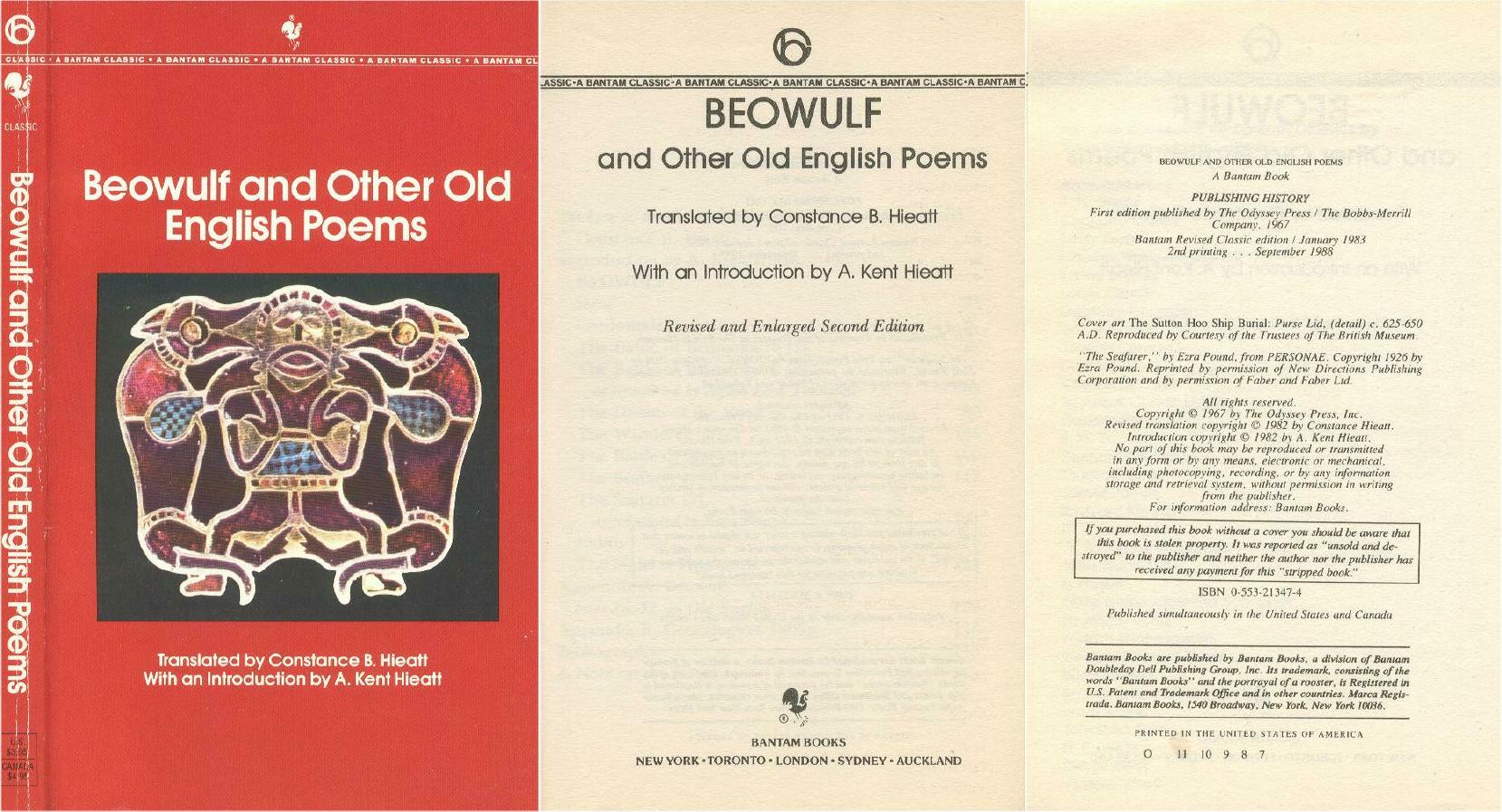
Naturally, I was curious as to the accuracy of these versions. I won’t ever truly know, because everything is a translation, but I thought I’d give an adult version a go. There’s so many versions out there, I think I’ll just try a different one every Middle Ages cycle. So I took the Constance B. Hieatt version with me to Atlanta and enjoyed it immensely, especially the little extras at the end.
The kiddo, of course, keeps asking me why we are using “fake stories as lesson books, they aren’t real stories mother!” I keep telling her, very ineloquently, that these stories help us understand the people who told them. Read them to her as bedtime stories and naturally she’s thrilled at the excitement of them.
We’ll collect more versions over the years and by the time she is grown she will know the story well – and remember it. Next go around we’ll even tackle it in poem form, and eventually we’ll read Gardner’s Grendel.
Do you have any favorite versions of Beowulf? Or, more importantly, do you know any great stories of the time period that should not be missed?
The Vikings Take Over Our Library
 As everyone else heads back to school, I looked over the last month and realized we really did treat the hottest months of the year like a summer vacation this year… mostly lolling around the house between events, taking extra naps after our dance parties in the living room, and mostly hiding our pasty skin from the hot, Texas sun. So I tackled cleaning out the closets, while everyone else was out buying school supplies, and organized our life the way it has always been organized in my brain… in unit studies. Of course, that got me in the mood to really tackle “school time” with more vigor and this last week or so we jumped back into the swing of things with Ancient Greece and Rome and then The Vikings and the Celts.
Viking Ships at Sunrise by Mary Pope Osborne was next in our Magic Tree House Adventures. We have not acquired the Viking research guide yet, but I believe there is one. We also re-read DK’s Eye Wonder Viking book, we had read it once before while perusing the exciting world of piracy, and a little repetition is good for a kiddo.
 But the really exciting book for this particular unit study was The Hero Beowulf.
Eric A. Kimmel’s retelling of Beowulf is a pretty neat picture book add on for little people. It’s illustrated by Leonard Everett Fisher and is complete with an author’s note about the original poem in the back. Beowulf, after all, isn’t just a monster myth, it’s the “oldest surviving epic poem in English literature,” all the way from the sixth century, to your hands now.
I can’t reiterate enough how much the classical education style appeals to me by teaching so much history through the other subjects… or rather teaching all the other subjects by tackling history so thoroughly. I love that there are so many resources, like Kimmel’s picture book, to make the tales and the culture more real and the epic poem more accessible when the time comes to tackle the original work; because in classical education everything repeats at a higher level over and over again.
After reading The Hero Beowulf, kiddo ran to grab other books with Viking ships on them and said, “Look mommy, more Beowulfs!” So she doesn’t entirely get it yet, but hey, she’s two.





 Anakalian Whims