Beauty in the Math
As a homeschool mom, I’ve been teaching math every day since 2017 when my oldest officially started first grade. We did Math-U-See Alpha through Pre-Algebra with steady diligence. When we finished the curriculum for the school year, we often used another to review. For years we had colorful, used copies of Singapore (1A-6B) to ensure there were no gaps in our learning. It wasn’t necessary, we just liked it. My oldest also loved reading Life of Fred books for fun until about a year ago when she grew as impatient with them as I have always been. We feel they make great supplements if your kid is into them, but they aren’t really a complete curriculum. (My husband and I honestly don’t understand how anyone learns anything from them at all.) With all this math drilling, I have always passionately felt like I needed to have books that kept that spark–the love of the beauty of math–alive in our home. It’s easy to get lost in crunching numbers and forget that it’s fun to play with numbers, to entertain ideas, and to marvel at the patterns.
Books that have helped me maintain that in the younger years were things like Swirl by Swirl, Blockhead, the Sir Cumference series, The Lion’s Share, and many more. I collect math picture books and biographies of mathematicians for kids like Michael Phelps collects Olympic medals. I love them and I love reading them to my kids. We enjoy Penrose the Cat and Bedtime Math: A Fun Excuse to Stay Up Late. I have a more MathStart picture books than I can count. Not really, Anno taught us to count pretty high. But as my oldest got older, I realized I needed to have more than just picture books to keep that love for math alive.
We started in middle school with books on fractals. She had already read Mysterious Patterns: Finding Fractals in Nature by Sarah C. Campbell, but we needed more. A friend recommended Lisle’s Fractals: The Secret Code of Creation and we ate that up. It’s so beautiful. I even bought and read Mandelbrot’s The Fractal Geometry of Nature from the 70’s, for my own personal amusement.
Then I became even more devoted to being purposeful in adding math books to our history and science reading. Zero: the Biography of a Dangerous Idea by Charles Seife was a fun one, and I recommend it for 7th and 8th graders tackling Algebra I for the first time. Learning about the beginnings of things, when the world wasn’t quite sure what to make of a concept, is always exciting. Adding living books to a student’s math studies is what I think is greatly missing from the public school system’s approach to math education in the upper grades. As a society we’re helping elementary students get excited with great picture books like The Boy Who Loved Math and then we leave them hanging once they hit Algebra. Books like Derbyshire’s Unknown Quantity aren’t being touched until college, if at all.
Just this week we finished A History of Pi. Beckmann’s writing isn’t as thrilling as Siefe’s, and he often goes on tangents about governments he doesn’t like, showing some interesting biases that made my 9th grader roll her eyes, but I’ll still take his passionate sometimes wrong hot takes over a boring textbook that never mentions the history of 3.14 and how it came to be what it is today.
Once you dive into the world of living math books, it’s actually more difficult to find someone dispassionate about their topic. Francis Su in Mathematics for Human Flourishing also has several political asides while arguing for math bringing virtue to those who study it. While it wasn’t my favorite of the math books I’ve read and I won’t be assigning it, it helped me identify and articulate some of my goals as a math teacher.
What math or math history books have you read that have inspired you as a teacher or student? Books that made the beauty of math shine for you?
(As an Amazon affiliate I earn from qualifying purchases.)
Fibonacci
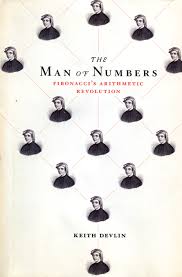 Title: The Man of Numbers
Author: Keith Devlin, PhD
Publisher: Walker & Company
Genre: Math History
Length: 183 pages
Swirl by Swirl – a child’s picture book – is where it started. We checked it out from the library once, then twice, and finally again and again. It’s about the Fibonacci sequence found in so many spirals in our natural world. We love it. Of course, it has a bit in the back about the Fibonacci sequence and the math involved, and that’s cool too, something to instill in young minds so that the re is familiarity with the topic before they begin Algebra in their tweens.
Of course, at some point I picked up The Pythagorean Theorem, and there Posamatier mentions Ptolemy and his great work The Algamest as well as Fibonacci’s Liber Abaci. Naturally, I requested these at my local library. “There’s a book about Fibonacci called The Man of Numbers that’s here if you want to read that while you wait for the others to come in,” she told me. Yes, yes, I would like to read that while I wait for the others.
I checked it out.
I ended up starting and finishing it, however, in one sitting while my kiddo made use of the sixty minute literacy computer session I allow her if she’s been good prior to coming to the library that day. It was good. Quick. Informative. And of course, just made me want Liber Abaci even more.
Devlin gives you all the necessary history in the concise nature of a mathematician. He even laments how most mathematicians are concerned about the math and the theorems and not necessarily who originally came up with them or their history, causing much of the history surrounding mathematical ideas to be lost or misconstrued. Who cares? It’s about the numbers.
I care. Historians care. We don’t care as much about the numbers as we do about the theory, the philosophy… we care about math’s heritage more than the practice of being all mathy. At least that’s how I feel. I’ll leave number crunching to my husband and daughter – I’ll just be able to tell them who came up with that particular way to crunch.
With all this caring comes the discovery that Fibonacci’s name wasn’t even Fibonacci. Devlin recounts the fact that the man’s name was Leonardo and he hailed from Pisa. Leonardo Pisano, as the people of that time and culture would say. But he referred to himself as fillies Boracic, “son of Bonacci.” Yet, his father’s name wasn’t Bonacci, so people assumed he meant that he was of the family Bonacci… the Bonacci family evolved and later historian Guillaume Libri coined the name Fibonacci. Hundreds of years later. Leonardo was renamed Fibonacci in 1838.
Fibonacci also referred himself as Leonardo Bigolli… a named once translated would be “Leonardo Blockhead.” Though, Devlin asserts, it’s doubtful that Fibonacci was calling himself a blockhead.
 That brings us to our latest picture book selection… Blockhead: the life of Fibonacci. This delightful picture book was written by Joseph D’Agnese and was illustrated by John O’Brien. Even though there’s a lot we don’t know about Fibonacci’s real life or how he came to discover his mathematical findings the way he did – it’s fun to imagine what his life was like and where he might have come up with his self-proclaimed nickname “Bigolli.”
For good measure, we re-read Swirl by Swirl afterward and are looking forward to memorizing a few things in the upcoming months.
The first is from Brahmagupta (quoted in Devlin’s book):
“A debt minus zero is a debt.
A fortune minus zero is a fortune.
Zero minus zero is a zero.
A debt subtracted from zero is a fortune.
A fortune subtracted from zero is a debt.
The product of zero multiplied by a debt or fortune is zero.”
The second are the first ten numbers in the Fibonacci sequence: 1, 1, 2, 3, 5, 8, 13, 21, 34, 55.





 Anakalian Whims