Passion Without Boundaries
Re-experiencing the Brontë Sisters, Part Two
I am re-reading Wuthering Heights, and doing a slow study of the Bronte Sisters. I have decided to give myself no deadline and maintain personal permission to read whatever I please between my studies. (Part One to this little blog series I am attempting may be found here.) I learned long ago, when it comes to a blog series, not to force myself into a formulaic mold or dictate a strict schedule or I would set myself up to fail. I love my readers and want to respect their time and curiosity, but also, I write for me as a thinking process and this blog has been (over the years) a way to grow as a writer, a way to grow as an author, a way to grow as a human, and sometimes a way to pay an electricity bill. It hasn’t done that last bit in a long, long time, as I went un-monetized for nearly a decade, but once upon a time I did rely on my blog to keep on the lights.
Although I hadn’t picked up Wuthering Heights to read in quite some time, I had several copies in various editions on my personal shelves, none of which were the copy I read out of in high school or my early twenties. I have a tendency to donate things I’m not reading and acquire different copies with different editorial essays than the other editions, because I happen to enjoy reading essays. Even bad ones with bad takes I will find entertaining sometimes. This time I am reading out of The World’s Popular Classics Art-type Edition. They were inexpensive hardbacks made in the 1940s and 1950s, printed in New York, and mine has a little burgundy spine. I plucked it out of a library sale for $2. It used to belong to one Carolyn Coppock. She left her bookplate on the front endpapers. It opens with a 1930 Editor’s Introduction that discusses its uniqueness in literature, describing “the peculiar quality of its power.” (pg 7)
As an older adult, I am having a much harder time getting into Wuthering Heights. As a child and teen the intrigue for me was: Will this be a Human Redemption story? Or a Kill the Monster story? And it is, in fact, neither. (Or both?) Well, not in the expected way, at least. I remember loving it because it was neither and it managed to surprise me. I didn’t see the cautionary tale coming and I didn’t recognize the redemption arc for the secondary characters. As a child, I wanted the redemption story, the knowledge that everyone can be saved tucked neatly in my back pocket. As a teenager I was more of a cynic and wanted the monster vanquished and judgments doled out. As a forty-one year old, I’m just too tired for all these people. I don’t want anything to do with any of them… I don’t want to save them or slay them. I want to walk away, close the book, and read something else. For that reason, I have been camped out re-reading Wuthering Heights for nearly a month, when normally it would take me a few hours. I keep putting it down in annoyance rather than feeling the rush of curiosity I had when I read it for the first time. I keep ping-ponging away from the characters to see what others have to say about them in essays. An easy task because the author herself didn’t give us personal access to them, but told us the story through the gossip of several first person narrators, with varying levels of reliability. This writing tactic is equal parts annoying and clever.
“Not Nature, but Fate, seem to take the pen from the writer, and write for her,” H.W. Garrod states. Pinning down a “review” or even a “literary criticism” of Wuthering Heights that feels true and accurate is a struggle because the entire work feels feral, but it’s obviously a controlled feral, so you know there is a purpose if only you can step away from the roller coaster ride long enough to look at it clearly. The characters seem to fight against the pen itself, wriggling and writhing under the documentation of their actions. Perhaps that is why everyone focuses on the madness of the Brontës, even Currer Bell (the brother) touches upon Emily’s taste for the grotesque and praises Sidney Dobell for recognizing his sister’s ability to look into the human psyche, her desire to see things that are criminal as not necessarily rooted in evil. The sisters not only attacked “societal norms” (as so many critics say) but also seemed to have a complicated relationship with the literary tradition, flirting with it while attempting to disregard it. “Neither Emily nor Anne was learned; they had no thought of filling their pitchers at the well-spring of other minds; they always wrote from the impulse of Nature, the dictates of intuition, and from such stores of observation as their limited experience had enabled them to amass.” (pg 20)
The Editor’s Preface is also written by Currer Bell. There he discusses the wildness of the moors and the story. He warns the reader of the “perverted passion and passionate perversity.” He goes on to explain that “the single link that connects Heathcliff with humanity is his rudely confessed regard for Hareton Earnshaw–the young man whom he has ruined; and then his half-implied esteem for Nelly Dean. These solitary trains omitted, we should say he was child neither of Lascar nor gipsy, but a man’s shape animated by demon life–a Ghoul–an Afreet.” (pg 25) Indeed, the work itself is “swarming with ghosts and goblins!” despite no goblins or ghosts in the traditional sense being present, but simply grotesque carvings in the architecture, bitter swirls of wind, and intrusions in dreamscapes. In typical Gothic fashion, there is “atmospheric tumult” and hints at the black arts, while the moors (symbolizing hell, the wilderness, the damned, the otherworldly) intermingle with the depictions of the characters’ souls.
I tossed the book in a bag and abandoned it for a week or so while I laid out Geometry lessons in my mind. One of the hazards and joys of being a homeschool mom is having many ideas crashing around in your head at once. I love continuing my education by educating my children and was willing to abandon Wuthering Heights completely as something “been there, done that” in my life, but was spurred on by the atrocities of the new movie trailer, featuring Margot Robbie and various other actors, sticking their fingers in each other’s and their own mouths, I had to revisit this “greatest love story ever told.” (The algorithm has me all wrong on this point, because I keep seeing these ads on the internet and I do not want to be seeing these ads on the internet.) I needed to understand where the disconnect lay between the story I thought I read and the one being advertised, because to me Wuthering Heights is as much a love story as Romeo & Juliet. Making that comparison it how I figured out why so many people have conflicting reactions to Wuthering Heights.
I suppose it is time for me to clarify. My hot take on Romeo & Juliet is that it is equal parts cautionary tale and satire. Romeo & Juliet, I think Shakespeare is telling us, is what happens when two teenagers deep dive into feelings without restraint or wisdom: everybody dies.
Wuthering Heights reads the same way for me. Unbridled passions, “love” without boundaries, destroys everyone around you and leaves destruction in your wake. The only hope of redemption is for the future generations after you’re dead because your passions gave way to chaos. Wuthering Heights remains, for me, a cautionary tale. It’s not a romance at all, as good, truth, and beauty was never part of the Heathcliff and Catherine equation. Instead, Heathcliff and Catherine embody toxic power struggle dynamics, passion for the sake of passion, and the two being in remotely the same vicinity of each other makes everyone worse.
We see Catherine’s passion being set up for sinful rage in the first hundred pages as Catherine “never had the power to conceal her passion, it always set her whole complexion in a blaze.” (pg 96) It reminds me of Susanna Kaysen’s observations in Girl, Interrupted: “Crazy isn’t being broken or swallowing a dark secret. It’s you or me amplified. If you ever told a lie and enjoyed it. If you ever wished you could be a child forever.” Catherine seems to enjoy her manic episodes and passionate rages and reminds me of my toddler who screamed at me mercilessly the other day because she wanted to wear her shirt on backwards. The character has bought the lie that feeling of any kind is what makes us alive, even if what we’re feeling and how we’re choosing to show that feeling to others, is leading us down the road to death.
Then we have Heathcliff, neither man nor monster, but for sure a monstrous man. “Heathcliff to me is a sort of sprite of the bergs, a cousin to Mary Shelly’s monster, a creature of the northern mists, a gnome,” Philip Larkin wrote to Monica Jones in 1955. Mary Shelly’s Monster was created. Beowulf’s Grendel simply was, Heathcliff, we could argue was both born monstrous and created to be more monstrous (“total depravity of man” theology plus abuse and ill treatment he received). Heathcliff is where the monster metaphor meets the psychological truth of human nature. Having re-read Count of Monte Cristo last year with my oldest daughter, I now see a lot of the similarities in the revenge stories. Both go away and return better educated and financially stable, but that education and financial gain combined with their anger becomes weaponized and ruthless. On page 130 on my edition, Heathcliff is described as “not a rough-diamond–a pearl-containing oyster of a rustic: he’s a fierce, pitiless, wolfish man.” As humans we want so badly for education and money to refine character, but character is refined by Jesus Christ, not worldly gains.
What makes the book worth reading is the redemption of the next generation. Despite Heathcliff’s abuse, the cycle was broken, generational curses do not have to exist. Human beings are free to choose the gift of peace. I’m not done re-reading the book, but I am seeing the light at the end of the tunnel while recalling what I do remember of each character’s ending.
(As an Amazon affiliate I earn from qualifying purchases.)
“Emptiness and boredom: what an understatement. What I felt was complete desolation. Desolation, despair, and depression.
Isn’t there some other way to look at this? After all, angst of these dimensions is a luxury item. You need to be well fed, clothes, and housed to have time for this much self-pity.”
― Susanna Kaysen, Girl, Interrupted
Jane Austen’s Use of Satire In Northanger Abbey
by: A.Z.K.R., from Tales of Porcelain Thrones: Middle School Edition
Jane Austen was an author in Regency Era England. She wrote satirical novels and enjoyed mocking the frivolities of English society and “the Novel” itself. Satire as defined by Webster’s New Word Dictionary is a literary work in which vices and follies are held up to ridicule, satire doesn’t have to be funny, but Austen’s work definitely is.
Jane Austen was born nine months after the beginning of The American Revolution, she had several brothers, and one sister (Leithart 1). Austen was an avid reader and loved novels, but she still found them a little ridiculous. Austen wanted her books to reflect the real world, showing real dangers. Instead of writing about bandits and murderers, Jane’s villains included liars and social climbers. Jane Austen was fighting against stereotypical heroines, bizarre and dangerous social expectations, and the problems of treating novels like real life. Yet, ironically, Jane Austen’s novels were realistic, which was sort of the point. Jane Austen wrote about real problems in a funny way. Even for someone who does not live in Regency Era England, Austen’s characters represent real types of people and can help give young women the wherewithal to avoid the Big Bad Wolves (John Thorps) of the world and find their very own Prince Charming (Henry Tilney).
Austen starts her book Northanger Abbey with a mockery of a novel’s heroine. Austen does this by describing her heroine, Catherine Morland, as normal, and “almost pretty,” emphasizing her normality by saying her family was neither rich nor poor, her father was a clergyman, neither of her parents were abusive, and her mother was—unfortunately—alive. Catherine loves reading novels, but not history books. These are all in direct contrast to the kinds of heroines Catherine herself reads about over the course of the book, stories such as Ann Radcliffe’s The Mysteries of Udolpho where the heroine, Emily St. Aubert, is beautiful, orphaned, and well versed in the arts. Catherine’s neighbors, the Allens, a childless couple of some fortune, decide to take sixteen year old Catherine to Bath. Bath is a tourist destination in England, complete with spas, parties, and shopping centers, which served many as a ‘coming out’ excursion (Cunliffe 41). Austen was able to write about Bath well because she lived there. Even while making fun of novels, Austen used some of their troops to her advantage, such as having a relative or family friend taking a young heroine on a coming out trip.
In English society one couldn’t just walk up to someone and talk to them, you had to be introduced by someone you already knew, forcing everyone to rely on family, family friends, other acquaintances, or the master of ceremonies. At Catherine’s first ball Mrs. Allen laments constantly that they don’t know anyone of consequence, while Catherine wishes they knew anyone at all (Austen 30).
At Catherine’s second ball, the master of ceremonies introduces her to Henry Tilney. Halfway through a conversation that they were having, Tilney interrupts by saying, “I hitherto have been very remiss, madam, in the proper attentions of a partner here; I have not yet asked you how long you have been in Bath.” Jane Austen mocks polite society through Henry Tilney’s comical performance of asking Catherine all the ‘right’ questions, such as ‘how long have you been in Bath,’ ‘do you enjoy Bath,’ ‘Is this your first ball,’ et cetera. Tilney, although he thinks society is silly, still follows its rules, and remains a respectable young man.
Jane Austen uses Catherine’s naivety to point out how unspoken rules can be extremely problematic, and even dangerous. The real dangers of society were people like the Thorps, social climbers and narcissists, who used these unspoken expectations to put other people in sticky situations. The Thorps, through a series of blunders, suppose that the Morlands have lots of money. They had already met Catherine’s older brother, James, at Oxford. Upon meeting Catherine with Mrs. Allen, they supposed that she would receive the Allen’s fortune due to the kind way the childless Allens were treating her. They catch their mistake when Isabella Thorp becomes engaged to James Morland and she receives a letter about James’s future income, one that sounds reasonable to the Morlands, but is disappointing to the gold digging Thorps. Isabella attempts to break off the engagement to run off with Henry Tilney’s older brother, Captain Frederick Tilney, but this proves to be her downfall. Captain Tilney, unlike his brother, is a rake, he doesn’t care about any of societies rules, and breaks the social customs that were actually worth keeping.
Because the Thorps thought Catherine so rich, and John Thorp planned to marry her, and they gossiped about her wealth in order to make themselves look better. At a theater, they brag to General Tilney, Henry’s father, who then wished to have Catherine married to his son. In order to empress her he invites her to stay at his home, Northanger Abbey for a holiday. Catherine is naive and unaware of the Thorps deceptions until she receives a letter from her brother explaining Isabella’s behavior. She is totally unaware that money is the reason General Tilney is interested in her alliance. Henry however is aware that his father cares a great deal about money, and isn’t sure why he is interested in having Catherine for a daughter-in-law. With these events Jane Austen is showing us the true the ‘villains’ of society, and how Catherine was totally oblivious to their presence. She was so caught up in the idea of bandits and mysterious murderers that she could not see the danger at the end of her nose.
‘The Novel’ becomes increasingly important in this part of the story, as it leads to Catherine’s embarrassment several times over the course of her stay at Northanger Abbey. Catherine’s preconceived notions about abbeys, established while reading gothic romances, leads her to disappointment when discovering modern renovations inside the home of her hosts. She fails to find secret passages, or incriminating letters, as the heroine Adeline did in Radcliffe’s Romance of the Forest, in her guest room and, worst of all it leads to a terrible confusion regarding the cause of Henry’s mother’s death. General Tilney is harsh, but not villainous. He takes good care of his servants and his estate, hence the renovations. He wants his children to marry well, thus his interest in Catherine’s supposed inheritance. General Tilney’s stony demeanor, combined with Catherine’s overconfidence in the reality of novels, leads her to make the worst of blunders: she makes assumptions. She speaks briefly to Miss Tilney, Henry’s sister, and finds she was not at home when her mother died, leading Catherine to assume no one was at home when Mrs. Tilney died. Catherine suspects foul play. Her blunder is discovered when she sneaks into Mrs. Tilney’s old room and is discovered by Henry. When she admits her thoughts, he admonishes her. He and his brother had been home when his mother had died, and she had perished of sickness rather than ill treatment. General Tilney’s behavior had nothing to do with skeletons in a closet. Catherine’s gothic fantasies stop here; she has learned and grown. The dangers are not ended, though.
The Thorps, angry due to their hurt pride, speak to General Tilney again and tell him not only that the Morlands are not rich, but that they were exceedingly poor, projecting their own flaws onto Catherine. General Tilney, in a rage, comes home and sends Catherine off in the middle of the night without a chaperone or money. The situation is quite unforgivable, but Catherine doesn’t yet understand and cannot fathom what she has done to displease General Tilney. Henry later comes to her house to explain and offer his hand in marriage, not just because he loves her, but because he feels responsible due to his father’s behavior. General Tilney, of course, does not approve.
Jane Austen, for all her realism, never leaves her stories with sad endings. Henry’s sister, previously forbidden, marries the man she loves, and by a novel twist of fate, now financially outranks her father. She demands that General Tilney allow Catherine and Henry to marry, and her will is done. Jane Austen defends the ending of her own book, at the beginning of the story, while talking about novels in chapter five. “For I will not adopt that ungenerous and impolitic custom so common to with novel-writers, of degrading by their contemptuous censure the very performances, to the number of which they are themselves adding— joining with their greatest enemies in bestowing the harshest epithets on such works, and scarcely ever permitting them to be read by their own heroine, who, if she accidentally take up a novel, is sure to turn over its insipid pages with disgust. Alas!” (Austen 42) Jane Austen is talking about Catherine’s own habit of consuming dramatic stories, but she’s also explaining here, that despite her book calling out the faults in these stories, its still a novel its self.
The story is funny, you can’t help but laugh when Catherine finds not evidence of murder, but instead laundry receipts in the cabinet. This is not was makes it satire however, Jane Austen books are satire because of exactly how it is funny: elements of the story mock society, and express its difficulties, she’s calling to attention problems regarding expectations when they are appropriate and when they are silly. We’re lucky to have Jane Austen doing this is a humorous manner as opposed to long dry articles listing the problems of society like a grocery list. Not all satire is presented in a comical fashion, but a point is better made when it provokes some kind of emotion, either anguish, or in Jane Austen’s case, joy.
Works Cited
Austen, Jane. Northanger Abbey. Signet Classic, 1996.
Cunliffe, Barry. The Roman Baths at Bath: Authorized Guide Book. Bath Archeological Trust, 1993.
Leithart, Peter. Jane Austen. Thomas Nelson, 2009.
Radcliffe, Ann. The Mysteries of Udolpho. Penguin Books, 2001.
Radcliffe, Ann. The Romance of the Forest. Oxford University Press, 1988.
The Year in Books
We read a lot. We are homeschoolers, so of course we spend a lot of time reading. I was at the pediatrician years ago with my oldest, an old man I didn’t know who didn’t know me… he complimented how articulate and well mannered my child was and then found out we homeschooled and immediately started lecturing me on the dangers of screen time and video games. I said, “Sir, we don’t even own a console.” He would not let up. He was convinced that being homeschooled meant we sat around and did nothing but watch TV and played video games. Funny thing is, now we don’t even own a TV. My teenager will tell you, we don’t have time for TV, because there are so many things to read. We play outside, we hang out with friends, we play musical instruments, we participate in clubs, she flies planes, and we read and read and read.
A lot of our books we read together, some (not not many) I read alone. This year (2025), we read:
- Writing to Learn by William Zinsser
- Napoleon’s Buttons by Le Couteur and Burreson
- Desiring God by John Piper
- The Magnificent Ambersons by Booth Tarkington
- The Scarlet Letter by Nathaniel Hawthorne (I actually read two different editions back to back with notes, as I was teaching it.)
- The Bringer of Fire by Oehler (I did not let my teen read this one)
- Why Read Moby Dick? by Philbrick
- Pride & Prejudice by Jane Austen
- The Communist Manifesto by Karl Marx
- The Peter Rabbit Library by Beatrix Potter (this is an ongoing favorite and I love having babies to re-read these to)
- Why? by Anne Graham Lotz
- Rapunzel (all the versions, every one we could get our hands on)
- The Adventures of Tom Sawyer by Mark Twain (another one I enjoy teaching to more than my own kids)
- Purgatorio by Dante
- The Great Gatsby by Fitzgerald
- All the Arnold Lobel picture books, including a few new ones I had not owned when my oldest was small.
- Jane Austen by Peter J. Leithart
- Hank the Cowdog by John R. Erickson (my son is obsessed with the books and the podcast, I think we have them memorized now)
- New Essays on The Great Gatsby by Matthew J. Bruccoli
- The Los Angeles Diaries by James Brown
- I Know Many Songs… by Brian Kiteley
- The Parrot’s Lament by Eugene Linden
- On Reading Well by Karen Swallow Prior
- Common Arts Education by Chris Hall
- You’re Not Enough (and That’s Okay) by Allie Beth Stuckey
- The Count of Monte Cristo by Dumas
- Everything we could get our hands on by Trina Schart Hyman because we love her.
- Midnight at the Bright Ideas Bookstore by Matthew Sullivan
- The Enchanted April by Elizabeth von Arnim (an annual Easter tradition at our house)
- Gatsby’s Girl by Caroline Preston
- Animal Farm by George Orwell
- The Disappearing Spoon by Sam Kean
- The History of Rasselas, Prince of Abissinia by Samuel Johnson
- Under the Greenwood Tree by Thomas Hardy
- A Hobbit, a Wardrobe, and a Great War by Joseph Loconte
- Rebel of the Sands by Alwyn Hamilton
- The World of Pooh by A.A. Milne
- Lightfoot the Deer by Thornton W. Burgess
- The Pursuit of Love and Love in a Cold Climate by Nancy Mitford
- The Geography Behind History by W. Gordon East
- String, Straight-Edge, and Shadow by Julia E. Diggins
- Anne of Green Gables by L.M. Montgomery
- Dracula by Bram Stoker
- Hamlet by Shakespeare
- World Enough & Time: On Creativity and Slowing Down by McEwen
- The Discarded Image by C. S. Lewis
- Drake Hall by Christina Baehr
- Anne of Avonlea by L.M. Montgomery
- The Floating City by Pamela Ball
- Moth and Spark by Anne Leonard
- That Eye, The Sky by Tim Winton
- Socrates Cafe by Christopher Phillips
- The Chemical History of a Candle by Michael Faraday
- Beauty and the Word by Stratford Caldecott
- Under the Wide and Starry Sky by Nancy Horan
- The Great Divorce by C.S. Lewis
- Nathaniel’s Nutmeg by Giles Milton
- J.R.R. Tolkien’s Santifying Myth by Bradley J. Birzer
- Engaging the Christian Scriptures by Aterbury and more
- Journey Into Summer by Edwin Way Teale
- Kon Tiki by THor Heyerdahl
- Lethal White by Robert Galbraith
- Be Strong (Joshua) by Warren W. Wiersbe
- A Chant to Soothe Wild Elephants by Jaed Coffin
- Anne of the Island by L.M. Montgomery
- Sightings by Sam Keen
- Maisie Dobbs by Winspear
- Local Girls by Hoffman
- Early Christian Writings: The Apostolic Fathers
- Rosencrantz and Guildenstern Are Dead by Stoppard
- How to Teach Kids Theology by Luce and Williams
- Medea and Other Plays by Euripedes
- The Infinities by John Banville
- Climbing Parnassus by Tracy Lee Simmons
- How to Keep From Losing Your Mind by Hudson
- Sharing His Secrets by Vickey Banks
- Goblin Market by Christina Rossetti
- Uglies by Scott Westerfeld
- The Last Rakosh by F. Paul Wilson (straight to the nope pile)
- A History of France by John Julius Norwich (he is one of my favorite historians)
- Book Trails for Baby Feet
- The Halloween Tree by Ray Bradbury
- Don’t Mom Alone by Heather MacFayden (a gift from my midwife after having baby number four)
- The Fall of the Year by Dallas Lore Sharp
- The Natural History of Selborne by Gilbert White
- Heaven by Jennifer Rothschild (donated this too)
- Cultural Literacy by E.D. Hirsch Jr.
- Bringing Up Boys by James C. Dobson
- Ourselves by Charlotte Mason
- The Story of Holly and Ivy by Rumer Godden (we read this every Christmas)
- One Man’s Christmas by Leon Hale
- The Iliad by Homer (Fagles)
- Hallelujah by Cindy Rollins (another annual tradition)
- Quietly in Their Sleep by Donna Leon
- Easily 300-400 picture books because I have three children under five and that’s what we do for hours on end.
I purged a lot this year, as you can see there’s a lot of chaff in this list. But I found favorites I will re-read with every child as well. We’ve been purging a lot as our shelves are stuffed to the gills (about 22 seven foot units retired from Half Price Books) and then some. I decided I don’t actually need more books, I need to be more conscientious about curating the ones I have, so I’ve been donating hundreds of volumes I’m done with every year… but we still have a packed inventory, because we are homeschoolers and we are readers.
As for this year, I truly enjoyed the chemistry titles. I actually enjoyed teaching high school chemistry, especially with the literature bent, essay writing, and speech giving I required of the students. The kids had more fun with the labs, obviously, but Napoleon’s Buttons, Faraday’s papers, and The Disappearing Spoon are all keepers, for sure.
I got rid of most the contemporary fiction, and kept the classics. I loved The Scarlet Letter when I read it in high school and I loved it even more while teaching it. The book as a whole is so much richer right after reading Dante’s Divine Comedy. “The Custom House” introduction hits so much deeper as an adult.
What did you read this year? Were they re-reads or new reads? A mixture of both? What was your favorite? What will you read again every year?
The Camera My Mother Gave Me
I am buying my childhood home. My mother has passed and my father has remarried a wonderful woman for whom he bought a new place, a place for them to make their own. It is good for him to leave walls saturated with memories of my mother and her influence, but I didn’t want the house my parents built in 1986 gone forever. My dad packed the things that were most important to him and is leaving behind things that were just filler (I’m getting a new comfy couch from my Bonus Mom I’m super excited about). My mom had a lot of filler.
Since I’m the book lady, he left me most of their books as well. I already have well over 5,000 volumes in my house (I quit counting long ago and just focus on making sure they all have a place to live) and I have four children that I will be moving into a home built for a family of four total (it’s the same size as my current home, but actually has one more room, there was a lot of wasted space in these 1995 builds). So as I go through books, determining what to keep and what to purge, I’m stumbling through decades of reading–my mother’s reading, and my own.
The Christian prairie romances went first. I’ve never been interested in that genre, but it was my mother’s primary reading (I added some to the church library and sent some to be sold at Good Oil Days). I’ve gotten rid of most of the Christmas books, she loved anything Christmas. My church does a holiday market every year where they sell Christmas crafts, decor, and gifts to raise money for various things we cannot afford to do as a congregation. This last year we replaced the doors. The old building was desperate for functioning doors with no cracks or blemishes and the Christmas market afforded us beautiful, but simple, wooden doors to invite the public into our home away from home. My mother would be pleased that she contributed to that. I’m excited to keep the antiques, they aren’t valuable but they are titles we will read and share with our children. There’s a set of Mark Twain I remember well that I’ll “inherit.”
With all this sorting and purging going on at my Dad’s house (soon to be my house), I’m sorting and purging from my own home as well. Books I loved in my twenties just don’t mean the same to me now that I am a mother of four. When we first moved to this house my goal was to make sure there were never stacks of books anywhere (I failed), that every book had its own place on the shelf (I failed big time). I spent the last four years donating anything I read that I had no intention of reading again, mostly books I had acquired for free or cheap over the years that upon finally reading didn’t live up to my latest standards. But now, I’m getting rid of books I loved and just don’t need or want lying around for children to encounter.
So this week I donated The Camera My Mother Gave Me and Girl, Interrupted (and four bags of other things I can’t recall). I loved Girl, Interrupted when I first read it. I think I was nineteen at the time. Susanna Kaysen fascinated me with her angst, her institutionalization, her ambivalence, and finally her resolve… to not be crazy. I respected her final conclusion. At forty-one, I just don’t need that affirmation from her anymore… that we can be surrounded by insanity and decide to not allow ourselves to go insane (mental illness is real, but there are also some who drive themselves nuts out of selfishness and conceit, or giving in to their environment).
Later, when I was running the sociology section at Half Price Books, I stumbled across The Camera My Mother Gave Me. It is a bizarre memoir about Kaysen’s vagina. I was shocked, baffled, and completely riveted by the book. I remember being appalled that I couldn’t put it down. I probably would have kept it forever and maybe read it again years from now because I don’t remember much of it, but I don’t want my sons plucking it off the shelf as emerging readers. It would make an interesting story for a stand-up comedy routine–or their future therapist–so off to the Friends of the Library it went.
I have donated nearly 1,000 volumes every time I have moved. Often it’s a simple Marie Kondo moment, happily removing piles of things accumulated that I’m now happy to give away. This move hits different. Instead of just not wasting some box or storage space, I’m more focused on refining my library. I am actively curating a specific environment to nurture my children.
What books do you enjoy that you still choose not to keep?
All About a Face That Launched 1000 Ships
…And a Book That Launched 1000 Rabbit Trails…
Fall of 2025 has been the semester in which my 9th grader has been reading the complete and unabridged Iliad for the first time. We have read picture books, chapter books, and abridged works over the years (Sutcliff’s Black Ships Before Troy, beautifully illustrated by Alan Lee, was probably my favorite), but now we’re nearly in the big leagues (the real big leagues would be reading it in Greek, maybe one day…).
I have maintained my habit of reading something new alongside teaching something old to me over the years, and while re-reading Homer’s Iliad (and listening to the Ascend podcast episodes with the kiddo) I decided to meander through Helen of Troy: Goddess, Princess, Whore by Bettany Hughes. Meander is the most appropriate word because, like my blog, Hughes’s work frolics about joyfully and a little chaotically. It’s entertaining though repetitive, it’s amusing and long-winded.
Czarney Pies, a Goodreads user, reviewed:
“Helen of Troy: Goddess, Princess, Whore” is a scatter-gun, scatter-brained work that is nonetheless highly entertaining. Reading it is something like inviting your friends from your undergraduate years over for dinner, plying them generously with alcohol and letting them rant on about whatever literary or artistic idea comes into their minds. History students will express themselves on Beethoven. English lit graduates will give you their opinions on Rabelais while philosophy students will tell you what they think the Federal Reserve Board should do about interest rates. The cacophony is as joyous as it is incoherent. As Hughes herself notes at one point that she may be presenting “a mangle of literary and social references (with a sprinkling of fanstasy [sic]) rather than historical fact.” (pp. 285- 286)
Quite frankly, that is the best description of Hughes’s work that could ever exist, in my opinion. I love this paragraph from Czarney Pies’s review so much I copied it –TWICE– into my commonplace journal. (I didn’t realize I was copying it for a second time until I was halfway through doing it and had a déjà vu moment.)
Pies makes you want to go to that party, and Hughes takes you there. Whether she intended it or not, her Helen magnum opus would be served best over a bottle of wine and a group of chatty nerds. While reading I found myself looking up a lot of paintings I had never seen and re-reading plays I hadn’t touched in decades.
My first rabbit trail was a quote on the top of page eight from Euripides, and I immediately stopped and read Medea and Other Plays from the Oxford University Press World’s Classics series. Translated by James Morwood, the collection highlights the flaws and follies of Grecian women in mythology and includes the plays Medea, Hippolytus, Elektra, and of course, Helen. I had read Medea before and knew about the Lilith/Lamia fashioned child-killer, but Euripides’s depiction of Helen of Troy was new to me. In this version, the adulteress of Troy is presented as a more palatable character who was squirreled away in Egypt for an entire decade long war and was never with Paris at all. The Helen we see in Troy was a phantom Helen created by the gods, and is a victim of circumstance.
Hughes pulls out every myth, legend, play, painting, poem, and tapestry ever known throughout history and discusses them thoroughly. She talks about the things most culturally literate people know off hand and things that only die-hard ancient literature or history buffs have researched. Sometimes treating Helen like a real person, the book takes on a biographical form. Sometimes Hughes detours into fictional fandom and muses on possibilities with whimsy. At all times I can picture Pies’s fictional party spitballing ideas about Helen of Troy, gossiping like pick-a-little-ladies and debating like Mensa meeting attendees.
(As an Amazon Associate I earn from qualifying purchases.)
A Life With Anne
When I was a child I adored the Anne of Green Gables series. I still do. But the height of me reading through the series was between the ages of 7 and 10, when I knew I could read all eight books in the 19 hour drive from Houston to Denver. I was an avid and precocious reader back then. Now I’m just avid. So color me surprised when I tried to introduce my oldest daughter to Anne during her elementary school years and the book fell flat for her. What we discovered, now that she is totally smitten with the series, is that she didn’t understand the appeal in a character who just sounded exactly like herself. For real, people have commented on how much my kid reminds them of Anne her whole life, but this year is the first year my darling girl has truly delighted in it.
I, apparently, had introduced my dear girl to Anne too soon which was mistake number one regarding my favorite auburn haired heroine (and my life for that matter, despite her being called my mini-me all the time, she is not–in fact–very much like me at all). Mistake number two was assuming everyone else I knew was thoroughly acquainted with her. So when we decided to choose Anne of Avonlea as our first San Salvatore Book Club pick, we were shocked to learn that these women we love and admire had actually never read Anne of Green Gables (some, not all, had watched the Megan Fellows series).
Naturally, I began to approach it as I do teaching. Having been raised on Anne’s beloved Miss Stacy being presented as the ideal teacher (which grew into a love of most things Charlotte Mason as I researched homeschool options), my notes always either begin or end with these questions: What did you notice? What did you wonder? What did you discover? What, if anything, did you find good, true, or beautiful about this book? Are there any other stories you’ve heard or know or read that are echoed in this story?
This post, specifically, is on the first two books and the things I noticed reading the Anne books as a woman in my forties instead of as a girl with a wild imagination.
I love how L. M. Montgomery begins both books with an exotic character. In the first, Anne is the exotic, and in the second Mr. Harrison is our foreign, otherworldly character. He is from elsewhere, new to the neighborhood, and comes with an unruly parrot named Ginger, who reminded me of my Uncle’s macaw, Chicken. Just as Anne asked to called Marilla her aunt in the first book, the opening sequences of Anne of Avonlea includes Mr. Harrison mistakenly calling Marilla Anne’s aunt. In Green Gables, Marilla shuts it down as a falsehood, and in Avonlea, Anne does the same. Harrison and Anne’s exchange regarding the cow invasion mirrors Anne’s first meeting with Rachel Lynde. In the first book, Anne is the outsider throwing a temper tantrum, in the second Anne is established as a true citizen of Avonlea as she suffers a newcomer’s temper tantrum. Montgomery’s alluding to her previous work is beautifully done.
As an adult, I also delighted in Harrison’s stab at Anne’s reading “yellow-jacket” novels. As a child I could visualize the novels perfectly because I grew up haunting antique stores and their book corners. Often, as a child, books were not worth my notice unless they were old, dusty, and had a faint smell of vanilla and moth balls (bonus points if there was a lingering odor of pipe tobacco). As a retired bookseller, this portion hit a bit differently and I laughed out loud. Yellow-jacket (“yellowback”) novels were “railway novels.” They were the equivalent of NY Times Bestselling thrillers or romances perched in a kiosk at an airport terminal (I’d say “today” but I really don’t fly much and I don’t know if people buy airport books these days). They were sensational fiction, much like dime novels, brightly colored (usually yellow) with ads on the back to cover the costs of the printing. Often they were simply cheaper reprints of already popular books. They were in direct competition with the “penny dreadfuls” G. K. Chesterton discusses in his essay A Defense of Penny Dreadfuls. Dracula was one such publication.
I also noticed, diving into the series as an adult, how much the Anne series had saturated the corners of my brain. In my late twenties I wrote two books in what is called The Bookshop Hotel series (book three was written just after I turned thirty, books four and five are still sitting unpublished on my computer). I wrote them under duress and my brain was completely fried, grasping at straws. One of my character’s names is Maud Montgomery. A few years ago I was asked by a reader if I had done that on purpose. I can firmly say, no, I did not. But reading now, I see how my mind had pulled something from a dark corner, something it had known and forgotten, and ran with it. L. M. Montgomery (Lucy Maud), called Maud by her friends, was a deeply religious person who functioned as a caretaker for her mentally ill husband. I can see in hindsight why my mind pulled this name out of the abyss during that time, as I thought I was the caretaker to a mentally unstable alcoholic husband myself. (Turns out, I was wrong, I was actually just a narcissist’s favorite toy. Thank God, that part of my life has passed.) The thread that holds so many of these episodic adventures in Avonlea is often the nuggets of wisdom and religious belief that seep through the pages, the empathy and compassion, the search for the divine, the delight in creation and whimsy.
Another strange moment for me was when I read in Anne of Avonlea:
“I think an old, deserted house is such a sad sight,” said Anne dreamily. “It always seems to me to be thinking about its past and mourning for its old-time joys.”
Leave it to my exhausted brain to also personify a house in my Bookshop series. What we read in childhood truly shapes the way we think.
I was amused to discover how much my parenting seemed to mimic Marilla’s and startled to get to know Miss Stacy as an adult reader. I have been homeschooling my children from the beginning. Public school was never going to be an option for us for many reasons, but as I was reading about Anne’s favorite teacher, whom I had read about hundreds of times in second and third grades, I realized that she embodies all my favorite elements of classical British educators during the turn of the century. More specifically, she has so many qualities Charlotte Mason hailed as correct.
Charlotte Mason lived from 1842-1923 and was known as a turn of the century educational reformer. She established the House of Education in Ambleside in the late 1800’s, which focused on teaching classically but with the added emphasis that “children are born persons.” She wrote a Home Education series I have read several times. When I was using Classical Conversations as a co-op opportunity for my oldest, people often told me I was too “Charlotte Mason.” (Classical Conversations is a nationwide neo-classical homeschool organization based out of North Carolina. There are things I love about their curriculum and things I could do without.) When we tried to connect with Charlotte Mason homeschoolers, die-hard AmblesideOnline families, we were often told we were “too neo-classical.” I now see the truth: we were never Classical Conversations people, nor were we Charlotte Mason followers… my aim has always been Miss Stacy. We are Miss Stacy homeschoolers! We do nature studies, literature based learning, Euclidean geometry. I still use McGuffey’s Readers and Susan Wise Bauer material, while adhering to a lot of AmblesideOnline’s schedules. We have always narrated, as advised by Cindy Rollins and Karen Glass. But in all these details, what I chose to use and what I have discarded, I have shaped my entire homeschool culture off a picture in my mind of the perfect educator–Miss Stacy!– and I wasn’t even aware I was doing it.
My daughter and I read Anne of the Island together, and we will resume the rest of the series soon, but took a break to focus on Homer’s Iliad. I am looking forward to seeing how Anne of Windy Poplars measures up to my memories of it being the best in the whole series, and what other things I notice and wonder, as someone who has been noticing and wondering for a much longer time than when I read it last. I’m excited to see what my real life Anne-girl thinks of her literary counterpart as she reads each book hereafter for the first time as well.
(As an Amazon Associate I earn from qualifying purchases.)
Einstein: His Life and Universe by Walter Isaacson – A Review
 Title: Einstein: His Life and Universe
Author: Walter Isaacson
Publisher: Simon & Schuster
Genre: Non-fiction, Biography, Science
Length: 675 pgs.

Albert Einstein was a prick. Not the description you were expecting? Me neither. We always hear about how brilliant he was, how much he changed humanity and the world of science with his great theories. We always see images of his goofy, yet charmingly wild smile and hair. We don’t see him through the eyes of the family he abandoned.
Isaacson is thorough in his research and the language of his biography of Einstein is easy and accessible. He sheds a lot of light on physics formulas that I had a hard time grasping in my high school science classes. But he also sheds a lot of light on Einstein the not-so-family man.
Not only did he and his wife abandon their first child, a girl who history has nearly erased,
“[Hans Albert, Einstein’s son] had powerfully conflicted attitudes towards his father. That was no surprise. Einstein was intense and compelling and at times charismatic. He was also aloof and distracted and had distanced himself, physically and emotionally, from the boy, who was guarded by a doting mother who felt humiliated.”
Einstein eventually divorced his wife, but not before maintaining an emotional affair with his cousin Elsa. “Companionship without commitment suited him just fine,” Isaacson writes about how Einstein toyed with both women’s heartstrings by alternating his attentions between them. In the end Einstein and Elsa did marry, but not before a questionable letter was written by Elsa’s daughter to a friend that mentioned Einstein’s true love interest was the twenty year old daughter, not the mother.
Isaacson’s presentation of Einstein is a great book for high school science and history students. Anyone trying to understand the genius’s formulas should also understand the history surrounding their creation/discovery. His life is also one to discuss with your teen touchy topics of worldview and the importance of values; world changing discovery vs. the importance of family, political and religious affiliations and observations. Each family’s opinion of Einstein’s life will most likely be different, and its one that should be surveyed and critically analyzed.
A Book Review: TumTum & Nutmeg by Emily Bearn
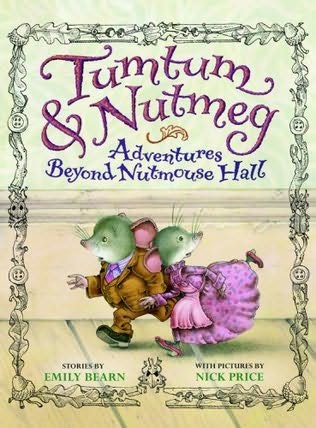 Title: TumTum & Nutmeg
Author: Emily Bearn
Available from Egmont
Genre: Children’s fiction
180 pages from Adventures Beyond Nutmouse Hall by Little, Brown
Please visit: http://www.tumtumandnutmeg.co.uk/index.htm
In the broom cupboard of a small dwelling called Rose Cottage, stands a house fit for a mouse – well, two mice actually. A house made of pebblestone, with gables on the windows and turrets peeking out of the roof. A house with a ballroom, a billiard room, a banqueting room, a butler’s room and a drawing room. The house belongs to Mr and Mrs Nutmouse, or Tumtum and Nutmeg as they affectionately call each other.
Tumtum and Nutmeg have a wonderful life but the children who live in Rose Cottage, Arthur and Lucy, are miserable. So, one day Tumtum and Nutmeg decide to cheer them up…
Tumtum repairs the electric heater in the attic where the children sleep and Nutmeg darns the children’s clothes. Arthur and Lucy are delighted and think a Fairy of Sorts is looking after them.
But then Aunt Ivy with her green eyelids and long, elasticey arms arrives. She hates mice and hatches a plan to get rid of them. Soon Tumtum and Nutmeg are no longer safe to venture out…
Tumtum and Nutmeg is a miniature masterpiece that will be loved by generations to come.– Summary by Egmont
I picked up TumTum & Nutmeg: Adventures Beyond Nutmouse Hall at Half Price Books in Humble, TX a few months back, with the intention of reading the stories to my daughter one day. I had never heard of them, but the front cover looked delightful and reminded me of the childhood days I spent pouring over The Borrowers by Mary Norton.
My daughter just turned one this last month and tired of re-reading every Eric Carle and Marcus Pfister book we own, I decided to see if she could sit through a few pages of Emily Bearn. I thought, maybe we can at least make it to the first illustration.
Low and behold, we were both captivated. I read until she fell asleep, and despite this book being written for very small children, I found I couldn’t put it down and wanted to know what would happen next. I was five years old again, huddled up in a quilt, lost in a world of a little family living in the nooks and crannies of an old house.
TumTum & Nutmeg is wonderful. It is precious in its descriptions and histories, the story is sweet and adventurous, enriching and exciting. I cannot wait to read the additional stories in the compilation and with sheer joy anticipate re-reading this story to my daughter when she is old enough to follow the story and not just my voice. This should be a part of every child’s library.


 Anakalian Whims