March
 Title: March
Author: Geraldine Brooks
Publisher: Penguin Books
Length: 280 pages
When I first selected March for the HPB Humble Book Club, I wasn’t fully aware of what I was getting myself into. I knew two things: it had been on my TBR for quite sometime and it had been quite popular with private book clubs in the area. By the cover and Geraldine Brooks reputation, I assumed it was some kind of historical fiction and that it was most likely to be something I considered good. I had not yet discovered that it was the story of Mr.March while off at war and Marmee. I did not realize I’d be reading back story on characters I’ve loved my whole life.
Geraldine Brooks’ writing is impeccable, amazing. It should be, she won a Pulitzer for this incredible book. I love the story.

I was ten when Susan Sarandon appeared in Little Women. It was not the first version of the movie I saw, nor the last; but as I watched the movie and re-read Little Women for the first time she became and still remains my favorite Marmee.
The problem is, I had an image of these wonderful people in my mind, an image I held onto for years and years. From the first time I read the book to the last time I re-read the book, through every movie adaptation, Marmee and Mr. March, though less present than the other characters, were pillars of perfect parenting, virtue, and strength. Brooks doesn’t take that away exactly, but she makes them so human it’s a bit disconcerting.
It’s like the first time you see pictures of your own parents at parties when they were young, before you were around. Or, the moment you come home at the proper time after prom to discover they are nowhere to be found and when you call them they are at some event you were unaware of, laughing and joking. In those moments you think, ‘Wow, they have a life.’ Marmee and Mr. March weren’t exactly having a party, most of the book is about the devastation of slavery and the civil war. Still, that moment you read about Marmee and Mr. March making passionate love in the woods before they were married, a tryst that resulted in Meg, you think: ‘No! I didn’t want to know that about them!’
At the same time, there’s something magical about the way Brooks has managed to weave a new tale from and into an old one. To take a small little quote about the girls missing their father who was so far away where the fighting was and turn it into a very distinct and unique piece of work, to read the telegram insisting Mrs. March go to her ill husband and have a whole life story revealed, it’s simply breath-taking and a bit of genius. It is all very excellent. It just isn’t what I had imagined for them myself.
Granted, many say Brooks based the story off of Louisa May Alcott’s own family life, as Alcott had written Little Women with the same background in mind. With that said, it stands to reason that Brooks book probably honors the author and her own imagination well.
 Still, I go back to my eight year old self (the first time I read Little Women) every time I re-read the book. The magic of books is that they may always take you back to a moment, a bit of time in your life where your mindset was a certain way, the feeling you had the first time you read those lines… like a song that gives you chills decades after it has made you cry. Geraldine Brooks’ March, though beautiful and epic, doesn’t fit with my eight year old Little Women reading self. There’s a disenchantment there.
The book is a dichotomy that flusters me to my core. To love a book so much and to be equally indignant about it is frustrating.
I plan to read Eden’s Outcasts
There will be a meeting to discuss March at Half Price Books in Humble at 7:30 pm. Join us!
If These Walls Had Ears

 Title: If These Walls Had Ears
Author: James Morgan
Publisher: Warner Books
Length: 275 pages
“A house is man’s attempt to stave off the anarchy of nature. Ripping up that floor had allowed a disturbing glimpse into the house’s secret life. It’s more comfortable not to know about such things.” – pg. 88
James Morgan may have been speaking about Billie Murphree’s floor rot from undercover water, but no words used in description of a house have ever hit me harder or rung so true.
Barely two years into owning our own home, my husband ripped up our living room carpet. We had lofty ambitions of laying tile or hardwood floors. We had tiled the living room of a town home once and it had turned out quite nicely for the low cost of $400. Those were the days when we thought home repair and renovation fun. Now, it’s just a necessity. No sooner had the carpet been pulled up, we discovered what we un-lovingly refer to as The Grand Canyon in our foundation.
Upon further inspection, the enormous crack ran from one end of the house to the other, from the outer wall where my rose and herb garden touches our driveway, through the kitchen, under the bar, across the living room, down the hallway, into the bathroom, and right out the outer wall against the side yard where I hope to make a courtyard one day.
 We were devastated. We had bought our dream home, except for the master bathroom which will forever irritate and haunt my poor husband, only to find that it wasn’t a dream at all. Our dream home was a wreck, a fixer upper, a money pitt – it kind of still is.
We had $15k worth of foundation repair done at a discounted price – the company is run by a saint – literally, he’s a Gideon, and I’m quite certain he felt sorry for us. He even gave us plenty of time to pay him off and didn’t charge us interest. No sooner had we paid our bill in full, we discovered the breakfast room was now sliding into our back yard and had to have more foundation repair. Our back fence, our back door, my daughter’s window, nothing in this house is safe. It’s fragile, it’s old, it’s exhausting. We had to dig up our front yard and repair plumbing ourselves, we’ve had work done by professionals under both bathrooms.
Oh, and our insurance company is worthless, they paid for exactly nothing.
Yes, Mr. Morgan, a home is man’s attempt to stave off the anarchy of nature. Nature riots in many ways: mud sliding our from under our apparently unstable foundation, a shake slithering up through the crack in our living room, the rain rotting our fence, the winds of Hurricane Ike displacing our other fence and blowing out a window pane in our back door. Our sidewalk to our mail box sunk into our front yard, a storm took down our light post. It never ends. It’s never over.
Despite the issues, despite the debt, despite it possibly being the biggest mistake of our married lives, I’m in love with this house. We’ve been through ups and downs, trials and errors, hell and we’re not quite back, but it’s my home. Technically, it belongs to the bank, but we live under the illusion that it’s ours, and the illusion has a safe feeling to it, until the next time something breaks…
“In a house you never can tell where the next trouble will erupt. A door knob will suddenly come off in your hand. A heating duct in the belly of the house will lose a screw and pop out of its fitting. Even if you think you know the trouble spots, you’ll be taken by surprise. A piece of upstairs trim will swell up and warp, and the next thing you know, the rain will be leaking in downstairs and two walls away.” – pg. 109
 Still, for whatever reason, everyone loves old houses. I remember when we were house hunting I specifically asked for a house in an older neighborhood surrounded by trees. “Nothing newer than the ’80’s,” I told my realtor, “No cookie cutter neighborhoods.” “Why, oh Why?!” I inevitably cursed later when we had to shave down parts of our interior doors so we could open and close them because the house had shifted yet again. “Why?!” we yelled when a brick just came out of our stoop, just slipped right out from under our door and lay across the porch where a welcome mat should have been. “Why?!” we screamed when a board from our deck in front of the garage door collapsed.
Because like Morgan says,
“Old houses look like home to us. They appeal not to our practical side but to whatever romantic part of us traffics in hopes and dreams, or wallows in nostalgia. They’re flirts, old houses. They get painted up real pretty – the way this house was when I first saw it – and they show off a lot of front porch and invite you in for a little French dooring, and the next thing you know, they’ve snared another sucker.” – pg. 180
Morgan’s book is endearing, nostalgic, and beautiful. It speaks to home owners, future home owners, and anyone who has ever fallen in love with a building of any kind. If These Walls Had Ears really speaks to my heart. There’s even an Andi that shows up briefly and takes part in 501 Holly’s biography. It makes you hope that in another fifty or so years someone will write a sequel to this old house’s life story.
The only part I didn’t like, despite a very beautiful quote in it, was the epilogue which summed up the lives (or the divorces and deaths, rather) of all the people who once lived in 501 Holly. It was depressing to say the least.

Weekly Low Down on Kids Books – Math Adventures
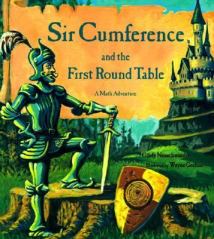 Title: Sir Cumference and the First Round Table
Author: Cindy Neuschwander
Illustrator: Wayne Geehan
I think everyone who has talked to me for longer than a minute and a half about children’s books knows how much I adore Brian P. Cleary
So a two year old who still stumbles through her ABC song, can only manage some really intense stripes when writing, and can only identify circles and triangles isn’t really ready for a book about circumferences, diameters, the concept of a radius, parallelograms, diamonds, and all that, but that’s when it is perfect to start reading these stories. By the time she needs the information, I want the stories thoroughly engrained in her mind.
Sir Cumference is a knight, married to Lady Di of Ameter, father of a short-stack son named Radius. With their help, King Arthur is able to come up with a plan to keep his knights on their best behavior as they discuss the well-being of Camelot. Add to the cast of characters a carpenter named Geo of Metry, the books instill all the basic concepts of geometry in the disguise of some exciting fake King Arthur folklore. Start reading the books to your kid from birth through early elementary school and you’ve got one math savvy child without even trying. As a home school mom with a serious distaste for math, I want my kid to enjoy it and make her life a lot easier than mine was by the time her high school curriculum comes along.
For slightly older kids, I’d say ages 5-10, the book easily lends itself to hands on activities. Paper projects, baking projects, even wood working if you were bold and wanted to make an actual play table, the story takes you step by step through cutting a rectangle down into all the various shapes. And, of course, it’s a series. Click the Sir Cumference link to purchase from Amazon. Click the collection image to go to another blogger’s reviews.
Other Sir Cumference
 Sir Cumference and the Dragon of Pi
Sir Cumference and All the King’s Tens
Sir Cumference and the Viking’s Map
Sir Cumference and the Isle of Immeter
Sir Cumference and the Great Knight of Angleland
Sir Cumference and the Sword in the Cone
(As an Amazon affiliate I earn from qualifying purchases.)
Best Book Boyfriends of 2012

I avidly read The Lit Bitch and a recent post included a top 12 book boyfriends list: http://thelitbitch.com/2012/12/29/top-12-in-2012-book-boyfriends/.
Cute concept, fun blog idea, but as I scrolled through my 74 books of the year, I realized that I didn’t read a lot of books in which there were boyfriends to pick from.
I started out with How to Buy a Love of Reading, and I think Hunter set me into a mood that I just couldn’t get past. There are other boyfriends I read through the year, but I barely remember them.
I don’t recall the characters in The House of Mirth by Edith Wharton. Regardless of what I thought of the book when I read it, no one in it made a lasting impact on me. I actually had to refer to my own review to remember Seldon’s name.
The Great Gatsby is a fantastic novel, one of my favorites, but Jay Gatsby is not someone I’d put on my list of literary love interests.
 I did read The Mortal Instruments and Infernal Devices series and there are plenty of boyfriends to be had in those books, and they are lovely, and romantic, and intense; but none of them lived up to Hunter.
I did read Inhale, the first of a series called Just Breathe, which is an urban fantasy erotica piece, but the characters there are what the genre calls for: super sexy, the end. Don’t get me wrong, sexy is nice, I think my husband is one of the sexiest, but I need more out of a character I’d want to put on a boyfriend of the year list.
 Rory Williams, for instance, the man who waited, the Roman centurion, one-half of a couple known as The Ponds on Doctor Who… he could go on a boyfriend of the year list. He’s just heavenly, and wonderful. But this is about books, not TV shows.
I read a lot of Agatha Christie this year, and she’s all mystery and not a whole lot of romance. Although a love story emerges here and there, it’s rarely more than a motive or plot device, therefore how can anyone in her books make the list?
On the other hand, I read cozy mysteries too. I like Cleo Coyle and her coffeehouse series. Cozy mysteries almost always have a boyfriend, but with there always being a boyfriend, I don’t often get the chance to delight in any of them. They are there to make the protagonist feel good or bad, have a romantic scene of some sort, and then on to the next guy. In real life, I’m morally opposed to most of the relationships that pop up in cozy mysteries. But, I figure it comes with the territory when reading about murderers and investigators.
Scrolling down my list of books read this year, I come to Karleen Koen’s Through a Glass Darkly. Sorry girls, I can’t recommend Montgeoffrey to anyone. He is the basis of all Babara’s pain… a ladies man, a cheater, and ultimately also gay. How many strikes can you add to a relationship before I’m just really tired of the guy? It makes the heroine incredibly interesting, but I can’t let Montgeoffrey anywhere near my book-boyfriend list.
So it comes down to the fellows in A.S. Byatt’s Possession, the cutie-patootie Sam in Michael Grant’s Gone, and Hunter of HTBALOR.
Byatt’s romances in Possession are powerful and intriguing, Sam Temple in Gone is a cute kid with the potential to be an incredible man when he’s all grown up, but I have to hand it to Hunter – he captured my heart.
Hunter is intelligent, sweet, broody, keeps a journal, and sadly is also an addict. Reading the conclusions of my own blog post, I find myself in disbelief… what does this say about my taste in men that I want to pick the suicidal one as book-boyfriend of the year? And that Marius of Les Miserables didn’t even make the short list of final contestants?
Who is on your list?
A Dubious Review
I get offers to review e-books all the time, it is the most efficient and affordable way for an author to get their work out there. However, I do not own an e-reader just yet. So as per my Review Policy, I found a guest blogger to read and review the book for me.
Lavois is an intelligent, honest gal that I’ve know most my life. She’s an intuitive reader, a good friends, and happens to own the device needed to help sort through pending e-book review requests.
I hope to feature more of her reviews and guest articles in the future.
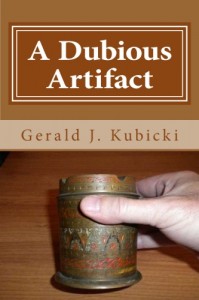 Title: A Dubious Artifact
Author: Gerald J. Kubicki
Publisher: Self-published/ Indie
Format: E-book
Let me begin by letting you know that I am not an experienced reviewer of books. In fact, this is my first. I’ve always been a voracious reader, even to the point of having to avoid reading certain books during certain times in my life, knowing that the book would consume all of my attention and free time. I had recently allowed myself to really start diving into reading full time again when my wonderful friend Anakalia offered me the opportunity to review a book for her. The book she sent me was A Dubious Artifact by Gerald J. Kubicki, the sixth novel in his Colton Banyon mystery/adventure series.
I think it’s also incumbent upon me to let you know that I have not read the first five novels published by Kubicki. I began with the sixth. I feel that it’s important for me to let you know this because I believe I may have connected better with the novel had I been involved in the rest of Banyon’s adventures. I initially wanted to chalk this up to weak character development but after thinking about it, I realized that these characters had been involved in five previous adventures together. Kubicki probably assumes that his readers would have started with book one and routinely references past adventures and past characters with only minimal explanation in A Dubious Artifact. For this reason it may serve you to start from the beginning. The first in the series, A Dubious Mission, can be found on Amazon by following the title link.
I must admit, had difficultly staying engaged while reading A Dubious Artifact and I believe that this can be remedied in large part by another round of editing. Kubicki’s story had some true potential, and at times I could feel myself slipping into the story, forgetting that I was reading a book, but then a spelling error, misused word or clumsily written sentence would yank me back into the reality of my reading chair. This was somewhat frustrating for me, not only because I so badly wanted to get into the novel, but because these were completely avoidable issues. Eventually, I had to set the book aside because I couldn’t get past this. It may be a good time for Kubicki to take stock of his entire series and come out with a newly revised second edition. While I had some difficulties with the novel this time around, I did get to know the characters enough that I can genuinely say I would give them another go in a revised edition.
An Exact Replica…
 Title:An Exact Replica of a Figment of My Imagination
Author: Elizabeth McCracken
Publisher: Jonathan Cape
Genre: Memoir/Autobiography
Length: 184 pages
I have never felt so awful as a human being as when I sat reading An Exact Replica of a Figment of My Imagination knowing I’d be ‘reviewing’ it for a blog shortly after I finished. How do you justify that in your mind? ‘Reviewing’ something so personal, so devastating, so beautiful, so intense. As an avid reader, a constant reviewer, and one those people who presume to call themselves a writer though I’ve yet to have anything published, I felt like an inconsiderate intruder reading such an intimate account of a loss so great. It’s rare to read something so personal.
As a mother, on the other hand, I wept. I wept, and wept, and wept, for little Pudding. I wept for Elizabeth. I wept for a friend who lost a baby not long after I had my own. I wept for all the things I may have said wrong, all the things I may have not said, and I wept for the selfish joy that my own sweet, precious child was snuggled next to me as I read. I wept for Pudding, I wept for another friend who died, I wept for his mother because even though she had 29 years with him he was still her child, and I wept for the baby cemetery that I pass every time I visit his grave.
I’ve had a writer’s crush on Elizabeth McCracken for sometime. I have an extremely vivid memory of reading A Giant’s House while having lunch with the same friend whose grave I now visit. We devoured deli food, iced tea, and discussed the oddity of a romance between a librarian and child giant. I remember telling him what a strange tale it was, but if I could ever manage to write anything half so interesting I would pee myself with happiness. He promised to read it too, though I’m quite certain he never did because he was in the habit of reading the first thirty or so pages of something and then proclaiming himself an expert on a topic, starting novels and not finishing them, and making half-hearted promises… little things that I tend to hate in people, but for whatever reason found endearing in him. I loved him dearly, and for that reason, I’ve never been quite certain whether my Elizabeth McCracken crush was because Elizabeth McCracken was all that amazing, or if it was because thinking of her always reminds me of him. I cannot think of one without thinking of the other.
Reading An Exact Replica of a Figment of My Imagination, I’m now quite certain that Elizabeth McCracken is that amazing, and deserves adoration outside the realm of Matty memories. She’s a wonderful writer, a fascinating person, has a rockin’ last name, and by sharing this book with the world has proved to me (without ever having met her) that she has a very giving soul.
Elizabeth McCracken, thank you for sharing Pudding’s story. And from the bottom of my heart: I am sorry for your loss.
Jean Valjean
Whether you have read the book or not, most people are familiar with this image:

The story has been a Broadway sensation for ages, the book itself has been a classic for even longer. And with Hugh Jackman acting the lead role of Jean Valjean in the movie production being released on Christmas Day, more people than ever are going to have the story of Les Miserables running through their heads.
That’s why earlier this year I committed to spending 2012 reading the classic tome along with Kate’s Library. It was amazing, and for the rest of my life I’ll remember 2012 as the year that I met Jean Valjean.

Ok, I know, I know, that fellow on the left there is not a depiction of Jean Valjean, it’s a picture of Victor Hugo; but despite my encounters with other works by Hugo (The Hunchback of Notre Dame
Valjean has a beautiful, though depressing story. A convict running from the law, early in the novel he is changed for life by a man called the Bishop, learns the importance of love and learning and becomes a new man. As his life progresses, he becomes someone altogether different and even assumes a new name. With a new name and some money, he finds himself in charge of a town and in a position to help a poor prostitute named Fantine who is dying and has left her only child to be raised by some hooligans elsewhere. Valjean, now a saint and model citizen, promises to care for the child and goes to retrieve her.
That’s when Valjean and Cosette (the large-eyed little child in the musical posters and book covers) join forces and run away together as father and daughter.
So many adventures, so many trials, life in a nunnery, life hiding out, life raising a child, a love story between Cosette and Marius… but Jean Valjean lives a great life under much mystery, oppression, and misery, and still somehow he finds joy in his little Cosette. Valjean is a prime example of a life changed, and a life found despite what the world and the government tries to throw at you.
The paragraph above is much too simple of a description of Hugo’s Valjean. There is a reason Hugo’s novel is 1260 pages long, and not a moment of it is to be missed. Les Miserables is a story of compassion, love, redemption, and a quest for freedom. Both the novel and the musical focus on these themes in a powerful way, though they differ in how they address them, typical of a novel to a musical. In the end, both forms of the story are about Valjean and the idea that if he can learn to love and be charitable after all he has suffered, who is there that cannot learn these things too? Who could possibly have suffered more?
If you have not read Les Miserables
Books I Read in 2012

Book Love Art
Every year I post a list of the books I read. It helps me wrap my brain around the year that has passed and put in my mind what I’d like the next year to look like, and it gives people an idea as to what books were reviewed and discussed when. Kids picture books are not included on this list this year as we read so many (usually a minimum of 7-10 new titles a week) the list would have become ridiculous, young adult/teen titles are included.
1. How to Buy a Love of Reading – Tanya Egan Gibson (January)
2. Mysterious Affairs at Styles – Agatha Christie (January)
3. House of Mirth – Edith Wharton (January)
4. The Great Gatsby- F. Scott Fitzgerald (January)
5. Murder on the Links – Agatha Christie (January)
6. Swan Thieves – Elizabeth Kostova (January)
7. Human Happiness – Blaise Pascal (January)
8. Holiday Grind – Cleo Coyle (January)
9. Inhale – Kendall Grey (February)
10. Poirot Investigates – Agatha Christie (February)
11. Tales from the Jazz Age – F. Scott Fitzgerald (February)
12. Murder of Roger Ackroyd – Agatha Christie (March)
13. Roast Mortem – Cleo Coyle (March)
14. The Big Four – Agatha Christie (March)
15. Stonehenge – Aubrey Burl (March)
16. House at Riverton – Kate Morton (March)
17. The Mystery of the Blue Train – Agatha Christie (March)
18. The Name of the Rose – Umberto Eco (April)
19. The Key to the Name of the Rose (April)
20. Peril at End House – Agatha Christie (April)
21. Water for Elephants – Sara Gruen (April)
22. Birds of Selborne – Gilbert White (April)
23. Dragonfly in Amber – Diana Gabaldon (April)
24. Voice of Conscience – Behcet Kaya (April)
25. Lord Edgeware Dies – Agatha Christie (April)
26. Napoleon’s Wars – Charles Esdaile (May)
27. The Trial – Franz Kafka (May)
28. Seed Savers: Treasure – S. Smith (June)
29. The Map of Time – Felix J. Palma (June)
30. Of Mice and Men – John Steinbeck (June)
31. Three Act Tragedy – Agatha Christie (June)
32. The Planets – Dava Sobel (June)
33. The Stranger – Albert Camus (June)
34. Clockwork Angel – Cassandra Clare (July)
35. City of Bones – Cassandra Clare (July)
36. City of Ashes – Cassandra Clare (July)
37. City of Glass – Cassandra Clare (July)
38. The Naked Olympics – Tony Perrottet (July)
39. Clockwork Prince – Cassandra Clare (July)
40. For Women Only – London Tracy (July)
41. City of Fallen Angels – Cassandra Clare (July)
42. The Book of Lilith – Koltuv (July)
43. Ruling Planets – Renstrom (July)
44. Working Days – John Steinbeck (August)
45. Animal Farm – George Orwell (August)
46. Through a Glass Darkly – Karleen Koen (August)
47. Number the Stars – Lois Lowry (August)
48. City of Lost Souls – Cassandra Clare (September)
49. Invisible Man – Ralph Ellison (September)
50. The Bookaholic’s Guide to Book Blogs (September)
51. The Symposium – Plato (September)
52. Emma The Twice-Crowned Queen – Isabella Strachon (September)
53. The Lost Continent – Bill Bryson (September)
54. The Customs of the Kingdoms of India – Marco Polo (October)
55. Parnassus on Wheels – Christopher Morley (October)
56. Possession – A.S. Byatt (November)
57. So Many Books, So Little Time – Sara Nelson (November)
58. Rich Fabric Anthology – Melinda McGuire (November)
59. Flatland – Edwin A. Abbott (November)
60. Unrecounted – Sebald & Tripp (November)
61. The Lit Report – Sarah N. Harvey (November)
62. Pippi Longstocking – Astrid Lindgren (November)
63. The Magician’s Elephant -Kate DiCamillo (November)
64. Kenny & the Dragon – Tony DiTerlizzi (November)
65. Seed Savers: Lily – S. Smith (November)
66. Collected Poems of Edna St. Vincent Millay (All Year)
67. The Old Curiosity Shop – Charles Dickens (December)
68. Julie & Julia – Julie Powell (December)
69. Gone – Michael Grant (December)
**. All Our Worldly Goods – Irene Nemirovsky (did not finish)
70. A Homemade Life – Molly Wizenberg (December)
71. The Case for Astrology – John Anthony West (July -December)
72. Franny and Zooey – J.D. Salinger (December)
73. Les Miserables – Victor Hugo (All Year)
74. An Exact Replica of a Figment of My Imagination – Elizabeth McCracken (December)
Visit Books I Read in 2011.
Click to purchase from Amazon.com.
*This post is subject to change until December 31st, 2012.*
A Day with the Glass Family
 Title: Franny and Zooey
Author: J.D. Salinger
As much as I disliked Catcher in the Rye, I loved Franny and Zooey. Apparently a short story combined with an intertwining novella, it reads like a full length novel just fine, and it’s pretty intriguing, unlike Salinger’s more famous work CitR.
Franny and Zooey are the youngest children of the rather large Glass family, and the baby (Franny) starts the book off as a twenty year old histrionic having a bit of a meltdown while out to eat with her boyfriend. Her brother, Zooey, spends a large portion of his story in the bath tub talking to his intrusive mother about the meltdown that has migrated to the family’s living room.
Surprised that Zooey is a boy? I was. Apparently it used to be used as a nick name for Zachary and Zachariah. I spent all of Franny wondering how this mysterious Zooey was going to fit into the story, which at that point revolved around a girl freaking out about Bohemians and Academia the way people in their mid to late twenties today lament the so-called Hipsters. There’s not much of a plot, more of a theme of self-discovery, religion, and philosophy, and what that all really means. But I like that sort of thing, and I loved Zooey and his smart ass attitude.
It was actually pretty cold today, completely out of nowhere, so the kiddo and I spent most the day snuggled up and bundled in sweaters while reading and writing. Basically, the perfect recipe for reading a quick book like Franny and Zooey between lunches and writing sessions and nap times. I picked it up around noon and after reading tidbits here and there all day, finally wrapped it up around kiddo’s bed time. I like having books like that around, especially as I finish up my year round Les Miserables Read-A-Long. It is the kind of book I hope to publish a few of here and there before I die, not in topic and theme, but in mood. I like getting to know characters in a specific moment of their life, like Virgina Woolf’s Mrs. Dalloway







 Anakalian Whims