My Classical Re-Education
 As some of you may know, I am a sucker for the classics. I’m also a sucker for lists. In addition to that, I plan to homeschool my daughter. What better books for me then are those of Susan Wise Bauer?
“Using the techniques and systems of classical education, this new guide will give you greater pleasure in what you read, and greater understanding of it.” – from Susan Wise Bauer’s The Well-Educated Mind
I am a college graduate who has had the pleasure of working for a bookstore for some years now and doesn’t want my “education” to end with a Bachelor’s degree in Business. I want to go through Bauer’s list while I pay off my student loans before going back to school. Bauers covers five genres worth of lists of books that people need to read to be fully and classically educated. Many of these a lot of us have already read, and many of these we’ve always heard referenced and talked about reading but have never actually done it.
Lately, in the blog world, I’ve been coming across a Classics Challenge, and was reminded of the fact that there may be others out there who would like access to this list and discussions where other people are reading these books.
For the last few years I have been leisurely strolling through her list provided in The Well Educated Mind:
I am also the admin of a Shelfari Discussion Group called Classical Re-Education and I post reviews and commentary on my reading in that group, links for each book discussion are provided. Of course, I also share my reviews here on my blog.
Cervantes – Don Quixote
http://www.shelfari.com/groups/32384/discussions/89445/Don-Quixote—Cervantes
Bunyan – Pilgrim’s Progress
http://www.shelfari.com/groups/32384/discussions/90600/Pilgrim-s-Progress—Bunyan
Swift – Gulliver’s Travels
http://www.shelfari.com/groups/32384/discussions/91884/Gulliver-s-Travels—Swift
Austen – Pride and Prejudice
http://www.shelfari.com/groups/32384/discussions/96506/Pride-Prejudice—Jane-Austen
Dickens – Oliver Twist
http://www.shelfari.com/groups/32384/discussions/98621/Oliver-Twist—Charles-Dickens
Bronte – Jane Eyre
http://www.shelfari.com/groups/32384/discussions/102210/Jane-Eyre—Charlotte-Bronte
Hawthorne – The Scarlet Letter
http://www.shelfari.com/groups/32384/discussions/104538/The-Scarlet-Letter—Nathaniel-Hawthorne
Melville – Moby Dick
http://www.shelfari.com/groups/32384/discussions/105905/Moby-Dick—Melville
Stowe – Uncle Tom’s Cabin
http://www.shelfari.com/groups/32384/discussions/121736/Uncle-Tom-s-Cabin—Stowe
Flaubert – Madame Bovary
http://www.shelfari.com/groups/32384/discussions/148024/Madame-Bovary—Flaubert
Dostoyevsky – Crime and Punishment
http://www.shelfari.com/groups/32384/discussions/165633/Crime-and-Punishment—Dostoyevsky
Tolstoy – Anna Karenina
http://www.shelfari.com/groups/32384/discussions/212374/Anna-Karenina—Tolstoy
Hardy – The Return of the Native
http://www.shelfari.com/groups/32384/discussions/233628/The-Return-of-the-Native—Thomas-Hardy
James – The Portrait of a Lady
http://www.shelfari.com/groups/32384/discussions/239963/Portrait-of-a-Lady—James
Twain – Huckleberry Finn
http://www.shelfari.com/groups/32384/discussions/319203/Huckleberry-Finn—Mark-Twain
Crane – Red Badge of Courage
http://www.shelfari.com/groups/32384/discussions/319206/Red-Badge-of-Courage—Crane
Conrad – Heart of Darkness
http://www.shelfari.com/groups/32384/discussions/324295/Heart-of-Darkness—Conrad
Wharton – House of Mirth
http://www.shelfari.com/groups/32384/discussions/324297/House-of-Mirth—Wharton
Fitzgerald – The Great Gatsby
http://www.shelfari.com/groups/32384/discussions/324292/The-Great-Gatsby—Fitzgerald
Woolf – Mrs. Dalloway
http://www.shelfari.com/groups/32384/discussions/420041/Mrs-Dalloway—Virginia-Woolf
Kafka – The Trial
http://www.shelfari.com/groups/32384/discussions/435148/The-Trial—Kafka
Wright – Native Son
http://www.shelfari.com/groups/32384/discussions/443717/Native-Son—Wright
Camus – The Stranger
Orwell – 1984
Ellison – Invisible Man
https://anakalianwhims.wordpress.com/2012/09/03/blasted-book-bouncing/
Bellow – Sieze the Day
Garcia Marquez – One Hundred Years of Solitude
Calvino – If on a Winter’s Night a Traveler
Morrison – Song of Solomon
Delillo – White Noise
Byatt – Possession
https://anakalianwhims.wordpress.com/2012/11/04/the-ultimate-possession-a-book-by-byatt/
As you can see, I just recently finished Kafka’s The Trial and will soon be starting The Native Son. I’d love for others to join me.
Have you read any of these lately? Which were your favorites? What would you add to the list if your goal was to walk people through the History of the Novel, as Bauer’s has done?
P.S. Susan Wise Bauer will be lecturing at the Texas Home School Coalition Southwest Convention The Woodlands, Texas, Thursday-Saturday August 2-4.
Kafka on Trial
 Title: The Trial
Author: Franz Kafka
Publisher: I am reading from a paperback copy from Vintage Books published in 1969
Published in 1937 by Knopf
Length: 341 pages, including post scripts and translator’s notes
I’d like to start by saying I love Kafka, I do, I really do, I think.
I read The Metamorphosis over and over again, wrote a paper on it in high school and two more in college. I can’t count how many times I’ve read it, I just think its so wonderful. After reading The Castle and The Trial, however, I’m realizing that Kafka’s greatest skill is in writing the most frustrating scenarios a human being could be plopped into – alienation and bureaucracy. Whether it becoming a giant bug, living under mysterious and unfair authorities, or dying after a year long quest to discover what crime you have been accused of, Kafka has helplessness down to an art. I love Kafka!
I love him because his concepts are fascinating. He is the most wonderful creator of modern day myth that I’ve read. But I find that while reading his full length novels, I feel a bit as I did when reading Don Quixote – screaming at Cervantes, “I get it! Iget it! I get it already!” Halfway through Kafka’s The Trial, I groaned wondering when it was all going to stop, knowing that I knew Kafka well enough to know that peace would not be had in the end (at least not the kind brought about by resolution). I love the exasperation of the short story or novella written to drive these scenarios home. My heart can’t stand it in a full length novel. At the end of The Trial, I hate Kafka.
But the story was so good!
Kafka belongs to the world of novellas and short stories. That is where I love him best.
Napoleon’s Wars
 Title: Napoleon’s Wars
Author: Charles Esdaile
Publisher: Penguin
Length: 622 pages (including appendices and index)
Its amazing to me how history is so often rewritten. Like the American Civil War and the issue of slavery, history textbooks would have you believe that the French Revolutionary Wars were about liberty alone. It’s only when you dig deeper into fascinating works like Esdaile’s that you learn better, just like that moment you discover that the Civil War was about State’s Rights. Esdaile’s book is enlightening, gracefully walking you through power struggles, political schemes, battles, marriages, and all sorts of human conflict. Silly, I know, as there is always political drama behind the scenes of any war, but I was completely unaware.
I blame this on my childhood education as well as my idealist nature, which begs to believe that things are always done for moral principle and meaning. I like to root for the underdog and weep for the wronged. Yet, scholarly study and reality steps in and I discover that Abe Lincoln was not this amazing and caring man elementary schools brain washed us into believing, that the Union was not so kind they fought a war over slavery, rather they were controlling and greedy and wanted to dictate laws on a Federal level rather than celebrate the spirit of our unique existence by allowing States to make their own decisions, much like the war on drugs now. See, even here I see my brain and heart leaning towards the idea that the South were fighting for their rights with ‘free spirits’! Also emotionally driven and not entirely accurate. There’s no winning with me.
 I need work like Esdaile’s in my life, to keep my brain on straight. He writes a beautiful historically accurate reality check, without casting blame or being cruel about the events of our past. He doesn’t bash nor celebrate Napoleon, he just explains the world that surrounded him. I picked this book up to help me wrap my brain around Hugo’s Les Miserables world, as the characters are living in the aftermath of the wars. I needed to comprehend the world at large at that time in order to really understand the characters’ world view, and to help me decide whether or not I even like Valjean! (Stay tuned for further updates on my Les Miserables reading, join my readalongs via the “Readalongs!” page on the right.)
What I found most astounding was the statement by Esdaile that “Napoleon came to power as a peacemaker. “(pg.75) Clearly, I didn’t know much about Napoleon, the history of France, the Revolution, any of it, before reading this book. Before, I always thought of Napoleon as a tyrant with a short man syndrome attitude. But in reading Esdaile’s work, I am reminded that people have to have something going for them to gain that much power. According to this history, it took quite awhile for Napoleon to acquire his ‘demon-like qualities’ and that ‘among the educated classes, he was widely admired.’ “[…] the emperor himself later remarked that the regime was ‘never afraid of him’ and ‘looked on him as a defender of royalism.’ ” So how do we get from there to Hugo’s Les Miserables? Esdaile gives us an answer with a quote from a pamphlet published in 1808:
“Napoleon… may be compared to the vine, a plant that if it is not pruned, throws out its branches in all directions and ends up by taking over everything. He wants peace, but at the same time wishes to dethrone kings… create new monarchies and destroy old republics… to undo the very globe and remake it in accordance with nothing other than his own will.” (pg. 344)
I love history, but I haven’t studied much of it in depth. My interests range through all of time and all over the globe, so at best I know a little of this and a little of that, but nothing thoroughly, nothing well. Prior to this book, if you had mentioned Mustafa, I probably would have said, “Oh, I love the Lion King.” Even that tidbit of ‘knowledge’ is wrong as the Disney cartoon lion’s name is Mufasa, which I didn’t realize until I went browsing for images to use in this blog post!
As a budding amateur historian, I still get excited when my history overlaps. Charles James Fox has a role in this time period of Europe and when I saw his name my heart leaped for joy. Someone I recognize, someone I’ve learned something about! Just last year or so, I read Amanda Foreman’s Georgiana, Duchess of Devonshire, where he had a huge role. As a huge supporter of the French Revolution, I was breathlessly proud of myself and the one little tidbit of something I knew while reading through a few pages of Napoleon’s Wars.
It also means that, even though I already have a book on the subject (but haven’t read it yet), I nearly fell out of my chair when I read that Napoleon went to Egypt (I didn’t realize that he actually went there, I thought maybe he just sent people there the way most rulers do). I’ve had a long-time obsession with Egypt, King Tut exhibits, Archeological Bibles, Nefertiti, Hapshepsut, the whole shebang. Even Amelia Peabody inspires me. So to see that I would have an opportunity to thoroughly study something that so heavily overlaps something I’ve studied, excites me.
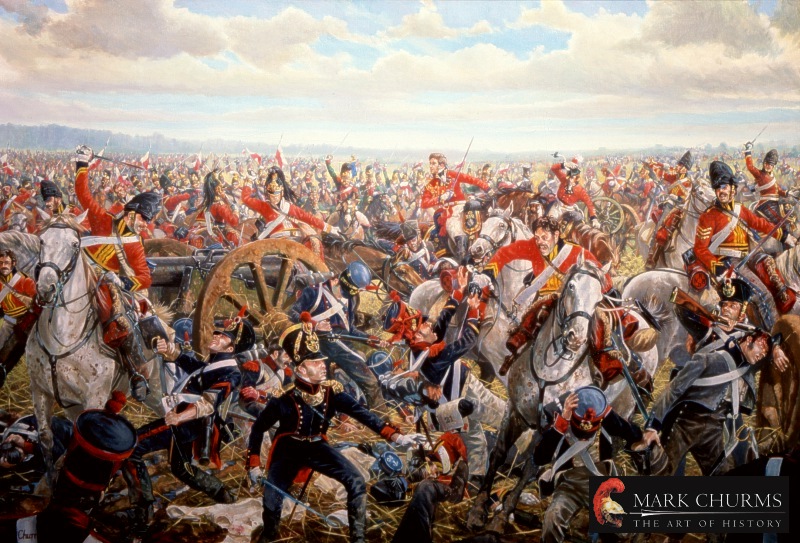 I’ve taken so many notes on this book, its so fascinating (if you’re friends with me on facebook or in real life, you’re probably tired of hearing me rant about how awesome it is). Among my notes are scribblings about how these wars are shockingly worldwide. Why wasn’t this called a World War? I am baffled at how many wars (not just battles, but WARS) were fought, overlapping each other in years and on continents, during this time. Before Napoleon even steps into the picture there’s the 1st and 2nd Coalition Wars (1792-1797, 1798-1802), which I had never heard of because they are always just called the French Revolutionary Wars, which should have given me pause and realization that wars was plural, therefore there was more to the story than just the word “Revolution.” I’m still not 100% clear on how it all works, as more research is needed, because the Revolutionary Wars are dated as 1789-1802. Then, there’s a War between Britain and France during 1803 to 1814, but not the same as the Coalition Wars… Third in 1805, Fourth from 1806-07, Fifth in 1809, and the 6th overlaps the Invasion of Russia from 1812-1814 – but apparently is separate from the War of 1812 which was between the U.S. and Britain. Finally, things wrap up a bit after the War of the Seventh Coalition in 1815. Not to mention, I totally skipped the Peninsular War from 1808- 1814 which was between France and the allied powers of Spain and only ended when the Sixth Coalition defeated Napoleon in 1814. Again, I ask you, why was this never referred to as a World War? Why wasn’t the debate about this being called a World War addressed in school? Why has this whole ordeal always been flippantly glossed over with literature like The Scarlet Pimpernel, Horatio Hornblower, and then wrapped up with Jane Austen and Les Miserables., not that I have a problem with that literature (they are all wonderful and personal favorites of mine). Because I read too much fiction, ok, ok, I get it.
Now, more than ever, I want to know more. I want to take classes at the University of Liverpool where Charles Esdaile teaches. He’s a professor there with a BA and PhD and a FRHistS (Fellow of the Royal Historical Society, I had to look that up, its so cool). But, alas, I am not in Liverpool. Also, I am not in college anymore.
Reading this book made me go do some research that I desperately needed to do. Not just historical research, but personal research. I’ve been wanting, planning, gabbing about going back to school for some time now. But finally, I went to some websites and looked into what that would take. Instead of dreamily telling people I’d like to go back to school and get a second Bachelors from a state school (I currently have a BBA in Marketing and Management: Entrepreneurship) I can now say: I’d like to join the Post-Baccalaureate program at Univeristy of Houston. My first class, when I finally get the finances to go, and the nerve to go up to the school and not worry about the fact that I’d be 10 years older than the traditional students (not that anyone would notice my five foot nothing – I get carded everywhere- self), I’d like my first class to be ANTH 1300: Introduction to Anthropology in the College of Liberal Arts and Social Sciences. There, it’s out there, and you guys are now encouraged to keep me accountable to my dreams.
Until then, I plan to read more books by Esdaile and a number of other historians. Reading this has been a fabulous experience.
Goodbye Mr. Sendak

Photograph by Astrid Christie
I would be remiss as a blogger, book lover, mother, former child, dreamer, and all around human being if I didn’t post something about Maurice Sendak upon his passing. Most famous for Where The Wild Things Are
Sendak made it to a whopping 83 and his life will be celebrated by a posthumous publication of his most current work called “My Brother’s Book” which he wrote in honor of his late brother. How fitting and beautiful that it will be his last new publication, and that he too will be gone for it.
Maurice Bernard Sendak was born June 10, 1928 and died May 8, 2012. For a proper ode to his entire life work, please read the New York Times article here: http://www.nytimes.com/2012/05/09/books/maurice-sendak-childrens-author-dies-at-83.html?pagewanted=all
Why I Loathe Rating Things With Stars
 A Review of Snow Falling on Cedars by David Guterson
I’ve been a voracious reader my entire life and I’ve always loved the classics. So it didn’t surprise me at all years ago when my AP English teacher handed me the semester syllabus with a list of titles to read and I unwisely blurted “I’ve already read them all,” with disappointment. He said “Fine” and later supplied me with a new list, all contemporary award winners I’d never heard of, including Snow Falling on Cedars
I read it. I re-read it. I couldn’t figure out why I hated it, and why I wanted to read it again.
Until now, when watching the movie, which is, amazingly, incredibly accurate from what I remember of the book – scene for scene.
At my core I am a romantic and idealist. I love forbidden marriages, truly and unhypocritically, as I am in one. I love childhood sweethearts, best friends, having secret adventures in the woods and on the seashore. I’ve been in love with my husband since I was fourteen, have now known him half my life, and am raising a beautiful daughter with him.
What I hate? That Hatsue doesn’t marry Ishmael. That she willingly chooses another, after giving herself to Ishmael like a little slut in the woods. What is a beautifully written piece of timeless literature, becomes an irritating anti-love story to me, until it becomes the ultimate love story by him saving her husband anyway. Poor Ishmael! Why did she not marry him? There’s so many reasons, so many. I cannot mar the merit of Guterson’s work, it is so well done. But I hate him for falling short in my ideally romantic heart. I cannot comprehend giving myself so fully to my best friend and then saying No to his marriage proposal for some loyalty to culture.
I remember that somewhere I’ve rated this book with 2 stars. 2, just 2. But –
 I haven’t read this book in over ten years and still it resonates with me. Even prior to watching the movie, I could recall various parts of the book in extreme detail, it’s actually why I chose to watch the movie this week. I knew I was in the mood for it. Now, with the movie so fresh in my mind, I think I should re-read it soon. The story is brilliant, and true to what I imagine life was like then. But I will always hate Hatsue a little more than I should, because Ishmael is one of the most beautiful human beings ever written and though it unfair to ask every character to behave as I would – I would have married him and lvoed him ’til the day I died.
So truth? I think I love Snow Falling on Cedars. I love it with a hateful indescribable passion. I hate Hatsue for being weak. I hate the United States for putting the Japanese into camps. I hate Kabuo for being so easy to love. I even hate Ishmael for being as Anne Elliot describes in Austen’s Persuasion, one of those who “love longest, when all hope is gone.” I hate it because I long to re-read it and every time I do I bawl like a baby, because every time I expect it all to be different.
I have a hard time rating things with stars. My initial shelfari review, where I gave it 2 stars, stated:
I didn’t like it is too strong a phrase, and I liked it also too strong. But I am committed to re-reading it eventually to see if my opinion has changed since I read it for school at seventeen. At the time, I found it awkward and sad. I do remember enjoying his descriptions, it was the storyline itself I was unsatisfied with.
Unclear, vague, and starless. But the book stays with you for so long, so how can I rate it badly? In all honesty, I can’t. Not anymore. I feel compelled to change the stars to 5, but tomorrow I’ll only want to give it 3. This is why I prefer to read full reviews, and not rely on stars. This is why I prefer conversations, rather than one-lined opinions.
David Guterson, if you read this, you are a brilliant writer. And I have a love/hate relationship with your book.
P.S. I adore Ethan Hawke, who plays Ishmael Chambers in the movie made in 1999. He is also an author, and I enjoyed his novel The Hottest State. I also have a copy of his book Ash Wednesday, but have never read it. If anyone is interested in reading it with me, let me know. I am also interested in reading Guterson’s book on homeschooling
The Mother’s Day Post
 Mother’s Day is celebrated all over the world at various times in Spring to, obviously, honor one’s mother. In the United States, Anna Jarvis founded the day we know now that is celebrated on the second Sunday of May, in 1908. By 1914 it was made a National Holiday. By Jarvis’ death, she was renouncing her own holiday as having become too commercialized.
It is too commercialized. But, who wants to abolish a holiday that celebrates ones mom? No one. Its not like Valentines when you can commit to showing your partner you love them every day of the year. A lot of children (especially adults) don’t live anywhere near their mothers, and this is a good day to (of all days) let them know that you’re still thinking of them even from afar.
My proposal? Untraditional gifts. Token mother’s day gifts come in the form of Hallmark Cards and flowers. That’s all well and good, and if your mother loves those things, by all means, get them for her. But get her something more as well.
 Always, I’m a fan of books, afterall I write a book blog. There’s always something special to be found at a bookstore. Whether its the latest and greatest of a beloved series, a funny gift book, a sappy gift book, a history book on a topic of interest that you both share, music, movies, or just a gift card so she can go have some time to herself and pick out something of her own choosing, there’s something for everyone at a bookstore.
 For Dads helping small children, a newer (but not too new) overlooked title is Tomie DePaola’s My Mother Is So Smart. DePaola has been an award winning children’s author for years, but even I didn’t know this 2010 publication existed until I stumbled across in the library the other day. Its beautiful, as are all his books, and celebrates the love and awe he had for his mother as a child. Its sweet, and perfect for a young mother to read to her toddler… although I did notice how many things I’ve neglected to master as a mom, like the perfect cookie recipe, and the uncanny ability to always know why my child is crying.
Great Gift #2: I dream of having a cleaning service come through my house once a year. I keep a fairly clean house. I actually enjoy cleaning, when I find the time and energy to clean up blocks and toys that have been strewn everywhere for the 300th time that day. But the idea of having a cleaning crew come in every Spring and scrub my base boards, toilets, showers, and maybe also have my AC ducts cleaned out – that would be the BEST mother’s day gift EVER. (Aside from someone purchasing and installing all my hardwood floors over night without any assistance from me… that would be even better, but a little less practical as a mother’s day gift.) If this awesome treat proved unobtainable, I might settle for lawn fairies to come weed my gardens in the middle of the night.

Shop AKKlemm.scentsy.us
Great Gift #3: After books and a laziness enabler, I choose Scentsy products. I love candles and fabulous smells, but the wickless candle deal with mood lighting has proven to be the best choice when a toddler is running all over the place. When (I say when NOT if) your kid decides to lather themselves in hot candle wax and try to put every blessed thing you own under wax treatment, you want it to be low heat, no flame, I promise. My favorite spring scents available this year are Pixie and Cerise. The Just Breathe is also quite excellent and one of my year round favorites of all time. But you know your Mom and/or Wife, get what she likes.
Great Gift #4: Reloadable Starbucks gift cards. Who doesn’t practically live at Starbucks, or would if they could? Its become an American staple. Cliche, over-rated, over-priced, I agree, but hey, its pretty darn good coffee available on every street corner, I’ll take it. The reloadable gift cards are pretty sweet. Reload them a few times and you are an upgraded customer with free birthday drinks, free syrup add ons, free cups of coffee with your bean purchases, the list goes on. Buy the mother in your life a gift card and take the time to reload it for her a few times before the year is up and BAM! she is one happy caffeined lady.
Whatever you do, be sure to enjoy the day. Sundays should be lovely days anyway, but I hope one day Ayla will love to spend a lazy Sunday with me, reading, having coffee, or maybe picnicing in the sun if the weather is nice.
Mid Week Thrifting
I used to haunt thrift stores the way I currently haunt bookstores. In late high school and early college, its where I picked up all my clothes. There was nothing better than a 50 cent blouse and some $2 jeans. Unfortuneately with the recession, thrift store clothing prices have increased to an amount that (unless its the world’s most awesome thrift store find) I can often find similar cheapy items for less at Wally World (sacriledge, I know). In theory I hate WalMart, but sometimes a tight budget makes the decision for me. But when my best friend says she wants to check out the newly reopened Goodwill Select in the Heights, I’m game.
Of course, I found dozens of things I wanted (there were piles of amateur paintings done by the same unknown person), but only came away with a few of the most inexpensive but longest lasting items money can buy: books. I acquired a few nice copies of things off Ayla’s Classical Education list that I didn’t already have… Sophocles and such because I will need them eventually and haven’t seen copies in this nice a condition for this cheap. It looks like someone dropped off an entire school library in mint condition. And two things that aren’t as easy to find (not difficult, just not typically parading themselves around in large quanities):
 Profiles in Science
Then, for me, I picked up The New Science of Strong Materials
For more on the exciting world of thrifting, follow Her Library Adventures, she too has a mid-week thrifting notice this week: http://herlibraryadventures.blogspot.com/2012/05/midweek-thrifting.html
Hurray for Spring! And Elephants!
 Weekly Low Down on Kids Books 5/03/12
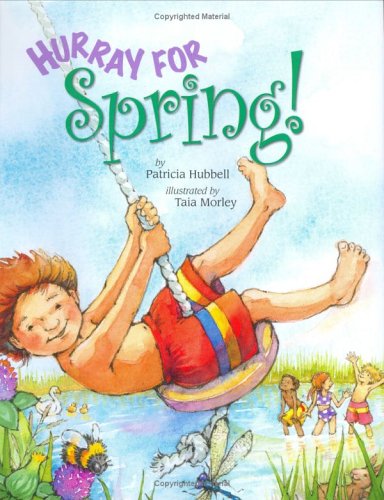
Title: Hurray for Spring!
Author: Patricia Hubbell
Illustrator: Taia Morley
Publisher: NorthWord
Genre: Childrens, Picture Books
Ayla has a wide assortment of books of her own, she can’t help it with a compulsive book buying mother. But going to the library and picking out special books for just the week is always fun. At a year and a half, she already loves books and spends a lot of time pretending to read or browsing illustrations. ‘Shopping’ at a library, however, is so much different than shopping at a store. For starters, there’s the Dewey Decimal System to contend with, something I honestly haven’t used in about ten years. Then, there’s the lack of beautifully merchandised end caps – you can ask my best friend, I’m a complete sucker for a pretty display. (That’s probably why I enjoyed making them so much in my merchandising days.) Still, we manage to find precious gems and exciting reads every week.
This week we haphazardly pulled Hurray for Spring! off the shelf. The poem tells of all the adventures one can have throughout the season and is accompanied by gorgeous illustrations of kids playing and dragon flies and flowers. There’s mice playing in the weeds, beautiful blue skies, and the book is an all around treat. We read it four times in a row before bed time Tuesday night because Ayla kept demanding, “More” as she turned the book back to the first page and patted the title, indicating a re-read.
I’d like to buy a copy to use to celebrate Easter every year. Its fresh, lively, and is a good way to get kids excited about playing outside, but if read softly the cadence of the words can still put a baby to sleep. We love Hurray for Spring! Even now Ayla discovered it in my hand and is hopping around, rummaging through the book bag, and begging me to read it again.
 Title:
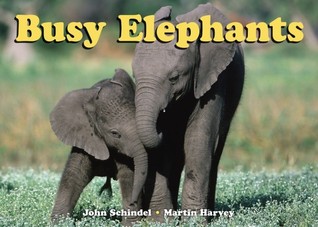
Busy Elephants
Author: John Schindel
Photographs: Martin Harvey
Publisher: Tricycle Press
Genre: Childrens, Board Books
In the past, we’ve tried Busy Penguins, which I loved, but Ayla had little interest in. This time, Busy Elephants was all the rage. Each page contains a photograph of elephants out in the wild, eating, running, bathing, etc. And after months and month of every blessed furry (or even some non-furry) animals being called ‘Dog’ its nice to finally see her point with recognition at the elephants on each page, listen to me say elephant, and then try the word out on her own mouth. So far, all we get is “lphn,” but that’s enough for me this week. She’s excited to learn new words, even if she can’t quite pronounce them properly. That’s what makes these kinds of books so great for babies: real photographs, repitition of a word, until by the end they’ve seen the world and added something to their vocabulary.
Titles, Actresses, and of Course Murder… Oh My!

First Edition UK Cover 1933
Title: Lord Edgware Dies
Author: Agatha Christie
Going through my own personal Agatha Christie Crime Collection challenge, next on my list for April was 13 At Dinner. My copies are leather bound editions with 3 titles per volume, in no particular order, so I thought my eyes were just going bad when I couldn’t find the title. Finally I settled on 13 Problems and thought I was ready to go, but opening it up, something didn’t feel right. So it was back to the internet to check over my list.
That’s when I discovered that 13 At Dinner was originally published as Lord Edgware Dies, and low and behold, I actually have a copy of THAT. The story follows the trail of a woman suspected of murdering her husband because, quite frankly, she told everyone he would and then he drops dead. It happens during a dinner party at which there are 13 guests, hence the republished title. But that doesn’t explain why they chose to retitle the book.
I was doing a little research into this phenomena, and discovered that this happens quite often especially in crime fiction. For Christie alone, there’s a fabulously long list of retitles, mostly between the first edition UK and the first edition US:
After the Funeral (UK) = Funerals are Fatal (US)
Death in the Clouds (UK) = Death in the Air (US)
Destination Unknown (UK) = So Many Steps to Death (US)
Dumb Witness (UK) = Poirot loses a Client
(US) Five little Pigs (UK) = Murder in Retrospect (US)
4.50 From Paddington (UK) = What Mrs McGillicuddy Saw (US)
Hercule Poirot’s Christmas (UK) = Murder for Christmas (US)
Hickory, Dickory Dock (UK ) = Hickory, Dickory Death (US)
The Hollow (UK) = Murder after Hours (US)
Lord Edgware Dies (UK) = Thirteen at Dinner (US)
The Mirror Crack’d From Side to Side (UK) = The Mirror Crack’d (US)
Mrs. McGinty’s Dead (UK) = Blood will Tell (US)
The Mousetrap (UK) = Three Blind Mice (US)
Murder in the Mews (UK) = Dead Man’s Mirror (US)
Murder is Easy (UK) = Easy to Kill (US)
Murder on the Orient Express (UK) = Murder in the Calais Coach (US)
One, Two, Buckle my Shoe (UK) = The Patriotic Murders (US)
Parker Pyne Investigates (UK) = Mr. Parker Pyne, Detective (US)
Poirot’s Early Cases (UK) = Hercule Poirot’s Early Cases (US)
The Sittaford Mystery (UK) = Murder at Hazelmoor (US)
Sparkling Cyanide (UK) = Remembered Death (US)
Taken at the Flood (UK) = There is a Tide (US)
Ten Little Niggers (Original UK) = And Then There Were None (Current UK) = Ten Little Indians (US)
They do it with Mirrors (UK) = Murder with Mirrors (US)
The Thirteen Problems (UK) = The Tuesday Club Murders (US) T
hree-Act Tragedy (UK) = Murder in Three Acts (US)
Why Didn’t they Tell Evans? (UK) = The Boomerang Clue (US) T
– taken from http://www.gaslightbooks.com.au/checklists/mchanges.html

While looking into that little curiousity, I stumbled onto another bit of fun. One of the characters in this particular Poirot adventure is based off a real historical person. Inspired would be more correct, as Ruth Draper
Draper was known for her monologues, ability to become something new with few props, and to immitate anyone. When Christie discovered Draper she thought “[…] how clever she was and how good her impersonations were; the wonderful way she could transform herself from a nagging wife to a peasant girl kneeling in a cathedral. Thinking about her led me to the book Lord Edgware Dies.” (from Christie’s autobiography
Apparently, Draper loved to perform at parties as well as on Broadway. It was said that she would watch people, taking note on all their little quirks and behaviors, and then turn what she gathered of them into one-person sketch, worthy of all sorts of accolades. She traveled throughout Europe as well and was quite the sensation. The character of Carlotta Adams is one in the same, aside from the small little detail that she doesn’t live to the ripe age of 70 because she gets wrapped up in a murder mystery.
I’m enjoying my weekly sit downs with Christie, and Lord Edgware Dies has been no exception. Its fun, interesting, and Poirot always keeps me on my toes.






 Anakalian Whims
Voice of Conscience by Behcet Kaya – A Review
April 28, 2012 at 10:10 pm (Reviews) (behcet kaya, books, culture, debut novel, reviews, social commentary, Turkey, turkish authors, world literature)
Author: Behcet Kaya
Publisher: AuthorHouse
Length: 414 pgs.
Described by multiple reviewers as a Shakespearean Tragedy, Kaya’s debut novel Voice of Conscience is a little bit Kite Runner and a little bit Bourne Identity, but still something all its own.
Best read in three days (because of its three parts set in Turkey, London, then California), Voice of Conscience follows the life of Ramzi Ozcomert Jr., from his childhood in Turkey and a culture of vengeance and family tradition – to love, marriage, and finally the return to his roots. In the spirit of Khaled Housseini (author of Kite Runner) and Manil Suri (author of The Death of Vishnu), Kaya dives into his own culture and gives us social commentary of a country often overlooked in literature. Addressing deep issues of the human condition througout love, loss, revenge, and guilt from the perspective of a Turkish author, I found the book rather enlightening and educational.
Prior to Kaya’s novel, the only books I had ever read involving Turkey were Middlesex by Jeffrey Euginedes (entire portions of the novel dedicated to the relationship between the Greeks and the Turks) and vampire hunting novels that often use Istanbul as a pitt stop within plot developments. I’ve encountered Orhan Pamuk over and over again, having worked in a bookstore running the literature section for years, but I never actually picked up any of his work, despite their accolades.
I read Part One set in Atamkoy, Turkey in 1962 curled up in my library with a cup of coffee, thinking this little tragedy was going to be more of a depressing, cozy read. Turns out, through Parts Two and Three, I had migrated to my Gazelle where I can work out and read simultaneously due to its low impact and breezy routine. I’m a mood reader, and the more the story progressed, the more Ramzi got closer and closer to going all mercenary ninja on his enemies, which gave me the desire to be on the move. By the time the book ended, in tradition of a perfect story arch, I was back in a cozy chair with my coffee and a beagle on my feet.
Overall, I appreciate Kaya’s novel and how much of himself he has poured into it. Its an excellent first novel, and I look forward to reading more of his work in the future. My only complaint is in some of the dialogue which occasionally seems to fall a bit flat and is often times too lengthy. (This coming from a girl who talks incessantly and tends to write how she speaks… could be the pot calling the kettle black!) But all in all, well done!
Additional articles to read:
http://www.prlog.org/11463686-behcet-kayas-voice-of-conscience.html
http://www.todayszaman.com/news-273884-international-readers-need-to-discover–turkish-literature–say-publishers.html
Permalink 3 Comments