Wild and Free

Once a year or so I choose an audiobook to listen to that is NOT for my children. I have an auditory processing disorder, which makes listening hard; but as a firm believer in working brain muscles, building skills, and asking for as few accommodations in life as possible, I work on my listening through audiobooks. It takes me months to listen to a book that I could otherwise read in an hour or two. (I read, according to my husband, extraordinarily fast.)
My audiobook choice the last few months has been Ainsley Arment’s The Call of the Wild and Free: Reclaiming Wonder in Your Child’s Education. I chose this one, frankly, because it was available on Spotify and as a homeschool mom for the last decade (and a homeschool aunt for the last two), I have tried to read anything and everything published on and within the homeschool community since my early twenties. It’s important to me to understand a lot of ideas to really feel comfortable choosing direction for our family. Although I firmly land in the Classical /Charlotte Mason corner of the homeschool realm, I have read a great deal on all the corners. I like that Ainsley Arment has as well. She has done her research, she has put in the hours, she is a fantastic source of information.
I needed the affirmation this week as I was recommending groups to new homeschool moms and realized I had been blocked from the one I was trying to recommend! I also, apparently, had accidentally been complicit to stirring a pot in another, by sharing it with people. You see, I classically educate my kids via the Charlotte Mason method, but I don’t limit myself to one particular curriculum or another. I refer to Ambleside Online, I look for ideas on The Charlotte Mason Cottage Curriculum, I utilize the free resources on the Well Educated Heart/Libraries of Hope website. I meet my kids where they are with resources I can afford. Many times I choose my own living books altogether, ones not mentioned on anyone’s published curriculum. For this, I’m not a part of any group. For this, I’m often evicted from certain communities for not doing the same thing the others are doing. If you don’t use Ambleside Online exactly as listed, I feel you are shunned by the AO purists. When I was using Classical Conversations resources as I saw fit, I was constantly admonished for not “trusting the process.” Veering my own direction as I meet the needs of my children is not leaving the path of God’s design, as I’m quite certain God does not have a hard rule on studying a specific topic in September verses February, or a requirement to do school for 8 months rather than year round, or that everyone has to been on the same exact topic at the same time in order to be part of a community. For this, I found Arment’s book a life giving relief after being a maverick black sheep in most homeschool communities. I show up for my kids to have people, I’m in the online groups for the exchange of ideas. I determined this week, I should probably just stay off the internet unless I’m blogging because my ideas are too fluid for those who write their own curricula.
The humor in this mentality amongst homeschool groups is that: aren’t we all bucking the system already? Why would those staying out of a system that doesn’t work for them choose to be a lemming in another system. Sharing ideas and curricula you’ve made is wonderful. I have some I’ve made as well; but when I share it, I share it knowing that it will (and should) be tweaked by the family using it. Why? Because each family unit is unique, each student is unique. I’m sharing what worked for me in case it works for you. I love reading through what works for others to see if it will work for me. The idea that our homes must all be identical is insane to me.
So without realizing it, I have embodied what Arment describes as “wild and free” for years, despite being methodical and extremely diligent. Being wild doesn’t mean abandoning guidelines, rules, or structure. It often comes with embracing rhythms rather than strict schedules. It comes with studying high school level Chemistry as an 8th grader, outside sprawled in the grass, but regularly sitting at the table for Algebra I. It means knowing that STEM can absolutely be prepped for through nature study. I actually had to defend that online earlier this week… the idea that a student can be fully prepped to engage in college level science due to their extensive nature studies was something I thought was common sense. Look at Isaac Newton, for example. People actually think you cannot study fractals and Fibonacci swirls, chemistry, physics, trigonometry, and calculus, without sitting in a classroom at a desk. I find this baffling. Nature philosophy is how every scientist from the beginning of time got their start, why does modern society discredit it so quickly?
If you are a parent doubting your ability to walk the homeschool path through graduation with you child, I urge you to read Arment’s book. Also try Julie Bogart’s The Brave Learner, Charlotte Mason’s Home Education series, and Law’s and Lygren’s How to Teach Nature Journaling or Anna Comstock’s Handbook of Nature Study. If you’ve been on the homeschool path awhile and don’t seem to “fit” anywhere, read The Call of the Wild and Free and know that it is ok. Your kids are learning, you probably do have friends, it just doesn’t feel like it sometimes when people get pigeon-holed into “you must do it this way or the highway” mentalities.
To anyone reading this, I do not subscribe to the practice of gatekeeping knowledge. My toxic trait is: the second someone tries to do so, I absolutely think less of them. After reading Arment’s book, I think quite highly of her.
Hard Roads to Cultural Literacy
In May of 2019, I read a book called Hard Road West: History and Geology Along the Gold Rush Trail by Keith Heyer Meldahl. I remember it being riveting. When I logged it on Goodreads all I wrote was, “Excellent and fascinating.” I was dating my now husband at the time and I remember sharing with him sections I thought he would enjoy, as we both like geology and one of our dates was to the HMNS gemstone exhibit. At one point I laughed out loud at something clever Meldahl wrote (I don’t recall what it was) and my husband commented that it is a rare geology book that causes one to laugh in pleasure.
Naturally, I thought this would make excellent assigned reading for my homeschooled highschooler. But one chapter into it she was struggling. It wasn’t the reading level, she has a collegiate reading level and has had one for a few years now. I was certain it couldn’t be the science as she had been perusing geology books since childhood and had done a whole geology curriculum with a friend as part of their own little science club they created. Nerds. I went over the science with her and she kept reading. It became less of a struggle, but she is not laughing out loud with pleasure from her geology book.
Then I started reading Cultural Literacy by E. D. Hirsch and things became clearer. In Cultural Literacy Hirsch talks about a study done on the results of seven year olds who took a reading assessment test. In the test the children were asked to read a story about a spider. The children who had more prior knowledge about spiders scored higher on the reading comprehension questions about the story (which did not require special knowledge about spiders) than those who did not know much about spiders.
I shared this with my oldest daughter, as we often study together while the younger kids are playing. We discussed it and determined that it makes sense to not get hung up on something being mentioned in passing because you already know a lot on a topic and can picture it in your mind with little effort, but to struggle to retain what something is about if it mentions a lot of things you’re trying to picture because you’re not as familiar with them. Perhaps it is easier to envision Charlotte in Charlotte’s Web if as a child you also have watched a real spider build its web, perhaps it is easier to remember the story if you’ve seen or read about how baby spiders hatch. Or, if you’ve had Charlotte’s Web read to you as a child, maybe a technical book on pig husbandry would be easier to retain as an adult. Hirsch includes an example of college students reading a paragraph about Ulysses S. Grant and Robert E. Lee and struggling because they had no prior knowledge of who they were and how they related to the Civil War (shocking because these were college students out of Virginia).
I was reminded about a public schooled girl I was working with who had failed her reading portion on her standardized tests. Her phonics were impeccable, but where she struggled was comprehension. When I worked with her, almost every time she struggled to read something it was because she had never heard the word. She didn’t have the vocabulary to support her phonics skills. I advised the family to listen to audiobooks, read stories together at night, talk to each other more, look words up in the dictionary. Children learn the meanings of words by hearing them, then when they see them on paper for the first time while sounding it out… they have a picture in their mind of what that word means, feels like, or how it can be used in different sentences. Kids should always have access to stories above their reading level, so that they can learn grammar structures and vocabulary words organically. Hirsch drives home the idea that you can know how to read and still be illiterate if you don’t know anything about what you’re reading.
I told my daughter how this was interesting to me because my husband had said he thought she didn’t know enough geology to read Hard Road West smoothly, even though I thought it was a very approachable book and that she had a strong foundation in geology. She and I laughed over the time a volunteer at the museum asked her what a specific rock smelled like and the big reveal fell flat when she answered, “Sulfur.” Poor guy deflated and said, “Yes, it’s Sulfur. You must be homeschooled.” Apparently the public school kids her age on field trips liked to shout “Farts!” She was about seven at the time and it is one of her favorite museum memories. (I’m not going to lie, even if I knew it was sulfur at seven, I’d probably have shouted “Farts!” too, but I went to public school.)
“So, why, if you’ve read all the same geology books we read as children, is this geology book difficult? Because I genuinely don’t think it would have been difficult for me at fifteen.” That is when she confessed that the geology books we owned and had spent hours reading… she hadn’t actually been reading them: “I was looking at the pretty rocks. I could tell you the page numbers where all my favorite rocks are, all the prettiest ones, I didn’t read all the stuff…” We genuinely laughed together, two wildly different personalities approaching children’s geology books in wildly different ways. As Charlotte Mason said, “Children are born persons.” But for every moment, like this geology one where she struggles because maybe she didn’t pay as much attention to what was put before her in the past, she has so many where she shines. She catches every Shakespeare reference. Every time. (Hirsch writes a bit about how Shakespeare allusions used to be quite common in all kinds of writing, including business memos, but as of the publication of his book in 1987, that was no longer the case.)
Hirsch’s argument for cultural literacy was never meant to be for homeschool parents to refine the presentation of their educational feasts, his goal is educational reform in the public sector. There is extensive discussion in his book about the struggle to properly regulate education in that if you mandate that schools teach at least two Shakespeare plays there will always be arguments about which two should be selected and that no two districts will choose the same two, therefore knowing who Shakespeare is might be universal, but catching Shakespeare references will vary. (I vote for all the Shakespeare. Every play! All the sonnets!) But I did feel like Hirsch’s essay very much affirmed the education I am providing. Maybe my oldest gets a little bogged down in this particular geology book, but to be fair, it could easily be assigned in a college course, most high school students wouldn’t be reading it between their Homer and Geometry lessons. The paragraph that boggled the minds of the Virginian community college students in the 1980s didn’t phase her, and for that I have hope.
Additional affirmation came when I realized I had owned other books by Hirsch in the past. He’s the one that wrote the series Everything Your ___Grader Needs to Know. My first two years of formal homeschooling (first and second grade), I had read those books out loud the last month of the traditional school year to see if we were covering everything. What I learned was reading those books out loud was a waste of time because a classical Charlotte Mason education is thorough and she not only knew what she needed, but she knew richer versions than the sad paragraphs presented. That was the final nail in the coffin on us ever relying on textbooks. Cultural literacy can be gained from textbooks, but it’s boring and far less effective. The better road to true literacy, in my opinion, is living books. I donated Hirsch’s other books, but I’m keeping Cultural Literacy.
One whole day after finishing Cultural Literacy, I went to our local library to donate a bag of books I was purging from my collection. There on the shelf next to the library bookstore register was E. D. Hirsch’s Dictionary of Cultural Literacy, a compilation of all the things the average American graduate should know, for $2. Of course I bought it.
“Also unrealistic is the pragmatist emphasis on individuality, at least as the idea has been institutionalized. The best teaching does accommodate itself to individual differences in temperament, but a child’s temperament does not come freighted with content. To learn a culture is natural to human beings. Children can express individuality only in relation to the traditions of their society, which they have to learn. The greatest human individuality is developed in response to a tradition, not in response to disorderly uncertain, and fragmented education. Americans in their teens and twenties who were brought up under individualistic theories are not less conventional than their predecessors, only less literate, less able to express their individuality.” – E. D. Hirsch, Cultural Literacy, pg. 126.
Getting to Know Charlotte
A Homeschool Life…
When I was first sold on homeschooling, I was smitten with the classical model. I learned later that most “classical” models being advertised in the United States are actually “neo-classical” in practice. They have taken an essay written by Dorothy L. Sayers on the Trivium and pigeon-holed it into something it wasn’t exactly meant to be. The neo-classical model sort of married the United States educational “ideal” and pushes intense academia early, limits the elementary school years to a lot of memorization (the grammar stage), and taken to the extreme (like anything taken to an extreme), steals joy from students and teachers alike.
If you have followed my blog for the last fifteen years, you might remember me “homeschooling” my toddler. (FYI, pre-school is just parenting, not homeschooling. It’s literally PRE school.) Pressured by a narcissistic ex who demanded that my then three year old be able to read already (it’s not developmentally appropriate to force formal reading lessons on children under six), be able to copy out poems (it’s not developmentally appropriate to force small children to write, look up x-rays of their hand bones), and wanted her to be trained as some government super spy assassin (I am a third degree black belt in Kung Fu, but some people have watched too many movies and have no sense of reality and I used to be married to “some people”). Homeschool regret #1: giving into the pressure of my ex to do formal reading lessons because she was bright and could do it and I was hyperlexic and was reading at age three despite knowing that educational studies have long stated that formal lessons shouldn’t begin until six. Homeschool regret #2: ever handing her a worksheet in kindergarten, which wasn’t often, but still…
The things I am proud of, however, is that despite all this pressure, we always focused on living books above all else and I encouraged verbal narrations for years. I do not regret the neo-classical homeschool co-ops we joined (and left), they held an important role in our lives at the time and I met some cherished and beloved friends there even if I was regularly told: you’re not very classical, you’re too Charlotte Mason. The first time I heard that, I started doing some research…
I learned that Charlotte Mason was very classical, and what calls itself classical these days just isn’t. Honestly, it doesn’t really matter, what matters is that I still very much subscribe to both tactics of education and as my oldest is now in highschool and I have three more children with one creeping up on kindergarten (FYI: kindergarten is also PRE- school), I’ve been doing even more reading and research and want to share my favorite resources… the ones I don’t regret.
First: if you’re new to homeschooling or not loving your current homeschool rhythm, this is my favorite link to send parents: The Five Flavors of Homeschooling. I like to share this link so much, I have gotten restricted on Facebook as a potential scammer, despite not having violated the group rules in any of the places I posted it. Knowing your “flavor” can save you a lot of money on homeschool pursuits, and I definitely feel like (having been a single homeschool mom who wasn’t receiving child support that was owed) Charlotte Mason and Unit Studies are the easiest to accomplish for FREE.
Which brings me to my next two resources: Ambleside Online (not an online school) and Well Educated Heart, two curricula that are totally FREE. Ambleside Online is named “online” so as to not confuse it with the Christian private school based on Charlotte Mason’s philosophy still operating in the UK. It’s a full “scope and sequence” and any time you can’t find a title for free or a price you can afford, you can usually access it on Project Gutenberg or substitute it with something suitable. The focus is having the students read real books and source documents, narrating those books, and embracing the idea that Education is the Science of Relations by making connections to things they have studied and the world around them. Well Educated Heart is very similar, but clusters the material into something like unit studies, despite Charlotte Mason discouraging unit studies (because she wanted the children to make the connection, not have the teacher present the ideas already connected). Well Educated Heart offers their curricula for free and the feature I like most is that the audio files are also available on their site for… wait for it… FREE.
But wait, what is narration? That brings me to my third resource that I like to send people: Episode 7 of Cindy Rollins’s podcast The New Mason Jar. I had already read Karen Glass’s book Know and Tell (as well as Charlotte Mason’s original Home Education series) when I stumbled across the podcast episode and I think the podcast is a more approachable way for people to access the road to narration because (Gasp!) a lot of people don’t want to read the books (it actually drives me nuts, but I kind of get it: people are busy, especially mothers). The beauty of pursuing the art of narration isn’t just in the brain development aspect (which is phenomenal), it’s also the price tag… narration is… you guessed it… FREE. No fancy writing programs, no workbooks checking reading comprehension, no drama. A verbal narration costs nothing but the work of a brain muscle and a listening ear plus time. As the students get older a composition book and pen will do the trick. Charlotte Mason educations are truly thorough and affordable. I still teach essay writing, Charlotte Mason purists say they don’t, but a narration is basically an expository essay written beautifully. I still don’t use curricula to teach essay writing, we use narrations and read a lot of well written essays (and sermons) and writing memoirs. My oldest loved Zen in the Art of Writing by Bradbury (after reading Fahrenheit 451) and Zinsser’s On Writing Well. Her seventh grade year also included Annie Dillard’s Pilgrim at Tinker Creek and Writing Life. I think the inspiration of her favorite authors talking about their writing lives was the most effective writing tutor I could have ever received.
Other things I’m pleased I did, but will definitely do more of with the younger ones:
- Fairy Tales: read all the fairy tales
- Music: classical music, folk songs, sea shanties, hymns… studying music throughout history and enjoying it in passing has done nothing but enrich our lives and our studies. My oldest plays the tin whistle, piano, clarinet, violin, and pretty much any instrument she can get her hands on. She also enjoyed two years of choir.
- Scripture Memory Box
- Poetry: we added a memory box just for poetry and the kids are loving it. Instead of being set up the way it is for the scripture memory box as described in the YouTube video I linked, it only has month tabs and we read a poem every day that month. This is in addition to the poetry we study for language arts.
- Picture Study: I want to be more intentional about this in the future, but currently we just decorate our home with real art. Paintings we find at Goodwill or garage sales plus a few John William Waterhouse prints I have always loved.
- Classical Conversations songs: they’re neo-classical, they’re expensive, but my goodness if you can find the CDs used somewhere or splurge on their overpriced app, the kids love and remember their awful songs! The Timeline song has been an atrocious gift that keeps on giving and I’m so happy it was and is a part of our lives.
This semester (Fall 2025), the oldest and I have been reading Charlotte Mason’s Ourselves. One of the fun things about homeschooling in the teen years is that as they grow and reason and read for themselves they really start to see the light regarding the choices you have made as a parent and educator over the years. Ourselves isn’t her favorite book, she didn’t catch right off the bat that Mason was alluding to Prudentius–She hasn’t read Prudentius. I’m 41 and have only read some of his work and The Fight for Mansoul just happened to be one of them because I’m a ‘buy all the Latin texts I can afford’ junkie.–But she is having thoughtful conversations with me about it and understands the value of it having been assigned. She can describe the Trivium and how it is needed when learning something new… you always start with the grammar stage (memorizing new facts, acquiring basic knowledge on a subject), move to a logic and dialectic stage (when you can understand and reason through the ideas presented in the subject at hand), and finally rest in a state of rhetoric (being able to express the ideas persuasively), and that these stages will be repeated throughout your whole life as you pursue new things to learn because education is a lifetime pursuit. It’s exciting to be here, even though she’s only in 9th grade, only fifteen years old, even though she wanted to start college courses several years ago and won’t be actually starting one until next semester, it is so exciting to be here and the teen years are absolutely my favorite… and I think Charlotte Mason (and more importantly God) has had a lot to do with that.
(As an Amazon affiliate I earn from qualifying purchases.)
A Life With Anne
When I was a child I adored the Anne of Green Gables series. I still do. But the height of me reading through the series was between the ages of 7 and 10, when I knew I could read all eight books in the 19 hour drive from Houston to Denver. I was an avid and precocious reader back then. Now I’m just avid. So color me surprised when I tried to introduce my oldest daughter to Anne during her elementary school years and the book fell flat for her. What we discovered, now that she is totally smitten with the series, is that she didn’t understand the appeal in a character who just sounded exactly like herself. For real, people have commented on how much my kid reminds them of Anne her whole life, but this year is the first year my darling girl has truly delighted in it.
I, apparently, had introduced my dear girl to Anne too soon which was mistake number one regarding my favorite auburn haired heroine (and my life for that matter, despite her being called my mini-me all the time, she is not–in fact–very much like me at all). Mistake number two was assuming everyone else I knew was thoroughly acquainted with her. So when we decided to choose Anne of Avonlea as our first San Salvatore Book Club pick, we were shocked to learn that these women we love and admire had actually never read Anne of Green Gables (some, not all, had watched the Megan Fellows series).
Naturally, I began to approach it as I do teaching. Having been raised on Anne’s beloved Miss Stacy being presented as the ideal teacher (which grew into a love of most things Charlotte Mason as I researched homeschool options), my notes always either begin or end with these questions: What did you notice? What did you wonder? What did you discover? What, if anything, did you find good, true, or beautiful about this book? Are there any other stories you’ve heard or know or read that are echoed in this story?
This post, specifically, is on the first two books and the things I noticed reading the Anne books as a woman in my forties instead of as a girl with a wild imagination.
I love how L. M. Montgomery begins both books with an exotic character. In the first, Anne is the exotic, and in the second Mr. Harrison is our foreign, otherworldly character. He is from elsewhere, new to the neighborhood, and comes with an unruly parrot named Ginger, who reminded me of my Uncle’s macaw, Chicken. Just as Anne asked to called Marilla her aunt in the first book, the opening sequences of Anne of Avonlea includes Mr. Harrison mistakenly calling Marilla Anne’s aunt. In Green Gables, Marilla shuts it down as a falsehood, and in Avonlea, Anne does the same. Harrison and Anne’s exchange regarding the cow invasion mirrors Anne’s first meeting with Rachel Lynde. In the first book, Anne is the outsider throwing a temper tantrum, in the second Anne is established as a true citizen of Avonlea as she suffers a newcomer’s temper tantrum. Montgomery’s alluding to her previous work is beautifully done.
As an adult, I also delighted in Harrison’s stab at Anne’s reading “yellow-jacket” novels. As a child I could visualize the novels perfectly because I grew up haunting antique stores and their book corners. Often, as a child, books were not worth my notice unless they were old, dusty, and had a faint smell of vanilla and moth balls (bonus points if there was a lingering odor of pipe tobacco). As a retired bookseller, this portion hit a bit differently and I laughed out loud. Yellow-jacket (“yellowback”) novels were “railway novels.” They were the equivalent of NY Times Bestselling thrillers or romances perched in a kiosk at an airport terminal (I’d say “today” but I really don’t fly much and I don’t know if people buy airport books these days). They were sensational fiction, much like dime novels, brightly colored (usually yellow) with ads on the back to cover the costs of the printing. Often they were simply cheaper reprints of already popular books. They were in direct competition with the “penny dreadfuls” G. K. Chesterton discusses in his essay A Defense of Penny Dreadfuls. Dracula was one such publication.
I also noticed, diving into the series as an adult, how much the Anne series had saturated the corners of my brain. In my late twenties I wrote two books in what is called The Bookshop Hotel series (book three was written just after I turned thirty, books four and five are still sitting unpublished on my computer). I wrote them under duress and my brain was completely fried, grasping at straws. One of my character’s names is Maud Montgomery. A few years ago I was asked by a reader if I had done that on purpose. I can firmly say, no, I did not. But reading now, I see how my mind had pulled something from a dark corner, something it had known and forgotten, and ran with it. L. M. Montgomery (Lucy Maud), called Maud by her friends, was a deeply religious person who functioned as a caretaker for her mentally ill husband. I can see in hindsight why my mind pulled this name out of the abyss during that time, as I thought I was the caretaker to a mentally unstable alcoholic husband myself. (Turns out, I was wrong, I was actually just a narcissist’s favorite toy. Thank God, that part of my life has passed.) The thread that holds so many of these episodic adventures in Avonlea is often the nuggets of wisdom and religious belief that seep through the pages, the empathy and compassion, the search for the divine, the delight in creation and whimsy.
Another strange moment for me was when I read in Anne of Avonlea:
“I think an old, deserted house is such a sad sight,” said Anne dreamily. “It always seems to me to be thinking about its past and mourning for its old-time joys.”
Leave it to my exhausted brain to also personify a house in my Bookshop series. What we read in childhood truly shapes the way we think.
I was amused to discover how much my parenting seemed to mimic Marilla’s and startled to get to know Miss Stacy as an adult reader. I have been homeschooling my children from the beginning. Public school was never going to be an option for us for many reasons, but as I was reading about Anne’s favorite teacher, whom I had read about hundreds of times in second and third grades, I realized that she embodies all my favorite elements of classical British educators during the turn of the century. More specifically, she has so many qualities Charlotte Mason hailed as correct.
Charlotte Mason lived from 1842-1923 and was known as a turn of the century educational reformer. She established the House of Education in Ambleside in the late 1800’s, which focused on teaching classically but with the added emphasis that “children are born persons.” She wrote a Home Education series I have read several times. When I was using Classical Conversations as a co-op opportunity for my oldest, people often told me I was too “Charlotte Mason.” (Classical Conversations is a nationwide neo-classical homeschool organization based out of North Carolina. There are things I love about their curriculum and things I could do without.) When we tried to connect with Charlotte Mason homeschoolers, die-hard AmblesideOnline families, we were often told we were “too neo-classical.” I now see the truth: we were never Classical Conversations people, nor were we Charlotte Mason followers… my aim has always been Miss Stacy. We are Miss Stacy homeschoolers! We do nature studies, literature based learning, Euclidean geometry. I still use McGuffey’s Readers and Susan Wise Bauer material, while adhering to a lot of AmblesideOnline’s schedules. We have always narrated, as advised by Cindy Rollins and Karen Glass. But in all these details, what I chose to use and what I have discarded, I have shaped my entire homeschool culture off a picture in my mind of the perfect educator–Miss Stacy!– and I wasn’t even aware I was doing it.
My daughter and I read Anne of the Island together, and we will resume the rest of the series soon, but took a break to focus on Homer’s Iliad. I am looking forward to seeing how Anne of Windy Poplars measures up to my memories of it being the best in the whole series, and what other things I notice and wonder, as someone who has been noticing and wondering for a much longer time than when I read it last. I’m excited to see what my real life Anne-girl thinks of her literary counterpart as she reads each book hereafter for the first time as well.
(As an Amazon Associate I earn from qualifying purchases.)
A Year of Homeschooling Peacefully in the Ancient Times
The school year began, for me, in a bit of chaos. My son was born over the summer. My mother had died. In addition to my newborn son, I had two extra children in my household. I was overwhelmed by the impending doom of our co-op. I could sense it coming, but I honestly thought it was a year or two off and I was committed to giving it my kiddo’s fifth grade year before bailing, believing that the proverbial poop would hit the fan a few months after my departure. (It hit sooner.)
Still, after the children went back to their own home. The co-op dissolved and something new began… we found ourselves homeschooling through the ancients in our own little Pax Romana. We declared this our year of homeschooling in peace and it has been phenomenal.
As usual, we began our dive into Ancient history with the Epic of Gilgamesh. After years of reading the picture book trilogy by Ludmila Zeman, it was time to upgrade to a a more “grown up” version of the story. Gilgamesh the Hero by Geraldine McCaughrean was a perfect bridge for the dialectic stage, from elementary to the full translations of high school. Kiddo was struck by the subtle differences, the pieces that make it suitable for older readers, but not for younger ones. As a child who doesn’t like change, learning that different adaptations have a different flow and feel to them has been a challenge. As a ten/eleven year old, she has now been exposed to several adaptations of the Gilgamesh myth and also has a much broader view of near eastern cultures and history. I’m happy to say, my homeschooler as an elementary graduate has a more thorough understanding of history and other people groups than I did as a public school high school graduate. These are the goals, and we’re winning.
I read The Golden Bull by Marjorie Cowley out loud to two ten year olds and an eight year old. This is right about the time we started making our timeline (using Amy Pak’s Home School in the Woods History Through the Ages Record of Time), and having the kids perform narrative plays of what I had just read to them while I nursed my infant. Our house is fairly full of music, so naturally we ended up making a lyre (and some ukuleles) as a hands on craft which in turn became props in our living room productions of The Golden Bull.
Meanwhile, we were also re-reading Susan Wise Bauer’s Story of the Wold Volume One for the third time, reading Story of Civilization for the first time, plucking our way through the Usborne Encyclopedia of the Ancient World, reading the Old Testament, and for good measure added a plethora of picture books I had on hand from the last time we studied the ancients.
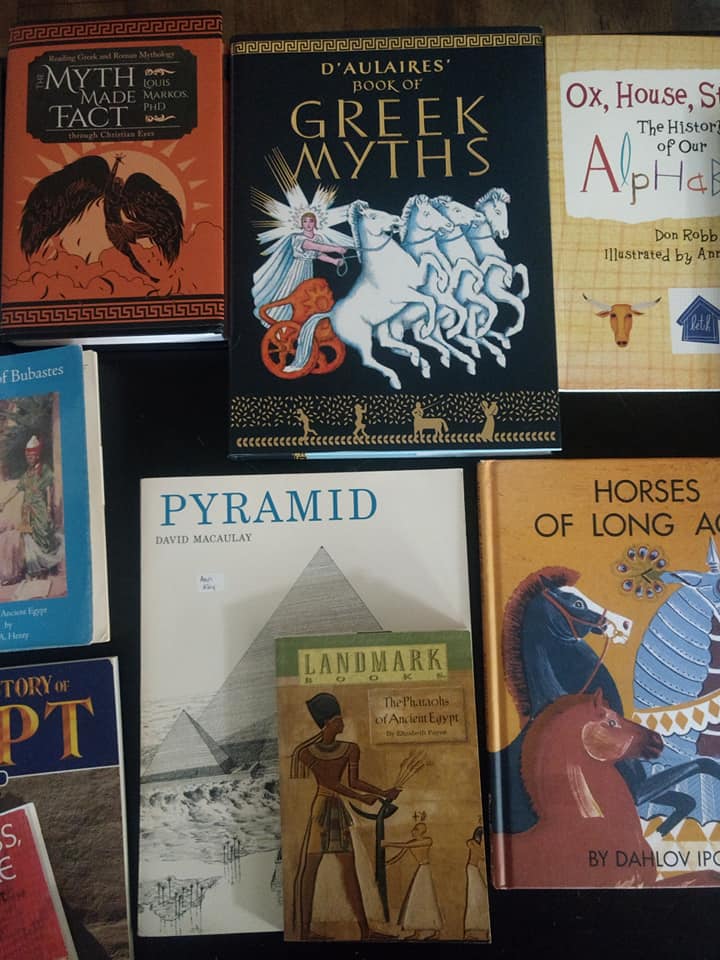
Ox, House, Stick by Robb was discovered while we studied the Phoenicians and the alphabet. This one came highly recommended, and the kids liked it ok, but it wasn’t my favorite. We also re-read The Riddle of the Rosetta Stone by Giblin, that one is always fun and fascinating.
We had some extensive discussions regarding laws and lawmakers. The kids each read a biography on Hammurabi, the one by Mitchell Lane Publishers was the best, we thought. A few rabbit trails later and we spent an afternoon on You Wouldn’t Want to Be an Assyrian Soldier.
As we moved into the time of the Egyptians, we tackled Green’s Tales of Ancient Egypt, The Landmark Book of Pharaohs by Payne, Mara: Daughter of the Nile by McGraw, The Golden Goblet also by McGraw, and The Cat of Bubastes by G. A. Henty. Kiddo hated Mara, I thought it was great. I found the Golden Goblet on the boring side, Kiddo loved it. The fun thing about reading so many books together are the discussions. Homeschooling is basically book club every day. I love book club!
One of my pet topics of study as an adult is the Pharaoh Hatshepsut. I find her to be the most intriguing and have some theories as to where her place in history overlaps with our knowledge of biblical history. The kids each grabbed a biography and I re-read a few of my own. Although I usually love National Geographic stuff, our favorite is the one put out by Compass Point Books. Compass Point Books, for the most part, is a huge go-to in our house. If I see one, I grab it, often accidentally purchasing duplicates. They are more thorough than the Who Was series, but less daunting than the DK series, although we own a good amount of both of those as well. At this point, Kiddo tried her hand at her first full length essay, complete with me dragging out my typewriter for her to type the finished product.
I also love David MacCauley books and we read Pyramid. Kiddo does *not* love David MacCauley books, which is unfortunate because I think I own them all. She preferred diving into Mummies, Tombs, and Treasure and the Magic Tree House Research Guide: Mummies & Pyramids. Side note to the Magic Tree House books: Although the fiction books are overly simplistic and quickly outgrown, we have found that the research guides last all of the elementary school years and are revisited often. We will keep the research guides long after the fiction series is purged, I believe. As homeschool eccentrics this study coincided with our anatomy studies in science. The kids got the chance to observe a profession necropsy of a rat and later Kiddo tried her hand at mummifying the spare dead rat. AmenRAThep still lies in our garage buried in salt in his intricately decorated plastic tomb. An expository essay on the mummification process ensued. More tapping away at my now “vintage” typewriter… More revisiting all our favorite picture books (Mummy Cat by Ewert just never gets old and Tutankhamen’s Gift is lovely) as well as the HMNS for the Ramses exhibit.


When we wrapped up our anatomy studies, the mummification process became a nice bridge into our archaeology unit. We used the Wonders of Creation series from MasterBooks.com. The Archaeology Book by David Down and The Geology Book by Dr. John D. Morris led beautifully into The Fossil Book by Gary Parker. We’re definitely going to continue through this series into Caves, Minerals, Oceans, Weather, and Astronomy as we move through the timeline to the middle ages.
I love multi-sensory learning whenever possible, so during all this we also tried our hands bringing our history studies to our taste buds. One of my favorite cookbooks to pull out during the ancient years is The Philosopher’s Kitchen. It’s full of ancient flavors that make use of modern kitchen routines so you can enjoy the taste of the times without slaving away. We have recipes we’ve attempted to make the way they would, but I’m content with learning to use the kitchen I have instead of trying to time travel. Kiddo found some easy kid recipes in various places and we also enjoyed some Mesopotamian sweet breads she made herself that were rather tasty. Cardimon and honey is a lovely flavor combination.


Another aspect to unit studies/ studying all disciplines through the timeline, is that we tried Spelling You See for the first time and used the Ancient (level F) package. Spelling You See was developed by a reading specialist who encourages identifying word patterns and color coding them. Married with dictation of an entire topical paragraph, this curriculum abandons the by rote memorization of a list of spelling words. I find this method useful, but we will also continue with our Spelling Workout books after we’ve completed all the lessons in this book, as spelling is a subject we’re going to have to continue to work on long after some of our peers have abandoned it as a subject. I’m ok with this, Kiddo tests gifted in most subjects but spelling is a struggle. We remind ourselves daily that we can do hard things (through Christ) and that it is ok to not be perfect at everything as long as we’re trying our best.
Adara by Gormley, God King by Williamson (we had already read Hittite Warrior years ago), and Days of Elijah by Noble were read as we continued our studies of the Old Testament as well as Herodotus. (Kiddo loved Days of Elijah, I tried to read it with her but I found the writing style very off putting, I honestly cannot remember if I finished it or not.) Kiddo re-read Bendick’s Herodotus & The Road to History, we both love all things Bendick. I wanted to re-read Herodotus’s book as the last time I had read it Kiddo was two or three, but time got away with me. We were knee deep in fractions because math may never be abandoned, no matter how many people die (we had four significant deaths this season), or how tired you may be. What kept our mind clear enough to finish our Singapore 4a&4B curriculum and get through Math-U-See Epsilon, was the fact that we were taking time to study God’s word daily. We weren’t just trying to incorporate theology in our homeschool, my husband was actually leading bible study every evening (and had been since the start of our marriage in 2020); and in addition to that, upon moving into our new house in 2021 we began using the Simply Charlotte Mason Scripture Memory System. I found a reasonably priced recipe box on Amazon and started adding index cards as per the instructions of the method (follow the link). Focusing on hiding God’s Word in your heart, opens the mind up for so much more, and in all the crazy we prayed for God to help us be good stewards of our brains and our time and the results have been delightful.
With all this Bible study, Kiddo requested to eventually study Aramaic and Hebrew and Koine Greek, but we decided to wait as we continue on our Latin studies. One thing at a time, and we still have some Latin books to complete.
Now, for the Greeks… The D’Aulaires have a lovely Greek Myths book. In addition to that, Kiddo read more books on Homer’s work than I can count. The highlight reel were repeat romps through the Mary Pope Osborn adaptation, Sutcliff’s Black Ships Before Troy and The Wanderings of Odysseus, and Lively’s In Search of a Homeland. She also read for the first time Aleta and the Queen, Flaxman’s The Iliad of Homer, and Colum’s Children’s Homer. By the time she reads Homer’s unabridged work, she’ll know the stories so thoroughly I’m hoping the poetry of it will shine through and delight her in ways that evaded me when I blindly trudged through it for the first time because I had no previous knowledge of context to work from. I had planned for us to read Edith Hamilton’s Mythology, but when you’re done, you’re done. So we’re saving Hamilton for the next time around, in four years.
Bendick’s Archimedes and the Door of Science as well as The Librarian Who Measured the Earth by Lasky are must haves. We have read them every time we’ve studied the Ancients and sometimes we pluck Lasky’s picture book up to read just for kicks.
Rome Antics by MacCauley was beautiful. It takes about ten minutes to read, but days to absorb if you want to go back and study all the architecture as well. I didn’t dwell on it too much as she’s already read Where Were the Seven Wonders of the Ancient World? and Where Is the Parthenon? (we did a hands on project with friends building the Parthenon out of marshmallows which was fun). While on the Who/What/Where series kick, she also read Where Is the Great Wall? We’ve studied ziggurats and pyramids and a number of other structures this year, and now that we are currently studying Rome, I’m going to have to collect my thoughts and make proper plans to lay the groundwork for a strong introduction to architecture. In the meantime, now that summer is here, we’re listening to the Rise of Rome on Wondrium, and plucking through our never ending reading list.
I’ll continue to update as we make our way through the last hundred years or so before Christ, through the New Testament, and onto the invasion of Britain. We already studied Pompeii and went to the museum exhibit with our co-op, and volcanoes were studied in passing while we raised money for the Pacific Rim Awana programs and made a homemade volcano during a friend-date at our house. (I think we may start a science club…)
(We got a taste of Asian mythology and folklore with some read alouds and picture books, but I think we will revisit them in a more heavy handed way when we study Marco Polo again. If you’re looking for titles, I recommend perusing everything by Demi as well as 101 Read-Aloud Asian Myths.)
This school year has been our most relaxing yet, despite the chaos of life, and we hope to continue this pattern in the years to come.
North American History and Some Confusion Over Canada
We read through history chronologically, something those who have read this blog for awhile are perhaps well aware. In doing so, we tend to skip around the globe a tad. I try to redirect the kiddo to maps, but in the case of North America, I failed somewhere…
“Wait, where’s Canada?”
“North.”
“I don’t see it.”
“It’s north of the United States.”
“Canada isn’t a state?”
As a homeschool mom my face palm was directed one hundred percent at myself. “No, baby, it’s its own country.”
I know how why the confusion occurred. Well, let’s back up. We’ve been reading, a LOT…
Saint Isaac and the Indians – Milton Lomask
When the French were flocking to North America and colonizing the forests and St. Lawrence River, along with them came Jesuit missionaries intent on sharing the word of God with the Mohawks (Iroquois) and Huron people. Some, were martyred by the very people whose souls they were trying to save. Isaac Jogues, was such a man. He was later sainted by the Catholic Church.
We are not Catholic, but we do value Catholic church history as an important part of education. I try to keep a well balanced and diverse selection of biographies as we study so we can see a complete picture of the world and all God’s creation. When looking for elementary friendly biographies on those who have been sainted, I find Ignatius Press a reliable source. Lomask’s book didn’t fail us and we were enthralled with Isaac’s story.
The Courage of Sarah Noble – Alice Dagliesh
Kiddo read this on her own, then I read it immediately afterward, so we could discuss. I’m getting to the point where I hand her more books to read alone, not because I’m reading out loud less, but so we have more time to read meatier things aloud while she tackles the easy stuff. She enjoyed this one and made a lap book off a kit I found on Teachers Pay Teachers. It’s not my favorite, but I definitely think it has value on an elementary reading list.
The Matchlock Gun – Walter D. Edmonds
This is the second time we’ve read this book. The first time we paired it up with a trip to the science museum for a firearms through the ages exhibit. Kiddo was excited to revisit it and we looked through old pictures from when we got to peruse cases and cases of antique matchlock guns. This is another fantastic “living book” to read during a study of early America.
Who Was Blackbeard? – James Buckley Jr.
Kiddo hates any book with “bobble head people” on the cover. When she was younger I used to put post-it notes over their faces. She’s getting better about ignoring the awkward caricatures on her own and was able to put a lot of personal preference aside for the sake of a good pirate story. The Who Was series is perfect for filler when you just can’t find a better biography on a person readily available.

Ben and Me – Robert Lawson
I love Robert Lawson books. So does Kiddo. But it wasn’t just Robert Lawson that captivated her for this one… mice make for riveting anthropomorphized creatures. We both just love a good rodent in the lead. For Kiddo there was another aspect… the week she read Ben and Me, she actually binge read about six Ben Franklin biographies. She just can’t get enough of the guy.
The D’aulaires have a fantastic picture book about him, we are on a mission to own everything they wrote, and there were a handful of other generic chapter books on our shelves she powered through for the sake of more Ben.
While she was doing all this Ben Franklin research, I read…
Myne Own Ground: Race and Freedom on Virginia’s Eastern Shore – T. H. Breen
…which was utterly brilliant. I’ve never read such an honest, objective account of the slave situation in colonial Virginia. It is single handedly the best race relations book I’ve read to date. And I’ve read a lot of them over the years, trying to understand everyone. Kiddo obviously didn’t read this one this time, but I definitely plan on including it on a high school reading roster.
This is where I derailed, while she focused on Ben, I was reading about the English Republic between 1649-1660. I read a book on Charles I by Leanda de Lisle, a book about Roger Williams by James A. Warren, a biography on Henrietta Miaria (Charles I’s wife) by Alison Plowden, and a biography on Charles II by Martyn R. Beardsley.
During this time we discussed Ben Franklin’s travels to France. We talked about a book we read a few years ago called Madeleine Takes Command about a French girl at a Fort in Canada. We discussed the politics of what was going on between North America and Europe… She likes to understand people and things they fight for, I didn’t catch on that the borders were unclear.
Benjamin West and His Cat Grimalkin – Marguerite Henry
My husband read Brighty of the Grand Canyon out loud before bedtime as a family. It was lovely. He has a lovely reading voice and Kiddo and I just love Marguerite Henry. Brighty is set during Teddy Roosevelt’s time, so it was a little misplaced, but delightful. Benjamin West was a perfect way to drag ourselves back to our timeline, and it was required reading for her history class at Atrium (our co-op she attends and I teach at once a week).
We loved this one and it put us both in the mood to paint, we watched a YouTube slideshow of his work, so we would be familiar. While feeling artsy, we read a biography on Maria Merian, The Girl Who Drew Butterflies. We revived our nature journaling.
But Benjamin West also gave us an opportunity to discuss Quakers. We hashed out the similarities and differences in our beliefs after she pointed out that they’re a bit like me… luddites. My kid likes to call me out for my avoidance of technology. Ironic, considering I’ve written a blog for over a decade.
Amos Fortune, Free Man – Elizabeth Yates
This is one of the most beautiful stories I’ve ever read. I’m so glad the Kiddo and I got to share reading it for our first times together. She asked if we could visit his historical landmark, and I definitely want to add that to our list of vacation goals.
Ethan Allen: Green Mountain Rebel – Brenda Haugen
I love the Signature Lives biographies. They’re such great resources. The cool thing about reading about people like Ethan Allen is the opportunity to really discuss flaws and virtues in human beings. How most people have both. Some people teeter into the realm of so flawed they become evil and some are so virtuous they become sainted… and some, like Ethan Allen, have a bizarre mix of both. Mischievous to a fault. Brash. Heroic. Terrible. Principled. A Menace. A Patriot. A Legend.
George Washington then became the highlight of our weeks… we read George Washington’s Teeth, Phoebe the Spy, we talked about the spy ring (an endless fascination because we descend from Townsends, but not those Townsends), The Winter at Valley Forge: Survival and Victory, George Washington’s Breakfast, Cinnabar, the One O’Clock Fox.
Calico Captive – Elizabeth George Speare
My first introduction to Elizabeth George Speare, I believe, was The Witch of Blackbird Pond. I can’t wait to share that with her; but Kiddo’s was Calico Captive. She was riveted. “One more chapter?” But the chapters are long. “Please?” We spent hours, against Charlotte Mason’s advice of limiting book binging, we binged.
Note: Calico Captive involves Indian capture, being sold to the French, living as a prisoner in CANADA.
Not to let a good theme go to waste, we also read Indian Captive: The Story of Mary Jamison by Lois Lenski.
We brushed up on our Benjamin Banneker knowledge from the last time we studied him, and then dived into…
Early Thunder – Jean Fritz
I just can’t get enough Jean Fritz. This particular title might be my favorite Jean Fritz yet, and I really do love them all. I thought it would take us longer to finish, but it became another “Please read another chapter” book. We finished this one even faster than Calico Captive.
Early Thunder follows our underlining theme for history this year which has largely been: “It’s Complicated.” I loved how perfectly it addressed all the emotions of the people in Salem as they wanted to be good citizens but also govern themselves. What makes a good citizen? Someone who sides with their neighbors or someone who is loyal to a distant government?
From an educational stand point it helped the Kiddo sort out who the Whigs and Tories were, what they stood for and why. It gave us an opportunity to lay out the monarchy of England, the purpose of Parliament (remember the Magna Carta? What did that mean? How is that affecting the 1700s?). It set her up for revisiting the Declaration of Independence with a clearer view.
From a spiritual maturity and empathy stand point, it helped her wrestle with the idea that we cast hindsight judgements on historical figures all day, but do we really know what we would do? Do we really know what we would choose when placed in those historical figure’s shoes? The book was truly a roller coaster ride of deep thinking for a kid, and I’m so glad we made time for it.
This doesn’t even come close to wrapping up our semester studies, I haven’t even caught up to where we are on our reading list as of the posting of this blog… we tackled Thomas Jefferson, Alexander Hamilton, James Madison, Johnny Appleseed, and more…
But it does bring me to the moment of my point–Canada–and why we now have a Geography curriculum.
“Mom, I might regret this, but… can we get a geography curriculum?”
I laughed. Heartily. And then proceeded to find and order what extra bits I needed to complete something I discovered I already owned half of.
Beautiful Feet: Geography Through Literature Pack
We already had a few of Holling’s picture books, I only had to order the guide, a book, and the maps. I’m so glad I did. We’re in love.


And, we understand what’s going on with Canada now.





 Anakalian Whims