The Mad Women of the Moors
Re-experiencing The Brontë Sisters, Part One
In 2024 I read Brontë’s Agnes Grey alongside the Literary Life Podcast. I hadn’t read a Brontë novel in years, more than a decade I believe. Though I greatly appreciate the Brontës, I’ve always been more of a Jane Austen girl. It’s a rare reader who loves both equally, I find. The Brontës wrote Gothic revival tales with a flare for romanticism (romanticism the movement, not romanticism featuring a meet-cute and happily ever after), whereas Jane Austen wrote satire. The Brontës make me sad and despair for humanity while Jane Austen makes me laugh at society’s nonsense. All four women had much to say about the world around them, they just said it very differently.
Agnes Grey, written by the youngest Brontë, Anne, is not the most riveting of classic works and I suspect it wouldn’t still be in print if Wuthering Heights and Jane Eyre weren’t currently so popular. I love to pair reading experiences, rabbit trail from one book to another, an exercise of associative reading, so I plucked a book I already had on my shelf and read it as well.
The book was The Madwoman Upstairs by Catherine Lowell, a contemporary literary mystery with the meet-cute kind of romance thrown in. The book follows fictional character Samantha Whipple through Oxford as the author fan-girls over Emily Brontë’s Wuthering Heights and Charlotte Brontë’s Jane Eyre. In a season when I am aggressively purging subpar books from my collection (we have over 5,000 volumes–I stopped counting long ago–and have legitimately run out of space) The Madwoman Upstairs is one I have chosen to keep, for now. I think my oldest might enjoy it after studying a Brontë book or two, it’s an easy breezy weekend novel.
That time might be coming soon as the trailers for this new Wuthering Heights movie blasts across the internet, appalling most readers I know. Teaching Wuthering Heights just moved up my to-do list as I counter parent pop culture, so that when my teen encounters the story for the first time it is not at the hands of the debaucherous movie industry who is advertising what looks like a Fifty-Shades version of what they are calling the “greatest love story ever told.” I thought it was a cautionary tale of what happens to humanity when we give into the monster of sin instead of slaying it. On a supernatural level, Wuthering Heights brings me back to Beowulf (I might be broken, because everything brings me back to Beowulf, it’s a favorite) and the torment of the wild (sin nature and Satan… Heathcliff has that whole Esau archetype going for him that reminds me of Grendel). On a psychological level, Cathy and Heathcliff remind me that sin nature is to be quashed lest we wander the moors ever after as lost souls unable to reach heaven. Apparently, that is not the popular reading, and Hollywood has turned it into some steamy lip biting panty dropper. Gross. But, I haven’t read the book in a coon’s age, and it’s possible I read it poorly and just saw the message I wanted to see.
Alice Hoffman said, “Read Wuthering Heights when you’re 18 and you think Heathcliff is a romantic hero; when you’re 30, he’s a monster; at 50 you see he’s just human.” When I was in my teens, I definitely read him as a tempting monster. I know I read Jane Eyre and Tenant of Wildfell Hall in my twenties, but I cannot recall if I re-read Emily’s work when I first read her sisters’ and stumbled across Gaskell’s biography. I’m 41 now and I’m curious to know how I read Heathcliff today.
English author Jeanette Winterson wrote on her website in 2011:
I read Wuthering Heights when I was sixteen and had just left home. I did not read it as a love story. I thought it was a loss story. Heathcliff loses Cathy. Cathy loses Heathcliff. Edgar Linton loses Cathy, their daughter, his life, and Thrushcross Grange. Hindley loses Wuthering Heights. His son Hareton is dispossessed, Heathcliff’s revenge on everyone, including himself, is matched by Cathy’s death-wish (Why did you betray your own heart?). Heathcliff is a foundling. As an adopted child I understood his humiliations, his ardour, and his capacity to injure. I also learned the lesson of the novel that property is power. It seemed to me that if you want to fall in love you had better have a house. Whatever Emily Bronte was doing, it was not the sentimental interpretation of this novel of all for love and the world well lost. Cathy is a woman and can’t own property in her own right. Therefore she can’t rescue Heathcliff unless she marries Edgar (and that is part of her plan but Heathcliff has already misunderstood and disappeared). Much later when her daughter marries Heathcliff’s horrible son Linton he gleefully claims that all her property is now his – and when he usefully dies, all that was hers passes to Heathcliff. Heathcliff himself starts with nothing—and so can’t marry Cathy. His gradual gain of every house, horse and heirloom belonging to the Earnshaws and the Lintons is his revenge and his ruin. What’s love got to do with it? (All right, quite a lot, but this is not a love story).
As I begin my journey of rediscovery, I find I agree that it is a story of loss. I also think it is a story of revenge, and possibly a story of ghosts… I’ll get back to you in Part Two of this blog series.
(As an Amazon affiliate I earn from qualifying purchases.)
Burgess, Beatrix, and Our Favorite Bear
One thing I didn’t expect to be doing in my forties was re-reading all the books of early childhood. I was a mom of only one for nearly eleven years and thought surely I wouldn’t revisit Thornton Burgess, Beatrix Potter, and Winnie-the-Pooh until I was a grandmother. But then I had three more babies.
I started reading Thornton Burgess out loud to my oldest and two of my niblings when there was a family crisis and I absorbed a niece and a nephew into my household for two months while my second child was two months old. Thornton Burgess always brings calm to an afternoon when you need it. He’s gentle, like Mr. Rogers, and tells you all about the animals the way Bob Ross tells you all about painting. During this season of chaos, we read The Big Book of Burgess, the pale green front board and back board matched my bedroom walls and put us all in a soothing nap-like mood. We usually read over elevenses or afternoon tea, the sunlight from my east facing living room windows often cascading over my shoulders while the baby kicked in the bouncer and the older kids settled in to watch the oak tree’s leaves dance across the area rug and faux hardwood flooring. What I learned then while the fifth graders sat restfully (the only time of day they were restful) and listened, is that I would never stop reading Burgess ever again. Never. Now, we always have a Burgess book going. I read bits of the Adventures of… series to my toddler, Lightfoot the Deer and Bowser the Hound when I had a teenager, a preschooler, and a toddler, and even now with a highschooler, preschooler, toddler, and newborn, we are reading Blacky the Crow. Burgess writes delightful little chapter books every age can enjoy, but…
Beatrix Potter’s work are picture books. I definitely didn’t expect to be reading The Tales of Peter Rabbit nearly every day for another decade. Even more, I didn’t expect to not get tired of them. Jeremy Fisher doesn’t stop being exciting, if anything I think he’s more exciting now that I have a little boy obsessed with fishing. Two Bad Mice is especially amusing with two precocious little human partners in crime scurrying about my home.
Last, I’ll never forget the first time I picked up the Winnie-the-Pooh collection to read to my second born. He was pudgy and snuggly and the lamplight was low and my voice fell into the patterns that my oldest calls my Winnie-the-Pooh voice and I thought, “Oh I get to do this again. How lovely.” The book smells like vanilla and baby powder, the spine reassuring in my palm. Winnie-the-Pooh of the Hundred Acre Wood, floating up to steal honey like a rain cloud really never gets old. It might be my favorite bedtime book.
(As an Amazon affiliate I earn from qualifying purchases.)
My Classical Re-Education Part 2
Kiddo and I started the year reading The Confessions over breakfast… we got caught up in The Magic Tree House Adventures and that got put on the back burner, but I intend on putting a good dent in this list this year, so we need to get back on it. Feel free to join me.

The Story of Me: Autobiography and Memoir
PART TWO of The Well-Educated Mind
Augustine – The Confessions
Margery Kempe – The Book of Margery Kempe
Michael de Montaigne – Essays
Teresa of Avila – The Life of Saint Teresa of Avila by Herself
Rene Descartes – Meditations
John Bunyan – Grace Abounding to the Chief of Sinners
Mary Rowlandson – The Narrative of the Captivity and Restoration
Jean-Jacques Rousseau – Confessions
Benjamin Franklin – The Autobiography of Benjamin Franklin
Henry David Thoreau – Walden
Harriet Jacobs – Incidents in the Life of a Slave Girl, Written by Herself
Frederick Douglas – Life and Times of Frederick Douglas
Booker T. Washington – Up from Slavery
Friederick Nietzche – Ecce Homo
Adolf Hitler – Mein Kampf
Mohandas Gandhi – An Autobiography: The Story of My Experiments with Truth
Gertrude Stein – The Autobiography of Alice B. Toklas
Thomas Merton – The Seven Storey Mountain
C.S. Lewis – Surprised by Joy: The Shape of My Early Life
Malcolm X – The Autobiography of Malcolm X
May Sarton – Journal of a Solitude
Aleksandr I. Solzhenistyn – The Gulag Archipelago
Richard Rodriguez – Hunger of Memory: The Education of Richard Rodriguez
Jill Ker Conway – The Road from Coorain
Elie Wiesel – All Rivers Run to the Sea: Memoirs
My Classical Re-Education
As some of you may know, I am a sucker for the classics. I’m also a sucker for lists. In addition to that, I plan to homeschool my daughter. What better books for me then are those of Susan Wise Bauer?
“Using the techniques and systems of classical education, this new guide will give you greater pleasure in what you read, and greater understanding of it.” – from Susan Wise Bauer’s The Well-Educated Mind
I am a college graduate who has had the pleasure of working for a bookstore for some years now and doesn’t want my “education” to end with a Bachelor’s degree in Business. I want to go through Bauer’s list while I pay off my student loans before going back to school. Bauers covers five genres worth of lists of books that people need to read to be fully and classically educated. Many of these a lot of us have already read, and many of these we’ve always heard referenced and talked about reading but have never actually done it.
Lately, in the blog world, I’ve been coming across a Classics Challenge, and was reminded of the fact that there may be others out there who would like access to this list and discussions where other people are reading these books.
For the last few years I have been leisurely strolling through her list provided in The Well Educated Mind:
I am also the admin of a Shelfari Discussion Group called Classical Re-Education and I post reviews and commentary on my reading in that group, links for each book discussion are provided. Of course, I also share my reviews here on my blog.
Cervantes – Don Quixote
http://www.shelfari.com/groups/32384/discussions/89445/Don-Quixote—Cervantes
Bunyan – Pilgrim’s Progress
http://www.shelfari.com/groups/32384/discussions/90600/Pilgrim-s-Progress—Bunyan
Swift – Gulliver’s Travels
http://www.shelfari.com/groups/32384/discussions/91884/Gulliver-s-Travels—Swift
Austen – Pride and Prejudice
http://www.shelfari.com/groups/32384/discussions/96506/Pride-Prejudice—Jane-Austen
Dickens – Oliver Twist
http://www.shelfari.com/groups/32384/discussions/98621/Oliver-Twist—Charles-Dickens
Bronte – Jane Eyre
http://www.shelfari.com/groups/32384/discussions/102210/Jane-Eyre—Charlotte-Bronte
Hawthorne – The Scarlet Letter
http://www.shelfari.com/groups/32384/discussions/104538/The-Scarlet-Letter—Nathaniel-Hawthorne
Melville – Moby Dick
http://www.shelfari.com/groups/32384/discussions/105905/Moby-Dick—Melville
Stowe – Uncle Tom’s Cabin
http://www.shelfari.com/groups/32384/discussions/121736/Uncle-Tom-s-Cabin—Stowe
Flaubert – Madame Bovary
http://www.shelfari.com/groups/32384/discussions/148024/Madame-Bovary—Flaubert
Dostoyevsky – Crime and Punishment
http://www.shelfari.com/groups/32384/discussions/165633/Crime-and-Punishment—Dostoyevsky
Tolstoy – Anna Karenina
http://www.shelfari.com/groups/32384/discussions/212374/Anna-Karenina—Tolstoy
Hardy – The Return of the Native
http://www.shelfari.com/groups/32384/discussions/233628/The-Return-of-the-Native—Thomas-Hardy
James – The Portrait of a Lady
http://www.shelfari.com/groups/32384/discussions/239963/Portrait-of-a-Lady—James
Twain – Huckleberry Finn
http://www.shelfari.com/groups/32384/discussions/319203/Huckleberry-Finn—Mark-Twain
Crane – Red Badge of Courage
http://www.shelfari.com/groups/32384/discussions/319206/Red-Badge-of-Courage—Crane
Conrad – Heart of Darkness
http://www.shelfari.com/groups/32384/discussions/324295/Heart-of-Darkness—Conrad
Wharton – House of Mirth
http://www.shelfari.com/groups/32384/discussions/324297/House-of-Mirth—Wharton
Fitzgerald – The Great Gatsby
http://www.shelfari.com/groups/32384/discussions/324292/The-Great-Gatsby—Fitzgerald
Woolf – Mrs. Dalloway
http://www.shelfari.com/groups/32384/discussions/420041/Mrs-Dalloway—Virginia-Woolf
Kafka – The Trial
http://www.shelfari.com/groups/32384/discussions/435148/The-Trial—Kafka
Wright – Native Son
http://www.shelfari.com/groups/32384/discussions/443717/Native-Son—Wright
Camus – The Stranger
Orwell – 1984
Ellison – Invisible Man
https://anakalianwhims.wordpress.com/2012/09/03/blasted-book-bouncing/
Bellow – Sieze the Day
Garcia Marquez – One Hundred Years of Solitude
Calvino – If on a Winter’s Night a Traveler
Morrison – Song of Solomon
Delillo – White Noise
Byatt – Possession
https://anakalianwhims.wordpress.com/2012/11/04/the-ultimate-possession-a-book-by-byatt/
As you can see, I just recently finished Kafka’s The Trial and will soon be starting The Native Son. I’d love for others to join me.
Have you read any of these lately? Which were your favorites? What would you add to the list if your goal was to walk people through the History of the Novel, as Bauer’s has done?
P.S. Susan Wise Bauer will be lecturing at the Texas Home School Coalition Southwest Convention The Woodlands, Texas, Thursday-Saturday August 2-4.
How Alcott Raises Little Women
Title: Little Women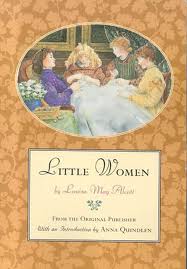
Author: Louisa May Alcott
Publisher: Little, Brown
Genre: Young Adult Classics
Length: 502 pages
I don’t remember learning to read, as I did it from such a young age. I do, however, remember the first books I fell in love with and the first books I read that were difficult for my limited vocabulary. Laura Ingalls Wilder I fell in love with first, I read the entire series several times by the end of first grade. Little Women, however, I fell in love with and learned from in second grade. Little Women taught me new words and phrases, culture, and how I wanted to live.
Josephine March has been one of my heroes since I was seven and first read about her chopping off all her luxurious hair. As a young girl, I identified quite well with her “one beauty” (that amazing hair) and tomboyish ways. I myself, was a ruddy, freckled girl, often found either playing tag football with boys at recess or perched in an oak tree reading a book, hair flowing every which way that my mother did not allow me to cut. My first significant hair cut, I donated two feet to locks of love, and who else was on my mind? Jo March.
I re-read the book multiple times before I left elementary school, getting more and more out of it each time as my reading skills improved. And despite cherishing it always, I set the book aside and did not read it again until my twenty-seventh year, this year, to my one year old daughter.
I opened it up a week or so before Christmas, not realizing it would spur a desire to re-read it every Christmas with my kid for the rest of her life if she likes it as much as I do. It’s such a great Christmas book! Upon this fresh re-read, I also discovered many other things that my brain had forgotten, but my soul must have internalized. For instance, the girls are all distraught and Hannah, bless her soul, “came to the rescue armed with a coffee-pot.”
Like every good American, I am wholly addicted to that black magical brew, it’s in our veins and culture, look at how well Starbucks has taken off. But my family did not keep coffee readily available, my dad won’t touch the stuff and my mom’s mother died of cancer the doctors blamed on her caffeine intake so she never kept it around growing up. So part of me wonders if Alcott played a role in my introduction to it, as I don’t remember a time when I did not love it. I remember sneaking cups of it from the employee break room at the bus barn where I waited with my bus driver between routes in elementary school. In hindsight, I believe it was the reverence that writers hold for it, the way it is talked about in books, that drove me to love it so much, and it very well may have begun with Little Women.
Then, there is Theodore Laurence. I believe every guy friend’s worth that I ever had my whole life was measured against the character of Laurie. He is whimsical, gallant, a rascal and a gentleman. Theodore Laurence is handsome, a friend, and all around a good time. Every girl needs a Teddy-Dear in her adolescent life and if you can’t get one in the real world, its time for yet another read of Little Women so you can live vicariously through Jo!
Jo March taught me to love, to read, to pursue life with a fiery passion, and how to pick my friends. It was Jo March that sparked the first desires in me to be a writer. It was Little Women, and the romance of Jo and the Professor, that set the stage for me to fall in love with the art of Jane Austen and the Brontes. It was the pen of Louisa May Alcott that taught me how to really enjoy books and the thrilling life they have to offer.






 Anakalian Whims