Jane Austen’s Use of Satire In Northanger Abbey
by: A.Z.K.R., from Tales of Porcelain Thrones: Middle School Edition
Jane Austen was an author in Regency Era England. She wrote satirical novels and enjoyed mocking the frivolities of English society and “the Novel” itself. Satire as defined by Webster’s New Word Dictionary is a literary work in which vices and follies are held up to ridicule, satire doesn’t have to be funny, but Austen’s work definitely is.
Jane Austen was born nine months after the beginning of The American Revolution, she had several brothers, and one sister (Leithart 1). Austen was an avid reader and loved novels, but she still found them a little ridiculous. Austen wanted her books to reflect the real world, showing real dangers. Instead of writing about bandits and murderers, Jane’s villains included liars and social climbers. Jane Austen was fighting against stereotypical heroines, bizarre and dangerous social expectations, and the problems of treating novels like real life. Yet, ironically, Jane Austen’s novels were realistic, which was sort of the point. Jane Austen wrote about real problems in a funny way. Even for someone who does not live in Regency Era England, Austen’s characters represent real types of people and can help give young women the wherewithal to avoid the Big Bad Wolves (John Thorps) of the world and find their very own Prince Charming (Henry Tilney).
Austen starts her book Northanger Abbey with a mockery of a novel’s heroine. Austen does this by describing her heroine, Catherine Morland, as normal, and “almost pretty,” emphasizing her normality by saying her family was neither rich nor poor, her father was a clergyman, neither of her parents were abusive, and her mother was—unfortunately—alive. Catherine loves reading novels, but not history books. These are all in direct contrast to the kinds of heroines Catherine herself reads about over the course of the book, stories such as Ann Radcliffe’s The Mysteries of Udolpho where the heroine, Emily St. Aubert, is beautiful, orphaned, and well versed in the arts. Catherine’s neighbors, the Allens, a childless couple of some fortune, decide to take sixteen year old Catherine to Bath. Bath is a tourist destination in England, complete with spas, parties, and shopping centers, which served many as a ‘coming out’ excursion (Cunliffe 41). Austen was able to write about Bath well because she lived there. Even while making fun of novels, Austen used some of their troops to her advantage, such as having a relative or family friend taking a young heroine on a coming out trip.
In English society one couldn’t just walk up to someone and talk to them, you had to be introduced by someone you already knew, forcing everyone to rely on family, family friends, other acquaintances, or the master of ceremonies. At Catherine’s first ball Mrs. Allen laments constantly that they don’t know anyone of consequence, while Catherine wishes they knew anyone at all (Austen 30).
At Catherine’s second ball, the master of ceremonies introduces her to Henry Tilney. Halfway through a conversation that they were having, Tilney interrupts by saying, “I hitherto have been very remiss, madam, in the proper attentions of a partner here; I have not yet asked you how long you have been in Bath.” Jane Austen mocks polite society through Henry Tilney’s comical performance of asking Catherine all the ‘right’ questions, such as ‘how long have you been in Bath,’ ‘do you enjoy Bath,’ ‘Is this your first ball,’ et cetera. Tilney, although he thinks society is silly, still follows its rules, and remains a respectable young man.
Jane Austen uses Catherine’s naivety to point out how unspoken rules can be extremely problematic, and even dangerous. The real dangers of society were people like the Thorps, social climbers and narcissists, who used these unspoken expectations to put other people in sticky situations. The Thorps, through a series of blunders, suppose that the Morlands have lots of money. They had already met Catherine’s older brother, James, at Oxford. Upon meeting Catherine with Mrs. Allen, they supposed that she would receive the Allen’s fortune due to the kind way the childless Allens were treating her. They catch their mistake when Isabella Thorp becomes engaged to James Morland and she receives a letter about James’s future income, one that sounds reasonable to the Morlands, but is disappointing to the gold digging Thorps. Isabella attempts to break off the engagement to run off with Henry Tilney’s older brother, Captain Frederick Tilney, but this proves to be her downfall. Captain Tilney, unlike his brother, is a rake, he doesn’t care about any of societies rules, and breaks the social customs that were actually worth keeping.
Because the Thorps thought Catherine so rich, and John Thorp planned to marry her, and they gossiped about her wealth in order to make themselves look better. At a theater, they brag to General Tilney, Henry’s father, who then wished to have Catherine married to his son. In order to empress her he invites her to stay at his home, Northanger Abbey for a holiday. Catherine is naive and unaware of the Thorps deceptions until she receives a letter from her brother explaining Isabella’s behavior. She is totally unaware that money is the reason General Tilney is interested in her alliance. Henry however is aware that his father cares a great deal about money, and isn’t sure why he is interested in having Catherine for a daughter-in-law. With these events Jane Austen is showing us the true the ‘villains’ of society, and how Catherine was totally oblivious to their presence. She was so caught up in the idea of bandits and mysterious murderers that she could not see the danger at the end of her nose.
‘The Novel’ becomes increasingly important in this part of the story, as it leads to Catherine’s embarrassment several times over the course of her stay at Northanger Abbey. Catherine’s preconceived notions about abbeys, established while reading gothic romances, leads her to disappointment when discovering modern renovations inside the home of her hosts. She fails to find secret passages, or incriminating letters, as the heroine Adeline did in Radcliffe’s Romance of the Forest, in her guest room and, worst of all it leads to a terrible confusion regarding the cause of Henry’s mother’s death. General Tilney is harsh, but not villainous. He takes good care of his servants and his estate, hence the renovations. He wants his children to marry well, thus his interest in Catherine’s supposed inheritance. General Tilney’s stony demeanor, combined with Catherine’s overconfidence in the reality of novels, leads her to make the worst of blunders: she makes assumptions. She speaks briefly to Miss Tilney, Henry’s sister, and finds she was not at home when her mother died, leading Catherine to assume no one was at home when Mrs. Tilney died. Catherine suspects foul play. Her blunder is discovered when she sneaks into Mrs. Tilney’s old room and is discovered by Henry. When she admits her thoughts, he admonishes her. He and his brother had been home when his mother had died, and she had perished of sickness rather than ill treatment. General Tilney’s behavior had nothing to do with skeletons in a closet. Catherine’s gothic fantasies stop here; she has learned and grown. The dangers are not ended, though.
The Thorps, angry due to their hurt pride, speak to General Tilney again and tell him not only that the Morlands are not rich, but that they were exceedingly poor, projecting their own flaws onto Catherine. General Tilney, in a rage, comes home and sends Catherine off in the middle of the night without a chaperone or money. The situation is quite unforgivable, but Catherine doesn’t yet understand and cannot fathom what she has done to displease General Tilney. Henry later comes to her house to explain and offer his hand in marriage, not just because he loves her, but because he feels responsible due to his father’s behavior. General Tilney, of course, does not approve.
Jane Austen, for all her realism, never leaves her stories with sad endings. Henry’s sister, previously forbidden, marries the man she loves, and by a novel twist of fate, now financially outranks her father. She demands that General Tilney allow Catherine and Henry to marry, and her will is done. Jane Austen defends the ending of her own book, at the beginning of the story, while talking about novels in chapter five. “For I will not adopt that ungenerous and impolitic custom so common to with novel-writers, of degrading by their contemptuous censure the very performances, to the number of which they are themselves adding— joining with their greatest enemies in bestowing the harshest epithets on such works, and scarcely ever permitting them to be read by their own heroine, who, if she accidentally take up a novel, is sure to turn over its insipid pages with disgust. Alas!” (Austen 42) Jane Austen is talking about Catherine’s own habit of consuming dramatic stories, but she’s also explaining here, that despite her book calling out the faults in these stories, its still a novel its self.
The story is funny, you can’t help but laugh when Catherine finds not evidence of murder, but instead laundry receipts in the cabinet. This is not was makes it satire however, Jane Austen books are satire because of exactly how it is funny: elements of the story mock society, and express its difficulties, she’s calling to attention problems regarding expectations when they are appropriate and when they are silly. We’re lucky to have Jane Austen doing this is a humorous manner as opposed to long dry articles listing the problems of society like a grocery list. Not all satire is presented in a comical fashion, but a point is better made when it provokes some kind of emotion, either anguish, or in Jane Austen’s case, joy.
Works Cited
Austen, Jane. Northanger Abbey. Signet Classic, 1996.
Cunliffe, Barry. The Roman Baths at Bath: Authorized Guide Book. Bath Archeological Trust, 1993.
Leithart, Peter. Jane Austen. Thomas Nelson, 2009.
Radcliffe, Ann. The Mysteries of Udolpho. Penguin Books, 2001.
Radcliffe, Ann. The Romance of the Forest. Oxford University Press, 1988.
An Eco Never Fails to Resonate
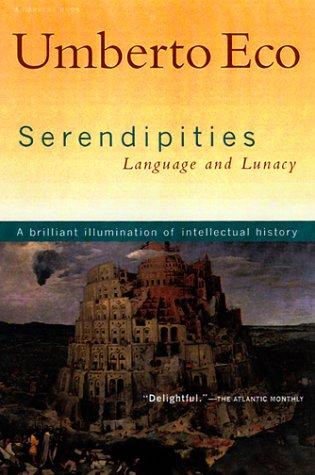 Title: Serendipities

Author: Umberto Eco
Eco never fails me. Except once… I didn’t care for Baudolino. But even after that epic let down, the work stayed with me – if only to prove that even a genius can manage to disappoint from time to time, because reading is a two way street.
The author must deliver, but the reader must be receptive.
Sometimes capturing the magic of that relationship is consistent, sometimes it isn’t…
Nevertheless, Eco never fails to resonate. I remember his name always. His words always mean something. His thoughts and opinions are ones I value and take into great consideration. He moves me.
He speaks of language and sounds, ideas that arbitrary and ones that are not. He writes about the things that speak to my soul every time. Eco and I, though of course he doesn’t know it, have a trust relationship. I trust him to deliver something that will mean something to me, and I suppose that he trusts that what he has to say needs to be said – what he writes is meant to be written.
Authors and books have a way of being there when you need them most. That comfort stays with me always.
The Rural Life
 Title: The Rural Life
Author: Verlyn Klinkenborg
Genre: Memoir/ Essays
Length: 213 pages
I don’t remember when I acquired this book, but I do remember the moment I first picked it up. I can’t place the moment in time or identify my whereabouts, but I distinctly remember being drawn in by the off white matte finish and the rich colors of the font. I remember seeing the house and the tree in the circular image, thinking “I want to live there.”
More than ever, I want to live there. We are saving for land and to build our own house. It still feels like a pipe dream, but it is a pipe dream in action. We have little choice but to make some version of it obtainable. We’ve dreamed of 40 acres, our goal is 10. We’ll take just 2 if that’s all we can get. But in all this dreaming and planning and saving, there are a fair number of doubters in our midst. It’s ok, I doubt myself too. But I do know my own mind – no matter how much work it is and whether I can make it happen or not – I want the life Klinkenborg describes in his memoir.
L’Engle sold me on Crosswicks… land and a 200 year old house. Klinkenborg sold me on his gardens, the work of an amateur ‘farmer’ who isn’t a farmer at all but a man who lives as self-sufficiently as he can. He talks of pig farmers, of an Iowa homestead he grew up on, he talks of Texas, and all corners of rural America, and his little journal of country life is endearing.
On lunch breaks at work I’m plucking through a Popular Mechanics publication about how to build log cabins and small houses. Practicality by day and soul searching by night, I may know my own mind but I do like to be sure of things on a fundamental level beyond my desires.
I want to build something that lasts for years to come. I want to work with my hands and create. These are things I’ve always wanted, except before I mostly sketched pictures and wrote books. Before I was sloshing paint on a canvas and writing very poor poetry. I want to continue to slosh paint, write, and tinker with things that are pretty… mosaics are a dream of mine… but I want to build a house that will stand for 100 years. I want a green house where I can watch things grow and dig my fingers in the dirt, eat the vegetables that come out of it. I want to milk my own goat and drink fresh milk while I contemplate character development.
I want my child to have fields and forests to romp in, chores in a barn to do, and chickens to pester.
I want space and fresh air.
I was laughing at work the other day, “I’ve already lived in the city ghetto [Oak Cliff], worked downtown as a server [West End, Dallas]. I did the suburbia routine [enjoyed a number of different sorts of neighbors, had block parties and dinner parties, exchanged mail in the street when our mail-woman proved a useless turd in Spring, TX]. Now, I’m ready to be OUT.”
In short, I want a full resume of human experience, but I want to end on the cozy bits. So when I’m old and gray, would it be too much to ask to be living the rural life like Klinkengborg? I’ll definitely be looking for his other books in the future. I may need them if my dreams don’t come to the fruition I’d like them to.
Literary Journal Monday
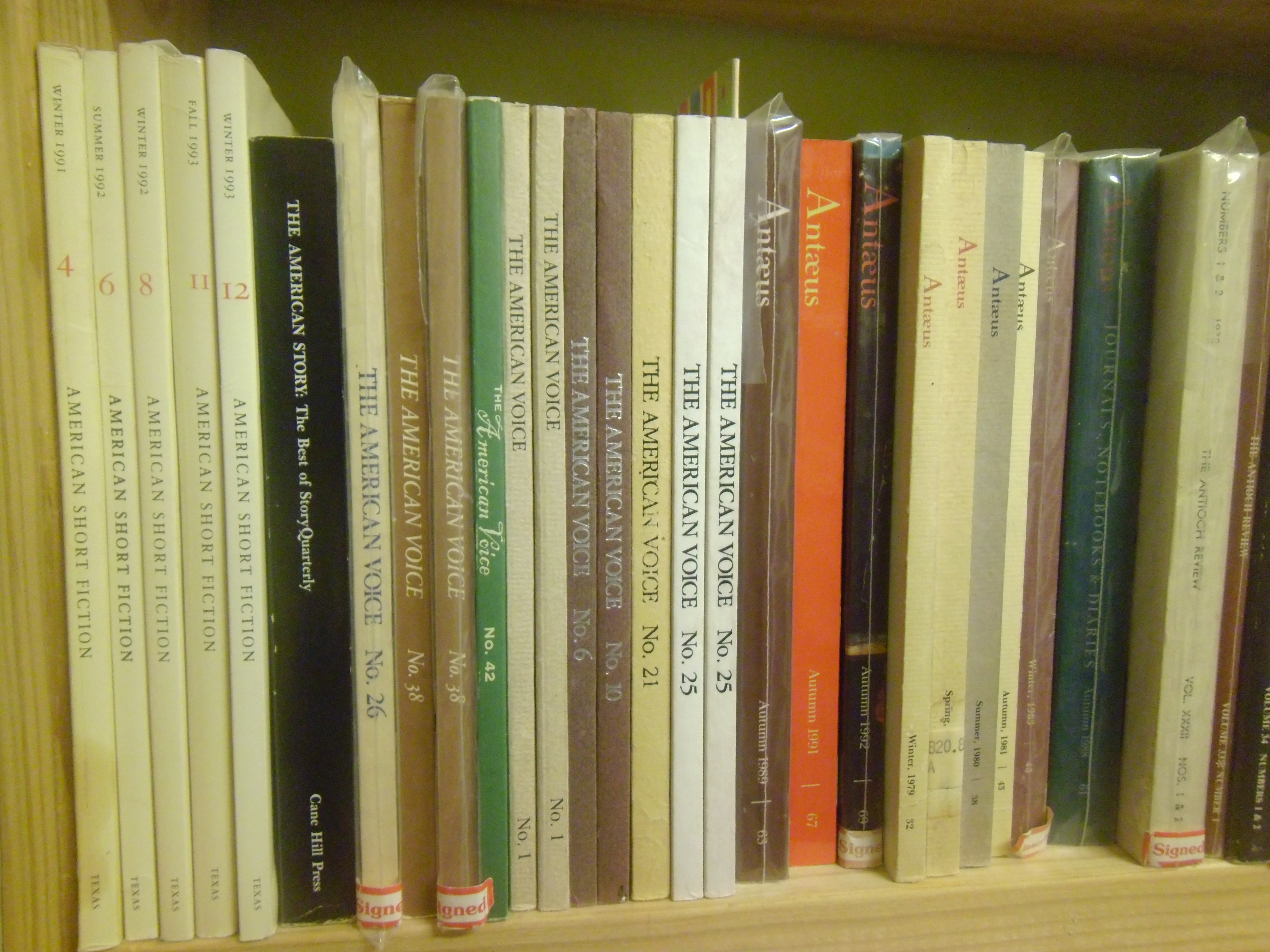
 Today, I picked up The Arizona Quarterly. It was Volume 37 from the Winter of 1981, Number 4. The ISBN is 004-1610. I chose this one for the first essay listed on the cover – one on Montaigne, Melville, and The Cannibals. It’s by one Gorman Beauchamp (what a name) and spells out what I now realize it is that keeps me coming back to Melville time and time again, even though I’m always slightly dissatisfied with his work.
“[…] being a work of intrinsic interest and inventiveness as fiction-autobiography-anthropology-travelogue […]”
Beauchamp identifies all my favorite subjects and genres, then attributes them to Melville. Ah, I see now.
This entire installment is dedicated to Melville – every essay. A poem by a Housman piqued my interest, briefly, but it wasn’t A.E., it was another Housman.
If I were to purchase this (roughly $5), I’d house it next to The Secret of Lost Things so the Melville cronies can bond… so it can be near something else that reminds me to tackle Melville with more zeal. After all, it is something to revisit once I have tackled Melville more thoroughly.
Until then, I’ve tucked it back on the shelf at Good Books in the Woods – with the rest of the A’s in the Literary Journal area in the back of the Gallery – to be revisited as long as it remains there while my child frolics in the rock garden out back.



 Anakalian Whims
Conspicuous Consumption by Thorstein Veblen – Lost in “Education”
June 27, 2010 at 5:52 pm (In So Many Words, Reviews, The Whim) (books, capitalism, conspicuous consumption, economics, education, essays, great ideas, historical document, marxism, reviews, social commentary, sociologist, source documents, veblen)
Why did we never read this for school? The relevancy is uncanny. The way the times haven’t changed is disturbing. I am definitely adding this to my required reading list for when I home school my child.
This book in reality is a 100 page essay or so, not long in the slightest and should take the reader a mere hour or two to digest and properly process (depending on the reader). What I plan to have my child address when I require this to be read are the following questions (and I’d like to know what you guys think too, if you’ve read this):
How do Veblen’s ideas tie into Darwin’s evolutionary theories?
How do they interact with Marxism and Capitalism?
How are his ideas relevant today?
How are the leisure class and ownership related, according to Veblen? What are the roots of conventional ownership and of marriage? Consider contemporary phrases like “trophy wife.” (How does this affect gender roles?)
Veblen sees “emulation” as a key feature of social life in “predatory societies.” How do the patterns of emulation change as predatory societies change?
What fundamental criticism does Veblen make of standard economics?
I actually have quite a few more that I have borrowed from other sites, essay questions and discussions to be had are all noted in a journal I am keeping of projects and assignments to remember. My point in posting the blog today, however, is this:
How did something so famous, so moving and so relevant – something Penguin even published in their Great Ideas series – get neglected in my own education? Not just high school with basic history, social studies, and economics, but also in college when half my life was filled with economic theory and consumer behavior as I earned a Marketing degree? I am realizing more and more the importance of not just reading about movements and theories, not just getting summaries from textbooks, but reading the original documents! How can your education be complete without going back to what started the ideas in the first place? How can you presume to know anything about anything if all your information comes from a summary in a textbook and you’ve never even heard of the essay that initiated the need for that summary?
Buy Here: http://rcm.amazon.com/e/cm?lt1=_blank&bc1=000000&IS2=1&bg1=FFFFFF&fc1=000000&lc1=0000FF&t=anakawhims-20&o=1&p=8&l=as4&m=amazon&f=ifr&ref=ss_til&asins=0143037595
Permalink 5 Comments