Wild and Free

Once a year or so I choose an audiobook to listen to that is NOT for my children. I have an auditory processing disorder, which makes listening hard; but as a firm believer in working brain muscles, building skills, and asking for as few accommodations in life as possible, I work on my listening through audiobooks. It takes me months to listen to a book that I could otherwise read in an hour or two. (I read, according to my husband, extraordinarily fast.)
My audiobook choice the last few months has been Ainsley Arment’s The Call of the Wild and Free: Reclaiming Wonder in Your Child’s Education. I chose this one, frankly, because it was available on Spotify and as a homeschool mom for the last decade (and a homeschool aunt for the last two), I have tried to read anything and everything published on and within the homeschool community since my early twenties. It’s important to me to understand a lot of ideas to really feel comfortable choosing direction for our family. Although I firmly land in the Classical /Charlotte Mason corner of the homeschool realm, I have read a great deal on all the corners. I like that Ainsley Arment has as well. She has done her research, she has put in the hours, she is a fantastic source of information.
I needed the affirmation this week as I was recommending groups to new homeschool moms and realized I had been blocked from the one I was trying to recommend! I also, apparently, had accidentally been complicit to stirring a pot in another, by sharing it with people. You see, I classically educate my kids via the Charlotte Mason method, but I don’t limit myself to one particular curriculum or another. I refer to Ambleside Online, I look for ideas on The Charlotte Mason Cottage Curriculum, I utilize the free resources on the Well Educated Heart/Libraries of Hope website. I meet my kids where they are with resources I can afford. Many times I choose my own living books altogether, ones not mentioned on anyone’s published curriculum. For this, I’m not a part of any group. For this, I’m often evicted from certain communities for not doing the same thing the others are doing. If you don’t use Ambleside Online exactly as listed, I feel you are shunned by the AO purists. When I was using Classical Conversations resources as I saw fit, I was constantly admonished for not “trusting the process.” Veering my own direction as I meet the needs of my children is not leaving the path of God’s design, as I’m quite certain God does not have a hard rule on studying a specific topic in September verses February, or a requirement to do school for 8 months rather than year round, or that everyone has to been on the same exact topic at the same time in order to be part of a community. For this, I found Arment’s book a life giving relief after being a maverick black sheep in most homeschool communities. I show up for my kids to have people, I’m in the online groups for the exchange of ideas. I determined this week, I should probably just stay off the internet unless I’m blogging because my ideas are too fluid for those who write their own curricula.
The humor in this mentality amongst homeschool groups is that: aren’t we all bucking the system already? Why would those staying out of a system that doesn’t work for them choose to be a lemming in another system. Sharing ideas and curricula you’ve made is wonderful. I have some I’ve made as well; but when I share it, I share it knowing that it will (and should) be tweaked by the family using it. Why? Because each family unit is unique, each student is unique. I’m sharing what worked for me in case it works for you. I love reading through what works for others to see if it will work for me. The idea that our homes must all be identical is insane to me.
So without realizing it, I have embodied what Arment describes as “wild and free” for years, despite being methodical and extremely diligent. Being wild doesn’t mean abandoning guidelines, rules, or structure. It often comes with embracing rhythms rather than strict schedules. It comes with studying high school level Chemistry as an 8th grader, outside sprawled in the grass, but regularly sitting at the table for Algebra I. It means knowing that STEM can absolutely be prepped for through nature study. I actually had to defend that online earlier this week… the idea that a student can be fully prepped to engage in college level science due to their extensive nature studies was something I thought was common sense. Look at Isaac Newton, for example. People actually think you cannot study fractals and Fibonacci swirls, chemistry, physics, trigonometry, and calculus, without sitting in a classroom at a desk. I find this baffling. Nature philosophy is how every scientist from the beginning of time got their start, why does modern society discredit it so quickly?
If you are a parent doubting your ability to walk the homeschool path through graduation with you child, I urge you to read Arment’s book. Also try Julie Bogart’s The Brave Learner, Charlotte Mason’s Home Education series, and Law’s and Lygren’s How to Teach Nature Journaling or Anna Comstock’s Handbook of Nature Study. If you’ve been on the homeschool path awhile and don’t seem to “fit” anywhere, read The Call of the Wild and Free and know that it is ok. Your kids are learning, you probably do have friends, it just doesn’t feel like it sometimes when people get pigeon-holed into “you must do it this way or the highway” mentalities.
To anyone reading this, I do not subscribe to the practice of gatekeeping knowledge. My toxic trait is: the second someone tries to do so, I absolutely think less of them. After reading Arment’s book, I think quite highly of her.
Traditions! (Hallelujah!)
A few years ago we started the tradition of celebrating Advent using Cindy Rollins’ Hallelujah! study of Handel’s Messiah and I absolutely love it. Celebrating Advent has been a new and gradual practice for me. About eight years ago. the church I was attending was lighting weekly candles at the front of service, but not spending much time explaining it and it provoked me to start doing some research in conjunction with learning about liturgical practices in the home.
As we settle into using Hallelujah! to enrich our family life, we’re adding in some of the things from the appendix slowly. This was our first year doing St. Nick shortbread cookies and I was pretty excited. Despite a few hiccups, we were pleased with our efforts. My oldest has been learning to decorate cakes off and on for the last five years, and she made icing and turned the cookies into little Christmas wreaths for an event the following week as well. We didn’t celebrate St. Lucia’s Feast Day this year, but little by little we’re adding traditions to our holiday season that line up with the Christian calendar.
In order to do that, I’ve been having to learn about the Christian calendar in general. I was not raised in a church that followed it other than Christmas and Easter. I knew nothing of Advent or Lent. I still don’t fully understand Lent, but I used Living the Christian Year by Gross as a starting point. It didn’t answer the questions I had, which as usual are questions I’m not even sure how to articulate yet, so I donated it to our church library hoping it will help someone else. I hoped to find more clarity by adding The Sacred Sacrifice to our Lent and Easter season, I read it last year when it first came out and plan use it again with my children during our morning basket time again this year.
It’s interesting because despite my children all loving classical music, my son used to beg to listen to Mozart as a toddler, they are fairly indifferent about these family traditions surrounding the Christian holidays and classical pieces. I’m curious to see how they feel about it the older we get as it becomes nostalgic and part of their family memories. When we first added the tradition of getting a live Christmas tree at a family owned Christmas tree farm, my oldest was also indifferent. But now they all beg to go to the farm as soon as Thanksgiving passes. They love the petting zoo feature, there are sure to be baby goats and tortoises. They love the outdoors and the bees and hunting down the perfect tree. They love getting subpar hot cocoa in Styrofoam cups (my husband makes amazing hot cocoa from scratch at home) and pumping Christmas themed rubber ducks down the PVC pipe racing shoots… these things have come to mean the beginning of the Christmas season to them and I love that.
Another tradition we have added to our lives is listening to The Dark is Rising BBC World Service production: https://www.bbc.co.uk/programmes/w13xtvp7. The Dark is Rising book (and podcast) starts on the winter solstice, December 20th, and it’s fun to listen to the events of the story alongside the events of our own corresponding days.
What does your family do as a household tradition?
(As an Amazon affiliate I earn from qualifying purchases.)
Getting to Know Charlotte
A Homeschool Life…
When I was first sold on homeschooling, I was smitten with the classical model. I learned later that most “classical” models being advertised in the United States are actually “neo-classical” in practice. They have taken an essay written by Dorothy L. Sayers on the Trivium and pigeon-holed it into something it wasn’t exactly meant to be. The neo-classical model sort of married the United States educational “ideal” and pushes intense academia early, limits the elementary school years to a lot of memorization (the grammar stage), and taken to the extreme (like anything taken to an extreme), steals joy from students and teachers alike.
If you have followed my blog for the last fifteen years, you might remember me “homeschooling” my toddler. (FYI, pre-school is just parenting, not homeschooling. It’s literally PRE school.) Pressured by a narcissistic ex who demanded that my then three year old be able to read already (it’s not developmentally appropriate to force formal reading lessons on children under six), be able to copy out poems (it’s not developmentally appropriate to force small children to write, look up x-rays of their hand bones), and wanted her to be trained as some government super spy assassin (I am a third degree black belt in Kung Fu, but some people have watched too many movies and have no sense of reality and I used to be married to “some people”). Homeschool regret #1: giving into the pressure of my ex to do formal reading lessons because she was bright and could do it and I was hyperlexic and was reading at age three despite knowing that educational studies have long stated that formal lessons shouldn’t begin until six. Homeschool regret #2: ever handing her a worksheet in kindergarten, which wasn’t often, but still…
The things I am proud of, however, is that despite all this pressure, we always focused on living books above all else and I encouraged verbal narrations for years. I do not regret the neo-classical homeschool co-ops we joined (and left), they held an important role in our lives at the time and I met some cherished and beloved friends there even if I was regularly told: you’re not very classical, you’re too Charlotte Mason. The first time I heard that, I started doing some research…
I learned that Charlotte Mason was very classical, and what calls itself classical these days just isn’t. Honestly, it doesn’t really matter, what matters is that I still very much subscribe to both tactics of education and as my oldest is now in highschool and I have three more children with one creeping up on kindergarten (FYI: kindergarten is also PRE- school), I’ve been doing even more reading and research and want to share my favorite resources… the ones I don’t regret.
First: if you’re new to homeschooling or not loving your current homeschool rhythm, this is my favorite link to send parents: The Five Flavors of Homeschooling. I like to share this link so much, I have gotten restricted on Facebook as a potential scammer, despite not having violated the group rules in any of the places I posted it. Knowing your “flavor” can save you a lot of money on homeschool pursuits, and I definitely feel like (having been a single homeschool mom who wasn’t receiving child support that was owed) Charlotte Mason and Unit Studies are the easiest to accomplish for FREE.
Which brings me to my next two resources: Ambleside Online (not an online school) and Well Educated Heart, two curricula that are totally FREE. Ambleside Online is named “online” so as to not confuse it with the Christian private school based on Charlotte Mason’s philosophy still operating in the UK. It’s a full “scope and sequence” and any time you can’t find a title for free or a price you can afford, you can usually access it on Project Gutenberg or substitute it with something suitable. The focus is having the students read real books and source documents, narrating those books, and embracing the idea that Education is the Science of Relations by making connections to things they have studied and the world around them. Well Educated Heart is very similar, but clusters the material into something like unit studies, despite Charlotte Mason discouraging unit studies (because she wanted the children to make the connection, not have the teacher present the ideas already connected). Well Educated Heart offers their curricula for free and the feature I like most is that the audio files are also available on their site for… wait for it… FREE.
But wait, what is narration? That brings me to my third resource that I like to send people: Episode 7 of Cindy Rollins’s podcast The New Mason Jar. I had already read Karen Glass’s book Know and Tell (as well as Charlotte Mason’s original Home Education series) when I stumbled across the podcast episode and I think the podcast is a more approachable way for people to access the road to narration because (Gasp!) a lot of people don’t want to read the books (it actually drives me nuts, but I kind of get it: people are busy, especially mothers). The beauty of pursuing the art of narration isn’t just in the brain development aspect (which is phenomenal), it’s also the price tag… narration is… you guessed it… FREE. No fancy writing programs, no workbooks checking reading comprehension, no drama. A verbal narration costs nothing but the work of a brain muscle and a listening ear plus time. As the students get older a composition book and pen will do the trick. Charlotte Mason educations are truly thorough and affordable. I still teach essay writing, Charlotte Mason purists say they don’t, but a narration is basically an expository essay written beautifully. I still don’t use curricula to teach essay writing, we use narrations and read a lot of well written essays (and sermons) and writing memoirs. My oldest loved Zen in the Art of Writing by Bradbury (after reading Fahrenheit 451) and Zinsser’s On Writing Well. Her seventh grade year also included Annie Dillard’s Pilgrim at Tinker Creek and Writing Life. I think the inspiration of her favorite authors talking about their writing lives was the most effective writing tutor I could have ever received.
Other things I’m pleased I did, but will definitely do more of with the younger ones:
- Fairy Tales: read all the fairy tales
- Music: classical music, folk songs, sea shanties, hymns… studying music throughout history and enjoying it in passing has done nothing but enrich our lives and our studies. My oldest plays the tin whistle, piano, clarinet, violin, and pretty much any instrument she can get her hands on. She also enjoyed two years of choir.
- Scripture Memory Box
- Poetry: we added a memory box just for poetry and the kids are loving it. Instead of being set up the way it is for the scripture memory box as described in the YouTube video I linked, it only has month tabs and we read a poem every day that month. This is in addition to the poetry we study for language arts.
- Picture Study: I want to be more intentional about this in the future, but currently we just decorate our home with real art. Paintings we find at Goodwill or garage sales plus a few John William Waterhouse prints I have always loved.
- Classical Conversations songs: they’re neo-classical, they’re expensive, but my goodness if you can find the CDs used somewhere or splurge on their overpriced app, the kids love and remember their awful songs! The Timeline song has been an atrocious gift that keeps on giving and I’m so happy it was and is a part of our lives.
This semester (Fall 2025), the oldest and I have been reading Charlotte Mason’s Ourselves. One of the fun things about homeschooling in the teen years is that as they grow and reason and read for themselves they really start to see the light regarding the choices you have made as a parent and educator over the years. Ourselves isn’t her favorite book, she didn’t catch right off the bat that Mason was alluding to Prudentius–She hasn’t read Prudentius. I’m 41 and have only read some of his work and The Fight for Mansoul just happened to be one of them because I’m a ‘buy all the Latin texts I can afford’ junkie.–But she is having thoughtful conversations with me about it and understands the value of it having been assigned. She can describe the Trivium and how it is needed when learning something new… you always start with the grammar stage (memorizing new facts, acquiring basic knowledge on a subject), move to a logic and dialectic stage (when you can understand and reason through the ideas presented in the subject at hand), and finally rest in a state of rhetoric (being able to express the ideas persuasively), and that these stages will be repeated throughout your whole life as you pursue new things to learn because education is a lifetime pursuit. It’s exciting to be here, even though she’s only in 9th grade, only fifteen years old, even though she wanted to start college courses several years ago and won’t be actually starting one until next semester, it is so exciting to be here and the teen years are absolutely my favorite… and I think Charlotte Mason (and more importantly God) has had a lot to do with that.
(As an Amazon affiliate I earn from qualifying purchases.)
Peace Like a River
 Title: Peace Like a River
Author: Leif Enger
Genre: Fiction/ Literature
One of the few tragedies of working in a bookstore is seeing the popularity aftermath of a book. When there are fifty copies of something for $1 we clerks get in the mindset (if we haven’t read the book yet) that the title was a fad. Not just a fad, but it was clearly a book not worth keeping or re-reading.
Note to shoppers: just because a lot of people don’t keep their books and just because a book isn’t something people jump to re-read, does not mean it’s not worth reading in the first place.
For this very reason, it has taken me years to getting around to reading Peace Like a River. Not just that, but I was tentative and checked the book out – I didn’t even purchase it!
Next time I see a beautiful hardback, I will.
Peace Like a River is all soul filled and gorgeous with running themes concerning miracles, family, God, and consequence. It’s not what I would call a happy book, but it’s not a sad one either. I think it is one of the few in this world written truthfully about human experience, religious families, and the nature of people who function within the knowledge of an ever present God. People without the faith of Jeremiah Lands just don’t live lives like Jeremiah Lands. Some might think that would be a blessing – to go through life without such scruples. I mean, look where it got him. The fictional character finds himself in the precarious position of being a good and godly father to a fugitive, his other son – though revived from death at birth by a miracle – is a severe asthmatic. His daughter is an insanely intelligent poet, but becomes a target in their war with existence.
How exhausting.
But Jeremiah Lands, even in pneumonia and illness, never seems exhausted. The guy is a far cry from energetic, but he is steady. He is solid. He is the kind of father I think many hope for, despite his oldest son’s resistance to him. That sort of resistance is natural, I think, when it comes to family and God. It happens. And it happens very much just like that. Davy is a good person with scruples of his own, he was raised right and chooses I think what many of us would choose in certain situations. But the consequences of his choices make faith hard, and the lack of faith makes each choice harder than the next.
I needed this book this year. And if you see a copy in a bookstore for a dollar, snatch it up quick.
Seashells, Gator Bones, and an Interview
Interview with Susan Adger
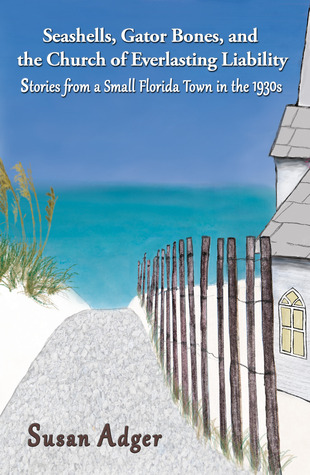 1. Seashells, Gator Bones, and the Church of Everlasting Liability. What a title! Can you tell us a bit about it?
Actually, my daughter Emily came up with the title, based on three of the stories in the book. Seashells are reminders of a girl’s first love, one of the characters makes jewelry out of gator bones, and the Church of Everlasting Liability is one of the town’s churches; the name came from the fact that the members are supposed to be “libel” for each other – to take care of each other – which means they have to know everybody’s else’s business.
2. What made you choose Florida as a setting?
My family has been in the Tampa Bay area for five generations, and the characters in the book are based on some of the old stories my Grandma Keathley used to tell us. When she was born in Mango, FL in 1891, the population swelled to thirty-eight people. Her mother was one of seven children, and her grandmother was one of eight, so there were plenty of crazy, I mean interesting, relatives out there to get ideas from. While everything in the book is fiction, my relatives will be able to tell you who some of the characters are based on.
3. Can you tell us a bit about your earlier work A Quiet Voice?
 The book was inspired by a man named Eugene Hairston, who grew up in grinding poverty, then to keep himself out of trouble – he thought – he enlisted in the army and ended up fighting in Vietnam. When he reported the rampant discrimination on the base, his sergeant pushed him out of a helicopter into Viet Cong territory. He survived almost by accident, when some American soldiers on patrol happened by a few days later and rescued him. After the incident was reported, Eugene was given the opportunity to return home, which he did. With untreated P.T.S.D., he became addicted to drugs and alcohol, spent almost two decades in jails and prisons, and lived on the streets of Tampa for eight long years.
In 1998 he changed his life. I met him a few years later and we started working on A Quiet Voice in 2005. It took us almost two years of meeting weekly to complete it. Today he is married, holds a responsible position at the Bay Pines Veterans Administration Medical Center in St. Petersburg, Florida, and is held in high esteem by hundreds of people who know him. The V.A. sends him to speak to veterans about his life at conferences nationwide, and he has received many incredibly heart-warming letters from readers. I’m very gratified to know that writing this book has helped him reach so many people.
4. Ray Bradbury once said, “You can’t learn to write in college. It’s a very bad place for writers because the teachers always think they know more than you do—and they don’t. They have prejudices.” What do you think about this statement?
Well, actually, I never studied writing in college, but for me it has been really important to read a lot, to learn from what others do, and to get feedback on my work. I’ve done this mostly with other writers; I’m in two critique groups and value their input. When I’m critiquing others, however, I always remind them that what they’ve written is their work, and while it’s good to listen to input, in the end it’s their creation.
 Initially, I was told that I should know my entire story inside and out before actually writing it; have my outline and character sketches completed and go from there. And heaven knows I tried to do that. But when writing fiction, the only way that seems to work for me is to have an idea about a character and then just watch to see what happens; when there’s a knock on the door in the story, I go along to answer it and we both see who’s there. Of course, I do a lot of editing that way, but it works for me.
I enjoy writing short stories, keeping it light. These days I can hardly bear to watch the news or read the paper; seems to me there’s plenty of negative out there and we could all use a laugh once in a while.
5. What were your educational experiences like? Do you think these experiences have influenced the kind of writer you have become?
I was never too wild about school and wasn’t a great student, partly because when I was growing up my family moved almost every year so I was always the new kid on the block. I remember in the second grade, looking out the classroom window and thinking I’d give anything to be outside with the guys trimming the hedge rather than sitting at my desk. But somehow I ended up with a B.A. in Sociology and a Master’s Degree in Education.
I’m sure everything I’ve experienced in my life has colored what I write. I don’t think any author can avoid putting themselves into their work, even if they want to. I spent a number of years working in child abuse and neglect, as well as with young children with behaviour/emotional problems or developmental delays, and their families. Being able to watch people work to make changes in their lives has been both rewarding and heart breaking. They all taught me a great deal.
6. What brought you to the writing world? What made you decide to write?
I am definitely a late starter. I first began writing when the last of my three children moved out. I remember coming home from work that day, sitting on the couch in an empty living room and listening to the quiet; nobody yelling that somebody stole her sweater (nothing was ever misplaced, it was stolen), no loud music competing with the television, no phone ringing off the hook. I felt let down, a little lonely. For about ten minutes. Then it occurred to me that after twenty-two years of raising kids, mostly as a single parent, I had a life of my own again and could do whatever I wanted. I started with family stories, and branched out from there.
7. Do you have future projects up your sleeve?
I’m in the middle of recording the Seashells book, in my grandma’s old Florida vernacular and hope to have it done this fall. (Why is everything harder than it looks?) And I have a number of stories completed for a companion book.
8. Who are your favorite authors? Do you have an author whose career you aspire to emulate?
Years ago I discovered Lee Smith, whose stories about poor families in Appalachia drew me in. While I haven’t intentionally used her as a model, she has unquestionably had an influence on my work.
9. I see on your facebook page that you do a number of public speaking events and lead group discussions on your books. What do these events involve? How do they work out for you?
I’ve been fortunate to be asked to give a number of book talks at local venues, and have been gratified to see how encouraging and supportive audiences have been. When I first started speaking, I found it quite challenging (read terrifying), but with practice, I no longer feel that I’ll have a nervous breakdown before it’s over.
I talk a little about how I got into writing and my Florida family’s background, read some excerpts from the book, and encourage listeners to record their family histories.
10. If there were one thing you would want your readers and fans to know about you, what would it be?
One of the reasons I thought to write this book was because of interviews I did with my Grandma Keathley. Years ago I sat down with her and recorded her reminiscences about growing up in Mango, and later raising her six children in Tampa. I had to kind of twist her arm to do it; she finally relented after I talked her into reciting poetry like she did to her kids when they were small, and singing a few hymns. Then I just kind of sneaked her into the interview by asking questions.
I love hearing her stories about growing up in Mango in her voice with the old Florida “southernisms” Sometimes when I’m feeling down, I’ll make myself the breakfast she’d always fix me, a fried egg on top of some buttered oatmeal, then listen to one of her interviews, and I feel better.
When I speak, I strongly encourage the audience to interview the older members of their families – these days it’s easy to videotape them – or write about their own histories. The little details are what I love most – knowing that the oxen my great-grandfather hooked up to the wagon to take his vegetables to market were named Red’en and George; and when my great-grandfather would pull my grandmother up on the horse with him so she could see the baby birds in their nest; and once, when my grandma was at a “Church Sing” with a new boyfriend, the horse took off with the buggy and when they found him he’d gotten stuck halfway over a fence. For me, details like that make my family history come to life.
And you can quote me on this: “There is NOTHING more interesting than families.”


Circle of Quiet, Trails of Solace
 Title:A Circle of Quiet
Author: Madeleine L’Engle
Publisher: Harper Collins
Genre: Memoir/ Spirituality
Length: 229 pages

A Circle of Quiet is powerful. So powerful it inspired me to write nearly 10,000 useable words, to writers you may note the awe I have when I say useable.
Some were used for the sequel to my novella, a novel that is supposed to come out in the fall of this year – fingers crossed. But most of the words were for a new book, stories about my trails in the woods that are itching to be told but I’ve not known how to tell them because it’s all still happening, my trails are still real.
What is most impressive to me about A Circle of Quiet is not how many beautifully quotable quotes there are, but how completely relevant L’Engle’s story is to me. So relevant, I didn’t noticed until 3/4 of the way through the book that it was published in 1972 and the things she writes about occurred in the early seventies if not the late sixties.
I was baffled to discover this. A Wrinkle in Time and the rest of her children’s books are as fresh to me as the Harry Potter series. I read them as I child without the impression that they were old. In my mind, L’Engle has been an author of the 80’s who would be around as long as C.S. Lewis once the years had passed. I did not realize that the books were much older than that and that the years had already passed. A Wrinkle in Time was first published in 1962.
How is this possible that every moment, every ache, every joy (aside from winning the Newberry of course, as I’ve won nothing) is one I feel in every fiber of my being as a thirty year old in 2014? When she was born in 1918. What struck me most is that A Circle of Quiet is timeless.
Madeleine L’Engle is timeless.
This is a must read for any mother, any writer or creative, any soul searching for God, any person trying to balance their introversion with their extroversion, and ultimately any person.
She published these from her journals, which she admits were written for publication, but still I am honored to have been allowed a peek into the window of her thoughts.
The Keeping Quilt
Little girl got soap in her eye in the bath tub tonight. It was awful. There was banshee-like screaming, bright red faces from all involved, and a lot of tears. Her daddy, the man with the magic hands, was able to pat her back long enough to soothe her into a half slumber after we got the eye rinsed out and pajamas donned. Just as we headed out of the room, though, a little voice piped up from beyond the darkness, “But you didn’t read me my bedtime story.”
So snuggled under her own quilt, I whispered to her the story of Patricia Polacco’s family –
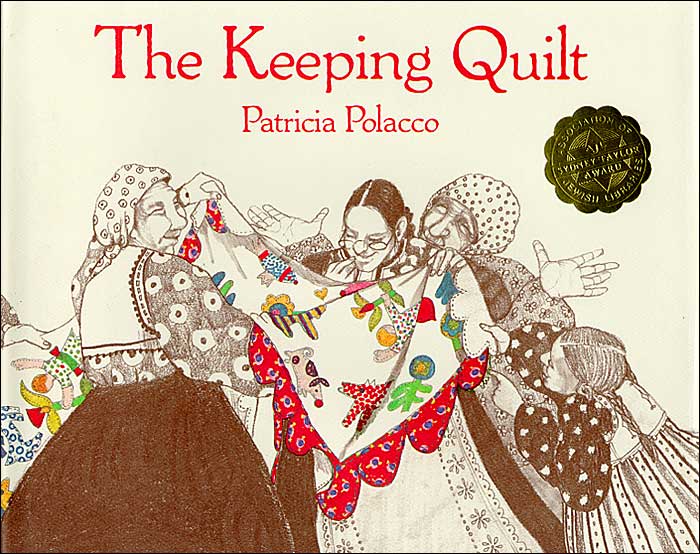 Title: The Keeping Quilt
Author: Patricia Polacco
Publisher: Aladdin Paperbacks
The Keeping Quilt is a beautifully illustrated family history that spans six generations. From the first immigrants of a family coming to America, through the making of a family quilt from the few cherished possessions they have from the mother country, through weddings, births, and old age, The Keeping Quilt tells a story of many lives united by love and history.
This book doesn’t just belong in every child’s library, but every quilt lover’s library as well. As we were reading, I couldn’t help but be reminded of Rich Fabric edited by Melinda McGuire and all the beautiful family histories captured in that volume as well.
I’m so glad I stumbled across this book today at the bookstore, honored to have been given the opportunity to step into Polacco’s family for the evening, and amazed at how perfectly soothing it was for a child who was emotionally and physically exhausted after a battle with a bar of soap.
Mother’s Day
This is my third mother’s day – fourth if you’re one of those people that count mother’s day when you’re pregnant because you’re a mother from the first heartbeat. I believe in life from the moment of conception, but I wasn’t really thinking of myself as a mother yet. I didn’t really feel like a mother until I was nursing and changing diapers and praying I didn’t screw it up.

Although this blog began as a book review blog, it is still a blog and by definition it is an online diary. Which means it contains not just one of my passions, but all of them. Books, Kung Fu, Cycling, and now, of course, for the last three years – mothering.
Being a mother, for me, has meant that I have found every possible way to make half my previous yearly income from home. I’m not quite making half as my book sales are chronically lean because it’s in the wrong category on Amazon. I’m a little conceited about the beauty of its cover and enticing back jacket blurb and think it would sell like hotcakes if only the right people could find it by browsing.
Of course, being a mother has actually made it possible for me to finish writing a book in the first place.
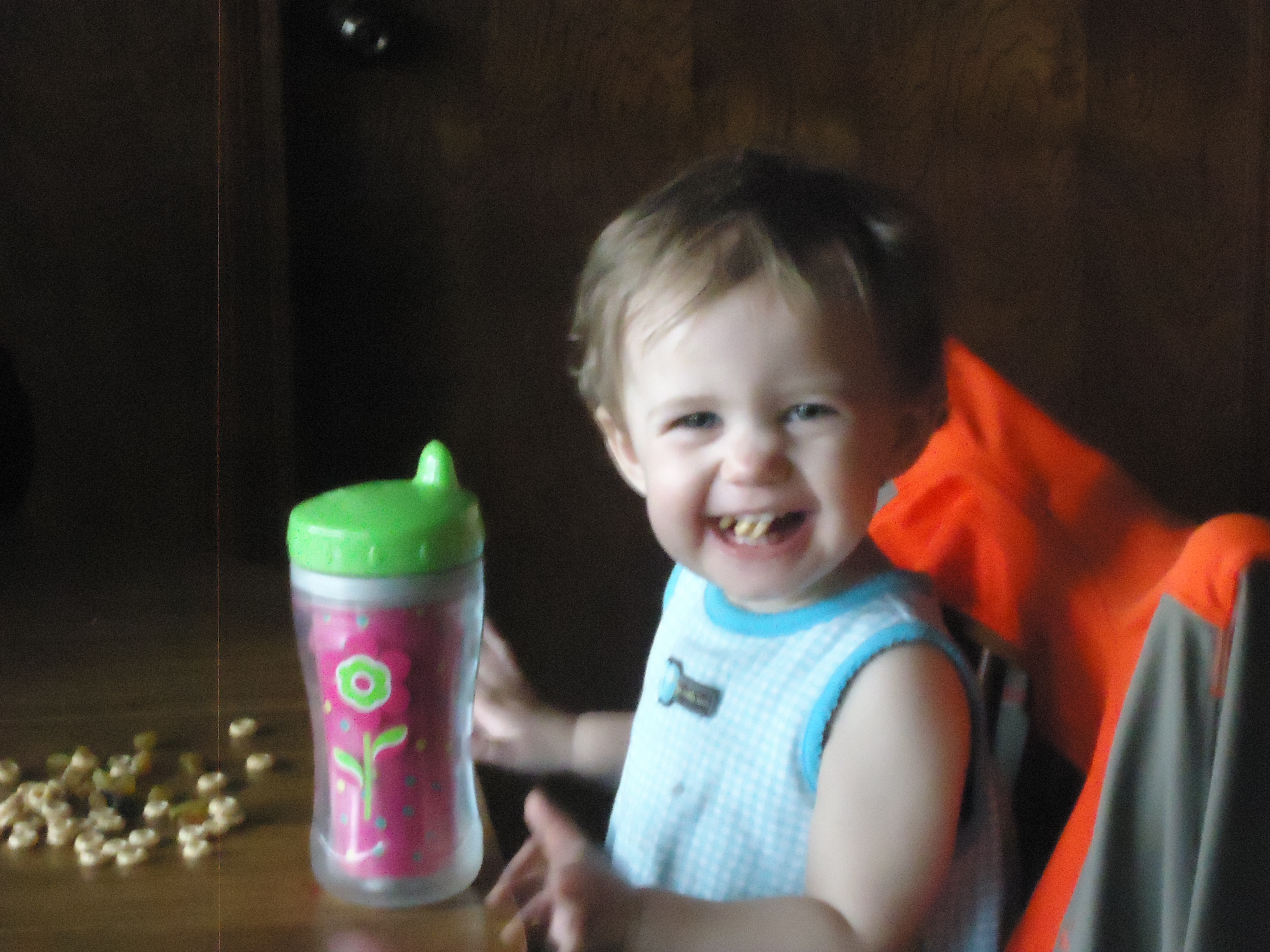 Being a mother, for me, has meant that my book reviews take me twice as long to write because I used to be able to completely bury myself in a book until I felt like coming up for air. Now, I don’t get to choose when I come up for air – that is usually chosen for me by a precocious three year old who will say things like, “Mommy, I need more juice.” “Mommy, look, it’s echoes, like in the bathroom.” (After drawing a series of parenthesis like lines getting larger across the width of her chalkboard.) “Mommy, I need a peanut butter sandwich.” “Mommy, you be the orange dalek and I’ll be the white one – ‘Exterminate! Exterminate!” (While dancing rubber Daleks across my kitchen table.) “Mommy, I want to learn something. Can we do a lesson?” “Mommy, can you teach me my letters now?” I love my tiny, vocal, human who will assert her needs and remind me to read to her at every turn and not neglect her schooling.
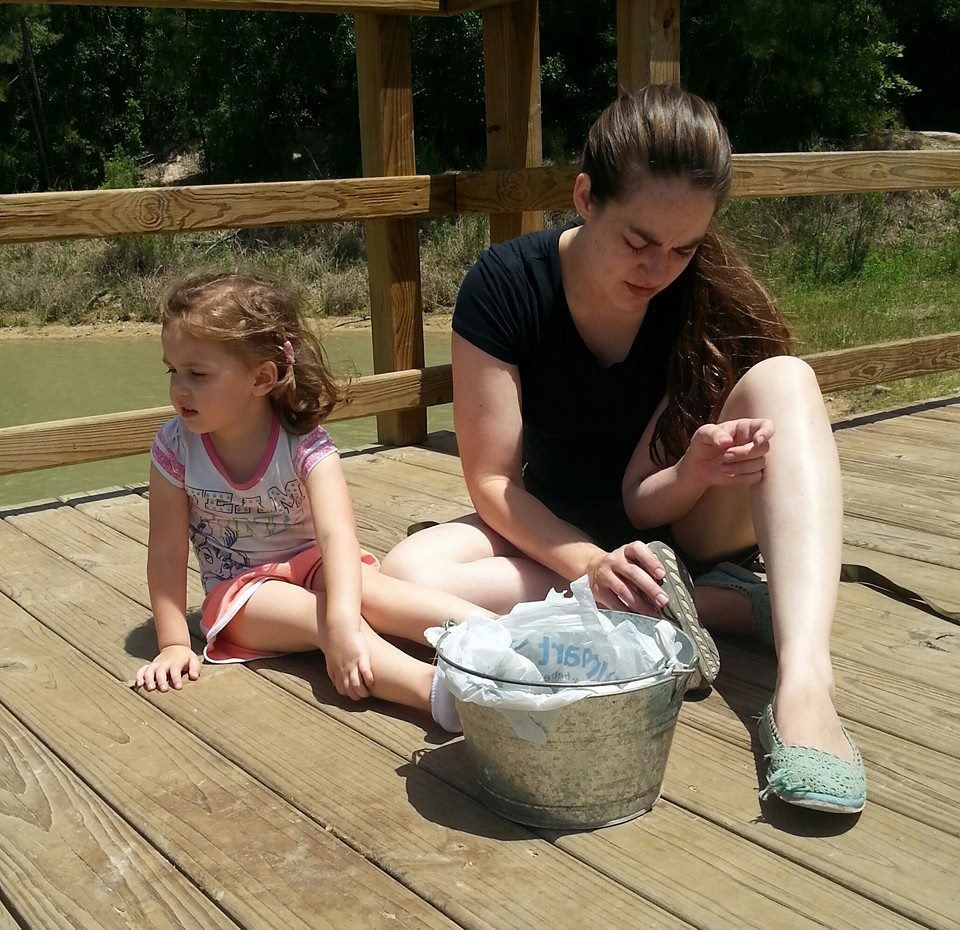 Being a mother, for me, means endless beautiful walks in the woods. Miles and miles of trails, flower picking, foraging, bird-watching, and outdoor story time. It means multiple trips to the park, the lake, the grocery store, bookstores, and libraries. It means art projects, painting, dancing, extra house cleaning just for the fun of letting her sweep and mop knowing I’ll have to do it again. It means demonstrating all of your passions, all your talents, all your dreams, and all your healthy habits to a small person who is watching your every move and gathering every ounce of information she can from it all.
Being a mother has meant seeing this little girl go from this:

To this:

In what can simultaneously be equated to a blink of an eye and the longest three years of my life.
I didn’t think I’d be a mother. But I’m enjoying it immensely.

Stuffed Grape Leaves and Dewberry Pie
Homeschooling adventures have turned into some serious life skills lessons, which in turn have become foraging.

As previously mentioned, we use foragingtexas.com as a main source of information, but we do a lot of external research on our own as well.
Mustang Grapes – from foragingtexas.com
Scientific name: Vitis mustangensis
Abundance: plentiful
What: fruits, leaves, young tendrils
How: fruit raw (very tart), cooked, dried, preserves, wine; leaves and tendrils cooked,
Where: Edges of woods. Mustang grape leaves are fuzzy and have a white underside.
When: summer
Nutritional Value: calories, antioxidants
Other uses: water can be obtained from the vines (see technique in grapes- muscadine post), wild yeast from the fruit
Dangers: Mustang grapes are very acidic and handling/eating large amounts of the raw fruit can cause burns to hands and mouth.
When homeschooling, this is a good time to teach your kiddo about plant classifications. While picking the leaves (we had a mixture of Mustang grape leaves and Muscadine grape leaves, but I don’t recommend stuffing the Muscadines, they end up a little stringy).
Kingdom – Plantae
Order – Vitales
Family – Vitaceae
Genus – Vitis
Species – V. mustangensis
Our lessons then continue into the kitchen where we follow recipes and learn about fractions and conversions. You’d be amazed at how much a three year old will pick up on if you just show them. We halved this recipe: http://allrecipes.com/recipe/my-own-famous-stuffed-grape-leaves/ as well as added lemon balm from our home garden to the rice mixture.
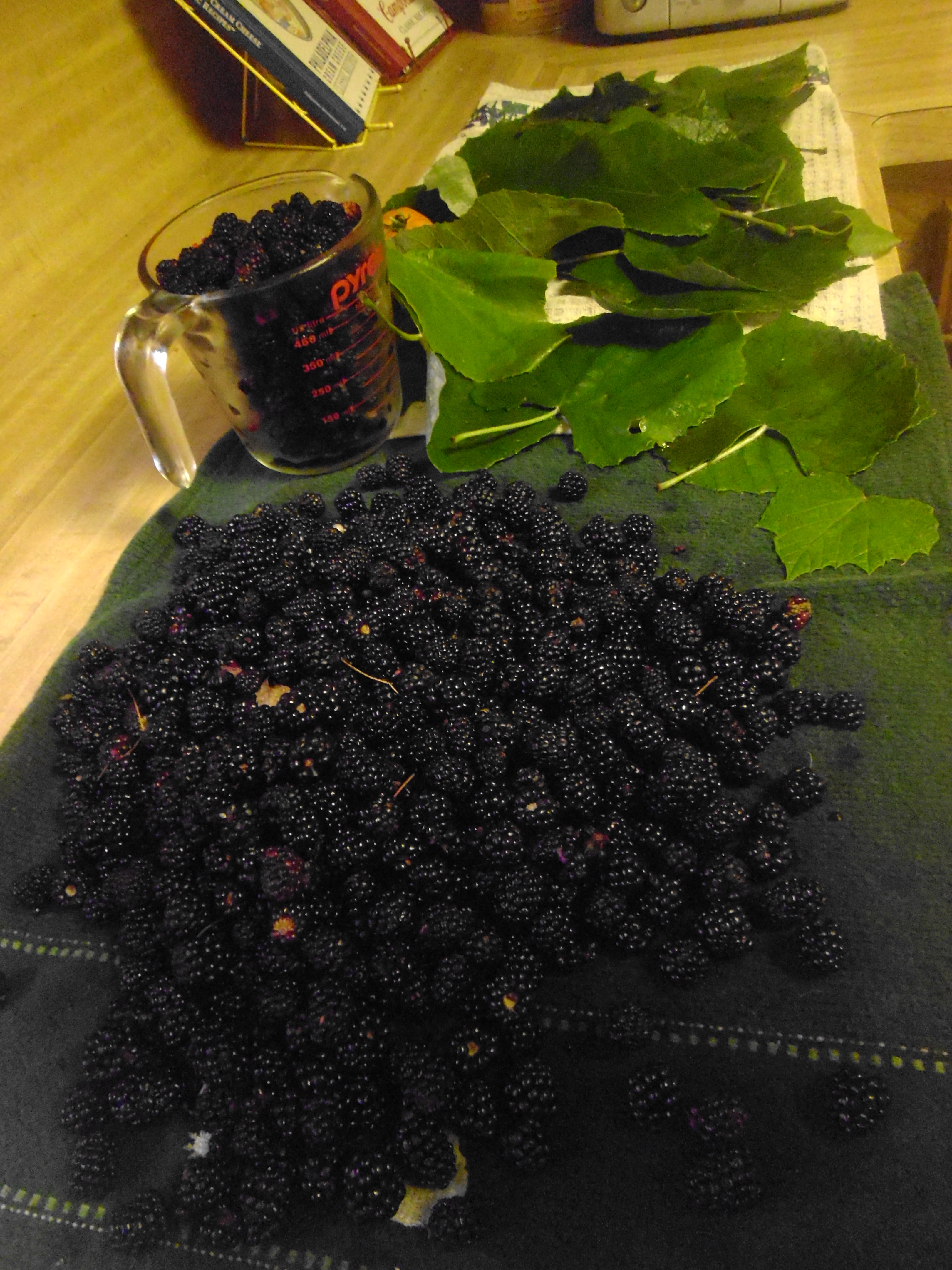 Our dewberry & grape leaf haul.
Dewberries – from foragingtexas.com
Scientific name: Rubus species
Abundance: plentiful
What: flowers, berries
How: open mouth, insert flower/fruit, then chew. seep flowers/young leaves in hot water for tea
Where: Sunny wastelands, borders between woods and fields. Dewberry plants grow as a low, horizontal ground cover.
When: Spring
Other uses: wine, jelly, tea, wine
Nutritional Value: carbohydrates, vitamin C; small amount of minerals and vitamins A & B
Dangers: sharp thorns
Again, our goal is to memorize the classifications and understand how they work:
Kingdom – Plantae
Order – Rosales
Family – Rosaceae
Genus – Rubus
Species – R. arborginum
Well, that and to make pies.
We used this pie recipe, except exchanged the blackberries for dewberries, and used a bit more sugar.
It was a hearty dinner and dessert.






 Anakalian Whims