Hard Roads to Cultural Literacy
In May of 2019, I read a book called Hard Road West: History and Geology Along the Gold Rush Trail by Keith Heyer Meldahl. I remember it being riveting. When I logged it on Goodreads all I wrote was, “Excellent and fascinating.” I was dating my now husband at the time and I remember sharing with him sections I thought he would enjoy, as we both like geology and one of our dates was to the HMNS gemstone exhibit. At one point I laughed out loud at something clever Meldahl wrote (I don’t recall what it was) and my husband commented that it is a rare geology book that causes one to laugh in pleasure.
Naturally, I thought this would make excellent assigned reading for my homeschooled highschooler. But one chapter into it she was struggling. It wasn’t the reading level, she has a collegiate reading level and has had one for a few years now. I was certain it couldn’t be the science as she had been perusing geology books since childhood and had done a whole geology curriculum with a friend as part of their own little science club they created. Nerds. I went over the science with her and she kept reading. It became less of a struggle, but she is not laughing out loud with pleasure from her geology book.
Then I started reading Cultural Literacy by E. D. Hirsch and things became clearer. In Cultural Literacy Hirsch talks about a study done on the results of seven year olds who took a reading assessment test. In the test the children were asked to read a story about a spider. The children who had more prior knowledge about spiders scored higher on the reading comprehension questions about the story (which did not require special knowledge about spiders) than those who did not know much about spiders.
I shared this with my oldest daughter, as we often study together while the younger kids are playing. We discussed it and determined that it makes sense to not get hung up on something being mentioned in passing because you already know a lot on a topic and can picture it in your mind with little effort, but to struggle to retain what something is about if it mentions a lot of things you’re trying to picture because you’re not as familiar with them. Perhaps it is easier to envision Charlotte in Charlotte’s Web if as a child you also have watched a real spider build its web, perhaps it is easier to remember the story if you’ve seen or read about how baby spiders hatch. Or, if you’ve had Charlotte’s Web read to you as a child, maybe a technical book on pig husbandry would be easier to retain as an adult. Hirsch includes an example of college students reading a paragraph about Ulysses S. Grant and Robert E. Lee and struggling because they had no prior knowledge of who they were and how they related to the Civil War (shocking because these were college students out of Virginia).
I was reminded about a public schooled girl I was working with who had failed her reading portion on her standardized tests. Her phonics were impeccable, but where she struggled was comprehension. When I worked with her, almost every time she struggled to read something it was because she had never heard the word. She didn’t have the vocabulary to support her phonics skills. I advised the family to listen to audiobooks, read stories together at night, talk to each other more, look words up in the dictionary. Children learn the meanings of words by hearing them, then when they see them on paper for the first time while sounding it out… they have a picture in their mind of what that word means, feels like, or how it can be used in different sentences. Kids should always have access to stories above their reading level, so that they can learn grammar structures and vocabulary words organically. Hirsch drives home the idea that you can know how to read and still be illiterate if you don’t know anything about what you’re reading.
I told my daughter how this was interesting to me because my husband had said he thought she didn’t know enough geology to read Hard Road West smoothly, even though I thought it was a very approachable book and that she had a strong foundation in geology. She and I laughed over the time a volunteer at the museum asked her what a specific rock smelled like and the big reveal fell flat when she answered, “Sulfur.” Poor guy deflated and said, “Yes, it’s Sulfur. You must be homeschooled.” Apparently the public school kids her age on field trips liked to shout “Farts!” She was about seven at the time and it is one of her favorite museum memories. (I’m not going to lie, even if I knew it was sulfur at seven, I’d probably have shouted “Farts!” too, but I went to public school.)
“So, why, if you’ve read all the same geology books we read as children, is this geology book difficult? Because I genuinely don’t think it would have been difficult for me at fifteen.” That is when she confessed that the geology books we owned and had spent hours reading… she hadn’t actually been reading them: “I was looking at the pretty rocks. I could tell you the page numbers where all my favorite rocks are, all the prettiest ones, I didn’t read all the stuff…” We genuinely laughed together, two wildly different personalities approaching children’s geology books in wildly different ways. As Charlotte Mason said, “Children are born persons.” But for every moment, like this geology one where she struggles because maybe she didn’t pay as much attention to what was put before her in the past, she has so many where she shines. She catches every Shakespeare reference. Every time. (Hirsch writes a bit about how Shakespeare allusions used to be quite common in all kinds of writing, including business memos, but as of the publication of his book in 1987, that was no longer the case.)
Hirsch’s argument for cultural literacy was never meant to be for homeschool parents to refine the presentation of their educational feasts, his goal is educational reform in the public sector. There is extensive discussion in his book about the struggle to properly regulate education in that if you mandate that schools teach at least two Shakespeare plays there will always be arguments about which two should be selected and that no two districts will choose the same two, therefore knowing who Shakespeare is might be universal, but catching Shakespeare references will vary. (I vote for all the Shakespeare. Every play! All the sonnets!) But I did feel like Hirsch’s essay very much affirmed the education I am providing. Maybe my oldest gets a little bogged down in this particular geology book, but to be fair, it could easily be assigned in a college course, most high school students wouldn’t be reading it between their Homer and Geometry lessons. The paragraph that boggled the minds of the Virginian community college students in the 1980s didn’t phase her, and for that I have hope.
Additional affirmation came when I realized I had owned other books by Hirsch in the past. He’s the one that wrote the series Everything Your ___Grader Needs to Know. My first two years of formal homeschooling (first and second grade), I had read those books out loud the last month of the traditional school year to see if we were covering everything. What I learned was reading those books out loud was a waste of time because a classical Charlotte Mason education is thorough and she not only knew what she needed, but she knew richer versions than the sad paragraphs presented. That was the final nail in the coffin on us ever relying on textbooks. Cultural literacy can be gained from textbooks, but it’s boring and far less effective. The better road to true literacy, in my opinion, is living books. I donated Hirsch’s other books, but I’m keeping Cultural Literacy.
One whole day after finishing Cultural Literacy, I went to our local library to donate a bag of books I was purging from my collection. There on the shelf next to the library bookstore register was E. D. Hirsch’s Dictionary of Cultural Literacy, a compilation of all the things the average American graduate should know, for $2. Of course I bought it.
“Also unrealistic is the pragmatist emphasis on individuality, at least as the idea has been institutionalized. The best teaching does accommodate itself to individual differences in temperament, but a child’s temperament does not come freighted with content. To learn a culture is natural to human beings. Children can express individuality only in relation to the traditions of their society, which they have to learn. The greatest human individuality is developed in response to a tradition, not in response to disorderly uncertain, and fragmented education. Americans in their teens and twenties who were brought up under individualistic theories are not less conventional than their predecessors, only less literate, less able to express their individuality.” – E. D. Hirsch, Cultural Literacy, pg. 126.
Education is a Lifetime Pursuit
“Education is a lifetime pursuit.” I tell my daughter this constantly. It is our household motto, so much so, I would not doubt if I had already posted something with the same title before. I even hope that my readers already have read this phrase.
I am a homeschool mother. I am, in the deepest parts of my soul, a teacher. I always have been, and have been overzealous about it since I discovered the classical model. What I have loved about the classical model most is the ease in which I can continue my own education while I educate my daughter. She memorizes facts and dates in the grammar stage and not only do we supplement with rich literature to help her remember, but I get to pluck out related reading material for myself. Individually, I learn and teach the classical model… as a household, we are constantly involved in “unit studies” that are structured chronologically throughout history.
While she was memorizing history sentences about Christopher Columbus, the Pilgrims, and eventually the colonists dumping tea into the Boston Harbor, I was reading Changes in the Land: Indians, Colonists, and the Ecology of New England by William Cronon.
First published in 1983, Changes in the Land is the earliest book I know of written directly about environmental history, not part of a political movement. Everything I’ve read published prior to this book are either beautiful transcendentalist nature essays (Emerson, Thoreau, Bronson Alcott, etc.), geological science books (Lyell, Stenson, etc.), or solely activist tree-hugger type stuff. In fact, I think it paved the way for books like the one I read recently (and thoroughly enjoyed) while she learned about the gold rush called Hard Road West: History and Geology along the Gold Rush Trail, whose author also crossed genres by highlighting the land, and all the things that make it what it is and the men who mar it, as the main character in the book’s story.
The biggest thing the two books have in common, for me, is at the end of each I thought, “This must be required reading for high school students.” After all, how do you learn history of a place without comprehending the blood, sweat, and tears, that was shed on it and ALL the reasons why, not the just the wars, but trails cut, deforestation, farms, dustbowls, mining… and not just focus on what it did to the people, but what it did to the land and how all that affects us today. Books like these are a beautiful marriage of history, social science, science, and more.
I love finding these gems as I sort through piles and piles of potential reading material, planning out lengthy lists of things to shape my kiddo’s mind. I love that my mind is also being shaped. I love that I am 35 and never done studying. I love that, in addition to growing my relationship with Jesus Christ and my daughter, education is my lifetime pursuit.
Finder’s Keepers
 THE WEEKLY LOW DOWN ON KIDS BOOKS
Title: A Rock is Lively
Author & Illustrator: Dianna Hutts Aston and Sylvia Long
Genre: Non-fiction Picture Books/ Children’s
As a child, I collected rocks. I think many children do this… bright, shiny objects with a splash of color are enticing. Small pebbles from river sides are exciting and make you feel like a million bucks when they are so tiny in your own tiny hands. I had a rock tumbler and every little piece of nothing could be made magical. On family vacations I used my pocket money to buy gems and stones native to the area we were visiting. With my sister and cousins, we would go on exploratory rock hunts together. I remember hearing shouts of: Finder’s Keepers!
I have also always adored books, and as an adult I try to find the most awesome of children’s books to share with my daughter. Last week at the library, while I browsed the children’s section of Baldwin Boettcher, I stumbled across A Rock is Lively
Except I will have to return this particular book and go buy a copy.
A Rock is Lively is an excellent introduction to geology – for all ages. My daughter will be three in October and she was riveted by all the colorful detail of gold, amethyst, peridot, and gypsum. The page about how rocks are mixed up and the description of how calcite, sodalite, pyrite, and lazurite becomes Lapis Lazuli excited her. She enjoyed telling me about all the colors she was seeing as I told her what the rocks were called.

Over and over again this week she has brought me the book, “What’s that?” she’ll say as she points to hematite… “What’s that?” she asks as she opens up the two page spread on obsidian. “What’s that?” she wants to know about the geodes…
A Rock is Lively is a must have. We will definitely be finding our own copy to own as well as the other books in the series: An Egg is Quiet, A Seed is Sleepy, and A Butterfly is Patient.
Crack in the Edge of the World
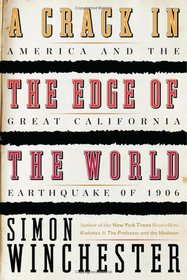
A Book Review
Simon Winchester never fails to fascinate and inform. When I picked up Crack in the Edge of the World, I was surprised to discover that the author I dearly remember for writing The Professor and the Madman (a history of the making of the Oxford English Dictionary) was also a geologist and highly knowledgeable in both language AND the science of rocks – what a foundation! This particular history on the great earthquake of San Fransisco met high expectations of Winchester’s talent compared to his previous work and I recommend this to anyone who likes history, science, or just plain good storytelling.



 Anakalian Whims