The Timon and Pumbaa Method
by A.Z.K.R.
Personality wise, my mother is always that tired, sarcastic, babysitting/parental figure in kids stories. She embodies the fish from The Cat in the Hat, Sebastian, from The Little Mermaid, and Zazu from The Lion King. But the other day, I didn’t compare her to Zazu, I compared her to Timon and Pumbaa.
She wrinkled her nose.
“Timon and Pumbaa? I’m both of them? The essence of two?”
While it sounds weird put like that, my point was how she acted in the homeschool community and within and outside of mom groups. She is the Pimon. The Tumbaa. However you want to say it. She lives outside of other people, she does her own thing. She chose not to be part of the public school system, why would she conform to a system set by anyone else? She isn’t someone else. She is the wild, bug-eating mom who adopts any floundering homeschool family that comes her way. Sure, she acts more like Zazu or Sebastian in the “someone needs to nail that girl’s fins to the floor” mentality, but when it comes down to her own lifestyle, she won’t let her fins be nailed to the floor. Not to be where the people are. Never to be where the people are, but to live in her own, private, homeschool jungle, eating grubs and educating the passing Simbas of the world.
Wild and Free

Once a year or so I choose an audiobook to listen to that is NOT for my children. I have an auditory processing disorder, which makes listening hard; but as a firm believer in working brain muscles, building skills, and asking for as few accommodations in life as possible, I work on my listening through audiobooks. It takes me months to listen to a book that I could otherwise read in an hour or two. (I read, according to my husband, extraordinarily fast.)
My audiobook choice the last few months has been Ainsley Arment’s The Call of the Wild and Free: Reclaiming Wonder in Your Child’s Education. I chose this one, frankly, because it was available on Spotify and as a homeschool mom for the last decade (and a homeschool aunt for the last two), I have tried to read anything and everything published on and within the homeschool community since my early twenties. It’s important to me to understand a lot of ideas to really feel comfortable choosing direction for our family. Although I firmly land in the Classical /Charlotte Mason corner of the homeschool realm, I have read a great deal on all the corners. I like that Ainsley Arment has as well. She has done her research, she has put in the hours, she is a fantastic source of information.
I needed the affirmation this week as I was recommending groups to new homeschool moms and realized I had been blocked from the one I was trying to recommend! I also, apparently, had accidentally been complicit to stirring a pot in another, by sharing it with people. You see, I classically educate my kids via the Charlotte Mason method, but I don’t limit myself to one particular curriculum or another. I refer to Ambleside Online, I look for ideas on The Charlotte Mason Cottage Curriculum, I utilize the free resources on the Well Educated Heart/Libraries of Hope website. I meet my kids where they are with resources I can afford. Many times I choose my own living books altogether, ones not mentioned on anyone’s published curriculum. For this, I’m not a part of any group. For this, I’m often evicted from certain communities for not doing the same thing the others are doing. If you don’t use Ambleside Online exactly as listed, I feel you are shunned by the AO purists. When I was using Classical Conversations resources as I saw fit, I was constantly admonished for not “trusting the process.” Veering my own direction as I meet the needs of my children is not leaving the path of God’s design, as I’m quite certain God does not have a hard rule on studying a specific topic in September verses February, or a requirement to do school for 8 months rather than year round, or that everyone has to been on the same exact topic at the same time in order to be part of a community. For this, I found Arment’s book a life giving relief after being a maverick black sheep in most homeschool communities. I show up for my kids to have people, I’m in the online groups for the exchange of ideas. I determined this week, I should probably just stay off the internet unless I’m blogging because my ideas are too fluid for those who write their own curricula.
The humor in this mentality amongst homeschool groups is that: aren’t we all bucking the system already? Why would those staying out of a system that doesn’t work for them choose to be a lemming in another system. Sharing ideas and curricula you’ve made is wonderful. I have some I’ve made as well; but when I share it, I share it knowing that it will (and should) be tweaked by the family using it. Why? Because each family unit is unique, each student is unique. I’m sharing what worked for me in case it works for you. I love reading through what works for others to see if it will work for me. The idea that our homes must all be identical is insane to me.
So without realizing it, I have embodied what Arment describes as “wild and free” for years, despite being methodical and extremely diligent. Being wild doesn’t mean abandoning guidelines, rules, or structure. It often comes with embracing rhythms rather than strict schedules. It comes with studying high school level Chemistry as an 8th grader, outside sprawled in the grass, but regularly sitting at the table for Algebra I. It means knowing that STEM can absolutely be prepped for through nature study. I actually had to defend that online earlier this week… the idea that a student can be fully prepped to engage in college level science due to their extensive nature studies was something I thought was common sense. Look at Isaac Newton, for example. People actually think you cannot study fractals and Fibonacci swirls, chemistry, physics, trigonometry, and calculus, without sitting in a classroom at a desk. I find this baffling. Nature philosophy is how every scientist from the beginning of time got their start, why does modern society discredit it so quickly?
If you are a parent doubting your ability to walk the homeschool path through graduation with you child, I urge you to read Arment’s book. Also try Julie Bogart’s The Brave Learner, Charlotte Mason’s Home Education series, and Law’s and Lygren’s How to Teach Nature Journaling or Anna Comstock’s Handbook of Nature Study. If you’ve been on the homeschool path awhile and don’t seem to “fit” anywhere, read The Call of the Wild and Free and know that it is ok. Your kids are learning, you probably do have friends, it just doesn’t feel like it sometimes when people get pigeon-holed into “you must do it this way or the highway” mentalities.
To anyone reading this, I do not subscribe to the practice of gatekeeping knowledge. My toxic trait is: the second someone tries to do so, I absolutely think less of them. After reading Arment’s book, I think quite highly of her.
The Year in Books
We read a lot. We are homeschoolers, so of course we spend a lot of time reading. I was at the pediatrician years ago with my oldest, an old man I didn’t know who didn’t know me… he complimented how articulate and well mannered my child was and then found out we homeschooled and immediately started lecturing me on the dangers of screen time and video games. I said, “Sir, we don’t even own a console.” He would not let up. He was convinced that being homeschooled meant we sat around and did nothing but watch TV and played video games. Funny thing is, now we don’t even own a TV. My teenager will tell you, we don’t have time for TV, because there are so many things to read. We play outside, we hang out with friends, we play musical instruments, we participate in clubs, she flies planes, and we read and read and read.
A lot of our books we read together, some (not not many) I read alone. This year (2025), we read:
- Writing to Learn by William Zinsser
- Napoleon’s Buttons by Le Couteur and Burreson
- Desiring God by John Piper
- The Magnificent Ambersons by Booth Tarkington
- The Scarlet Letter by Nathaniel Hawthorne (I actually read two different editions back to back with notes, as I was teaching it.)
- The Bringer of Fire by Oehler (I did not let my teen read this one)
- Why Read Moby Dick? by Philbrick
- Pride & Prejudice by Jane Austen
- The Communist Manifesto by Karl Marx
- The Peter Rabbit Library by Beatrix Potter (this is an ongoing favorite and I love having babies to re-read these to)
- Why? by Anne Graham Lotz
- Rapunzel (all the versions, every one we could get our hands on)
- The Adventures of Tom Sawyer by Mark Twain (another one I enjoy teaching to more than my own kids)
- Purgatorio by Dante
- The Great Gatsby by Fitzgerald
- All the Arnold Lobel picture books, including a few new ones I had not owned when my oldest was small.
- Jane Austen by Peter J. Leithart
- Hank the Cowdog by John R. Erickson (my son is obsessed with the books and the podcast, I think we have them memorized now)
- New Essays on The Great Gatsby by Matthew J. Bruccoli
- The Los Angeles Diaries by James Brown
- I Know Many Songs… by Brian Kiteley
- The Parrot’s Lament by Eugene Linden
- On Reading Well by Karen Swallow Prior
- Common Arts Education by Chris Hall
- You’re Not Enough (and That’s Okay) by Allie Beth Stuckey
- The Count of Monte Cristo by Dumas
- Everything we could get our hands on by Trina Schart Hyman because we love her.
- Midnight at the Bright Ideas Bookstore by Matthew Sullivan
- The Enchanted April by Elizabeth von Arnim (an annual Easter tradition at our house)
- Gatsby’s Girl by Caroline Preston
- Animal Farm by George Orwell
- The Disappearing Spoon by Sam Kean
- The History of Rasselas, Prince of Abissinia by Samuel Johnson
- Under the Greenwood Tree by Thomas Hardy
- A Hobbit, a Wardrobe, and a Great War by Joseph Loconte
- Rebel of the Sands by Alwyn Hamilton
- The World of Pooh by A.A. Milne
- Lightfoot the Deer by Thornton W. Burgess
- The Pursuit of Love and Love in a Cold Climate by Nancy Mitford
- The Geography Behind History by W. Gordon East
- String, Straight-Edge, and Shadow by Julia E. Diggins
- Anne of Green Gables by L.M. Montgomery
- Dracula by Bram Stoker
- Hamlet by Shakespeare
- World Enough & Time: On Creativity and Slowing Down by McEwen
- The Discarded Image by C. S. Lewis
- Drake Hall by Christina Baehr
- Anne of Avonlea by L.M. Montgomery
- The Floating City by Pamela Ball
- Moth and Spark by Anne Leonard
- That Eye, The Sky by Tim Winton
- Socrates Cafe by Christopher Phillips
- The Chemical History of a Candle by Michael Faraday
- Beauty and the Word by Stratford Caldecott
- Under the Wide and Starry Sky by Nancy Horan
- The Great Divorce by C.S. Lewis
- Nathaniel’s Nutmeg by Giles Milton
- J.R.R. Tolkien’s Santifying Myth by Bradley J. Birzer
- Engaging the Christian Scriptures by Aterbury and more
- Journey Into Summer by Edwin Way Teale
- Kon Tiki by THor Heyerdahl
- Lethal White by Robert Galbraith
- Be Strong (Joshua) by Warren W. Wiersbe
- A Chant to Soothe Wild Elephants by Jaed Coffin
- Anne of the Island by L.M. Montgomery
- Sightings by Sam Keen
- Maisie Dobbs by Winspear
- Local Girls by Hoffman
- Early Christian Writings: The Apostolic Fathers
- Rosencrantz and Guildenstern Are Dead by Stoppard
- How to Teach Kids Theology by Luce and Williams
- Medea and Other Plays by Euripedes
- The Infinities by John Banville
- Climbing Parnassus by Tracy Lee Simmons
- How to Keep From Losing Your Mind by Hudson
- Sharing His Secrets by Vickey Banks
- Goblin Market by Christina Rossetti
- Uglies by Scott Westerfeld
- The Last Rakosh by F. Paul Wilson (straight to the nope pile)
- A History of France by John Julius Norwich (he is one of my favorite historians)
- Book Trails for Baby Feet
- The Halloween Tree by Ray Bradbury
- Don’t Mom Alone by Heather MacFayden (a gift from my midwife after having baby number four)
- The Fall of the Year by Dallas Lore Sharp
- The Natural History of Selborne by Gilbert White
- Heaven by Jennifer Rothschild (donated this too)
- Cultural Literacy by E.D. Hirsch Jr.
- Bringing Up Boys by James C. Dobson
- Ourselves by Charlotte Mason
- The Story of Holly and Ivy by Rumer Godden (we read this every Christmas)
- One Man’s Christmas by Leon Hale
- The Iliad by Homer (Fagles)
- Hallelujah by Cindy Rollins (another annual tradition)
- Quietly in Their Sleep by Donna Leon
- Easily 300-400 picture books because I have three children under five and that’s what we do for hours on end.
I purged a lot this year, as you can see there’s a lot of chaff in this list. But I found favorites I will re-read with every child as well. We’ve been purging a lot as our shelves are stuffed to the gills (about 22 seven foot units retired from Half Price Books) and then some. I decided I don’t actually need more books, I need to be more conscientious about curating the ones I have, so I’ve been donating hundreds of volumes I’m done with every year… but we still have a packed inventory, because we are homeschoolers and we are readers.
As for this year, I truly enjoyed the chemistry titles. I actually enjoyed teaching high school chemistry, especially with the literature bent, essay writing, and speech giving I required of the students. The kids had more fun with the labs, obviously, but Napoleon’s Buttons, Faraday’s papers, and The Disappearing Spoon are all keepers, for sure.
I got rid of most the contemporary fiction, and kept the classics. I loved The Scarlet Letter when I read it in high school and I loved it even more while teaching it. The book as a whole is so much richer right after reading Dante’s Divine Comedy. “The Custom House” introduction hits so much deeper as an adult.
What did you read this year? Were they re-reads or new reads? A mixture of both? What was your favorite? What will you read again every year?
Traditions! (Hallelujah!)
A few years ago we started the tradition of celebrating Advent using Cindy Rollins’ Hallelujah! study of Handel’s Messiah and I absolutely love it. Celebrating Advent has been a new and gradual practice for me. About eight years ago. the church I was attending was lighting weekly candles at the front of service, but not spending much time explaining it and it provoked me to start doing some research in conjunction with learning about liturgical practices in the home.
As we settle into using Hallelujah! to enrich our family life, we’re adding in some of the things from the appendix slowly. This was our first year doing St. Nick shortbread cookies and I was pretty excited. Despite a few hiccups, we were pleased with our efforts. My oldest has been learning to decorate cakes off and on for the last five years, and she made icing and turned the cookies into little Christmas wreaths for an event the following week as well. We didn’t celebrate St. Lucia’s Feast Day this year, but little by little we’re adding traditions to our holiday season that line up with the Christian calendar.
In order to do that, I’ve been having to learn about the Christian calendar in general. I was not raised in a church that followed it other than Christmas and Easter. I knew nothing of Advent or Lent. I still don’t fully understand Lent, but I used Living the Christian Year by Gross as a starting point. It didn’t answer the questions I had, which as usual are questions I’m not even sure how to articulate yet, so I donated it to our church library hoping it will help someone else. I hoped to find more clarity by adding The Sacred Sacrifice to our Lent and Easter season, I read it last year when it first came out and plan use it again with my children during our morning basket time again this year.
It’s interesting because despite my children all loving classical music, my son used to beg to listen to Mozart as a toddler, they are fairly indifferent about these family traditions surrounding the Christian holidays and classical pieces. I’m curious to see how they feel about it the older we get as it becomes nostalgic and part of their family memories. When we first added the tradition of getting a live Christmas tree at a family owned Christmas tree farm, my oldest was also indifferent. But now they all beg to go to the farm as soon as Thanksgiving passes. They love the petting zoo feature, there are sure to be baby goats and tortoises. They love the outdoors and the bees and hunting down the perfect tree. They love getting subpar hot cocoa in Styrofoam cups (my husband makes amazing hot cocoa from scratch at home) and pumping Christmas themed rubber ducks down the PVC pipe racing shoots… these things have come to mean the beginning of the Christmas season to them and I love that.
Another tradition we have added to our lives is listening to The Dark is Rising BBC World Service production: https://www.bbc.co.uk/programmes/w13xtvp7. The Dark is Rising book (and podcast) starts on the winter solstice, December 20th, and it’s fun to listen to the events of the story alongside the events of our own corresponding days.
What does your family do as a household tradition?
(As an Amazon affiliate I earn from qualifying purchases.)
The Mad Women of the Moors
Re-experiencing The Brontë Sisters, Part One
In 2024 I read Brontë’s Agnes Grey alongside the Literary Life Podcast. I hadn’t read a Brontë novel in years, more than a decade I believe. Though I greatly appreciate the Brontës, I’ve always been more of a Jane Austen girl. It’s a rare reader who loves both equally, I find. The Brontës wrote Gothic revival tales with a flare for romanticism (romanticism the movement, not romanticism featuring a meet-cute and happily ever after), whereas Jane Austen wrote satire. The Brontës make me sad and despair for humanity while Jane Austen makes me laugh at society’s nonsense. All four women had much to say about the world around them, they just said it very differently.
Agnes Grey, written by the youngest Brontë, Anne, is not the most riveting of classic works and I suspect it wouldn’t still be in print if Wuthering Heights and Jane Eyre weren’t currently so popular. I love to pair reading experiences, rabbit trail from one book to another, an exercise of associative reading, so I plucked a book I already had on my shelf and read it as well.
The book was The Madwoman Upstairs by Catherine Lowell, a contemporary literary mystery with the meet-cute kind of romance thrown in. The book follows fictional character Samantha Whipple through Oxford as the author fan-girls over Emily Brontë’s Wuthering Heights and Charlotte Brontë’s Jane Eyre. In a season when I am aggressively purging subpar books from my collection (we have over 5,000 volumes–I stopped counting long ago–and have legitimately run out of space) The Madwoman Upstairs is one I have chosen to keep, for now. I think my oldest might enjoy it after studying a Brontë book or two, it’s an easy breezy weekend novel.
That time might be coming soon as the trailers for this new Wuthering Heights movie blasts across the internet, appalling most readers I know. Teaching Wuthering Heights just moved up my to-do list as I counter parent pop culture, so that when my teen encounters the story for the first time it is not at the hands of the debaucherous movie industry who is advertising what looks like a Fifty-Shades version of what they are calling the “greatest love story ever told.” I thought it was a cautionary tale of what happens to humanity when we give into the monster of sin instead of slaying it. On a supernatural level, Wuthering Heights brings me back to Beowulf (I might be broken, because everything brings me back to Beowulf, it’s a favorite) and the torment of the wild (sin nature and Satan… Heathcliff has that whole Esau archetype going for him that reminds me of Grendel). On a psychological level, Cathy and Heathcliff remind me that sin nature is to be quashed lest we wander the moors ever after as lost souls unable to reach heaven. Apparently, that is not the popular reading, and Hollywood has turned it into some steamy lip biting panty dropper. Gross. But, I haven’t read the book in a coon’s age, and it’s possible I read it poorly and just saw the message I wanted to see.
Alice Hoffman said, “Read Wuthering Heights when you’re 18 and you think Heathcliff is a romantic hero; when you’re 30, he’s a monster; at 50 you see he’s just human.” When I was in my teens, I definitely read him as a tempting monster. I know I read Jane Eyre and Tenant of Wildfell Hall in my twenties, but I cannot recall if I re-read Emily’s work when I first read her sisters’ and stumbled across Gaskell’s biography. I’m 41 now and I’m curious to know how I read Heathcliff today.
English author Jeanette Winterson wrote on her website in 2011:
I read Wuthering Heights when I was sixteen and had just left home. I did not read it as a love story. I thought it was a loss story. Heathcliff loses Cathy. Cathy loses Heathcliff. Edgar Linton loses Cathy, their daughter, his life, and Thrushcross Grange. Hindley loses Wuthering Heights. His son Hareton is dispossessed, Heathcliff’s revenge on everyone, including himself, is matched by Cathy’s death-wish (Why did you betray your own heart?). Heathcliff is a foundling. As an adopted child I understood his humiliations, his ardour, and his capacity to injure. I also learned the lesson of the novel that property is power. It seemed to me that if you want to fall in love you had better have a house. Whatever Emily Bronte was doing, it was not the sentimental interpretation of this novel of all for love and the world well lost. Cathy is a woman and can’t own property in her own right. Therefore she can’t rescue Heathcliff unless she marries Edgar (and that is part of her plan but Heathcliff has already misunderstood and disappeared). Much later when her daughter marries Heathcliff’s horrible son Linton he gleefully claims that all her property is now his – and when he usefully dies, all that was hers passes to Heathcliff. Heathcliff himself starts with nothing—and so can’t marry Cathy. His gradual gain of every house, horse and heirloom belonging to the Earnshaws and the Lintons is his revenge and his ruin. What’s love got to do with it? (All right, quite a lot, but this is not a love story).
As I begin my journey of rediscovery, I find I agree that it is a story of loss. I also think it is a story of revenge, and possibly a story of ghosts… I’ll get back to you in Part Two of this blog series.
(As an Amazon affiliate I earn from qualifying purchases.)
Hard Roads to Cultural Literacy
In May of 2019, I read a book called Hard Road West: History and Geology Along the Gold Rush Trail by Keith Heyer Meldahl. I remember it being riveting. When I logged it on Goodreads all I wrote was, “Excellent and fascinating.” I was dating my now husband at the time and I remember sharing with him sections I thought he would enjoy, as we both like geology and one of our dates was to the HMNS gemstone exhibit. At one point I laughed out loud at something clever Meldahl wrote (I don’t recall what it was) and my husband commented that it is a rare geology book that causes one to laugh in pleasure.
Naturally, I thought this would make excellent assigned reading for my homeschooled highschooler. But one chapter into it she was struggling. It wasn’t the reading level, she has a collegiate reading level and has had one for a few years now. I was certain it couldn’t be the science as she had been perusing geology books since childhood and had done a whole geology curriculum with a friend as part of their own little science club they created. Nerds. I went over the science with her and she kept reading. It became less of a struggle, but she is not laughing out loud with pleasure from her geology book.
Then I started reading Cultural Literacy by E. D. Hirsch and things became clearer. In Cultural Literacy Hirsch talks about a study done on the results of seven year olds who took a reading assessment test. In the test the children were asked to read a story about a spider. The children who had more prior knowledge about spiders scored higher on the reading comprehension questions about the story (which did not require special knowledge about spiders) than those who did not know much about spiders.
I shared this with my oldest daughter, as we often study together while the younger kids are playing. We discussed it and determined that it makes sense to not get hung up on something being mentioned in passing because you already know a lot on a topic and can picture it in your mind with little effort, but to struggle to retain what something is about if it mentions a lot of things you’re trying to picture because you’re not as familiar with them. Perhaps it is easier to envision Charlotte in Charlotte’s Web if as a child you also have watched a real spider build its web, perhaps it is easier to remember the story if you’ve seen or read about how baby spiders hatch. Or, if you’ve had Charlotte’s Web read to you as a child, maybe a technical book on pig husbandry would be easier to retain as an adult. Hirsch includes an example of college students reading a paragraph about Ulysses S. Grant and Robert E. Lee and struggling because they had no prior knowledge of who they were and how they related to the Civil War (shocking because these were college students out of Virginia).
I was reminded about a public schooled girl I was working with who had failed her reading portion on her standardized tests. Her phonics were impeccable, but where she struggled was comprehension. When I worked with her, almost every time she struggled to read something it was because she had never heard the word. She didn’t have the vocabulary to support her phonics skills. I advised the family to listen to audiobooks, read stories together at night, talk to each other more, look words up in the dictionary. Children learn the meanings of words by hearing them, then when they see them on paper for the first time while sounding it out… they have a picture in their mind of what that word means, feels like, or how it can be used in different sentences. Kids should always have access to stories above their reading level, so that they can learn grammar structures and vocabulary words organically. Hirsch drives home the idea that you can know how to read and still be illiterate if you don’t know anything about what you’re reading.
I told my daughter how this was interesting to me because my husband had said he thought she didn’t know enough geology to read Hard Road West smoothly, even though I thought it was a very approachable book and that she had a strong foundation in geology. She and I laughed over the time a volunteer at the museum asked her what a specific rock smelled like and the big reveal fell flat when she answered, “Sulfur.” Poor guy deflated and said, “Yes, it’s Sulfur. You must be homeschooled.” Apparently the public school kids her age on field trips liked to shout “Farts!” She was about seven at the time and it is one of her favorite museum memories. (I’m not going to lie, even if I knew it was sulfur at seven, I’d probably have shouted “Farts!” too, but I went to public school.)
“So, why, if you’ve read all the same geology books we read as children, is this geology book difficult? Because I genuinely don’t think it would have been difficult for me at fifteen.” That is when she confessed that the geology books we owned and had spent hours reading… she hadn’t actually been reading them: “I was looking at the pretty rocks. I could tell you the page numbers where all my favorite rocks are, all the prettiest ones, I didn’t read all the stuff…” We genuinely laughed together, two wildly different personalities approaching children’s geology books in wildly different ways. As Charlotte Mason said, “Children are born persons.” But for every moment, like this geology one where she struggles because maybe she didn’t pay as much attention to what was put before her in the past, she has so many where she shines. She catches every Shakespeare reference. Every time. (Hirsch writes a bit about how Shakespeare allusions used to be quite common in all kinds of writing, including business memos, but as of the publication of his book in 1987, that was no longer the case.)
Hirsch’s argument for cultural literacy was never meant to be for homeschool parents to refine the presentation of their educational feasts, his goal is educational reform in the public sector. There is extensive discussion in his book about the struggle to properly regulate education in that if you mandate that schools teach at least two Shakespeare plays there will always be arguments about which two should be selected and that no two districts will choose the same two, therefore knowing who Shakespeare is might be universal, but catching Shakespeare references will vary. (I vote for all the Shakespeare. Every play! All the sonnets!) But I did feel like Hirsch’s essay very much affirmed the education I am providing. Maybe my oldest gets a little bogged down in this particular geology book, but to be fair, it could easily be assigned in a college course, most high school students wouldn’t be reading it between their Homer and Geometry lessons. The paragraph that boggled the minds of the Virginian community college students in the 1980s didn’t phase her, and for that I have hope.
Additional affirmation came when I realized I had owned other books by Hirsch in the past. He’s the one that wrote the series Everything Your ___Grader Needs to Know. My first two years of formal homeschooling (first and second grade), I had read those books out loud the last month of the traditional school year to see if we were covering everything. What I learned was reading those books out loud was a waste of time because a classical Charlotte Mason education is thorough and she not only knew what she needed, but she knew richer versions than the sad paragraphs presented. That was the final nail in the coffin on us ever relying on textbooks. Cultural literacy can be gained from textbooks, but it’s boring and far less effective. The better road to true literacy, in my opinion, is living books. I donated Hirsch’s other books, but I’m keeping Cultural Literacy.
One whole day after finishing Cultural Literacy, I went to our local library to donate a bag of books I was purging from my collection. There on the shelf next to the library bookstore register was E. D. Hirsch’s Dictionary of Cultural Literacy, a compilation of all the things the average American graduate should know, for $2. Of course I bought it.
“Also unrealistic is the pragmatist emphasis on individuality, at least as the idea has been institutionalized. The best teaching does accommodate itself to individual differences in temperament, but a child’s temperament does not come freighted with content. To learn a culture is natural to human beings. Children can express individuality only in relation to the traditions of their society, which they have to learn. The greatest human individuality is developed in response to a tradition, not in response to disorderly uncertain, and fragmented education. Americans in their teens and twenties who were brought up under individualistic theories are not less conventional than their predecessors, only less literate, less able to express their individuality.” – E. D. Hirsch, Cultural Literacy, pg. 126.
Getting to Know Charlotte
A Homeschool Life…
When I was first sold on homeschooling, I was smitten with the classical model. I learned later that most “classical” models being advertised in the United States are actually “neo-classical” in practice. They have taken an essay written by Dorothy L. Sayers on the Trivium and pigeon-holed it into something it wasn’t exactly meant to be. The neo-classical model sort of married the United States educational “ideal” and pushes intense academia early, limits the elementary school years to a lot of memorization (the grammar stage), and taken to the extreme (like anything taken to an extreme), steals joy from students and teachers alike.
If you have followed my blog for the last fifteen years, you might remember me “homeschooling” my toddler. (FYI, pre-school is just parenting, not homeschooling. It’s literally PRE school.) Pressured by a narcissistic ex who demanded that my then three year old be able to read already (it’s not developmentally appropriate to force formal reading lessons on children under six), be able to copy out poems (it’s not developmentally appropriate to force small children to write, look up x-rays of their hand bones), and wanted her to be trained as some government super spy assassin (I am a third degree black belt in Kung Fu, but some people have watched too many movies and have no sense of reality and I used to be married to “some people”). Homeschool regret #1: giving into the pressure of my ex to do formal reading lessons because she was bright and could do it and I was hyperlexic and was reading at age three despite knowing that educational studies have long stated that formal lessons shouldn’t begin until six. Homeschool regret #2: ever handing her a worksheet in kindergarten, which wasn’t often, but still…
The things I am proud of, however, is that despite all this pressure, we always focused on living books above all else and I encouraged verbal narrations for years. I do not regret the neo-classical homeschool co-ops we joined (and left), they held an important role in our lives at the time and I met some cherished and beloved friends there even if I was regularly told: you’re not very classical, you’re too Charlotte Mason. The first time I heard that, I started doing some research…
I learned that Charlotte Mason was very classical, and what calls itself classical these days just isn’t. Honestly, it doesn’t really matter, what matters is that I still very much subscribe to both tactics of education and as my oldest is now in highschool and I have three more children with one creeping up on kindergarten (FYI: kindergarten is also PRE- school), I’ve been doing even more reading and research and want to share my favorite resources… the ones I don’t regret.
First: if you’re new to homeschooling or not loving your current homeschool rhythm, this is my favorite link to send parents: The Five Flavors of Homeschooling. I like to share this link so much, I have gotten restricted on Facebook as a potential scammer, despite not having violated the group rules in any of the places I posted it. Knowing your “flavor” can save you a lot of money on homeschool pursuits, and I definitely feel like (having been a single homeschool mom who wasn’t receiving child support that was owed) Charlotte Mason and Unit Studies are the easiest to accomplish for FREE.
Which brings me to my next two resources: Ambleside Online (not an online school) and Well Educated Heart, two curricula that are totally FREE. Ambleside Online is named “online” so as to not confuse it with the Christian private school based on Charlotte Mason’s philosophy still operating in the UK. It’s a full “scope and sequence” and any time you can’t find a title for free or a price you can afford, you can usually access it on Project Gutenberg or substitute it with something suitable. The focus is having the students read real books and source documents, narrating those books, and embracing the idea that Education is the Science of Relations by making connections to things they have studied and the world around them. Well Educated Heart is very similar, but clusters the material into something like unit studies, despite Charlotte Mason discouraging unit studies (because she wanted the children to make the connection, not have the teacher present the ideas already connected). Well Educated Heart offers their curricula for free and the feature I like most is that the audio files are also available on their site for… wait for it… FREE.
But wait, what is narration? That brings me to my third resource that I like to send people: Episode 7 of Cindy Rollins’s podcast The New Mason Jar. I had already read Karen Glass’s book Know and Tell (as well as Charlotte Mason’s original Home Education series) when I stumbled across the podcast episode and I think the podcast is a more approachable way for people to access the road to narration because (Gasp!) a lot of people don’t want to read the books (it actually drives me nuts, but I kind of get it: people are busy, especially mothers). The beauty of pursuing the art of narration isn’t just in the brain development aspect (which is phenomenal), it’s also the price tag… narration is… you guessed it… FREE. No fancy writing programs, no workbooks checking reading comprehension, no drama. A verbal narration costs nothing but the work of a brain muscle and a listening ear plus time. As the students get older a composition book and pen will do the trick. Charlotte Mason educations are truly thorough and affordable. I still teach essay writing, Charlotte Mason purists say they don’t, but a narration is basically an expository essay written beautifully. I still don’t use curricula to teach essay writing, we use narrations and read a lot of well written essays (and sermons) and writing memoirs. My oldest loved Zen in the Art of Writing by Bradbury (after reading Fahrenheit 451) and Zinsser’s On Writing Well. Her seventh grade year also included Annie Dillard’s Pilgrim at Tinker Creek and Writing Life. I think the inspiration of her favorite authors talking about their writing lives was the most effective writing tutor I could have ever received.
Other things I’m pleased I did, but will definitely do more of with the younger ones:
- Fairy Tales: read all the fairy tales
- Music: classical music, folk songs, sea shanties, hymns… studying music throughout history and enjoying it in passing has done nothing but enrich our lives and our studies. My oldest plays the tin whistle, piano, clarinet, violin, and pretty much any instrument she can get her hands on. She also enjoyed two years of choir.
- Scripture Memory Box
- Poetry: we added a memory box just for poetry and the kids are loving it. Instead of being set up the way it is for the scripture memory box as described in the YouTube video I linked, it only has month tabs and we read a poem every day that month. This is in addition to the poetry we study for language arts.
- Picture Study: I want to be more intentional about this in the future, but currently we just decorate our home with real art. Paintings we find at Goodwill or garage sales plus a few John William Waterhouse prints I have always loved.
- Classical Conversations songs: they’re neo-classical, they’re expensive, but my goodness if you can find the CDs used somewhere or splurge on their overpriced app, the kids love and remember their awful songs! The Timeline song has been an atrocious gift that keeps on giving and I’m so happy it was and is a part of our lives.
This semester (Fall 2025), the oldest and I have been reading Charlotte Mason’s Ourselves. One of the fun things about homeschooling in the teen years is that as they grow and reason and read for themselves they really start to see the light regarding the choices you have made as a parent and educator over the years. Ourselves isn’t her favorite book, she didn’t catch right off the bat that Mason was alluding to Prudentius–She hasn’t read Prudentius. I’m 41 and have only read some of his work and The Fight for Mansoul just happened to be one of them because I’m a ‘buy all the Latin texts I can afford’ junkie.–But she is having thoughtful conversations with me about it and understands the value of it having been assigned. She can describe the Trivium and how it is needed when learning something new… you always start with the grammar stage (memorizing new facts, acquiring basic knowledge on a subject), move to a logic and dialectic stage (when you can understand and reason through the ideas presented in the subject at hand), and finally rest in a state of rhetoric (being able to express the ideas persuasively), and that these stages will be repeated throughout your whole life as you pursue new things to learn because education is a lifetime pursuit. It’s exciting to be here, even though she’s only in 9th grade, only fifteen years old, even though she wanted to start college courses several years ago and won’t be actually starting one until next semester, it is so exciting to be here and the teen years are absolutely my favorite… and I think Charlotte Mason (and more importantly God) has had a lot to do with that.
(As an Amazon affiliate I earn from qualifying purchases.)
A Life With Anne
When I was a child I adored the Anne of Green Gables series. I still do. But the height of me reading through the series was between the ages of 7 and 10, when I knew I could read all eight books in the 19 hour drive from Houston to Denver. I was an avid and precocious reader back then. Now I’m just avid. So color me surprised when I tried to introduce my oldest daughter to Anne during her elementary school years and the book fell flat for her. What we discovered, now that she is totally smitten with the series, is that she didn’t understand the appeal in a character who just sounded exactly like herself. For real, people have commented on how much my kid reminds them of Anne her whole life, but this year is the first year my darling girl has truly delighted in it.
I, apparently, had introduced my dear girl to Anne too soon which was mistake number one regarding my favorite auburn haired heroine (and my life for that matter, despite her being called my mini-me all the time, she is not–in fact–very much like me at all). Mistake number two was assuming everyone else I knew was thoroughly acquainted with her. So when we decided to choose Anne of Avonlea as our first San Salvatore Book Club pick, we were shocked to learn that these women we love and admire had actually never read Anne of Green Gables (some, not all, had watched the Megan Fellows series).
Naturally, I began to approach it as I do teaching. Having been raised on Anne’s beloved Miss Stacy being presented as the ideal teacher (which grew into a love of most things Charlotte Mason as I researched homeschool options), my notes always either begin or end with these questions: What did you notice? What did you wonder? What did you discover? What, if anything, did you find good, true, or beautiful about this book? Are there any other stories you’ve heard or know or read that are echoed in this story?
This post, specifically, is on the first two books and the things I noticed reading the Anne books as a woman in my forties instead of as a girl with a wild imagination.
I love how L. M. Montgomery begins both books with an exotic character. In the first, Anne is the exotic, and in the second Mr. Harrison is our foreign, otherworldly character. He is from elsewhere, new to the neighborhood, and comes with an unruly parrot named Ginger, who reminded me of my Uncle’s macaw, Chicken. Just as Anne asked to called Marilla her aunt in the first book, the opening sequences of Anne of Avonlea includes Mr. Harrison mistakenly calling Marilla Anne’s aunt. In Green Gables, Marilla shuts it down as a falsehood, and in Avonlea, Anne does the same. Harrison and Anne’s exchange regarding the cow invasion mirrors Anne’s first meeting with Rachel Lynde. In the first book, Anne is the outsider throwing a temper tantrum, in the second Anne is established as a true citizen of Avonlea as she suffers a newcomer’s temper tantrum. Montgomery’s alluding to her previous work is beautifully done.
As an adult, I also delighted in Harrison’s stab at Anne’s reading “yellow-jacket” novels. As a child I could visualize the novels perfectly because I grew up haunting antique stores and their book corners. Often, as a child, books were not worth my notice unless they were old, dusty, and had a faint smell of vanilla and moth balls (bonus points if there was a lingering odor of pipe tobacco). As a retired bookseller, this portion hit a bit differently and I laughed out loud. Yellow-jacket (“yellowback”) novels were “railway novels.” They were the equivalent of NY Times Bestselling thrillers or romances perched in a kiosk at an airport terminal (I’d say “today” but I really don’t fly much and I don’t know if people buy airport books these days). They were sensational fiction, much like dime novels, brightly colored (usually yellow) with ads on the back to cover the costs of the printing. Often they were simply cheaper reprints of already popular books. They were in direct competition with the “penny dreadfuls” G. K. Chesterton discusses in his essay A Defense of Penny Dreadfuls. Dracula was one such publication.
I also noticed, diving into the series as an adult, how much the Anne series had saturated the corners of my brain. In my late twenties I wrote two books in what is called The Bookshop Hotel series (book three was written just after I turned thirty, books four and five are still sitting unpublished on my computer). I wrote them under duress and my brain was completely fried, grasping at straws. One of my character’s names is Maud Montgomery. A few years ago I was asked by a reader if I had done that on purpose. I can firmly say, no, I did not. But reading now, I see how my mind had pulled something from a dark corner, something it had known and forgotten, and ran with it. L. M. Montgomery (Lucy Maud), called Maud by her friends, was a deeply religious person who functioned as a caretaker for her mentally ill husband. I can see in hindsight why my mind pulled this name out of the abyss during that time, as I thought I was the caretaker to a mentally unstable alcoholic husband myself. (Turns out, I was wrong, I was actually just a narcissist’s favorite toy. Thank God, that part of my life has passed.) The thread that holds so many of these episodic adventures in Avonlea is often the nuggets of wisdom and religious belief that seep through the pages, the empathy and compassion, the search for the divine, the delight in creation and whimsy.
Another strange moment for me was when I read in Anne of Avonlea:
“I think an old, deserted house is such a sad sight,” said Anne dreamily. “It always seems to me to be thinking about its past and mourning for its old-time joys.”
Leave it to my exhausted brain to also personify a house in my Bookshop series. What we read in childhood truly shapes the way we think.
I was amused to discover how much my parenting seemed to mimic Marilla’s and startled to get to know Miss Stacy as an adult reader. I have been homeschooling my children from the beginning. Public school was never going to be an option for us for many reasons, but as I was reading about Anne’s favorite teacher, whom I had read about hundreds of times in second and third grades, I realized that she embodies all my favorite elements of classical British educators during the turn of the century. More specifically, she has so many qualities Charlotte Mason hailed as correct.
Charlotte Mason lived from 1842-1923 and was known as a turn of the century educational reformer. She established the House of Education in Ambleside in the late 1800’s, which focused on teaching classically but with the added emphasis that “children are born persons.” She wrote a Home Education series I have read several times. When I was using Classical Conversations as a co-op opportunity for my oldest, people often told me I was too “Charlotte Mason.” (Classical Conversations is a nationwide neo-classical homeschool organization based out of North Carolina. There are things I love about their curriculum and things I could do without.) When we tried to connect with Charlotte Mason homeschoolers, die-hard AmblesideOnline families, we were often told we were “too neo-classical.” I now see the truth: we were never Classical Conversations people, nor were we Charlotte Mason followers… my aim has always been Miss Stacy. We are Miss Stacy homeschoolers! We do nature studies, literature based learning, Euclidean geometry. I still use McGuffey’s Readers and Susan Wise Bauer material, while adhering to a lot of AmblesideOnline’s schedules. We have always narrated, as advised by Cindy Rollins and Karen Glass. But in all these details, what I chose to use and what I have discarded, I have shaped my entire homeschool culture off a picture in my mind of the perfect educator–Miss Stacy!– and I wasn’t even aware I was doing it.
My daughter and I read Anne of the Island together, and we will resume the rest of the series soon, but took a break to focus on Homer’s Iliad. I am looking forward to seeing how Anne of Windy Poplars measures up to my memories of it being the best in the whole series, and what other things I notice and wonder, as someone who has been noticing and wondering for a much longer time than when I read it last. I’m excited to see what my real life Anne-girl thinks of her literary counterpart as she reads each book hereafter for the first time as well.
(As an Amazon Associate I earn from qualifying purchases.)
Dracula
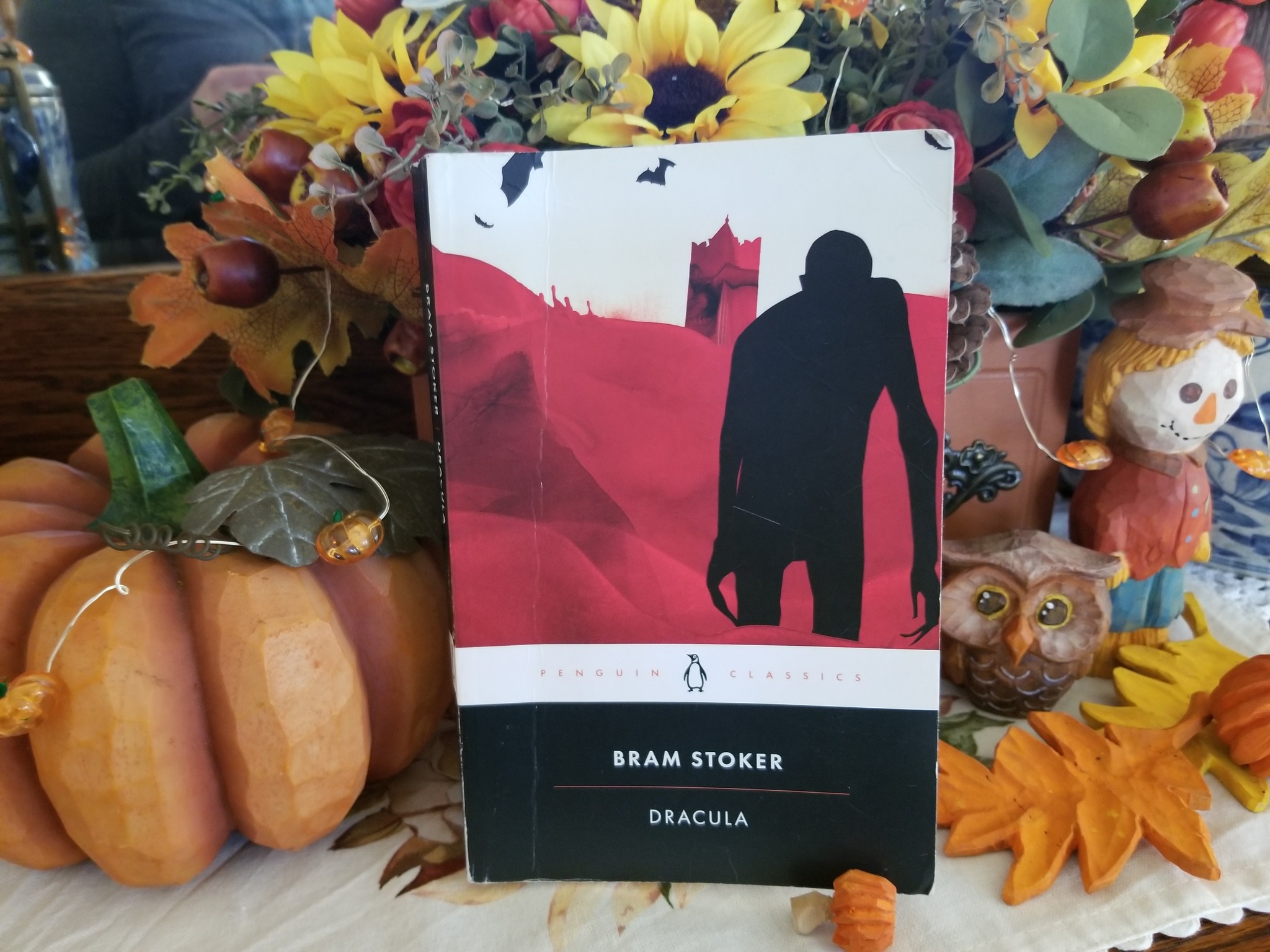
I walked my fifteen year old through Bram Stoker’s Dracula this October. I thought it would be a fun way for a ninth grader to celebrate Halloween. I also thought it would be a neat one to cover with my newly developing book club: The San Salvatore Book Club, primarily made up of my older mentors in my Baptist church. There were gasps of “Are you sure?” and polite “I think I’ll bow out of that one” to which I promptly said, “Why? It’s such a beautiful Christian allegory!”
Side note: I’ve been listening to the Literary Life Podcast with Angelina Stanford for about two years now, caught up on most the episodes and sometimes use them to supplement my home school when I need to be doing something other than teaching literature. My number one complaint to my husband is, “they act like no one knows this and everyone knows this!” to which I am learning every day that, actually, no Angelina Stanford is right: not everyone knows this. I’m not always claiming to have the correct most perfect reads, but I have been shocked to learn I have been reading differently than mainstream society since childhood. So my Angelina Stanford grumbles have ceased now that I know she is operating from the experience of people genuinely not knowing about the material she shares and I’ve been operating under the experience of not sharing because I thought everyone knew. That being the case, my apologies if some of what I share simply sounds like it came from her podcast. It is unintentional, though, yes I listened to her Dracula episodes back in February to make sure when we discussed it in October, I would not have skipped over anything that I assumed “everyone already knew.”
While I was teaching Dracula, I realized I had never written about Dracula on my blog. My blog began, I think, during the height of the Twilight series and I spent so much time focusing on how we shouldn’t be romanticizing vampires with chests that sparkle and misplaced teenage angst, I forgot to write about the roots of vampire lore and my love for Stoker’s classic work, which is in fact a Christian medieval quest to kill a dragon disguised as a techno-thriller. I also realized that I don’t remember what of my essays, stories, and discussions over the years ended up in my journal or my blog, or was relegated only to bookstore employee discussions as we cleaned the store each night. I have spent years reading C. S. Lewis, G. K. Chesterton, George MacDonald, all the classics, yet my blog is mainly limited to home school material and book reviews sent to me by authors and publishers. Therefore, as I begin to teach high school literature to my oldest, I imagine there is a lot of who we are as readers not documented on Anakalian Whims.
To read Dracula well, I think you need a foundation in Genesis, specifically 1:26-4:16. It’s important to read John 1 where the New Testament is clear that Jesus is the Word. It’s important to know a little bit about Jewish and Mesopotamian mythology regarding Lilith, who was a demon and seductress, the disordered first wife of Adam who feeds on children and relishes in child sacrifice as opposed to feeding and nurturing children from her own body as God designed. “Lilitu” was a “night monster.” In my teaching notes, I recommend re-reading the book of Revelation (so you can remember how the bible used imagery of dragons and oceans) and Beowulf. While reading Dracula, you might need to recall stories like Hansel & Gretel, Bluebeard, Homer’s The Odyssey, Dante’s Divine Comedy, Spenser’s The Faerie Queene, and Shakespeare’s Hamlet. It’s easy to enjoy Stoker’s work without these tales fresh on your mind, but it might also be easy to fall victim to Freudian false interpretations if you’re not reading from the framework that Stoker was actually writing during the Gothic revival of the 1800’s. You’ll be limited to the Victorian techno-thriller, which is still awesome, and see all the wrong “imagery” of suppressed sex, which is inaccurate and not awesome.
You have to keep in mind the quote from Devendra Varma: “During the period when the forces of Christianity were nearly spent and materialism had dislodged spiritual values, the Gothic novelists planned their novels with an awareness of the Deity and the consequences of a just fate. The villains learn in due course that the wages of sin is death.”
With that in mind, we enter a world where the monster in the night is indeed an evil to be vanquished, not to be loved for his sparkly chest and undying devotion to trying to get the girl. Traditionally, the villain in these stories is a symbol for Satan, a metaphor for evil itself. We see these villains portrayed as witches, monsters, vampires, and werewolves, who modern literature is now conflating with handsome boys who just need more hugs. Since the dawn of time, human beings have suffered from an evil that must be conquered, and in Stoker’s Dracula we have a group of Christians on a quest to conquer that evil… the “Son of the Dragon” or “Son of the Devil” named Dracula. The best literature will always remind us that the ultimate battle is between the Dragon (the monster) and the Savior (Jesus), and the Savior has already won. That is exactly what makes Dracula one of the best pieces of literature. The monster is the problem, the monster is not the love interest. As C. S. Lewis said, “Who is the witch? The witch is Lilith. The witch is Circe. Every child is born knowing who the witch is.” As Angelina Stanford said, “The monster is not the wounded person, the monster is the [cause of the] wound.”
I don’t want to repeat all the information already available to the public for free on The Literary Life Podcast, but I do want to share some of my favorite parts of the novel that get my skin all tingly when I read them. I’ll try not to repeat too much of what they focus on in the podcast.
In chapter two, we walk through an octagonal room. In Babylonian culture, the eighth realm is the realm of the gods, a realm where for Christians, false gods, fallen angels, and demons congregate. Eight, therefore, is often considered a number affiliated with the occult. Charlemagne’s Aachen Cathedral, where his tomb resides, is an octagonal shape believed to be a mesh of where God meets the secular as it is a circle with straight lines and points. I ask my students what they think Stoker is trying to tell us by Harker walking through an octagonal room as he enters Dracula’s residence, just after a wild carriage ride that resembles a descent into Hades.
Later in this chapter, Dracula throws a mirror out the window. It is absolutely chilling as the mirror in medieval tradition is a symbol of divine truth. It doesn’t matter how many times I read Dracula, the Adversary both literally and figuratively throwing Divine Truth out the window gives me chills every time.
The setting of Whitby, which has a castle or abbey with an extensive graveyard by the sea sets itself up for so much intense imagery and meaning. We have our Gothic trope intermingled with the real history of the Synod of Whitby, where two traditions were ended. Meanwhile Dracula is asking Harker if a man of England can have two solicitors or more? Stoker is tossing around ideas of can man serve two masters? Who will man choose? Dracula is basically asking, how can I trick England into abandoning God and worshiping me? Whitby Harbour had a history of ships crashing, which will offer up opportunities for both Tempest and Rime of the Ancient Mariner allusions.
Stoker offers layer after layer of symbolism with the names and social positions of the characters as well. The podcast talks extensively about the roles of women in Victorian society and how Stoker played with Lucy being the “Light of the West” and “angel of the house” and Mina being the modern woman (I’m not sure if they covered the meaning of her name which sums up to be “Resolute Protection of the Lord”), but my favorite is actually the role of the men in this allegory. We have a fellowship of knights on a quest, all devoted to one woman (Mina), headed off to kill a dragon (Dracula), interwoven with Aristotle’s classical elements: Abraham Van Helsing, the professor (Merlin/ father figure, fire); Arthur Holmwood, the future Lord Gadalming (nobility whose name means “Of God-helm” in the Surrey Kingdom where there is a village called Thursley, near Hammer Pond and Thor’s Stone… King Arthur/ Thor, thunder, or air); John/ Jack Seward, whose name means “Guardian of the Sea,” is a doctor and scientist (a knight on our quest, water); Jonathan Harker, Mina’s husband whose name means “The Lord has Given” (earth); and our fifth man Quincey Morris, a cowboy from Texas (the fifth element) and (spoiler alert) our “Good boy. Brave boy. […] all man.”
From a book review standpoint, Dracula is hands-down a five star book. Above I shared my favorite pieces of a very complex allegory, but there’s so much more to it covered in the series of episodes of the Literary Life Podcast, and even more in my teaching notes, imagery that covers the Eucharist, Anti-Eucharist, Passover, John the Baptist and Anti-John the Baptist imagery. The story is one of wars to fight devils and ends on All Saint’s Day, celebrating rebirth in Christ and the achievement of Heaven. If you’re not seeing these metaphors for yourself when you read please go listen to the podcast episodes so that you can enjoy this beautiful work of fiction (and truth) for yourself.
(As an Amazon affiliate I earn from qualifying purchases.)
Medieval Homeschooling with a Twist
One thing about homeschooling I love is the ability to really dive into subjects and LIVE there. We follow a classical model, with a Charlotte Mason bent, heavily influenced by unit studies, and are extremely eclectic. If you have watched The Five Flavors of Homeschooling video you might understand why this is a little bit funny. We just love to learn and we do it in ALL the ways. Most people pick one or mesh two. We enjoy taking it day by day and the only guarantee is that we are on the classical track. Which means this year we’ve been frolicking through the late ancient era and into the middle ages. Also, Kiddo loves cake decorating and party planning. So for her last “kid” party, she hosted a medieval feast/ ren faire in the backyard.
My mother-in-law and husband are both amazing at decorating cakes (and pretty much every crafty venture they try), so when Kiddo had a BIG idea… well, it turned out like this:
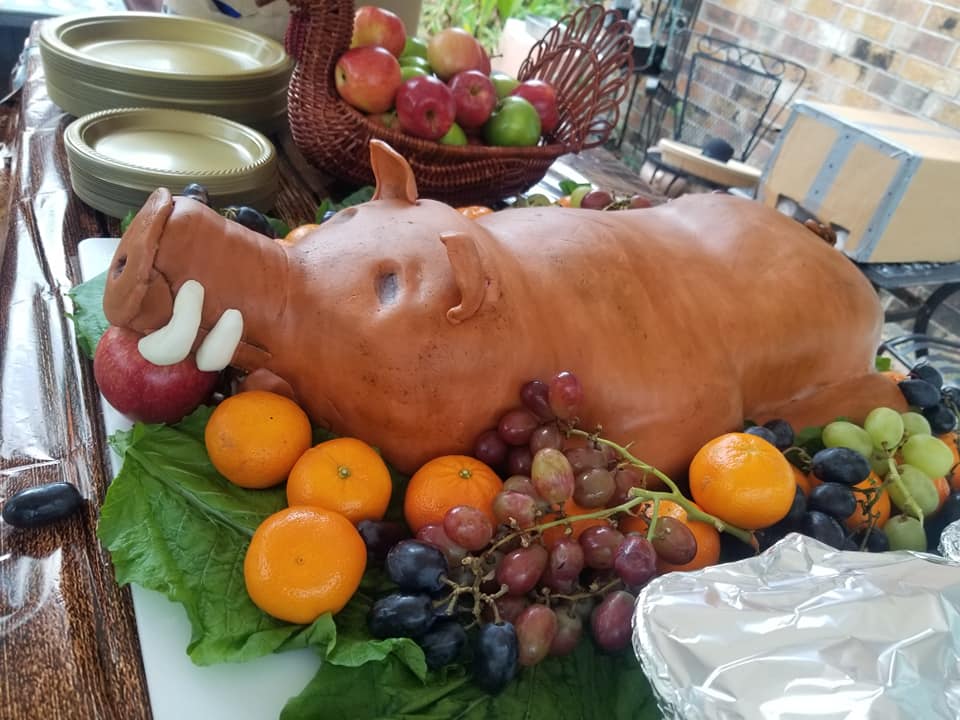
Yes, she asked for a giant pig cake. To make the table look more authentic. The cake took a lot of planning and several days of my mother-in-law teaching Kiddo step by step how to make it and Kiddo functioning as an official cake decorating assistant. The fondant was homemade because it’s my in-law’s recipe and actually edible versus a lot of the weird tasting too sugary stuff you get at the store. I love that I can’t share all the steps with you, because it means Kiddo did so much of the work. She asked for party-planning gifts this year… so helping Kiddo make the cake for the event with her grandmother was the big gift. Our goal is to stop collecting stuff and make a point to collect memories and skills, and build relationships.
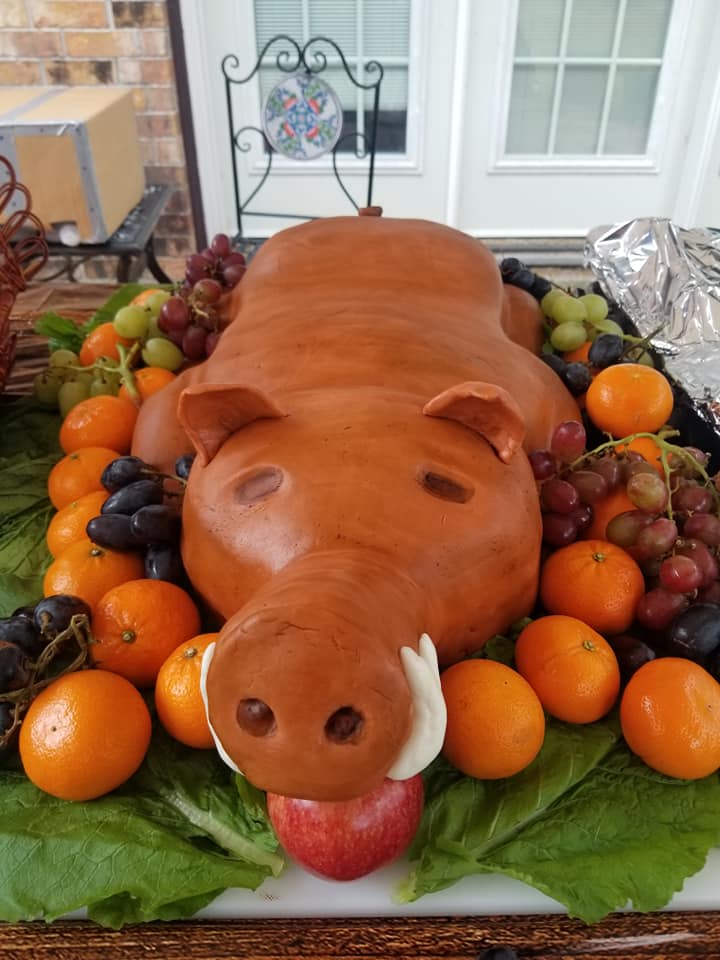

Here is the pig next to our (not historically accurate) feast spread. My husband smoked forty pounds of chicken, I roasted about twenty-five pounds of potatoes and sauteed onions, carrots, and radishes. Kiddo baked eight loaves of bread. She served all her friends bread she made herself in addition to making the cake. Remember, she’s given a budget every year and told she may have presents or party or a mix of both but can’t go over budget. She voted for putting in the work on all the bells and whistles of a party. This is my favorite thing about how homeschooling becomes a whole lifestyle. This is her “Home Economics” credit, so much more extensive than a Foods for Today class where we identified a spatula on a worksheet. Sometime in the next semester or so, she will make a cake (of similar caliber) from start to finish on her own and earn a “Cake Decorating” credit. In addition to learning Latin, French, and Spanish, staying well above average in math and science, and a full host of other things, she has time to do all these fun electives that would have been a pipe dream for me when I was in public school. We are having so much fun.
My best friend and her partner then pitched in to put the entire event over the top. Their gift was a jousting tournament.

Let me tell you, this was brilliant. They took tomato plant spikes and attached silver-painted styrofoam cups to them. The cups looked a bit like castles, but their function was to hold the rings you see in the picture. Two blow-up horses and a pool noodle for each made a jousting tournament. The kids had to race to see who could collect the rings in their lane with the pool noodle the fastest. The winner of the tournament went home wearing a crown.
The day was amazing. My twelve-year-old managed to plan something that children of all ages and adults enjoyed. She used her resources, asked for help when she needed help, and tapped into the various expertise of those around her for the best possible outcome. We learned more about the middle ages as we determined that our feast was not actually accurate to the times, but the best fit for the budget we had. Homeschooling looks different for everyone, we bend the curriculum (and create our own) to meld to the personality and mind we are teaching. For my extroverted entertainer, this is how the middle ages came alive for her. Of course, she can dialogue all about Clovis, Augustine of Kent, the evacuation of Rome from Britain, Vikings, and more, but she can also budget, plan an event, manage requests, bake bread, alter recipes, and decorate cakes.
I have the opportunity, every day, to be so impressed by her.




 Anakalian Whims