Traditions! (Hallelujah!)
A few years ago we started the tradition of celebrating Advent using Cindy Rollins’ Hallelujah! study of Handel’s Messiah and I absolutely love it. Celebrating Advent has been a new and gradual practice for me. About eight years ago. the church I was attending was lighting weekly candles at the front of service, but not spending much time explaining it and it provoked me to start doing some research in conjunction with learning about liturgical practices in the home.
As we settle into using Hallelujah! to enrich our family life, we’re adding in some of the things from the appendix slowly. This was our first year doing St. Nick shortbread cookies and I was pretty excited. Despite a few hiccups, we were pleased with our efforts. My oldest has been learning to decorate cakes off and on for the last five years, and she made icing and turned the cookies into little Christmas wreaths for an event the following week as well. We didn’t celebrate St. Lucia’s Feast Day this year, but little by little we’re adding traditions to our holiday season that line up with the Christian calendar.
In order to do that, I’ve been having to learn about the Christian calendar in general. I was not raised in a church that followed it other than Christmas and Easter. I knew nothing of Advent or Lent. I still don’t fully understand Lent, but I used Living the Christian Year by Gross as a starting point. It didn’t answer the questions I had, which as usual are questions I’m not even sure how to articulate yet, so I donated it to our church library hoping it will help someone else. I hoped to find more clarity by adding The Sacred Sacrifice to our Lent and Easter season, I read it last year when it first came out and plan use it again with my children during our morning basket time again this year.
It’s interesting because despite my children all loving classical music, my son used to beg to listen to Mozart as a toddler, they are fairly indifferent about these family traditions surrounding the Christian holidays and classical pieces. I’m curious to see how they feel about it the older we get as it becomes nostalgic and part of their family memories. When we first added the tradition of getting a live Christmas tree at a family owned Christmas tree farm, my oldest was also indifferent. But now they all beg to go to the farm as soon as Thanksgiving passes. They love the petting zoo feature, there are sure to be baby goats and tortoises. They love the outdoors and the bees and hunting down the perfect tree. They love getting subpar hot cocoa in Styrofoam cups (my husband makes amazing hot cocoa from scratch at home) and pumping Christmas themed rubber ducks down the PVC pipe racing shoots… these things have come to mean the beginning of the Christmas season to them and I love that.
Another tradition we have added to our lives is listening to The Dark is Rising BBC World Service production: https://www.bbc.co.uk/programmes/w13xtvp7. The Dark is Rising book (and podcast) starts on the winter solstice, December 20th, and it’s fun to listen to the events of the story alongside the events of our own corresponding days.
What does your family do as a household tradition?
(As an Amazon affiliate I earn from qualifying purchases.)
A Remarkable Portrait
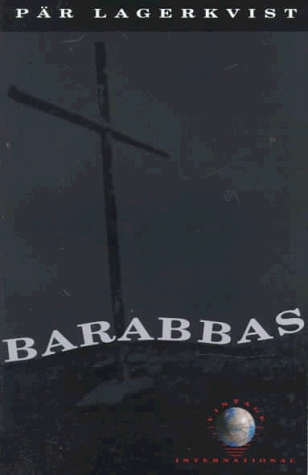 Title: Barabbas

Author: Par Lagerkvist
Genre: Fiction/ Literature
I’m pretty terrible about not investigating books before reading them, even more terrible about not investigating them before buying them (or bringing them home). Something moves me and immediately on impulse I add it to my collection. You never know when it might come in handy. It looks like it could be interesting on a rainy day in summer when I have no internet my daughter suddenly finds herself in a nap and my brain is somewhere between writing historical fiction and flying away in a space ship. Oh, and look, that possible moment in theoretical time happened this week.
So I picked up Barabbas, a short novel that had some vague ties to an author who had won the Nobel Prize for literature. A thin slip of a thing that might find itself in the donate pile if it didn’t prove itself worthy in an hour and a half.
It proved itself. Of course it did. The concept is too fascinating to not earn itself at least 4 stars in my very critical book.
Matthew 27: 11-26
11 Now Jesus stood before the governor, and the governor asked him, “Are you the King of the Jews?” Jesus said, “You have said so.” 12 But when he was accused by the chief priests and elders, he gave no answer. 13 Then Pilate said to him, “Do you not hear how many things they testify against you?” 14 But he gave him no answer, not even to a single charge, so that the governor was greatly amazed.
15 Now at the feast the governor was accustomed to release for the crowd any one prisoner whom they wanted. 16 And they had then a notorious prisoner called Barabbas. 17 So when they had gathered, Pilate said to them, “Whom do you want me to release for you: Barabbas, or Jesus who is called Christ?” 18 For he knew that it was out of envy that they had delivered him up. 19 Besides, while he was sitting on the judgment seat, his wife sent word to him, “Have nothing to do with that righteous man, for I have suffered much because of him today in a dream.” 20 Now the chief priests and the elders persuaded the crowd to ask for Barabbas and destroy Jesus. 21 The governor again said to them, “Which of the two do you want me to release for you?” And they said, “Barabbas.” 22 Pilate said to them, “Then what shall I do with Jesus who is called Christ?” They all said, “Let him be crucified!” 23 And he said, “Why, what evil has he done?” But they shouted all the more, “Let him be crucified!”
24 So when Pilate saw that he was gaining nothing, but rather that a riot was beginning, he took water and washed his hands before the crowd, saying, “I am innocent of this man’s blood;[a] see to it yourselves.” 25 And all the people answered, “His blood be on us and on our children!” 26 Then he released for them Barabbas, and having scourged[b] Jesus, delivered him to be crucified.
 Unnecessary Summary: Barabbas was the criminal released instead of Jesus. Jesus was then crucified, the very moment that determined once and for all who would die that day.
Of course that’s a little factoid that almost every Christian knows. Many non-Christians probably know it too… Barabbas evil criminal let loose and poor Jesus killed.
I never thought about what that would mean. Not just in the grand scheme of things, but in the small ways that are epic to one and often meaningless to the masses. Barabbas – how did Barabbas feel? I never thought of it until Lagerkvist made me think about it. I picked up the book, understanding who the title referenced, but not imagining that it would be a historical piece on the person referenced – on his life, on his feelings, on his thoughts after Jesus took his place on the cross. Literally, not just in the spiritual salvation way, but physically died in his stead.
So many times we are encouraged to ruminate on Thomas (who doubted) and Peter (who denied). The thief who was admitted into paradise at the last minute, hanging on the cross next to Jesus, he’s a really big deal in the church. But Barabbas? Barabbas was just a bad dude who should have hung and died instead of our innocent savior… Really? What does that look like?
Lagerkvist tells us his version of what that looks like.
 (If you’re not quite as oblivious as me, you probably already know this by the numerous film productions that have been done based on Lagerkvist’s work. You probably also know about the Marie Corelli book which inspired its own film versions. You probably know all sorts of cool things about Barabbas that I don’t. But if you don’t know anything about it all – keep reading and I’ll tell you what I think.)
This is a fascinating tale documenting the evolution of a person’s heart, the confusion of their mind as they try to sort out philosophical things in the midst of chaos and history being made. I’m startled by such a remarkable portrait.
It came out of left field. It’s been sitting on my shelf for God knows how long. And it was stunning.
It would seem that I am stunned by everything lately. The truth is, as much as I read and review here, there are four times as many books that I pick up and discard without even making it through the first chapter. (Those are either returned to the library because I borrowed them in the first place, or are delivered to the library because I am bewildered they made it across my threshold at all.)
The moral of this story: Lagerkvist is a keeper. There’s a reason he’s an award winning author. There’s a reason his book appears on the 1001 Books to Read Before You Die list. He’s pretty incredible.






 Anakalian Whims