Hard Roads to Cultural Literacy
In May of 2019, I read a book called Hard Road West: History and Geology Along the Gold Rush Trail by Keith Heyer Meldahl. I remember it being riveting. When I logged it on Goodreads all I wrote was, “Excellent and fascinating.” I was dating my now husband at the time and I remember sharing with him sections I thought he would enjoy, as we both like geology and one of our dates was to the HMNS gemstone exhibit. At one point I laughed out loud at something clever Meldahl wrote (I don’t recall what it was) and my husband commented that it is a rare geology book that causes one to laugh in pleasure.
Naturally, I thought this would make excellent assigned reading for my homeschooled highschooler. But one chapter into it she was struggling. It wasn’t the reading level, she has a collegiate reading level and has had one for a few years now. I was certain it couldn’t be the science as she had been perusing geology books since childhood and had done a whole geology curriculum with a friend as part of their own little science club they created. Nerds. I went over the science with her and she kept reading. It became less of a struggle, but she is not laughing out loud with pleasure from her geology book.
Then I started reading Cultural Literacy by E. D. Hirsch and things became clearer. In Cultural Literacy Hirsch talks about a study done on the results of seven year olds who took a reading assessment test. In the test the children were asked to read a story about a spider. The children who had more prior knowledge about spiders scored higher on the reading comprehension questions about the story (which did not require special knowledge about spiders) than those who did not know much about spiders.
I shared this with my oldest daughter, as we often study together while the younger kids are playing. We discussed it and determined that it makes sense to not get hung up on something being mentioned in passing because you already know a lot on a topic and can picture it in your mind with little effort, but to struggle to retain what something is about if it mentions a lot of things you’re trying to picture because you’re not as familiar with them. Perhaps it is easier to envision Charlotte in Charlotte’s Web if as a child you also have watched a real spider build its web, perhaps it is easier to remember the story if you’ve seen or read about how baby spiders hatch. Or, if you’ve had Charlotte’s Web read to you as a child, maybe a technical book on pig husbandry would be easier to retain as an adult. Hirsch includes an example of college students reading a paragraph about Ulysses S. Grant and Robert E. Lee and struggling because they had no prior knowledge of who they were and how they related to the Civil War (shocking because these were college students out of Virginia).
I was reminded about a public schooled girl I was working with who had failed her reading portion on her standardized tests. Her phonics were impeccable, but where she struggled was comprehension. When I worked with her, almost every time she struggled to read something it was because she had never heard the word. She didn’t have the vocabulary to support her phonics skills. I advised the family to listen to audiobooks, read stories together at night, talk to each other more, look words up in the dictionary. Children learn the meanings of words by hearing them, then when they see them on paper for the first time while sounding it out… they have a picture in their mind of what that word means, feels like, or how it can be used in different sentences. Kids should always have access to stories above their reading level, so that they can learn grammar structures and vocabulary words organically. Hirsch drives home the idea that you can know how to read and still be illiterate if you don’t know anything about what you’re reading.
I told my daughter how this was interesting to me because my husband had said he thought she didn’t know enough geology to read Hard Road West smoothly, even though I thought it was a very approachable book and that she had a strong foundation in geology. She and I laughed over the time a volunteer at the museum asked her what a specific rock smelled like and the big reveal fell flat when she answered, “Sulfur.” Poor guy deflated and said, “Yes, it’s Sulfur. You must be homeschooled.” Apparently the public school kids her age on field trips liked to shout “Farts!” She was about seven at the time and it is one of her favorite museum memories. (I’m not going to lie, even if I knew it was sulfur at seven, I’d probably have shouted “Farts!” too, but I went to public school.)
“So, why, if you’ve read all the same geology books we read as children, is this geology book difficult? Because I genuinely don’t think it would have been difficult for me at fifteen.” That is when she confessed that the geology books we owned and had spent hours reading… she hadn’t actually been reading them: “I was looking at the pretty rocks. I could tell you the page numbers where all my favorite rocks are, all the prettiest ones, I didn’t read all the stuff…” We genuinely laughed together, two wildly different personalities approaching children’s geology books in wildly different ways. As Charlotte Mason said, “Children are born persons.” But for every moment, like this geology one where she struggles because maybe she didn’t pay as much attention to what was put before her in the past, she has so many where she shines. She catches every Shakespeare reference. Every time. (Hirsch writes a bit about how Shakespeare allusions used to be quite common in all kinds of writing, including business memos, but as of the publication of his book in 1987, that was no longer the case.)
Hirsch’s argument for cultural literacy was never meant to be for homeschool parents to refine the presentation of their educational feasts, his goal is educational reform in the public sector. There is extensive discussion in his book about the struggle to properly regulate education in that if you mandate that schools teach at least two Shakespeare plays there will always be arguments about which two should be selected and that no two districts will choose the same two, therefore knowing who Shakespeare is might be universal, but catching Shakespeare references will vary. (I vote for all the Shakespeare. Every play! All the sonnets!) But I did feel like Hirsch’s essay very much affirmed the education I am providing. Maybe my oldest gets a little bogged down in this particular geology book, but to be fair, it could easily be assigned in a college course, most high school students wouldn’t be reading it between their Homer and Geometry lessons. The paragraph that boggled the minds of the Virginian community college students in the 1980s didn’t phase her, and for that I have hope.
Additional affirmation came when I realized I had owned other books by Hirsch in the past. He’s the one that wrote the series Everything Your ___Grader Needs to Know. My first two years of formal homeschooling (first and second grade), I had read those books out loud the last month of the traditional school year to see if we were covering everything. What I learned was reading those books out loud was a waste of time because a classical Charlotte Mason education is thorough and she not only knew what she needed, but she knew richer versions than the sad paragraphs presented. That was the final nail in the coffin on us ever relying on textbooks. Cultural literacy can be gained from textbooks, but it’s boring and far less effective. The better road to true literacy, in my opinion, is living books. I donated Hirsch’s other books, but I’m keeping Cultural Literacy.
One whole day after finishing Cultural Literacy, I went to our local library to donate a bag of books I was purging from my collection. There on the shelf next to the library bookstore register was E. D. Hirsch’s Dictionary of Cultural Literacy, a compilation of all the things the average American graduate should know, for $2. Of course I bought it.
“Also unrealistic is the pragmatist emphasis on individuality, at least as the idea has been institutionalized. The best teaching does accommodate itself to individual differences in temperament, but a child’s temperament does not come freighted with content. To learn a culture is natural to human beings. Children can express individuality only in relation to the traditions of their society, which they have to learn. The greatest human individuality is developed in response to a tradition, not in response to disorderly uncertain, and fragmented education. Americans in their teens and twenties who were brought up under individualistic theories are not less conventional than their predecessors, only less literate, less able to express their individuality.” – E. D. Hirsch, Cultural Literacy, pg. 126.
Literacy and Education
Every day I read. And since having a child, every book I read is filtered through a mental checklist of sorts: Would this be useful to Kiddo? How would I feel about her reading this? What age is this appropriate for? How can we apply tools, principles, morals, themes, etc. that we learn from reading this to our lives?
Does this mean she’s the center of my universe and I do it all for her? No. I read for myself. It might not seem like it when I’m making lessons plans, blogging reviews with Amazon affiliate purchase links (every time YOU buy a book by clicking the link from my site, a portion of that money is used as much needed income – thank you), posting about bookstore events, etc. But I do so much of it for me it verges on selfishness. This is my vice, my hobby, my job, my world. I am a book fiend and somehow I have made that work for me on as many fronts as possible.
But even with all that self-serving book binging going on, determining how my reading material could mold the mind of my child – whether directly or indirectly – is a constant subplot to my life story.
If I weren’t homeschooling, would I have been interested in titles like Why School?
I laughed at myself several times this week. By the time I’m done raising my daughter I could have a PhD in education, going by my thirst for educational theory. However, it’s not even remotely close to what I desire to earn a PhD in. Is every parent required to study this hard? No. Is it necessary to do all this leg work to be a homeschool mom? Absolutely not. You are qualified to teach your child just by virtue of being their parent and longing to make a priority of their spiritual, educational, and physical growth, of viewing your parent-child relationship as something worthy of being tackled with excitement and care. But for those naturally driven to research and reading, for those who have undeniably lofty ideas regarding the swoon of academia, for those who possibly have an unhealthy love for pens and paper, stacks and shelves, mahogany and oak, for those people it’s a little hard not to fall “victim” to the pull of differing philosophies regarding your life choice to teach your child yourself. (God help me when it comes to instructing her on the laws of grammar as I’ve never quite mastered getting over run on sentences, they are my favorite grammatical mistake. Those, and sentence fragments, I suppose.)
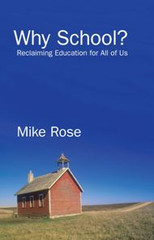 Why School? is a diminutive sized hardback with a picture of an old one room schoolhouse on the front. Behind the schoolhouse – identical to what I long to build on my future homestead, although much larger I’m sure – is a vast sky of blue inviting you to all the possibilities contemplation and the school of thought might have to offer you. The book begins with a tale about a janitor who had suffered some brain damaged, but chose to work at a community college to be around “where it happens” and to have access to materials he could study and/or take home to his daughter. It was a beautiful tale regarding academia and how it is viewed from different sets of eyes. Most people see it as a mandatory road map in life, one they can’t get out of. Some see it as a golden ticket to the land of opportunity. Few actually see it for what it is meant to be: a place to learn.
The author, Mike Rose, talks about many things regarding school and college and life. He discusses blue collar life vs. white collar life. He addresses a few political issues, some I agree with and some I don’t. But one thing is clear: he is passionate about learning. He is passionate about education. Rose’s goal is to make others aware of the importance of developing the mind and taking charge of what we put in it, whether it be tools and life skills or book facts.
“We live in a time of much talk about intelligence. Yet we operate with a fairly restricted notion of what that term means, one identified with the verbal and quantitative measures of the schoolhouse and the IQ test. As the culture of testing we live in helps define achievement and the goals of schooling, it also has an effect on the way we think about ability.” – pg. 73
I loved that part. I loved how he addressed the parts of the brain used by those who work with their hands. My husband works with his hands, he is a millwright. More than anything, I want to balance my child’s developmental education with things both her parents are passionate about. I want her to continue to love books, but I want to allow her to be passionate about building things (the girl is a master tower builder when it comes to legos and VHS tapes). So much creative energy is dismissed when people look at their mechanic or a machinist. People do not understand how even your diner waitress is the Queen of her domain, has mastered brain patterns you cannot fathom, and has an internal clock and rhythm you could not duplicate without years of practice and training. I understood this example Rose provided well, having waited tables just long enough to say I learned to do it the best I ever could and could not do it forever. (I was a good server, well-liked by most my customers, but I was no Wanda.)
 I read chapters of Rose’s book in between dives into Adolescent Literacy Research and Practice. Where Rose is quaint and inspiring, though thoughtful and well-spoken, Adolescent Lit. is all academic essays, lengthy work cited pages, references to studies and schools of thought. The book is written by public school educators for public school educators, but one would be remiss if they didn’t hear the constant hum of “Homeschooling is the answer” to nearly every issue they address. The writers would laugh, I think, as there is an entire section dedicated to how people tend to read things and find support for their own arguments and core beliefs even where there may be none.
Timothy and Cynthia Shanahan were the contributors I enjoyed reading the most. They talked in great detail about what literacy is truly about, what being able to write is for, and how important it is in the education process to not confuse its purpose. Literacy and developing good writing habits are at the core of understanding any subject – not just literature – but math, science, and history as well. Writing isn’t merely about communicating what you have learned, but a process of diving deeper into a subject and gleaning a more thorough understanding of it. Not just about memorizing facts and regurgitating, but thinking about what those facts mean to you and how that may or may not affect your world view. It is about engaging the brain and coming up with new thoughts about old concepts. It is about developing theories from research. It is about invention and progress. It isn’t just about basic comprehension, it’s about eventual enlightenment on any given subject.
Several essayists in the book discuss the issue of the misconception that writing is only for the literature major and how there is only one way to read. There is great detail on how the practices for reading a science text cannot be considered the same as those to read classic fiction. So many do not address this, which is why we have children in our schools reading their chemistry and physics homework, plodding their way through formulas, but they haven’t internalized it. They only barely understand, it’s passion-less math or vague theories… whereas teaching these same kids how to read their science text (and giving them more than just standard textbooks, but also journals produced by scientists and articles from the professional world) will bridge the gap between the information and the passion to do something with that information. Not everyone is Einstein, but we are not raising independent thinkers with a drive to feed their brains. We are raising frustrated honey bees who have been deprived of pollen, and by doing such a thing they become useless drones who produce nothing.
I say this screams “homeschool is the solution” to me because the essence of the discussion in the book is teach a child to read for each appropriate discipline and you give them the world. You teach them how to teach themselves. You teach them how to use their brains and be studious and good stewards of their minds. Not for the sake of a grade, not for an award or blessing, but for the act of embracing the knowledge itself. We are driven by standardized tests – and I get it, how else do you assess where a child is when you must maintain some semblance of order while still addressing the needs of 30 students at a time. How else do you sort them out and provide the best education possible? If you can, you teach them at home. Smaller classrooms, a personal relationship, true observing of where that child is developmentally and how you can aid them on the path to true literacy. In Texas a homeschool is considered a private school run out of the home. If there was nothing I liked about Texas (and I love Texas, but if I didn’t), this fact alone would keep me here as long as possible.
There’s also a thing called Unschooling that I’m finding more and more I lean to (I am combining classical education and unschooling education styles in my “private school” that is the Klemm home). Unschooling is child driven. You pursue their interests with a passion when they have them. You learn what you can while they are motivated to learn it. Every moment is a possible classroom moment. The other day we researched praying mantises after discovering one in the garden we were weeding. Kiddo was so excited and immediately went to her bug book and found a picture of one, thrilled to see something in the book that she had just seen in real life. Well that’s easy when they’re in pre-school, people like to say. Yes, it is. But it can continue to be that way as they get older.
“Reading classrooms at the secondary school level typically tend to minimize student choice (Guthrie & Davis, 2003). However, giving students opportunities to ‘self-rule’ and ‘self-determine’ can make learning more personally meaningful and intrinsically motivating (Deci & Ryan, 1985, Deci, Vallerand, Pelletier, 1991; Ryan & Powelson, 1991).” – pg. 286
What do you think?
Unexpected Gem
The Reader by Bernhard Schlink
 The Reader is a touching coming of age novel that reads like a memoir. Reminiscent of McEwan’s Atonement in its themes of shame and intense raw humanity, Schlink constantly begs the question from his characters and his readers: “What would you have done?” The humility of illiteracy, ignorance, and confinement brought tears to my eyes. I found The Reader to be an unexpected gem.




 Anakalian Whims