Hard Roads to Cultural Literacy
In May of 2019, I read a book called Hard Road West: History and Geology Along the Gold Rush Trail by Keith Heyer Meldahl. I remember it being riveting. When I logged it on Goodreads all I wrote was, “Excellent and fascinating.” I was dating my now husband at the time and I remember sharing with him sections I thought he would enjoy, as we both like geology and one of our dates was to the HMNS gemstone exhibit. At one point I laughed out loud at something clever Meldahl wrote (I don’t recall what it was) and my husband commented that it is a rare geology book that causes one to laugh in pleasure.
Naturally, I thought this would make excellent assigned reading for my homeschooled highschooler. But one chapter into it she was struggling. It wasn’t the reading level, she has a collegiate reading level and has had one for a few years now. I was certain it couldn’t be the science as she had been perusing geology books since childhood and had done a whole geology curriculum with a friend as part of their own little science club they created. Nerds. I went over the science with her and she kept reading. It became less of a struggle, but she is not laughing out loud with pleasure from her geology book.
Then I started reading Cultural Literacy by E. D. Hirsch and things became clearer. In Cultural Literacy Hirsch talks about a study done on the results of seven year olds who took a reading assessment test. In the test the children were asked to read a story about a spider. The children who had more prior knowledge about spiders scored higher on the reading comprehension questions about the story (which did not require special knowledge about spiders) than those who did not know much about spiders.
I shared this with my oldest daughter, as we often study together while the younger kids are playing. We discussed it and determined that it makes sense to not get hung up on something being mentioned in passing because you already know a lot on a topic and can picture it in your mind with little effort, but to struggle to retain what something is about if it mentions a lot of things you’re trying to picture because you’re not as familiar with them. Perhaps it is easier to envision Charlotte in Charlotte’s Web if as a child you also have watched a real spider build its web, perhaps it is easier to remember the story if you’ve seen or read about how baby spiders hatch. Or, if you’ve had Charlotte’s Web read to you as a child, maybe a technical book on pig husbandry would be easier to retain as an adult. Hirsch includes an example of college students reading a paragraph about Ulysses S. Grant and Robert E. Lee and struggling because they had no prior knowledge of who they were and how they related to the Civil War (shocking because these were college students out of Virginia).
I was reminded about a public schooled girl I was working with who had failed her reading portion on her standardized tests. Her phonics were impeccable, but where she struggled was comprehension. When I worked with her, almost every time she struggled to read something it was because she had never heard the word. She didn’t have the vocabulary to support her phonics skills. I advised the family to listen to audiobooks, read stories together at night, talk to each other more, look words up in the dictionary. Children learn the meanings of words by hearing them, then when they see them on paper for the first time while sounding it out… they have a picture in their mind of what that word means, feels like, or how it can be used in different sentences. Kids should always have access to stories above their reading level, so that they can learn grammar structures and vocabulary words organically. Hirsch drives home the idea that you can know how to read and still be illiterate if you don’t know anything about what you’re reading.
I told my daughter how this was interesting to me because my husband had said he thought she didn’t know enough geology to read Hard Road West smoothly, even though I thought it was a very approachable book and that she had a strong foundation in geology. She and I laughed over the time a volunteer at the museum asked her what a specific rock smelled like and the big reveal fell flat when she answered, “Sulfur.” Poor guy deflated and said, “Yes, it’s Sulfur. You must be homeschooled.” Apparently the public school kids her age on field trips liked to shout “Farts!” She was about seven at the time and it is one of her favorite museum memories. (I’m not going to lie, even if I knew it was sulfur at seven, I’d probably have shouted “Farts!” too, but I went to public school.)
“So, why, if you’ve read all the same geology books we read as children, is this geology book difficult? Because I genuinely don’t think it would have been difficult for me at fifteen.” That is when she confessed that the geology books we owned and had spent hours reading… she hadn’t actually been reading them: “I was looking at the pretty rocks. I could tell you the page numbers where all my favorite rocks are, all the prettiest ones, I didn’t read all the stuff…” We genuinely laughed together, two wildly different personalities approaching children’s geology books in wildly different ways. As Charlotte Mason said, “Children are born persons.” But for every moment, like this geology one where she struggles because maybe she didn’t pay as much attention to what was put before her in the past, she has so many where she shines. She catches every Shakespeare reference. Every time. (Hirsch writes a bit about how Shakespeare allusions used to be quite common in all kinds of writing, including business memos, but as of the publication of his book in 1987, that was no longer the case.)
Hirsch’s argument for cultural literacy was never meant to be for homeschool parents to refine the presentation of their educational feasts, his goal is educational reform in the public sector. There is extensive discussion in his book about the struggle to properly regulate education in that if you mandate that schools teach at least two Shakespeare plays there will always be arguments about which two should be selected and that no two districts will choose the same two, therefore knowing who Shakespeare is might be universal, but catching Shakespeare references will vary. (I vote for all the Shakespeare. Every play! All the sonnets!) But I did feel like Hirsch’s essay very much affirmed the education I am providing. Maybe my oldest gets a little bogged down in this particular geology book, but to be fair, it could easily be assigned in a college course, most high school students wouldn’t be reading it between their Homer and Geometry lessons. The paragraph that boggled the minds of the Virginian community college students in the 1980s didn’t phase her, and for that I have hope.
Additional affirmation came when I realized I had owned other books by Hirsch in the past. He’s the one that wrote the series Everything Your ___Grader Needs to Know. My first two years of formal homeschooling (first and second grade), I had read those books out loud the last month of the traditional school year to see if we were covering everything. What I learned was reading those books out loud was a waste of time because a classical Charlotte Mason education is thorough and she not only knew what she needed, but she knew richer versions than the sad paragraphs presented. That was the final nail in the coffin on us ever relying on textbooks. Cultural literacy can be gained from textbooks, but it’s boring and far less effective. The better road to true literacy, in my opinion, is living books. I donated Hirsch’s other books, but I’m keeping Cultural Literacy.
One whole day after finishing Cultural Literacy, I went to our local library to donate a bag of books I was purging from my collection. There on the shelf next to the library bookstore register was E. D. Hirsch’s Dictionary of Cultural Literacy, a compilation of all the things the average American graduate should know, for $2. Of course I bought it.
“Also unrealistic is the pragmatist emphasis on individuality, at least as the idea has been institutionalized. The best teaching does accommodate itself to individual differences in temperament, but a child’s temperament does not come freighted with content. To learn a culture is natural to human beings. Children can express individuality only in relation to the traditions of their society, which they have to learn. The greatest human individuality is developed in response to a tradition, not in response to disorderly uncertain, and fragmented education. Americans in their teens and twenties who were brought up under individualistic theories are not less conventional than their predecessors, only less literate, less able to express their individuality.” – E. D. Hirsch, Cultural Literacy, pg. 126.
A Year of Homeschooling Peacefully in the Ancient Times
The school year began, for me, in a bit of chaos. My son was born over the summer. My mother had died. In addition to my newborn son, I had two extra children in my household. I was overwhelmed by the impending doom of our co-op. I could sense it coming, but I honestly thought it was a year or two off and I was committed to giving it my kiddo’s fifth grade year before bailing, believing that the proverbial poop would hit the fan a few months after my departure. (It hit sooner.)
Still, after the children went back to their own home. The co-op dissolved and something new began… we found ourselves homeschooling through the ancients in our own little Pax Romana. We declared this our year of homeschooling in peace and it has been phenomenal.
As usual, we began our dive into Ancient history with the Epic of Gilgamesh. After years of reading the picture book trilogy by Ludmila Zeman, it was time to upgrade to a a more “grown up” version of the story. Gilgamesh the Hero by Geraldine McCaughrean was a perfect bridge for the dialectic stage, from elementary to the full translations of high school. Kiddo was struck by the subtle differences, the pieces that make it suitable for older readers, but not for younger ones. As a child who doesn’t like change, learning that different adaptations have a different flow and feel to them has been a challenge. As a ten/eleven year old, she has now been exposed to several adaptations of the Gilgamesh myth and also has a much broader view of near eastern cultures and history. I’m happy to say, my homeschooler as an elementary graduate has a more thorough understanding of history and other people groups than I did as a public school high school graduate. These are the goals, and we’re winning.
I read The Golden Bull by Marjorie Cowley out loud to two ten year olds and an eight year old. This is right about the time we started making our timeline (using Amy Pak’s Home School in the Woods History Through the Ages Record of Time), and having the kids perform narrative plays of what I had just read to them while I nursed my infant. Our house is fairly full of music, so naturally we ended up making a lyre (and some ukuleles) as a hands on craft which in turn became props in our living room productions of The Golden Bull.
Meanwhile, we were also re-reading Susan Wise Bauer’s Story of the Wold Volume One for the third time, reading Story of Civilization for the first time, plucking our way through the Usborne Encyclopedia of the Ancient World, reading the Old Testament, and for good measure added a plethora of picture books I had on hand from the last time we studied the ancients.
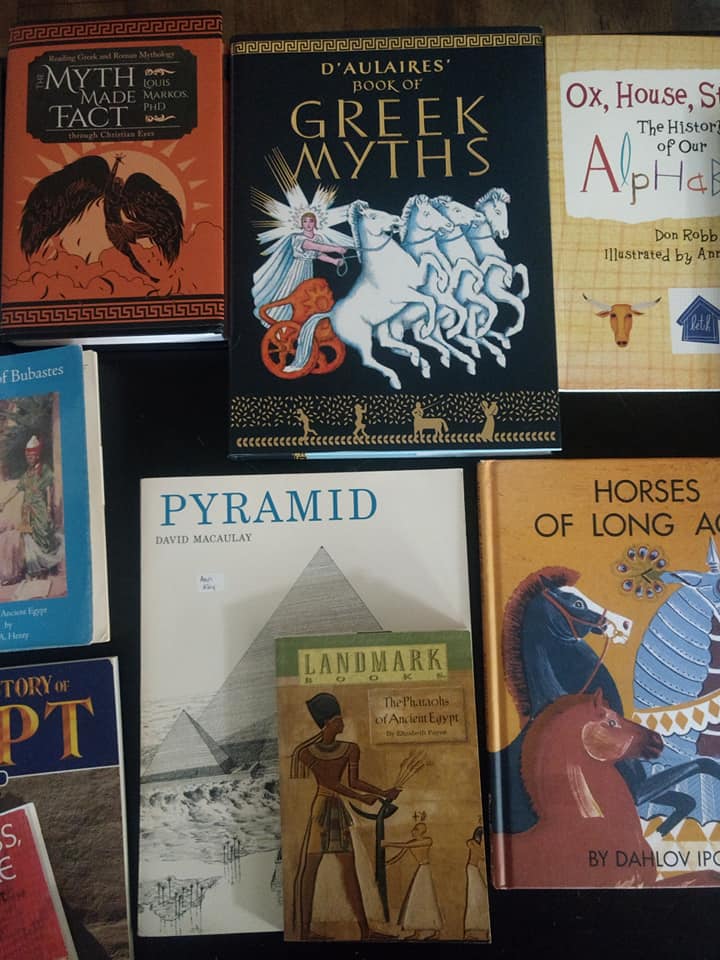
Ox, House, Stick by Robb was discovered while we studied the Phoenicians and the alphabet. This one came highly recommended, and the kids liked it ok, but it wasn’t my favorite. We also re-read The Riddle of the Rosetta Stone by Giblin, that one is always fun and fascinating.
We had some extensive discussions regarding laws and lawmakers. The kids each read a biography on Hammurabi, the one by Mitchell Lane Publishers was the best, we thought. A few rabbit trails later and we spent an afternoon on You Wouldn’t Want to Be an Assyrian Soldier.
As we moved into the time of the Egyptians, we tackled Green’s Tales of Ancient Egypt, The Landmark Book of Pharaohs by Payne, Mara: Daughter of the Nile by McGraw, The Golden Goblet also by McGraw, and The Cat of Bubastes by G. A. Henty. Kiddo hated Mara, I thought it was great. I found the Golden Goblet on the boring side, Kiddo loved it. The fun thing about reading so many books together are the discussions. Homeschooling is basically book club every day. I love book club!
One of my pet topics of study as an adult is the Pharaoh Hatshepsut. I find her to be the most intriguing and have some theories as to where her place in history overlaps with our knowledge of biblical history. The kids each grabbed a biography and I re-read a few of my own. Although I usually love National Geographic stuff, our favorite is the one put out by Compass Point Books. Compass Point Books, for the most part, is a huge go-to in our house. If I see one, I grab it, often accidentally purchasing duplicates. They are more thorough than the Who Was series, but less daunting than the DK series, although we own a good amount of both of those as well. At this point, Kiddo tried her hand at her first full length essay, complete with me dragging out my typewriter for her to type the finished product.
I also love David MacCauley books and we read Pyramid. Kiddo does *not* love David MacCauley books, which is unfortunate because I think I own them all. She preferred diving into Mummies, Tombs, and Treasure and the Magic Tree House Research Guide: Mummies & Pyramids. Side note to the Magic Tree House books: Although the fiction books are overly simplistic and quickly outgrown, we have found that the research guides last all of the elementary school years and are revisited often. We will keep the research guides long after the fiction series is purged, I believe. As homeschool eccentrics this study coincided with our anatomy studies in science. The kids got the chance to observe a profession necropsy of a rat and later Kiddo tried her hand at mummifying the spare dead rat. AmenRAThep still lies in our garage buried in salt in his intricately decorated plastic tomb. An expository essay on the mummification process ensued. More tapping away at my now “vintage” typewriter… More revisiting all our favorite picture books (Mummy Cat by Ewert just never gets old and Tutankhamen’s Gift is lovely) as well as the HMNS for the Ramses exhibit.


When we wrapped up our anatomy studies, the mummification process became a nice bridge into our archaeology unit. We used the Wonders of Creation series from MasterBooks.com. The Archaeology Book by David Down and The Geology Book by Dr. John D. Morris led beautifully into The Fossil Book by Gary Parker. We’re definitely going to continue through this series into Caves, Minerals, Oceans, Weather, and Astronomy as we move through the timeline to the middle ages.
I love multi-sensory learning whenever possible, so during all this we also tried our hands bringing our history studies to our taste buds. One of my favorite cookbooks to pull out during the ancient years is The Philosopher’s Kitchen. It’s full of ancient flavors that make use of modern kitchen routines so you can enjoy the taste of the times without slaving away. We have recipes we’ve attempted to make the way they would, but I’m content with learning to use the kitchen I have instead of trying to time travel. Kiddo found some easy kid recipes in various places and we also enjoyed some Mesopotamian sweet breads she made herself that were rather tasty. Cardimon and honey is a lovely flavor combination.


Another aspect to unit studies/ studying all disciplines through the timeline, is that we tried Spelling You See for the first time and used the Ancient (level F) package. Spelling You See was developed by a reading specialist who encourages identifying word patterns and color coding them. Married with dictation of an entire topical paragraph, this curriculum abandons the by rote memorization of a list of spelling words. I find this method useful, but we will also continue with our Spelling Workout books after we’ve completed all the lessons in this book, as spelling is a subject we’re going to have to continue to work on long after some of our peers have abandoned it as a subject. I’m ok with this, Kiddo tests gifted in most subjects but spelling is a struggle. We remind ourselves daily that we can do hard things (through Christ) and that it is ok to not be perfect at everything as long as we’re trying our best.
Adara by Gormley, God King by Williamson (we had already read Hittite Warrior years ago), and Days of Elijah by Noble were read as we continued our studies of the Old Testament as well as Herodotus. (Kiddo loved Days of Elijah, I tried to read it with her but I found the writing style very off putting, I honestly cannot remember if I finished it or not.) Kiddo re-read Bendick’s Herodotus & The Road to History, we both love all things Bendick. I wanted to re-read Herodotus’s book as the last time I had read it Kiddo was two or three, but time got away with me. We were knee deep in fractions because math may never be abandoned, no matter how many people die (we had four significant deaths this season), or how tired you may be. What kept our mind clear enough to finish our Singapore 4a&4B curriculum and get through Math-U-See Epsilon, was the fact that we were taking time to study God’s word daily. We weren’t just trying to incorporate theology in our homeschool, my husband was actually leading bible study every evening (and had been since the start of our marriage in 2020); and in addition to that, upon moving into our new house in 2021 we began using the Simply Charlotte Mason Scripture Memory System. I found a reasonably priced recipe box on Amazon and started adding index cards as per the instructions of the method (follow the link). Focusing on hiding God’s Word in your heart, opens the mind up for so much more, and in all the crazy we prayed for God to help us be good stewards of our brains and our time and the results have been delightful.
With all this Bible study, Kiddo requested to eventually study Aramaic and Hebrew and Koine Greek, but we decided to wait as we continue on our Latin studies. One thing at a time, and we still have some Latin books to complete.
Now, for the Greeks… The D’Aulaires have a lovely Greek Myths book. In addition to that, Kiddo read more books on Homer’s work than I can count. The highlight reel were repeat romps through the Mary Pope Osborn adaptation, Sutcliff’s Black Ships Before Troy and The Wanderings of Odysseus, and Lively’s In Search of a Homeland. She also read for the first time Aleta and the Queen, Flaxman’s The Iliad of Homer, and Colum’s Children’s Homer. By the time she reads Homer’s unabridged work, she’ll know the stories so thoroughly I’m hoping the poetry of it will shine through and delight her in ways that evaded me when I blindly trudged through it for the first time because I had no previous knowledge of context to work from. I had planned for us to read Edith Hamilton’s Mythology, but when you’re done, you’re done. So we’re saving Hamilton for the next time around, in four years.
Bendick’s Archimedes and the Door of Science as well as The Librarian Who Measured the Earth by Lasky are must haves. We have read them every time we’ve studied the Ancients and sometimes we pluck Lasky’s picture book up to read just for kicks.
Rome Antics by MacCauley was beautiful. It takes about ten minutes to read, but days to absorb if you want to go back and study all the architecture as well. I didn’t dwell on it too much as she’s already read Where Were the Seven Wonders of the Ancient World? and Where Is the Parthenon? (we did a hands on project with friends building the Parthenon out of marshmallows which was fun). While on the Who/What/Where series kick, she also read Where Is the Great Wall? We’ve studied ziggurats and pyramids and a number of other structures this year, and now that we are currently studying Rome, I’m going to have to collect my thoughts and make proper plans to lay the groundwork for a strong introduction to architecture. In the meantime, now that summer is here, we’re listening to the Rise of Rome on Wondrium, and plucking through our never ending reading list.
I’ll continue to update as we make our way through the last hundred years or so before Christ, through the New Testament, and onto the invasion of Britain. We already studied Pompeii and went to the museum exhibit with our co-op, and volcanoes were studied in passing while we raised money for the Pacific Rim Awana programs and made a homemade volcano during a friend-date at our house. (I think we may start a science club…)
(We got a taste of Asian mythology and folklore with some read alouds and picture books, but I think we will revisit them in a more heavy handed way when we study Marco Polo again. If you’re looking for titles, I recommend perusing everything by Demi as well as 101 Read-Aloud Asian Myths.)
This school year has been our most relaxing yet, despite the chaos of life, and we hope to continue this pattern in the years to come.





 Anakalian Whims