The Mad Women of the Moors
Re-experiencing The Brontë Sisters, Part One
In 2024 I read Brontë’s Agnes Grey alongside the Literary Life Podcast. I hadn’t read a Brontë novel in years, more than a decade I believe. Though I greatly appreciate the Brontës, I’ve always been more of a Jane Austen girl. It’s a rare reader who loves both equally, I find. The Brontës wrote Gothic revival tales with a flare for romanticism (romanticism the movement, not romanticism featuring a meet-cute and happily ever after), whereas Jane Austen wrote satire. The Brontës make me sad and despair for humanity while Jane Austen makes me laugh at society’s nonsense. All four women had much to say about the world around them, they just said it very differently.
Agnes Grey, written by the youngest Brontë, Anne, is not the most riveting of classic works and I suspect it wouldn’t still be in print if Wuthering Heights and Jane Eyre weren’t currently so popular. I love to pair reading experiences, rabbit trail from one book to another, an exercise of associative reading, so I plucked a book I already had on my shelf and read it as well.
The book was The Madwoman Upstairs by Catherine Lowell, a contemporary literary mystery with the meet-cute kind of romance thrown in. The book follows fictional character Samantha Whipple through Oxford as the author fan-girls over Emily Brontë’s Wuthering Heights and Charlotte Brontë’s Jane Eyre. In a season when I am aggressively purging subpar books from my collection (we have over 5,000 volumes–I stopped counting long ago–and have legitimately run out of space) The Madwoman Upstairs is one I have chosen to keep, for now. I think my oldest might enjoy it after studying a Brontë book or two, it’s an easy breezy weekend novel.
That time might be coming soon as the trailers for this new Wuthering Heights movie blasts across the internet, appalling most readers I know. Teaching Wuthering Heights just moved up my to-do list as I counter parent pop culture, so that when my teen encounters the story for the first time it is not at the hands of the debaucherous movie industry who is advertising what looks like a Fifty-Shades version of what they are calling the “greatest love story ever told.” I thought it was a cautionary tale of what happens to humanity when we give into the monster of sin instead of slaying it. On a supernatural level, Wuthering Heights brings me back to Beowulf (I might be broken, because everything brings me back to Beowulf, it’s a favorite) and the torment of the wild (sin nature and Satan… Heathcliff has that whole Esau archetype going for him that reminds me of Grendel). On a psychological level, Cathy and Heathcliff remind me that sin nature is to be quashed lest we wander the moors ever after as lost souls unable to reach heaven. Apparently, that is not the popular reading, and Hollywood has turned it into some steamy lip biting panty dropper. Gross. But, I haven’t read the book in a coon’s age, and it’s possible I read it poorly and just saw the message I wanted to see.
Alice Hoffman said, “Read Wuthering Heights when you’re 18 and you think Heathcliff is a romantic hero; when you’re 30, he’s a monster; at 50 you see he’s just human.” When I was in my teens, I definitely read him as a tempting monster. I know I read Jane Eyre and Tenant of Wildfell Hall in my twenties, but I cannot recall if I re-read Emily’s work when I first read her sisters’ and stumbled across Gaskell’s biography. I’m 41 now and I’m curious to know how I read Heathcliff today.
English author Jeanette Winterson wrote on her website in 2011:
I read Wuthering Heights when I was sixteen and had just left home. I did not read it as a love story. I thought it was a loss story. Heathcliff loses Cathy. Cathy loses Heathcliff. Edgar Linton loses Cathy, their daughter, his life, and Thrushcross Grange. Hindley loses Wuthering Heights. His son Hareton is dispossessed, Heathcliff’s revenge on everyone, including himself, is matched by Cathy’s death-wish (Why did you betray your own heart?). Heathcliff is a foundling. As an adopted child I understood his humiliations, his ardour, and his capacity to injure. I also learned the lesson of the novel that property is power. It seemed to me that if you want to fall in love you had better have a house. Whatever Emily Bronte was doing, it was not the sentimental interpretation of this novel of all for love and the world well lost. Cathy is a woman and can’t own property in her own right. Therefore she can’t rescue Heathcliff unless she marries Edgar (and that is part of her plan but Heathcliff has already misunderstood and disappeared). Much later when her daughter marries Heathcliff’s horrible son Linton he gleefully claims that all her property is now his – and when he usefully dies, all that was hers passes to Heathcliff. Heathcliff himself starts with nothing—and so can’t marry Cathy. His gradual gain of every house, horse and heirloom belonging to the Earnshaws and the Lintons is his revenge and his ruin. What’s love got to do with it? (All right, quite a lot, but this is not a love story).
As I begin my journey of rediscovery, I find I agree that it is a story of loss. I also think it is a story of revenge, and possibly a story of ghosts… I’ll get back to you in Part Two of this blog series.
(As an Amazon affiliate I earn from qualifying purchases.)
The Beginner’s Goodbye
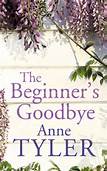 Title: The Beginner’s Goodbye

Author: Anne Tyler
Publisher: Knopf
Genre: Fiction
Length: 198 pages
I have two Anne Tyler books on my bookshelf. I acquired them somehow, possibly gifts or hand-me-downs from someone else. I know I didn’t buy them, because I’ve never felt moved to read them. Perhaps they were freebies I toted home thinking, “I might need these if I start dying from cancer.” It’s morbid, but it is a frequent thought where free books are concerned. I worry that I will be trapped in the house or the hospital without reading material. That must be a phobia of some kind or another, I’m sure of it.
The two books I have are Back When We Were Grown Ups and Digging to America. They sit perched there right after Mark Twain and before John Updike. I almost put them in the garage sale we had this week, but couldn’t bring myself to do it. Something about them makes me want to hold on to them even as I try to decide what to keep and what not to keep during our ‘we might be moving, but aren’t sure’ months.
 This last week at the library, however, I caught a glimpse The Beginner’s Goodbye in the stacks. On the cover is a coffee cup and a dainty tea cup, immediately invoking the idea that two very different companions will be separated and someone will find themselves with a hole in their heart.
There are many covers out for this book, published in 2012, by a Pulitzer prize winner, everyone wants to add their own touch and be associated with it. But this one with the cups, that’s what did it for me – that is what captures the essence of the book in my mind. That’s what conveyed that essence to me from the shelf and prepared me for a mood that I wanted. The other covers are beautiful, but I probably would have gone on forever ignoring them.
Anne Tyler wrote something in The Beginner’s Goodbye that I wish I had written. I suppose I say that fairly frequently, but it is the highest compliment I know how to give. There is much in the reading world I enjoy with all my heart but wouldn’t necessarily long to have my name attached to it. This, is not one of those things, this is lovely and beautiful and gives you a taste of sweet humanity that even the greatest of storytellers seem to miss sometimes.
Appropriately titled and timed for my life, I’m learning to say goodbye to books that I anticipated keeping until my kid was old enough to read and discard them. I might be saying goodbye here soon to my extensive library. Granted, I could get rid of half my books and still have more books than anyone else I know, but sorting through them is hard for me. By checking out this book from the library, Anne Tyler has made it clear that I at least need to read her other two before I give them up – and that when I give them up they should be wrapped and lovingly gifted, not tossed in a garage sale.
An Exact Replica…
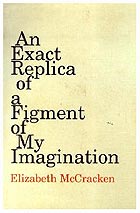 Title:An Exact Replica of a Figment of My Imagination

Author: Elizabeth McCracken
Publisher: Jonathan Cape
Genre: Memoir/Autobiography
Length: 184 pages
I have never felt so awful as a human being as when I sat reading An Exact Replica of a Figment of My Imagination knowing I’d be ‘reviewing’ it for a blog shortly after I finished. How do you justify that in your mind? ‘Reviewing’ something so personal, so devastating, so beautiful, so intense. As an avid reader, a constant reviewer, and one those people who presume to call themselves a writer though I’ve yet to have anything published, I felt like an inconsiderate intruder reading such an intimate account of a loss so great. It’s rare to read something so personal.
As a mother, on the other hand, I wept. I wept, and wept, and wept, for little Pudding. I wept for Elizabeth. I wept for a friend who lost a baby not long after I had my own. I wept for all the things I may have said wrong, all the things I may have not said, and I wept for the selfish joy that my own sweet, precious child was snuggled next to me as I read. I wept for Pudding, I wept for another friend who died, I wept for his mother because even though she had 29 years with him he was still her child, and I wept for the baby cemetery that I pass every time I visit his grave.
I’ve had a writer’s crush on Elizabeth McCracken for sometime. I have an extremely vivid memory of reading A Giant’s House while having lunch with the same friend whose grave I now visit. We devoured deli food, iced tea, and discussed the oddity of a romance between a librarian and child giant. I remember telling him what a strange tale it was, but if I could ever manage to write anything half so interesting I would pee myself with happiness. He promised to read it too, though I’m quite certain he never did because he was in the habit of reading the first thirty or so pages of something and then proclaiming himself an expert on a topic, starting novels and not finishing them, and making half-hearted promises… little things that I tend to hate in people, but for whatever reason found endearing in him. I loved him dearly, and for that reason, I’ve never been quite certain whether my Elizabeth McCracken crush was because Elizabeth McCracken was all that amazing, or if it was because thinking of her always reminds me of him. I cannot think of one without thinking of the other.
Reading An Exact Replica of a Figment of My Imagination, I’m now quite certain that Elizabeth McCracken is that amazing, and deserves adoration outside the realm of Matty memories. She’s a wonderful writer, a fascinating person, has a rockin’ last name, and by sharing this book with the world has proved to me (without ever having met her) that she has a very giving soul.
Elizabeth McCracken, thank you for sharing Pudding’s story. And from the bottom of my heart: I am sorry for your loss.




 Anakalian Whims