Have Child, Plant a Tree, Write a Book
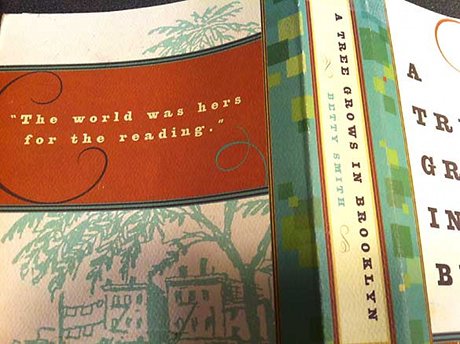
“Then it came to me: Zola had said: ‘To have a child, to plant a tree, to write a book.’ That, he said, was a full life!” – Betty Smith
 What I love about being a book reviewer is the constant discovery of new things. Picking up books I may have never had the opportunity to read, and learning from those books – not how to write better necessarily, but – what kind of writer I want to be.
Book reviewing has also required me to read things more closely, not just the way I would for school, but in a more personal way as well. It’s not just about finding the literary value, it’s not just about liking or not liking, it becomes more and more important to be able to people and my readers why I loved a book. What moved me to passion? What is so relevant about this story to my own life? In doing that, it makes me dig deeper into myself, deeper into my library, and deeper into the art of research.
I’ve slacked off the last few weeks about publishing a literary journal post, but I haven’t stopped reading the literary journals. I meant to write this yesterday, it’s been dancing around in my head the last few weeks as I’ve alternated between picking my way through McSweeney’s issue 18 and researching to see if anything was written about Betty Smith. I’ve been scouring the internet for evidence of things written about A Tree Grows in Brooklyn, or perhaps a long buried article or story she may have had published before infamy. I didn’t know a lot about her, so it’s been an educational endeavor.
I started with what was available in the back of the Harper Perennial Modern Classics edition that I read the book from. The little extras this edition provides are wonderful, including the first piece Smith ever published: a bit of prose called “Winter” when she was 8 years old and still in grade school, under the name Elizabeth Wehner.
I enjoyed reading the article from This Week that she wrote called “Fall in Love With Life.” It’s a beautiful glimpse into her mind and life and what led her to know that she had had a full and marvelous life. It was refreshing to read, after feeling like a failure on most days, knowing I’ve had a child, planted a tree, and written book, changed my outlook on my life at 30.
Of course, the research continued and in my searching I found this: http://web.njit.edu/~cjohnson/tree/context/context.htm
I also found this and am pretty disappointed that I can’t find a copy of “On Discovering Thomas Hardy” anywhere: http://www2.lib.unc.edu/mss/inv/s/Smith,Betty.html
If anyone knows of any publications or articles written on or by Betty Smith, please share. I’d like to discover them too.
To Live And Die By Books
“She never wanted me to save her, only to love her as she was.”
– from The Archivist
The awful truth of it all is that madness isn’t beautiful. But it can be made to sound like it is by literary giants who suffer from it or have had someone close suffer from it. Anyone who has read the works of Sylvia Plath or T.S. Eliot could tell you this. Martha Cooley makes this so utterly clear in The Archivist. Reading Cooley’s work is like coming home.
“Her anger lay just under the surface, and it governed. I was foolish to think I could urge or lead her anywhere.”
If you’ve known or been close to a manic depressive, you know how maddening this can be. You know how frustrating the inability to react properly to anything that goes on in their head. You know how quickly you, too, can be sucked into their reactions and find yourself angry as well. You also know how wonderful is the defense mechanism of diving into a good book or hiding away with your journal and pen.
“People with special powers are frightening to love. That’s why Eliot and Vivienne were doomed by the way – why their marriage was bound to fail. They terrified each other.”
The literary mind finds safe places where it can… inside the pages of books.
“[…]While denial is useful, it has its price. There’s no such thing as identity without history.”
So many quotes from Cooley moved me with their simplicity and truth. They are words that I feel in my bones. “Authentic moral resonance,” Robert Taylor of the Boston Globe called it. Resonance is always felt in my bones, for all their conditioning I am oddly hyper aware of them. They are undeniably tied to my passions – my loves – my needs – my life.
 In 1998, Steven Moore of the Washington Post Book World, wrote: “It is rare and gratifying to read a novel about people who take literature seriously, who practically live and die by books…”
It’s not so rare anymore with the likes of Diane Setterfield, Carlos Ruiz Zafon, and Kate Morton lurking about. These days there is a whole sub-genre of fiction dedicated to it featuring titles like The Secret of Lost Things and The Little Book. My own book is a feeble attempt to honor these authors with a dose of what suited the publishing company at the time. The Bookshop Hotel is a bit of a romance – but one where the main character is quite in love with books and her small town more than in love with another human.
Poets, a marriage, diaries… Possession won awards and became insanely famous. Somehow, however, Cooley’s book got buried once it ceased being a New York Times Bestseller – but it should never be forgotten.
I think I’m drawn to these kinds of books because I always find peoples’ relationships to books telling of what their relationships to people are. Sampling someone’s library is like peering into their soul and seeing where their loyalties lie. Or, if they have loyalties at all.
There’s a quote on page 47 that I find so familiar –
“She had become familiar to me physically as well as intellectually; I knew her dark brows and good coloring, […] the slope of her neck, the slight overbite of her upper teeth. I was familiar with the details, yet she eluded me. Something to do with her motives remained completely beyond my grasp.”
I find this true of many people I’ve encountered. And many books too. You hold them, weigh them in your hands. You lovingly caress their spines. You know their smell, you know what they are saying. You know their stories, their backgrounds, their recurring themes. But you couldn’t begin to comprehend why they are telling you and what motivated them to do so. You’re not always certain what they want you to do with the information. That part belongs tucked away in someone’s secret heart and one can only guess.
“I sat at my desk, staring at the note and struggling to make sense of it. I remember feeling a peculiar detachment – as if I were someone else, trying to unravel a mystery that was captivating but in which I wasn’t personally implicated.”
The Archivist is a must have for any book lovers library, especially for those who live and die by the printed word.
Earth Day Reading With Little People
The Weekly Low Down on Kids Books – selected by The Kiddo
Holiday reading with preschoolers can actually be quite fun. Although most people are doing a lot of Easter books, we’ve spent our focus on nature, enjoying spring, and covering the catechism this week. Easter bunnies and egg hunting a thing on hold for now.

Our daily go to during any season tends to be Cat in the Hat Learning Library
Life Cycles
Because it’s Earth Day season (the actual day is April 22nd, which falls on a Tuesday this year), we’ve been reading up on conservation and organic gardening. Of course, that also means that I’m letting my three year old water my tomatoes and walk in my garden. It’s a learning experience for her and a letting go experience for me.
That’s why the woods being by the house is best for us. It’s where I can really let her go and frolic and be herself.
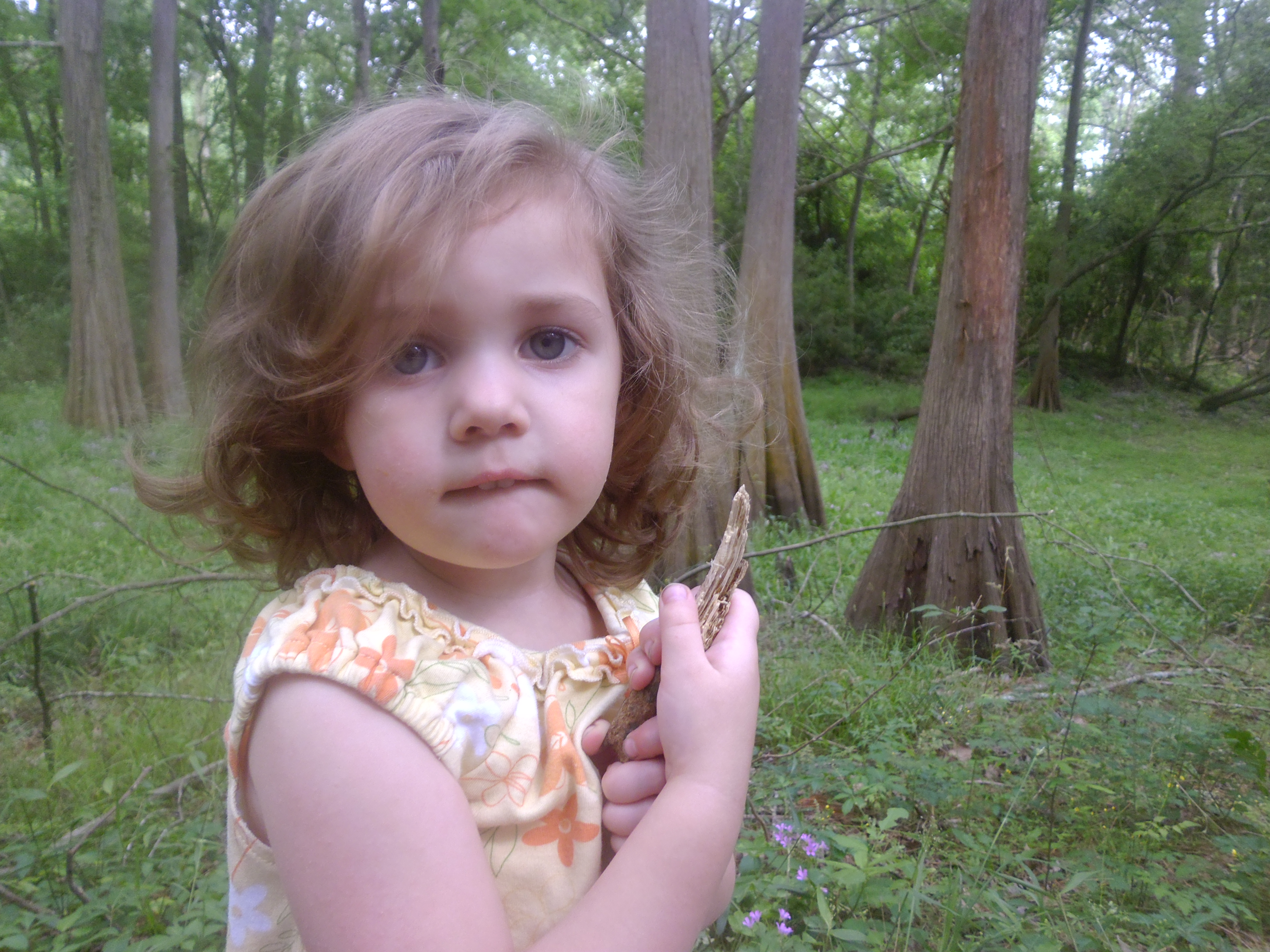
When we get to the open fields she gets to pick as many flowers as she wants.
 Whether you want to make it part of your normal routine or you’re just celebrating Earth Day, check out kiddo’s favorite books and find a good outdoor park this weekend. The fresh air and sunshine is amazing.
GreenGreenerGreenest – Earth Day Every Day Part Five
 Title: Green Greener Greenest
Author: Lori Bongiorno
Publisher: Perigee (Penguin)
Genre: Nature/Organic Living
Length: 310 pages
Written by a journalist and freelance writer, GreenGreenerGreenest is a concise but thorough way to get up to date information and advice on how to handle the green movement in your life.
This is a handy reference book that should be on the shelf of every self-proclaimed hippie, home owner, or human being. Yes, it’s that useful and that important.
There’s so much information out there about how to live an eco-friendly life, and so many opinions on which way is correct. GreenGreenerGreenest takes all the advice, all the information, and categorizes it for you so you can select which option works for your life and budget. It helps people see clear cut options for how to go as green as you can in every area of your existence without shaming you for not being able to do it perfectly in all of them. Sometimes going green is what you can afford, sometimes being greenest is easiest, either way Bongiorno helps clear the red tape of confusion and spells out what is what.
There are a lot of things discussed that I already knew about, things I thought everyone probably knows. But there are twice as many things that I read that I had never given a second thought to. For instance, I had no idea you could get reusable menstrual pads, not sure why it didn’t occur to me, but it didn’t. It’s the greener option. (Green being using chlorine free and chemical free ones made by companies like Seventh Generation.) My response to that was similar to my response to Merriweather of Foraging Texas cooking June bugs for breakfast – I’m not that hippie yet. Bongiorno makes me feel like that’s ok. I can choose a greenest option in another category to make up for it.
Which I do in my house, little did I know. We have ripped out all our carpets and have concrete flooring. Mostly because we’re poor and concrete floors are cheap – your foundation is already there whether you like it or not. I already knew carpets weren’t the best for your health (dust, dust mites, allergens, dirt, overall ick), but I hadn’t thought of it as “green” living. We live with area rugs we can remove from the house to clean. Area rugs last longer and keep you healthier… and apparently is better for the environment as most carpeting is made with petroleum products.
Food and Beverages, Personal Care, Babies and Children, Transportation, and more, Bongiorno covers it all, and provides links and websites when helpful. Love it.

Photograph by Joel Robison
Earth Day Every Day 2014 – Part One
Spring time… the sun is out, the animals are about, it’s time for spring cleaning and for our family to start hitting the trails every day again. It also means April is here, and so my environmental awareness is in high gear. Earth Day and Arbor Day means Earth Day events at the bookstores and local libraries. It also means I start seeing my favorite color (green) plastered all over displays, and books with pretty leafy covers come out of the woodwork. Thus begins the Earth Day reading highlight reel.
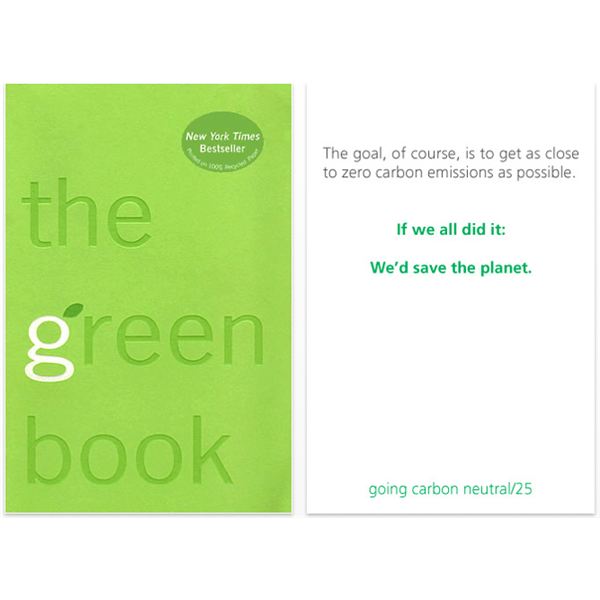 Title: The Green Book
Authors: Elizabeth Rogers and Thomas M. Kostigen
Publisher: Three Rivers Press
Genre: Nature – Environmental Conservation & Protection
Length: 201 pages
This is a handy little book that is easy to read and full of celebrity pep talks for going green. The writers have pointed out a lot of easy to remember ways to readjust your existing lifestyle to recycle more and waste less. I liked it.
It was published in 2007, so some of the information feels a little outdated. It also gets a little repetitive for those who have the ability to apply one concept to multiple aspects of their life, but it’s a good little book nonetheless.
My favorite tidbit from this book – being a cyclist – is this:
“Try to recycle your old bicycle tires and inner tubes instead of throwing them away. You’ll prevent about two pounds of rubber from being landfilled and may help provide materials for a new handbag, a pair of hiking boots, or even a bike path itself. If one in fourteen American cyclists were to recycle his or her bicycle tires each year, the rubber saved could pave the current route of the Tour de France.”
Worth checking out from the library or downloading to an e-reader. The only time I could see wanting a physical copy would be for your child’s library – and even the authors think you should buy these books used.
 This photograph is a Joel Robison piece. I love all his work, it has been awhile since I’ve shared it, though. However, some of his earthy pieces seem extremely appropriate this time of year as we’re reminded to enjoy our world and treat it kindly. Click the image to visit his blog.
Follies Past – A Review
 Title: Follies Past
Author: Melanie Kerr
Publisher: Petticoat Press
Genre: Historical fiction/ Classic spin-off
Length: 272 pages
“Follies Past” should be the name of the file folder for every other Jane Austen spin off, because this book blows them all out of the water.
This is by far the best Austen spin off I’ve had the pleasure of reading. Most Pride & Prejudice sequels or prequels read like fan fiction, but Kerr has managed to construct a novel that reads like one of Austen’s own making. It could very well have been a long lost manuscript of Jane’s, documenting the characters of Pride & Prejudice before they encounter the Bennets.
I was so happy reading this, I’ve always longed to get a bit more of Georgiana’s story. Kerr does an excellent job of taking the small tidbits of information we know about characters and giving them a full and lush back story without straying from our vision of them.
I think Caroline Bingley was truly brought to life as well. I both hate her more and less – how is that possible? Through Darcy’s eyes: “He ought to have known that a lady who is too sparkling and clever is also cunning and insolent and not to be trusted.”
Much is learned from Darcy’s perspective without the act of spelling everything out, something other books have done in diary form turning Darcy into an effeminate sap. Instead, from Kerr, Darcy expresses himself naturally and in his own fashion: “Gibbon’s History is worth an entire library of your sentimental drivel. The depth and breadth of his scholarship paints a picture of the Empire that may never be surpassed. How can you compare such an achievement to your works of vapid sentiment.”
Kerr has stayed true to the characters, true to the time, and yet wielded a rich and elaborate story. It’s beautiful and brilliant, and I cannot imagine an Austen fan who would not love it.
My one criticism is this: I ADORE the front cover of this book – but my first and continuous reaction is that it is not a cover that belongs on *this* book. It’s a fun and awesome piece of art, I’d even hang it on my wall I like it so much, but it doesn’t truly portray what is within the pages.
Below, Miss Golightly is caught on film inspecting Kerr’s book. She had the same reaction I did to the cover, “Oh I love that cover! Wait, her writing sounds like it could be Jane Austen! That’s incredible. I’m a little confused by the cover now.”

Five stars for the story. Five stars for the cover art. But only three stars for matching the cover art to the story.
The Colorado Kid / Haven
 Title: The Colorado Kid
First Edition Release Date: October, 2005
Author: Stephen King
Synopsis taken from stephenking.com:
Vince Teague and Dave Bowie are the sole operators of The Weekly Islander, a small Maine newspaper. Stephanie McCann has been working for them as an intern. When Stephanie asks if they’ve ever come across a real unexplained mystery in the fifty years they’d been publishing the paper, they tell her the story of The Colorado Kid.
I have to be honest, I picked up this book because I have developed an unhealthy obsession for the tv show Haven.
Which, despite being drastically different stories, I like both King’s original story and the tv show spin off, a lot.
There are a lot of complaints on the internet about the show having nothing to do with the book. I wonder what King thinks, actually, because even though there were some definite creative licensees taken, I think the writers of the show have tried to honor the original creator.
In the book, Vince and Dave are not brothers – in the show they are. I’m not sure why that particular route was taken for the show, I don’t think it would have made a big difference to keep their original relationship. I do, however, like their characters’ dynamic in the show. And I adore the actors who play them.
The book focuses on the intern, Stephanie, who is asking Vince and Dave questions regarding the biggest mystery in Hammock Beach. In Haven, Audrey Parker (FBI) has come to town to investigate a different murder. Absurdly different, until you dive deeper into the show where you find that Audrey’s entire reason for being in Haven (or Hammock Beach, as it is called in the novel) has everything to do with the 1980’s mystery of The Colorado Kid.
If you have the patience to really get into the show, you’ll find that the show and the book have this main common thread:
In 1980 an unidentified body is found on a beach in Maine, wearing gray slacks, and a white shirt. No one seems to know who he is, or how he got to be there, but he is dubbed The Colorado Kid.

King’s book allows this mystery to mostly go unsolved, as Dave Sturm wrote in 2009:
“[…] King has written a meditation on stories by telling one that heads to a letdown, because the central mystery — SPOILER: How did the body of a Coloradan end up dead on a Maine beach just hours after he disappeared from Colorado???: END SPOILER — is left a mystery at the end.
King has violated a central tenet inherent in Hard Case Crime. The story has no plausible resolution.”
by Dave Sturm
Rambles.NET
8 August 2009
The point of the book is the beauty of things that are mysterious, how one answer unveils another question – at least that’s what I got out of it. The book also leaves itself wide open to becoming a set of mysteries that must be solve to explain the existence and death of this strange man on a beach, which the tv show honors.
So, in Haven, every answer Audrey Parker uncovers in the show leads to another series of questions. The show has one magical quality – it’s entire existence is someone’s creative answer to King’s unsolved mystery. By the fourth season, you may start to catch my drift. I am still patiently waiting for season five to get uploaded to Netflix.
In short, I adore the show and I loved the book. I read the first 137 pages of the book during my one hour lunch break. I read the rest of the book as soon as I completed my work. One thing that I missed doing, however, was read King’s afterward. I was in a hurry to get home, but couldn’t go without finishing the story – but putting all my thoughts in review here I wish I had taken the extra moments to read what he had to say about his own work.

Housman for Kids
 A Weekly Low Down on Kids Books
Title: A Shropshire Lad
Author: A. E. Housman
Illustrator: Charles Mozley
Genre: Poetry
In February I stumbled across A.E. Housman. Between the state of my soul, the weather, and Housman’s poetry, I found a little hub of safety. In the words of my best friend, “Where has he been all our lives?”
Apparently everywhere.
Even in kid’s books, of all places.

The book I found is a $10 hardback from Good Books in the Woods. It’s a hardback. It was printed in 1968, and the style of binding, as well as the illustrations, reflect that. To me, it’s the perfect edition to have floating around the house for your kiddo to discover and flip through as early readers. Same classic poetry with a much different kid friendly feel.

Literary Journal Monday – The Black Cat
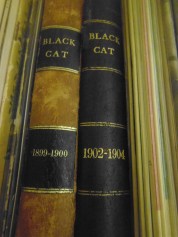 It may have been a whole week since my last post, but the discovery I made today has made the whole week of dry reading worth it. In fact, what I discovered today at Good Books in the Woods made this entire series of Literary Journal Mondays worth it.
Today I found The Black Cat.
Tucked away, just two hardbound volumes (collections of the actual magazine), hidden in the Literary Journal room.
It was a beautiful, thrilling moment, opening the jacket to a random page and finding this:
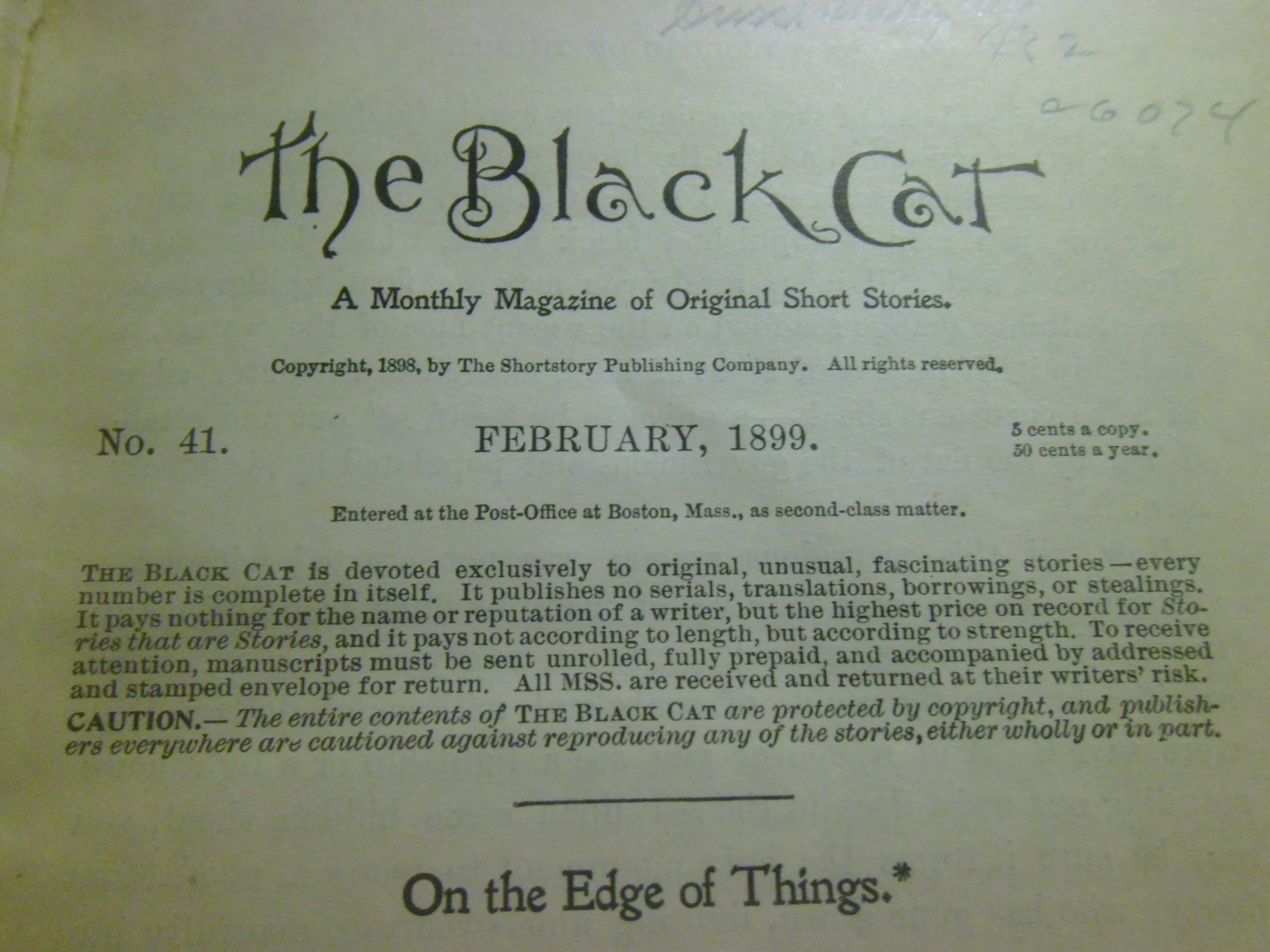
“The Black Cat” is a short story by Edgar Allen Poe, originally published in The Saturday Evening Post in 1843 – it was a horror piece about a murderer similar to The Tell-Tale Heart. It’s no wonder that in 1895, a literary journal called The Black Cat was born, dedicating itself to short stories of an “unusual nature.” Of course, I don’t know for sure that the founders of The Black Cat were referencing Poe, but I can’t help but jump to that conclusion. It’s something I would do.
The original m agazine covers varied from month to month, like most magazine covers do, but they all have a spunky contemporary Gothic look that I imagine was hard for people to pass up. The publication ran until 1922 and featured some surprising contributors. Rupert Hughes, Susan Glaspell, Ellis Parker Butler, Alice Hegan Rice, Holman Day, Rex Stout, O. Henry, Charles Edward Barns, and Octavus Roy Cohen all made appearances in the journal. For Jack London collectors it has become a bit of marvelous legend, as London attributed his “A Thousand Deaths” story being printed there to saving his life. They paid him when no one else would, and when he really needed the cash. London is quoted having said, “literally and literarily I was saved.”

It is so coveted by collectors that the original edition featuring London sells at auction for more than the above hardbound books go for in antiquities stores.

Were I a millionaire, I would not hesitate to buy them all up. Standing in the store today I remembered Nicholas Basbaines’ A Gentle Madness as I salivated over the two collectibles on the shelf. This is true beauty, I thought, this in my hand.
I read Jack London’s contribution, it is only a few pages, then continued to snap photos as I carefully turned the pages, my eyes thirsty for old fonts and typesetting.



 Anakalian Whims
People Aren’t Who They Say They Are
April 12, 2014 at 1:42 am (Reviews) (A Tree Grows in Brooklyn, Betty Smith, books, Francie Nolan, Johnny Nolan, liars, literary criticism, people, reviews, social commentary)
The most offhand statement, the smallest turn of phrase, a random word, can completely start my mind reeling for hours, days even.
A friend said to me, about nothing and no one in particular, “People aren’t who they say they are,” and I couldn’t stop thinking about it. As much as I try to let things roll off my back, I internalize and mull over everything and this statement today relates so well to a piece of fiction I started long ago. In addition to that, about a dozen short story ideas popped into my head from the one phrase.
The thought that won’t leave me, though, is not that people lie, it’s that people don’t think they’re lying. People aren’t who they say they are, but they are only capable of telling you who they think they are.
I can only tell the truth as I see it. I can only tell you what’s in my head, not what you perceive of my actions. Isn’t this why people read novels? In third person omniscient you get everyone’s version of the truth – and how very different it can look.
The Ugly Duckling kept telling everyone he was a duck, but in reality he was a swan. He wasn’t who he said he was, but he was saying who he thought he was.
Along this line of thought, many novels and their characters come to mind: The Great Gatsby, The Fountainhead, the Harry Potter series, The Poisonwood Bible, and many, many more. But currently, what is most fresh in my mind is A Tree Grows in Brooklyn.
Francie’s father, Johnny is a talented, sweet, and incredibly handsome, alcoholic. He dreams and wastes away while his wife takes care of the family. He knows he’s a drunk, he thinks he’s useless and has nothing to offer, and his wife comes to a point where she believes this as well. Afterall, he has let her down over and over again with his failures. The only thing he seems to manage is to sing well and entertain his neighbors and friends.
Though he’s not conventionally a good man of the house, and is an awful care giver when it comes to providing food and rent money, but when it comes down to the children’s emotional needs he is there where his wife is not.
Francie’s mother admittedly doesn’t love Francie as much as she loves the son, Neeley. Francie’s mother sends the children to get their inoculations alone – the young kids were terrified and had no loving support from their mom. But she loves them best, right? She cares for them, keeps a roof over their head, and keeps them fed.
Clearly, both parents love their children the best they know how, that much is evident in the novel, but both parents are also not who they say they are – but they say exactly what they think they are.
Johnny meant what he said when he told Katie he would love her forever, that she was the one for him. He didn’t realize when he said it that he wouldn’t know what to do with himself once he became a father of two at age 20. He didn’t know what he was made of yet, or what he wasn’t made of.
A man like Johnny is a great babysitter, the best man to have on a family vacation, a little girl’s knight in shining armor. He will walk her to school, help her get into the school of her choice, because he’s a dreamer and by God he will teach his daughter that her dreams are relevant and important.
Johnny thinks he’s the worst father. He is dejected by his inability to hold down a job other than one as a singer/waiter, singing and bringing food and drinks for tips. He’s Caractacus Potts (Dick Van Dyke) in “Chitty Chitty Bang Bang” had the man never managed to invent something and find Truly Scrumptious. [Completely random side note: Did you know “Chitty Chitty Bang Bang” was based on an Ian Fleming story (the author of the James Bond novels)?] An airheaded dreamer, but ultimately a good person with a big heart.
In Francie’s eyes, Johnny isn’t who he says he is – or even who other people say he is – but everyone says who they think he is, including himself.
Maybe if Johnny hadn’t started to believe that he had to be so ashamed, he wouldn’t have had so much to be ashamed of. Maybe if he’d let go of some of those bad thoughts and acted on the dreamy happy ones, life would have been better for everyone. The character of Johnny Nolan is a complete disappointment to everyone. I haven’t finished the book, yet. I’m not sure how it all turns out, but I do know one thing: Johnny may be a disappointment, but he isn’t useless no matter how much he thinks and says it. He isn’t who he says is his, but he definitely says what he thinks he is.
Obviously, that’s probably a reverse scenario than what is typical of that statement. Most people present themselves as better than what they are, I think. But unless you’ve been utterly broken, it’s highly likely that you think you’re better at things – at life – then others will believe or know.
Maybe it’s because they don’t see every aspect of your life, maybe it’s because you’ve had to shield yourself from truths that hurt too much, maybe you’re a little delusional, but I believe less and less that the majority of humanity is blatantly lying with purpose. The people I have met who do, are manipulative and underhanded and typically have large groups of people fooled, but these people are few.
Then again, maybe I see the world through rose colored lenses. Maybe Johnny Nolan is a useless piece of crap of a human, and I just only see the good in fictional characters. Sort of a difficult idea to embrace from such a self-proclaimed skeptic. And maybe this is the worst piece of literary criticism and character analysis ever to come out of someone who pretends to understand literature so well. But as we know, people aren’t who they say they are.
Permalink 2 Comments