Jane Austen’s Use of Satire In Northanger Abbey
by: A.Z.K.R., from Tales of Porcelain Thrones: Middle School Edition
Jane Austen was an author in Regency Era England. She wrote satirical novels and enjoyed mocking the frivolities of English society and “the Novel” itself. Satire as defined by Webster’s New Word Dictionary is a literary work in which vices and follies are held up to ridicule, satire doesn’t have to be funny, but Austen’s work definitely is.
Jane Austen was born nine months after the beginning of The American Revolution, she had several brothers, and one sister (Leithart 1). Austen was an avid reader and loved novels, but she still found them a little ridiculous. Austen wanted her books to reflect the real world, showing real dangers. Instead of writing about bandits and murderers, Jane’s villains included liars and social climbers. Jane Austen was fighting against stereotypical heroines, bizarre and dangerous social expectations, and the problems of treating novels like real life. Yet, ironically, Jane Austen’s novels were realistic, which was sort of the point. Jane Austen wrote about real problems in a funny way. Even for someone who does not live in Regency Era England, Austen’s characters represent real types of people and can help give young women the wherewithal to avoid the Big Bad Wolves (John Thorps) of the world and find their very own Prince Charming (Henry Tilney).
Austen starts her book Northanger Abbey with a mockery of a novel’s heroine. Austen does this by describing her heroine, Catherine Morland, as normal, and “almost pretty,” emphasizing her normality by saying her family was neither rich nor poor, her father was a clergyman, neither of her parents were abusive, and her mother was—unfortunately—alive. Catherine loves reading novels, but not history books. These are all in direct contrast to the kinds of heroines Catherine herself reads about over the course of the book, stories such as Ann Radcliffe’s The Mysteries of Udolpho where the heroine, Emily St. Aubert, is beautiful, orphaned, and well versed in the arts. Catherine’s neighbors, the Allens, a childless couple of some fortune, decide to take sixteen year old Catherine to Bath. Bath is a tourist destination in England, complete with spas, parties, and shopping centers, which served many as a ‘coming out’ excursion (Cunliffe 41). Austen was able to write about Bath well because she lived there. Even while making fun of novels, Austen used some of their troops to her advantage, such as having a relative or family friend taking a young heroine on a coming out trip.
In English society one couldn’t just walk up to someone and talk to them, you had to be introduced by someone you already knew, forcing everyone to rely on family, family friends, other acquaintances, or the master of ceremonies. At Catherine’s first ball Mrs. Allen laments constantly that they don’t know anyone of consequence, while Catherine wishes they knew anyone at all (Austen 30).
At Catherine’s second ball, the master of ceremonies introduces her to Henry Tilney. Halfway through a conversation that they were having, Tilney interrupts by saying, “I hitherto have been very remiss, madam, in the proper attentions of a partner here; I have not yet asked you how long you have been in Bath.” Jane Austen mocks polite society through Henry Tilney’s comical performance of asking Catherine all the ‘right’ questions, such as ‘how long have you been in Bath,’ ‘do you enjoy Bath,’ ‘Is this your first ball,’ et cetera. Tilney, although he thinks society is silly, still follows its rules, and remains a respectable young man.
Jane Austen uses Catherine’s naivety to point out how unspoken rules can be extremely problematic, and even dangerous. The real dangers of society were people like the Thorps, social climbers and narcissists, who used these unspoken expectations to put other people in sticky situations. The Thorps, through a series of blunders, suppose that the Morlands have lots of money. They had already met Catherine’s older brother, James, at Oxford. Upon meeting Catherine with Mrs. Allen, they supposed that she would receive the Allen’s fortune due to the kind way the childless Allens were treating her. They catch their mistake when Isabella Thorp becomes engaged to James Morland and she receives a letter about James’s future income, one that sounds reasonable to the Morlands, but is disappointing to the gold digging Thorps. Isabella attempts to break off the engagement to run off with Henry Tilney’s older brother, Captain Frederick Tilney, but this proves to be her downfall. Captain Tilney, unlike his brother, is a rake, he doesn’t care about any of societies rules, and breaks the social customs that were actually worth keeping.
Because the Thorps thought Catherine so rich, and John Thorp planned to marry her, and they gossiped about her wealth in order to make themselves look better. At a theater, they brag to General Tilney, Henry’s father, who then wished to have Catherine married to his son. In order to empress her he invites her to stay at his home, Northanger Abbey for a holiday. Catherine is naive and unaware of the Thorps deceptions until she receives a letter from her brother explaining Isabella’s behavior. She is totally unaware that money is the reason General Tilney is interested in her alliance. Henry however is aware that his father cares a great deal about money, and isn’t sure why he is interested in having Catherine for a daughter-in-law. With these events Jane Austen is showing us the true the ‘villains’ of society, and how Catherine was totally oblivious to their presence. She was so caught up in the idea of bandits and mysterious murderers that she could not see the danger at the end of her nose.
‘The Novel’ becomes increasingly important in this part of the story, as it leads to Catherine’s embarrassment several times over the course of her stay at Northanger Abbey. Catherine’s preconceived notions about abbeys, established while reading gothic romances, leads her to disappointment when discovering modern renovations inside the home of her hosts. She fails to find secret passages, or incriminating letters, as the heroine Adeline did in Radcliffe’s Romance of the Forest, in her guest room and, worst of all it leads to a terrible confusion regarding the cause of Henry’s mother’s death. General Tilney is harsh, but not villainous. He takes good care of his servants and his estate, hence the renovations. He wants his children to marry well, thus his interest in Catherine’s supposed inheritance. General Tilney’s stony demeanor, combined with Catherine’s overconfidence in the reality of novels, leads her to make the worst of blunders: she makes assumptions. She speaks briefly to Miss Tilney, Henry’s sister, and finds she was not at home when her mother died, leading Catherine to assume no one was at home when Mrs. Tilney died. Catherine suspects foul play. Her blunder is discovered when she sneaks into Mrs. Tilney’s old room and is discovered by Henry. When she admits her thoughts, he admonishes her. He and his brother had been home when his mother had died, and she had perished of sickness rather than ill treatment. General Tilney’s behavior had nothing to do with skeletons in a closet. Catherine’s gothic fantasies stop here; she has learned and grown. The dangers are not ended, though.
The Thorps, angry due to their hurt pride, speak to General Tilney again and tell him not only that the Morlands are not rich, but that they were exceedingly poor, projecting their own flaws onto Catherine. General Tilney, in a rage, comes home and sends Catherine off in the middle of the night without a chaperone or money. The situation is quite unforgivable, but Catherine doesn’t yet understand and cannot fathom what she has done to displease General Tilney. Henry later comes to her house to explain and offer his hand in marriage, not just because he loves her, but because he feels responsible due to his father’s behavior. General Tilney, of course, does not approve.
Jane Austen, for all her realism, never leaves her stories with sad endings. Henry’s sister, previously forbidden, marries the man she loves, and by a novel twist of fate, now financially outranks her father. She demands that General Tilney allow Catherine and Henry to marry, and her will is done. Jane Austen defends the ending of her own book, at the beginning of the story, while talking about novels in chapter five. “For I will not adopt that ungenerous and impolitic custom so common to with novel-writers, of degrading by their contemptuous censure the very performances, to the number of which they are themselves adding— joining with their greatest enemies in bestowing the harshest epithets on such works, and scarcely ever permitting them to be read by their own heroine, who, if she accidentally take up a novel, is sure to turn over its insipid pages with disgust. Alas!” (Austen 42) Jane Austen is talking about Catherine’s own habit of consuming dramatic stories, but she’s also explaining here, that despite her book calling out the faults in these stories, its still a novel its self.
The story is funny, you can’t help but laugh when Catherine finds not evidence of murder, but instead laundry receipts in the cabinet. This is not was makes it satire however, Jane Austen books are satire because of exactly how it is funny: elements of the story mock society, and express its difficulties, she’s calling to attention problems regarding expectations when they are appropriate and when they are silly. We’re lucky to have Jane Austen doing this is a humorous manner as opposed to long dry articles listing the problems of society like a grocery list. Not all satire is presented in a comical fashion, but a point is better made when it provokes some kind of emotion, either anguish, or in Jane Austen’s case, joy.
Works Cited
Austen, Jane. Northanger Abbey. Signet Classic, 1996.
Cunliffe, Barry. The Roman Baths at Bath: Authorized Guide Book. Bath Archeological Trust, 1993.
Leithart, Peter. Jane Austen. Thomas Nelson, 2009.
Radcliffe, Ann. The Mysteries of Udolpho. Penguin Books, 2001.
Radcliffe, Ann. The Romance of the Forest. Oxford University Press, 1988.
Justified
Title: Ape and Essence
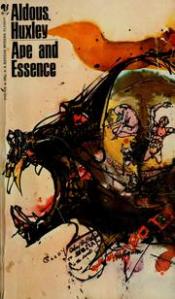 Author: Aldous Huxley
Genre: Fiction/ Literature/ Allegory
Length: 152 pages
Of the four Aldous Huxley books included on the 1001 Books You Must Read Before You Die list, is not one of them.
With good reason.
While I was reading I kept thinking, I like the concept, but I am aghast that this is the man famous for a book that millions are required to read for school. Not because there is anything bad about it… it’s just… really? This is the kind of stuff we want to force teenagers to read? It’s disjointed, surly, and… dare I say… a little boring.
The best moment, by far, was when I read:
‘Give back that ring.’
‘Which ring?’ the man falters.
At which point my nerdy self said to my book: “The one that will rule them all, duh!”
To be fair, the book that is typically required reading for students is Brave New World, not Ape and Essence. So, naturally, I had to do a bit of research before considering reading Brave New World, giving Huxley a chance to prove himself in my eyes. If I can’t stomach 152 pages of the man, why would I submit myself to more?
I feel justified in my disappointment, because as my kid sat and worked through a literacy program on the computer at the library, I consulted the Concise Dictionary of Literary Biography: Volume 6: Modern Writers 1914-1945, and read up on Huxley and this piece of drivel I had just plowed through.
There I read, “Aldous strained to pile horror upon cross horror… the book, it always seemed to me, achieves a high degree of unbearableness.”
There I also read, “most the characters and ideas come from a discount Huxley warehouse.”
Deep sigh of exasperated relief. I don’t have to like this book. Thank God.
Mikhaul Bakhtin described Huxley’s work as the “Canivalesque Novel.” Others in this category would be Rabelais’ Gargantua and Cervantes Don Quixote. These novels are known for “emphasizing inclusion rather than selection” and are “structured like a ‘plate of mixed fruit.’” They are known as the anti-novel.
Sheldon Sacks, on the other hand, considered Huxley’s work as apolgoues, like More’s Utopia, Voltaire’s Candide, and Johnson’s Rasselas… fictions structured as persuasive arguments. (For the record, I am basically paraphrasing – and point blank quoting – the CDBLB!)
The title for Ape and Essence was taken from Shakespeare’s Measure for Measure, when Isabella says:
Could great men thunder
As Jove himself does, Jove would ne’er be quiet,
A sFor every pelting, petty officer
Would use his heaven for thunder;
Nothing but thunder! Merciful Heaven,
Thou rather with thy sharp and sulphurous bolt
Split’st the unwedgeable and gnarled oak
Than the soft myrtle: but man, proud man,
Drest in a little brief authority,
Most ignorant of what he’s most assured,
His glassy essence, like an angry ape,
Plays such fantastic tricks before high heaven
As make the angels weep; who, with our spleens,
Would all themselves laugh mortal.
Again, I have not read Brave New World, but I come away with the overpowering sense that perhaps it is easier to digest because, like the CDBLB says, Brave New World is about what could happen; Ape and Essence is presented as something that probably will. Ape and Essence leaves you with nothing to hope for, and in a world full of agony – hope is vital. The whole book is about how “faith in progress has led to outright regression,” and the book ends with an egg being cracked over a gravestone.
A society so driven by perfection and stamping out rebellion and evil that they have destroyed everything. They do not have the hope and insight of Steinbeck when he wrote in East of Eden, “And now that you don’t have to be perfect, you can be good.” Instead, everyone strives for perfection until they’ve essentially destroyed themselves and everything around them. They’ve destroyed the world’s ability to think and grow.
Ape and Essence is the most depressing piece of near-satire I’ve ever encountered.
The man himself, however, had some awesome things to say on the nature of writing. Many people read his novels and were irritated by finding mirror images within some of his characters. After a few lost friends he responded,
“Of course I base my characters partly on people I know – one can’t escape it – but fictional characters are oversimplified; they’re much less complex than the people one knows. There is something of (John Middleton) Murry in several of my characters, but I wouldn’t say I’d put Murry in a book.”
I could not say it better myself. Characters may seem a bit like this person or that, but never, never is any fiction that I write in any way biographical. So even though I did not care for Ape and Essence, I came away from researching Huxley fulfilled – and justified.






 Anakalian Whims
Happy Birthday Pride & Prejudice
January 28, 2013 at 11:24 pm (Reviews) (200 Year Anniversary, book to movie, books, happy birthday, illustrations, jane austen, Pride and Prejudice, review, romance, satire, social commentary)
“[…] Jane Austen is the greatest writer ever – because she was the first storyteller to make me care about an old-fashioned love story.”
– Adam Jones
I have to say, I think Jane Austen is one of the greatest writers ever, but not because she was the first to make me care about old-fashioned love stories. I always liked those.
In fact, the first time I read Pride & Prejudice I was too young to catch all the subtle things that make Austen great, I think. I read the book because I thought Emma was funny. It’s easier to recognize the humor in Emma, P&P takes a few more reading years under your belt. At least it did for me.
What is so awesome about Jane Austen is that shallow readers may enjoy the romantic notions of it all (hence loving the books in elementary school when I was devouring them along side Anne of Green Gables) and still have more to offer as you age. The greatest of writers can be enjoyed by the young and reveal themselves over time with multiple readings. I think I was twelve or thirteen before I realized that most of Austen’s work is pure satire and subtle hilarity.
Even though I adore the Bronte sisters, the mastery of language and social fantasy Pollock talks about is what makes Austen’s work accessible to a much wider audience. Wuthering Heights is all dark secrets and emotion, whereas Pride & Prejudice is social commentary, comedy, romance, and more.
Look at Darcy, the most introverted socially awkward geek of all time. The only reason he is considered desirable by such a wide array of women is because he has money and a pretty face. Without those two things, he would be Sheldon Cooper of The Big Bang Theory. At least, that’s how I read him. Apparently, I’m not the only one or the movie made in 2005 starring Keira Knightley would have been a bit exasperating. Instead, it has become a favorite on rainy sick days.
So Happy 200th Birthday Pride & Prejudice and well done, Jane.
Permalink Leave a Comment