Hard Roads to Cultural Literacy
In May of 2019, I read a book called Hard Road West: History and Geology Along the Gold Rush Trail by Keith Heyer Meldahl. I remember it being riveting. When I logged it on Goodreads all I wrote was, “Excellent and fascinating.” I was dating my now husband at the time and I remember sharing with him sections I thought he would enjoy, as we both like geology and one of our dates was to the HMNS gemstone exhibit. At one point I laughed out loud at something clever Meldahl wrote (I don’t recall what it was) and my husband commented that it is a rare geology book that causes one to laugh in pleasure.
Naturally, I thought this would make excellent assigned reading for my homeschooled highschooler. But one chapter into it she was struggling. It wasn’t the reading level, she has a collegiate reading level and has had one for a few years now. I was certain it couldn’t be the science as she had been perusing geology books since childhood and had done a whole geology curriculum with a friend as part of their own little science club they created. Nerds. I went over the science with her and she kept reading. It became less of a struggle, but she is not laughing out loud with pleasure from her geology book.
Then I started reading Cultural Literacy by E. D. Hirsch and things became clearer. In Cultural Literacy Hirsch talks about a study done on the results of seven year olds who took a reading assessment test. In the test the children were asked to read a story about a spider. The children who had more prior knowledge about spiders scored higher on the reading comprehension questions about the story (which did not require special knowledge about spiders) than those who did not know much about spiders.
I shared this with my oldest daughter, as we often study together while the younger kids are playing. We discussed it and determined that it makes sense to not get hung up on something being mentioned in passing because you already know a lot on a topic and can picture it in your mind with little effort, but to struggle to retain what something is about if it mentions a lot of things you’re trying to picture because you’re not as familiar with them. Perhaps it is easier to envision Charlotte in Charlotte’s Web if as a child you also have watched a real spider build its web, perhaps it is easier to remember the story if you’ve seen or read about how baby spiders hatch. Or, if you’ve had Charlotte’s Web read to you as a child, maybe a technical book on pig husbandry would be easier to retain as an adult. Hirsch includes an example of college students reading a paragraph about Ulysses S. Grant and Robert E. Lee and struggling because they had no prior knowledge of who they were and how they related to the Civil War (shocking because these were college students out of Virginia).
I was reminded about a public schooled girl I was working with who had failed her reading portion on her standardized tests. Her phonics were impeccable, but where she struggled was comprehension. When I worked with her, almost every time she struggled to read something it was because she had never heard the word. She didn’t have the vocabulary to support her phonics skills. I advised the family to listen to audiobooks, read stories together at night, talk to each other more, look words up in the dictionary. Children learn the meanings of words by hearing them, then when they see them on paper for the first time while sounding it out… they have a picture in their mind of what that word means, feels like, or how it can be used in different sentences. Kids should always have access to stories above their reading level, so that they can learn grammar structures and vocabulary words organically. Hirsch drives home the idea that you can know how to read and still be illiterate if you don’t know anything about what you’re reading.
I told my daughter how this was interesting to me because my husband had said he thought she didn’t know enough geology to read Hard Road West smoothly, even though I thought it was a very approachable book and that she had a strong foundation in geology. She and I laughed over the time a volunteer at the museum asked her what a specific rock smelled like and the big reveal fell flat when she answered, “Sulfur.” Poor guy deflated and said, “Yes, it’s Sulfur. You must be homeschooled.” Apparently the public school kids her age on field trips liked to shout “Farts!” She was about seven at the time and it is one of her favorite museum memories. (I’m not going to lie, even if I knew it was sulfur at seven, I’d probably have shouted “Farts!” too, but I went to public school.)
“So, why, if you’ve read all the same geology books we read as children, is this geology book difficult? Because I genuinely don’t think it would have been difficult for me at fifteen.” That is when she confessed that the geology books we owned and had spent hours reading… she hadn’t actually been reading them: “I was looking at the pretty rocks. I could tell you the page numbers where all my favorite rocks are, all the prettiest ones, I didn’t read all the stuff…” We genuinely laughed together, two wildly different personalities approaching children’s geology books in wildly different ways. As Charlotte Mason said, “Children are born persons.” But for every moment, like this geology one where she struggles because maybe she didn’t pay as much attention to what was put before her in the past, she has so many where she shines. She catches every Shakespeare reference. Every time. (Hirsch writes a bit about how Shakespeare allusions used to be quite common in all kinds of writing, including business memos, but as of the publication of his book in 1987, that was no longer the case.)
Hirsch’s argument for cultural literacy was never meant to be for homeschool parents to refine the presentation of their educational feasts, his goal is educational reform in the public sector. There is extensive discussion in his book about the struggle to properly regulate education in that if you mandate that schools teach at least two Shakespeare plays there will always be arguments about which two should be selected and that no two districts will choose the same two, therefore knowing who Shakespeare is might be universal, but catching Shakespeare references will vary. (I vote for all the Shakespeare. Every play! All the sonnets!) But I did feel like Hirsch’s essay very much affirmed the education I am providing. Maybe my oldest gets a little bogged down in this particular geology book, but to be fair, it could easily be assigned in a college course, most high school students wouldn’t be reading it between their Homer and Geometry lessons. The paragraph that boggled the minds of the Virginian community college students in the 1980s didn’t phase her, and for that I have hope.
Additional affirmation came when I realized I had owned other books by Hirsch in the past. He’s the one that wrote the series Everything Your ___Grader Needs to Know. My first two years of formal homeschooling (first and second grade), I had read those books out loud the last month of the traditional school year to see if we were covering everything. What I learned was reading those books out loud was a waste of time because a classical Charlotte Mason education is thorough and she not only knew what she needed, but she knew richer versions than the sad paragraphs presented. That was the final nail in the coffin on us ever relying on textbooks. Cultural literacy can be gained from textbooks, but it’s boring and far less effective. The better road to true literacy, in my opinion, is living books. I donated Hirsch’s other books, but I’m keeping Cultural Literacy.
One whole day after finishing Cultural Literacy, I went to our local library to donate a bag of books I was purging from my collection. There on the shelf next to the library bookstore register was E. D. Hirsch’s Dictionary of Cultural Literacy, a compilation of all the things the average American graduate should know, for $2. Of course I bought it.
“Also unrealistic is the pragmatist emphasis on individuality, at least as the idea has been institutionalized. The best teaching does accommodate itself to individual differences in temperament, but a child’s temperament does not come freighted with content. To learn a culture is natural to human beings. Children can express individuality only in relation to the traditions of their society, which they have to learn. The greatest human individuality is developed in response to a tradition, not in response to disorderly uncertain, and fragmented education. Americans in their teens and twenties who were brought up under individualistic theories are not less conventional than their predecessors, only less literate, less able to express their individuality.” – E. D. Hirsch, Cultural Literacy, pg. 126.
Homeschooling Chemistry and Physics
This year at Atrium (my kiddo’s co-op), I’ve been teaching science with a bit more purpose than I did last year. Last year consisted of a lot of impromptu science articles and activities… when we were studying the bubonic plague in history, I covered fleas on rats, the plague, what modern day scientists said about it, and played a song from YouTube about it set to the tune of Hollaback Girl. In the spring we covered lots of random pollinator things, talked about bees and butterflies and the anatomy of a flower. We did black out poetry over articles I had printed. At some point in the year, I brought roly polies and we talked about crustaceans and literally played with bugs in the driveway. We made terrariums. It was a hodge-podge of whetting the group’s appetite for the idea of studying science seriously, but was mostly exactly what you’d expect homeschool science to be: nature studies, crafts, songs, and critters.
The 2020-21 school year I was determined to do different—to do better.
Naturally, I started teaching what I consider the most difficult science of all the sciences: Chemistry & Physics. To a group of children that range between 5 and 13.
If you’re going to get serious about science, the studies of matter and energy are the way to go, right? Every time I prep for class I’m two parts terrified and one part giddy.
But today, I realized, I’m not failing them. And more than that, they seem to be enjoying themselves.
In our first two lessons, we covered matter. We talked about properties and how scientists use properties to describe matter. I started by describing that matter is anything that has volume and mass, but to say that then I had to describe what volume and mass are. I sent them home with a white bread recipe. One of the fourth graders actually baked it over the weekend and was able to tell me all about how cool it was that the same ingredients can create something with a different amount of volume. I was so pleased. If only this one child understood volume because of a white bread recipe, then I felt I was already winning.
During that same first lesson I taught them about displacement and was delighted when my classically educated group of kids were able to participate in a retelling of Archimedes and the Goldsmith. Several kids shouted “Eureka!” along with me. If I wasn’t already sold on the trivium, that moment would have done it.
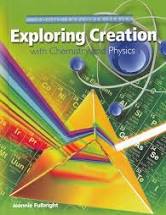
Density was when it got really fun. In Exploring Creation with Chemistry and Physics I found a lab with salt, water, two eggs, and two cups. Fill both cups with water about halfway. Dissolve a quarter cup of salt into one of the glasses. Have the kids announce their hypothesis on what might happen, then drop the eggs in their own glass. The egg in the salt water will float because the water is more dense than the egg when there is salt there, but the egg in the regular water will sink because the egg has more density. One of the kids was convinced it was because one of the eggs was bad and one of them was good, so another mom swapped them. The experiment won out!
After that we talked about buoyancy and made aluminum boats. (This lab was also found in Fulbright’s textbook.) Everyone had brought a casserole pan where we had blue dyed salt water and pennies sprinkled at the bottom of each. The goal was to make a boat that could float the most pennies without sinking. The kids loved playing pirates and stole each other’s pennies a lot in a spirit of imagination and fun. Our best ship held 176 pennies. Runner up had 173 before the ship started taking water. The take away: surface area helps.
On day two, the following week, we talked a lot about gold versus pyrite, how luster and hardness helps you identify matter.

The kiddo and I made playdough the day before and at the start of the lesson I put pieces of tree limbs, various garden and river rocks, aluminum foil, and the play dough out on the table. There were plenty of sensory aids for everyone to have their hands on something. Nearly everyone squished play dough in their hands for the duration of the lesson, which I thought was perfect as it helped explain the concept of malleability to the littlest ones and kept hands busy so their brains could focus.
My new, very involved husband sent me to class with a giant magnet and we also discussed how magnetism can help you identify different materials. Everyone got a turn choosing a piece of junk I’d collected from around the house to try against the magnet.
Finally we wrapped up the day with a Mel Science Lab. I’m obsessed with our subscription and it was pretty cool seeing the kids get to do a more intense lab. I had the oldest kids in the group do work, two boiled water and we talked about the “rapid vaporization of a liquid using heat” because I love defining things while two others mixed up the chemicals and dropped in the pyrite samples. Fifteen minutes later, we had a small sample of Prussian Blue!
All in all, I’m pretty pleased how our class is going and I can’t wait to map out next week’s adventure. Because of the broad age range of kids and the desire to keep them all engaged and learning, I’m trying to maintain at least one craft oriented activity, some sensory aids, and a Mel Science Lab per gathering. If you have any ideas or advice, please leave a comment, I’d love to hear from the more experienced.
Education is a Lifetime Pursuit
“Education is a lifetime pursuit.” I tell my daughter this constantly. It is our household motto, so much so, I would not doubt if I had already posted something with the same title before. I even hope that my readers already have read this phrase.
I am a homeschool mother. I am, in the deepest parts of my soul, a teacher. I always have been, and have been overzealous about it since I discovered the classical model. What I have loved about the classical model most is the ease in which I can continue my own education while I educate my daughter. She memorizes facts and dates in the grammar stage and not only do we supplement with rich literature to help her remember, but I get to pluck out related reading material for myself. Individually, I learn and teach the classical model… as a household, we are constantly involved in “unit studies” that are structured chronologically throughout history.
While she was memorizing history sentences about Christopher Columbus, the Pilgrims, and eventually the colonists dumping tea into the Boston Harbor, I was reading Changes in the Land: Indians, Colonists, and the Ecology of New England by William Cronon.
First published in 1983, Changes in the Land is the earliest book I know of written directly about environmental history, not part of a political movement. Everything I’ve read published prior to this book are either beautiful transcendentalist nature essays (Emerson, Thoreau, Bronson Alcott, etc.), geological science books (Lyell, Stenson, etc.), or solely activist tree-hugger type stuff. In fact, I think it paved the way for books like the one I read recently (and thoroughly enjoyed) while she learned about the gold rush called Hard Road West: History and Geology along the Gold Rush Trail, whose author also crossed genres by highlighting the land, and all the things that make it what it is and the men who mar it, as the main character in the book’s story.
The biggest thing the two books have in common, for me, is at the end of each I thought, “This must be required reading for high school students.” After all, how do you learn history of a place without comprehending the blood, sweat, and tears, that was shed on it and ALL the reasons why, not the just the wars, but trails cut, deforestation, farms, dustbowls, mining… and not just focus on what it did to the people, but what it did to the land and how all that affects us today. Books like these are a beautiful marriage of history, social science, science, and more.
I love finding these gems as I sort through piles and piles of potential reading material, planning out lengthy lists of things to shape my kiddo’s mind. I love that my mind is also being shaped. I love that I am 35 and never done studying. I love that, in addition to growing my relationship with Jesus Christ and my daughter, education is my lifetime pursuit.
Archimedes and the Door of Science
 Title: Archimedes and the Door of Science
Author: Jeanne Bendick
Publisher: Bethlehem Books
Genre: Children’s Biography
I love these Living History Library books and Jeanne Bendick has a wonderful way of introducing great people in history and what they did/discovered on a child’s level without truly “dumbing” anything down. These books should be a part of any child’s library, and for sure any homeschoolers’ library. My kid’s eyes have been opened to so many ideas because of this book. At age 5, she’s already been checking out levers and experimenting with density while playing in the bathtub, she showed me how her ball has a pattern of concentric circles on it and informed me that it was three dimensional… These aren’t things that would be in her vocabulary without me reading this book out loud to her this month.
The Martian

Title: The Martian
Author: Andy Weir
Genre: Science Fiction
The Martian is freaking amazing. Just as amazing, it seems, is the author Andy Weir, as I was just as entertained by his essay and interview in the back of the Broadway Books edition I was reading.
In addition to being clever and snarky, the book has a fun history. Originally it was self-published on a website. It got such a following that it was then released for kindles… and was so popular there that Weir got a book and a movie deal practically at the same time.
Oh, and, Weir loves Doctor Who, so there’s that.
I’m a little late to the game, I wish I had discovered him sooner so I could say something original and exciting about The Martian (I would have loved to interview him) – so this review will be short and void of spoilers. But if you’re in the mood for some suspenseful comedy set in space, all MacGyver style with the science, you need some Andy Weir in your life.
I can’t wait to see what he writes next. If you’ve already read The Martian, you might also want to check out the work of Heinlein and/or George Wright Padgett.
In case you haven’t seen it yet – here’s the movie trailer: https://www.youtube.com/watch?v=Ue4PCI0NamI
A Fragrant Universe
 Title: Pheromones and Animal Behavior

Author: Tristram D. Wyatt
Publisher: Cambridge University Press
Genre: Science / Animal Communication
Length: 391 pages
“[…] one doesn’t realise how much ‘savor’ is smell. You smell people, you smell books, you smell the city, you smell the spring – maybe not consciously, but as rich unconscious background to everything else. My whole world was suddenly radically poorer.” – O. Sacks, The man who mistook his wife for a hat
So completely fascinated with the human scent and sense of smell this month, I picked up a textbook on pheromones at the public library.
What I’ve learned is that I can read up on everything there is to know scientifically about ones sense of smell and how they use it, but I still won’t completely understand all the nuances of how that affects interpersonal communications. Correction – I understand how, but not why it affects us so completely.
Having this knowledge of the how should enable me to shut it off when it does not suit my emotional well being, right? After all, knowledge is power.
No. We, as humans, are too complex for that. (Or simple, depending on how you look at it.) Our emotions can even heighten our perception of these smells, tie that to menstrual cycles and memory and we’re pretty much screwed to always have knee jerk reactions to certain scents whether we like it or not.
Even Wyatt states in the closing chapter of his textbook:
“One of the major challenges to human pheromone research is that of designing rigorous experiments that eliminate other cues and variables. As well as the complexity of odour that being a mammal brings, humans are also complex emotionally. This makes us doubly difficult as experimental subjects.”
I absolutely adore the smell of a well cared for old book. But the effect that beautiful freshly cut grass mixed with vanilla, a tinge of dust, and leather has on me can be overwhelming or something I barely note in passing, depending on the mood I’m already in.
All this sensory awareness just reminds me of a John Oehler book I read awhile back, Aphrodesia – and led me to finally committing to pick up the book Perfume by Suskind (which I haven’t done just yet, but will soon). People have been talking about it for years, I’ve been shelving copies of it at the bookstore in droves for as long as I’ve worked there. It’s even on the 1001 Books to Read Before You Die list, but I don’t read the books on that list merely because they are on it – I try to let those titles come to me organically via other means of gathering more books for my TBR pile. All of these things in Suskind’s favorite, but his work never really moved me until now.
A Talking Dick Head
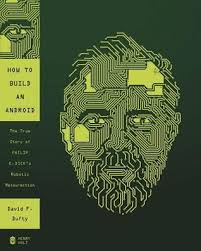 Title: How to Build An Android, the true story of Philip K. Dick’s Robotic Restoration
Author: David F. Dufty
Publisher: Henry Holt & Company
Genre: Technology
Length: 272 pages
Yesterday afternoon I messaged my friend after returning from running errands which involved the bookstore, lunch with my daughter, Hobby Lobby, and of course – the library.
“So I know you’re at work, but did you know that in 2005 some scientists made an android that looked just like Philip K. Dick and one of them LEFT HIS HEAD ON A PLANE! The robotic Philip K. Dick head has never been found. Some super nerd freak has his head somewhere. (And I’m jealous.)” I said.
“We must search for this robo head.”
We certainly do not plan to go searching for Philip K. Dick’s robotic head that has been missing for a decade. The police have not found it and ended their search a long time ago. The creators aren’t even looking for it anymore. It was never insured, so there was nothing fraudulent about the circumstances. But someone, somewhere, in a very A Gentle Madness style, is hoarding Dick’s head in their basement – probably in Washington State… or Orange County… or well, anywhere the airline could go.
Dufty’s recount of the building of the android and his version of events at Comic Con and other such places is a fun, light, entertaining read that I read in two sittings. It’s fascinating that so many intelligent people were involved in such a large scale plan that ended in something Philip K. Dick would probably determine predestined and foreseen. They made an android of the author who wrote Do Androids Dream of Electric Sheep? then lost its head. It’s a funny bit of irony, no?
The book isn’t just about building an android though, and isn’t as mechanical as you’d think. It’s got a lot of commentary about Dick, his life, his themes, his work, and, of course, what makes a human human and an android a mere android. If you appreciate robotics or are a Philip K. Dick fan, I recommend checking this one out sometime.
Pheromones
Title: Bombardier Beetles and Fever Trees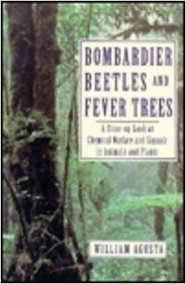
Author: William Agosta
Publisher: Helix Books * Addison-Welsey Publishing Company
Genre: Science/ Nature
Length: 224 pages
It started because I realized I had used the word “pheromone” one too many times during every day discussions that week. It seemed from a biological standpoint my nose – and my whole body really – was on high alert. I could smell EVERYTHING. Which happens more often than I’d like. And not normal smells like the fast food restaurants when you drive by or someone’s overbearing perfume. It’s not even the homeless guy that comes into work from time to time. He’s odorous, don’t get me wrong, but those aren’t the smells I tend to notice.
I smell clean skin a lot. And not the soap that was used, just skin. I tend to pick up on not the typical overly sweaty man on a jog, but the very subtle clammy sort of sweat that someone gets when they are thinking too hard or are wearing the shirt they slept in. I can smell my daughter’s little curls – not the shampoo, not the preschooler desperately needs a bath smell, but HER smell. Obviously, I have a word and a basic gist of why humans respond to these smells (whether they are aware of them or not), but I wanted to know more.
The library has NOTHING on people. So beetles it was.
And Agosta is fascinating. I love this book and plan to purchase it for kiddo to read for a biology course when she’s older. It’s smooth reading, has a lot of information, and has taught me something new about a subject I was already interested in (nudibranchs) that I wasn’t aware was going to be included in this title. Agosta goes over caterpillars and butterflies, discusses spiders and their silk, and even talks about plants, opium, and medicinal remedies.
Definitely loved every word and page and am now moving onto Wyatt’s Pheromones and Animal Behavior. Pipe in if you’re interested in a discussion.
Swirl By Swirl

Title: Swirl By Swirl
Authors: Beth Krommes & Joyce Sidman
Genre: Picture Book / Educational
We actually read this one quite a bit ago, I was hoping to review it when I finally got around to purchasing it, but I can’t wait any longer. It’s too wonderful to keep under wraps any longer and it has been an inspiration to my kiddo who now draws swirls and “round ups” into all her artwork.
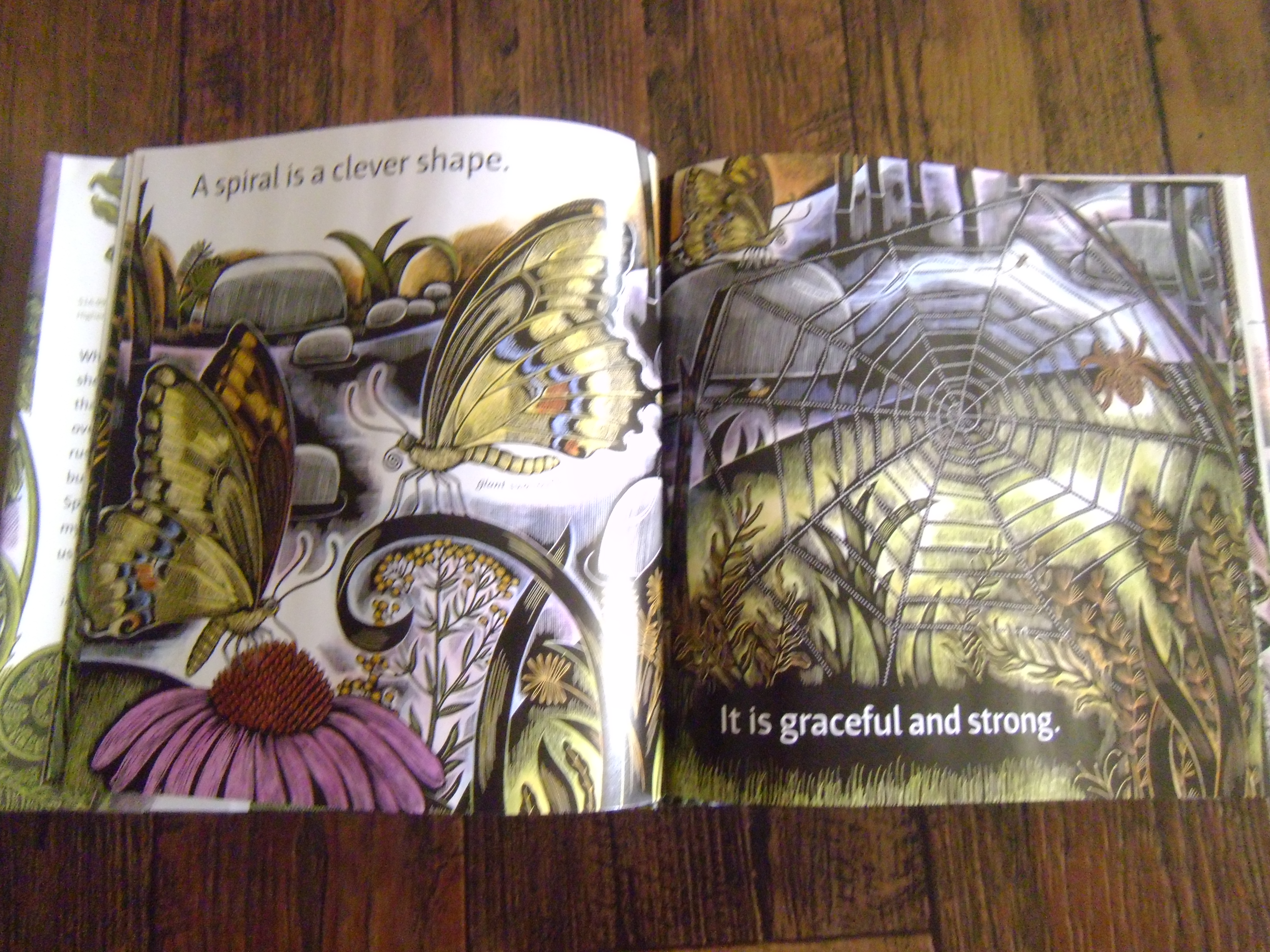
The book is all about finding math in nature. About how snails, flowers, and everything have mathematical patterns that create functional things we can see. It first page by page identifies all these things… spider webs, tendrils on foliage, the curls of animals’ tails, etc.
Then, it explains the how and why of it all.
Kiddo’s eye lit up at the end of the book every time (we had to read it over and over again before we turned it back into the library). My four year old’s mind was blown.
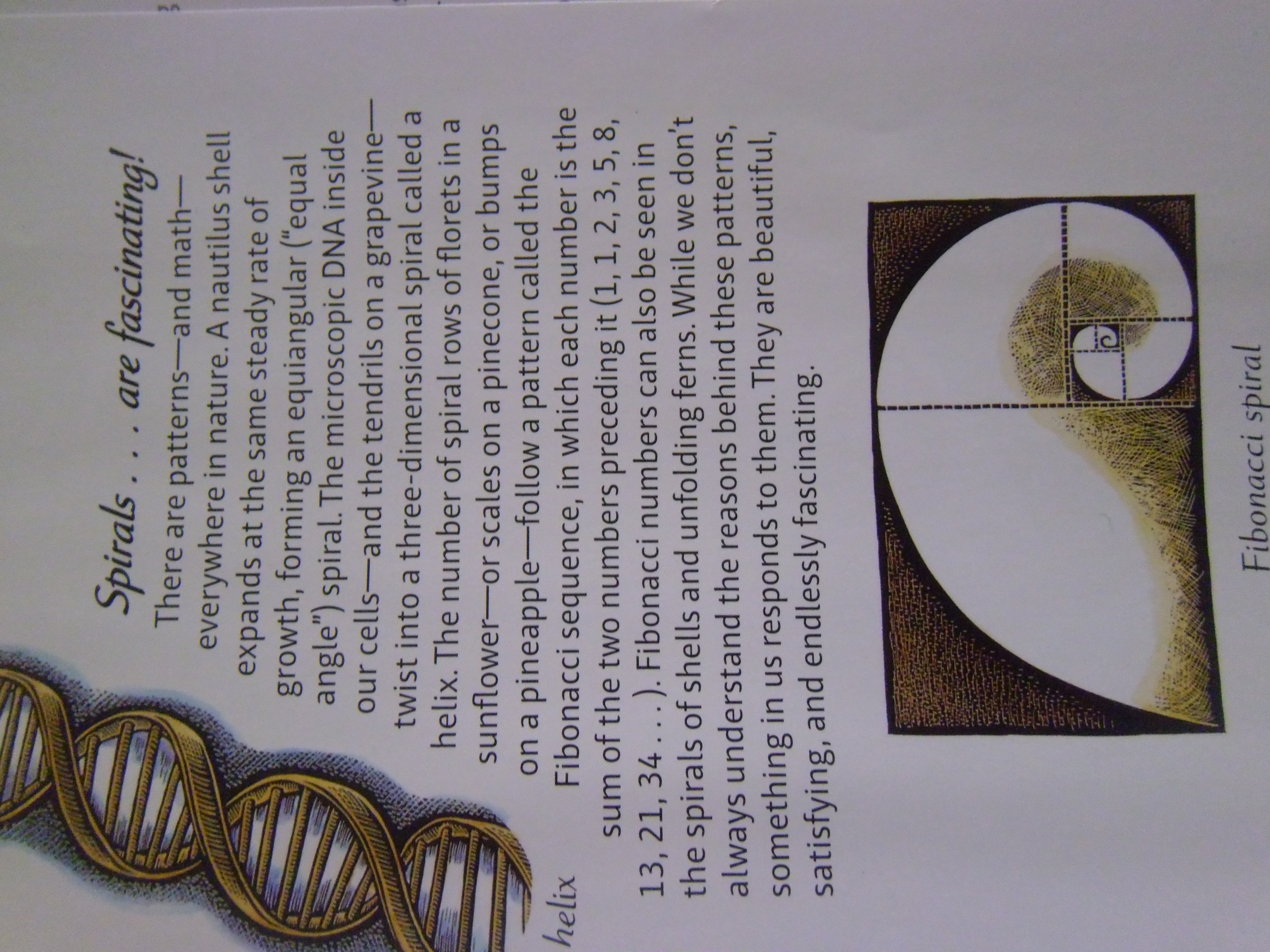 I want to have this book on hand when she’s older as well, to revisit and enjoy the beautiful illustrations again and again through out her studies. It’s so lovely.

Stuffed Grape Leaves and Dewberry Pie
Homeschooling adventures have turned into some serious life skills lessons, which in turn have become foraging.

As previously mentioned, we use foragingtexas.com as a main source of information, but we do a lot of external research on our own as well.
Mustang Grapes – from foragingtexas.com
Scientific name: Vitis mustangensis
Abundance: plentiful
What: fruits, leaves, young tendrils
How: fruit raw (very tart), cooked, dried, preserves, wine; leaves and tendrils cooked,
Where: Edges of woods. Mustang grape leaves are fuzzy and have a white underside.
When: summer
Nutritional Value: calories, antioxidants
Other uses: water can be obtained from the vines (see technique in grapes- muscadine post), wild yeast from the fruit
Dangers: Mustang grapes are very acidic and handling/eating large amounts of the raw fruit can cause burns to hands and mouth.
When homeschooling, this is a good time to teach your kiddo about plant classifications. While picking the leaves (we had a mixture of Mustang grape leaves and Muscadine grape leaves, but I don’t recommend stuffing the Muscadines, they end up a little stringy).
Kingdom – Plantae
Order – Vitales
Family – Vitaceae
Genus – Vitis
Species – V. mustangensis
Our lessons then continue into the kitchen where we follow recipes and learn about fractions and conversions. You’d be amazed at how much a three year old will pick up on if you just show them. We halved this recipe: http://allrecipes.com/recipe/my-own-famous-stuffed-grape-leaves/ as well as added lemon balm from our home garden to the rice mixture.
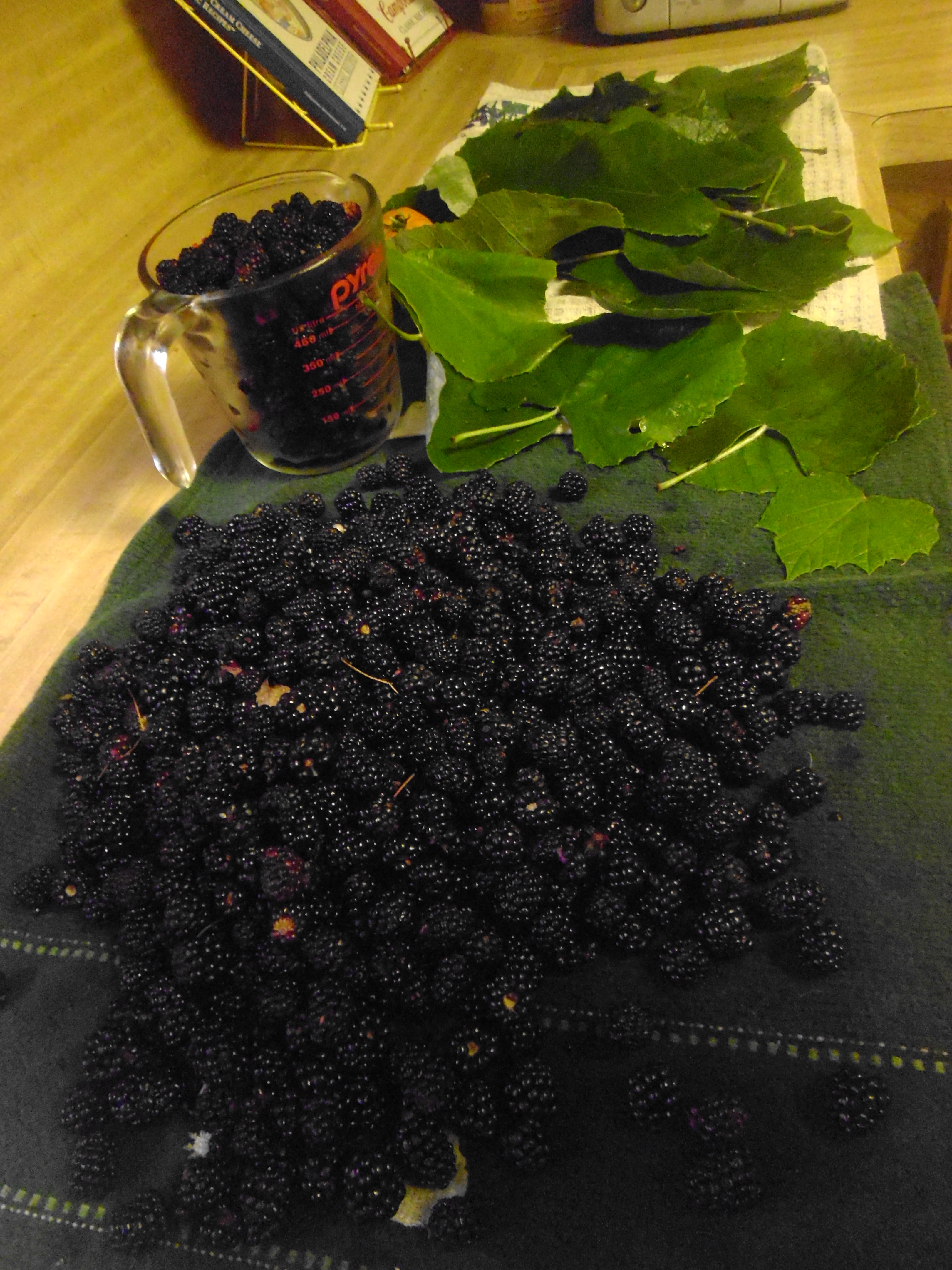 Our dewberry & grape leaf haul.
Dewberries – from foragingtexas.com
Scientific name: Rubus species
Abundance: plentiful
What: flowers, berries
How: open mouth, insert flower/fruit, then chew. seep flowers/young leaves in hot water for tea
Where: Sunny wastelands, borders between woods and fields. Dewberry plants grow as a low, horizontal ground cover.
When: Spring
Other uses: wine, jelly, tea, wine
Nutritional Value: carbohydrates, vitamin C; small amount of minerals and vitamins A & B
Dangers: sharp thorns
Again, our goal is to memorize the classifications and understand how they work:
Kingdom – Plantae
Order – Rosales
Family – Rosaceae
Genus – Rubus
Species – R. arborginum
Well, that and to make pies.
We used this pie recipe, except exchanged the blackberries for dewberries, and used a bit more sugar.
It was a hearty dinner and dessert.




 Anakalian Whims