Dracula
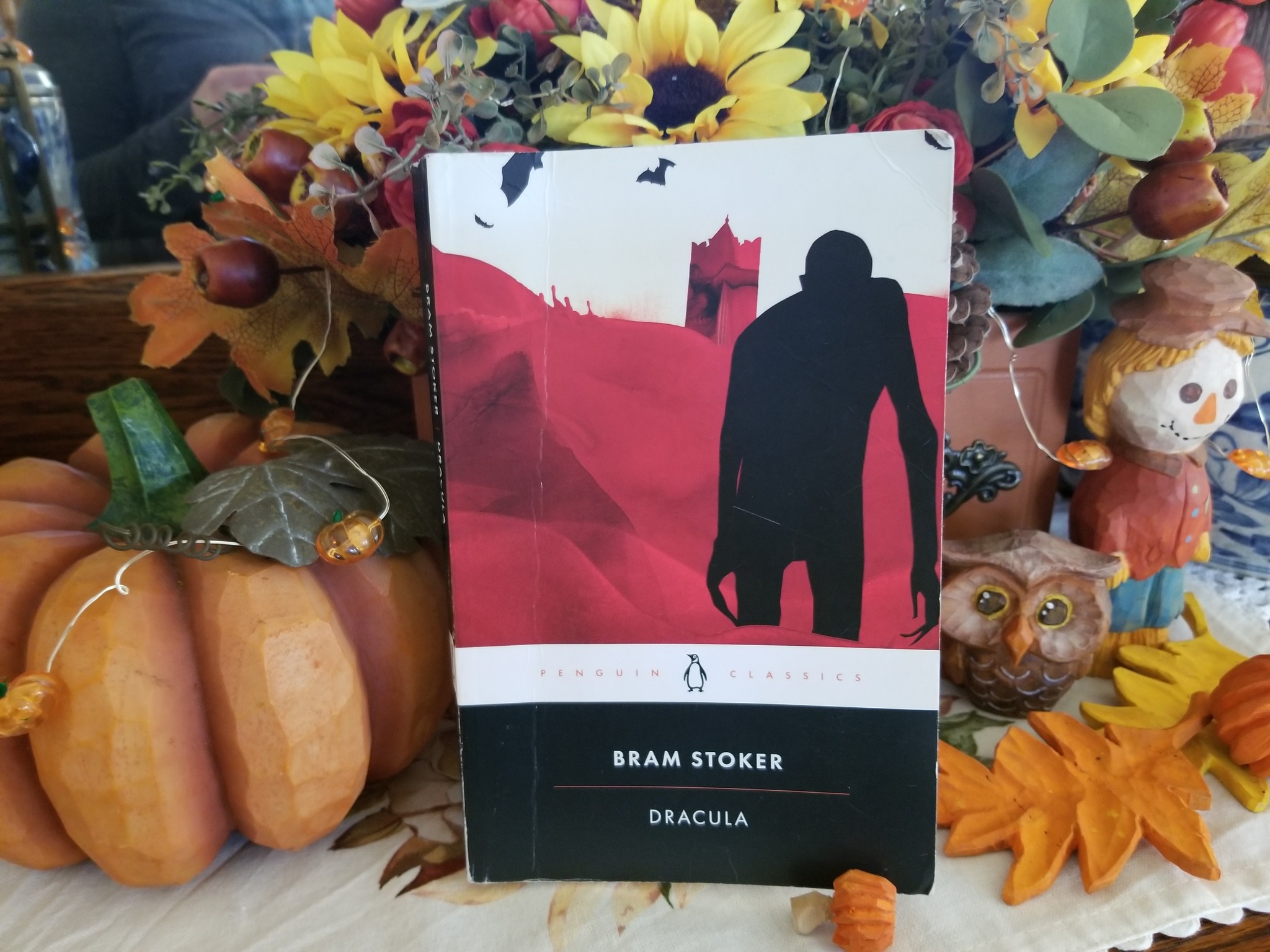
I walked my fifteen year old through Bram Stoker’s Dracula this October. I thought it would be a fun way for a ninth grader to celebrate Halloween. I also thought it would be a neat one to cover with my newly developing book club: The San Salvatore Book Club, primarily made up of my older mentors in my Baptist church. There were gasps of “Are you sure?” and polite “I think I’ll bow out of that one” to which I promptly said, “Why? It’s such a beautiful Christian allegory!”
Side note: I’ve been listening to the Literary Life Podcast with Angelina Stanford for about two years now, caught up on most the episodes and sometimes use them to supplement my home school when I need to be doing something other than teaching literature. My number one complaint to my husband is, “they act like no one knows this and everyone knows this!” to which I am learning every day that, actually, no Angelina Stanford is right: not everyone knows this. I’m not always claiming to have the correct most perfect reads, but I have been shocked to learn I have been reading differently than mainstream society since childhood. So my Angelina Stanford grumbles have ceased now that I know she is operating from the experience of people genuinely not knowing about the material she shares and I’ve been operating under the experience of not sharing because I thought everyone knew. That being the case, my apologies if some of what I share simply sounds like it came from her podcast. It is unintentional, though, yes I listened to her Dracula episodes back in February to make sure when we discussed it in October, I would not have skipped over anything that I assumed “everyone already knew.”
While I was teaching Dracula, I realized I had never written about Dracula on my blog. My blog began, I think, during the height of the Twilight series and I spent so much time focusing on how we shouldn’t be romanticizing vampires with chests that sparkle and misplaced teenage angst, I forgot to write about the roots of vampire lore and my love for Stoker’s classic work, which is in fact a Christian medieval quest to kill a dragon disguised as a techno-thriller. I also realized that I don’t remember what of my essays, stories, and discussions over the years ended up in my journal or my blog, or was relegated only to bookstore employee discussions as we cleaned the store each night. I have spent years reading C. S. Lewis, G. K. Chesterton, George MacDonald, all the classics, yet my blog is mainly limited to home school material and book reviews sent to me by authors and publishers. Therefore, as I begin to teach high school literature to my oldest, I imagine there is a lot of who we are as readers not documented on Anakalian Whims.
To read Dracula well, I think you need a foundation in Genesis, specifically 1:26-4:16. It’s important to read John 1 where the New Testament is clear that Jesus is the Word. It’s important to know a little bit about Jewish and Mesopotamian mythology regarding Lilith, who was a demon and seductress, the disordered first wife of Adam who feeds on children and relishes in child sacrifice as opposed to feeding and nurturing children from her own body as God designed. “Lilitu” was a “night monster.” In my teaching notes, I recommend re-reading the book of Revelation (so you can remember how the bible used imagery of dragons and oceans) and Beowulf. While reading Dracula, you might need to recall stories like Hansel & Gretel, Bluebeard, Homer’s The Odyssey, Dante’s Divine Comedy, Spenser’s The Faerie Queene, and Shakespeare’s Hamlet. It’s easy to enjoy Stoker’s work without these tales fresh on your mind, but it might also be easy to fall victim to Freudian false interpretations if you’re not reading from the framework that Stoker was actually writing during the Gothic revival of the 1800’s. You’ll be limited to the Victorian techno-thriller, which is still awesome, and see all the wrong “imagery” of suppressed sex, which is inaccurate and not awesome.
You have to keep in mind the quote from Devendra Varma: “During the period when the forces of Christianity were nearly spent and materialism had dislodged spiritual values, the Gothic novelists planned their novels with an awareness of the Deity and the consequences of a just fate. The villains learn in due course that the wages of sin is death.”
With that in mind, we enter a world where the monster in the night is indeed an evil to be vanquished, not to be loved for his sparkly chest and undying devotion to trying to get the girl. Traditionally, the villain in these stories is a symbol for Satan, a metaphor for evil itself. We see these villains portrayed as witches, monsters, vampires, and werewolves, who modern literature is now conflating with handsome boys who just need more hugs. Since the dawn of time, human beings have suffered from an evil that must be conquered, and in Stoker’s Dracula we have a group of Christians on a quest to conquer that evil… the “Son of the Dragon” or “Son of the Devil” named Dracula. The best literature will always remind us that the ultimate battle is between the Dragon (the monster) and the Savior (Jesus), and the Savior has already won. That is exactly what makes Dracula one of the best pieces of literature. The monster is the problem, the monster is not the love interest. As C. S. Lewis said, “Who is the witch? The witch is Lilith. The witch is Circe. Every child is born knowing who the witch is.” As Angelina Stanford said, “The monster is not the wounded person, the monster is the [cause of the] wound.”
I don’t want to repeat all the information already available to the public for free on The Literary Life Podcast, but I do want to share some of my favorite parts of the novel that get my skin all tingly when I read them. I’ll try not to repeat too much of what they focus on in the podcast.
In chapter two, we walk through an octagonal room. In Babylonian culture, the eighth realm is the realm of the gods, a realm where for Christians, false gods, fallen angels, and demons congregate. Eight, therefore, is often considered a number affiliated with the occult. Charlemagne’s Aachen Cathedral, where his tomb resides, is an octagonal shape believed to be a mesh of where God meets the secular as it is a circle with straight lines and points. I ask my students what they think Stoker is trying to tell us by Harker walking through an octagonal room as he enters Dracula’s residence, just after a wild carriage ride that resembles a descent into Hades.
Later in this chapter, Dracula throws a mirror out the window. It is absolutely chilling as the mirror in medieval tradition is a symbol of divine truth. It doesn’t matter how many times I read Dracula, the Adversary both literally and figuratively throwing Divine Truth out the window gives me chills every time.
The setting of Whitby, which has a castle or abbey with an extensive graveyard by the sea sets itself up for so much intense imagery and meaning. We have our Gothic trope intermingled with the real history of the Synod of Whitby, where two traditions were ended. Meanwhile Dracula is asking Harker if a man of England can have two solicitors or more? Stoker is tossing around ideas of can man serve two masters? Who will man choose? Dracula is basically asking, how can I trick England into abandoning God and worshiping me? Whitby Harbour had a history of ships crashing, which will offer up opportunities for both Tempest and Rime of the Ancient Mariner allusions.
Stoker offers layer after layer of symbolism with the names and social positions of the characters as well. The podcast talks extensively about the roles of women in Victorian society and how Stoker played with Lucy being the “Light of the West” and “angel of the house” and Mina being the modern woman (I’m not sure if they covered the meaning of her name which sums up to be “Resolute Protection of the Lord”), but my favorite is actually the role of the men in this allegory. We have a fellowship of knights on a quest, all devoted to one woman (Mina), headed off to kill a dragon (Dracula), interwoven with Aristotle’s classical elements: Abraham Van Helsing, the professor (Merlin/ father figure, fire); Arthur Holmwood, the future Lord Gadalming (nobility whose name means “Of God-helm” in the Surrey Kingdom where there is a village called Thursley, near Hammer Pond and Thor’s Stone… King Arthur/ Thor, thunder, or air); John/ Jack Seward, whose name means “Guardian of the Sea,” is a doctor and scientist (a knight on our quest, water); Jonathan Harker, Mina’s husband whose name means “The Lord has Given” (earth); and our fifth man Quincey Morris, a cowboy from Texas (the fifth element) and (spoiler alert) our “Good boy. Brave boy. […] all man.”
From a book review standpoint, Dracula is hands-down a five star book. Above I shared my favorite pieces of a very complex allegory, but there’s so much more to it covered in the series of episodes of the Literary Life Podcast, and even more in my teaching notes, imagery that covers the Eucharist, Anti-Eucharist, Passover, John the Baptist and Anti-John the Baptist imagery. The story is one of wars to fight devils and ends on All Saint’s Day, celebrating rebirth in Christ and the achievement of Heaven. If you’re not seeing these metaphors for yourself when you read please go listen to the podcast episodes so that you can enjoy this beautiful work of fiction (and truth) for yourself.
(As an Amazon affiliate I earn from qualifying purchases.)
Meet Felix Gomez…
 Title: Nymphos of Rocky Flats
Author: Mario Acevdeo
Genre: Urban Fantasy/ Mystery
Meet Felix Gomez, Iraqi-vet Vampire P.I. who has been called to Denver to investigate an outbreak of Nymphomania. It sounds silly because it is. But it’s equally adventurous and well written. It’s a slightly older title, but the series is still fresh with a current addition that came out in April (Rescue from Planet Pleasure).

Mario and Me at Dragon Con 2016
At Dragon Con people would walk up to the WordFire Press booth and ask, “Do they come with pictures?” To which Acevedo would, without skipping a beat, reply, “No, only scratch and sniff.”
I laughed every time. It just didn’t stop being funny to me.
I think that’s how Felix Gomez will be as I continue to read the series. I’ve never been so amused as while reading Nymphos of Rocky Flats. It has all the excitement of the X-Files with the plot development silliness of Eureka. Just as I had settled into the pace of the book and thought, “Ok, I’m ready for all this to wrap itself up,” he’d toss something else at me and I’d giggle, “Maybe not…”
I enjoyed having a vampire story-line with a more realistic life story being dropped into an absurd universe (Iraqi War Vet meets Vampirism, Werevolvishness, and Aliens) – as opposed to the typical unrealistic life stories being dropped into a more familiar world (Two-hundred year old man falls in love with high school teen in the mundane school cafeteria; I’ll take aliens over high school again).
What I didn’t expect were the author’s deep thoughts on life to make subtle waves in some of his writing. Hints at politics and undertones on what might be Acevedo’s worldview were made but never formulated completely. Having met the man, I know he is intelligent, well-read, and has a lot of wisdom regarding the world. As much as I enjoy his humorous banter, in both real life and his books, I’m interested to hear or read what his deep thoughts on life are.
Aside from deep thoughts, this book is all guy all the time but one girls can enjoy too. It sells in mass market paperback form at the bookstore to middle-aged men like hotcakes all the time, but I plan to start pushing it toward more ladies. The trade paperbacks have a longer shelf life, but honestly, I think it’s just because of where they are located. I’m already mentally planning a place to feature them for Halloween as I type.
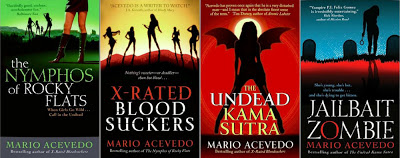
A previous reviewer referred to the Felix Gomez series as Dude-lit. “When Girls Go Wild… Call in the Undead” the tagline of the book says. If this doesn’t place it in that fabulous sub-genre of Dude-lit, I don’t know what would. The fact that the book is the first vampire novel ever to be declassified by the U.S. government is another tell-tale sign.
Ironically, scantily clad women in hooker boots is not sub-genre specific, merely a hint that it’s urban fiction as it’s something that women expect to see on their chick-lit as well. It is a consumer behavior impulse I will never quite understand – like how magazines for men and women alike feature half naked women on the fronts… And despite the book being classic dude-lit, I’m a chick and I loved it. Then again, as a character in Rocky Flats points out: “Earth women are surprisingly complicated…”
Side Note on Content & Ratings: I was pleasantly pleased that with all the hinting and perverted jokes, the book isn’t actually raunchy. The movie version would probably still be rated R for nudity, but there’s a reason the books are not classified as erotica, and for that I was grateful. If it had been, I’m not sure I could look the author in the eye again – and I really like him, he’s fun. There’s more porn in the Outlander series than in Rocky Flats.
The Vampire Diaries Review
 Title: The Vampire Diaries Books 1-4
Author: L.J. Smith
Publisher: HarperTeen
Genre: Young Adult Fantasy
The Vampire Diaries is a young adult vampire horror series of novels written by L. J. Smith. The story centers around Elena Gilbert, a high school girl torn between two vampire brothers. The series was originally a trilogy published in 1991, but pressure from readers led Smith to write a fourth volume, Dark Reunion, which was released the following year. The first four novels in the original series: The Awakening, The Struggle, The Fury and Dark Reunion all feature Stefan Salvatore and Elena Gilbert as the main protagonists. The first three novels in the original series are from both Stefan and Elena’s point of view, but the last book in the original series, Dark Reunion, is from Bonnie McCullough’s point of view. – Summary from wikipedia
I initially started reading The Vampire Diaries because I got hooked on the show. I have a rant about television shows, movies, and book reading regarding the whole ordeal here: https://anakalianwhims.wordpress.com/2011/11/09/books-to-movies-to-tv-shows/, basically saying I was shocked to find that I love the series and hate the books.
Well, why bother reading the rest of the series after loathing the first book so much? I’m a start a series finish a series kind of girl, no matter how awful. It’s just polite to give the author a chance to 1) redeem themselves after a bad experience 2) let the characters and story warm on you, sometimes you meet someone and think they are horrible people only later find out they were just having a bad first impression day 3) be sure you weren’t just in a judgmentally bad mood that day.
And I tried, I really did. I read the first volume of books one and two and got all the way through book three of this second volume. One chapter into the fourth part and I gave up. How can the show be so intriguing and the books be so awful? Amazing liberties taken with the story by those fab people in Atlanta, that’s how. These books are truly terrible; I don’t know why I bothered.
Smith has the uncanny ability to make dialogue something I dread. Instead of the simplicity of a he said she said, we get every –ly word found in my third grade Webster’s dictionary thrown at us, even when they don’t make the best of sense. Admittedly, I always hated the overuse of this in writing, but didn’t really understand how much until Stephen King put my own thoughts into words in On Writing. Now that I have read detailed explanations of my own gut instinct, I find it even more nauseating.
L.J. Smith’s original books are merely a reoccurring fad due to people’s fascination with vampires. But if you’re looking for Stefan, Damon, and Elena time – watch the CW television show, it’s available on Netflix. If you’re looking for some Vampire literature, stick to Anne Rice and Bram Stoker. Then, there’s always one of my cotton candy favorites: Robin McKinley’s Sunshine. My copies of The Vampire Diaries series got thrown along with Twilight – the library donation bin.

*Edit/Postscript in the form of a confession: I am not and never have been the target market for this book. It’s unfair for me to judge so harshly when the book was clearly not meant for me and I knew that from page 2 of the first installment.
Unclean Spirits by M.L.N. Hanover

Book One of the Black Sun’s Daughter Series
Unclean Spirits is a fun adventure filled fantasy to veg out with your favorite snack and a comfy pillow. Hanover did a good job of taking an overused theme (vampires and metaphysical ghosties verses the good guys fighting evil) and turning it into something fresh and fun and not too plot heavy with romance. Jayne Heller makes for a great escape fiction heroine and I’ll be interested to see how the rest of the trilogy turns out.






 Anakalian Whims