Antique Book Find

#thingswelove: discovered at the antique store yesterday: Victor Hugo The Man Who Laughs from 1888 #goodreads – Jennifer Fritz
Jean Valjean
Whether you have read the book or not, most people are familiar with this image:

The story has been a Broadway sensation for ages, the book itself has been a classic for even longer. And with Hugh Jackman acting the lead role of Jean Valjean in the movie production being released on Christmas Day, more people than ever are going to have the story of Les Miserables running through their heads.
That’s why earlier this year I committed to spending 2012 reading the classic tome along with Kate’s Library. It was amazing, and for the rest of my life I’ll remember 2012 as the year that I met Jean Valjean.

Ok, I know, I know, that fellow on the left there is not a depiction of Jean Valjean, it’s a picture of Victor Hugo; but despite my encounters with other works by Hugo (The Hunchback of Notre Dame
Valjean has a beautiful, though depressing story. A convict running from the law, early in the novel he is changed for life by a man called the Bishop, learns the importance of love and learning and becomes a new man. As his life progresses, he becomes someone altogether different and even assumes a new name. With a new name and some money, he finds himself in charge of a town and in a position to help a poor prostitute named Fantine who is dying and has left her only child to be raised by some hooligans elsewhere. Valjean, now a saint and model citizen, promises to care for the child and goes to retrieve her.
That’s when Valjean and Cosette (the large-eyed little child in the musical posters and book covers) join forces and run away together as father and daughter.
So many adventures, so many trials, life in a nunnery, life hiding out, life raising a child, a love story between Cosette and Marius… but Jean Valjean lives a great life under much mystery, oppression, and misery, and still somehow he finds joy in his little Cosette. Valjean is a prime example of a life changed, and a life found despite what the world and the government tries to throw at you.
The paragraph above is much too simple of a description of Hugo’s Valjean. There is a reason Hugo’s novel is 1260 pages long, and not a moment of it is to be missed. Les Miserables is a story of compassion, love, redemption, and a quest for freedom. Both the novel and the musical focus on these themes in a powerful way, though they differ in how they address them, typical of a novel to a musical. In the end, both forms of the story are about Valjean and the idea that if he can learn to love and be charitable after all he has suffered, who is there that cannot learn these things too? Who could possibly have suffered more?
If you have not read Les Miserables
St. Denis

Click to visit Kate’s Library
My thoughts on Part Four of Les Miserables
Maybe it is a bit shallow and unliterary of me to come away from St. Denis and only have the story of my own marriage on my mind, but that’s the truth of it. How can you read what has become a nearly epic love story and not think of your own? Call it what Hugo does, The Stupefaction of Complete Happiness, and then maybe you can forgive me for getting wrapped up in the romance of it all and not caring for the extensive history, the depth of the literature, and all the rest of it.
“From time to time Marius’ knee touched Cossette’s knee, which gave them both a thrill.” – Book Fifth
Do you remember that? That feeling like a shock, but so much gentler, when the object of your affection makes contact; the feeling incredibly enhanced when that person loves you back… Do you remember?
I met my husband when I was fourteen, my freshman year of high school. He was old for our grade and already fifteen. By the time I was fifteen too, I was sitting next to him at lunch our sophomore year, just friends but wondering desperately if he would ever want more. In those days, I thought a knee knock or a hand graze was everything. Come to find out, it was nothing compared to him taking my hand to walk me down the hall later that year. Or even much later – years later – when he would hold just my pinky finger under a blanket in college because we were under orders from my then boyfriend not to hold hands. We were best friends by then and the idea of not holding hands with my best friends was excruciating. That same evening he leaned in and whispered in my ear, “I’ll always love you,” and then some blithering nonsense about my boyfriend and the direction of our lives.
Things changed then. Obviously that (very awesome and dear to me) boyfriend didn’t last as a boyfriend, and I finally knew what I had wanted to know all along: my best friend was my truest love.

Our first year as a couple at my 3rd degree black belt test.
The innocent but thrilling touches didn’t end there, we spent an entire summer trying to ease my parents into the idea that he was around. I neither confirmed nor denied that he was my boyfriend – at twenty I didn’t think it was any of their business – but during the school term we were in different cities so we wanted to take advantage of the time we did have. It was like a Jane Austen novel in my head, something like Jane Fairfax and Frank Churchill: catching glances across the room, brushing knuckles and fingertips in the hall. Sneaking a whisper and a kiss when no one was in the room.
“What passed between these two beings? Nothing. They were adoring each other.” – Book Eighth
Apparently, I have thing for secrets, because that was nearly the entirety of all my relationships, relishing in the act of not letting anyone know. The difference this time is I was dying to scream it from the roof tops: One day I will be Mrs. Jonathan Klemm!
As for complete happiness, it is still had. We fight and argue – after all, we are married- but at the end of the day, at the end of it all, I can snuggle up in the crook of my love’s arm and hold his hand. He will rub his thumb against mine, lean down and kiss my forehead, and all is well again. The thrill of the small and innocent touches still there – after all, we are married.
Skip to my next Les Miserables post.
Les Miserables – BANNED
 The practice of banning books is beyond a bit baffling, it is also fascinating. The first ‘official’ censorship, of course, began with the Catholic Church in 1559, an extensive list of forbidden books tasked to be made by Pope Paul IV. Since then, the practice of banning books hasn’t been limited to the religious, but been taken on by governments, schools, libraries, and organizations both public and private all around the world. Some make the mistake of assuming these books simply ‘must be bad’ if they are restricted so often, but the reality is that somebody somewhere will always feel threatened or offended by the thoughts of another and people of power will always try to enforce their thoughts and opinions on those who are subject to them. “The hand that rocks the cradle, rules the world,” said Karl Marx. Well, I say: The one that chooses the books, rules the world, unless of course you allow them to choose for themselves and then you have to rise up and be a better leader.
I am currently reading Part IV: Saint Denis
Les Miserables, one of the most impassioned and well-written novels in all of history was often a threat to poor leaders. It is a beautiful story of familial love, sacrifice, tragedy, the history surrounding the French Revolution, and his personal views on the church and government. Hugo doesn’t pull punches, however, when describing these beautiful and tragic things, he doesn’t leave out a bit wretchedness, he presents the world as it he saw it, and in doing so was punished for it. Hugo was banished from France for life by Napoleon III for criticizing his government and all of Hugo’s works were banned in Russia by Nicholas I for the unpleasant way which royalty was portrayed in his novels. Not only that, the Catholic Church added everything Hugo had written to the Index Librorum Prohibitorum (often referred to as The Pauline Index) for “sensual, libidinous or lascivious.”
These challenges did not merely last Hugo’s life time. His works weren’t removed from the Index until 1959. This essential piece of literature has been considered threatening for portraying prostitution, murder, the church as unimportant, and glorifying the French Revolution. 1959, such a time of the past… but the fight is never over. In 2007, Hugo’s grandson and an emerging author battled in the French courts over whether or not a sequel to Les Miserables could be published. This time, instead of contesting Hugo’s work, his grandson is fighting to protect “the spirit” of his work, claiming that Les Miserables should all be considered intellectual property. Valid perhaps, but what would Hugo say about his grandson banning an author?
 Hugo was part of the original literacy war in Paris in 1830. In addition to his books being banned, his plays were also challenged. Authors and artists paid professionals to sit in audiences and applaud their plays in order to counter those trying to shut them down. Duels were fought, defending the right to write, one young man even died for the sake of Hugo’s Hernani. Protect the spirit of Les Miserables? Yes, please. Ban literature? No, thanks. It is up to the individual reader/fan to protect the spirit of an author’s work, though, choose NOT to read it. The government should not be able to authorize the restriction.
This coming Saturday, October 6th, Half Price Books Humble will be hosting a Read Out from 1:00 pm to 3:00 pm. Come hang out with fellow book lovers and read a line or two from your favorite and most cherished banned or challenged book.
Additional blogs and articles of interest:
Dangerous Pages
Index Liborum Prohibitorum (About)
Index Libroum Prohibitorum (List)
About Hugo
Les Miserables II
More on Les Miserables II
My post on St. Denis.
Political Statements in Art
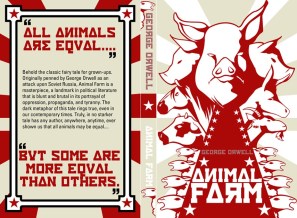 Title: Animal Farm
Author: George Orwell (real name: Eric Blair)
Length: 80 pages
“Political Statements in Art” sounds a little scary, intimidating. I grow weary of political statements. But I am a reader, and among the list of most amazing authors of all time, though, great activists can be found. Ayn Rand
Although I had a general understanding of the novella, and the statement it was going to make, I was surprised when the animals all had real names. Silly, I know, I just hadn’t expected that. Not that I expected them to be called pig, horse, or dog, it was just one of those things I hadn’t thought to think about prior to reading the book. Of course, I should have anticipated nothing less from Orwell, after all, the man was a genius. In good literary form, Napoleon represents a villain, Boxer is strong, Snowball is the opposite of Napoleon, Squealer is the epitome of propaganda, and Mr. Jones is a typical neighbor you might love to hate – the human. It is allegory at its finest.
Yet, I pretty much hated it. How did this happen? I adore Orwell! I do, I really do. I just could not get into the anthropomorphism. When I read animals personified to represent people, I find I don’t want them to be JUST like people. I want my fuzzy mole to be a fuzzy mole who talks (Wind in the Willows), I want my mice to still live under floor boards and not have day jobs, even if they cook and clean (TumTum and Nutmeg), and so on. Obviously, Orwell’s intent was for us to see ourselves as we are, “The creatures outside looked from pig to man, and from man to pig, and from pig to man again; but already it was impossible to say which was which,” along with the dangers of communism and totalitarianism.
But who wants to be reminded of that?
Just kidding. Truly, I see the merits of Animal Farm, and at another time I just may enjoy it. But today, right now, this moment… I did not. Still, I love Orwell. I (usually) love to read his work, and (always) aspire to be more like him. In Why I Write, he said:
“From a very early age, perhaps the age of five or six, I knew that when I grew up I should be a writer. Between the ages of about seventeen and twenty-four I tried to abandon this idea, but I did so with the consciousness that I was outraging my true nature and that sooner or later I should have to settle down and write books.”
Nothing speaks to me more. I have been journaling, writing stories, and using the written word as my own catharsis my whole life, since before I could do much more than copy letters. Perhaps I will never be the caliber of writer I’d like, but always and forever I shall write. So because I write, also shall I read.
Marius
Click to visit Kate’s Library
My Thoughts on Part 3 of Les Miserables
I had a hard time getting into part 3, as I tend to be impatient in my reading constantly wondering about relevance. But of course, Hugo makes everything worth while and without fail Marius is just as intriguing as his predecessors: Fantine and Cosette.
I love how Hugo builds a story out of lengthy character developments and social commentary. There’s no story, just life, but in that it is one of the most fascinating stories ever told. I think that is why I always find the climactic plot points so startling and wonderful – I don’t expect them. Hugo waits until you’ve settled into not being impatient, gotten cozy with the daily ins and outs of a particular character’s existence, and then shatters your world with a life altering event for them. The whole thing is beautiful, and depressing, and wonderful. .. think East of Eden, but instead of a sunny dust bowl, you’ve got the dank, cold of Paris. Why am I so drawn to this kind of literature?
I am 710 pages into this novel with only 550 pages to go, the overwhelming intimidation behind me, now I’m just eager to see what happens to all these people I have come to love (and hate). I am so glad I joined a readalong to encourage me through this novel, but I have found that the group really hasn’t served the purpose I previously expected. I hoped to read posts and have discussions, following the thoughts of others in a classroom like manner as I plodded through this masterpiece. Instead, I impatiently wait for other bloggers to share their reading experiences, only to find they haven’t read or at least haven’t posted about what they’ve read.
So instead, I sit here cherishing Fantine, Cosette, Jean Valjean, and Marius alone. Instead, I find that few others are sharing my desire to throw the Thenardier’s off a cliff by the mere fact that they are not presently posting the desire. God, I hope I am not the only one feeling murderess passions toward these useless pieces of crap who keeps “a pipe in his mouth, and was smoking. There was no more bread in the den, but there was tobacco.” People who do nothing for themselves, but scrape by off the hard work and sympathies of others, breaking their own windows to appear even more poor to a wealthier man who might give them money.
Misery loves company, and as I am reading Les Miserables – I want company to lament in the utter awfulness of these people who do everything they can to bring the good ones down to their level. The good ones being those equally destitute, equally at odds with the world, but doing their best to make a life and stay as happy as can be imagined.
Have you read Les Miserables? Care to join me? We will be all ready to see this at the end of the year: http://www.grantland.com/blog/hollywood-prospectus/post/_/id/50396/the-les-miserables-trailer-a-million-theater-geeks-just-fainted
Read my next post on Les Miserables.
Les Miserables Readalong Update 5/04/12
 I am currently reading Cosette. It is, of course, fascinating and full of all sorts of history and thoughts about the revolution and so on and so on. So of course, I had to put it down for a bit and am now reading Napoleon’s Wars: An International History by Charles Esdaile. So far its exactly what I hoped it would be, a broad picture of the world at large to help me better understand the smaller piece of France Hugo has us tucked away in for 1200 some odd pages. I am loving it and I hope that others participating in the Les Miserables 2012 Readalong join me with Esdaile as well. Full reviews of Cosette and Napoleon’s Wars to come.
To join this blog hop/readalong and follow the links to read Fantine: https://anakalianwhims.wordpress.com/2012/04/12/les-miserables-blog-hop-8/
To read my official Cosette review posted on 5/19/12: https://anakalianwhims.wordpress.com/2012/05/20/cosette/




 Anakalian Whims