Totalitarian Caste Systems in Dystopian Fantasy
A Guest Blog Post by: A.Z.K.R., author of Tales of Porcelain Thrones: Middle School Edition
Totalitarianism is a system of government that is headed by an absolute dictator who supports themselves with some kind of violent force. In a totalitarian country there is no freedom of the people. One example of totalitarianism can be found in Brandon Sanderson’s Mistborn. The Final Empire is headed by the Lord Ruler, who uses emotional manipulation against the populous. They are required to believe only what the Steel Ministry tells them and treat the Lord Ruler as god. The Final Empire is also a caste system. A caste system is a system of government in which people are divided into sections based on race and or job description. The Final Empire is not an exact Caste System sine the Garrison and a few merchants come from the Skaa population.
A better example of a Totalitarian Caste System is Suzanne Collins’s series Hunger Games. In Hunger Games President Snow represents the the absolute ruler and the Hunger Games themselves serve as the violent force. The caste system in Panam is much stricter than the one in the Final Empire. The people are confined to geographically separated districts that are each in charge of one resource that is distributed across the whole country, such as coal lumber, and technology. District Thirteen is the rebel district, their Mistborn counterparts would be the thieving crews. In both dystopian societies the government mostly ignored the rebels, avoiding conflict and keeping the peace. Up until the nineteen forties India was a real life example of a totalitarian caste system. The noblemen and Garrison plus the District two and the capital are equal to the Kshatriyas. Likewise the Chandles are similar to the thieving crews or district thirteen.
Totalitarian caste systems are terrible for everyone except the people on top. Even now as a democracy India is a miserable place still scarred by its past government. On the flip side, the opposite of a totalitarian caste system would be a world with no ruler or government system at all. You may note that in the United States religious freedom only goes as far as it can without infringing on other peoples’ rights. Or it was supposed to anyway. Both extremes are bad. People need guidance, not total dominance. Rules, not oppression.
Literary Journal Mondays

Remember the zine movement? (No? Visit Snapdragon Zine Fair) Ah, the 90’s and early 2000’s. Except that’s not where it started. No, it began long ago, and still goes on, in Literary Journals.
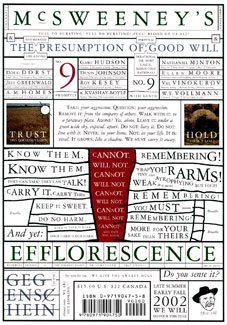 McSweeney’s Quarterly Concern comes to mind.
But do you remember Granta? (or Paris Review, or Soho Square, or The Quarterly, or countless others?)
My eyes tend to rest on Granta when I’m in a bookstore. Such colorful spines… printed by Penguin.
Today, #24 Inside Intelligence pops out at me… “Her Majesty’s Government does not want you to know about the life of Anthony Cavendish,” the cover reads. There’s a huge circular stamp in the bottom right corner: BANNED IN BRITAIN. How do you pass that up?
What follows is a spirited and creative journalistic effort to share news in the form of intelligent literature. Photographs and interviews you wouldn’t get in a newspaper, writing worthy of Pulitzers (and sometimes even written by Pulitzer winners). Just in Granta #24 alone, Philip Roth, Peter Carey, Tobias Wolff, Bruce Chatwin, and E.L. Doctorow all grace us with their presence.
The world of literary journals is a fascinating and amazing one that goes back centuries.
 Paul Collins wrote an essay called “121 Years of Solitude” for Bookmark Now about his own journeys through a literary journal called Notes and Queries: A Medium of Intercommunication for Literary Men – a weekly magazine from the Victorian era. Collins’ memoir-like essay of his time spent in the Portland, Oregon library is one I dive into regularly, envious of his access and ability to take time to develop a daily library routine. Bus rides downtown, coffee, grand staircases, Notes and Queries, the entire endeavor sounds heavenly to me.
I don’t have time in my life – or the ability, as a mom of a three year old – to replicate a similar endeavor right now. But, the idea of taking an extra 30 minutes to an hour each Monday to peruse a literary journal that graces the shelves of my existing Monday routine (Good Books in the Woods) sounds plausible.
So here’s to Literary Journal Mondays – may they be more consistent than my Weekly Low Down of Kids Books (which happens sporadically throughout most months instead).







 Anakalian Whims