“I can always live by my pen.”
The above quote is from the infamous Jane Austen. And although I don’t get paid for my writing (yet!), I’d like to think that I too live by my pen.
Journaling has always been such a huge part of my reading experience. So I don’t know why I haven’t thought of it before, but I was reading through the blogs I follow this morning and discovered a new one: The Journal Keepers. Immediately, I thought that it was about time I had a post about journaling.
Journaling is a crucial part of the learning experience. When you read, listen, or are shown anything its so important to take note of new information. After your notes, discuss how it affects you, and make plans for its use in the future.
Journaling keeps your brain active, keeps you on your toes. Its also good for documentation – keeping tabs on all you’ve discovered and how you’ve changed over the years. Its how you avoid repeating history and all the bad things of your past, see your progress, revel in your accomplishments.
There are so many different ways to journal. Some people keep strict notes or outlines. Some people make lists, tell stories, or merely share their day. I’ve seen journals full of poetry, and journals full of nothing but sketches and other art work. I’ve heard of people who only journal using prompts either from websites, magazines, books, or sometimes simply from the journal.
 Mine? A combination of all of the above, but the prompts I usually come up with myself or get from close friends.
There are so many different ways to partake in this enriching activity, and it doesn’t really matter how you do it, the important thing is the doing itself. I can’t imagine writing a useful review with out sitting down with my journal at some point while reading the book, or at least immediately after finishing the book. I don’t know how I would effectively sort through my TBR pile without my beloved notebooks. My entire life is chronicled, book after book, with messy, sprawling ink from my pen – years and years of thoughts, events, emotions, lists, notes, quotes, and more.
Do you journal while you read? How do you journal?
Teacher Appreciation Celebration!
This Week is National Teacher Appreciation Week. Next week, Half Price Books in Humble will share the love and appreciation.
Win a Teacher Appreciation Gift Basket Our hard-working teachers deserve a well-earned break. What better way to start the summer than with a “Pamper Yourself” gift basket. From Monday, May 14 to Saturday, May 19, use your Educator Discount Card at our HPB Humble store and you can enter to win a wonderful gift basket full of Mary Kay Mani/Pedi products, an Ophelia’s Quote Mug (http://www.etsy.com/shop/OpheliasGypsyCaravan), plus a Summer Surprise Reading Bundle. See store for details.

The Summer Reading Bundle has several titles donated by Half Price Books that should entice you, but I wont give away the surprise! You’ll have to go into the store and see for yourself! But I will let you know that there is a sneak peek of an event to come with an Advanced Reading Copy of Delaney Rhodes’ first book Celtic Storm.

In additon to that, there’s a Scentsy hand foam and catalogue provided by yours truly (akklemm.scentsy.us) to add to all this Pamper Yourself fun. Teachers are an important part of our lives and crucial members of our community, we want to let them know it!
If you are passionate about giving back to our teachers, contact me at andiklemm@rocketmail.com. I am constantly brain storming future events and any contributions whether it be donated items or ideas to help make the celebrations more wonderful, are most welcome.
Napoleon’s Wars
 Title: Napoleon’s Wars
Author: Charles Esdaile
Publisher: Penguin
Length: 622 pages (including appendices and index)
Its amazing to me how history is so often rewritten. Like the American Civil War and the issue of slavery, history textbooks would have you believe that the French Revolutionary Wars were about liberty alone. It’s only when you dig deeper into fascinating works like Esdaile’s that you learn better, just like that moment you discover that the Civil War was about State’s Rights. Esdaile’s book is enlightening, gracefully walking you through power struggles, political schemes, battles, marriages, and all sorts of human conflict. Silly, I know, as there is always political drama behind the scenes of any war, but I was completely unaware.
I blame this on my childhood education as well as my idealist nature, which begs to believe that things are always done for moral principle and meaning. I like to root for the underdog and weep for the wronged. Yet, scholarly study and reality steps in and I discover that Abe Lincoln was not this amazing and caring man elementary schools brain washed us into believing, that the Union was not so kind they fought a war over slavery, rather they were controlling and greedy and wanted to dictate laws on a Federal level rather than celebrate the spirit of our unique existence by allowing States to make their own decisions, much like the war on drugs now. See, even here I see my brain and heart leaning towards the idea that the South were fighting for their rights with ‘free spirits’! Also emotionally driven and not entirely accurate. There’s no winning with me.
 I need work like Esdaile’s in my life, to keep my brain on straight. He writes a beautiful historically accurate reality check, without casting blame or being cruel about the events of our past. He doesn’t bash nor celebrate Napoleon, he just explains the world that surrounded him. I picked this book up to help me wrap my brain around Hugo’s Les Miserables world, as the characters are living in the aftermath of the wars. I needed to comprehend the world at large at that time in order to really understand the characters’ world view, and to help me decide whether or not I even like Valjean! (Stay tuned for further updates on my Les Miserables reading, join my readalongs via the “Readalongs!” page on the right.)
What I found most astounding was the statement by Esdaile that “Napoleon came to power as a peacemaker. “(pg.75) Clearly, I didn’t know much about Napoleon, the history of France, the Revolution, any of it, before reading this book. Before, I always thought of Napoleon as a tyrant with a short man syndrome attitude. But in reading Esdaile’s work, I am reminded that people have to have something going for them to gain that much power. According to this history, it took quite awhile for Napoleon to acquire his ‘demon-like qualities’ and that ‘among the educated classes, he was widely admired.’ “[…] the emperor himself later remarked that the regime was ‘never afraid of him’ and ‘looked on him as a defender of royalism.’ ” So how do we get from there to Hugo’s Les Miserables? Esdaile gives us an answer with a quote from a pamphlet published in 1808:
“Napoleon… may be compared to the vine, a plant that if it is not pruned, throws out its branches in all directions and ends up by taking over everything. He wants peace, but at the same time wishes to dethrone kings… create new monarchies and destroy old republics… to undo the very globe and remake it in accordance with nothing other than his own will.” (pg. 344)
I love history, but I haven’t studied much of it in depth. My interests range through all of time and all over the globe, so at best I know a little of this and a little of that, but nothing thoroughly, nothing well. Prior to this book, if you had mentioned Mustafa, I probably would have said, “Oh, I love the Lion King.” Even that tidbit of ‘knowledge’ is wrong as the Disney cartoon lion’s name is Mufasa, which I didn’t realize until I went browsing for images to use in this blog post!
As a budding amateur historian, I still get excited when my history overlaps. Charles James Fox has a role in this time period of Europe and when I saw his name my heart leaped for joy. Someone I recognize, someone I’ve learned something about! Just last year or so, I read Amanda Foreman’s Georgiana, Duchess of Devonshire, where he had a huge role. As a huge supporter of the French Revolution, I was breathlessly proud of myself and the one little tidbit of something I knew while reading through a few pages of Napoleon’s Wars.
It also means that, even though I already have a book on the subject (but haven’t read it yet), I nearly fell out of my chair when I read that Napoleon went to Egypt (I didn’t realize that he actually went there, I thought maybe he just sent people there the way most rulers do). I’ve had a long-time obsession with Egypt, King Tut exhibits, Archeological Bibles, Nefertiti, Hapshepsut, the whole shebang. Even Amelia Peabody inspires me. So to see that I would have an opportunity to thoroughly study something that so heavily overlaps something I’ve studied, excites me.
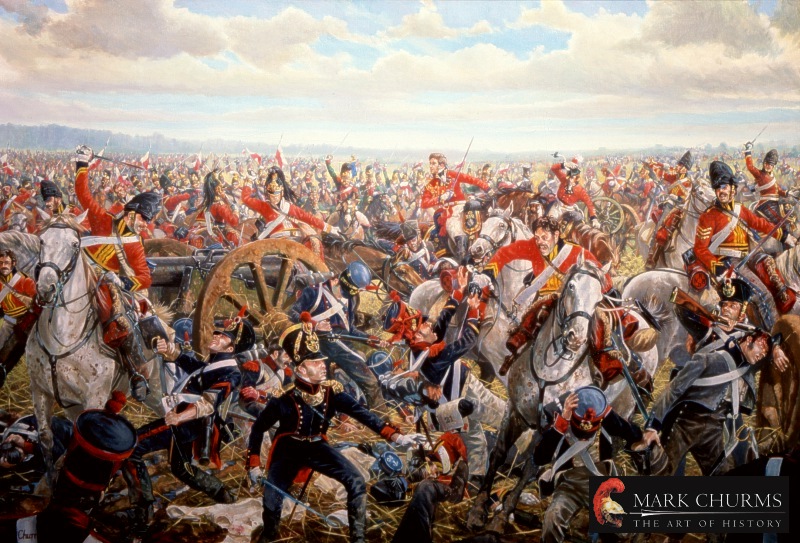 I’ve taken so many notes on this book, its so fascinating (if you’re friends with me on facebook or in real life, you’re probably tired of hearing me rant about how awesome it is). Among my notes are scribblings about how these wars are shockingly worldwide. Why wasn’t this called a World War? I am baffled at how many wars (not just battles, but WARS) were fought, overlapping each other in years and on continents, during this time. Before Napoleon even steps into the picture there’s the 1st and 2nd Coalition Wars (1792-1797, 1798-1802), which I had never heard of because they are always just called the French Revolutionary Wars, which should have given me pause and realization that wars was plural, therefore there was more to the story than just the word “Revolution.” I’m still not 100% clear on how it all works, as more research is needed, because the Revolutionary Wars are dated as 1789-1802. Then, there’s a War between Britain and France during 1803 to 1814, but not the same as the Coalition Wars… Third in 1805, Fourth from 1806-07, Fifth in 1809, and the 6th overlaps the Invasion of Russia from 1812-1814 – but apparently is separate from the War of 1812 which was between the U.S. and Britain. Finally, things wrap up a bit after the War of the Seventh Coalition in 1815. Not to mention, I totally skipped the Peninsular War from 1808- 1814 which was between France and the allied powers of Spain and only ended when the Sixth Coalition defeated Napoleon in 1814. Again, I ask you, why was this never referred to as a World War? Why wasn’t the debate about this being called a World War addressed in school? Why has this whole ordeal always been flippantly glossed over with literature like The Scarlet Pimpernel, Horatio Hornblower, and then wrapped up with Jane Austen and Les Miserables., not that I have a problem with that literature (they are all wonderful and personal favorites of mine). Because I read too much fiction, ok, ok, I get it.
Now, more than ever, I want to know more. I want to take classes at the University of Liverpool where Charles Esdaile teaches. He’s a professor there with a BA and PhD and a FRHistS (Fellow of the Royal Historical Society, I had to look that up, its so cool). But, alas, I am not in Liverpool. Also, I am not in college anymore.
Reading this book made me go do some research that I desperately needed to do. Not just historical research, but personal research. I’ve been wanting, planning, gabbing about going back to school for some time now. But finally, I went to some websites and looked into what that would take. Instead of dreamily telling people I’d like to go back to school and get a second Bachelors from a state school (I currently have a BBA in Marketing and Management: Entrepreneurship) I can now say: I’d like to join the Post-Baccalaureate program at Univeristy of Houston. My first class, when I finally get the finances to go, and the nerve to go up to the school and not worry about the fact that I’d be 10 years older than the traditional students (not that anyone would notice my five foot nothing – I get carded everywhere- self), I’d like my first class to be ANTH 1300: Introduction to Anthropology in the College of Liberal Arts and Social Sciences. There, it’s out there, and you guys are now encouraged to keep me accountable to my dreams.
Until then, I plan to read more books by Esdaile and a number of other historians. Reading this has been a fabulous experience.
Pesky Giveaway Winners
So I tried my very first giveaway in April. An Elizabeth George book that I had on hand, with plans of doing on a month for the rest of the year as I have copies of things that indie authors have sent me and I’d like to share the love, as well as books my brother-in-law had brand new duplicates of and offered them up to me as blog giveaway prizes.
But the winner of my very first giveaway hasn’t given me her address. I have no way of getting her prize to her.
How do you handle giveaways? When do I stop holding out for the original winner and pick a new one? She said in her entry that she followed my blog and my twitter, so in theory she should have got the announcement that she won (as well as the pleas to email me with her address).
Goodbye Mr. Sendak

Photograph by Astrid Christie
I would be remiss as a blogger, book lover, mother, former child, dreamer, and all around human being if I didn’t post something about Maurice Sendak upon his passing. Most famous for Where The Wild Things Are
Sendak made it to a whopping 83 and his life will be celebrated by a posthumous publication of his most current work called “My Brother’s Book” which he wrote in honor of his late brother. How fitting and beautiful that it will be his last new publication, and that he too will be gone for it.
Maurice Bernard Sendak was born June 10, 1928 and died May 8, 2012. For a proper ode to his entire life work, please read the New York Times article here: http://www.nytimes.com/2012/05/09/books/maurice-sendak-childrens-author-dies-at-83.html?pagewanted=all
Art Tones of Tuesday
Book Love Art
Reading about the French Revolution inspires my Bohemian side. And though my art is a little more old lady and not a lot Bohemian at all, I got to painting this morning.
Of course, no painting experience is complete without literary inspiration, and today it was that of the illustrative genius from the author of Gossie and Friends
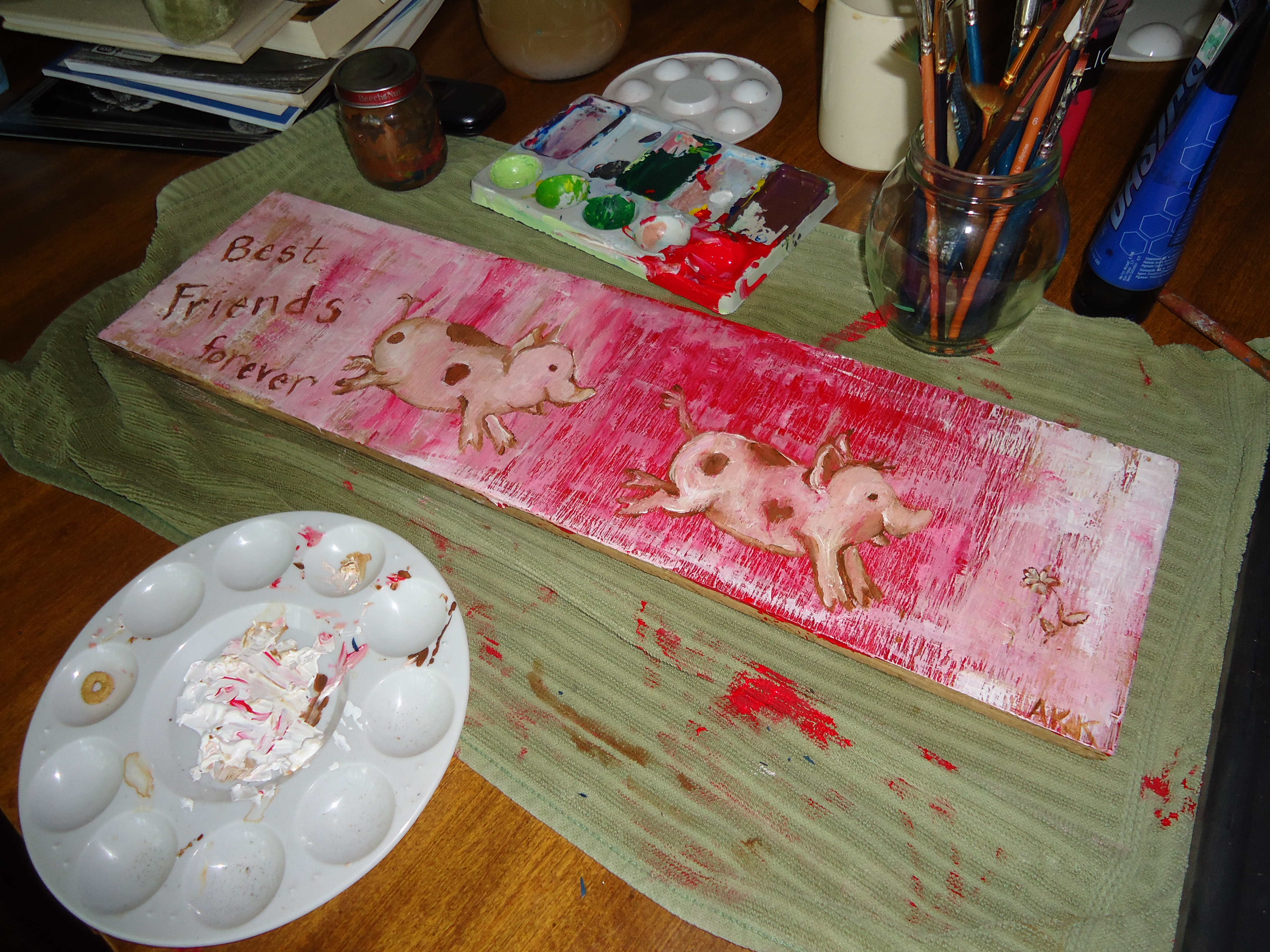
Pig Art

Piggie #1
Steampunk goodness
Love Felicia Day, love books, love the Victorian Era, what’s not to love about this post?

If you love books, you know that steampunk is a genre.
If you’re pretentious, you know three different ways of pronouncing “genre” and scoff — pish-posh! — at lowbrows who pronounce it incorrectly.
If you’re literary agent Cherry Weiner, you know that there are different branches of steampunk (cowboy, gaslight, etc), because YOU INVENTED IT and are too cool for school.
This is an interesting and worthy genre, and all good fun. I believe it is far, far superior to the over-used genres known as “sparkly vampire YA nonsense trying to ride the coattails of TWILIGHT” and “angry elves with lightsabers riding into battle against dinosaurs in spaceships” and yes, those two things basically exist.
As a man who’s only fashion instincts are “three piece suits” and “nothing that makes you look like a doofus,” I appreciate this little video of steampunk clothing, especially the line, “I want…
View original post 10 more words
Weekly Low Down on Leprechauns… I Mean Kids Books 5/07/12
 The Luckiest Leprechaun
The super challenge to parents: Read the whole thing with an Irish accent. I had to summon my inner Mrs. Paroo (from The Music Man), and I know that an actual Irishman would be ashamed of me, but I was quite proud of myself. Ayla may have just thought I was a weird-o, but she had me read it twice in a row even though its pretty lengthy for a kids picture book for her age, so I must have been entertaining.
I highly recommend this one. Justine Korman did a great job portraying a cynical, and somewhat rotten, leprechaun in need of an attitude change, unwillingly becoming best friends with the sweetest dog in the world (named Lucky). Its got the same illustrator as the Junie B. Jones books (Denise Brunkus) although I don’t know that I care for those books, the illustrations are awesome. I loved it. Ayla clearly loved it. It was an awesome library pick that I am sure to go buy, because I’ll be needing this every Spring for years to come.
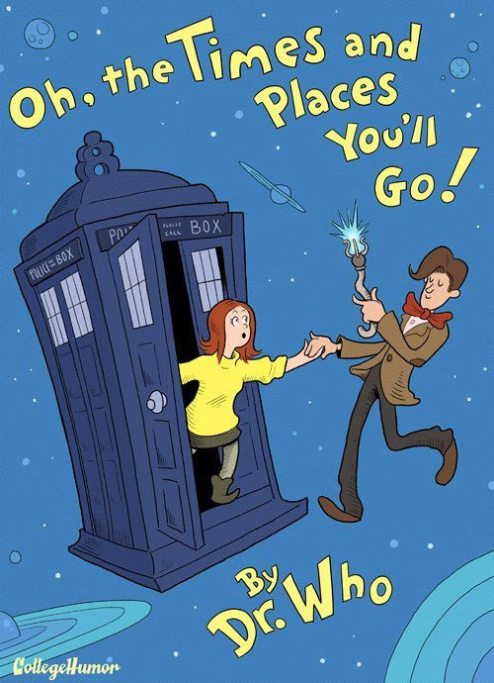
Tardis Adventures in Seuss-Land
It doesn’t get much nerdier than this! Here’s my Book Love Art of the week, this one’s from http://www.collegehumor.com/.
Book to Film Fail
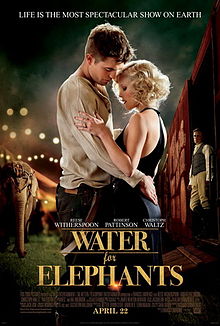 Remember my Water for Elephants review? I loved the book. It was wonderful. Read it in one day, and thought it was lovely. It was lovely in a raw and gritty circus animal way. At the end of my review I let you all know that I hadn’t seen the movie, but I’d let you know what I thought of it when I did. Well, now I’ve seen it and I’m royally disappointed.
It’s too clean.
The set looks clean, the characters are too clean. The magic of the gritty circus look is absolutely missing. I love Reese Witherspoon to death, but she was utterly wrong for the role of Marlena. Her acting is always impeccably perfect, but to no fault of her own she’s too blonde, too beautiful, and too old for the role. Vampire Boy/ Cedric Diggory/ Robert whats-his-face is entirely the wrong look as well. He should be a red head, couldn’t they have dyed his hair? Even the midget is too pretty of a midget. And the character that gets the Jakes should have looked a little more like Dopey from the 7 Dwarfs… no one looks their part. The train is too clean, the tents are too clean. Where are the dust bowls? Where’s the Depression?
In addition to all this clean-ness, the cinematography is too crisp. But not in a new movie way, its crisp like I’m watching an afternoon soap opera, or someone’s home movie. Everything is so bright, in the book I imagined the circus being a small series of twinkles in a long road of darkness.
The structure and mood of the movie is nothing of that of the book. If you’ve read the book, you remember the opening? The scene that sets up the premise for all that is to come – the scene that makes you want to read the rest of the book in the first place? That scene is completely omitted from the opening of the film. What’s so depressing about that is that they filmed it! You see it at the end! Why didn’t they edit it so that it matched the genius of the bookend style that Sara Gruen so brilliantly wrote?
As the last scene closes, my best friend, who waited to watch the movie with me because we both loved the book so much says, “That was lame.”
The movie had no umph.





 Anakalian Whims