An Education in WWII
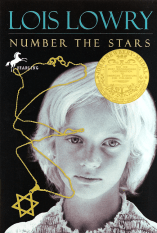 Title: Number the Stars
Author: Lois Lowry
Genre: Young Adult
I have been a long-time fan of Lois Lowry from my wonderful experience with The Giver
What I love most about reading this as an adult is that the book is set in Denmark, and King Christian X plays a role in the landscaping of the novel. I missed out on learning any details about King Christian X during my World War II studies in school, so I pretty much knew next to nothing about him prior to this novel. Not that there is a lot to learn about him in the pages of Number the Stars, but definitely enough to make me want to go pick up a biography on him the first chance I get. The little tidbit in the novel about how he rode the streets of Denmark on his trusty horse, Jubilee, every morning and greeted his subjects is so endearing and immediately peaks my interest. The story Lowry includes about the little boy and the Nazi soldier… ‘Where are his bodyguards?’ asked the Nazi. ‘All of Denmark are his bodyguards,’ the boy responded. Brilliant deviance and loyalty! Did this really happen or is this a bit of fiction Lowry put into her tale? Either way, I like it! Still, I mean to find out the answer!
I’ve decided this wonderful piece of literature will not be lost on the kiddo. The beauty of homeschooling is having the ability to choose the absolute must-reads for her education. The beauty of a classical education is being able to have age appropriate reading material for everything that is meant to be learned. No missing out on any particular piece of literature because it hits the wrong age group when you’re studying any particular topic. Number the Stars has been added to the list; and yes, there really is a list. (It’s never too soon to start writing curriculum!) The other beauty of homeschooling is that as a parent your education is never quite done either. There will always be something to read – something to study – to make sure I don’t miss a beat while schooling the kiddo.
For more about the occupation of Denmark and the nation’s amazing effort (and success!) in saving their Jewish population during the war, visit this site: http://www.auschwitz.dk/Denmark.htm
A Book I mean to check out:


When We’re Not Reading – August Edition

… Is such a great place to take kids. Ayla has a blast just running in any place that has vast, open spaces. Add farm animals and swing sets, and you just can’t go wrong. It’s only $8 a person to get in, so even if you’re not one of those cool people with coupons (like me), it’s pretty cheap if you only have one kid. The baby goats were easily kiddo’s favorite as they were about the size of a one year old beagle, you know before the hounds get fatter, so they were easy to maneuver around. Although we didn’t use these particular things, because we were only there for about an hour, there’s a swimming pool and pony rides too. The most gratifying part for me, as both a mom and a reader, was when she was able to identify the pigs, having seen them previously in her Gossie & Friends

> Kiddo making friends with Guitar playing strangers; these two lovely people were incredibly sweet considering my daughter totally invaded their date night.
Find a parking spot, buy your picnic food at HEB (which is right there), and head on over to the park. Again, the kiddo loves having vast, open places to run and play, and apparently everyone is willing to share balls and frisbees with a toddler. Good thing too, because I think she may have stolen them otherwise. What’s great about hanging out here, I discovered thanks to my bestie, is that you can pretty much hear any concert being held at Cynthia Woods Mitchell Pavilion for free. This is great for families with small kids and poor students because you can pop in for a bit, not feel obligated to stick around for the whole thing, but still hear a great show. Artists will sell demo cds (for donation only, of course) and the hipsters sit around and play their guitars while dads throw footballs with their kids. It’s great. There was a lady there this evening at the Jason Mraz
Meteor Shower
I’d write about our meteor shower adventure last night, but really we just did even more running in fields and caught a few really low flying airplanes that kiddo thought was pretty cool. We sang Twinkle Twinkle Little Star
City of Fallen Angels and Lilith Lore

Lilith in Atrology, click to read more
*Spoilers*
I sat down with City of Fallen Angels over a week ago, but just finished it this morning. The first half was hard for me to get into, having the melodrama equivalent of The Twilight Saga’s New Moon
I have many interests, and though I tend to purchase books sporadically, when reading through my TBR’s I’d like to think that I do it with a little finesse, with purpose. Years ago, I did a brief research day on Lilith, spawned from a conversation I had with someone completely convinced that Adam from Genesis had two wives. I was startled that someone would think this and wanted to get to the root of it all, and spent my astonishment reading through websites, encyclopedias, and other reference material. I have days like this, spent on a particular topic, often. Mostly I end up purchasing things to read later. Who would have thought that Cassandra Clare’s Mortal Instruments
So I plucked The Book of Lilith
The most confusing thing about Lilith (that Koltuv sorts out for the reader well) is all the contradictions embodied in her. She is supposed to be the first wife of Adam, equal to him being brought up from the dust like him, rather than a submissive form pulled from his bones. Yet, she is also a she-demon, according to many as powerful as God, equal but opposite. Some say she is God’s concubine, some say she is Lucifer’s current wife, but still Adam’s ex. She is often linked or married to the King of the Demons known as Samael. Sometimes Samael is thought to be equal to Lucifer, and sometimes he is thought to be Lucifer’s version of Adam, his own creation. All the mythology overlaps making Lilith a strange, cloudy line between humanity and Satan, but always the opposite of Truth, Goodness, and Steadfastness in every way. These characters are full of secrets and lies, evil, and are ever changing according to the story tellers grasp and manipulation. One would expect nothing less from those who are supposed to counter balance God.

Lilith in History, click to view a concise but informative website
The most consistent version of Lilith is that she is a succubus for men, and “for women she is the dark shadow of the Self that is married to the devil” (Koltuv). Like Cassandra Clare’s character in City of Fallen Angels, she is a baby killer and is known as the goddess of dead children, Clare uses this concept as a cult inadvertently kill their offspring via demon blood while trying to please her.
So tied to feminism and the uterus, people also believe that she is ever linked to women in the form of the curse of our menstrual cycle. Tethered to our raging hormones, sexuality, and PMS. This line of thinking eventually made possible the transition of Lilith of evil she-demon to a goddess and Feminist icon/idol. It is amazing that this mythical creature has managed to be so many things (even a screeching night owl and a Leviathan)! Some of the discrepancies can be attributed to the idea of there being two Liliths: a Grandmother Lilith (married to Samael) and a Maiden Lilith (married to a dark prince of demons, Ashmodai).
I find it all rather fascinating. Throughout history people have linked Lilith to hundreds of stories, and though I don’t belive any of them as fact (I personally plop her right in there with Zeus, Athena, and Buffy the Vampire Slayer), I find the use of her in fiction pretty riveting.
A Rainy Day With the Olympics

Gabby Douglas, Winner of the U.S. Olympic Team Trials 2012
Bright and early this morning, I went to my best friend’s house to watch the Olympic Trials (old news, we were watching what we missed of the Women’s Gymnastics Team Trials on the DVR). It had been pouring down rain most the night and well into the morning, keeping my sweet baby asleep much longer than usual. So by the time I was heading over for some Olympic goodness, kiddo still cozy in her pajamas, the streets were quite flooded. It was a delightful morning, sipping coffee, hanging out, watching the best athletes in the country do their thing. It set me up for my whole day.
First, while watching Gabby Douglas rock day two and Sarah Finnegan do that fancy beam skill she shares with Terin Humphrey (Click to see the awesome beam skill I’m talking about: Sarah, Terin), I heard a commentator say something that got me pretty curious about Olympic rules and regulations I wasn’t familiar with already. They were talking about how young Sarah was. Young? I thought. Dominque Moceanu was young. This girl is normal… right? Nope, not anymore.
Dominique Moceanu was the youngest to win nationals at 13. She was allowed to compete because she would turn 15 during the Olympic year, which means she was actually 14 during the summer Olympics when the Magnificent Seven awed the world. That was 1996. In 1997 the rules were changed. Instead of gymnasts being required to turn 15 in the Olympic year, the eminent “they” that makes important Olympic rules added an extra year to that requirement, and now girls must be 16 (or turning 16). So Dominique Moceanu will remain the youngest for quite sometime, because it will be impossible for any equally talented 13-year-old to even have the same chances to prove themselves. In addition to that, there are rumors that the age may be increased to 18! I, personally, am not a fan of these rules. Yes, our children should be protected, but I think there is a higher risk of injury for training that intensely after an athlete has peaked. No, I was never an Olympian, but I am very familiar with peaking as an athlete and then things going downhill from there, no matter how hard you train.
Of course, I discovered all this and formed all these opinions today during kiddo’s nap time, while also polishing off my assigned reading for the day:
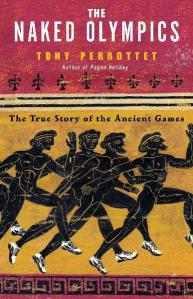 Title: The Naked Olympics
Author: Tony Perrottet
Publisher: Random House
Genre: Sports, Ancient History
Length: 214 pages
Perrottet takes an already fascinating subject and presents it in the form of riveting history. I was surprised how much detail had been discovered regarding the ancient games, and was impressed at how well Perrottet presents it step by step, without leaving anything out. There were so many things included in the games back then, beauty contests, poetry readings; it wasn’t just for athletes, it was an all out ancient world pagan party honoring Zeus and Eros. A lot of this information (though it makes perfect sense and fits right in with what I already knew about the times) was new to me.
I was fascinated by how often names I knew popped up in the commentary… Plato, Socrates, Herodotus… I didn’t expect them at the Olympic games! I also was ignorant of the role the Nazi’s played in our modern view of today’s Olympics, and the lighting of the torch. An interesting tidbit about the Nazis being so fascinated with Sparta kept popping up, along with tales that put shivers up my spine.
Regardless of the Olympic Games origins and history, and how much of it goes against my personal world view and moral standing, I still find the Olympics wonderful. Should you purposely breed Olympians? No. But if someone has the drive and talent and has a passion for it, competing in the Olympics is a beautiful dream and an awesome thing to behold.
Perrottet has done a great job portraying the Olympics for what they are, presenting a well-rounded quick study of the origins of an event which everyone is already familiar. As I plan to educate kiddo classically, I think this would make a fun optional read during the summer games when she hits her teens. I see us doing what we did today, eating tomato, avocado, honey mustard, parmesan cheese sandwiches on toasted wheat, sipping coffee, watching the trials, and doing some research. It could be a fun study/ study break from regular school assignments.
My Classical Re-Education
 As some of you may know, I am a sucker for the classics. I’m also a sucker for lists. In addition to that, I plan to homeschool my daughter. What better books for me then are those of Susan Wise Bauer?
“Using the techniques and systems of classical education, this new guide will give you greater pleasure in what you read, and greater understanding of it.” – from Susan Wise Bauer’s The Well-Educated Mind
I am a college graduate who has had the pleasure of working for a bookstore for some years now and doesn’t want my “education” to end with a Bachelor’s degree in Business. I want to go through Bauer’s list while I pay off my student loans before going back to school. Bauers covers five genres worth of lists of books that people need to read to be fully and classically educated. Many of these a lot of us have already read, and many of these we’ve always heard referenced and talked about reading but have never actually done it.
Lately, in the blog world, I’ve been coming across a Classics Challenge, and was reminded of the fact that there may be others out there who would like access to this list and discussions where other people are reading these books.
For the last few years I have been leisurely strolling through her list provided in The Well Educated Mind:
I am also the admin of a Shelfari Discussion Group called Classical Re-Education and I post reviews and commentary on my reading in that group, links for each book discussion are provided. Of course, I also share my reviews here on my blog.
Cervantes – Don Quixote
http://www.shelfari.com/groups/32384/discussions/89445/Don-Quixote—Cervantes
Bunyan – Pilgrim’s Progress
http://www.shelfari.com/groups/32384/discussions/90600/Pilgrim-s-Progress—Bunyan
Swift – Gulliver’s Travels
http://www.shelfari.com/groups/32384/discussions/91884/Gulliver-s-Travels—Swift
Austen – Pride and Prejudice
http://www.shelfari.com/groups/32384/discussions/96506/Pride-Prejudice—Jane-Austen
Dickens – Oliver Twist
http://www.shelfari.com/groups/32384/discussions/98621/Oliver-Twist—Charles-Dickens
Bronte – Jane Eyre
http://www.shelfari.com/groups/32384/discussions/102210/Jane-Eyre—Charlotte-Bronte
Hawthorne – The Scarlet Letter
http://www.shelfari.com/groups/32384/discussions/104538/The-Scarlet-Letter—Nathaniel-Hawthorne
Melville – Moby Dick
http://www.shelfari.com/groups/32384/discussions/105905/Moby-Dick—Melville
Stowe – Uncle Tom’s Cabin
http://www.shelfari.com/groups/32384/discussions/121736/Uncle-Tom-s-Cabin—Stowe
Flaubert – Madame Bovary
http://www.shelfari.com/groups/32384/discussions/148024/Madame-Bovary—Flaubert
Dostoyevsky – Crime and Punishment
http://www.shelfari.com/groups/32384/discussions/165633/Crime-and-Punishment—Dostoyevsky
Tolstoy – Anna Karenina
http://www.shelfari.com/groups/32384/discussions/212374/Anna-Karenina—Tolstoy
Hardy – The Return of the Native
http://www.shelfari.com/groups/32384/discussions/233628/The-Return-of-the-Native—Thomas-Hardy
James – The Portrait of a Lady
http://www.shelfari.com/groups/32384/discussions/239963/Portrait-of-a-Lady—James
Twain – Huckleberry Finn
http://www.shelfari.com/groups/32384/discussions/319203/Huckleberry-Finn—Mark-Twain
Crane – Red Badge of Courage
http://www.shelfari.com/groups/32384/discussions/319206/Red-Badge-of-Courage—Crane
Conrad – Heart of Darkness
http://www.shelfari.com/groups/32384/discussions/324295/Heart-of-Darkness—Conrad
Wharton – House of Mirth
http://www.shelfari.com/groups/32384/discussions/324297/House-of-Mirth—Wharton
Fitzgerald – The Great Gatsby
http://www.shelfari.com/groups/32384/discussions/324292/The-Great-Gatsby—Fitzgerald
Woolf – Mrs. Dalloway
http://www.shelfari.com/groups/32384/discussions/420041/Mrs-Dalloway—Virginia-Woolf
Kafka – The Trial
http://www.shelfari.com/groups/32384/discussions/435148/The-Trial—Kafka
Wright – Native Son
http://www.shelfari.com/groups/32384/discussions/443717/Native-Son—Wright
Camus – The Stranger
Orwell – 1984
Ellison – Invisible Man
https://anakalianwhims.wordpress.com/2012/09/03/blasted-book-bouncing/
Bellow – Sieze the Day
Garcia Marquez – One Hundred Years of Solitude
Calvino – If on a Winter’s Night a Traveler
Morrison – Song of Solomon
Delillo – White Noise
Byatt – Possession
https://anakalianwhims.wordpress.com/2012/11/04/the-ultimate-possession-a-book-by-byatt/
As you can see, I just recently finished Kafka’s The Trial and will soon be starting The Native Son. I’d love for others to join me.
Have you read any of these lately? Which were your favorites? What would you add to the list if your goal was to walk people through the History of the Novel, as Bauer’s has done?
P.S. Susan Wise Bauer will be lecturing at the Texas Home School Coalition Southwest Convention The Woodlands, Texas, Thursday-Saturday August 2-4.
The Communist Manifesto by Karl Marx
 “The Communist Manifesto
For that reason, I think everyone should read this book and grasp a greater understanding of the world around them. At the risk of ‘igniting violent debate’ I’ll let it be known that I disagree with the concept. I am especially opposed to the idea of the abolition of a right to inheritance, as I would love to pass my library down to the future generations of my family. Perhaps some things should be a little more equal, but I like the individuality we have in being able to select what we purchase and accumulate. I enjoy the right to educate our own children, having the privilege to opt out of public education in order to give our children more – more knowledge, more quality time, more love.
Banvard’s Folly A Must Read
 Paul Collins is a genius and I love him. If I have children, they will learn history from this book (as I will home school)… these people will all be included in their lessons from when we’re studying Nathaniel Hawthorne and Emily Dickinson to Thoreau and the Concord Grape. John Banvard will be discussed when learning about art and art history as well as financial wisdom. We will discuss Delia Bacon in relation to the people she corresponded with as well as when we study Shakespeare… along with her, Coates’ adventures as Romeo will be a humorous anecdote to read between plays and the discussion of various acting techniques. This is a fantastic piece of history that I find amazing the world has forgotten. Let’s bring these stories back for the future generations! Thank you Paul Collins for bringing them all back to life in the pages of your book.





 Anakalian Whims
Seed Savers – a series to be treasured
June 8, 2012 at 1:00 am (Education, Reviews) (books, Christian fiction, dystopian society, fiction, gardening, homeschooling, kids books, reviews, S. Smith, Seed Savers, self-sufficient living, series, social commentary, Treasure, young adult)
Author S. Smith has written the latest and greatest of young adult dystopian society novels. In the spirit of the previously mentioned Lowry novel and and Monica Hughes’ Invitation to the Game , Smith has given us solid middle grade tale featuring a new (and somewhat real) futuristic threat – illegal gardening. It’s yet another great pre-cursor to students preparing to read Orwell’s 1984
 . Educators everywhere should be aware of this rising star in children’s literature.
The detailed history of how this society came to be is part of its unique twist. Most dystopian society stories don’t spend a lot time telling you how it got this way, just that it did and people didn’t notice, the path somewhat alluded to but not specific. Smith helps point out the steps leading up to this future with factoids that suspciously resemble things that are happening in both the farmlands and corporate America. From living organism patents made legal in the 1980’s to genetically engineered seedlings, Smith spells out just exactly how this future (though a little outlandish in a society newly obsessed with being eco-friendly in its marketing) could quite possibly go from where it is now to the kind of United States described in the book (corporations and the government in bed with each other making trouble for the little people – Banks, anyone?… in combination with the idea that a government can make a plant illegal – marijuana comes to mind). Yet, she does this effortlessly, without killing the flow of the story.
I personally love social commentary presented through the art of fiction. (You like this too? Check out this site: http://www.jstor.org/discover/10.2307/371512?uid=3739920&uid=2129&uid=2&uid=70&uid=4&uid=3739256&sid=56242603693). I find it compelling and quite frankly the best way to address particular situations that when written about in a nonfiction format becomes an irate rant. I love the way it personalizes events and characters in a book so quickly, in a way that the average story cannot do. Get under the skin of an art fanatic… make it impossible for art to be appreciated, collected, loved (if you’re not a reader, check out the movie Equilibrium, then again, if you’re not a reader what’s up with you reading my blog? What brought you here? Leave me a comment.) Tug at the heartstrings of a gardener… attack the very core of their being by telling them in this reality, they can’t have one.
Needless to say, I loved it. S. Smith, you are brilliant, my dear, and I can’t wait to read the rest of the series. This one is going on loan to my nieces and nephews, is getting short listed on my very long list of required reading for my daughter who will one day be homeschooled. It will be the fun fiction to parallel our botany classes that week, the friendly reminder of why she will be taught to tend her own garden, and perhaps raise a chicken.
Buy Your Copy of Seed Savers Today!
Visit the author’s website here: http://authorssmith.com/
Want to start your own garden (before its too late!), check out Mel Bartholomew’s Square Foot Gardening tutorial: http://www.youtube.com/watch?v=N5Lu-7FIj_g
Also for fun, check out this blog: http://www.thisgardenisillegal.com/
Permalink 10 Comments