There is a Season
As a homeschool mom there’s a constant struggle for designating specific “school times” through out the day. She is learning that education is a life pursuit, and at four can tell you that. I can’t tell you how adorable it is to have a four year old look at someone when they ask her about school and tell them, “Education is a life pursuit.” Every day, every moment, is a chance to learn something – and she is extremely aware of this as we stop to read information along trails, get sidetracked by research projects after asking a simple question, and discuss the scientific reasons things are happening in the kitchen as I cook. But sitting down for specific lessons, that’s a bit harder to grasp. We open our reading book and she thinks that crazy silly time shall commence. She has a stubborn nature she gets from me combined with her father’s joy of watching me fume with frustration, seriously, I get angry and she laughs at me. It’s a problem.
Someone from one of the homeschooling forums on Facebook gave us a great idea, though. Read Ecc. 3:1 before every lesson. Don’t know that one off the cuff? The “lyrics” were made famous in the 1950’s by The Byrds.
The concept of there being a proper time and place for every activity and emotion, is a necessary lesson to teach toddlers (and kids, and teenagers, and humans at large). Emotions, feelings, and attitudes toward chores can be intense. There is a time to feel those things and a time to suck it up and do what you have to do. Just like a gardener has “a time to plant and a time to uproot” there’s also “a time to weep and a time to laugh.” We end the reading of these verses with, “there is also a time to be silly and a time to focus on your lessons.”
Needless to say, both little girl and I were excited to find this book at the public library last month.
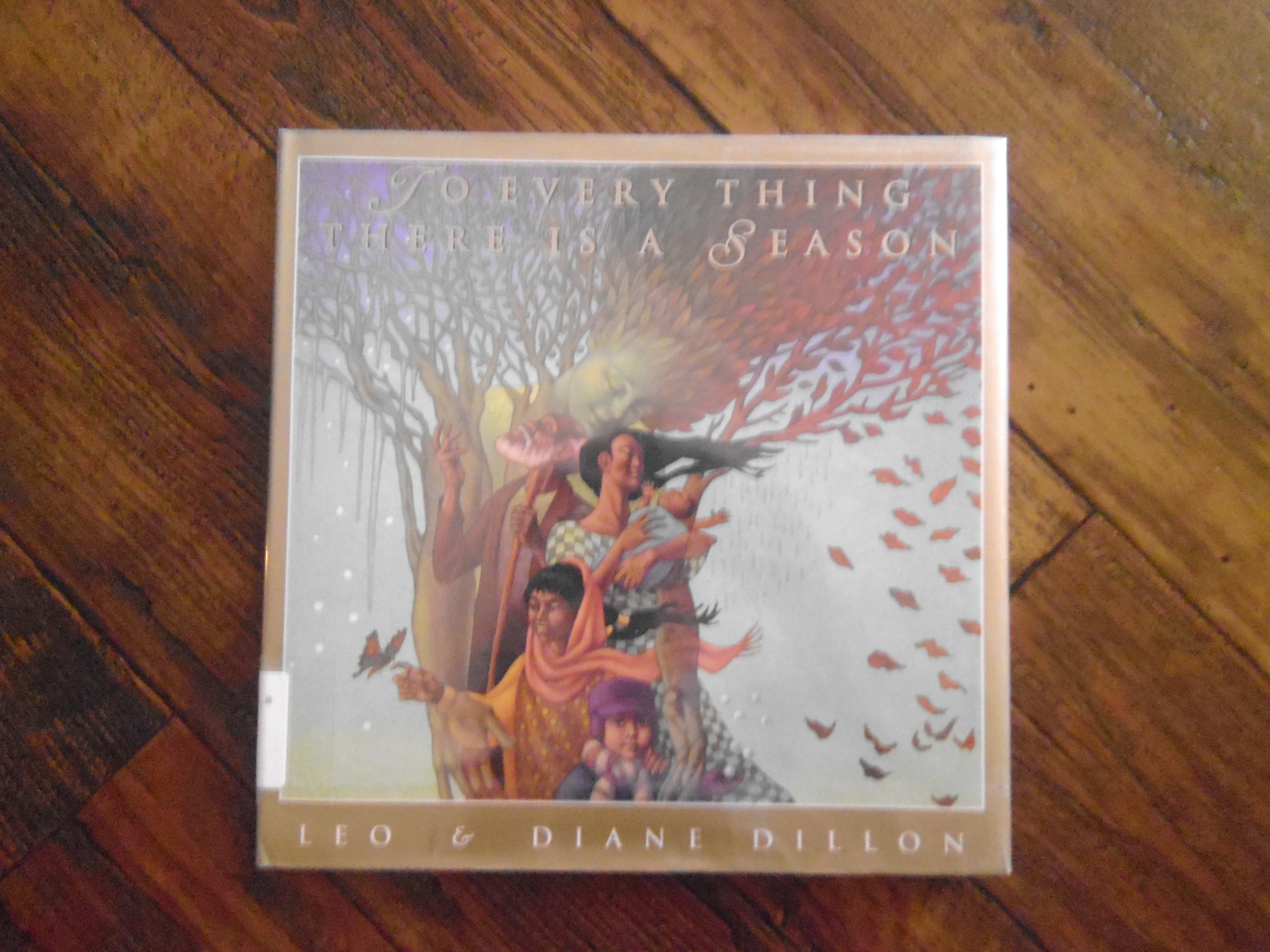
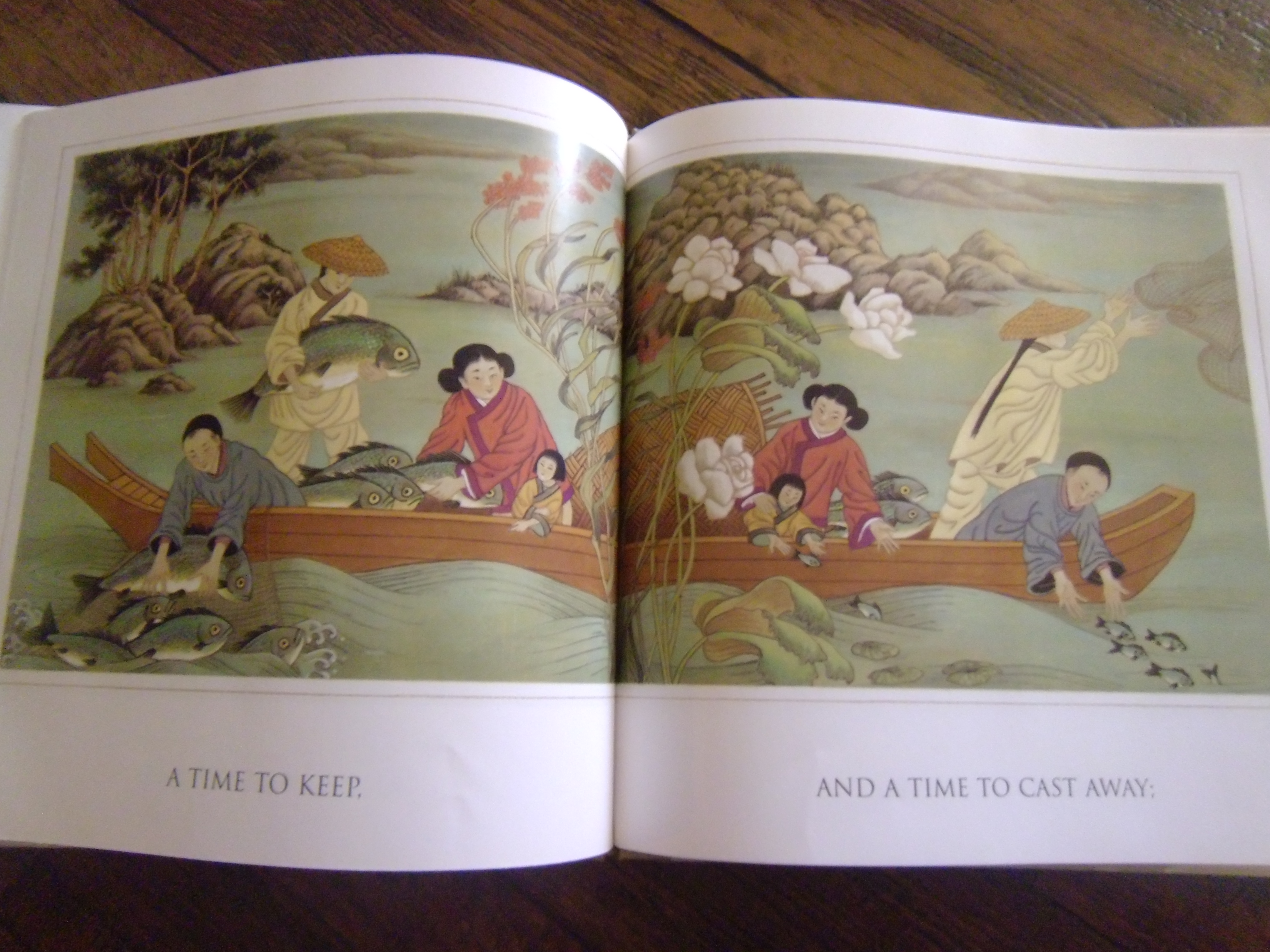
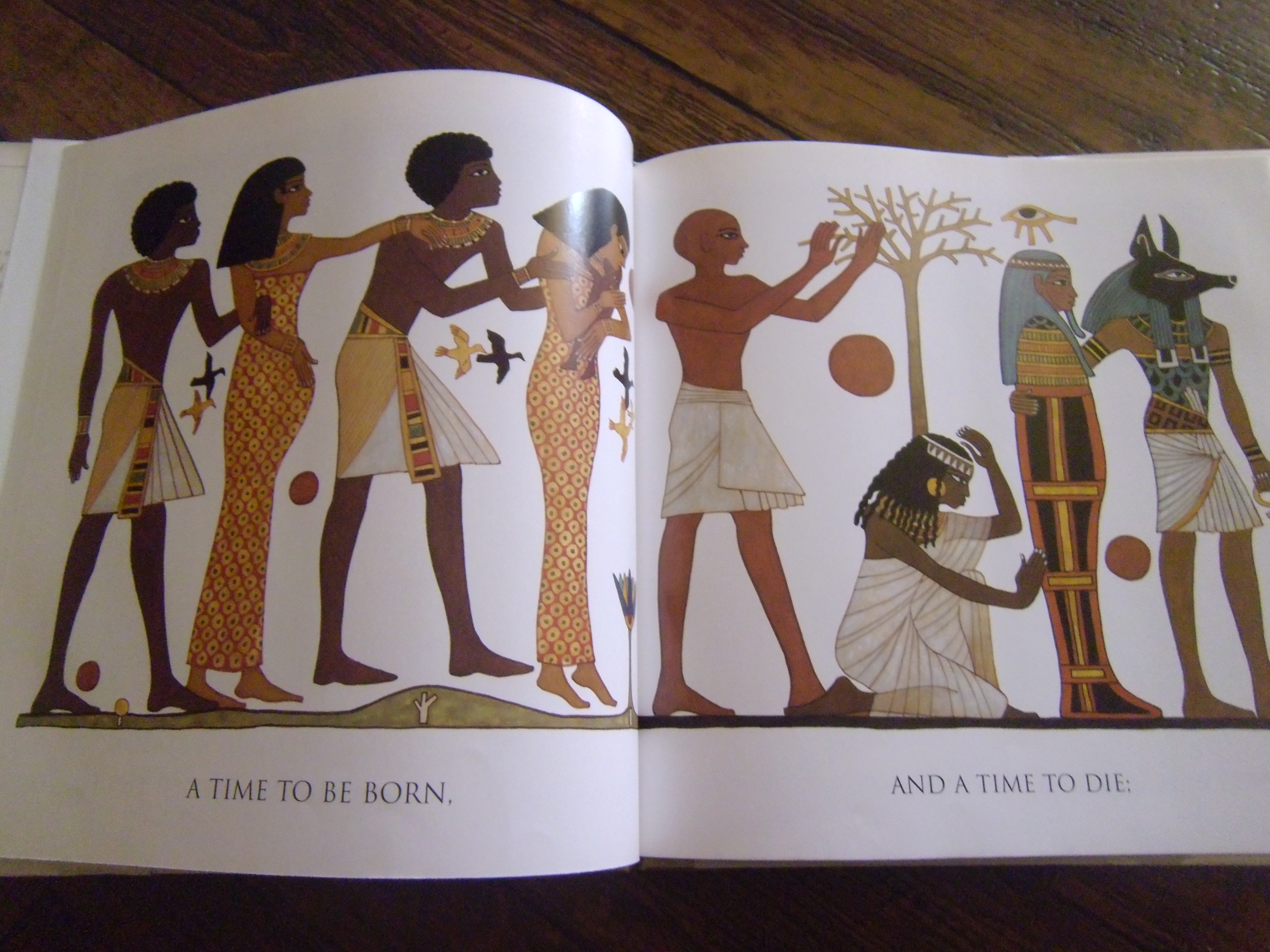
This picture is beautiful. It reveals art styles from all different regions, cultures, and time. It gives a child a great sense of the impact these words have on every human throughout history. Everyone must learn this lesson, the fact that everything has a time and place. That feelings can and will be embraced and (if we want to be overly bookish and quote An Imperial Affliction – a book by a character imagined by John Green in The Fault in our Stars) and say, “Pain demands to be felt,” but as every grown person has learned at some point, sometimes it can’t be felt right now. For a four year old, the wiggles must come out… but they can’t always come out right now either.
And everyone must learn this lesson. Whether you are from China, Russia, Germany, Egypt, or Ancient Greece. Whether you are Native American or from the heart of Mexico. Whether you hail from the Ukraine or Australia, Japan or England. Humanity is united in this one all encompassing lesson of life: “There is a time to mourn and a time to dance… a time to search and a time to give up… a time to love and a time to hate… a time for war and a time for peace.”

Hello Wilderness, We’ve Missed You
Since moving away from our beloved Timberlane Estates, we’ve been in dire need for nature. Especially with this winter we just had – harsher than I remember winter being – wet, muddy, colder sooner, and nowhere cozy to defrost. Temporary living arrangements have caused us to leave the comfort of having a nearly 1000 square foot library just down the hall from our beds. We also don’t have a fireplace here. It’s been a long time since I lived without a fireplace. But the change is good, it’s helped us redefine necessities, discover the beauty of new public libraries we hadn’t yet visited, save m oney for the land and dream home we want, and teach our daughter lessons she might have otherwise missed.
We’ve also discovered the Lake Houston Wilderness State Park. We went from 100+ acres of trails and exploration that we knew like the back of our hands to not having anything most of the winter, to Lo! And Behold! 4700+ acres of trails and wilderness closer than we could have ever imagined. Ask and ye shall receive. Take a ride down the highway and pay attention to those marvelous brown signs!
It costs $3 per adult to get in, kids under 13 and senior citizens are free. OR (and this is what we’ve done) it’s $25 for a year pass for an adult and three adult guests; basically, a family pass.
We’ve been back about every other day since we’ve discovered it. We walk, tromp, and read. We snack and picnic, we play in the creek, we stare at the trees. We read all the sign posts and discover new plants we’ve never heard of. We soak up vitamin D and work our muscles.
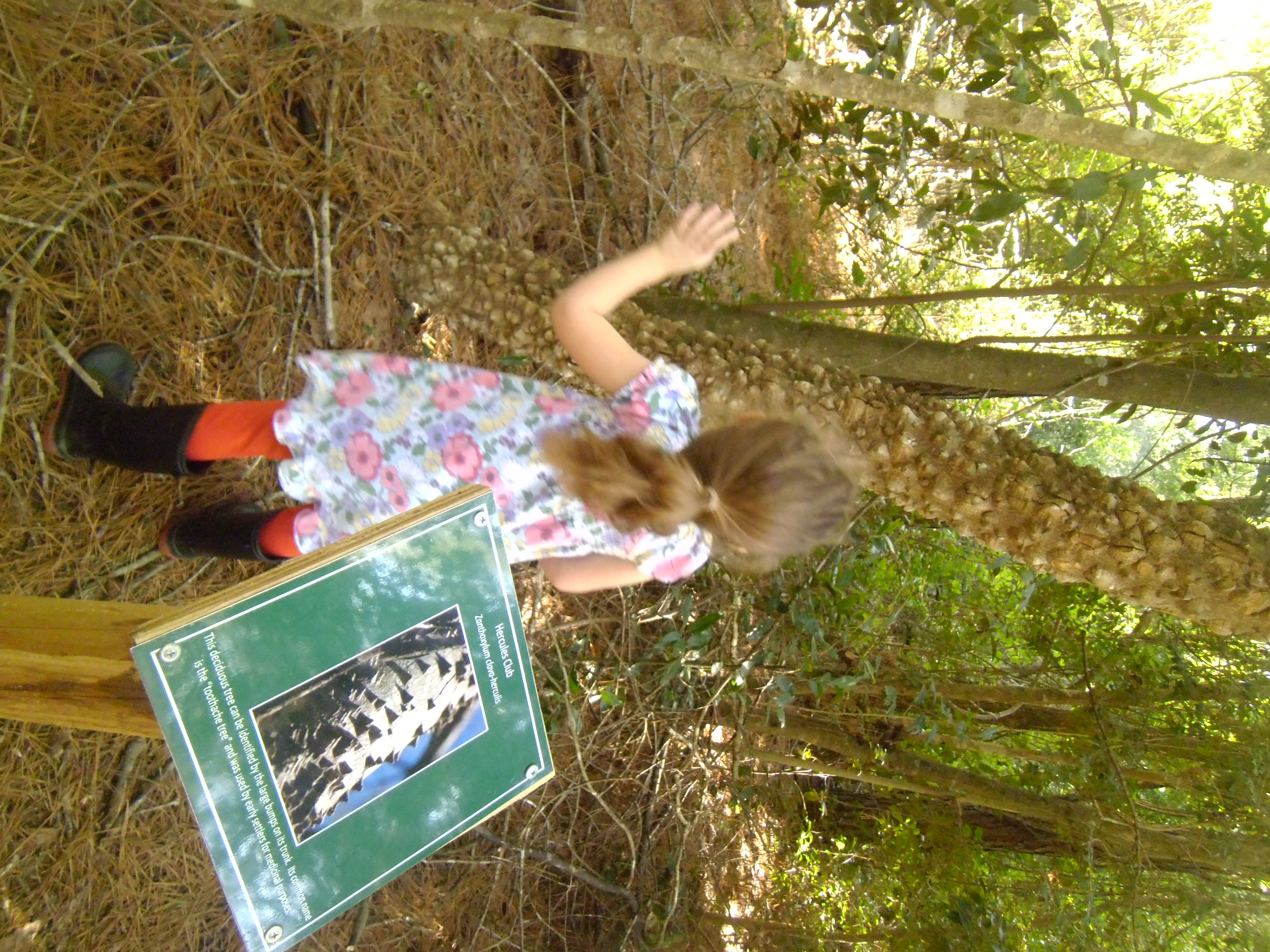
To the left you’ll see a Hercules’ Club. We were pretty excited about this discovery and did a mini-research project on it when we got home.
In all this much needed tromping and new library resources at my fingertips, I stumbled across a Guide to Wild Foods and Useful Plants
Teaching Life and Liberty
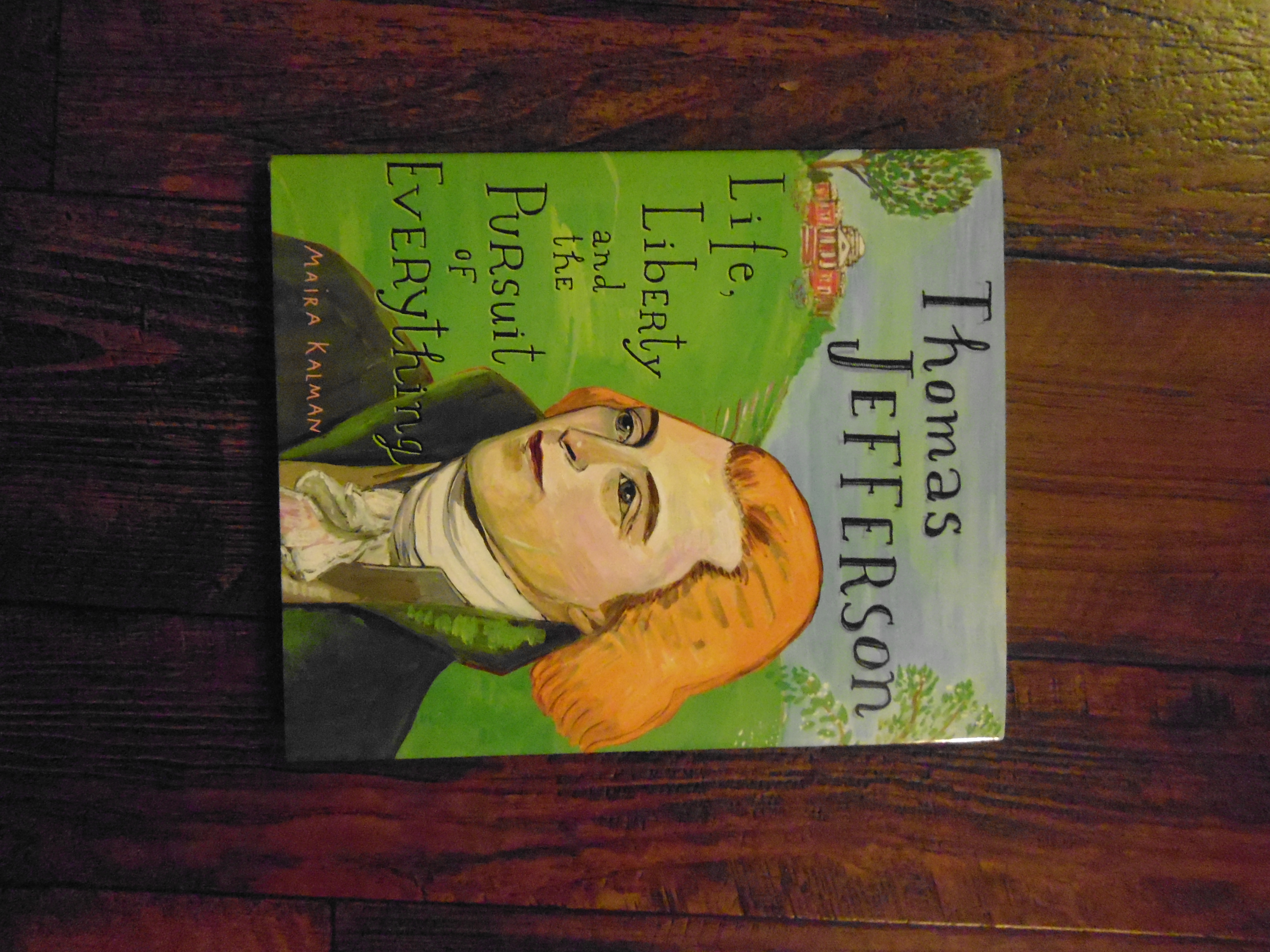 Title: Thomas Jefferson
Author/Illustrator: Maira Kalman
Publisher: Penguin
If you want to teach about the founders of America via biographical picture books, Maira Kalman is a great place to start. With spunky pictures and fonts, Kalman introduces children to Jefferson (and in another book she tackles Lincoln), his love for books, language, and gardening.
Kids can discover in Thomas Jefferson quirky details about how Jefferson got out of bed in the morning, his obsession for peas, and learn the quote he told his wife:
“Determine never to be idle. No person will have occasion to complain of the want of time who never loses any.”
There’s a few pages dedicated to Jefferson’s friends: John Adam, Benjamin Franklin, and George Washington, and the ideals the team struggled for.
Kalman doesn’t pull any punches. She talks about slavery and addresses the truth of Sally Hemings. Jefferson had so many wise quotes that adults praise and sharing them with a four year old is especially wise:
“When you are angry, count TEN before you speak; if very angry, to ONE HUNDRED.”
The book ends with a visit to his burial grounds and notes regarding his epitaph.
As a whole it’s lovely and educational. When I told kiddo I was finally posting the review and asked her what she wanted to say about it, she said, “I think we should read it again.”
President’s Day is fast approaching. This one is worth having in your hands on that day.
A Boy Called Dickens
* A Weekly Low Down on Kids Books *
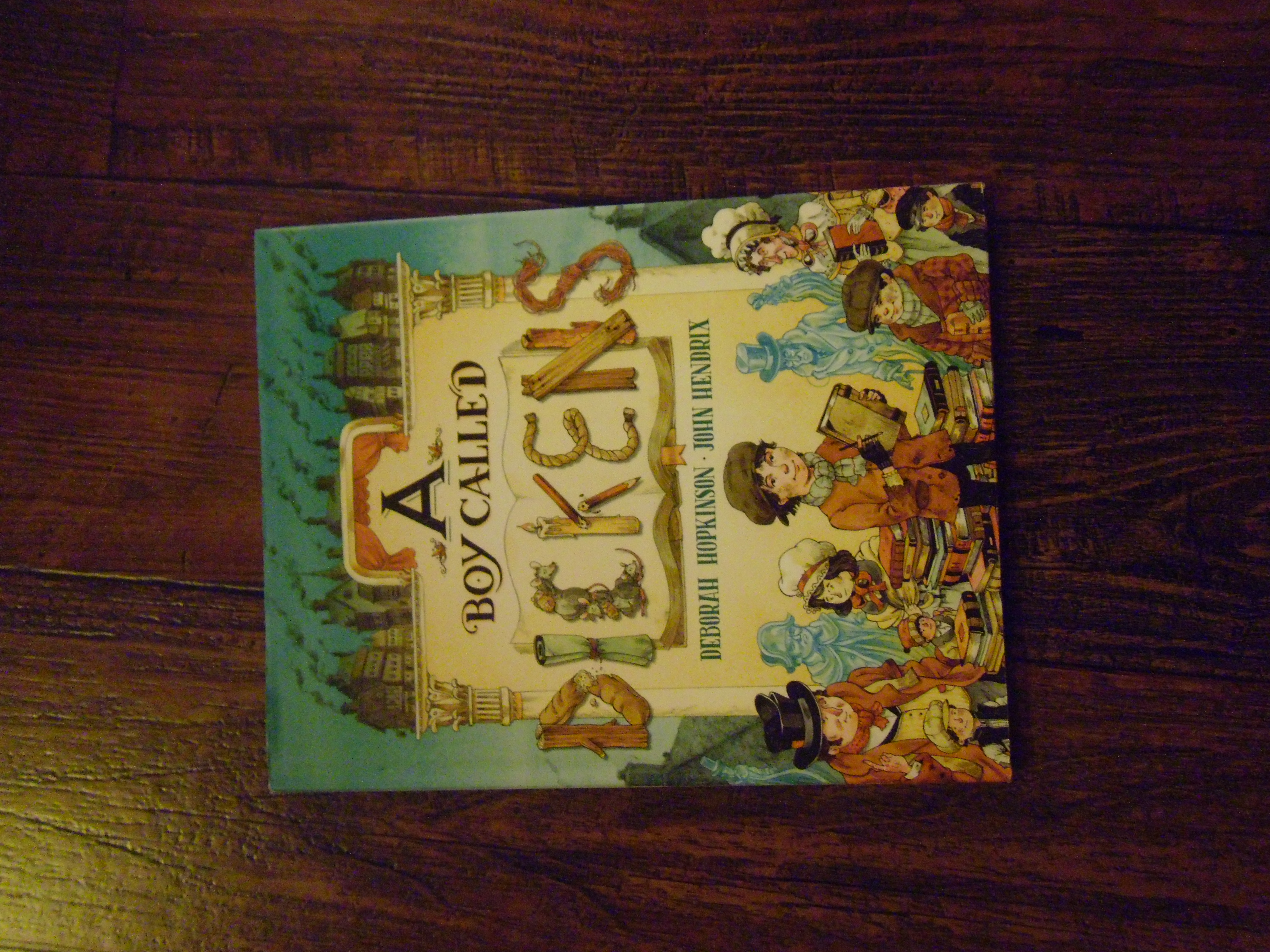 Title: A Boy Called Dickens
Author: Deborah Hopkinson
Illustrator: John Hendrix
As a homeschool family, we’re suckers for the educational picture book. Especially biographies.
A Boy Called Dickens tells the life of Charles Dickens. Obviously there are some creative liberties taken with Dickens’ boyhood thoughts and how he might have come to write certain stories, but that happens with any piece of biographical fiction.
As an adult Dickens fan, you recognize characters peeking around corners and haunting the boy’s subconscious as he works at the factory, tells stories to his friend, helps get his family out of debtor’s prison, and finally returns to school.
When I finished read the book, kiddo said, “Let’s read it again.”
I was out of breath from my strained fake British accent. I’m not an actress, but I like to make story time fun. It takes more effort than I’d care to admit. “No, I’m not reading it again right now.”
“Well, I think we should do the same thing with this one – let other kids read it!”
“You mean you recommend it?”
“Yes.” She gave it a literal thumbs up, with a tongue half sticking out the side of her mouth in thought.
Any biographical picture books you can find are great teaching tools, and you might as well fill them with as much information as you can while they’re sponges. History is easiest to remember as a tale, Dickens world and era becomes one you can touch and taste. Telling it from his boyhood makes it more relatable to a tiny one. Whether you’re a homeschool mom, or just someone who reads to your kids when you can, this book is a great resource; it’s colorful, factual, and engrossing.
(If you’re a seasonal reader, this one is perfectly wintery.)
Houston Pow Wow 2014
Already in the mere four years I’ve been a homeschool mom, with my child not even “school age,” homeschooling in general has proven to be as much an education for me as it is for her. When you homeschool, field trips feel imperative. Not only do you want your kid to interact in the world, but even the most extreme homebody, if not an agoraphobe, gets a touch of cabin fever now and again.
 In 2012, we discovered that Houston has an annual Pow Wow and attended. I documented that trip here. The kiddo loved it. We studied everything a two year old could “study” about Native Americans at that time and watched a lot of Pocahontas after the event. The culture, the dancing, the drums, the music, the food, I tried to dip my very pasty child in the whole experience. She came away desperately wanting an out fit just like the girl’s she took a picture with in my previous blog post (see left).
Life happened and we missed the 2013 gathering, though we do intend to attend every year.
 This year, though kiddo didn’t do much in the way of pre- Pow Wow “research,” I felt the need to grab a book. On my lunch breaks I’ve been perusing The Five Civilized Tribes
I’m not done reading, so a full review cannot commence. Currently, I’ve read through the Choctaw segment and now am knee deep in the Creeks. The book, however, is thorough and enjoyable though – as the Christian Science Monitor reported – “pure history, sober, and fully documented.” One would assume that it would read dry, but it’s not. Sober and dry should not be used interchangeably when speaking of history, but often it is. Especially when dealing with the history of the Native American Indian tribes. Their cultures are too colorful and their history too rich to ever be considered dry.
My favorite bit about the Choctaw is how thoroughly devoted to educating their children they were. Building school houses and hiring teachers was a huge deal for them. They built educational requests into their treaties. Although I don’t agree with institutionalizing, I do find it interesting how much they wanted to learn about those infiltrating their land. Some would say that it was an effort to assimilate, but I don’t think so. I think it was more of an effort to understand. Understanding and knowledge is important to me, though, so perhaps that is always how I will interpret those sorts of actions.
 We don’t speak with the competitors at the Pow Wows much. I’d like to know what tribes they are affiliated with, who their ancestors are, whether they live next door or on a reservation. I’d like to talk to them all, interview them all, watch them all more closely. But they are there for a competition and seem to be far more in the public eye than what could possibly be comfortable. Instead we politely nod, smile, purchase raffle tickets for Indian Blankets, donate money to musicians, and try not to take too many invasive pictures of the dancers. Instead, my child makes friends with their children for the day and blows bubbles, and desperately contains herself from touching their bead work and feathers, lest a fiercely intense father of a playmate scowl at all his hard work being undone.
The event is beautiful. It’s all so beautiful.
Today, however, it was rainy and cold. The Pow Wow had to be moved from the arena to a pavilion. The show must go on, though, rain or shine, and despite the cold and the wet, they danced, and they were brilliant and kind. Kind – even when my daughter said quite boldly during their prayer time, “But Indians DON’T PRAY!” I promise I didn’t teach her that. I popped her little butt and said, “Everyone prays, now bow your head.”

Literacy and Education
Every day I read. And since having a child, every book I read is filtered through a mental checklist of sorts: Would this be useful to Kiddo? How would I feel about her reading this? What age is this appropriate for? How can we apply tools, principles, morals, themes, etc. that we learn from reading this to our lives?
Does this mean she’s the center of my universe and I do it all for her? No. I read for myself. It might not seem like it when I’m making lessons plans, blogging reviews with Amazon affiliate purchase links (every time YOU buy a book by clicking the link from my site, a portion of that money is used as much needed income – thank you), posting about bookstore events, etc. But I do so much of it for me it verges on selfishness. This is my vice, my hobby, my job, my world. I am a book fiend and somehow I have made that work for me on as many fronts as possible.
But even with all that self-serving book binging going on, determining how my reading material could mold the mind of my child – whether directly or indirectly – is a constant subplot to my life story.
If I weren’t homeschooling, would I have been interested in titles like Why School?
I laughed at myself several times this week. By the time I’m done raising my daughter I could have a PhD in education, going by my thirst for educational theory. However, it’s not even remotely close to what I desire to earn a PhD in. Is every parent required to study this hard? No. Is it necessary to do all this leg work to be a homeschool mom? Absolutely not. You are qualified to teach your child just by virtue of being their parent and longing to make a priority of their spiritual, educational, and physical growth, of viewing your parent-child relationship as something worthy of being tackled with excitement and care. But for those naturally driven to research and reading, for those who have undeniably lofty ideas regarding the swoon of academia, for those who possibly have an unhealthy love for pens and paper, stacks and shelves, mahogany and oak, for those people it’s a little hard not to fall “victim” to the pull of differing philosophies regarding your life choice to teach your child yourself. (God help me when it comes to instructing her on the laws of grammar as I’ve never quite mastered getting over run on sentences, they are my favorite grammatical mistake. Those, and sentence fragments, I suppose.)
 Why School? is a diminutive sized hardback with a picture of an old one room schoolhouse on the front. Behind the schoolhouse – identical to what I long to build on my future homestead, although much larger I’m sure – is a vast sky of blue inviting you to all the possibilities contemplation and the school of thought might have to offer you. The book begins with a tale about a janitor who had suffered some brain damaged, but chose to work at a community college to be around “where it happens” and to have access to materials he could study and/or take home to his daughter. It was a beautiful tale regarding academia and how it is viewed from different sets of eyes. Most people see it as a mandatory road map in life, one they can’t get out of. Some see it as a golden ticket to the land of opportunity. Few actually see it for what it is meant to be: a place to learn.
The author, Mike Rose, talks about many things regarding school and college and life. He discusses blue collar life vs. white collar life. He addresses a few political issues, some I agree with and some I don’t. But one thing is clear: he is passionate about learning. He is passionate about education. Rose’s goal is to make others aware of the importance of developing the mind and taking charge of what we put in it, whether it be tools and life skills or book facts.
“We live in a time of much talk about intelligence. Yet we operate with a fairly restricted notion of what that term means, one identified with the verbal and quantitative measures of the schoolhouse and the IQ test. As the culture of testing we live in helps define achievement and the goals of schooling, it also has an effect on the way we think about ability.” – pg. 73
I loved that part. I loved how he addressed the parts of the brain used by those who work with their hands. My husband works with his hands, he is a millwright. More than anything, I want to balance my child’s developmental education with things both her parents are passionate about. I want her to continue to love books, but I want to allow her to be passionate about building things (the girl is a master tower builder when it comes to legos and VHS tapes). So much creative energy is dismissed when people look at their mechanic or a machinist. People do not understand how even your diner waitress is the Queen of her domain, has mastered brain patterns you cannot fathom, and has an internal clock and rhythm you could not duplicate without years of practice and training. I understood this example Rose provided well, having waited tables just long enough to say I learned to do it the best I ever could and could not do it forever. (I was a good server, well-liked by most my customers, but I was no Wanda.)
 I read chapters of Rose’s book in between dives into Adolescent Literacy Research and Practice. Where Rose is quaint and inspiring, though thoughtful and well-spoken, Adolescent Lit. is all academic essays, lengthy work cited pages, references to studies and schools of thought. The book is written by public school educators for public school educators, but one would be remiss if they didn’t hear the constant hum of “Homeschooling is the answer” to nearly every issue they address. The writers would laugh, I think, as there is an entire section dedicated to how people tend to read things and find support for their own arguments and core beliefs even where there may be none.
Timothy and Cynthia Shanahan were the contributors I enjoyed reading the most. They talked in great detail about what literacy is truly about, what being able to write is for, and how important it is in the education process to not confuse its purpose. Literacy and developing good writing habits are at the core of understanding any subject – not just literature – but math, science, and history as well. Writing isn’t merely about communicating what you have learned, but a process of diving deeper into a subject and gleaning a more thorough understanding of it. Not just about memorizing facts and regurgitating, but thinking about what those facts mean to you and how that may or may not affect your world view. It is about engaging the brain and coming up with new thoughts about old concepts. It is about developing theories from research. It is about invention and progress. It isn’t just about basic comprehension, it’s about eventual enlightenment on any given subject.
Several essayists in the book discuss the issue of the misconception that writing is only for the literature major and how there is only one way to read. There is great detail on how the practices for reading a science text cannot be considered the same as those to read classic fiction. So many do not address this, which is why we have children in our schools reading their chemistry and physics homework, plodding their way through formulas, but they haven’t internalized it. They only barely understand, it’s passion-less math or vague theories… whereas teaching these same kids how to read their science text (and giving them more than just standard textbooks, but also journals produced by scientists and articles from the professional world) will bridge the gap between the information and the passion to do something with that information. Not everyone is Einstein, but we are not raising independent thinkers with a drive to feed their brains. We are raising frustrated honey bees who have been deprived of pollen, and by doing such a thing they become useless drones who produce nothing.
I say this screams “homeschool is the solution” to me because the essence of the discussion in the book is teach a child to read for each appropriate discipline and you give them the world. You teach them how to teach themselves. You teach them how to use their brains and be studious and good stewards of their minds. Not for the sake of a grade, not for an award or blessing, but for the act of embracing the knowledge itself. We are driven by standardized tests – and I get it, how else do you assess where a child is when you must maintain some semblance of order while still addressing the needs of 30 students at a time. How else do you sort them out and provide the best education possible? If you can, you teach them at home. Smaller classrooms, a personal relationship, true observing of where that child is developmentally and how you can aid them on the path to true literacy. In Texas a homeschool is considered a private school run out of the home. If there was nothing I liked about Texas (and I love Texas, but if I didn’t), this fact alone would keep me here as long as possible.
There’s also a thing called Unschooling that I’m finding more and more I lean to (I am combining classical education and unschooling education styles in my “private school” that is the Klemm home). Unschooling is child driven. You pursue their interests with a passion when they have them. You learn what you can while they are motivated to learn it. Every moment is a possible classroom moment. The other day we researched praying mantises after discovering one in the garden we were weeding. Kiddo was so excited and immediately went to her bug book and found a picture of one, thrilled to see something in the book that she had just seen in real life. Well that’s easy when they’re in pre-school, people like to say. Yes, it is. But it can continue to be that way as they get older.
“Reading classrooms at the secondary school level typically tend to minimize student choice (Guthrie & Davis, 2003). However, giving students opportunities to ‘self-rule’ and ‘self-determine’ can make learning more personally meaningful and intrinsically motivating (Deci & Ryan, 1985, Deci, Vallerand, Pelletier, 1991; Ryan & Powelson, 1991).” – pg. 286
What do you think?
Welcome to PreSchool at “Klemm University”
Teach Your Child to Read Outside and Play – A Lot
It’s been awhile since I shared a bit from our homeschooling adventures. Since my last homeschooling post, we purchased Teach Your Child to Read in 100 Easy Lessons and have progressed to Lesson 9. We’ve taken Poet Laureate and Professor Mark Strand’s advice about memorizing 1500 lines of poetry and memorized the first four verses of Psalm 1, with the intent of memorizing a verse a week until we know the whole book by heart (no, I did not do the math on this and I have no idea how long it will take – I think the less I know in this regard the better). We’ve moved, and have done a lot of exploring our new school-site – via bubble blowing. We’ve learned to play Checkers (pretty exciting for an almost four year old), and we’re tackling bead projects.
Drawing Dinosaurs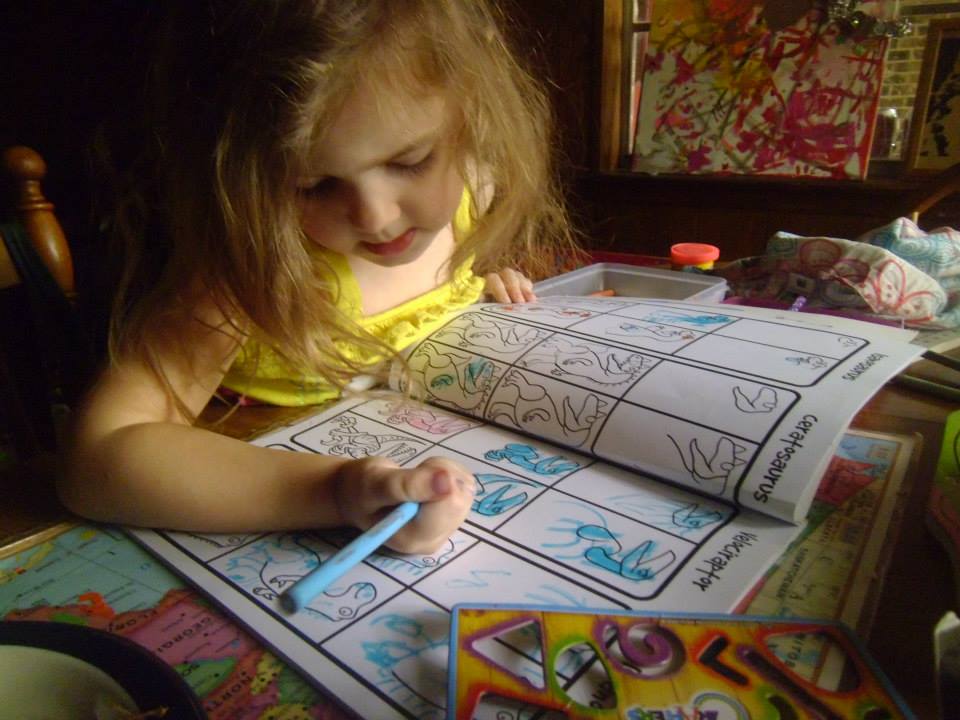
She got this cool dinosaur coloring book awhile back, but has really taken to it in the last few months. The book teaches your kid how to draw properly named dinosaurs step by step. Whether you’re a die hard dinosaur believer, or a skeptic to their existence, all kids love dinosaurs – they’re just so cool!
Activity books like these teach kids to follow step by step instructions, help with dexterity and handling writing utensils, and keep them busy for thirty minutes to an hour at a time. Win, win for everyone.
Moving and Acoustics
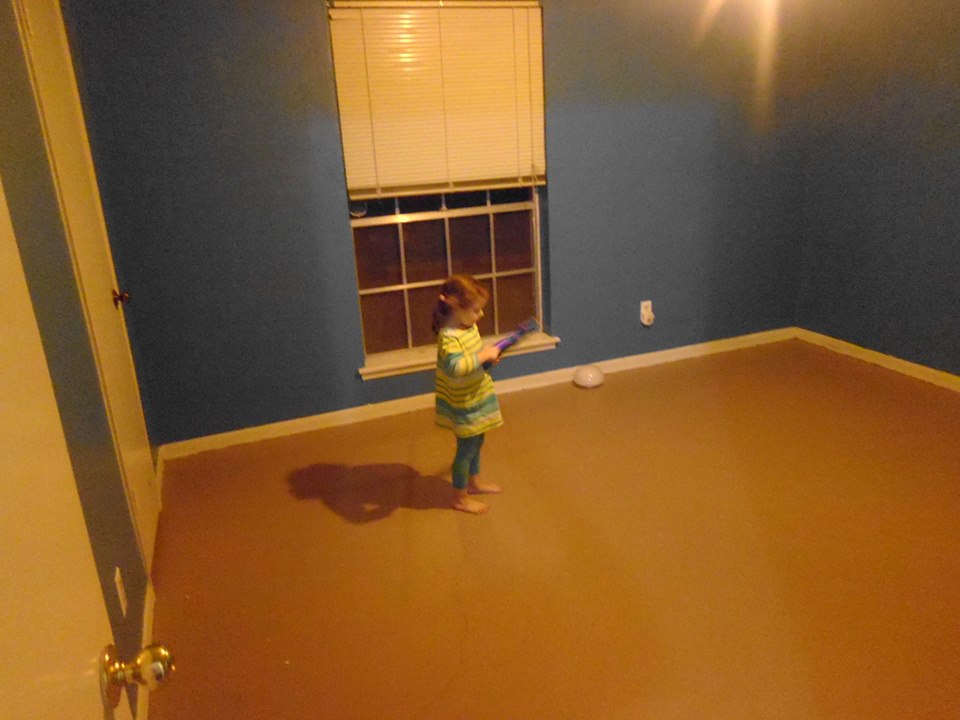 The great thing about moving with a small child is teaching your kid the art of donation from a young age. What we don’t need anymore, we’ve been donating. For a kid who has outgrown those things, it’s time consuming, but giving them the knowledge and opportunity to come to conclusions about their own belongings is an eye-opening experience. I haven’t forced her to get rid of anything, and I’m overjoyed to have so many moments when my kiddo comes to me and says, “Mama, I don’t need this anymore. We can give this to another kid.” And off to Goodwill we go. (At our garage sales she selected things to sell and was quite the little negotiator. She made about $5 off old toys other kids carried off and put that money right in her piggy bank. Now, she keeps telling me she has plenty of money for Chick-fi-la…)
On top of all that, every kid should get a chance to stand in an empty room and shout at the top of their lungs. (Or spin in circles singing All Around the Mulberry Bush while shooting a soft dart gun…)
 Teach Your Child to Read in 100 Easy Lessons
This book came highly recommended by my sister who has taught 5 kids to read (not including myself when I was 4) and has 2 more that are on their way to starting lessons. The above link is for Amazon.com, but I actually purchased my copy from hpbmarketplace.com.
Teach Your Child to Read goes straight into the phonics and skips the step of learning what a letter is called. My kid could already identify all her letters and knew most of her phonics, but she’s enjoying diving right into the decoding process by seeing an “m” and knowing to say “Mmmmm.” We’re only on Lesson 9 and she can already read words like “mat” and “sat,” “am” and “Me” just by sounding them out. These beginning lessons do not teach sight words but sounding out and decoding a word even if it means you don’t understand the word right away. I like this because it allows a child to read outside their vocabulary and have the tools to learn new words.
We do the rhyming and say it fast/ say it slow exercises while outside playing bubbles:
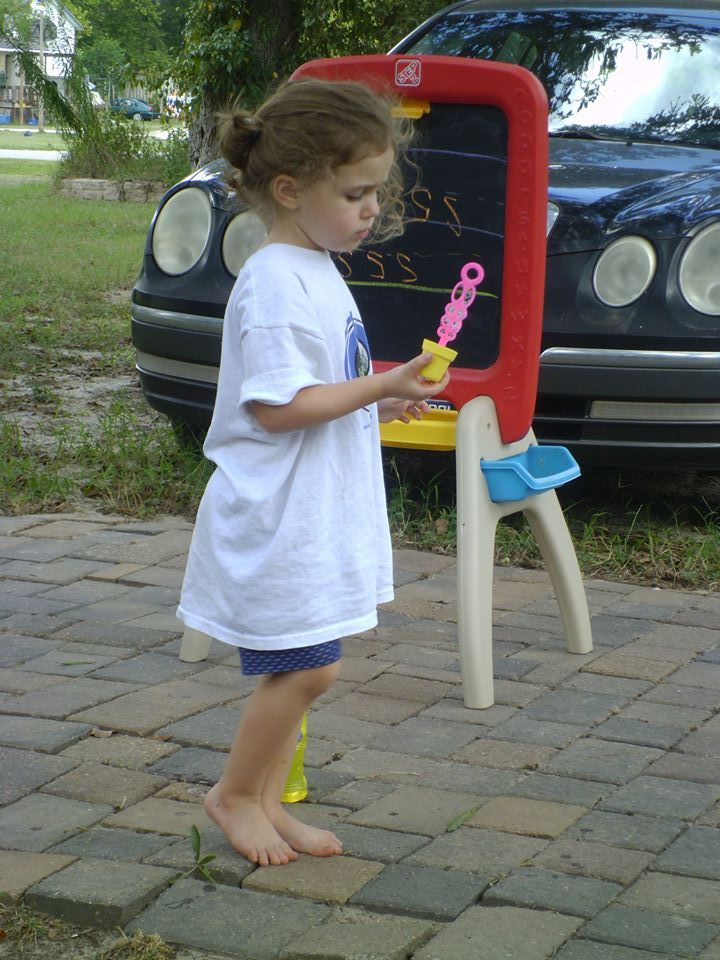
Here, she’s not just practicing the “sssss” sound (and writing it, look at the chalkboard behind her), she’s also blowing some stellar bubbles while sporting a Seed Savers t-shirt, compliments of S. Smith, author of the series. Kiddo adores Sandy and the shirt she gave her.
Beads and Dexterity
No preschool program is complete without crafts!
While moving I rediscovered some craft supplies from my own childhood. I thought about donating these as well, but kiddo begged to do a bead project and I determined that these were worth saving. The star was her first try, it took about an hour to complete; so if your preschooler doesn’t quite have the patience and attention span, be prepared to split a project like this into two sessions.
 Check out Klemm University for more frequent updates. We are an online homeschool group based in Texas and would love for other homeschool moms, teachers, and general citizens to pipe in with ideas for keeping our educational journey more exciting, diverse, and thorough. Come join the conversations!
Miraflores
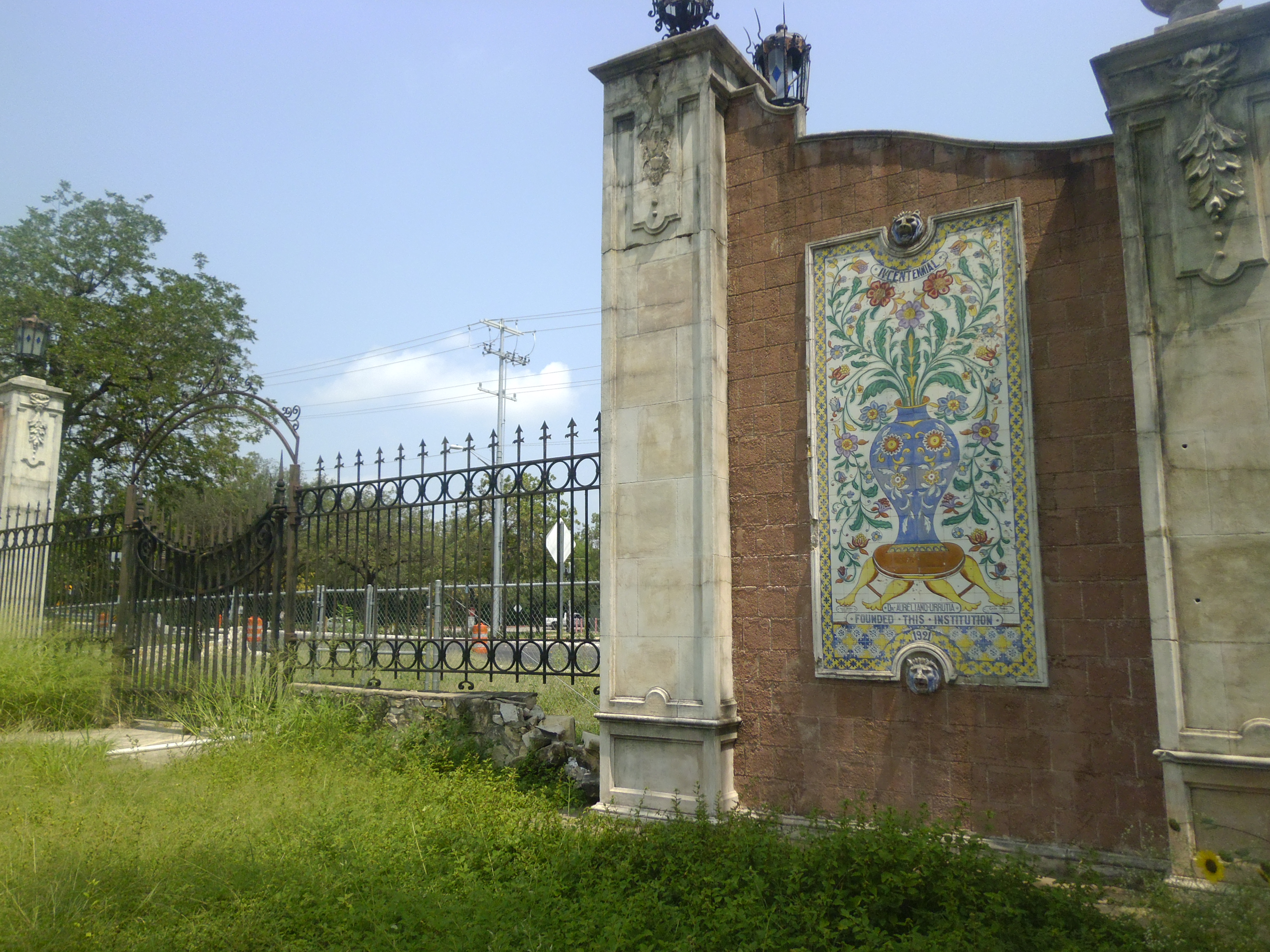
We saw it from the road when we were on our way to a bookstore. It was on the right (off Hildebrand, on our way to Broadway, I think) and I would have missed it behind the construction cones along the road and the gritty chain link National Rent-a-Fence. But the gates loomed, demanding to be seen. The statues looking like mysterious cemetery pieces, but alas, there were no tombstones.
We passed it several times and weren’t actually able to go investigate until our last day there.
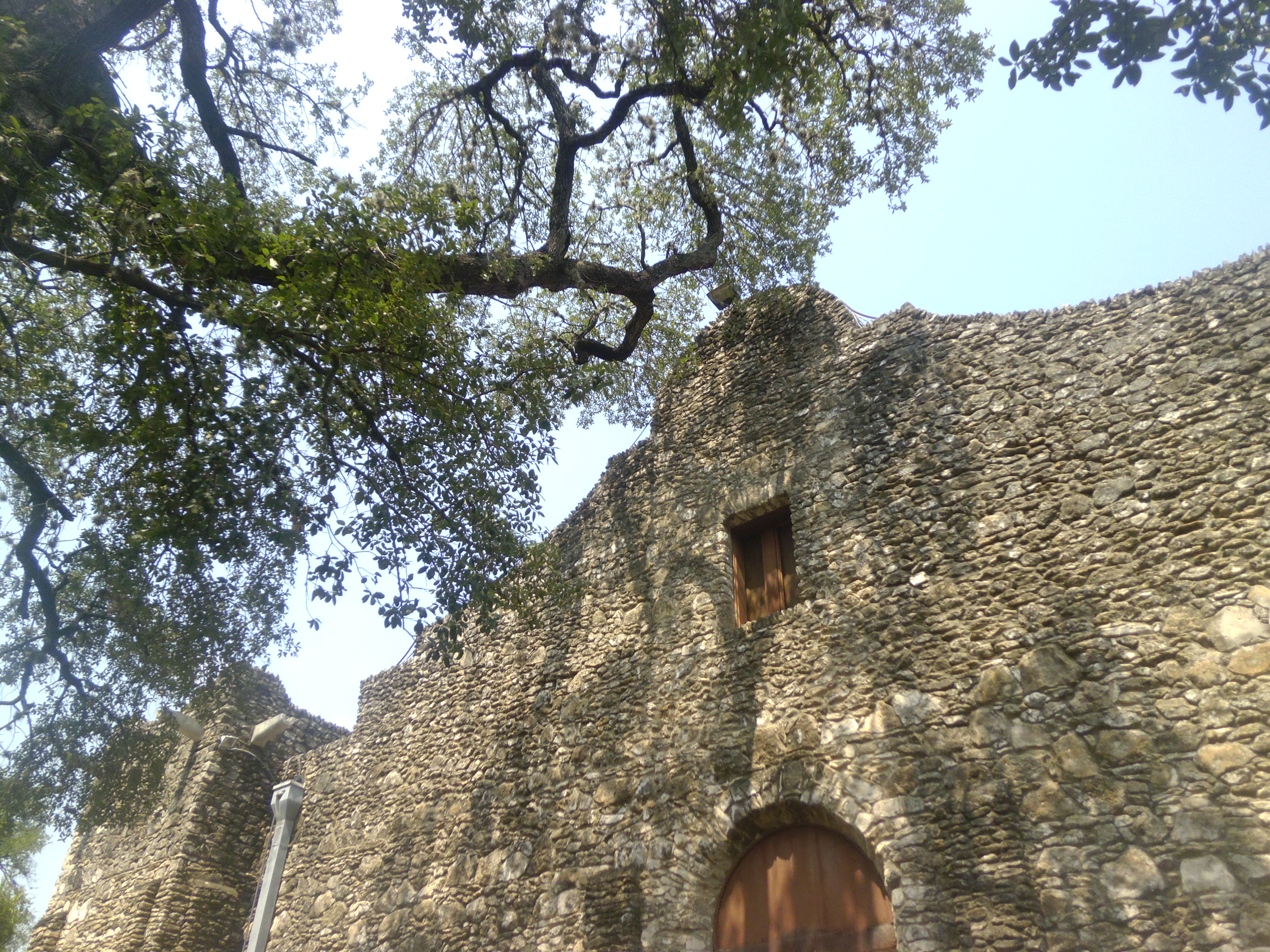 First we stopped at an old Spanish mission (turned greeting center, perhaps?) with a San Antonio Zoo sign perched near the steps. I suppose we were on the backside of the zoo, or maybe it wasn’t even open, but we found ourselves in a beautiful park.
There were families, and ducks, and families of ducks. But ultimately that ‘cemetery’ was calling our names and we had to go see it. We drove back to the main street and lamented the fence. We entered the parking lot to elsewhere and lamented the fence. Then, we saw that the chain link gate was ajar. Left for someone to go in and out for the day? We determined that it must be open by day and locked up at night to keep out the riffraff. So, cameras in hand, we entered Miraflores, not knowing its name, and explored.
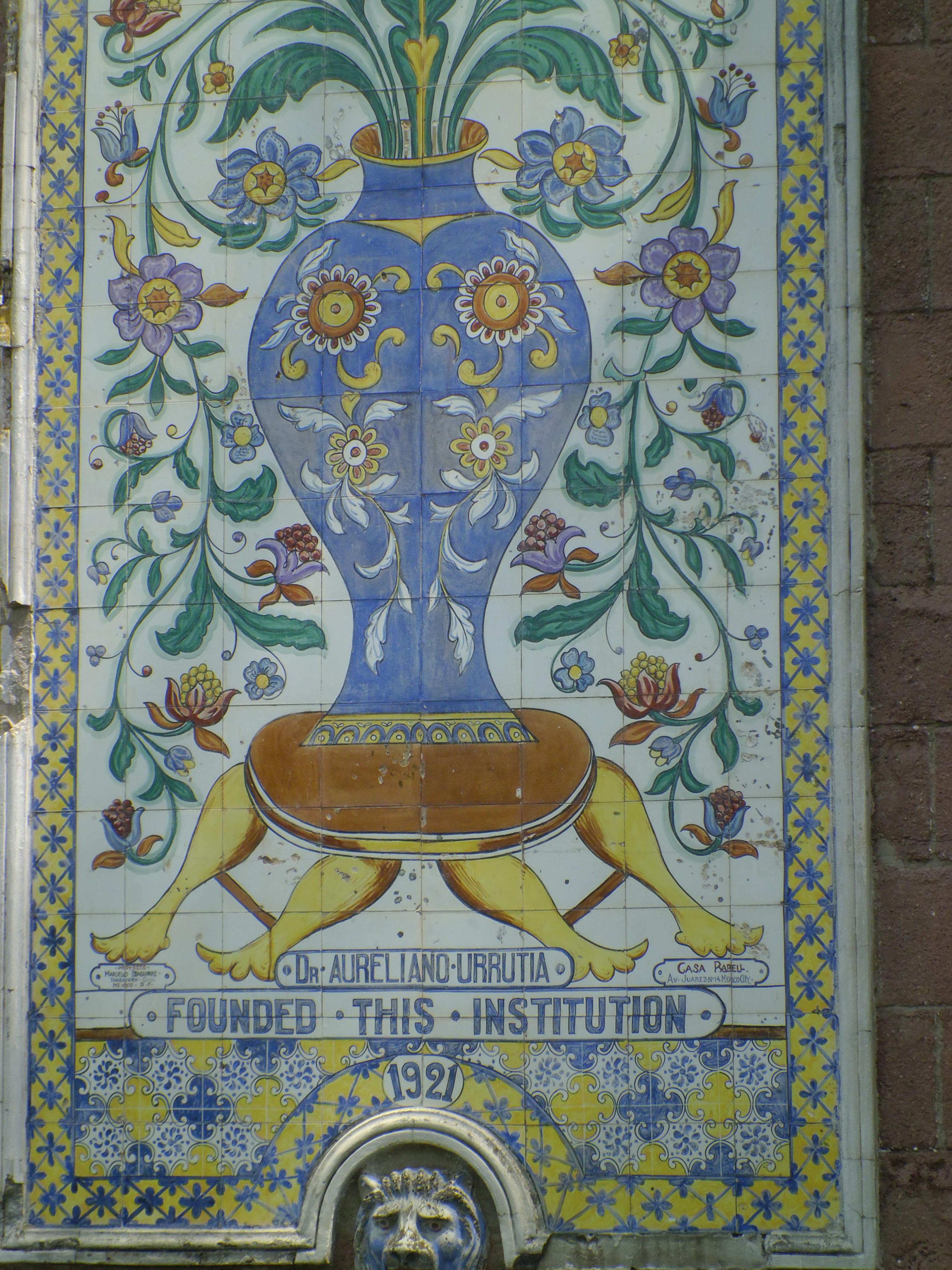
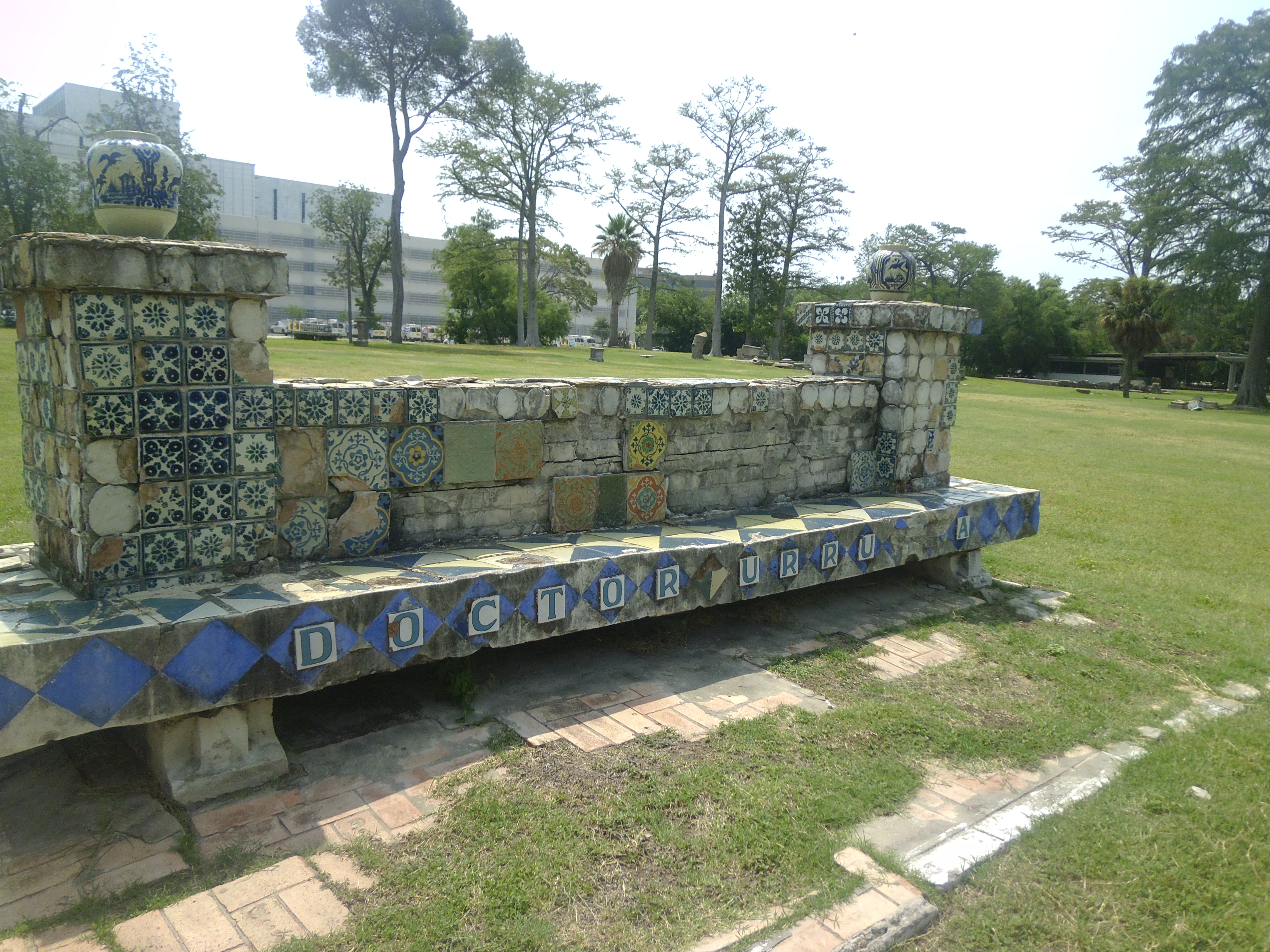 We found the Doctor’s name on several of the tiled benches. To my uninformed eye, there was no way for me to know they were designed by Atlee B Ayres, a famous San Antonio architect. I just knew they were beautiful and that they were made in honor of or for a Doctor, as the letters were mostly chipped away. Later, we would see the name Urrutia on the gates. There, in the mosaics of those grand gates, his name remained intact and I took yet another photograph. I skipped jotting down the information in my journal for the sake of spending that precious time getting more photographs. Even though I thought it was ok to be there, something about the whole experience felt a bit like we had discovered a magic hour of sorts and I didn’t want to waste a moment.
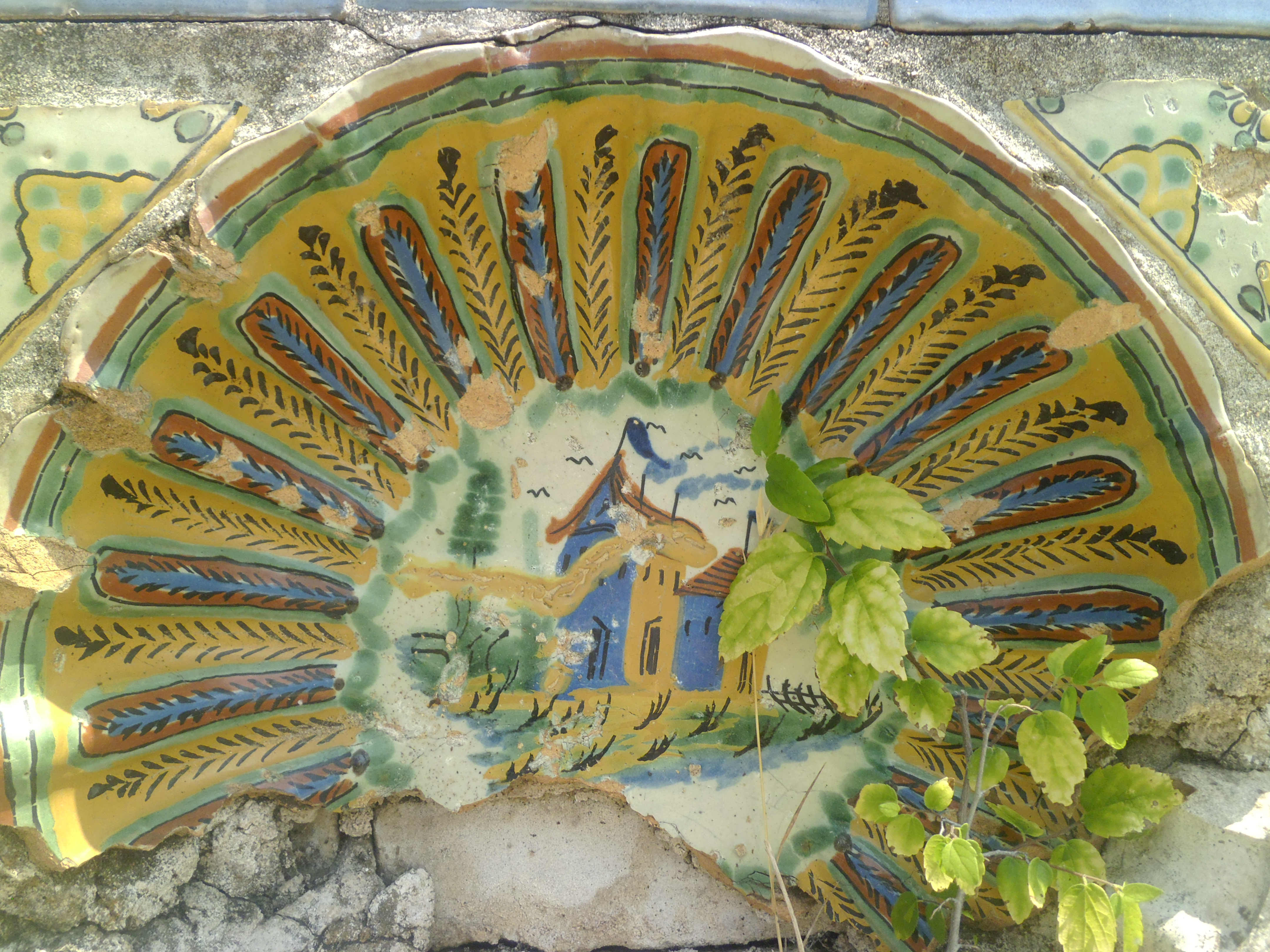 Though, I could spend hours there writing. What I wanted to do more than anything was stay there all day and document every fragmented tile. I longed for a library to access and investigate each piece of art and how it came to be gathered in this statuary field. The gate said the “institute” was founded by Doctor Urrutia in 1921. What institute? Who was Doctor Urrutia? What was the plan for this acreage?
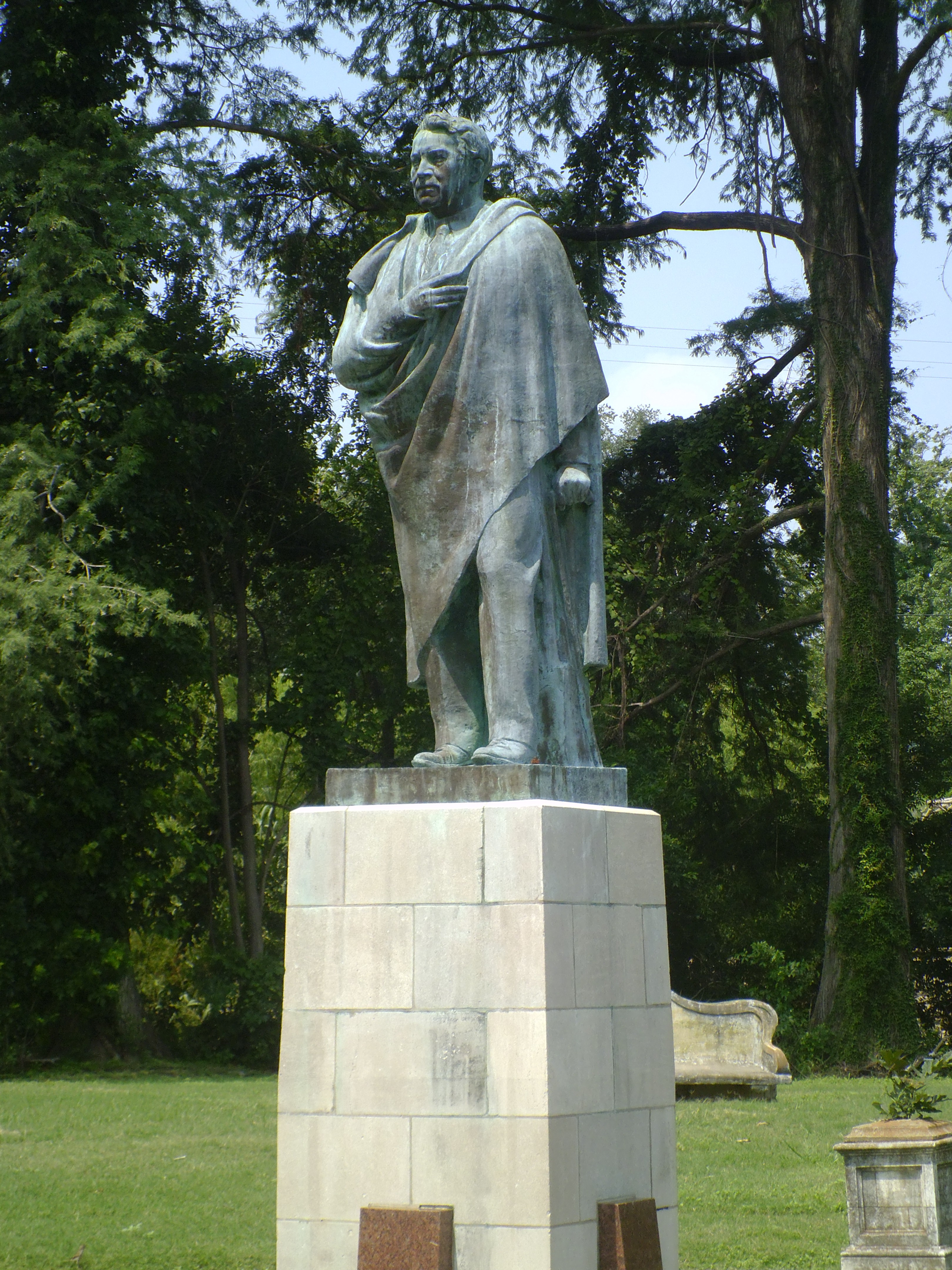 Dr. Urrutia arrived in the States from Mexico in 1915 – as an exile. He was born in the town “of floating gardens” just south of Mexico City and was a full-blooded Aztec Indian. He went to medical school, graduated top of his class, and by the age of 22 was the President’s personal physician. In 1910 Presidente Diaz was replaced by Madero, who was then killed and replaced by Huerta. In all this killing and backstabbing, Huerta had got himself stabbed in the eye, and it was Urrutia who operated on him. Then, according to Walt Lockley, Urrutia functioned a bit like a puppet master for the gangster and helped him run the country.
What happened next is a biography worth reading in itself:
But after dark, Urrutia was also accused of a medical assassination – a federal senator from Chiapas who publicly spoke against Huerta, Belisario Dominguez, was arrested as an enemy of the government, in the Jardin Hotel, on October 7, 1913, then taken to a cemetery, where dark persistent rumor has it that Dr. Urrutia cut out his tongue.
Without anesthetic.
Huerta threw eighty congressmen into prison at one point. Urrutia himself issued an ill-advised ultimatum to the US government, wanting official recognition, and Woodrow Wilson responded with battleships to Veracruz. In the late summer of 1914, as this government fell apart, a lot of the Huertistas and the well-to-do and ex-governors and henchmen drained out through Veracruz. Dr. Urrutia was arrested there by General Frederick Funston and was allowed to exile himself to the US: by ship from Veracruz to New Orleans, train from New Orleans to San Antonio, and two rail cars of treasure smuggled across the border later, to finance his new American life and humanitarian career.
– Walt Lockley
Urrutia died in 1975 at the age of 103, in his sleep, at his grand 15 acre estate in San Antonio. But before that would happen, he would be the first doctor to separate Siamese twins in Texas and he would build something marvelous: Miraflores. And I got to traipse around its remains.
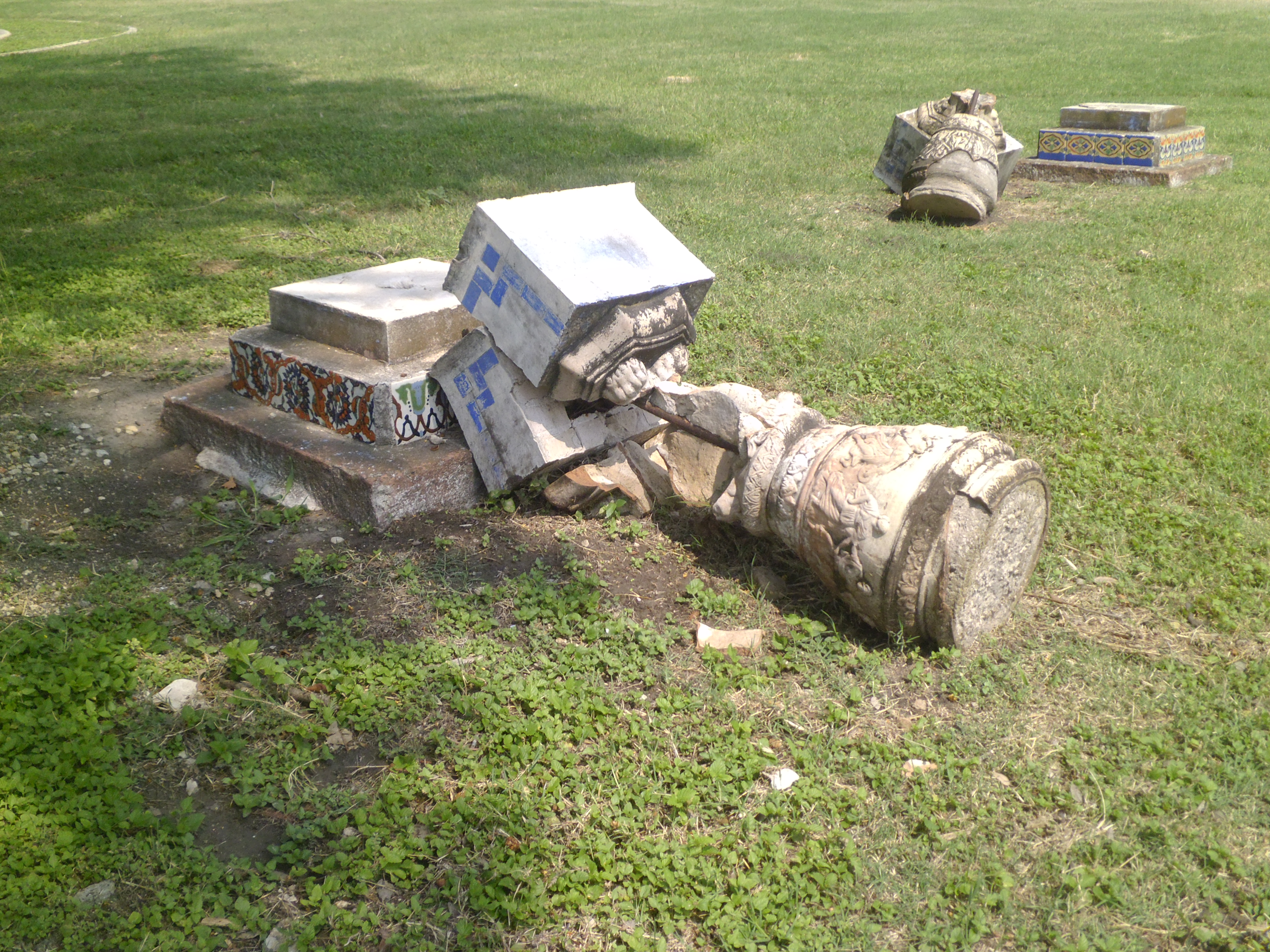 Other artists contributed to this historic monument. According to Capturing Nature
In 2004, the area was added to The National Register of Historic Places, primarily for Rodriguez’s contributions. It is thought that Miraflores contains his earliest work in the states as well as the “most intact and concentrated groupings” of his work. One of those pieces is actually an extremely unique foot bridge in Breckenridge Park that caught our eyes several times.
The blog Urban Spotlight San Antonio describes a plan, in a post dated 2009, that would make the park open to the public. We saw the bridge from Breckenridge Park the post describes, but the public pedestrian walkway was blocked off and locked. I am still unsure if the entrance I used was meant for the public or not. Either way, I am glad I used it and got a chance to see so many beautiful works of art up close. (There’s an extensive history included in that post regarding who owned the property during which decades and how they used it. It’s quite interesting.)
According to SA Cultural Tours:
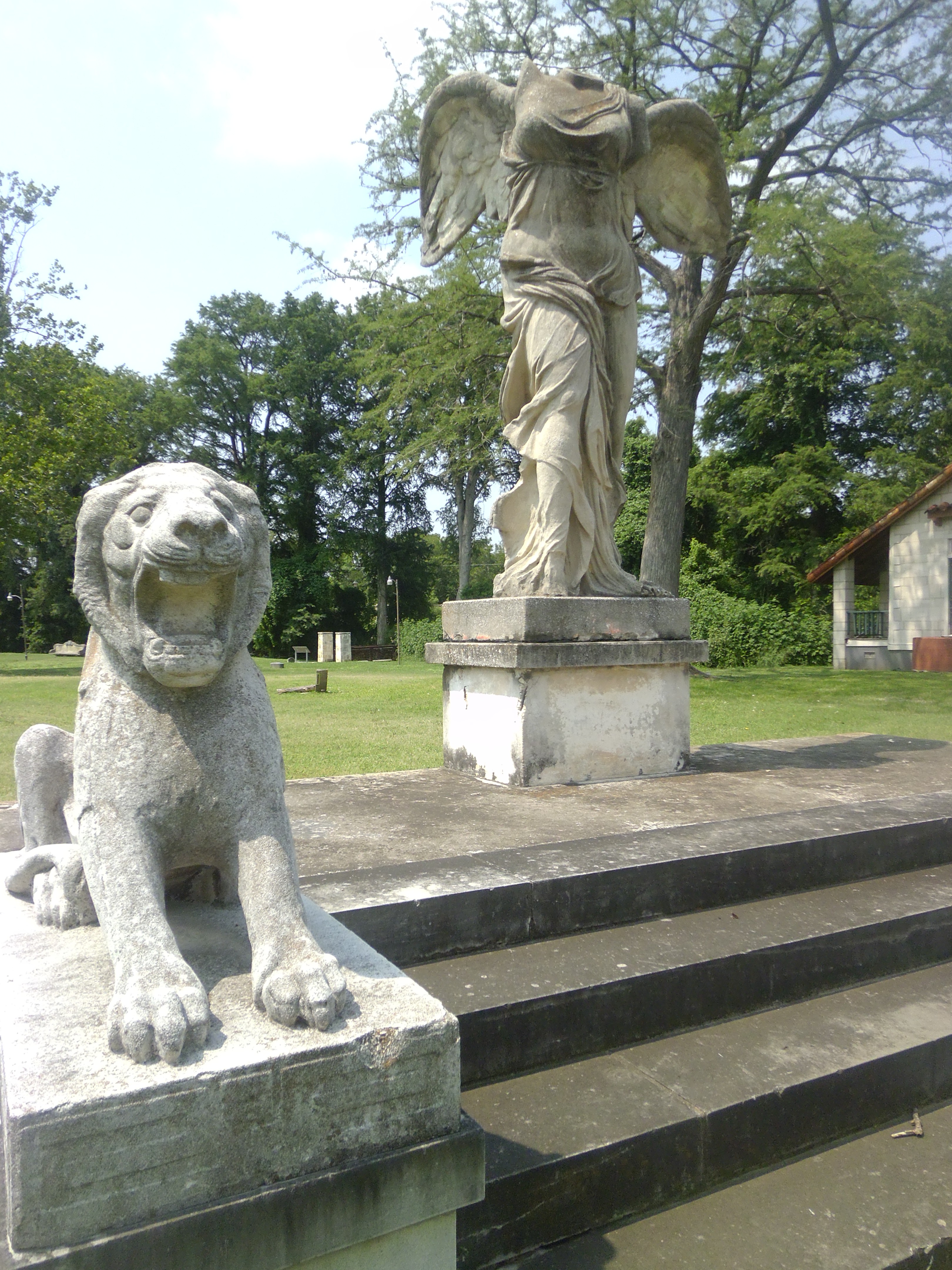
Much of the statuary originally designed for the park has been lost or damaged over the past several decades. Remaining features include the tiled entrance gates along Hildebrand, designed by Mexican artist Marcelo Izaguirre, as well as the 1946 statue of Dr. Urrutia that originally stood in the center of a large pool. […] The park originally featured a small tower building housing Dr. Urrutia’s library, but it has been demolished. The small remaining cottage, Quinta Maria, was built in 1923 as a guest house. Statuary moved to the park in the 1960s following the demolition of Dr. Urrutia’s nearby home include the Winged Victory with crouching lions, and the replica of Coyolxauhqui, the Aztec moon goddess.
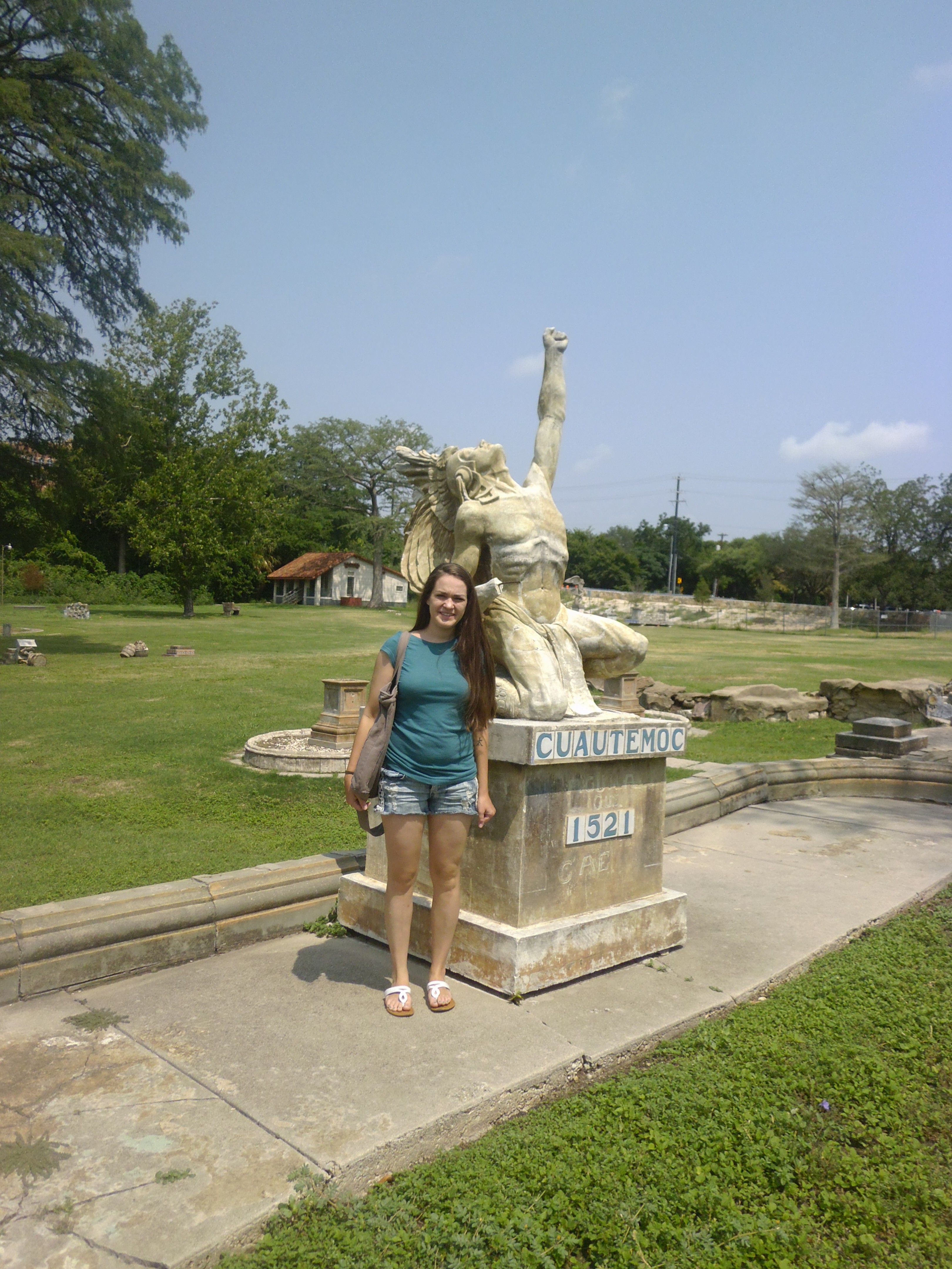
I think my favorite… the place where I could sit for hours and reflect and write… would be near Cuautemoc. He is the last ruler of the Aztecs, extremely energetic, and makes me feel mighty and safe.
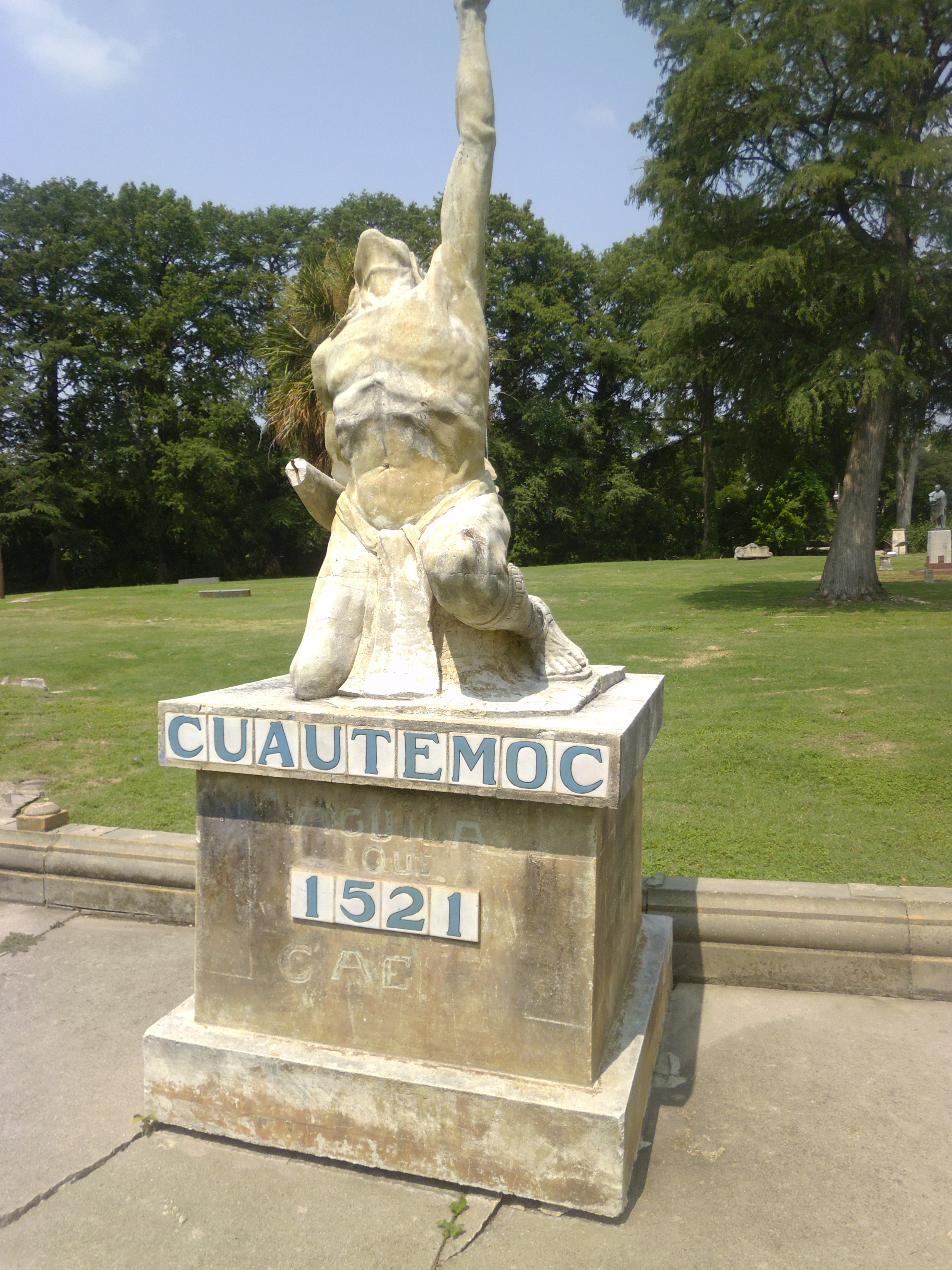
Luis L. Sanchez designed him in 1921, and it’s one of the most impressive statues I have seen in person, just for the sheer power it seems to radiate, like Achilles.
I love that Urrutia chose to include him in his garden. Regardless of the sinister rumors that still surround Urrutia and his political dealings – including this statue in his place of exile says a lot about his passions and his identity. He respected his heritage, his elders, and the past. He had a taste for art, I think, I cannot bring myself to believe that he did this for the mere sake of showing off his money. He had a library that has not survived, and clearly had a thirst for knowledge and legacy.
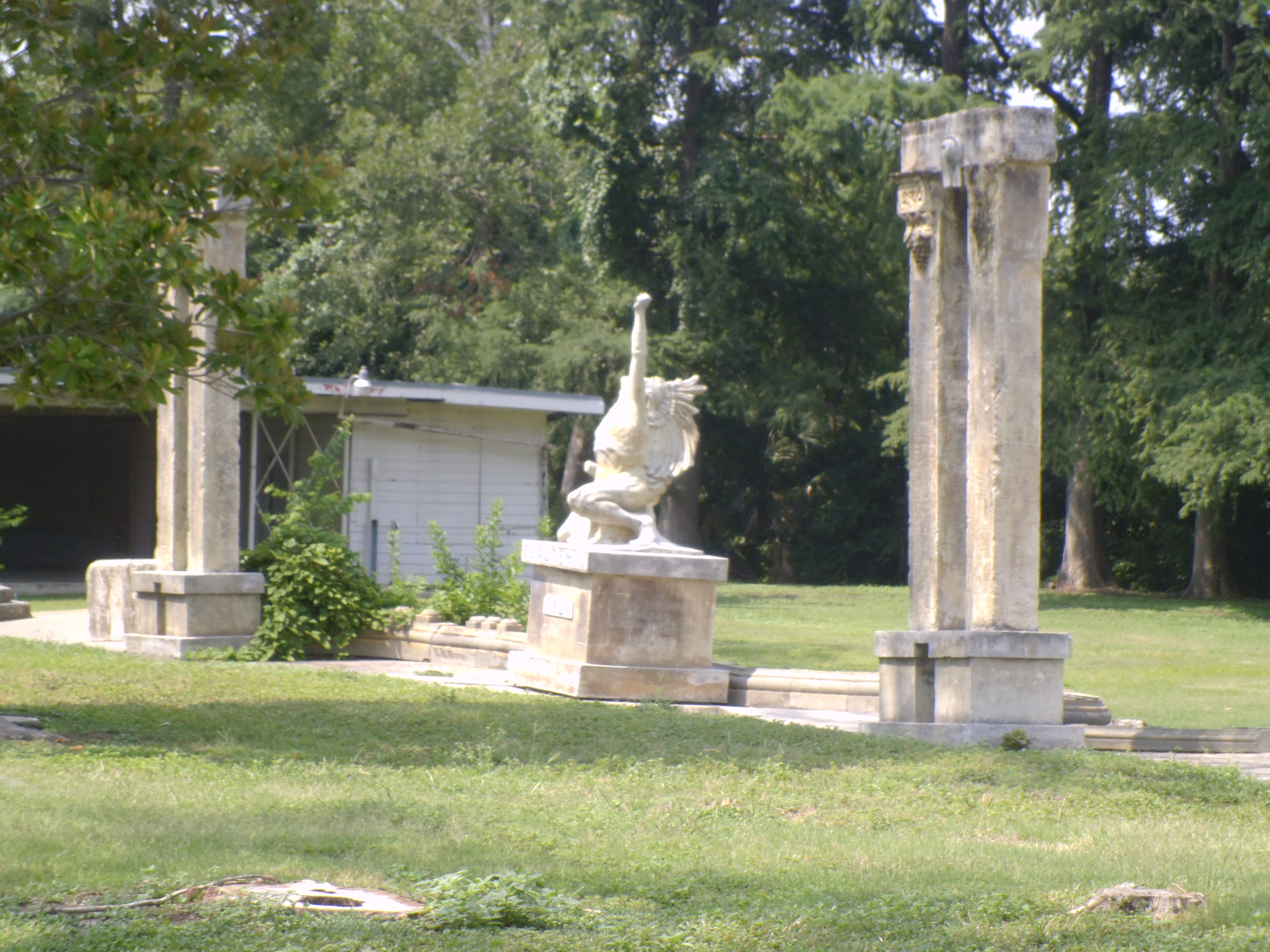
After many business deals and exchanging of hands, The University of Incarnate Word now stands where Urrutia wanted a hospital. The San Antonio Express reported in 1929 that Urrutia’s “grand ambition is to found a hospital here which will perpetuate his work … a hospital composed of pleasant, homelike bungalows surrounded by flowered lawns, clustered around a central House of Administration. For this purpose, he has bought an extensive piece of property on Broadway and Hildebrand.” It sounds to me as though he sought some gentle peace after his years in Mexican politics.
However, Urrutia’s “institution” remained a private garden for hosting his family and parties, for morning excursions to swim laps in the pools, and to feed his peacocks while wearing his infamous cape. I’m a little sorry the property never became exactly like he dreamed, but am glad he put forth the effort to get the gardens going.
How to Achieve True Boredom
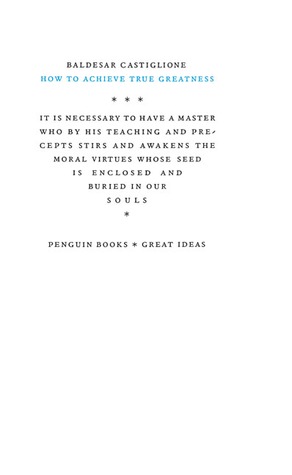 Title: How to Achieve True Greatness
Author: Baldesar Castiglione
Publisher: Penguin (Great Ideas)
The Penguin Great Ideas Books are usually my go to source of reading something in one sitting. If not that, I toss them in my bag or back pocket for a walk in the woods or for waiting room entertainment.
How to Achieve True Greatness did not live up to my expectations.
This was 93 pages of pure boredom.
I picked it up – read some pages – put it down. I took it to the bathtub with me only to find myself wanting to get out of the tub faster to pick a different book.
There were some bits about twenty pages in that interested me long enough for the book to start redeeming itself, but then I later lost interest again.
Not your best, world history masters, not your best.
Story Times are Magical

Every Wednesday during the summer I make an appearance at Half Price Books Humble, 10:30 am sharp. I make an announcement over the intercom – NOT my forte – place snacks on the children’s table, and pick out stories to read out loud to whoever arrives.
Sometimes I have crowds! Sometimes it’s just me and Kiddo hanging out reading as we would at home. Sometimes I have authors come and read their books to the kids. But ALWAYS it is a little bit magical.
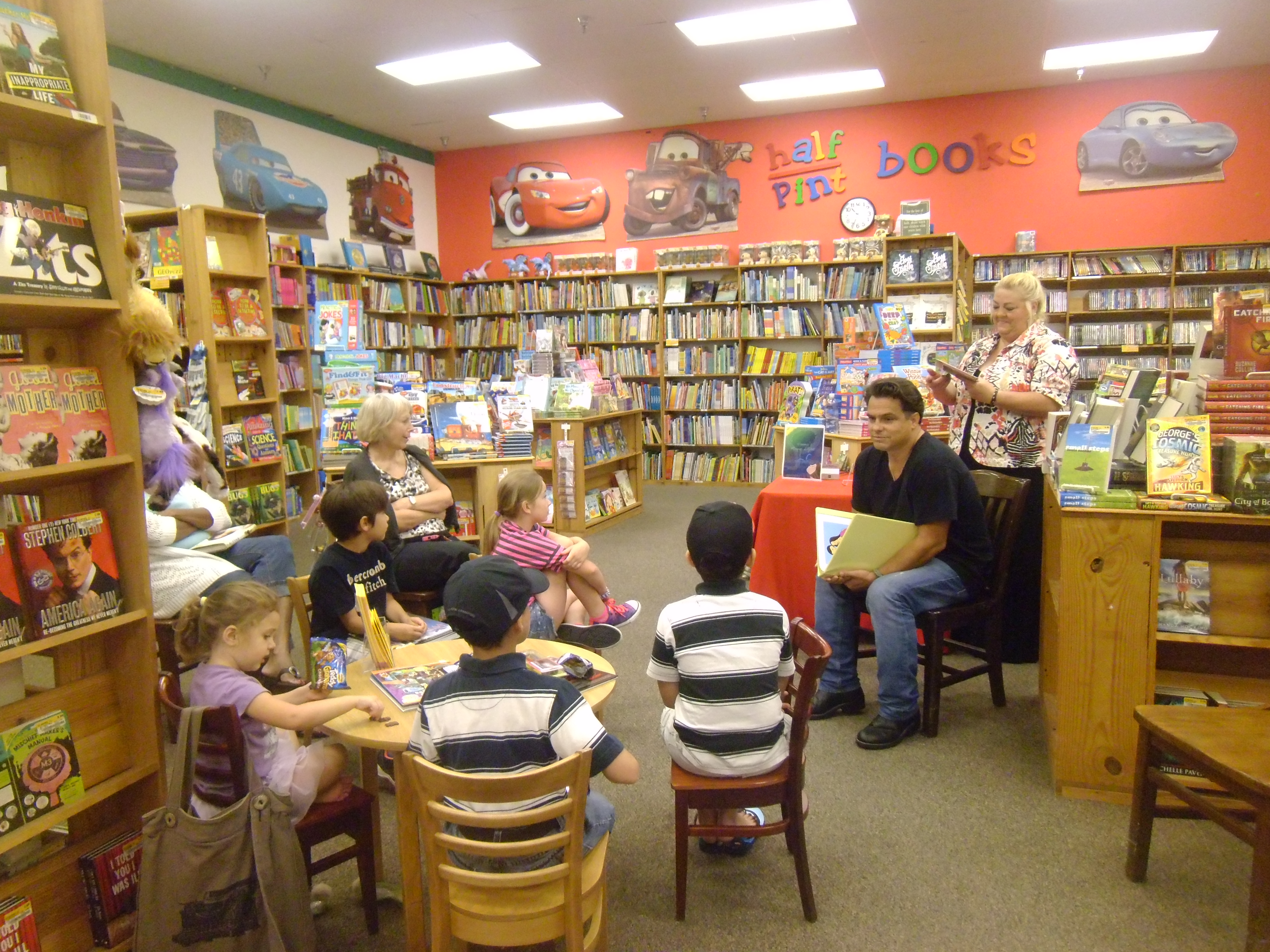 How appropriate then that Edward Castro joined us for a second time with his book Hanna’s Magic Light
Not available yet in a physical copy, Castro read to the kids from a bound manuscript while his agent showed the pictures on her tablet. The kids were riveted by the story about Hanna and her Daddy and the magical dome light in the car, turned lesson on finding your own inner light.
At the end, each kid received a cupcake and/or cookie as well as a “magic light” of their own to take home – Glow Sticks made into a necklace.
Tomorrow is Wednesday again. We won’t have Castro back this soon, but we will be featuring Song for Papa Crow, compliments of Schiffer Publishing.
Castro will return later in July. For those who cannot make middle of the week events, this will allow you to meet the author and purchase a hard copy of his picture book, as he hopes to have some in print by then:




 Anakalian Whims