Interview with Science Fiction Author George Wright Padgett
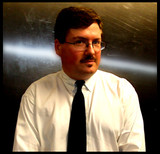 George Wright Padgett is the author of the science fiction title Spindown
1. Describe your book and its inception. What was your muse, so to speak?
I tend to question things about the world and our place in it. When I started writing Spindown I wanted to explore the age-old topic of nature vs. nurture – Are we born who we are to become, or are we only the byproducts of our experiences? And what does it mean to be free? Believe it or not, I leaned heavily on Golding’s The Lord of the Flies as a study of characters reacting individually and as a tribe with and against each other. I freely admit that the Draad flashlight is a version of the conch shell of authority that is found on the island in his book.
My writing style is that I tend to reverse engineer my stories. I start with the question and then work my way backwards filling in the holes until there’s a logic for why things are as they are.
For example, I decided to start with characters that were blank canvases that I could expose to extreme situations and watch how they reacted to each other and solve problems.
For it to work I had to answer to myself why would these people would not have any emotional experiences and yet be full grown adults? The solution was make them have lives that were severely isolated – keeping them from each other as much as possible and when they were forced to interact with each other they would be drugged into a stupor.
Then the question arises how or who would do this – So by reverse engineering I realized that it must be an ore corporation behind it and to save money from sending people to Jupiter to mine, they use harvested clones to do the labor. That’s just one example of how as I would walk through one door and answer a question, there’d be another waiting behind it. When all of the doors were opened (save the final one) the story was over.
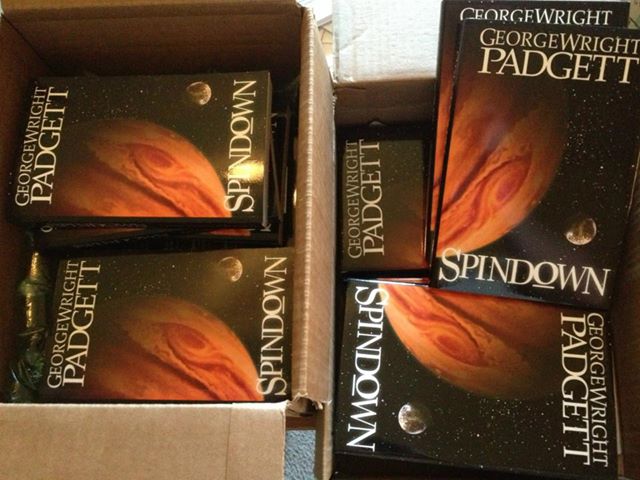
2. Your book has ‘classic science fiction’ all over it. What authors do you read and do you consider them heavy influences on your writing?
I’ve read a tremendous amount from the classic authors Asimov, Clarke, etc. (as a matter of fact, I recently finished Foundation again).
One thing that I’ve always appreciated about those writers is the level of authenticity in their stories. I spent many months building and rebuilding on paper the vast mining compound on Ganymede before I wrote a single word. It required a stupid amount of discipline to resist the urge to dive right in, but my deferred gratification paid off. When it came time to write the story, all that I had to do was to ‘activate’ the characters to run and follow them as if I were an imbedded reporter.
I didn’t set out to write a modern story in the classic sci-fi style; in fact I am humbled to have Spindown even compared to those great works. All that I can attest the results to be my exposure to their styles must have seeped through into my story. I feel like the character in The Amazing Colossal Man who accidentally wanders into a plutonium blast in the desert. The radiation transforms him due to his exposure to it, not through anything that he did. I was exposed to the radiation of many great storytellers.
3. Just like when I read, when I write I find myself enjoying some characters more than others – regardless of their role in the story. Did you have a favorite in Spindown? Who was it? Why?
Wow. It’s too difficult for me to pick just one – so I won’t. (I’ll do my best to avoid spoilers for the uninitiated.) I enjoyed watching Prall 4167 develop throughout the piece. Here’s a guy that is used to being in control, and is faced with his entire world being turned inside out. Readers undoubtedly cast him as a villain, but when you clinically review what he does and why he does things, he sort of makes sense. He’s the most practical one of the escaped clones and never displays a shred of self-doubt. Don’t misunderstand, what he does/allows is reprehensible to say the least, but he doesn’t see himself that way- he is only about one thing: Survival of Prall 4167. Can you blame him? His Machiavellian approach to situations intrigued me to the point that when it was time to assign the characters their suffix numbers, I gave him 4167 (my birthdate of 4/1/67).
Another part that was fun to write was the interactions between Martin and Buck. By the time we meet up with them again, they have been companions for a very long time. They remind me of an old married couple; they bicker with each other, but there’s no mistaking the love that has developed between them over the years.
Ah… then there’s Fowler and Sholve. I enjoyed how Fowler usually has his plans backfire on him or not go exactly how he thought things would work out. Often Sholve has to bail him out in some way. In all, they end up making a good team, with her problem-solving skills and his physical strength. One of my favorite exchanges between them is when they have opposing views on if they should ‘contaminate’ the Setter character with the knowledge of what is actually happening to clones on Marius 516. They come at the situation with polar opposite philosophies, forcing the reader to pick a side- Do we let him go on, and live blindly? Or do we confront him with the truth allowing him to decide for himself what to do?

George and Grey Gecko Press at Half Price Books Humble
4. Did you learn anything from writing your book? What was it?
My inability to spell and use proper grammar is far worse than I could have ever imagined (even with spellcheck)
5. Exactly how much research was needed to pull off this level of scientific expertise? What was that process like?
As I mentioned before, I probably spent way too much time on this. I found that my compulsiveness seems to require a ridiculous amount of backstory and detail for whatever I’m working on. An example of this is how an early draft of Spindown had the clones speak a hyper-restrictive tongue called Chone. I developed the entire language removing any ‘hot words’ from their vocabulary. The result would have made Orwell’s writers of NewSpeak blush it was so limiting. It took a month of refining over and over. It was beautiful- and every bit of it ended up on the ‘cutting room floor’. While readers likely will notice the absence of the personal pronoun of ‘us/we’ from the first half of the book, that is the only thing that remained! It became too cumbersome for the clones to speak – a month totally wasted! I also know more about Ganymede than any non-Nasa personnel is allowed.
My habit is to completely immerse myself in the research and the world building of the story. This is fine, but a good writer has to edit out the artifacts that do not advance the story – sorry, Chone language.
Click to visit Grey Gecko Press
6.How did you come across Grey Gecko Press? How has that relationship been for you?
I encountered the owner, Jason Aydelotte at a social gathering of other Houston area writers. He’s the author of the acclaimed Dying of the Light Zombie series. He had just self-published his first novel in the trilogy and his enthusiasm about publishing was contagious. He told the people at the table that he was considering helping others learn how to do what he had done for their stories. Over time, his help and advice transformed into GGP. He left his day job to start Grey Gecko Press for authors who wanted to ‘storm the castle’ of traditional publishing with him. I was fortunate (and maybe crazy enough) to be counted among them. That was ten-thousand books ago. Since then, everyone there has been remarkable. Without Grey Gecko, there would be no Spindown because I likely would not have finished it. Jason’s team was the mid-wife to my book.
7. If Spindown were to be made into a movie, who would you want to tackle it? (JJ Abrams? Joss Whedon? Steven Moffat? Some unknown?)
Sid and Marty Krofft (Google it, kids).
Seriously, I am flattered that so many readers have said that they’d like to see Spindown on the big screen. I love movies, especially sci-fi, and my writing has been influenced by dozens of classic flicks, but at the end of the day, I’m just a storyteller, not a movie producer. It’s fun to think of, but what do I know about any of that? I’d welcome it if someone felt they bring something to the story, but I’ll leave it to the experts.
8. Other than writing, what are your hobbies and talents?
I play jazz piano (under a different stage name), I do graphic design, and am neck-deep in writing the songs and script for a full-length musical.
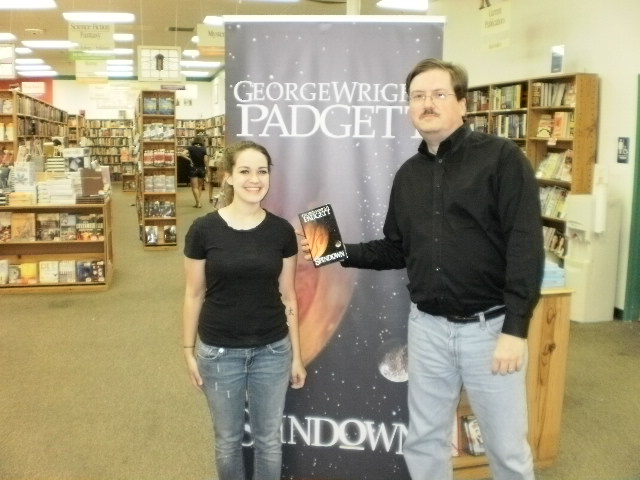
9. Do you listen to music while you write? If so, what were some of the musical influences you had while writing Spindown?
Music is a very important part of my life, so much a part of it that songs/genres that I listen to when not writing easily distract me when I’m ‘working’. I do this kind of Pavlovian conditioning thing in which there are some classical and ambient selections that I ONLY listen to when writing. It helps to trigger my brain into knowing that ‘It’s time to write’ when this music is played:
Philip Glass – Symphony No. 9, Low Symphony, Heroes Symphony
The soundtrack to ‘Monster’s Ball’
Brian Eno – Music for Airports
Anything from the band Pauseland
and a minimalist band from Austin called ‘Stars of the Lid’
Listen to Philip Glass/No.9 and read any of the chase scenes from Spindown. You’ll find that they match up perfectly.
10. If there was just one thing you would want your readers/ fans to know about you, what would it be?
I’m a big dork. Really I am (my wife and kids will attest to the fact). I don’t allow myself to take my self too seriously, and I will do anything for a laugh (anything). I still feel and view myself as the 4th grader version of myself. Sure, I get to drive a car, I can order wine in a restaurant, and do ‘big people’ stuff like that, but after you pull back all the layers, I am still just as silly, needy, and unreservedly amazed with the universe as I was way back then. And for better or worse, if I haven’t grown up by now, I think that I’m probably stuck this way – and I’m okay with that.

Click to Visit George’s Facebook Page
Interview with Author Rhonda R. Dennis

Author of the Green Bayou Novels
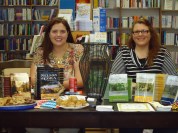
Rhonda on the right at HPB Humble last year.
I met Rhonda R. Dennis while booking her and Melinda McGuire for A Southern Saturday – an event we put on at the Half Price Books in Humble. It featured southern authors, southern goodies, and all around a lot of southern hospitality. We had a blast. Rhonda was friendly, donated a lot of her own books to raffle off to customers, and kept a professional attitude.
Another signing is the works now, with details to follow later. But since I can’t quite have her in the store again just yet, I’ve arranged an interview! (So exciting! As I’ve said before, interviews and guest blogs make me feel like Oprah.)
- Your books are set in Southern Louisiana, and you’re also from there. What were your favorite things about the state when growing up? What are your favorite things about living there now?
First, I want to thank you for having me as a guest! I absolutely love reading your posts.
While growing up, I never gave much thought to how different my culture is to others. I assumed that everyone ate tons of seafood, celebrated Mardi Gras, and had the innate ability to pronounce French names. I started traveling, and realized that was far from true! I love visiting new places and I have a huge appreciation for their traditions, but South Louisiana will always be home to me. It’s definitely a place that everyone should visit at least once.
- Your books are Romantic Suspense/ Mysteries. Is this the genre you typically read as well? What authors or books are on your ‘favorites’ shelf?
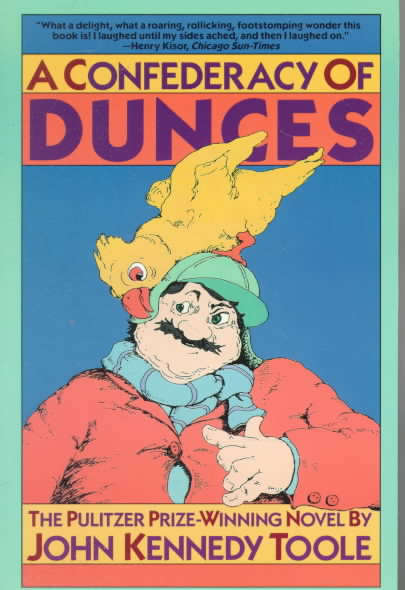 I enjoy most genres. My favorite book is A Confederacy of Dunces
- Do you have play lists of mood music you write to? If so, which artists/songs generally make the cut?
 My music choices are even more eclectic than my reading preferences. Depending on the mood of the scene I’m writing, I will listen to anything from Red Hot Chili Peppers to Bruno Mars. I’ve been listening to a lot of 80’s and 90’s music lately, as well as the Les Miserables soundtrack. A lot of times, I have to turn the music off because I spend more time belting out tunes than getting my story down!
- What do you find to be the easiest part of the writing and editing process? What is the hardest for you?
 The easiest part is coming up with the general direction I want to take the story. Generally, I type a skeleton version then rework it until I’m happy with the manuscript. The hardest part is when I actually put it out there for the public to read. I believe in my stories, my beta readers are generally enthusiastic about the books, but until I get that feedback from the readers, I’m waiting with bated breath. Please leave reviews people!! You have no clue how important they are to authors, not for an ego boost, but for validation that we’re on the right track. J
- When you complete a book and it goes to print, how do you celebrate?
It’s generally a quiet, personal pat on the back kind of thing. Although, the series will be wrapping with book six at the end of the year, so I anticipate a book launch/series finale party for that one.
- I’ve met a lot of authors with drastically differing views on this… would you ever be interested in a TV or movie deal for your series? If so, how involved would you want to be? (There every step of the way? Or hand it over and let the film people do their thing?)
I have so many people tell me that they strongly feel the series needs to be made into a movie/movies. I’m all for it! I’d love to have lots of control over it, but I’m realistic enough to know that that probably won’t be likely. My only wish is that they would do the series justice.
- I’ve read in other interviews that you’ll write this series as long as Emily has stories to tell. Do you have any other projects in mind at this time?
I do have some projects lined up after the last book of The Green Bayou Novels series is released. I want to branch out a little bit. I have plans for a couple of stand-alone novels, as well as a book about local ghost stories.
- You’ve been featured on Melinda McGuire’s Southern Creatives segment of her blog, been involved in joint book signings, and contributed to a project she edited (Rich Fabric) [I’ll link to Rich Fabric]. How did you meet?
 That is one of the wonderful things about technology! We met online! I want to say it was the Goodreads website? Anyway, being that we are both writers of Southern fiction, we instantly bonded, even though our writing styles are quite different. She writes from a historical perspective, whereas my novels are set in modern times. I’m pretty sure she’ll agree that we have a mutual appreciation of each other’s enthusiasm for all things Southern. I’m a definite fan of her work.
- Every reader or writer has a favorite bookstore (and if you don’t, please don’t spoil my delusion!). Now is your chance for a shout out! Tell us who you love and what you love about them.
While I could easily spend loads of time and money in any Barnes and Noble store (or any other major retailer for that matter), I prefer the feel of the small Mom and Pop bookstores. I love walking into a place where you know the staff is there because it’s their passion, not just a job. We had a quaint little bookstore in Morgan City, but unfortunately, it shut down. I continually hope that someone will try to open another one.
I should also mention that we don’t have any Half Price Book branches in Louisiana, but based upon the reactions of my husband and son when I had my joint signing with Melinda McGuire in Humble, we’d be spending lots of time in there, too!
- Outside of writing and Southern Louisiana, what are your passions?
I am very passionate about giving back to others. I’ve donated many copies of my books, t-shirts, and other prizes to raffles and auctions to raise funds for injured or ill persons. My favorite charities revolve around cancer research/children’s charities: St. Jude’s, the Shriner’s Hospitals, American Cancer Society… At this moment, I’m in the process of working something out for our local Relay for Life.
I’m also passionate about treating others the way I would like to be treated, and doing all I can to help make this world a better place for my son to grow up in. I love to promote the good things that are happening around us. I feel that we often get bogged down in the bad news. Just as many wonderful things occur in a day, however, it’s not often considered “newsworthy”.

Rhonda R. Dennis posing for the St.MaryNow Franklin Banner Tribune fifteen months ago. Click on the image to visit the article.
Interview with S. Smith
 I’m excited to share with you all an interview with S. Smith, author of Seed Savers
1. This is quite a political statement, was that your intention?
Not so much. I think it was more about my love of good food. Seed Savers is a love story starring home-grown food. I love food—growing, harvesting, cooking, eating, and sharing it. And I think a lot of people these days maybe are missing out on that. I grew up on a small family farm and we always just ate what we grew, putting the fruit and veggies up for the winter and enjoying the goodness of how much better everything tasted than the “store kind.” Sure, politics obviously comes into the book, but it’s much more than that.
2. I read on your blog that Senate Bill S510, the Food Safety Modernization Act, inspired the story line. But what made you choose to tell the story through the eyes of children for children, instead of writing a piece more geared towards adults?
Actually, although I mention Senate Bill S510 as being the idea behind my story, I believe I wrote Seed Savers prior to hearing about it. I started writing Seed Savers in April of 2010, and most of the internet frenzy on the bill came out after that. I think a friend told me about the bill after reading a draft of my story—it’s hard for me to remember exactly. The inspiration for the book and the reason I wrote for children is covered in the blog titled “How It All Started”(May 2012).
3. There are many documentaries floating around about the habits of companies similarly described in the history of your futuristic world. Have you seen any of them? If so, which ones did you consider the most inspirational or informative? (I’d like to watch them.)
Here in Salem we enjoy the Salem Progressive Film Series, which is a “volunteer organization dedicated to educating and raising awareness of important current events.” They bring in great documentaries and speakers once a month. I have enjoyed going to many of these. I’ve watched movies on water, dirt, food, urban gardening, MONSANTO, etc. As mentioned in the “How It All Started” blog, Food, Inc. truly was a part of the inspiration for my book.
4. You must be a gardener! What are your favorite household ‘crops’? (Mine are lemon balm and rosemary – for the smell, of course.)
Oh my gosh. Well I do live right in the center of town, so I only have a very limited amount of space for my own little garden, but I do love growing tomatoes—I’ve been starting my own from seed for about the last four years—and yes, the fresh herbs are wonderful (cilantro, basil, sage, rosemary, thyme, parsely, dill, oregano….). I also have strawberries, raspberries, blueberries, and one boysenberry bush.
 5. The lupines are a symbol of safety for the children during their flee from oppression to knowledge and fruitfulness (both literally and figuratively). Why the lupine? Does it hold special significance for you?
Well, I think that’s covered in the book. Mt. St. Helens is sort of in our backyard here in Oregon, so we get a lot of coverage about whatever is going on up there. I either heard on t.v. or read somewhere that lupines were the first plant life to come back after the devastation of the volcanic eruption and I jotted it down to use in my book. I still have the scrap of paper on which I wrote it down.
6. Seed Savers is reminiscent of titles like The Giver and Invitation to the Game. Do you often read dystopian society literature? What are your favorites?
The Giver is one of my favorites. I also really love Fahrenheit 451 and The House of the Scorpion.
7. Your book is peppered with verses from the Bible as well as symbols regarding Mother Earth. Do you mind me asking about your religious beliefs? What’s your life’s mission statement? (This is something I find particularly fascinating about writers in general, how C.S. Lewis’ beliefs seeped into The Chronicles of Narnia, the infrastructure of Orson Scott Card’s science fiction and that of Mormonism, and so on…)
“To act justly, love mercy, and walk humbly…” 🙂 I am a Christian, but more importantly, I had to be true to my characters. I didn’t want flat characters, and children at that age often do go to church and have strong beliefs. My two favorite books, Peace Like a River and The Secret Life of Bees, both have spiritual themes running through them. And let’s not forget that Twilight begins with a quote from Genesis.
I certainly hope the book can be viewed for all of its layers and not dismissed on account of some Bible verses.
8. When can we expect Book Two in your series? Have you written the whole series and just timing their releases or are you writing as you go? (I’m dying for the next installment already!)
Thanks! Book two, Lily, will probably be out sometime in August. It is completed and in the editorial process right now. Treasure will be available on Kindle devices soon (in process right now). I have not written the entire series yet, but do have a brief outline. I am currently about one quarter of the way through the first draft of book three.
9. The kids do a lot of traveling as they run away from home to Canada, in the last third of the book. Do you enjoy travel? Have you been to Canada? What are your favorite things about both your hometown and your favorite place to visit?
Is this a spoiler? Yes, I enjoy traveling a lot, but as I get older, I dislike flying more and more. I have been to Canada, but only British Columbia, not Quebec.
Oregon has often been referred to as “the Eden at the end of the Oregon Trail,” and for good reason. It is very green here, and we have gorgeous lakes, rivers, and forests. I live in the Willamette Valley, so when I go to a place without mountains in the horizon, it’s a bit disconcerting.
My favorite place to visit is Logan Pass on the Continental Divide at Glacier National Park in Montana. Even though I live in a valley, I absolutely love standing on the top of high places and looking down. 🙂
10. Is there anything you’d like to share about yourself or your work to your readers and fans that hasn’t already been discussed?
I think Seed Savers is very timely in regard to topics such as the urban garden movement, food deserts, childhood obesity, school gardens, etc. The science teacher at my school (who also has a gardening class) was very much of a help and encouragement to me as I was writing the story. We like the idea of kids having a novel to read in science or gardening class for that literacy tie-in. In regard to my writing process, I don’t always know what my characters are going to do next. They often surprise me as much as they might surprise you (perhaps even more so!) 🙂
Thank you for interview!
Diana Gabaldon Interviews with Anakalian Whims!
 Diana Gabaldon
1. You’ve made it clear that you don’t like your books catalogued as romance (completely understandable – and I agree that they are so much more than that!). What genre would you prefer them to be classified?
Well, so far, I’ve seen them classified and sold (with evident success) as: <deep breath> Literature, Fiction, Historical Fiction, Historical NON-Fiction (really), Science Fiction, Fantasy, Mystery, Romance, Military History (really; the Military History Book Club has carried several of my titles), Gay and Lesbian Fiction, and…Horror. (No, really. A BREATH OF SNOW AND ASHES beat both George RR Martin and Stephen King for a Quill Award a few years back. Very gratifying. <g>)
On the whole, I’d just like to see them classified as “Fiction.” If you call them anything related to a specific genre, you’re just asking for half the people who encounter them to shrug and go, “Enh…I don’t really read that kind of book.” No point in alienating an audience a priori, I mean.
2. The Outlander Series has been a best-selling series for twenty years. Is this what you imagined for yourself? Did you ever think Jamie and Claire’s story would reach this level of fame?
Well, no. I wrote OUTLANDER for practice, in order to learn how to write a novel. I didn’t intend even to tell anyone I was writing it, let alone try to get it published. But you know, Things Happen. <g>
3. There is a lot of detailed history in your novels. Do you enjoy doing the necessary research involved when writing these books? Outside of your research for these novels do you read a lot of history?
I love doing research. I chose to write a historical novel for practice because I was a research professor (though in the sciences), and knew my way around a library. I figured it was easier to look things up than to make them up—and if I turned out to have no imagination, I could steal things from the historical record. <g> (This works really well, btw.)
I enjoy history in general, but am a dilettante reader; I just pick up books I’ve read good reviews of or hear well-spoken of, in just about any period. Reading for pleasure is a whole different animal than doing research—the latter is kind of guerrilla warfare, as opposed to a nice stroll through the scenic landscape.
4. I read that a Dr. Who episode inspired the setting for your books. I’ve been a Dr. Who fan since childhood, so I’ve got to ask: Which actor plays your favorite Doctor?
Oo, hard to choose! I suppose David Tennant wins by a bit—though I _really_ liked Chris Eccleston in his single season, and who doesn’t like Tom Baker? Matt Smith’s very enjoyable so far, but I’ve only seen his first season, as yet.
5. I am completely fascinated by the Geillis Duncan/ Gillian Edgars character. What was your inspiration for including this character in the story?
Oh, a real Scottish witch <g> named Geillis Duncan. See—“steal things from the historical record,” above.
6. I read on your website bio that you hold degrees in various sciences and were actually a college professor. Did you enjoy teaching? Any favorite anecdotes from that life?
I loved teaching; it’s the only thing I miss about academia (and thus I enjoy teaching workshops at writers conferences and the like). Anecdotes…well, there was the class I taught in Philadelphia some years ago. I was teaching a class in Human Anatomy and Physiology, to nursing students from Temple University. One of my favorite students was a black guy in his mid-thirties—all the students were a big older than the usual run of college students; these were mostly people returning to school for a nursing degree—who had a colorful background, but looked rather like the owner of a successful bar: slightly overweight, balding, glasses, conservatively but casually dressed, very outgoing and genial. His name was…well, I’ll call him Wally.
Now, all my students took the same curriculum of nursing classes, so they’d often come in talking about what had happened in the class before mine, which was something like applied techniques—a lab class where they learned to take each other’s blood pressure, draw blood, do CPR, and practice various bedside techniques. This particular month, they’d been doing bedside procedures, with a life-size dummy, demonstrating that they knew how to change a bed, check vitals, check the patient’s general well-being, take care of any personal issues, and do it all while addressing the “patient” in a kind, respectful, informative way.
On this one occasion, they came in very excited, having had an important exam in that class—they _had_ to pass that class, or they’d be thrown out of the nursing program and have to re-apply and start over. And at the end of the influx came Wally, flushed and wild-eyed, in a Complete State.
“What on earth happened?” I asked, whereupon he waved his arms and shook his fist at the heavens.
“I ran with gangs! I been in jail twice! I’ve been shot, I’ve been stabbed! I been married twice and I got three kids, I got out of the gangs, I come back to school—and now I’m about to be kicked out of school and RUIN MY LIFE…because I FORGOT TO WIPE A GODDAMN DUMMY’S ASS!!!”
7. How did your teaching career and background in science affect your approach to writing fiction?
It didn’t. At least, not in any direct or describable way. There are certain parallels between science and art, but part of that is just the way the world _is_, and part of it is just the way my mind works.
8. Do you have any nonfiction publications (other than The Outlandish Companion) in the works? (If so, I can’t wait to read them!)
Not other than a handful of scientific papers. <g> Now, in the fullness of time, I will have THE OUTLANDISH COMPANION, Part II, and am also working on a book about writing, called THE CANNIBAL’S ART. Neither of those will be out ‘til after I finish WRITTEN IN MY OWN HEART’S BLOOD, though.
9. I read that your 8th Outlander book will come out sometime next year. You also have another series, Lord John, which has become popular. You’ve become quite prolific! Do you have any advice for aspiring authors?
It’s the same advice for _any_ writer, no matter what their level of experience:
Gabaldon’s Three Rules for Becoming a Writer:
- Read. Read a lot, read everything. This is where you find out what you like and what you don’t like (and it’s a total waste of time to try to write something you don’t like just because you think it might sell—it won’t, believe me)—and also where you begin to learn the craft of writing. You read two books in the same genre, for instance, and think, “I like this one a lot, that one, not quite so much. Why is that?” Well, the first one has better characters; they seem realer. Oh? And why is that? Mmmm….I think it’s the way they talk. These people sound like people really sound, and the other one’s kind of wooden. OK. How did the writer do that? ‘Cuz everything a writer does is right there on the page; there’s no way to hide your techniques. <g> If you look carefully and read with attention, you’ll start to see things—for instance, that good dialogue usually consists of short sentences and brief paragraphs, while bad dialogue tends to drone on and have convoluted sentences. Or that good dialogue never tells you stuff that the characters already know—whereas a bad writer will often use dialogue as a way of info-dumping on the reader. That kind of thing.
- Write. Unfortunately, this is the only way of actually learning to write. You can read all the books you want, and take classes in creative writing, and they may be useful—but nothing will actually teach you to write, except the act of putting words on the page.
- And the last rule is the most important: DON’T STOP!!
10. I truly appreciate you taking time to interview with me. (Feels kind of like I won the lottery!) Do you have anything you would like readers to know about you and your novels that I haven’t already covered?
Let me see…Oh! We (me, my agent, and Random House <g>) are releasing a series of novellas—originally written for various anthologies—as individual e-books. These are for the benefit of readers who either didn’t see the original anthologies, or who perhaps don’t want to experiment with a collection of unknown-to-them writers just to get one story by a favorite author.
Anthologies usually only keep the reprint rights for a year or two, and once those expire…I can do anything I like with the stories. So. Those stories are beginning to come back to me, and as they do, we’ll make them available individually.
Right now, you can get “The Custom of the Army” as a separate e-novella, for any common e-reader format (i.e., Kindle, Nook, etc.), _in the US and Canada_, and you’ll be able to get “A Leaf on the Wind of All Hallows” (this is the story of Roger MacKenzie’s parents, Jerry and Dolly, during WWII, wherein you learn what _really_ happened to his father) as an e-novella in October.
Because there are different rights in different geographical territories, often I get the international rights to something back well after I get the US rights back. And there are sometimes differences between the print rights and the e-rights. What THIS means is that while UK/Australia/NewZealand fans can’t (yet) get the e-novellas—BUT they’ll be able to get a print collection in October that includes not only “Custom” and “Leaf”—but also “Lord John and the Plague of Zombies” and “The Space Between” (a long novella involving Marsali’s younger sister Joan, Young Ian’s elder brother Michael, the Comte St. Germain (no, of course he isn’t dead; don’t be silly), Mother Hildegarde (and Bouton) and…Master Raymond. (NB: “The Space Between” will be available for the US and Canada in both print and e-book form in February 2013, when the anthology for which it was written comes out—the anthology is titled THE MAD SCIENTIST’S GUIDE TO WORLD DOMINATION, edited by John Joseph Adams. <g>)

Meet Behcet Kaya
 Just last week, I read the debut novel of Behcet Kaya (who goes by Ben). Voice of Conscience
Many reviewers have referred to Voice of Conscience as a Shakespearean Tragedy. Was that your intention?
Not at all. Although I have read Shakespeare extensively, the inspiration for Voice of Conscience was the 1958 movie “The Bravados” starring Gregory Peck, who seeks to avenge the murder of his wife and, in the process, nearly destroys himself.
You were born and raised in Turkey? So was Ramzi. Did you want to write a biographical novel to celebrate your roots and experiences? Or was The Voice of Conscience merely an example of someone writing what they know?
As a first time writer, I wanted to tell a story in a way that would remain in the reader’s mind, a story with the message that vengeance only destroys, and so I wrote the story and based the characters around what I was familiar with. Since most of my readers think this is my biography, I began having doubts as to whether I was a writer or not. In an attempt to find out whether I could write a story completely separate from any of my experiences, I spent two years doing in depth research and completed my second novel, Murder on the Naval Base
Both in your book and in your real life you’ve spent time at the Texas Pancake House in London. As a proud member of the Lone Star State who has never been to England, I have to ask: What’s so Texas about it? Do you know if it is still there? And have you ever spent time in Texas?
The walls of the Texas Pancake house were filled with photographs of scenery of Texas, the booths were large and comfortable, and the portions served were Texas-size. The restaurant specialized in pancakes, and they were so large that most people could not eat more than two. Unfortunately no, it is no longer there. It is now a McDonalds. Yes, I have been to Texas, but only passing through, and I am still amazed with the vastness and beauty of the area, and the fact that it takes more than two days to drive across the entire state.
Other than what you’ve included in your novel what would you like your readers to know about your homeland?
Where do I start? Turkey has 13,000 years of history. Over the centuries, Constantinople, renamed Istanbul in 1923, has been the point where East meets West, the crossroads of many civilizations, and the capital of two grand empires. The Byzantine Empire lasted from the fourth century to the 15th century, when the Ottoman Empire took over, ruling through the end of World War I. Just to name one of our many treasures – in Istanbul, we have one of the greatest houses of worship in both the Christian and Muslim worlds: Hagia Sophia, the Great Church of Constantinople. Built by the Byzantine Emperor Justinian in the early 6th century on the grandest scale possible, it faces Jerusalem. It was later converted into a mosque by the conquering Ottomans and today it’s a museum. Beyond Istanbul, there is Izmir, Konya, Cappadocia, and so many more areas with historical and cultural significance. Our history is rich; the diversity of our landscape is immense; from the Mediterranean to the Black Sea, from Istanbul to the Georgian border. Although Turkey is 90% Muslim, we are NOT an Arab country. Modern Turkey was born in 1923 from the ashes of the old Ottoman Empire and we are proud to be a secular democracy. Our people are friendly and welcoming to more than 31 million tourists a year.

I’m a big foodie and enjoy celebrating good books with a good meal. What’s your favorite Turkish dish?
I have several favorites, all of which are traditional Turkish dishes, including kuru fasulya (white beans with meat), shiskabab with rice pilaf, and siron (very thin bread topped with yogurt, garlic and melted butter).
From what I understand, you’ve been living in the U.S. for years now, after spending time in England. What are your favorite things about the three countries you’ve called home? What made you choose the U.S. for now?
I am proud to say my roots and culture are Turkish, my education and love of learning comes from my schooling in England, and the U.S. is where I feel at home.
Who are your favorite authors? What genre do you prefer to read? Which do you consider your major influence?
My favorite authors are Tolstoy, Dostoyevsky, and Yashar Kemal, and I prefer to read classic literature. Being a Turk, I would have to say Yashar Kemal is my major influence. However, in writing my second novel, Murder on the Naval Base, I did extensive research by reading biographies of prominent naval heroes, and many fiction as well as non-fiction novels about the navy.
How did you come to be published by AuthorHouse? In your future ventures in the publishing world, what would you do differently?
Frustrated at not being able to enlist the help of an agent, I decided to self-publish and AuthorHouse was recommended. I would prefer, in the future, to be represented by a literary agent, and published by one of the major publishing houses.
 You’ve written two books in addition to The Voice of Conscience. Can you tell us a bit about them?
My second book is Murder on the Naval Base, a murder-mystery about a young navy lieutenant falsely accused of the murder of his wife and former best friend. It is currently in publication in e-book form and available for Kindle, Nook, Sony Reader and Apple. My third book, Erin’s Story is still in progress, and it is the sequel to Voice of Conscience. Ramzi’s daughter, Erin, returns to Turkey on a mission of self-discovery, and in the process finds mystery, intrigue, and love.
How would you feel about having your books made into movies?
Thrilled!! I can see Voice of Conscience being made into a three-part movie (movie of the week perhaps?) and preferably produced by the BBC. Murder on the Naval Base, according to Pacific Book Review, “is easily adaptable for a screenplay and an excellent choice for a Hollywood blockbuster.”
For more information on Voice of Conscience, Murder on the Naval Base, Erin’s Story, or Behcet Kaya himself, check out his site: http://www.behcetkaya.com/
Kendall Grey Interview and Special Whale Video
 Not too long ago I posted a review of Kendall Grey’s book Inhale
Describe your books. What genre do you prefer them to be classified? Is this your favorite genre to read as well?
The JUST BREATHE trilogy is 51% urban fantasy and 49% romance. The books mix a lot of ideas that don’t seem to go together—whales, dreams, Elementals, fantasy, music, romance—but I think I mesh them in a way that makes sense. *Knocks wood* Urban fantasy and paranormal romance are my two favorite genres to read.
You are extremely knowledgeable and passionate about whales and whale education. Will you ever write a nonfiction piece on the topic?
I’ve thought a lot about writing a nonfiction whale book for kids. I have gobs of pictures I’ve taken over the years that I could use within the pages. I don’t have the time now, but it’s bound to happen eventually.
What is the first book(s) you remember reading? Has that impacted the way you write?
I read Nancy Drew books as a kid, but I was never a big reader. I’m ashamed to admit I’m still not. I don’t know that any particular book or author has influenced my style. I just write the same way I think. The word “raw” comes to mind. 😉
You’ve got characters from all over the world (and beyond) in your books, did you find it difficult to write and stay true to their dialects? (They read quite smoothly.)
Thank you! Yes, it was difficult at times. I did tons of research on Aboriginal Australians to get Yileen’s dialect down, but it’s nowhere near perfect.
I’ve visited Australia several times and have some friends there who helped me with common Aussie sayings and phrases. I had to cut some of the more obscure references because my editor felt most readers wouldn’t understand their meaning. I wanted to portray the characters as authentically as possible, but she’s right. Quirky Aussie humor goes right over our American heads. Ha!
Do you have a personal favorite out of the characters in your book? Who is it and why?
You’re gonna make me choose? If I can only pick one, I’ll have to go with Gavin. He’s got all the qualities I love in a man—tall, tattooed, Australian, rugged but sensitive, a musician. *Sigh* But I adore the other characters too. Zoe for her dedication to the whales, Adriene for being the perfect best friend, Scarlet for being so bad she’s good, Yileen for his wisdom, and Sinnder for his moral ambiguity.
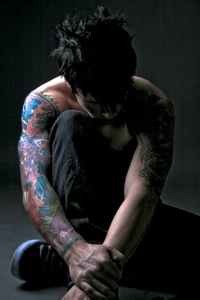
Photograph by Jemma Milanovic used in the cover of “Exhale” to portray Gavin Cassidy
How did you come across the photographs featured on the covers on Inhale and Exhale?
I found the Zoe picture on the INHALE cover on a stock photo site. The “Gavin” photo for EXHALE came from Deviant Art. Both images took months to find. Funny bit of trivia…the Gavin model is Australian and lives in New South Wales where Gavin does.
Did you learn anything from writing your books? What was it?
The biggest lesson I learned was humility. I wrote the first draft of INHALE almost four years ago and knew it would be a best seller. A deluge of cold-as-a-dead-fish form rejections from agents and editors informed me it was actually smellier than the creamy center of an 8-foot high chicken manure pile. Getting shoved out of my ivory tower was painful, humbling, and exactly what I needed. It forced me to seek help from other writers. I would never have gotten published without my writer friends and critique partners.
Being self published, did you find the responsibility and choices involved in cover art and fonts, etc. freeing and empowering, or a burden?
A little bit of both. I love the freedom and control I have. Many traditionally published authors have little or no say in the production of their books. Part of the reason I chose to self-publish was because I had a vision for my trilogy, and I didn’t want anyone messing it up.
The hard part for me is bearing the “What if?” burden. What if the books flop? What if they’re no good? Every author faces these fears, but I think it’s harder on self-publishers because we aren’t endorsed by the Powers That Be in New York. Many people don’t take indies seriously, which makes promotion and marketing difficult.
In your future ventures in the publishing world, what will you do differently? Why?
So far, I think I’ve done a pretty good job of managing the many the aspects of publishing (writing, revising, edits, more revisions, formatting final drafts, organizing reviews, promoting, developing marketing materials, etc.), but now that I’m close to finishing the trilogy, I don’t think the third book in the series will be ready by my projected publication date of July. The good news is, I’m self-publishing. My boss doesn’t mind if I’m a little late. 🙂 I’ll do my best to meet my self-imposed deadlines, but if I don’t make them, I don’t make them. Now that I’ve been through the process, I should be able to manage future books much better.
Outside of your love for whales, what’s one thing you would want your readers and fans to know about you?
There’s nothing special about me. I’m just a person who wrote some books. I have plenty of flaws, fears, and loud feelings. I’m not afraid to share them. What you see is what you get. 🙂
Thanks so much for having me on your blog, AndiKay!
Additional Notes
INHALE, an urban fantasy romance by Kendall Grey, is now available in paperback and e-book for Kindle (MOBI) and Nook (EPUB). INHALE is the first book in the JUST BREATHE trilogy. Kendall is donating all profits from the sale of the trilogy to programs that educate people about whales and the challenges they face. Watch the video to find out why: http://www.youtube.com/embed/YQfjxacis28
Kendall encourages interested readers to consider purchasing an e-book instead of a paperback. E-books save trees, cost considerably less, and bring in much more money for the whales.
Thank you for supporting INHALE, and most importantly, the whales that need our help.
Check out Inhale’s web page: http://www.justbreathenovel.com/Just_Breathe/The_Books.html
Read my review of Inhale here: https://anakalianwhims.wordpress.com/2012/02/08/inhale-and-be-ready-to-hold-your-breath-a-lot-a-review/
Some of my interview questions have been known to have been inspired by http://riteshkala.wordpress.com/
Archie Rocks Acoustic, Totally Rocked Half Price Books
 Booking musicians to serenade customers at a bookstore has been pretty fun so far. Sure, it has ups and downs… a great musician, a no show musician, a nice musician, a quirky musician… but tonight it was all UP! Archie Parks had the tips flowing, the book buying happening, and customers tapping their toes while they shopped LP’s, and applauding from the DVD aisles. A couple came to find me to ask if he had cd’s for sale and why not. So after the show, I took some time to pour over the calendar with him and conduct an interview for my blog.
Who are your biggest influences?
Bush, Gavin Rossdale, Cobain. That dude from Seether, I can’t think of his name right now, but I’d know it when I see it. 90’s Grunge music mostly, you know STP. I could go all day… Pearl Jam, Smashing Pumpkins, Shoe.
When did you start playing and why?
Jr. High. My Dad had a guitar and a friend had a drum set. Started writing our own songs because if we messed up nobody knew. And then it snowballed. So I guess the answer is boredom.
Where else are booked to play?
I’m trying to set up a show at Bohemeos. It’s real chill there.
What made you decide playing in a bookstore would be right for you?
It’s chill. My new style is perfect for a chilling bookstore.
Since we’re in a bookstore, who are your favorite authors?
Asimov, he’s the shit. Herbert, I love science fiction, obviously. I heard a new Dark Tower came out, Stephen King, but not Stephen King, I like his alter ego Bachman. But Asimov is number one. I love robots, man. And those dudes that came out with new Dune books, they weren’t Herbert, but they were still pretty sweet. And I’m into Eastern Philosophy. But it’s fucking lame. I’m into it, but not to be a hipster.
Do you read much? Does your reading affect your lyric writing?
No, I don’t read much. It doesn’t affect my writing. What does is school, I’m taking Creative Works.
What messages do you wish to convey through your music?
My number one theme is love. I sing about it all the time because I love the ladies. But my goal is to help people find the right path for them. That’s why I like Eastern Philosophy and I’m not a hipster. Help people find themselves, and feel stuff.
When do you think you’ll have cds or downloadable songs ready for sale?
I have enough material for a seven track album. But I’m leery, I need moral support because I don’t want to rip people off just selling me and a guitar. I have higher standards. I don’t want to put my name on crap.
At which point, I had to tell him that I thought the idea of a cd with just him on a guitar wouldn’t be a rip off at all, it would actually be quite lovely. He’s very humble, but not in a self degrading well. He was genuinely pleased and surprised that customers were interested in buying his music if it was available.
Interview With Author Tanya Egan Gibson

Tanya Egan Gibson, photo from article: http://www.marinij.com/lifestyles/ci_12499312
I read How to Buy a Love of Reading
- Fitzgerald is obviously a heavy influence for you, who else were among your first literary loves?
Kurt Vonnegut, for sure, in high school. Slaughterhouse-Five changed the way I thought about what a novel “should be.” C.S. Lewis in elementary school. I loved the Narnia books. I wanted a wardrobe. Oh, and between that, all of Conan Doyle’s Sherlock Holmes tales. I had a serious crush on Holmes—the more eccentricity the better.
I should probably clarify, too, that it took me a really long time to appreciate Fitzgerald. I didn’t like The Great Gatsby in high school or in college. It wasn’t until I was assigned to teach it at a high school in California that I saw it differently. One of my students asked, “So why is Daisy such a bee-atch?” Which snapped me out of concentrating on the book’s famous symbolism (The Green Light! The Eyes of Doctor T.J. Eckleburg!) and refocused me on the people (characters) and their desperation to be loved.
- My favorite part of HTBALOR is how raw Hunter comes across, how much his character development rings true. That’s rare for a female author to write a male character so well. Is he the character you identify with most? Or did you fall in love with him a little? (Admittedly, I did a little of both.)
As a lifetime watcher of shows like Beverly Hills 90210 (the original one) and its successors, I always found the rich-kid-who-lives-alone-in-a-posh-hotel-or-other-parentless-situation to be a cool trope. (Yeah, we can call it a stereotype, but the literary ring of “trope” sounds much more forgiving.) I’m fascinated by stereotypes because it seems to me that people (real people, not just characters) often end up becoming them of their own volition, giving up on some of their most interesting dimensions for the safety/security/ease of neatly defining themselves.
The rich-kid-who-lives-alone is nearly always a misunderstood “bad boy” who (when we meet him at, say, the beginning of a CW television series) is engaging in self-destructive behavior and has a mean streak. Usually, as the series progresses, the character cleans up his act (usually for the love of a good girl) and he learns to become a responsible person (with, perhaps, a couple of dips into recidivism when the ratings need a boost) and discovers his inner poet/artist/recycling advocate/vegan.
So, when I wrote Hunter, I kept wondering what such a character would be like the other way around: What if the character was originally a responsible, mature-beyond-his-years person who knew who he was? What if living alone with too much money and little supervision hadn’t turned him into a spoiled, self-destructive brat? What if he liked to cook and knew how to clean and didn’t act or feel embarrassed about being a book geek? What would it take for that character to end up turning himself into the self-destructive-kid-with-a-mean-streak stereotype? Looks. And being looked at.
I suppose that’s a long preface and I still haven’t answered your question—sorry! What fascinates me about Hunter is that being so highly visible (an overnight hottie who never meant to be a hottie) deprives him of being himself. He wants to be kind and gentle and loving and loved. At his core these—and privacy—are what he most values. But these aren’t qualities valued in an appearance-obsessed community or expected of him as the community’s golden child.
So many of the good things Hunter does for other people are quiet, under-the-radar, private. Yet he’s constantly getting the message from his parents and peers—and even his college application essay prompts–that nothing matters if people can’t see it. (Thank you, reality TV society.) So he kind of splits himself into public-Hunter and private-Hunter. And in so doing, unravels.
Which, finally, brings me to answering your question: Yeah, I probably understand Hunter the best out of my characters because he’s desperate to reshape his world into something lovely and full of love—and also made to feel embarrassed about such inclinations. Like private-Hunter, I’m hopelessly thin-skinned and I get crushes on authors (even dead ones) and I daydream about them being kind. I’m very self-conscious, an introvert who pretends to be an extrovert because I really like people and like to talk with them—even though they often scare me. I write about love and loveliness; I believe there is much love and loveliness in life waiting to be discovered. (I’ve been called a Pollyanna. To my face.) But I’m no longer embarrassed by it.
- It’s clear you have a love/hate obsession-like relationship with meta-fiction. It’s also clear how beautifully you write the layers of a book, like a rose in bloom or an onion being peeled. When you are writing, do you find that meta-fiction lends itself to these unfolding layers or does it work against it?
Yup, I wrote a novel that makes fun of meta-fiction while taking the form of meta-fiction. So yeah, I do both love and hate it. Oh, and thank you for the compliment. Back to the love-hate relationship: It’s complicated. Self-consciousness tends to get in the way of emotion. (Have you ever watched a play where one of the actors is supposed to say something like, “I swoon for you!” but is too embarrassed to go all the way with it, his self-consciousness turning it hollow?)
Meta-, of course, is about consciousness of self. But it also invites the reader backstage, saying, “Slip in behind the curtain. It’s okay, there’s room. Check out that actor’s insincerity!” Maybe this affords the reader the opportunity to observe up-close that the actor is shaking, and gives him or her clues to the emotion behind the hollow “I swoon for you.” Maybe the real story isn’t the play on the stage, but rather the story of why that actor is too terrified/nervous/exhausted/ill to embody the emotion of that line. So the question is whether it’s worth sacrificing the outer story (the story being played out onstage with the supposedly swoon-worthy damsel) to this inner story.
For me, the answer is sometimes, and only if I’m sure that the main narrative (swoon-worthy damsel) is ultimately deepened, emotionally, by that meta- jolt. When you go meta-, you’re sacrificing the readers’ waking dream—plucking them out of a world and then asking them to willingly reenter it. That’s a lot to ask.
The short answer to your question: I cut way more meta-material than I ever use.
- One of the characters, Bree McEnroy, writes a meta-novel. Do you have a favorite book from another author that fits this genre? If so, what is it and when did you first discover it?
Waterland, by Graham Swift, is one of my favorite books ever. I discovered it in graduate school, where my love-hate relationship with postmodernism and all things meta- broke down into way more hate than love. Waterland was assigned in a British Literature course I did, in fact, love–a respite from talking about literary theorists with difficult French names.
The novel is about a history teacher who is supposed to be teaching his students about the French Revolution. But who, because he’s sort of losing it, starts telling his students about his own personal history instead. Among other things, the book calls into question the difference (if any) between story and history.
- Your book references several fictional characters as authors and includes excerpts from their work. Do you have full manuscripts of these books lurking away somewhere? Like J.K.Rawling’s Tales of Beedle the Bard and Quidditch Through the Ages, do you have plans to publish these?
No full manuscripts exist of Between Scylla and Alta Vista or Unwritten. I promise. I did write small excerpts of them for my website, though, where a few pages of each of these books “exist” on a virtual bookshelf. In “Hunter’s journal” (on my website)—the story he wants to write about a girl and boy going on a ski trip in fact existed as a large flashback in an earlier draft of HTBALOR. (It was originally the story of how Hunter and Carley, the protagonist of HTBALOR, met. Later, it was replaced by a shorter flashback near the end of the book where they bond over an incident on the Long Island Sound.)
- As a writer, I dread asking this question (I have no idea if I will finish my own novel this year or this decade), but as a fan I am dying to know: when can we expect another book?
HTBALOR was published eight or nine years after I started writing it. I’m hoping the novel I’m currently writing (the working title is LANDS) won’t take quite that long. Like HTBALOR, it contains a meta- element, and getting all the layers of it to line up (while at the same time making each layer emotionally true to itself) is, as I indicated above, kind of tricky. Plus, I’m balancing writing with taking care of my two wonderful children, ages 7 and almost-4. One nice thing about LANDS: it takes place at a fictional theme park, so my children love coming along on amusement park research trips and think the pictures in my shelf full of amusement park research books are very cool.
- The cover art of the Dutton hardback edition, also featured on your website, is the reason I picked up your book. As a writer and art fanatic with a Bachelors in Marketing, I can’t help but wonder: Were you involved in picking out this art, or was it all Dutton? If so, what was your level of involvement?
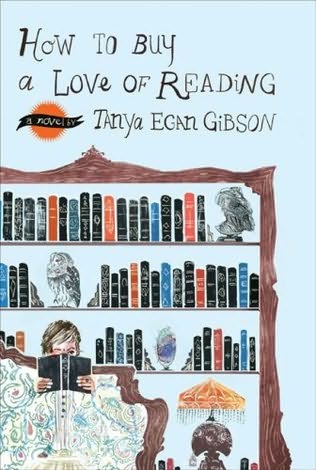 Dutton chose the cover design and illustration, which were done by an artist named Ben Gibson (no relation). I think it’s beautiful, and I was particularly happy about the way the girl’s body. The spine of the book kind of becomes her spine, but the rest of her body seems to blend into/disappear into the couch. Weight is overly important in the fictional community of HTBALOR—the protagonist, according to the personal trainer hired by her mother, is 57 pounds overweight—and this rendering of Carley honors the conclusion of the book, in which the reader is never told what “size” she ends up.
- Does the cover art for this book represent your own art tastes? Who is your favorite artist? (Or what is your favorite piece?)
I’m kind of a Philistine when it comes to art. Not a three-dogs-playing-poker or velvet-Elvis glow-in-the-dark wall art Philistine—but still pretty unknowledgeable. (I did, at least, learn something from doing research for Bree’s never-to-be-completed book about art patronage.) I’m particularly fond of my seven-year-old daughter’s pastel rendering of two orange Amazon rainforest frogs and my three-year-old son’s multi-colored blob paintings that he insists are either trucks, dinosaurs, or me.
- Carley and Hunter are both only children. Did you have siblings growing up?
My brother wasn’t born until I was ten or eleven and we were raised in different households—after my parents divorced, my father remarried, so we’re half-sibs who were kind of each raised as only children. While it’s wonderful to have a sibling as an adult (my brother is very cool), I definitely wondered, as a child, what it would be like to have someone there to do things with. My daughter likes to tell people that my husband and I had her little brother “so I’ll always have someone to play with.” Which is not exactly untrue.
- What is one thing you want your readers and fans to know about you?
I love reading and writing so much, and feel unbelievably fortunate to have a book out there in the world. I love to write emails to authors when I enjoy their books, and when I receive emails/Facebook messages/Tweets from readers who connected emotionally with HTBALOR, it makes my day. Reading, for me, is all about connection, and when people take the time to tell me that my novel made them feel something, I’m thrilled beyond words.
Please follow Tanya Egan Gibson on Twitter @tanyaegangibson.
Follow this link to purchase How to Buy a Love of Reading
Michael Goodell, Interview and Book Signing
I met author Michael Goodell, Author of Zenith Rising, on shelfari.com a few years ago. I bought his book, eager to read a something published by someone who I actually got to interact with in a book club. I love getting to know authors along side their work and separate from their work, its fascinating to me, which is why I am a huge fan of reading biographies and memoirs after reading everything the author has written. I enjoy pairing fiction with nonfiction and finding the beautiful little seams that tie the two together. So imagine my excitement when, in addition to booking a signing with me, Michael Goodell agreed to do a blog interview as well!
Describe your book. What genre do you prefer it to be classified?
Zenith Rising is a work of mainstream fiction with a linear narrative function. It is set in a declining industrialized Midwesetern American city, and describes how a handful of characters respond to the city’s decline, including that of the protagonist, a real estate developer who, on the eve of his greatest triumph, is rudely confronted with the poverty in his city, and decides he must attempt to do something to try to save the city.
I prefer to use the term serious contemporary fiction to describe its genre. In other words, I don’t aspire to write literary fiction, because I think most literary fiction today employs tricks, slight of hand and technical flourishes. It is actually more a matter of showing off, or of trying to impress your creative writing teacher or seminar host. The view today is, bizarrely, “If it reads well, it can’t be literature.”
What were the major influences for you when writing this book and for you as a writer in general?
I was working with a nonprofit housing group, trying to arrest the downward spiral of poverty and despair through restoring housing. It was such a positive experience, meeting a compelling need, that I wanted to get the message out to a wider audience. I thought fiction would be the best way to go. The kind of fiction I like always has a message–not an overt one, but one conveyed through the story. Since the novel was based inDetroit, but I set it in the fictional city ofZenith, where Sinclair Lewis set Babbitt, I suppose you could say he was a major influence at the time. So was Hemingway, along with Paul Bowles and John Fante.

Come Meet Michael Goodell in person!
When and why did you begin writing?
I have always written, because, trite as it may sound, I had to.
What is the first book you remember reading?
I don’t remember the name, but it involved a pair of wooden skis, a hut, and a hill. I was very young.
Do you have a personal favorite out of the characters in your book? Who is it and why?
When I started it was Narrows Burton. By the time I finished it was Seneca Doane III. He started out as a villain, and, honestly, I never expected him to turn into one of the good guys.
How did you come across the artist featured on Zenith Rising’s cover?
I met Warren Dreher inSan Francisco. We were both working in the back office of a brokerage firm. He was a painter, I was a writer, and we got an apartment together, along with a third friend who played the saxophone. We used to dream about how our lives were likeParisin the 20’s. There were some nights when we would all be in our rooms working on our respective crafts, and it was beautiful. WhenWarrenpainted the cover painting, I told him I wanted it on the front page of my first novel. I never realized it would take 20 years, but eventually, it made it.
Did you learn anything from writing your book? What was it?
I learned that if your work is real the characters actually take over the story, as I mentioned with Doane above. I had a basic story line in my head, but the characters kept driving the plot. I suppose one thing I learned, then, is to get out of the way of the story, that if you are struggling with the plot it probably means you are trying to force the story somewhere it doesn’t want to go.
In your future ventures in the publishing world, what will you do differently? Why?
I won’t get published by PublishAmerica. I would rather not self-publish, which is basically what I ended up doing with PublishAmerica, even though they billed themselves as a legitimate publisher. At this late date I may end up having to self-publish though.
Tell me about your next book. How is it linked to Zenith Rising? When is it coming out?
The new book is called Rebound. It’s more of a straight murder mystery, or what I called a postmodern treatment of the hard-boiled detective novel. It came about as a “what if” response to a news article. I wrote 30 pages and then let it sit for ten years because I didn’t know where to go next. When I dusted it off and reread it, I was amazed that there were arrows pointing the way. So I wrote it. It’s set in Zenith, but involves entirely new characters, though some of the old ones make cameo appearances. Much more of the novel unfolds in the exclusive suburb ofWellingtonLakes, where the rich and powerful kill each other and break all the laws. It was fun to write. The dying city plays as big a role in this one, though not as a theme, merely as background. It will come out when I find a publisher, or decide to do it myself.
What’s one thing you would want your readers and fans to know about you?
Tough question. I was going to say that I’m honest, especially in relation to writing. I suppose, though, I should say I am passionate about the written word.
Read My Official Review of Zenith Rising
Interview Questions inspired by Ritesh Kala’s Book Reviews Blog




 Anakalian Whims