HPB Humble Book Club Meeting March 2013
Lords of Finance Discussion Part Three (to read parts one and two, start here)
 Title: Lords of Finance
Author: Liaquat Ahamed
Publisher: Penguin
Genre: Economics/ History
Length: 508 pages
When all was said and done, Lords of Finance was a pleasant (and very meaty) read. It was definitely nice wrapping up the completion of the book with a discussion at Half Price Books among customers turned friends. The discussion definitely went down well with some home made German Chocolate Pie brought by a member.
 We sat together with internet research and a handy dandy chart of all the key players in Ahamed’s book and brought up our favorite quotes as well as bits and pieces that piqued our interest.
I was especially intrigued by the dialogue between Senator Mayfield and Senator Brookhart on pages 316-317 regarding Texas wanting to pass a bill prohibiting gambling via the stock market. Apparently, there were a lot of hearings that went on “in an attempt to refine the distinction between investing and gambling.” Upon reading this I immediately wanted to hash out the distinction and research the laws with others. What a fascinating paper this would make for a young economics student to be assigned in order to both understand the inner workings of the stock market and to establish their own world view in terms of monetary ethics and morals. Honestly, have you ever wondered… What is the line between gambling and investing? Off hand, I’m not sure I have a steadfast answer to give. Do you?
At the meeting we talked about businesses that are publicly traded verses those that are not. We touched on Roosevelt and Hoover and what they had to deal with as presidents in comparison to what Obama is dealing with today, and over all what a relevant piece of history this book is. One of my favorite quotes came very late in the book on pages 438-439:
When, in August 1932, a reporter for the Saturday Evening Post asked John Maynard Keynes if there had ever been anything like this before, he replied, “Yes. It was called the Dark Ages, and it lasted four hundred years.”
That line from Keynes about the Great Depression had me smitten with him. When I got to the store, I immediately headed toward the economics section and picked out a book he wrote called The General Theory of Employment, Interest, and Money
It took us awhile to decide who would actually be purchasing the only title by Keynes in the store. Everyone, I think, likes to read titles mentioned in books they read and Ahamed mentioned Keynes work quite a bit. We are in agreement that the books (both Keynes’ and Ahamed’s) should be used as require reading for economics classes, both high school and college. As someone who actively participates in continuing education on a self-study basis, I am interested to see how the end of this book leads into World War II. So many financial agreements were made and unmade, I want to know in detail how things were handled during the war on a financial level. None of us in the group were financial historian buffs and were unable to answer our own questions, but discovering the answers in the future should be exciting.
As for our reading future as a group, we tossed around ideas for the next set of books. This isn’t quite set in stone just yet, but it’s looking like the HPB Humble Book Club reading schedule will look like this:
April: On Chesil Beach – Ian McEwan (we will probably also discuss Atonement)
May: The Heart is a Lonely Hunter – Carson McCullers
June: The Princess Bride – William Goldman (the online Half Price Books book club will also be discussing this book in June)
July: John Adams – David McCullough
August: The Color Purple – Alice Walker
Any changes to this tentative reading schedule will be made at the April meeting.
The Froggy Books
 Weekly Low Down on Kids Books
Title: The Froggy Books
Author: Jonathan London
Illustrator: Frank Remkiewicz
If I never have to read another one of these books that would be fine by me! BUT, that’s not going to happen as the kiddo so kindly nominated these as the must read series for the last two weeks running.
I picked up ten titles in the series at the library and have not had a break from them since. She saw frogs on the cover, so frogs we had to have, and we checked out everything available in the series.
They aren’t bad, they’re very toddler friendly actually, I’m just tired. Any time Froggy goes somewhere he has to flop, flop, flop. When he puts on his clothes it’s with a lot of zips, zats, and znats. There are bonks and clangs, lots of “Froooooooogggggy!” and “Whaaaaaat!” exchanges between Froggy and his parents. Then of course, there’s that defining moment in each story when Froggy “more red in the face than green” discovers he’s doing something ridiculous.
The kiddo loves them and I cannot sit down to read a Froggy book without reading at least three Froggy books. This week, on multiple occasions, Froggy has gone to school, learned to swim, gone to bed, played T-ball, eaten out, gone to Hawaii, played in a band (kiddo’s favorite), gotten dressed (my least favorite), had the best babysitter, and had a sleepover.
They don’t have to be read in any particular order, but if you happen to find them in order you will definitely benefit. London does a good job of bouncing previous lines from previous stories into a later book. For instance, if we had not read Froggy Learns to Swim I would not have understood why in Froggy Goes to School the characters start chanting ‘bubble bubble toot toot chicken airplane soldier’ and think that it has anything to do with swimming. I guess I missed out on that swimming lesson as a child. But thankfully, I’d been to Froggy’s swimming lessons, so it wasn’t too weird.
There’s a lot of Froggy books and I’m sure we shall read more of them in the future as we come across them. As I said, great toddler titles… for the toddler. Parents: you’ll be longing for the days when you were reading Eric Carle twenty times instead.

While Away with Winston
Lords of Finance Discussion Part Two
Title: Lords of Finance: The Bankers Who Broke the World
Author: Liaquat Ahamed
Publisher: Penguin
Genre: Economics/ History
Length: 508 pages
“Socialism is a philosophy of failure, the creed of ignorance, and the gospel of envy, its inherent virtue is the equal sharing of misery.”
Winston Churchill. That quote is really intense! But we’ve all heard it, I’m sure. And everyone knows the name Winston Churchill, has a basic idea of what he looks like, and knows where he belongs in history. Everyone knows he’s great. But beyond one little paragraph of description and some quotes you’ve heard, how much do you actually know?
The second installment of the Lords of Finance posts is in regards to Parts 2&3 of the book. Actually, it’s in regards to the parts in those parts that talked about Winston Churchill. It was during these segments that I realized how much I didn’t know about him at all.
 All of my knowledge of the man prior to this book was based in a few intense quotes, a lot of school propaganda, and a few character appearances in Doctor Who episodes. Frankly, prior to reading this book I didn’t feel much inclined to study up on Churchill, I mean could he be any cooler than how he is portrayed in Doctor Who? I doubt the real Churchill had a direct line to The Doctor or any time traveling space alien for that matter. But obviously, one must move on from fictional portrayals and out of context quotes at some point in their life – and Ahamed makes me want to.
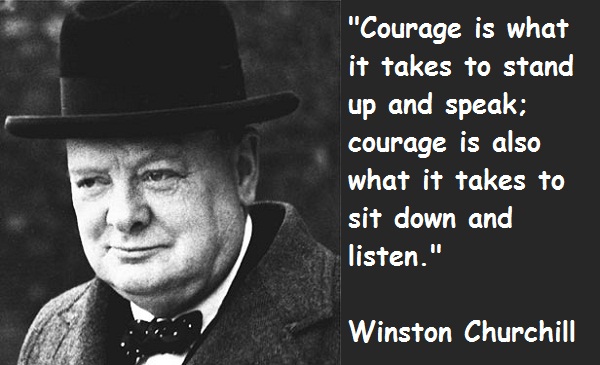 While I was reading about the “turbulent pushing busybody Winston” with his silk underwear, champagne, and Havana cigars, I immediately remembered a story I heard about him once. Someone once told me that Winston Churchill
So mid sentence, I left my toddler at the kitchen table putting together a completely unrelated paper penguin craft, and took a look at my library shelves. I have one biography and two books written by him. The books look like they belong to a set, a familiar set that I took home impulsively pieces at a time; but now that I am looking at them with curious research eyes they seem completely foreign and magical.
I still have much to read about The Bankers Who Broke the World, but a little visit with The Last Lion would be nice. What do you know about Churchill? Would you be interested in reading up on the great man with me?
Follow this link to read the next installment in the Lords of Finance discussion.
What’s Awesome on Audio
 FOR KIDS… actually, for adults too!
Title: The Bippolo Seed
Author: Dr. Seuss
Read by: Neil Patrick Harris
Until I went browsing through the audio book section of our public library I had never heard of The Bippolo Seed. I love Dr. Seuss, he’s pretty much always awesome… but the clincher for me picking up this edition to enjoy at home with the kiddo… why, Neil Patrick Harris of course!
Most child stars are annoyed by being referred to by the role that gave them their big name… I know Mark Wahlberg hates being called Marky-Mark and Maureen McCormack has made it quite clear that she is not Marcia Brady. But seeing Neil Patrick Harris’ name on that Bippolo Seed box, all I could think (and I apologize to NPH in advance!) was: Doogie Howser reads Dr. Seuss! What could be better!? Nothing, I tell you, nothing.
The fabulousness of Dr. Seuss combined with the sheer genius of Neil Patrick Harris is awesome. I love stumbling upon these kinds of wonderful things, because I’m certain my child is as tired of hearing my reading voice as I am of reading sometimes. I don’t feel so guilty passing the buck when I know someone as boisterous and Harris is taking the lead.
As for the “other lost stories,” there are a ton of talented stars featured on this audio book. Angelica Huston was surprisingly wonderful. Surprising not because she’s untalented or anything, just because I confuse her with Sarah Douglas and always imagine it was Huston, not Douglas, who played Ursa in Superman II (don’t ask me why)… and Ursa always appropriately gave me the creeps.
The point? Whether you’re a kid or a grown up, it’s never too late to hear The Bippolo Seed on audio.
Economic Education

Lords of Finance Discussion Part One (I am writing this only 150 pages into a 508 page book. I anticipate a series of reviews, much like how I handled Les Miserables in 2012, except over a short amount of time. I will have the book completed no later than March 4th, 2013)
Title: Lords of Finance: The Bankers Who Broke the World
Author: Liaquat Ahamed
Publisher: Penguin
Genre: Economics/ History
Length: 508 pages
Inevitably I read something and find about ten more things I need to read. My constant lament on this blog is why we didn’t read more source documents in school. So is it any wonder at all that while reading Lords of Finance for the HPB Humble Book Club I discover that I absolutely must have a copy of The Economic Consequences of the Peace
In addition to that title, I find myself longing to dive into more history books on the time period as well as full length biographies on a few of the people mentioned. You wouldn’t expect that kind of revelation out of reading a finance book, but Ahamed has a way of turning a phrase that makes interest and exchange rates, and the people directly responsible for their flux, fascinating.
I think this would be a great title to hand to a high school student during an economics course, it would definitely make the class more interesting. I enjoyed my economics classes in college, taught by a clever little man with a wonderful accent (Scotland? Liverpool? Not sure) and had a great sense of humor despite teaching all his courses at eight o’clock in the morning. But what I remember of high school economics was pretty cold and void of any kind of spunk. It was filled with boring formulas, worksheets, and a fairly heavy textbook that we read very little of. Obviously, the formulas are handy and important, but couldn’t there have been a little more meat? A little more perspective? A little more history?
Maybe living in a recession has weighed heavily in how I view the dollar, but I would like my child to grow to understand how much the economy effects politics, social customs, humanity, and art.
Idolizing money is a concern and a problem, but seeing how money fits into our lives and the bigger picture is important. So often we are taught that money is separate and that we should keep it that way, but the truth is money is never separate. Our history is riddled with money driven politics, so why is our history class and our economics class separate? Our religions are filled with instructions on what to do with our money, our philosophies rooted in our thoughts on whether to live richly or poorly and how rich and poor are defined. I think the history of banks, the dollar, and what your views are on the matter should all be addressed while you are learning how to calculate it, not as a completely separate train of thought.
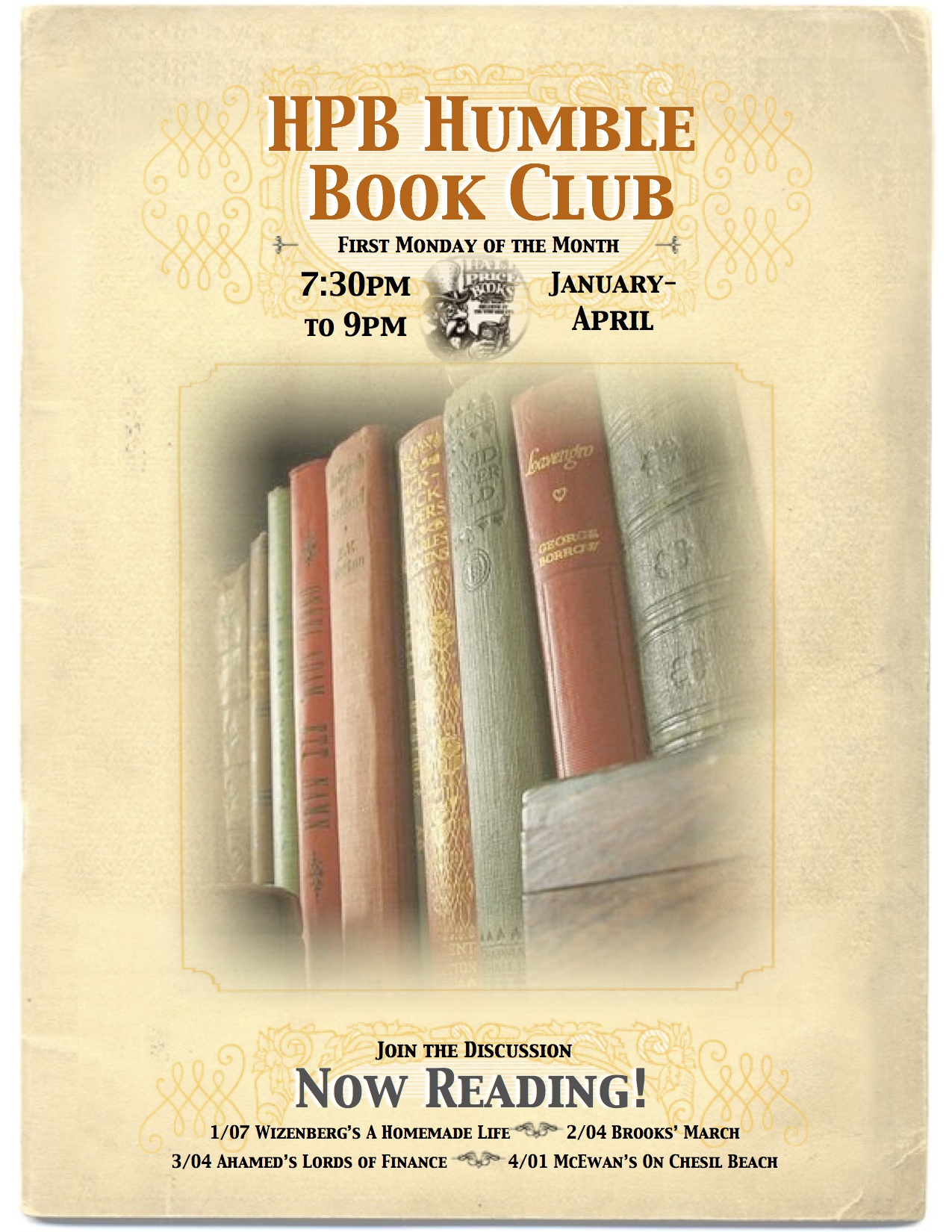 Ahamed’s Lords of Finance was recommended to me by a customer at Half Price Books, it was actually chosen for the Humble location’s book club by that same customer, and I am so glad I took his advice. We will be discussing the book as a group March 4th, 2013, starting at 7:30 pm. Additional members are welcome, so if you are interested in the book and are in the area, please join us. Treats are provided.
So far, the book is enlightening and informative, it covers a lot of the banking information provided in the documentary Zeitgeist without the haze of conspiracy theories and blasphemy. I imagine we will have a lot to discuss when we meet. Until then, I plan to share my own thoughts here.
Other titles in my personal Economic Library:
Adam Smith’s The Wealth of Nations
Thorstein Veblen’s Conspicuous Consumption
Craig Karmin’s The Biography of the Dollar
Thomas Stanley’s The Millionaire Next Door
Please share any titles you think should be added from a historical, philosophical, or sheer financial perspective.
Valentine’s Day News
Weekly Lo w Down on Kids Books
Title: Slugs in Love
Author & Illustrator: Susan Pearson and Kevin O’Malley
Join Herbie and MaryLou, two slugs on a farm, in their quest to find each other and true love. They write poetry and love letters back and forth on garden hoes and barn doors, leave messages in strawberry patches and on tomato vines. It’s really cute and a household favorite of ours year round, but is especially wonderful when celebrating Valentine’s Day with small children.
 Also, tonight at Half Price Books Humble…
As it is the second Thursday of the month, we’ll be journaling at the table in Metaphysics and Health from 7-9 pm. Bring your love or come alone, either way it should be fun to journal with art together.
Featured on the right is a Valentine’s piece from a journaling/art blog I found today.
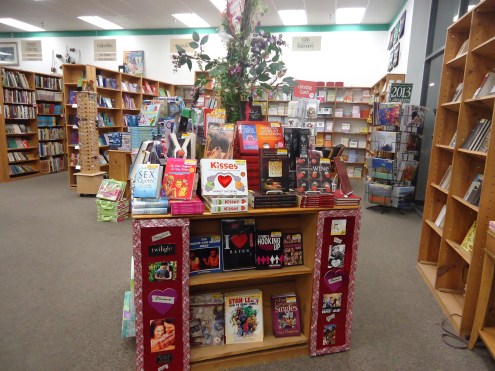
If you’re not into journaling, you should still come into HPB Humble before the Valentine’s display comes down. The Store Inventory Merchandiser did a pretty rockin’ job on it:


Weekly Low Down on Kids Books – Green Eggs and Ham
 The problem with toddlers, and kids in general, is the second you pin down what they like and don’t like they immediately turn into liars. Coincidentally, my kid did this with the infamous Dr. Seuss title Green Eggs and Ham.
As you probably well know, Green Eggs and Ham is about a guy discrediting something entirely without ever trying it. He insists through the whole book that he doesn’t like Green Eggs and Ham, he won’t like them here or there or anywhere, he’ll never try them because he knows he’ll never like them. Of course, as the twist of fate will have it, to get Sam-I-Am to leave him alone about the matter, he agrees to try them and discovers that low and behold they are GREAT!
That’s kind of how kiddo has been the last week or so about the book. I picked it up thinking, here’s a classic my kid needs, and read it to her (and some other kids) for the first time during Story Time at Half Price Books Humble. In a retail environment you don’t really have the freedom to take full advantage of all the exclamation points, so I bought it and read it to her at home.
 Halfway through our first reading at home she said, “No, no mommy, no green eggs and ham. No, no.” She put her hand over the book, shook her head at me, and instantly replaced it with another title. The title she wanted instead was a Max Lucado picture book from the library called One Hand Two Hands
A few days later, it hit me, but not until after second breakfast. At second breakfast, I started reading Green Eggs and Ham, which she insisted I put down. So, I went to pick out a different title and when I did this she protested!
“No, mommy, I like Green Eggs and Ham.”
“Oh, really?”
“Yes, now I like Green Eggs and Ham. Read.”
Like the star of Dr. Seuss’ little book, Kiddo had to warm up to the idea of Green Eggs and Ham. For whatever reason, when first introduced she was certain she would not like the book. Maybe it seemed to long. Maybe it was too repetitive. Maybe too loud. Who knows, maybe Sam-I-Am just annoyed her with all his persistence. But at the end of second breakfast, after trying to re-read it for over a week, my kiddo decided – finally – that maybe she liked Green Eggs and Ham after all.
Oh Heavenly Days
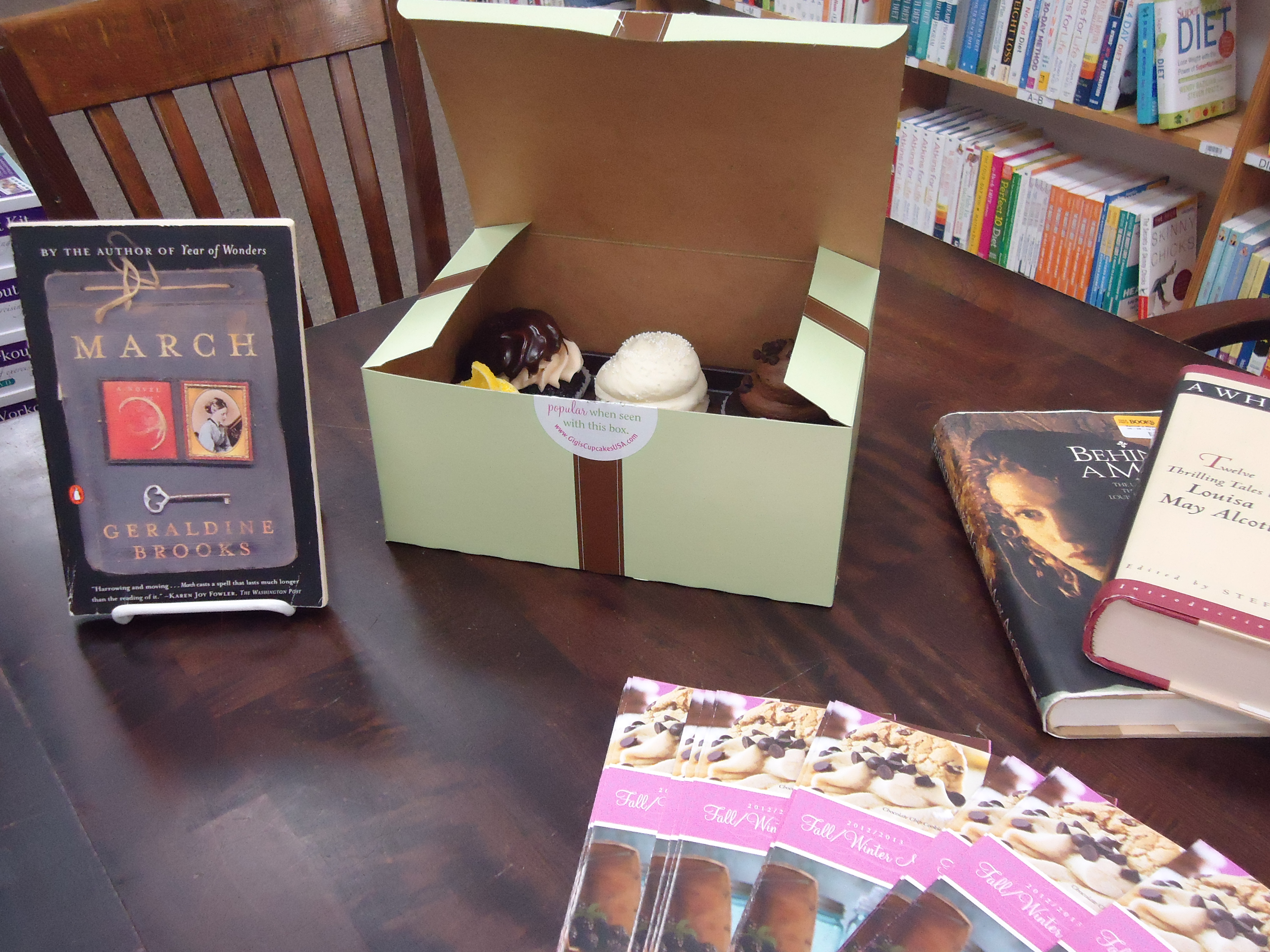 My post today is supposed to be an update of last night’s book club meeting at Half Price Books in Humble. We discussed Geraldine Brooks’ March, Alcott’s Little Women, Bronson Alcott, Fruitlands, and more. Gigi’s Cupcakes in The Woodlands donated a half dozen cupcakes (which are more like really rich mounds of awesomeness than your typical idea of a cupcake) and mid way through the discussion and a bit of double vanilla icing melting in my mouth, all my very southern self could think was “Oh My Heavenly Days.” The I-literally-feel-like-I-am-in-heaven version of that line, not the rolling of the eyes sarcastic version… you fellow southerners know the very huge difference.
The discussion was awesome. I am quite enjoying this little once a month activity. I love how prepared my gentleman patron comes, with several books and research in tow. I love yacking aimlessly on end about our likes and dislikes and anything about the book that has moved us that much. Add in free cupcakes from GiGi’s and I feel as though we have created a true little slice of heaven tucked away in the corner of Half Price Books.
As far as the discussion of March was concerned, one thing that was agreed upon was the difficulty in reconciling the characters Brook created with the characters we all know and love from Little Women. How did such a hot-headed Marmee become such a controlled and beautifully calm version we read in Alcott’s original work? Things that Brooks clearly well researched don’t mesh with the feel we have for the same history growing up in the States. One thing that stuck out in our minds, as a group, is whether Marmee would have actually gone and stayed under the same roof with the character Grace. What do you think? It’s not too late to join the discussion, leave your thoughts in a comment or come to the meeting next month.
We also agreed on a memorable quote that made an appearance quite early in the novel:
“For to know a man’s library is, in some measure, to know his mind. And this mind was noble in its reach, wide in its interests, discerning in its tastes.” – pg. 18-19
Of course a group of bibliophiles would enjoy that one, of course.
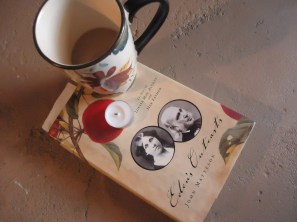 I am still reading Eden’s Outcasts, a book about Bronson Alcott and his daughter Louisa May. I believe I expressed this opinion last night, so I shall re-hash it here, and will probably say it again when I provide an official review of the biography… Bronson Alcott was a weird dude.
Louisa May Alcott’s father was a true transcendentalist, and with that come some shocking beliefs to someone raised as I was. To have your sole guide to life be your own conscious is rather difficult when your conscious moves you to establish a commune with other transcendentalists. Fruitlands became a commune of many differing beliefs and activities that never seemed to find a happy balance. You have one member running the place naked with another member refusing to farm, another with children, and others anti-children. The only common belief system to educate and be separate from the world. In Bronson Alcott’s attempt to create a heavenly utopia he created a hot mess, which upon seeing it I would exclaim in sarcasm now: Oh My Heavenly Days.
I am amazed that Louisa May Alcott came out mostly well adjusted. I am not, however, surprised that the story of Little Women in a happy little world to lose yourself. Little Women functions as a biography of the best versions of her family brought to life in fiction, all the strange and unhappy parts discarded probably for the sake of sanity.
That brings me back to Geraldine Brooks’ March. March is a much darker, sinister, true to life version of the tale of Little Women and Mr. and Mrs. March. It is a grown ups history. I think what is most difficult is reconciling the fictional tale of Little Women with the very real feeling war novel of March. There are some details here and there that ring false, but for the most part it is graphically realistic of some pieces of the Civil War. It captures the darker sides of human nature that Little Women does not address, things that coming from an abolitionist’s family Louisa might have been very familiar.
What do you think?
Little Monster Friends Part Two
Awhile back I did a Weekly Low Down on Kids Books that I titled Little Monster Friends. It was about Eleanor Taylor’s picture book My Friend the Monster. Then the other night I was recommending one of my kiddo’s favorite books to a friend who has a little girl kiddo’s age and when I went to link to my review of it, I discovered there was none. Or, I just can’t find it. So it’s about time I tell you (or remind you) of my little toddler’s new favorite monster book. It’s one I’ve enjoyed reading to her for quite sometime, but has recently become the most exciting thing in the world to her… at least a few times a day when something else isn’t more exciting. You know two year olds – maybe.
So here’s to our newest little monster friends…
 Title: Jumpy Jack and Googily
Author: Meg Rosoff
Illustrator: Sophie Blackall
Jumpy Jack is a delightfully nervous little snail who is terrified of pretty much everything, completely convinced there is a monster lurking around every corner. Googily is his adorably huge friend who checks for monsters everywhere they go, just to be safe. The catch? The terrifying monsters of Jumpy Jack’s imagination are always exact descriptions of his best friend and neither one of them know it.
This is a fantastic little picture book about imagination and friendship. The illustrations are fantastic and the story and the images both give the kiddo and I the giggles before bed at night.
Now that kiddo is chattering up a storm all the time, intelligibly, she does the cutest things and it’s even clearer than before what things resonate with her. Now she jumps around the house in the day time saying, “No monsters here,” and waggles her finger at me. Sometimes she brings me a sock and waves it at me and mimics the last page “Boo! Said the sock!”
Click the front cover to hear a little girl named Sarah on youtube read the book, check out all the pages. Then come back and click the title link to amazon. Just like Sarah says herself, if you don’t already own the book you’re gonna wish you did.





 Anakalian Whims
The Price of Excellence
February 20, 2013 at 4:20 am (Education, Reviews) (Appleton, Bel Kaufman, books, college, education, May Sarton, novel, professors, reviews, social commentary, students, teachers, The Small Room, universities, Up the Down Staircase)
I have a love/hate relationship with education. Or should I say formal education.
I love to read, I thoroughly enjoy research. But most my teachers over the years would tell you I was a horrible student, if they even remember me. My work was typically mediocre, often done at the last minute. The ones that do remember me probably remember a fairly obstinate and argumentative irritant, not really someone you want filling out your back row.
Yet, I find myself longing for the chance to go back and get a frivolous Master’s degree. I watch movies only to be wooed by the montages of students in glorious libraries. I fall in league with nerds like Rory Gilmore and Felicity Porter and lean toward books like May Sarton’s The Small Room .
.
Rather than an emotional feminist vs. anti-feminist story one would expect from the setting, The Small Room is about exploring the many nuances of excellence in education… and the price of obtaining it for both teachers and students.
Frankly, education is such a moving and sensitive topic. Who isn’t brought to tears by Dead Poet’s Society? Who doesn’t stand and applaud Mr. Holland’s Opus or The Emperor’s Club ? Who doesn’t watch Finding Forrester on repeat?
Then on the counter balance… Who doesn’t laugh their butt off reading Kaufman’s Up the Down Staircase and acknowledge how utterly familiar it sounds?
While reading, I imagined Appleton to be a smaller version of Wellesley.
May Sarton’s The Small Room is delightful and truthful. Without full on hating on education altogether, it takes into careful consideration the heavy weight being a teacher or a student can be on a human being and their relationships.
I have a 1976 Norton Library edition (featured above) and I fell in love with the book immediately. Long before I picked it up to read it, Sarton’s novel was part of my personal collection. I remember being so struck by the green leafy cover, the musty smell, and the promise of imaginary academia while holding the book in the used bookstore. The novel has lived up to the promise of its cover (and its smell!) and I think any alumni or teacher would appreciate the ethical discussions within its pages as Sarton and her characters attempt to define the price of excellence.
Permalink 1 Comment