A Rich Anthology

Rich Fabric lying on a piece of my own rich fabric, a quilt made by a family friend’s grandmother.
Title: Rich Fabric
Editor: Melinda McGuire
Length: 165 pages
When I first booked Melinda McGuire to do a signing at Half Price Books in Humble, I didn’t know I was about to meet one of the sweetest and down to earth people ever. A successful indie author of southern fiction and fellow Texan, she has been to the store for two events now, and hopefully more. Her most recent project, Rich Fabric, is an anthology about quilting, “the tradition, culture & symbolism.” With a dozen contributors, memoirs, short stories, tidbits, tricks of the trade, and all sorts of cozy anecdotes, Rich Fabric truly shows off the exciting and colorful heritage of quilting.
During the book signing on November 3rd, Melinda was kind enough to give me a copy of this little anthology, and yesterday I finally sat down to read it by my fireside, hot cocoa in hand. I knew it would be interesting and precious, but I didn’t expect such a lovely and diverse group of writers. Not all were from the south, not all were over thirty; in fact, there were contributors from all over and of all ages. The entire work is dedicated to a woman whose work is included within the pages, but died before Rich Fabric’s publication, an avid quilter named Crystal Vining. All the profits go to the Twilight Wish Foundation, a non-profit organization that grants wishes to senior citizens living at or below the poverty level, but the work itself leaves you with a strong sense that quilting is not just something of interest to senior citizens, but the young and the very young as well.

A beautiful inscription.
I have truly enjoyed the stories and pictures in Rich Fabric. I have enjoyed the feeling of getting to know families I have never met while being inspired to hunker down and complete my own unfinished quilt, as I have been working on one for years but all the quilts in my house were made by others. Many of the anecdotes were so intimate and involved, I began to feel a little sad for my quilts not having such an involved history. Each of mine were made by friends of the family and their families, they are items I received used, merely by accident; though they are well-loved here in my home, I do not personally know their crafters or the circumstances in which they were brought into existence. Then, I read Claire Burson’s piece about her quilt, passed down through the family and cherished but the intimate details being lost. She explains the treat and delight in the mystery of the quilt itself, how there is beauty in the known facts but beauty in the lost details as well because then she can imagine all the possibilities. In that moment, the sadness for my hand-me-down quilts was gone and I realized she was right, it is kind of nice to be able to imagine.
I hope there will be more Rich Fabric volumes. It truly is a little treasure to have on the shelf, and with all the lovely stories within its pages it is only so glaringly obvious that there must be so many more out there in the world. I’d like to read those too some day.
So Many Books
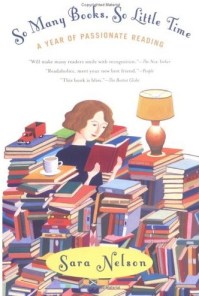 Title: So Many Books, So Little Time
Author: Sara Nelson
Publisher: Putnam
Length: 242 pages
Ironically, when I find myself so overwhelmed by my mountainous TBR pile I become crippled and damn near illiterate, I find that the perfect cure is a book about books. More specifically, a book with lots of lists and descriptions and lengthy lamenting of how many books there are in the world that are begging my attention. So my latest reading slump (if anyone but me were keeping tabs, they’d see I only read two books – other than children’s books – in the whole of October) I picked up a copy of Sara Nelson’s quasi-memoir detailing a year in the life of a professional book reviewer.
It’s short and sweet, and has a lovely methodical layout. Each chapter is dated, and dedicated to a week of time (I am assuming, as the whole purpose of the project was to read a book a week and write a bit on her life as she read said book, but I didn’t count the chapters and they are un-numbered). It was a pleasant read, I enjoyed the simplicity and quickness of it. But it also made me think, I found myself journaling after I finished every chapter.
She has a little segment on Then & Now, discussing the great reads of her adolescence and what she thought the first time she read it versus how she feels as a grown up and I found myself solidifying my plan to have my kiddo journal and document her own reading experiences throughout childhood to remember the titles and authors as well as her true feelings on the subject matter. Of course, we’ll keep it age appropriate, at first she will only be able to summarize briefly, but then she’ll have proof of the process of change and growth as a literary being. I’ve journaled my whole life, but not always with purpose. Purpose is a delightful thing to have. The ability to later compare your thoughts and feelings about literary ventures with such clarity would be such a treasure.
The chapter reminded me of my re-reading of The Great Gatsby earlier this year, and how much I truly enjoyed it. It reminded me of a need to re-read Hemingway’s The Old Man and the Sea, which I always hated, but feel I was just too immature and boisterous to care about a man fishing. Typically, my Then & Nows are quite vague, but with all this recent documentation of my reading life, I’ll have a better view of my lit-brain when I’m 80.
But above all, the chapter reminded me that there is value in my re-reading. Often, my TBR pile is so high, I feel guilty when compelled to read something I have already read. Should I really be doing this? I wonder. I know Persuasion nearly by heart, shouldn’t I be tackling Bauer’s Ancient History, a book I’ve been slowly pecking through, and loving it, for almost a year and a half now. Shouldn’t I be immersed in George MacDonald’s Lilith, a book I’ve had for ages, but keep only relishing in the first chapter and never moving on – over and over again? The list goes on. And yes, there is a physical list in my own writing, with not nearly enough checked off titles because I continually pick up others.
Then Sara Nelson says, “If you want to make the book god laugh, show him your reading list.” I nearly died. YES! However, every so many weeks, I find myself sitting down to write a new one anyway. I find them therapeutic, refreshing, even mysterious as I tend to write them haphazardly allowing my subconscious to take over and just see what spilled out of the ink pen next. What has been hiding in the recesses of my bookshelf that my brain remembers is calling my name? I think that’s why book lovers revel in their lifestyle so much. Whether they care a lick about the mystery genre, every book lover enjoys a good mystery.
Being a patron of libraries and used bookstores, I often find myself in the middle of a mystery. Whether it be a random scribble in the margins: Secret meeting in the place at 8, password candles, or some such nonsense, highlighting or dog-eared pages, when a book shares owners all sorts of questions arise. Most specifically, for me, I often find stashed bookmarks in the books I read. Sometimes at the start of a chapter, or in the middle of randomness where someone either wanted to savor a line or simply gave up reading the book; sometimes it’s a receipt or a thank you note, birthday cards, and even checks… things people stashed and forgot about, or possibly the item just slid into the pages when the book was stashed into a purse or bag. I often wonder which of these is the story for whatever scrap I find.
SMB,SLT had a small post-it stuck between pages 54 and 55, the beginning of February 27th, chapter: The Clean Plate Book Club. Did they run out of time and have to turn a nearly over due book back into the library? Did they give up because they hated it? Or give up out of principle, because the chapter is about seasoned readers having the power to give up on a book if they aren’t interested in it, wanting to prove something to themselves? Did they simply mark the chapter because the ideas within its pages spoke to them? We may never know. It keeps the mind reeling, though.
I couldn’t stop thinking about the idea that mature readers, seasoned readers, are the only ones who can give up on a book part way. Nelson describes it as a reader’s rite of passage.
“Allowing yourself to stop reading a book – at page 25, 50, or even less frequently, a few chapters from the end – is […] the literary equivalent of a bar mitzvah or a communion, the moment at which you look at yourself and announce: Today I am an adult. I can make my own decisions.”
Funny, I always thought of it as something slackers do in high school. Post motherhood, I thought it was something I did because I killed brain cells while being pregnant and having a baby. Quitting kills me every time, but there are times that I feel compelled to do it, mostly because I either plan to finish it when I’m in a different mood, or I discover the author is what Paul Collins would describe as someone who writes ‘unequivocal crap.’
It seems, then, I am a late bloomer in, yes, even reading. I thought at least I had escaped that title in one thing in life, having been a very early reader. But apparently not.
The most interesting chapter for me, though, where I might leave a small post-it myself, is March 15th: Eating Crows. It’s all about recommending books to friends and how it can possibly damage the friendship. What if one likes it and the other doesn’t? What does this say about each person? How does this new information you have gathered about your so-called friend change the friend dynamic.
This is where I found myself saying, ‘Oh, hell.’ I’ve been around book nerds, book people, bookstore staff, customers, friends, family, the whole shebang, and this is the first I’ve heard about this dilemma. I recommend books to people all day, every day. It’s my favorite thing to do. If I recommend a book it is because I either liked it, or I truly think you may like it. May is a big word in this sentence. If you don’t like it, that’s your own business, but I’d love to discuss why and learn more about the world around me. It isn’t going to make me not want to be friends with you, that’s just shallow and dumb… even though I may secretly think that what you read is shallow and dumb, I know that somewhere someone is thinking the same thing about what I read – so why should it matter?
The next chapter about borrowing or loaning books is also silly to me. I don’t loan it if I’m not ok with not getting it back – usually. If that’s not the case, then I’ll tell you PLEASE PLEASE GET THIS BACK TO ME one day, and that only happens with someone who has already established a good track record. If I don’t say that, you may bring it back, or just consider it a gift if you fall in love with it. I don’t care. I have plenty of books, and multiple copies of some of my favorites. A book will not ruin our friendship unless you write one about me that is awful, spilling the beans that you’ve actually hated me all these years but haven’t said so because… Then, we might have issues. That hasn’t happened to me, but I wouldn’t be surprised if it did. And no, I don’t have anyone in mind, I’m just used to being surprised by what people think of me.
All in all, Nelson you served your purpose. I have a new list of titles to tackle, nothing you mentioned in your book because we have entirely different reading tastes. That’s not true. They are similar in the way a Venn diagram is similar. Not a Venn diagram, more like if there are four quadrants of reading (I, II, III, and IV), and I & II are two different kinds of book snobs and III & IV are polar opposites of I & II who read varying kinds of ‘unequivocal crap’, we are readers I & II. Still, we may not have the same, identical tastes, and in real life you would probably never want to be my friend, but I enjoyed your book and it has made me voracious for the piles and piles on my own shelves again.
A Book Club Possessed…
… by the power of the words of A.S. Byatt.
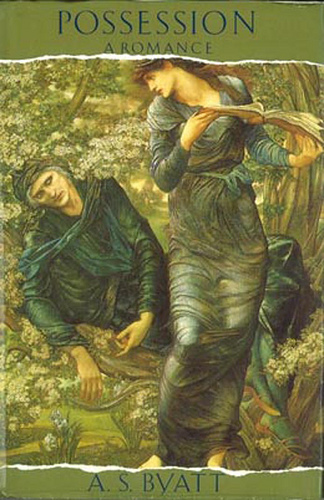

I already shared with you my thoughts on A.S. Byatt’s Possession, how the novel leaves me overwhelmed with inadequacy. But tonight, at the Half Price Books Humble monthly Book Club meeting, I got to discuss with others how it made them feel.
Over a strawberry cream cheese coffee cake, we talked a lot about French mythology, feminism, the Victorian era, the roaring twenties (a discussion that branched out of our feminism discussion), human nature, and more.
There is so much to talk about in this book, so much material, so many memorable quotes, I found it exhilarating that the things I wanted to discuss were things someone else wanted to discuss too. When I asked about favorite quotes from the book, a typical book clubbish question, it was exciting to see that Henry had underlined the same quote on page 39 that I had. What are the odds?
“It’s an odd affair – tragedy and romance and symbolism rampant all over it […]”
The quote is about the fabricated poet Christabel LaMotte and her poem about Melusina, and in hindsight it doesn’t necessarily stand out that much from the other wonderful quotes to be found in the book. However, it is so close to the beginning that you wouldn’t know that so many amazing bits of prose are to come. I think I had initially underlined it, supposing (correctly) that it would equally describe Christabel’s poem and Byatt’s work as a whole. There is tragedy. There is romance. And the symbolism is rampant all over it.
The idea of cleanliness, purity, and the color white intermingle with Victorian era ideology while also contrasting against the deviance of feminism in bold greens, crimsons, plums, and blues.
What is so interesting about all this symbolism with color, is that like it’s themes, that the white and the color overlap so effortlessly, so surprisingly, when the final work is complete it is hard to decide where you would want to end up – with the pure white? or the passionate color? It seems as though to be complete, there would need to be both.
There’s an essay floating about in cyberspace written by a Stephen Dondershine titled Color and Identity in A.S. Byatt’s Possession. In it, he talks of the book being just like a Pre-Raphaelite painting and quotes Raymond Watkinson”s Pre-Raphaelite Art and Design:
One of the marks of the finest Pre-Raphaelite work was, and still is, the exciting and disturbing power of its colour — very much the least naturalistic aspect of the new painting. The painters of the Brotherhood, and their associates, went beyond the frank record of the green trees and grasses, the bright pure hues of flowers, and reintroduced into painting ranges and relations of colour unused in European art since the Middle Ages — an alarming array of blues, greens, violets, purples, used not simply because they were there to be painted, but chosen for their powerful emotional effect. It was not of course simply the colours, but their combination, that compelled and provoked these effects.
Dondershine stresses the word combination with good reason. Would any of these paintings speak to us visually and emotionally even half as well if the lights and darks were not so opposite and vibrant? If the color was not so colorful and rich, if the white was not so stark?

Would Maude be so fascinating if she wasn’t so broken by Fergus? Would Christabel’s story be quite so passionately romantic if she hadn’t been a virgin before Ash? Would the story have meant so much if their love hadn’t been somewhat forbidden? At the same time, doesn’t her fate make you think twice about her rash haste to be independent? Doesn’t the idea of freedom being found within the safety and confines of a marriage, a partnership become solidified when viewed in the severe contrast of Christabel’s dependency on her cousin later in life… when seen how famously Roland and Maude get along?
Then there is Melusina. Melusina, the story actually being described in that oh so telling page 39 quote. I had never heard of Melusina until this book. I am now completely captivated by the French version of the Scots selkies, the Ondines/Undines of the world; except instead of being a beautiful and gentle seal-woman, Melusina is a serpent of the water-sprite variety. Now, of course, I am dying to get my hands on a compilation of French myths, equipped with illustrations throughout history, of course!

All in all, it was an exciting meeting, and left me much to ponder. I cannot wait until next month’s gathering when we will discuss Charles Dickens’ The Old Curiosity Shoppe.
The Ultimate Possession – a book by Byatt
 Title: Possession
Author: A.S. Byatt
Publisher: Random House
Length: 555 pages
Nothing can make you feel so inadequate as a writer as when you read a piece of such perfection that your own work cannot but pale in stark comparison. It’s possibly something like being the mediocre gymnast addicted to watching the Olympics, knowing that the athletic achievements they witness will not and cannot be their own reality.
Someone can write and write, practice with diligence, read, and surround themselves with excellence of the craft – but there is an element of giftedness that can only be handed down by the command of God.
A.S. Byatt is such a person graced with immense giftedness.
Possession is overwhelmingly and alarmingly riddled with her talent and sheer genius for the craft.
Prose, poetry, storytelling, she has it all and shares it with such ease. Nothing is forced, everything unfolds with the exquisite engineering of a flower in bloom, or a butterfly emerging from a cocoon. Intricately beautiful.
How can a person contain so much talent?
I imagine hundreds of years from now archeologists and scholars will discover a copy and upon inspection will accuse the author of not being a lone writer – but a pen name used for a collective. They will say the book is a collaborative effort between several poets, a journalist, a researcher, and possibly a novelist. Someone would be supposed to offer their services as the voice of Christabel LaMotte, another as R. Henry Ash. They may even miss the point altogether and believe it to be an actual account on a literary discovery, or a novelization of a literary discovery.
I think of myself as a writer. I have unfinished stories, a three-quarters written novel or two. I even used to attempt to write poetry – that was eons ago. None of it is really any good. I love words, but do not have the grasp and understanding of them to put them to proper use. I do not have the finesse of a linguistic artist. The words just linger muddled and puddled in my brain and sometimes my journals, fragments of fragments end up on this blog. I always tell myself that I’ll be better when I’m older, but I never am.
The only thing I can claim with absolute truth, is that I am a reader. As one reader to another, I must tell you, anyone who makes that claim cannot go through life without having read Possesssion.
“Your Review Helped…”
I love getting these emails:
AnakaliaKlemm, a customer just told us your review was helpful to them while shopping on Amazon.
 |
 June 11, 2012
|
Read my review here.
The Guardians of Childhood
 *A Weekly Low Down on Kids Books*
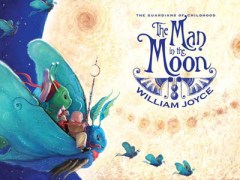
Title: The Man in the Moon
Author: William Joyce
I clearly have an artistic and literary crush on the fabulous writer and illustrator of The Fantastic Flying Books of Mr. Morris Lessmore! William Joyce’s work is simply beautiful, spunky, cozy, and classic.
During story time at Half Price Books in Humble, I was very pleased to discover a pile of The Man in the Moon on the shelf this morning, the first of many in Joyce’s Guardians of Childhood series. It seems as though Joyce’s work, despite being lengthy, is just the remedy for a squirmy, whiny toddler. One look at these gorgeous illustrations and immediately stillness and wonder ensues.
Joyce presents the myths of childhood in a way that a child will understand that they are beautiful dreams to enjoy, a fantasy to embrace. Kids and and adults alike cannot tear their eyes away from the colorful and powerful images he creates, and all are equally riveted by the presenation of the tales.
I am coming to cherish my time reading these books to the kiddo and I cannot wait to acquire the others in this amazing series:

Buy your own collection of Joyce’s Guardians of Childhood today!
Weekly Low Down on Kids Books – Previously
 Title:Previously
Authors: Allan Ahlberg and Bruce Ingman
Publisher: Candlewick Press
Kiddo and I closed the book with a happy sigh. *Previously* we had been reading a lovely tale that included every tale.
From Goldilocks to Jack and the Bean Stalk, Jack and Jill to the Gingerbread Boy, Ahlberg and Ingman have brilliantly included all the familiar fairy stories in a unique fashion that teaches a kid the meaning of the word “previously.” How fun!
How did they come up with it, I wonder?
The whole idea is just so clever. The pictures so simple and exciting! The kiddo was riveted and I simply couldn’t wait to see how Ahlberg and Ingman would connect the story dots next.
In contrast to the intelligence it took to write this fabulous little picture book, we also read Ok Go by Carin Berger and were quite unimpressed. The art and design of the book is really cute, but the work as a whole was a bit lost on me, kiddo was pretty uninterested.
Parnassus on Wheels – Can I Have One?
 Title: Parnassus on Wheels
Author: Christopher Morley
Publisher: Akadine Press
Length: 160 pages
“[…] When you sell a man a book you don’t sell him just twelve ounces of paper and ink and glue – you sell him a whole new life. Love and friendship and humour and ships at sea by night – there’s all heaven and earth in a book, a real book I mean.”
Parnassus on Wheels is both sweet and clever. It is adorably romantic. After reading this, I want desperately to peddle books from a horse-drawn early 1900s RV. Morley has captured a tale of an adventure that is every book lovers dream: to travel in a cozy carriage with a dog and horse, spreading the love and joy of literature to everyone you meet. What could be better?
Mr. Mifflin is a middle-aged ginger, evangelizing about the religion of books as a way of life, when he meets over-weight Helen McGill. Helen is tired but spunky, she’s been a ‘house-wife’ to her brother for years on the farm they share. Her brother, a famous author doesn’t really treat her as though she’s her own person, and 6,000 loaves of bread into life, she buys Mifflin’s whole operation for $400 on a lark. Of course, everyone thinks Mr. Mifflin is taking advantage of the lady, but in reality he has offered a whole new life, a new way of seeing the world, and an absurd amount of joy.
As a bookseller, this story speaks to me. I ran the literature sections for several years, and I received an intense amount of satisfaction from finding books for my customers. The idea that you could deliver books straight to someone’s doorstep in such a homey but noninvasive manner sounds so enticing and whimsical to me.
Peddlers are well-known concept:
THE PEDDLER’S CARAVAN
[46]
I wish I lived in a caravan,
With a horse to drive like a peddler-man!
Where he comes from nobody knows,
Or where he goes to, but on he goes!
His caravan has windows two,
And a chimney of tin, that the smoke comes through;
He has a wife, with a baby brown,
And they go riding from town to town.
Chairs to mend, and delf to sell!
He clashes the basins like a bell;
Tea trays, baskets ranged in order,
Plates, with alphabets round the border!
The roads are brown, and the sea is green,
But his home is like a bathing-machine;
The world is round, and he can ride,
Rumble and slash, to the other side!
With the peddler-man I should like to roam,
And write a book when I came home;
All the people would read my book,
Just like the Travels of Captain Cook!
—WILLIAM BRIGHTY RANDS.
But a book peddler is a fairly unique idea, and I love Christopher Morley for sharing this idea with the world. Clearly, he didn’t invent the concept, but one wonders if he encountered a caravan such as R. Mifflin’s Traveling Parnassus, or is it merely a dream he had for himself? Parnassus on Wheels was Morley’s first novel, first published in 1917. Mr. Mifflin returns in the book The Haunted Bookshop, a sequel I am strongly looking forward to, but what I find most interesting is that Christopher Morley wrote over 100 novels. Have you heard of any of them? I had not, I was only aware of Morley because he was pressed on me by a fellow bookseller. I rarely come across his work in bookstores, and I have never seen a title of his in any library. I now plan to collect his work more vigorously.
Morley apparently wrote a number of essays and poems as well, and lectured at University. One adorable little factoid is that he married a woman named Helen shortly after studying history in college. I can’t help but wonder how much Helen McGill, of Parnassus on Wheels, resembled his own wife whom he loved.
Have you read anything by Christopher Morley? Please leave comments.
Great Journeys – Marco Polo
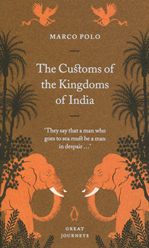 Title: The Customs of the Kingdoms of India
Author: Marco Polo
Publisher: Penguin Books
Length: 86 pages
Inspired by the Great Ideas series, Penguin Books printed a Great Journeys companion series as well. From Herodotus to George Orwell, the series chronicles twenty of the most famous and intriguing adventurers in history. Third in this series is Marco Polo’s journey to South Asia, where he discusses the culture, the economy, the industry, religious practices and more.
I picked this book up for two simples facts: 1. I am collecting all of Penguin Books Great Ideas publications and 2. There are elephants on the front cover. I adore elephants. They are powerful, dignified, trustworthy, humorous, and endearing. Marco Polo’s The Customs of the Kingdoms of India has little do with elephants.  Actually, I’m pretty sure it has absolutely nothing to do with elephants. Of course, that’s not the point, elephants are broadly recognized as a symbol of India/ South Asia, so naturally they would be an image of choice for the front cover of an Indian travel book.
Marco Polo does not go into great detail about how the elephants are used as means of transportation, status symbols, work beasts, and more. He mentions them in passing, but says in the places he visits, they are not indigenous to the area but imported from other islands. He does, however, discuss the art of physiognomy, which immediately made me think of the science fiction piece by Jeffrey Ford called The Physiognomy
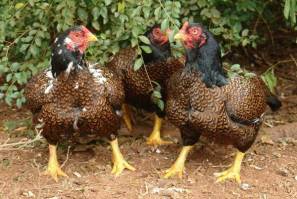
Did Marco Polo’s “prettiest hens” look like these?
Apparently, in South Asia, hens represent prosperity, and today you can buy ‘prosperity hens,’ little talismans similar to a rabbit’s foot. Of course, Marco Polo again does not go into detail regarding this, he merely mentions their beauty and moves on. Marco Polo’s writing is that of traveling merchant. He chronicles quick and simple descriptions that would be useful for a businessman, but avoids the great detail of a philosopher or anthropologist. The things that strike his fancy for elaboration are the rituals that would intrigue a vendor, rather than those that would fascinate a theology student. Where he does talk about religion, it seems to be in a political and historically informative way to help you understand a province as a whole, moving quickly to the supplies they live on because of their past. Like a professional trader, he wishes to dwell on the rice, the wheat, and the growth of cotton. Respect for various people groups and villages he encounters is highly dependant on how much they function on industry and marketplaces.
I don’t believe Marco Polo to be much of a writer, and I think his accounts would have benefited from being written while on his voyage. But according to historians, he dictated these adventures of sailing the Indian Ocean later to a fellow inmate in prison. This practice of dictation could have played a role in his style of often informing his reader “I will tell you how” and “I will describe to you,” as well as “let me tell you why” and so on; repetitive and unnecessary phrases that, quite frankly, annoyed me.
Still, this concise 86 page piece is interesting, and a great addition to any young scholar’s library. It would be a wonderful supplement to a world geography study on South Asia for a middle grade student and could open up a lot of dialogue between teachers and students regarding history, religious practices, other cultures, world economies, and more.
Les Miserables – BANNED
 The practice of banning books is beyond a bit baffling, it is also fascinating. The first ‘official’ censorship, of course, began with the Catholic Church in 1559, an extensive list of forbidden books tasked to be made by Pope Paul IV. Since then, the practice of banning books hasn’t been limited to the religious, but been taken on by governments, schools, libraries, and organizations both public and private all around the world. Some make the mistake of assuming these books simply ‘must be bad’ if they are restricted so often, but the reality is that somebody somewhere will always feel threatened or offended by the thoughts of another and people of power will always try to enforce their thoughts and opinions on those who are subject to them. “The hand that rocks the cradle, rules the world,” said Karl Marx. Well, I say: The one that chooses the books, rules the world, unless of course you allow them to choose for themselves and then you have to rise up and be a better leader.

I am currently reading Part IV: Saint Denis
Les Miserables, one of the most impassioned and well-written novels in all of history was often a threat to poor leaders. It is a beautiful story of familial love, sacrifice, tragedy, the history surrounding the French Revolution, and his personal views on the church and government. Hugo doesn’t pull punches, however, when describing these beautiful and tragic things, he doesn’t leave out a bit wretchedness, he presents the world as it he saw it, and in doing so was punished for it. Hugo was banished from France for life by Napoleon III for criticizing his government and all of Hugo’s works were banned in Russia by Nicholas I for the unpleasant way which royalty was portrayed in his novels. Not only that, the Catholic Church added everything Hugo had written to the Index Librorum Prohibitorum (often referred to as The Pauline Index) for “sensual, libidinous or lascivious.”
These challenges did not merely last Hugo’s life time. His works weren’t removed from the Index until 1959. This essential piece of literature has been considered threatening for portraying prostitution, murder, the church as unimportant, and glorifying the French Revolution. 1959, such a time of the past… but the fight is never over. In 2007, Hugo’s grandson and an emerging author battled in the French courts over whether or not a sequel to Les Miserables could be published. This time, instead of contesting Hugo’s work, his grandson is fighting to protect “the spirit” of his work, claiming that Les Miserables should all be considered intellectual property. Valid perhaps, but what would Hugo say about his grandson banning an author?
 Hugo was part of the original literacy war in Paris in 1830. In addition to his books being banned, his plays were also challenged. Authors and artists paid professionals to sit in audiences and applaud their plays in order to counter those trying to shut them down. Duels were fought, defending the right to write, one young man even died for the sake of Hugo’s Hernani. Protect the spirit of Les Miserables? Yes, please. Ban literature? No, thanks. It is up to the individual reader/fan to protect the spirit of an author’s work, though, choose NOT to read it. The government should not be able to authorize the restriction.
This coming Saturday, October 6th, Half Price Books Humble will be hosting a Read Out from 1:00 pm to 3:00 pm. Come hang out with fellow book lovers and read a line or two from your favorite and most cherished banned or challenged book.
Additional blogs and articles of interest:
Dangerous Pages
Index Liborum Prohibitorum (About)
Index Libroum Prohibitorum (List)
About Hugo
Les Miserables II
More on Les Miserables II
My post on St. Denis.





 Anakalian Whims