Ramses Volume 3: The Battle of Kadesh
A review on the third volume of the bestselling series by Christian Jacq:
The character development is poor and I’m definitely disappointed with the level of historical accuracy and shallowness of all the well-known figures. To me, it might be better to write a piece on Ramses from an unknown person’s point of view – character development can go as deep as the imagination, and the writing wouldn’t seem so lacking because what the character sees of Ramses would be based in what we find in museums and history books. Instead, Jacq uses redundant phrases and paragraphs to describe the relationships between characters – much like Nicholas Sparks whom I despise. But, it is an entertaining vacation read.
Ramses Volume 2: The Eternal Temple
The further into Ramses story Jacq gets the farther away he gets from history and truth. I like my historical fiction to be based in a little more fact and so much of the story and so many of the characters are off base. Its all rather disappointing.
Ramses: The Son of Light by Christian Jacq
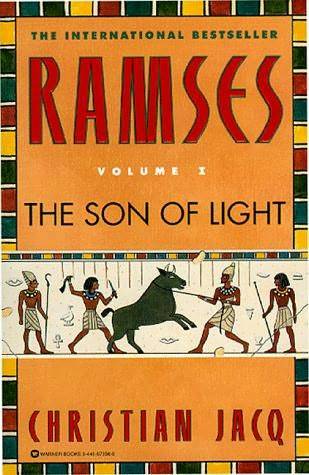 This is a great kick start to the life of Ramses the Great. We are introduced to his throne hungry brother Shaanar, his father Seti, mother Tuya, obnoxious sister Dolora, and his two wives Iset the Fair and Nefartari. Moses is also introduced, which is slightly irksome because the book is written off the old school of thought that Moses was during the time of Ramses the Great due to the mention of the city of Ramses in the scriptures. I believe its highly likely that the name of the city mentioned in the bible was updated by an eager scribe and that the proper date of Moses’ lifespan would place him during the 15th century/18th dynasty about 200 years before Ramses. Generally, I enjoyed the book although I feel much is lost in the translation from the French (Jacq’s writing seems too simplistic and listy), but I am still excited about reading the four remaining books in the series to see how it all plays out from Jacq’s perspective.

A fabulous article on Moses and his placement in history: http://www.biblearchaeology.org/post/2009/02/27/Moses-and-Hatshepsut.aspx
Anna Karenina
I’m reading Anna Karenina right now, its clever and interesting. There’s a much different feel and mood than Dostoevsky’s Crime and Punishment (which I just finished recently).
I don’t have a formal review as of yet, I am just now starting Part II, but I did find this fantastic article and wanted to point it out:
http://chaosandoldnight.wordpress.com/2007/02/22/tolstoy-happiness-and-objective-meaning/
The Angel’s Game by Carlos Ruiz Zafon
 Ruiz revisits the world of the Cemetery of Forgotten Books first introduced in Shadow of the Wind and presents us with a strangely philosophical mystery of life, death, love, and literature. Uniquely captivating from start to finish, the story unravels in such a way that in the end, like the narrator, I was still wondering who exactly had died and who had survived. I highly recommend The Angel’s Game (and The Shadow of the Wind) to any book lover.
A Walk in the Woods with Bill Bryson
 A Walk in the Woods makes me desperately want to go hiking. This was my first Bryson, I find the author surprisingly witty and fun, although perhaps a bit truthfully cruel in the beginning. I have to admit, prior to reading this I knew very little about the Appalachian Trail – it was a trail I had heard of but didn’t really have a clue about its length (Georgia to Maine, 2200 miles), its fame, or its history. This is the perfect blend of traveling memoir and a true survival/ adventure story, and I was completely captured by the weather conditions, the terrain, the fellow hikers, and the long nights in cold shelters. It’s definitely an adventure I’d like to take, even if it means I only finish 39% of the trail like Bryson himself.
Rosalind Miles’ Guenevere
Guenevere, Queen of the Summer Country:
The First of the Guenevere Novels by Rosalind Miles
 Though racier than I would have liked, Rosalind Miles portrays the Arthurian Romance of Guenevere, Arthur, and Lancelot exactly how I should think someone going for historical and religious accuracy should. Miles captures the thoughts and rituals of the pagans well and interweaves the young Christian societies the way they must have seemed to the Druids of the time. This first chapter of Guenevere’s life shows the gradual change from pagan feminism to the changing views of the times that brought women to more submissive roles, as she is caught between a husband trying to be a Christian King and an upbringing where royalty was passed down through the female line with sexual freedoms to boot. Can’t wait to read the second and third parts.
A Russian Study
Have I invited my fellow bloggers and blog-readers to my Russian study?
http://www.shelfari.com/groups/32350/discussions/182887/A-Russian-Study
Welcome to the Russian Study! We hope that everyone interested in Russia, its culture and history, and its literature, will enjoy perusing through and adding to this discussion. Feel free to add your own books to the list or read along with the ones already here below…
* Crime and Punishment – Dosoyevsky (fiction)
* Anna Karenina – Tolstoy (fiction)
* War and Peace – Tolstoy (fiction)
* The Magical Chorus: A History of Russian Culture from Tolstoy to Solzheinitsyn – Volkov (literary criticism, history)
* The Axe and the Icon – Billington (history)
* The Vision Unfulfilled – Thompson (history)
* Fathers and Sons – Turgenev (fiction)
* The Captain’s Daughter & Other Stories – Pushkin (fiction)
* One Day in the Life of Ivan Denisovich – Solzhenitsyn’s (fiction)
* Sofia Petrovna – Lydia Chukovskaya (fiction)
* I think some Robert Alexander historical fiction titles would do well at the end. One is called Rasputin’s Daughter, but he has many.
I have already completed Crime and Punishment, below is my official review:
Good book, well written, yet I could have gone my whole life without having read it and not felt like I missed out much. The final confession felt like the final moment in Moby Dick when the whale actually shows – all I could think was: “its about time.” Its on Bauer’s list of books to read before you die, which I plan to use as curriculum for my kid when I home school, but I’m not sure that I’ll make them read this, unless they are utterly captivated by it and want to – especially with Tolstoy next on the list. I was hoping to be more captivated myself.
The Girl from the Fiction Department
A Portrait of Sonia Orwell by Hilary Spurling
 This was a lovely piece of literary history documenting not just the life of Sonia Orwell, a famous and well-known editor on her own as well as the second wife of George Orwell, but that of many of the literary giants she befriended. The book is short, easy, and a fascinating glimpse into the hearts of so many European authors and artists for anyone who enjoys well-written literature and the bohemian lifestyle in which many of them lived.
I was baffled and surprised by Sonia’s many love affairs, saddened and elated by Sonia and George’s short-lived union, and angered by the notion that other biographers have so readily misunderstood her. I found Sonia interesting and bold, yet I also found myself so relieved to have not lived her life. She truly must have been someone to behold, respect, and possibly hate at some moments – though I think I might have liked her most of the time.
I loved that Sonia’s biography was so linked to her role in Orwell’s writing the character of Julia in 1984, the girl from the fiction department. Its such a quick and concise biography that manages to branch out and cover personalities of so many of those of Orwell’s time, I believe if I were a high school English teacher I would either require the reading of The Girl from the Fiction Department directly after assigning 1984 (or at least offering it up as an extra credit assignment).






 Anakalian Whims
Conspicuous Consumption by Thorstein Veblen – Lost in “Education”
June 27, 2010 at 5:52 pm (In So Many Words, Reviews, The Whim) (books, capitalism, conspicuous consumption, economics, education, essays, great ideas, historical document, marxism, reviews, social commentary, sociologist, source documents, veblen)
Why did we never read this for school? The relevancy is uncanny. The way the times haven’t changed is disturbing. I am definitely adding this to my required reading list for when I home school my child.
This book in reality is a 100 page essay or so, not long in the slightest and should take the reader a mere hour or two to digest and properly process (depending on the reader). What I plan to have my child address when I require this to be read are the following questions (and I’d like to know what you guys think too, if you’ve read this):
How do Veblen’s ideas tie into Darwin’s evolutionary theories?
How do they interact with Marxism and Capitalism?
How are his ideas relevant today?
How are the leisure class and ownership related, according to Veblen? What are the roots of conventional ownership and of marriage? Consider contemporary phrases like “trophy wife.” (How does this affect gender roles?)
Veblen sees “emulation” as a key feature of social life in “predatory societies.” How do the patterns of emulation change as predatory societies change?
What fundamental criticism does Veblen make of standard economics?
I actually have quite a few more that I have borrowed from other sites, essay questions and discussions to be had are all noted in a journal I am keeping of projects and assignments to remember. My point in posting the blog today, however, is this:
How did something so famous, so moving and so relevant – something Penguin even published in their Great Ideas series – get neglected in my own education? Not just high school with basic history, social studies, and economics, but also in college when half my life was filled with economic theory and consumer behavior as I earned a Marketing degree? I am realizing more and more the importance of not just reading about movements and theories, not just getting summaries from textbooks, but reading the original documents! How can your education be complete without going back to what started the ideas in the first place? How can you presume to know anything about anything if all your information comes from a summary in a textbook and you’ve never even heard of the essay that initiated the need for that summary?
Buy Here: http://rcm.amazon.com/e/cm?lt1=_blank&bc1=000000&IS2=1&bg1=FFFFFF&fc1=000000&lc1=0000FF&t=anakawhims-20&o=1&p=8&l=as4&m=amazon&f=ifr&ref=ss_til&asins=0143037595
Permalink 5 Comments