The Most Biased Book Review Ever

Title: The Lost Legends
Editor: Adam D. Jones
Today is the day you can buy a physical copy of a book (to be two-day delivered via Amazon to your home) in which the woman I call “the other half of my brain” has written a short-story.
Once upon a time, in college, I had a roommate. I actually had several roommates over the years, but this one is THE Roommate. We shared a dorm. We co-existed. We got a townhouse together, and co-existed some more. We co-existed so well, that fifteen years later, married and with children living in separate cities, we still call each other for morning coffee almost every day. We homeschool our children “together,” planning out the best curriculums and deciphering educational theory by phone. We manage a homeschool Facebook page together, previously referred to as Klemm University, but renamed for our mutual interests as Lovelace Classical Academy (if Facebook will ever allow us to update it, that would be wonderful). But I digress… the point is: She is the other half of my brain. And since we first met, we both knew we wanted to be writers. More than that, we both knew we were writers who simply hadn’t been published yet.
She has lamented and rejoiced with me through every major life event… and now, it’s my turn:
E. S. MURILLO IS A PUBLISHED AUTHOR!
as a contributor to The Lost Legends anthology, edited by Adam D. Jones and Renea McKenzie (more college friends of mine).

This anthology is fun for any fantasy reader, I honestly believe that. The stories are well crafted, edited properly (a huge feat in the indie-publishing world for debut work), and fun. Obviously, An Inconsequential Miscalculation is my favorite, as – by sharing a brain – I was able to see the story as it was meant to be told from its very first incarnation and have had the pleasure of reading it in most of its versions. Reading it in its completed form brings me sheer joy.
Mostly high fantasy, there are a few writers in the mix who are downright funny, the future Terry Pratchetts to the future J.R.R. Tolkiens (My favorite stories are the funny ones)… the anthology has a wide variety of tales, but flows seamlessly as an anthology, which is generally hard to do.
I am exceptionally proud of my friends and would love if all of my fantasy reading followers checked this book out for themselves – you will not be disappointed in it.
Click to order:

Diminutive Books I Have Loved
Once upon a time…
I was on a book hunting excursion at the Recycled Bookstore in Denton, Texas. That night I purchased and read a book by Paul Collins called Sixpence House: Lost in a Town of Books. I loved every minute of it and proceeded to hunt down everything the man had ever written. When pressed, I will tell people this is my *favorite* book. As a book lover, it hurts me to choose just one, so I must admit I don’t even know if this is an accurate proclamation. But it is the one I claim.

Later, I would get a job at Half Price Books and not only re-read this gem, but purchase any copies that came into the store. I’ve given several copies away, I think I own a few still, the one I will always keep is the polypropylene covered first edition I bought in Denton. Of all the parts of the book, one quote regarding dust jackets and marketing is the one that has always stuck with me, it’s something I have even told other booksellers when training them:
“Woe and alas to any who transgresses these laws. A number of reviewers railed against ‘The Bridges of Madison County’ because it used the diminutive hardcover size and muted color scheme of, say, an Annie Dillard book–thus cruelly tricking readers of Serious Literature into *buying crap*. Not to be outdone, the Harvard University Press issued Walter Benjamin’s opus ‘The Arcades Project’ with gigantic raised metallic lettering. One can only imagine the disgust of blowhard fiftysomethings in bomber jackets as they slowly realised that the project they were reading about was a cultural analysis of 19th century Parisian bourgeoisie–and not, say, a tale involving renegade Russian scientists and a mad general aboard a nuclear submarine.”
I am a sucker for diminutively sized hardback books with matte finished covers, especially if they are about books or nature. Case and Point: the hardback edition of Sixpence House is 5.7 x 1.2 x 8.6 inches in size. It isn’t small per se, but it is definitely smaller than your typical contemporary New York Times bestselling fiction, like Big Little Lies by Liane Moriarty, for instance, which is 6.4 x 1.5 x 9.3 inches. Or, if your flavor is more sci-fi/fantasy, Brandon Sanderson’s Way of Kings hardcover stands at 6.4 x 2 x 9.6 inches. 8.6 inches to 9.6 inches is a meaningful jump in the publishing world. It tells you something about what is lurking inside those beautiful, beautiful pages.

Imagine how much more significant a leap from 9.6 inches down to 7.3 inches, which is the height of the hardcover edition of The Sound of a Wild Snail Eating. I plucked this book up sometime before I separated from my ex-husband. I read it just a month before I finally said enough was enough. I remember reading it and craving the calm of being bedridden and having nothing to do except think and watch a snail creep around the house. I was aware that it was probably ridiculously unhealthy – to crave someone else’s pain, but I was very much exhausted of my own. Much relief comes from evicting an abusive drunk from your home, but before you’re free it’s nice to find comfort in books like this one. I’d like to re-read it again, and soon, so I can appreciate it more fully for what it is rather than using it to hide from what it isn’t.

I’m in a good place now, much healing has occurred over the last few years, but I still occasionally crave tiny and textured books. Keeping an eye out for calming and similar reading experiences, and knowing what I know about book covers, imagine my glee when I discovered Grayson by Lynne Cox.
One of the most lovely qualities of such books is that they can be read in one sitting by nearly any audience, but they rarely talk down to the reader and are often articulate and well-researched. These are the books written by amateur observers – remember the Latin root for amateur is amo, “I love.” An amateur is not someone who is less competent, as the connotation has evolved, but someone who has learned something for the sheer passion of it. They didn’t study for a grade, they aren’t necessarily doing it for their job, instead it is their passionate hobby. It is what they pursue at the end of the day when their bones are tired and their eyelids weak.
Lynne Cox loved to swim in the ocean. She swam every day for miles. I read about her swimming habits and am in awe. Several times I looked at my fiancé and said, “I would have drowned.” I definitely would have probably choked on the grunion when it slithered into my mouth, and then drowned. But Lynne Cox didn’t drown the day a baby whale found her during her morning swim. In fact, she swam and tread water for hours so she could help him find his mama. She didn’t go back to shore when her lungs were burning and her body freezing, because he would have beached himself and died. Lynne Cox loves the open water and the beach and you can experience how deep this love goes when you read about just one morning of her whole life. So much quality is packed into 150 pages: quality time (my love language), quality writing, rich and genuine details about sea creatures off the coast of California. I loved every second of this darling book and I’m grateful Cox chose to share it with the world.
This experience, to me, defines the genre of diminutive books. They aren’t separated out in any particular way in any bookstore I’ve ever patronized (again, I’m using the less commonly used definition here: “frequently shop”), but they definitely reside in the same file folder in my brain… and yes, my brain is actually a series of files and folders (and boxes and “gently raining post-it notes”) I spend hours sorting through. The books, and an assortment of others, all belong in the same place in my mind – not just belong in the same place, but belong to each other, I think.
Each one is a small nod of knowing to another, whether they are aware of it or not, guiding people ever so tenderly down a cobblestone path lit by fireflies and dreams…
The Small & The Invisible

Title: Dust
Author: Joseph A. Amato
Publisher: University of California Press
Length: 250 pages
I work at a used bookstore and am constantly confounding my co-workers with my eclectic taste in books. I like histories of things, biographies of objects, anthropomorphizing of trees and plants and bugs. Honestly, the weirder and more obscure, the better. So imagine everyone’s excitement when this came in… and the universal proclamation that Andi needed to see it.
When I think of dust, immediately three specific things come to mind:
- My older sister singing “Dust in the Wind” in our living room, circa 1994. There were choreographed dramatic arm motions worthy of Michael Bolton and Whitney Houston. It was a very serious affair. I’m not sure Kansas even took this song as seriously as my sister did. Her hair was way better, though.
- My fiancé and his dust mite allergies.
- Watching the speckles float past my window as a child when I was still tucked in my bed, but the sun was beating down hard through the panes. I imagined they were fairies, as I’m sure every child does.
Needless to say, my co-workers were right, I was VERY excited about this book. And it started out wonderfully, so promising! There were even a smattering of beautiful illustrations of small creatures known to reside in dust, which is right up my alley. Then it derailed into theories and modern commentary on germs and such, seemingly to reach a word count. I’d rather read science than political and social commentary.
Overall, I enjoyed it, but the conclusion went on far longer than necessary. Where I started the book excited and engaged, I ended it bored, with a sigh of relief.
That being said, if I ever wrote a nonfiction piece even half so interesting, I’d probably be pretty pleased with myself. I hope, regardless of my opinion, that Joseph A. Amato is pleased with himself – and I don’t say that lightly or sarcastically. He is a professor of Intellectual and Cultural History, so it is most appropriate that his book took the turn that it did, but I was still hoping for more of something a microbiologist would write.
I have in my possession a first edition hardback in near mint condition that I do plan to keep. I find the size and marketing of the book quite lovely, and the pages are high quality and the best texture. It is the little things I appreciate most, and for this title specifically I find that pleasingly appropriate.
King’s List
As a classical homeschool mom, I encounter many lists, I don’t always remember their sources, and often I add to them. One list is my “Chronological Order of People to Cover,” scrawled out in a yellow, college-ruled, spiral notebook that I picked up for some ridiculously inexpensive price (11 cents sounds about right) at a school supply clearance sale post Labor Day. There’s a sloppy box around my ineloquent title, and my initial attempt at writing neatly at the top of the page, beginning with:
“Cheops, pharaoh of Egypt 2700-2675 BC
epic Gilgamesh legend by 2600 BC, written 2100
Hammurabi 1750 BC
Hatshepsut 1480 BC
Tutankhamen 1355 BC…
the list goes on, until I reach King David 1000 BC”
King David is often skipped over when you consult secular lists, after all he’s not just known as the King of the Israelites, he’s the scrawny kid on the felt boards in your Sunday School class who killed a giant with a slingshot.
It’s true that those most interested in King David’s existence would be those studying Judaism or Christianity, as there are not many references to his historical presence outside those sources. But it is also interesting that he appears in the Quran, as well as the Tel Dan Stele, a stone with Aramaic writings regarding the battle history and reign of King Hazel from the 840’s. In Hazael’s account of his rule and victories, he includes an account of having killed a man of the House of David.
I love history. I love archeology. Maybe one day I’ll do more with these loves than read a lot of books, maybe not. But this bit of history found on a basalt stone is enough for me to remember that the history of God’s chosen people is a history worth studying by all people, whether you believe in religion or not. The Old Testament, archeology, all of these things are stories and evidence that point to the good news of Jesus Christ and why He’s available for ALL people to accept. All of these people are relevant pieces to the giant web of life and affect religion and politics today.

During my separation from my ex-husband I read a Beth Moore study called David: 90 Days with a Heart Like His. It was my first Beth Moore study, despite being from the bible belt of Houston. I found it comforting, captivating even. During my latest revival of the ancient history cycle with my kiddo, I read David: A Man of Passion & Destiny by Charles R. Swindoll and I found it both theologically and spiritually educational.
Beth Moore’s study, as you can imagine, goes into all the great things we think about David. All the things that truly help us see why he was called a man after God’s own heart. Swindoll does a better job of addressing his sins, the parts of him that make us wonder how this man could possibly be considered a man after God’s own heart. Swindoll addresses what a non-believer might get hung up on: David was a warlord, adulterer, possibly a rapist (depending on how you view the story of Bathsheba), he wasn’t a great father, he had many wives and his household fell to shame and scandal more than once. But David always got back up again. He always repented of his sin, looked to the Lord, and asked how to fix it.
As a history enthusiast, my immediate reaction is to find more sources and do more research on this man. I know his heart, as presented by the bible and Christian commentaries, but I want to know his world. Naturally I made some requests from the library and pulled out a few choice titles from my boxes of ancient history books… yes, boxes – plural – of ancient history books, that I own. I have a bit of a book problem and a perpetually insatiable curious mind. However, I’m still lacking the focus to choose one particular thing to study, fancy degrees, and access to fabulous antiquarian documents.
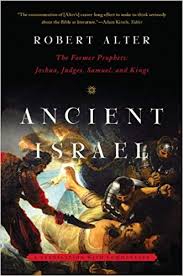
First up, Robert Alter’s Ancient Israel. I invite you to join me, if you’re interested.
Heir of Ra – Book Review

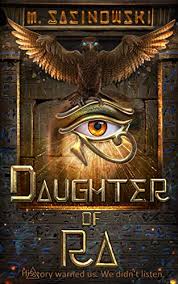
Ancient Egyptian artifacts, conspiracies, 10,000 year old biological nanotechnology… hand me my tin-foil fedora and “follow me, I know the way!” This book is FUN.
Heir of Ra is an action packed thriller, merging archeology, science fiction tech, and the mysteries of ancient Egypt. As an amateur historian (without a degree in the field to speak of) and wanna-be Egyptologist, the premise excites me to no end; but I’m not going to lie, I kept wanting to picture various characters as the “hair guy” with the bad tan on Ancient Aliens. In the end, though, Sasinowski’s writing shines through and doesn’t allow for that.
Although the book is categorized as young adult, the gentle nods to Edgar Cayce and vague feel of Frank Herbert’s White Plague, it seems like something more suitable for older, tired, adults with an hour or two to kill. Sure, the driving relationship is between a father and her young adult daughter, but I’m hesitant to restrict this title to the younger corner of a bookstore. Instead I want to share it with the Amelia Peabody and Lara Croft fan bases – which in theory should not be the same people, but there’s a Venn diagram for everything and Heir of Ra lands in this one’s center.
Still, it’s quick to draw in mythological sources to a modern day page turner, laced with a twinge of humor – not too far off base from a Rick Riordan series, just a little more grown up while staying appropriately clean.
I look forward to the inevitable screenplay and movie release.
To purchase: https://www.amazon.com/Heir-Ra-Blood-Book-One-ebook/dp/B07GDSK23D
P.S. The sequel was just released in June!
Gilgamesh
If you’re studying ancient history in chronological order, sometime after you’ve read the Book of Genesis, it’s really fun to dive into Gilgamesh. Gilgamesh is an epic poem most kids have to read in high school or early college for literature classes, originally written in Akkadian. It’s a mythological adventure about a real Sumerian king documented in history, who, like many kings of old, became a legend passed down through the ages, the truth of his life distorted and lost to deification.
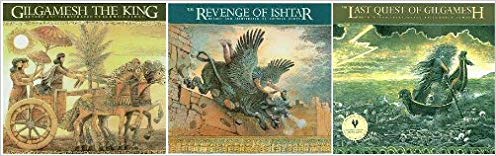
Ludmilla Zeman has a fantastic children’s picture book trilogy that I find to be the best starting point for learning about Gilgamesh. It is consistent with most translations and full of beautiful illustrations. When kiddo was small and we were studying ancient history the first time around, we checked these out from the library over and over again. She loved them. This time I bought them, brand new. They’re worth every penny.
I picked up used copies of the epic for myself. I was disappointed to discover that every translation available was a translation of a translation. I know its ignorant to expect to read direct translations of the Old Babylonian tablets when you pick up a Penguin trade paperback, but I did. I went back to the store after reading through David Ferry’s pretty version and N.K. Sandar’s better translation, looking for something closer to Andrew George’s 2003 version – or better yet, George Smith’s 1870’s version! To no avail. Everyone wants new and better more modern ways to tell the tale, while I bemoan my inability to read archaic clay tablets I’d never get my hands on anyway.
I was hoping to find a cool cartoon on the tale for us to watch together, desiring a repeat of the experience we had when we studied Beowulf in 2016 (YouTube had an amazing cartoon rendition of Beowulf featuring the voice of Joseph Fiennes at the time…). All I found were some not so kid friendly “cliff notes” style videos of people walking students through what it was all about so they wouldn’t have to read the book themselves.
Attention all animators: Please provide a kid appropriate Gilgamesh cartoon, featuring an oddly famous actor of the 90’s of my choice. Thanks.
Gilgamesh is neat. I love the beautiful picture books we own. I will be the parent that makes sure she reads poem and doesn’t watch internet video summaries when she’s older. But I’m not in love with it the way I am with The Iliad and Beowulf. I think it may be the insincerity of it all. It feels obvious that it was a legend born of puffing up the ego of a king and his people. It takes Noah’s ark and twists it, I love reading confirmation that many regions of the world had a major flood, I’m saddened when the details are distorted and inconsistent, making heroes of those who weren’t and forgetting the one man who did obey.
Maybe I’ll love it when I finally get my hands on one of the George translations…
Seed Savers – Unbroken
Title: Unbroken

Author: Sandra Smith https://authorssmith.com
Genre: Teen/ Young Adult
Length: 339 pages
“Had Smith been right? Was the U.S. headed for disaster?”
This line in Sandra Smith’s latest installment of the Seed Savers series made me laugh out loud. In Unbroken, Caleb Smith is a whistleblower who sent the government a 23-page letter regarding the impending doom of monocultures. In the real world, Sandra Smith has written a riveting series that gets kids thinking about where their food comes from, who controls the sources, and who should control the sources. This one line in the book could sum up the entire series.
I’ve had the pleasure of reading each of the Seed Savers books as they come out, in advance reader copy formats. I’ve seen characters grow, I’ve witnessed Smith’s writing change and develop, and I’ve gotten to be excited with her (via email) over the much anticipated dream covers.
This series has been with me as I raise my daughter and I’ve loved having it as a reminder of why we garden, forage, and go back to the dirt and the seeds every season. We would have always gardened, but Smith’s books took it up a notch. It has always kept me true to my desire to sit with my kid and show her how to harvest a seed from a plant, or even produce from the grocery store.
Much of Unbroken concerns an ever looming food shortage in a society where food is no longer grown. Because of food shortages in my own life, I can’t express enough how much the message of this book, seed saving being the key to ensuring the world can eat, moves me. Having tomatoes planted every summer makes a huge difference for a hungry family. Being able to harvest Creeping Cucumbers, wild garlic, dewberries, grapes and grape leaves, and plant indigenous seeds in my yard for easy access, makes it that much easier to get by when faced with an over stretched budget. The books also open the door to discussion about ethics and politics, and most of all, where our belief in God and our responsibility to be good stewards of the earth overlap.
Like the Harry Potter books, the series starts out geared toward one age level and evolves into something for an older crowd. I think this is good for young adult series so that kids can have characters who grow up with them. An eight year old could thoroughly enjoy Treasure, but I wouldn’t hand Unbroken (book five) to an elementary student. With that in mind, I only read the first few books out loud to my kiddo, and the rest of the series will come later. That simply means I’ll have the pleasure of enjoying Smith’s books twice.
Wicked Histories
While reviewing all the books of years past, it’s impossible to avoid children’s history books, audiobooks, picture books, and a great many of odd resources. As mentioned many times before, I homeschool, so most my reading material reflects that.

We stumbled across the Wicked Histories series a few years ago, and I find the series extremely helpful when trying to find biographies on people who helped shaped the world but aren’t typically doted upon in children’s literature. From this series, last July while studying the 1700’s-1800’s we read Catherine the Great: Empress of Russia by Zu Vincent.
One thing I love about the Wicked Histories is that it has been an excellent tool for walking my kid through discernment practices. How do you identify bad people? What makes someone a safe person? People can be evil and still do good things. People can be good and still do bad things. It’s what they do longest, it’s the legacy they leave behind, that tends to define them. Most people, as researchers and biographers know, have a running theme for their life. The “theme,” so to speak, is often the best judge of their heart. They can say a few nice things, but if their legacy was that of slaughtering people in the street, could you truly call them good? Maybe they were known to love their family, but if all their political policies doomed their nation, what then? I like that Wicked Histories isn’t afraid to have these discussions with children. I also like that they never give a straight answer, the authors leave the conclusion up to the children.
Because these books are so full of moral nuance, I don’t have her read these alone, even though she could. I read all the Wicked Histories aloud as part of our school day and we discuss. Some of our most riveting discussions came while reading Cixi: Evil Empress of China? by Sean Stewart Price and Grigory Rasputin: Holy Man or Mad Monk? by Enid A. Goldberg. It’s helping her see that she has the power to pursue what is good and just in the world, or choose personal glory, fame, and power which tends to corrupt. These stories are helping her see that what you make your priorities matters, who you put your trust in matters. Alexandra Romanov, as well as many other Russian women of the time, were deceived by Grigory Rasputin. How do you watch for deceit while maintaining your positive attitude toward other human beings. I think these are important and healthy lessons to learn. We learn these lessons best by reading God’s word, yes, but also by and knowing our history.
Education is a Lifetime Pursuit
“Education is a lifetime pursuit.” I tell my daughter this constantly. It is our household motto, so much so, I would not doubt if I had already posted something with the same title before. I even hope that my readers already have read this phrase.
I am a homeschool mother. I am, in the deepest parts of my soul, a teacher. I always have been, and have been overzealous about it since I discovered the classical model. What I have loved about the classical model most is the ease in which I can continue my own education while I educate my daughter. She memorizes facts and dates in the grammar stage and not only do we supplement with rich literature to help her remember, but I get to pluck out related reading material for myself. Individually, I learn and teach the classical model… as a household, we are constantly involved in “unit studies” that are structured chronologically throughout history.
While she was memorizing history sentences about Christopher Columbus, the Pilgrims, and eventually the colonists dumping tea into the Boston Harbor, I was reading Changes in the Land: Indians, Colonists, and the Ecology of New England by William Cronon.
First published in 1983, Changes in the Land is the earliest book I know of written directly about environmental history, not part of a political movement. Everything I’ve read published prior to this book are either beautiful transcendentalist nature essays (Emerson, Thoreau, Bronson Alcott, etc.), geological science books (Lyell, Stenson, etc.), or solely activist tree-hugger type stuff. In fact, I think it paved the way for books like the one I read recently (and thoroughly enjoyed) while she learned about the gold rush called Hard Road West: History and Geology along the Gold Rush Trail, whose author also crossed genres by highlighting the land, and all the things that make it what it is and the men who mar it, as the main character in the book’s story.
The biggest thing the two books have in common, for me, is at the end of each I thought, “This must be required reading for high school students.” After all, how do you learn history of a place without comprehending the blood, sweat, and tears, that was shed on it and ALL the reasons why, not the just the wars, but trails cut, deforestation, farms, dustbowls, mining… and not just focus on what it did to the people, but what it did to the land and how all that affects us today. Books like these are a beautiful marriage of history, social science, science, and more.
I love finding these gems as I sort through piles and piles of potential reading material, planning out lengthy lists of things to shape my kiddo’s mind. I love that my mind is also being shaped. I love that I am 35 and never done studying. I love that, in addition to growing my relationship with Jesus Christ and my daughter, education is my lifetime pursuit.



 Anakalian Whims