Three A.M. – A Short Story
 Original Story by E.B. Jones
I woke up slowly and looked at the clock, it was three in the morning. I can’t remember a single night since my wife and I moved here that I didn’t end up waking up at three in the morning. A train used to always come by at three and blow it’s whistle at the intersection right behind out house. The first time that it happened my wife and I both shot out of bed, scared out of our minds trying to figure out just what the hell was going on. We knew that there was a train track behind our house but we didn’t have any idea that it was going to be going past at three in the morning. The realtor had failed to mention that whenever we were looking at the house.
We’d moved here about six months after we were married because we decided that buying a home was the next logical step in our lives.
“It’s more like an investment,” She would say as she chewed celery and looked at the brochure that the mortgage company had given us. “I mean, right now we’re just throwing money away at that sleazy land lord of ours, and you know real estate always goes up in value.”
“Sounds good,” I would say, sipping my coffee and not trying to be contentious, “But are we really ready to settle down just yet?”
“Well, we were settled down enough to get married.” She laughed.
“You have a point.” I told her.
“Besides,” She would say as she put her hand on mine. “I think we’re ready.”
We both smiled and then spent the rest of the time figuring out the details on how to close, how much we would need for a down payment and everything else. She was much better with the numbers than I was so she took care of most of the details, besides, we both knew that it was really going to be her house.
The next few weeks we spent looking through the real estate ads at all the houses that were for sale.
“Oh, I absolutely love this one!” She would tell me quietly. She had heard that if the realtor knew that we were excited about a place then they would have an easier time convincing the client that it was a good home, despite the obvious flaws.
The realtor could still always tell whenever she was excited though, so I had to be the skeptic and ask questions that might make us look less interested. “I don’t know,” I would say, “I mean, what is the crime rate around here?” I wanted to make sure we weren’t getting something we would regret.
“It’s a lovely neighborhood, low crime, great schools and the neighbors are all just so active in the community.” The realtors always said the same thing, sometimes even in the same exact words and I wondered if there was some sort of script that all realtors had to memorize in order to get their license.
The first time we walked into the house that we would eventually buy in a month and a half my wife couldn’t keep it in. “I just love it!” She blurted out.
And we both told the realtor, “We’ll take it!” The final paperwork was signed and we made the hefty down payment and they handed us the keys.
We drove from the old apartment to the new house with the last of our things and got out, marveling at our first real purchase as a married couple. We stood for at least ten minutes just looking at the front door, then she broke the long silence. “Oh my god, a flower garden here on the front with some bushes would look amazing! I could plant some azalea’s and maybe some small bushes,” and then, “You can put in a nice brick walkway up to the front porch, and then people can walk up to it while we sit on the porch in the spring and sip on tea!”
She was so excited about our new home. I was excited as well, “I can build a shop back here so I can work on things.” I told her. I had no idea what I would work on, I was just an accountant and had never really built or repaired anything in my life, but it seemed like something that a married man would do.
“Oh! What kind of shop!” She would ask me excitedly.
“I don’t know yet, maybe I’ll get a lathe and learn how to do wood carving, like my grandpa did. Or I could just turn the garage into an auto repair place and buy me a hot rod and soup it up!”
She tilted her head and looked at me, “As long as it doesn’t take up my side of the garage.”
After walking around the house and coming up with all of our crazy ideas of shops, gardens, sun rooms, dinner parties, barbeques and even a quickly dismissed idea of beekeeping, we started to unload the car.
Most of the larger or heavy stuff we had hired professional movers to take care of so it didn’t take us very long to get everything into the house. We walked around the three bedroom house and were amazed at just how little possessions we actually owned.
“It’s ok, we can buy new things. Furniture that actually matches so it all looks proper.” I laughed.
“You’re right, and there’s two empty rooms, maybe we could think about starting a family. You know, once we get all settled in.” She said looking at me with a gleam in her eyes.
“Really?” I asked, “You want to try for kids?” I wasn’t sure how I felt about kids. I wasn’t against the idea, I had just never really given it much thought.
“Yeah,” She hesitated, “I mean, if you want too.”
I hesitated myself, then finally, “Of course, I’d love too.”
She slung her arms around me and kissed me and then jumped up in the air and before we realized what was going on we were in bed working on starting up a new family.
That evening we ordered pizza. I think it was mostly so we could invite someone to see our new place, thinking that they would think it was just as spectacular as we thought it was. The pizza delivery boy didn’t seem as excited as we were whenever she told him that we had just moved into the neighborhood.
We ate the pizza and watched our favorite movie together and then decided to go to sleep, it had been a very long day today, and we still had many more boxes to unpack tomorrow.
A few hours later, it happened, the loud screeching of a train screaming through the room like some kind of banshee trying to warn us that the house was haunted. I jumped out of bed and grabbed for something to beat off whatever the noise was that had interrupted our peaceful slumber.
It only took about thirty seconds for us to figure out what was going on but it felt like an eternity. She was holding a fly swatter and I had picked up a cardboard tube that one of her paintings was in. We looked at each other and then we started laughing. Then we got back in bed and both fell asleep to the sound of the train going off in the distance.
The next day we unpacked and laughed some more about the train that night, thinking it was probably just a one time thing. It wasn’t. Every single night at close to three in the morning the train whistle would screech through our room, waking us up every night.
The train whistle wasn’t the reason that she left, but she isn’t here anymore. We never had any children and she never planted that garden. None of the furniture is the same and I’m still driving the same four door sedan that I’ve had for the past six years. The train doesn’t come by anymore, but I still wake up every morning, for just a minute or two, at three in the morning.
Parnassus on Wheels – Can I Have One?
 Title: Parnassus on Wheels
Author: Christopher Morley
Publisher: Akadine Press
Length: 160 pages
“[…] When you sell a man a book you don’t sell him just twelve ounces of paper and ink and glue – you sell him a whole new life. Love and friendship and humour and ships at sea by night – there’s all heaven and earth in a book, a real book I mean.”
Parnassus on Wheels is both sweet and clever. It is adorably romantic. After reading this, I want desperately to peddle books from a horse-drawn early 1900s RV. Morley has captured a tale of an adventure that is every book lovers dream: to travel in a cozy carriage with a dog and horse, spreading the love and joy of literature to everyone you meet. What could be better?
Mr. Mifflin is a middle-aged ginger, evangelizing about the religion of books as a way of life, when he meets over-weight Helen McGill. Helen is tired but spunky, she’s been a ‘house-wife’ to her brother for years on the farm they share. Her brother, a famous author doesn’t really treat her as though she’s her own person, and 6,000 loaves of bread into life, she buys Mifflin’s whole operation for $400 on a lark. Of course, everyone thinks Mr. Mifflin is taking advantage of the lady, but in reality he has offered a whole new life, a new way of seeing the world, and an absurd amount of joy.
As a bookseller, this story speaks to me. I ran the literature sections for several years, and I received an intense amount of satisfaction from finding books for my customers. The idea that you could deliver books straight to someone’s doorstep in such a homey but noninvasive manner sounds so enticing and whimsical to me.
Peddlers are well-known concept:
THE PEDDLER’S CARAVAN
[46]
I wish I lived in a caravan,
With a horse to drive like a peddler-man!
Where he comes from nobody knows,
Or where he goes to, but on he goes!
His caravan has windows two,
And a chimney of tin, that the smoke comes through;
He has a wife, with a baby brown,
And they go riding from town to town.
Chairs to mend, and delf to sell!
He clashes the basins like a bell;
Tea trays, baskets ranged in order,
Plates, with alphabets round the border!
The roads are brown, and the sea is green,
But his home is like a bathing-machine;
The world is round, and he can ride,
Rumble and slash, to the other side!
With the peddler-man I should like to roam,
And write a book when I came home;
All the people would read my book,
Just like the Travels of Captain Cook!
—WILLIAM BRIGHTY RANDS.
But a book peddler is a fairly unique idea, and I love Christopher Morley for sharing this idea with the world. Clearly, he didn’t invent the concept, but one wonders if he encountered a caravan such as R. Mifflin’s Traveling Parnassus, or is it merely a dream he had for himself? Parnassus on Wheels was Morley’s first novel, first published in 1917. Mr. Mifflin returns in the book The Haunted Bookshop, a sequel I am strongly looking forward to, but what I find most interesting is that Christopher Morley wrote over 100 novels. Have you heard of any of them? I had not, I was only aware of Morley because he was pressed on me by a fellow bookseller. I rarely come across his work in bookstores, and I have never seen a title of his in any library. I now plan to collect his work more vigorously.
Morley apparently wrote a number of essays and poems as well, and lectured at University. One adorable little factoid is that he married a woman named Helen shortly after studying history in college. I can’t help but wonder how much Helen McGill, of Parnassus on Wheels, resembled his own wife whom he loved.
Have you read anything by Christopher Morley? Please leave comments.
Great Journeys – Marco Polo
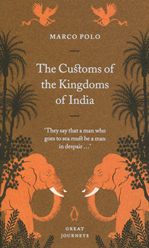 Title: The Customs of the Kingdoms of India
Author: Marco Polo
Publisher: Penguin Books
Length: 86 pages
Inspired by the Great Ideas series, Penguin Books printed a Great Journeys companion series as well. From Herodotus to George Orwell, the series chronicles twenty of the most famous and intriguing adventurers in history. Third in this series is Marco Polo’s journey to South Asia, where he discusses the culture, the economy, the industry, religious practices and more.
I picked this book up for two simples facts: 1. I am collecting all of Penguin Books Great Ideas publications and 2. There are elephants on the front cover. I adore elephants. They are powerful, dignified, trustworthy, humorous, and endearing. Marco Polo’s The Customs of the Kingdoms of India has little do with elephants.  Actually, I’m pretty sure it has absolutely nothing to do with elephants. Of course, that’s not the point, elephants are broadly recognized as a symbol of India/ South Asia, so naturally they would be an image of choice for the front cover of an Indian travel book.
Marco Polo does not go into great detail about how the elephants are used as means of transportation, status symbols, work beasts, and more. He mentions them in passing, but says in the places he visits, they are not indigenous to the area but imported from other islands. He does, however, discuss the art of physiognomy, which immediately made me think of the science fiction piece by Jeffrey Ford called The Physiognomy
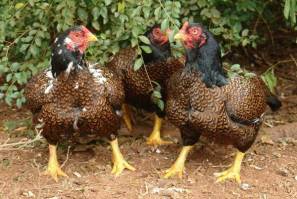
Did Marco Polo’s “prettiest hens” look like these?
Apparently, in South Asia, hens represent prosperity, and today you can buy ‘prosperity hens,’ little talismans similar to a rabbit’s foot. Of course, Marco Polo again does not go into detail regarding this, he merely mentions their beauty and moves on. Marco Polo’s writing is that of traveling merchant. He chronicles quick and simple descriptions that would be useful for a businessman, but avoids the great detail of a philosopher or anthropologist. The things that strike his fancy for elaboration are the rituals that would intrigue a vendor, rather than those that would fascinate a theology student. Where he does talk about religion, it seems to be in a political and historically informative way to help you understand a province as a whole, moving quickly to the supplies they live on because of their past. Like a professional trader, he wishes to dwell on the rice, the wheat, and the growth of cotton. Respect for various people groups and villages he encounters is highly dependant on how much they function on industry and marketplaces.
I don’t believe Marco Polo to be much of a writer, and I think his accounts would have benefited from being written while on his voyage. But according to historians, he dictated these adventures of sailing the Indian Ocean later to a fellow inmate in prison. This practice of dictation could have played a role in his style of often informing his reader “I will tell you how” and “I will describe to you,” as well as “let me tell you why” and so on; repetitive and unnecessary phrases that, quite frankly, annoyed me.
Still, this concise 86 page piece is interesting, and a great addition to any young scholar’s library. It would be a wonderful supplement to a world geography study on South Asia for a middle grade student and could open up a lot of dialogue between teachers and students regarding history, religious practices, other cultures, world economies, and more.

 It’s Banned Book Week sponsored by the American Library Association and I’ve been seeing a lot of posts with ALA lists of most frequently banned or challenged books (in the U.S.) and so on. I’ve found that I have surprisingly mixed feelings about Banned Books Week.
First off, let me say that I fully support the goals of the ALA in reminding us of the importance of our freedom to read and the need to continue to protect that freedom. I want to look at this from a different perspective though.
Number of books banned by the United States:…
Number of books banned by states within the U.S.:…
The book banning that that ALA is talking about is the removal of books from particular public libraries and school libraries. They publish prominently that there are thousands of challenges where individuals or groups request removal of a book, but…
View original post 223 more words
Les Miserables – BANNED
 The practice of banning books is beyond a bit baffling, it is also fascinating. The first ‘official’ censorship, of course, began with the Catholic Church in 1559, an extensive list of forbidden books tasked to be made by Pope Paul IV. Since then, the practice of banning books hasn’t been limited to the religious, but been taken on by governments, schools, libraries, and organizations both public and private all around the world. Some make the mistake of assuming these books simply ‘must be bad’ if they are restricted so often, but the reality is that somebody somewhere will always feel threatened or offended by the thoughts of another and people of power will always try to enforce their thoughts and opinions on those who are subject to them. “The hand that rocks the cradle, rules the world,” said Karl Marx. Well, I say: The one that chooses the books, rules the world, unless of course you allow them to choose for themselves and then you have to rise up and be a better leader.

I am currently reading Part IV: Saint Denis
Les Miserables, one of the most impassioned and well-written novels in all of history was often a threat to poor leaders. It is a beautiful story of familial love, sacrifice, tragedy, the history surrounding the French Revolution, and his personal views on the church and government. Hugo doesn’t pull punches, however, when describing these beautiful and tragic things, he doesn’t leave out a bit wretchedness, he presents the world as it he saw it, and in doing so was punished for it. Hugo was banished from France for life by Napoleon III for criticizing his government and all of Hugo’s works were banned in Russia by Nicholas I for the unpleasant way which royalty was portrayed in his novels. Not only that, the Catholic Church added everything Hugo had written to the Index Librorum Prohibitorum (often referred to as The Pauline Index) for “sensual, libidinous or lascivious.”
These challenges did not merely last Hugo’s life time. His works weren’t removed from the Index until 1959. This essential piece of literature has been considered threatening for portraying prostitution, murder, the church as unimportant, and glorifying the French Revolution. 1959, such a time of the past… but the fight is never over. In 2007, Hugo’s grandson and an emerging author battled in the French courts over whether or not a sequel to Les Miserables could be published. This time, instead of contesting Hugo’s work, his grandson is fighting to protect “the spirit” of his work, claiming that Les Miserables should all be considered intellectual property. Valid perhaps, but what would Hugo say about his grandson banning an author?
 Hugo was part of the original literacy war in Paris in 1830. In addition to his books being banned, his plays were also challenged. Authors and artists paid professionals to sit in audiences and applaud their plays in order to counter those trying to shut them down. Duels were fought, defending the right to write, one young man even died for the sake of Hugo’s Hernani. Protect the spirit of Les Miserables? Yes, please. Ban literature? No, thanks. It is up to the individual reader/fan to protect the spirit of an author’s work, though, choose NOT to read it. The government should not be able to authorize the restriction.
This coming Saturday, October 6th, Half Price Books Humble will be hosting a Read Out from 1:00 pm to 3:00 pm. Come hang out with fellow book lovers and read a line or two from your favorite and most cherished banned or challenged book.
Additional blogs and articles of interest:
Dangerous Pages
Index Liborum Prohibitorum (About)
Index Libroum Prohibitorum (List)
About Hugo
Les Miserables II
More on Les Miserables II
My post on St. Denis.
Banned Books Week 2012
Join a Read Out near you! There will be one at Half Price Books Humble on Saturday, October 6th from 1pm-3pm.
HPB Humble October Meeting Prep
Bill Bryson’s bestselling books include A Walk in the Woods, Notes from a Small Island, In a Sunburned Country, Bryson’s Dictionary of Troublesome Words, A Short History of Nearly Everything, which earned him the 2004 Aventis Prize, and The Life and Times of the Thunderbolt Kid. Bryson lives in England with his wife and children. – from The Official Bill Bryson Website, http://www.randomhouse.com/features/billbryson/about.html
Discussion Topics for October 1st:
- “It must be very frustrating to have a truly unique experience.” – pg. 159 What unique experiences have you had lately?
- There is a Veblen reference on page 151, “conspicuous consumption.” How do you feel about this assessment of America?
- What did you think of Bryson’s description of the south?
- Have you ever stopped to read historical landmarks? Do you know about the historical landmarks here in Humble?
- What was your favorite part of the book? What was your least favorite part of the book?
Below I have included historical landmarks of Humble, TX, taken from the Humble area website: http://www.humblearea.com/history/
|
Humble, Texas Historical Markers Humble Cemetery – Humble (227) This cemetery is believed to be the town of Humble’s oldest. The earliest documented burial is that of Joseph Dunman (1867-1879). Also believed to be buried here in an unmarked grave is Jane Elizabeth Humble, wife of the community’s founder, Pleasant Humble. The first legal record of the cemetery appears in a deed transferring the cemetery property from Jonas Altmont to trustees in 1914. Civil War veteran Houston Young and several World War I veterans are also interred here. This cemetery serves as a reflection of Humble’s pioneer heritage. Humble Lodge No. 979, A.F. & A.M. – Humble (164) Near the turn of the century, the town of Humble was home to many Masons who were members of lodges located in nearby towns. With the help of local Justice of the Peace F. K. Wise, Humble area Masons organized their own lodge in 1908. Humble State Bank president and future Texas Governor Ross Sterling (1875-1949) provided meeting facilities in the bank building which formerly stood at this site. After the bank burned in 1912, the Masons bought the property and built a new lodge hall. The Masons have been active in civic programs over the years. Humble, City of – Humble (164) A pioneer oil boom town. Originated as crossroads community named for settler Pleasant Smith Humble (1835?-1912), who lived here before 1889, hewing his timber into railroad ties, mining gravel from his land, keeping store, and serving as justice of the peace. Neighbors included the Bender, Durdin, Isaacks, Lee, Slaughter, and Williams families. Economic bases were farms and sawmills. The post office opened 1902. In 1904 C. E. Barrett (1866-1926) drilled for oil in this area, securing small production on Moonshine Hill. On Jan. 7, 1905, he brought in the No. 2 Beaty Well which yielded 8,500 barrels a day, opening the great boom. From a village of 700, Humble grew at once into a town of 20,000. Field production– the largest in Texas for the year 1905– was 15,594,923 barrels of oil. The field was named for the town. A group of its operators, including Ross S. Sterling, later (1931-33) governor of Texas, in 1911 incorporated a new oil company named for the field, thus spreading into the annals of world commerce the town’s name. Production from several strata here exceeded the total for fabulous Spindletop by 1946. Known as the greatest salt dome field, Humble still produces and the town for which it was named continued to thrive. Moonshine Hill – Humble (105) Early reports of natural gas seepages in this area were not uncommon in the late 19th century. James Slaughter noticed such natural occurrences near the San Jacinto River in 1887. Several years later, with S. A. Hart, he set up a drilling operation in the area, but it proved unsuccessful. Charles Barrett, a former Huston merchant, also drilled wells here, but found the results limited. In 1904, the Higgins Oil Company brought in a major gas well and the following year, the first successful oil well was drilled. This area, known as the Moonshine Hill section of the great Humble oil field, became the site of a boom town. Within months of the 1905 discovery, the population of the Moonshine Hill settlement increased to 10,000. Early operations associated with the site included the Moonshine Oil Company of Walter Sharp, Ed Prather, and Howard R. Hughes. Although tents comprised most of the early structures, Moonshine Hill eventually included a church, school, postal station, stores, hotels, and saloons. Despite three separate boom eras, the last occurring in 1929, Moonshine Hill declined as a community. Its brief existence, however, had a dramatic impact on the economic development of Humble and Houston. Texas Sesquicentennial 1836 – 1986 First United Methodist Church of Humble – Humble (86) Founded in 1886, Humble was an oil boom town in 1907 when the Rev. J. T. Browning of Houston began conducting Methodist worship services for residents of the area. The services were first held in a building that had housed a bottle factory. In 1908, this church was organized with 37 charter members. The following year, the congregation constructed their first building, a small frame structure later destroyed by fire. Subsequent church facilities have reflected the continued growth of the congregation and community. Texas Sesquicentennial 1836 – 1986 Lambrecht’s Artesian Well – Humble (50) An oil well drilled at this site in 1912 yielded not oil, but free-flowing artesian water. The following year, German native Nick Lambrecht (1855-1920) purchased the property. Lambrecht served as justice of the peace and mayor during Humble’s oil boom days in the early 20th century and in 1904 had installed a water system to meet the needs of the many oil field workers who came to town. Lambrecht’s artesian well was used to supply water to bathhouses and was also piped to nearby homes. In earlier years, water had been hauled to town in barrels on horse-drawn wagons. Texas Sesquicentennial 1836-1986 |
Banned Books Week
One of my favorite novels, Mrs. Dalloway
Yet, people find the book itself and the material in it threatening. I, on the other hand, find it fascinating.
In the comments this week: share your favorite banned books with me.
Challenge this week: read a book from a banned or challenged book list.
Visit DeleteCensorship.org to view lists of banned books.

Articles about Banned Books:
NPR on Grapes of Wrath
The Lord of the Rings Controversy
Amen.

According to Peter Stothard, this year’s chair of the Man Booker Prize judges, book bloggers are harming literature. Well thanks, Peter. Thanks a lot. I’m sure there are many people who have come across my blog who might have been indifferent or in strong disagreement with my reviews but I never expected the whole concept of my blog to be accused of being detrimental to literature. That seems quite extreme to me.
I am not a professional critic. I enjoy reading books and nobody pays me to write reviews. I did not study English Literature at university. I do not work in publishing or journalism. As a blogger, I don’t have an editor to check my posts and I know my writing isn’t perfect. However, I completely reject Stothard’s assertion that blogging is drowning out ‘serious criticism’. He appears to have lumped all bloggers into the category of what…
View original post 298 more words
Bill Bryson, I adore You
 Title: The Lost Continent
Author: Bill Bryson
Publisher:Harper Perennial
Length: 299 pages
I read A Walk in the Woods a year or two ago and I remember thinking, “What a witty, sarcastic, jack-ass – I love him!” The same holds true for one of Bryson’s earlier works, The Lost Continent.
This book is a great travel memoir of a road trip in America, back when it was still glaringly clear that we were The United States of America, each part of our country a very unique place, in the midst of the late 80’s and early 90’s when the lines were getting blurred and we as a nation fell more and more into a federal ‘group-think’ existence.
Being from the south, there are many times when I feel I should be greatly offended by the things Bryson has to stay about my neck of the woods. Three things must be said about my not getting offended 1. We southerners don’t offend easily, we just pat your hand and say ‘Bless Your Heart’ for not understanding us and 2. Bryson is funny and intelligent, and despite a lot of generalizations and false conclusions, many parts of his descriptions are familiar and full of truth. But finally, 3. “The South” and “Texas” don’t always mean the same thing, we are a brand all our own, and mighty proud of it.
Bryson’s version of tourism is wonderful. It has both the comprehension of American ways and not quite being an outsider, as well as the fresh eyes of someone who has been away for so long. His adventures around national landmarks, travels through run of the mill towns, and his uncanny ability to not be duped in one instance and be completely suckered in another is fantastic. He finds himself in both the best and the worst of places. From the smallest hotel room in NY to the cleanest hotel room in New England, Bryson experiences it all, and shares every scurrilous detail.
If you’ve ever stepped foot in any of these places, you can’t help but enjoy his descriptions. If you haven’t yet been there, you find yourself intrigued. If you’ve ever read Conspicuous Consumption, you can’t help but notice how Bryson spells out the concepts Veblen’s concepts with severe imagery. If you’ve never read anything at all, you can at least appreciate his comedic nature and how much his books will make you laugh.
Scentsy pairing: Clean Breeze or Route 66
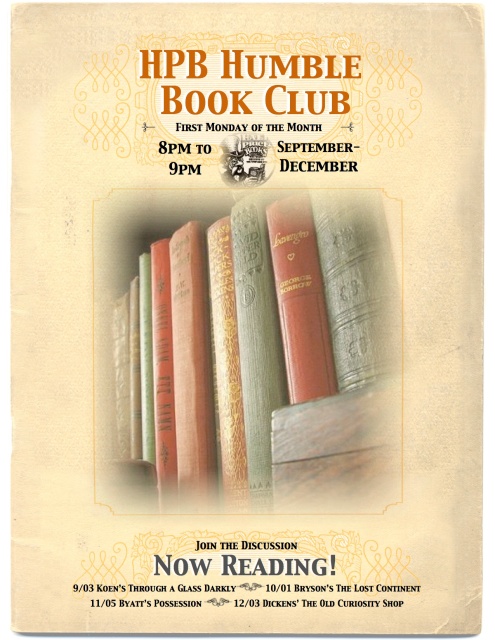
As usual, I’m enjoying Bryson’s work quite a bit and am so excited to get a chance to discuss this book with other people at the Half Price Books Humble Book Club meeting on October 1st. There’s still a few days to find a copy, read it, and pipe in at the meeting.








 Anakalian Whims