Emma, my introduction to the Viking era
 Title: Emma: The Twice-Crowned Queen
Author: Isabella Strachan
Publisher: Peter Owen Publishers
Length: 192 pgs.
First of all, let me premise this by informing you that like the Catherines/Katherines of Henry VIII’s time, the name Elgiva/Emma runs rampant during the Viking age of England. For instance, the subject of this biography was born Emma but the English chose to call her by the Latin equivalent: Elgiva. Emma was the second wife of the widowed Ethelred, whose first wife’s name was Elgiva. When Ethelred (king of England under the Saxons) dies and his land then conquered by the Danes (while King Swegn ruled), a Dane named Canute (Cnut) came to power. Emma becomes his wife as well, but guess what? He already has a ‘wife’ named… any takers? anyone? anyone? Yep, Elgiva. This makes for some interesting reading, but Strachan eases the issue by always referring to Emma as only Emma and providing a handy-dandy cast list in the front of the book.
When I first heard of Emma, I expected a woman who was cunning and manipulative. Someone with political the intrigue of a Cleopatra or Elizabeth I. I thought I’d be reading about a woman with a deep political agenda, always out-playing others in a real-life chess match. Instead I found a woman who seems to me to have been more adaptive, reactive, a survivor constantly caught between a rock and a hard place. The Twice-Crowned Queen is less of a political master mind and more of a drowning victim always bobbing up to the surface of the water just moments before death.
She was young when she became the bargaining chip in an arranged marriage to King Ethelred. It was a political ploy of others that ensured the Normans and Vikings were kept at bay during a time of imminent war, as both her father and half-brother were Dukes of Normandy with close, friendly ties to the Vikings. After Ethelred dies and England taken over by the Danes, Canute is chosen to be the new King. The problem with this arrangement is that the Church and Cabinet wanted Emma to remain the Queen. It remained good political sense, but Canute already had a wife. Canute had a handfast wife, referred to as Elgiva of Northampton. From what I gather from Strachan, a handfast wife was the Medieval equivalent of a ‘Common-law wife.’ Handfast wives had all the political and societal rights of a true spouse, but were not recognized by the church. Later William the Conqueror’s own mother would turn out to be a Handfast Wife, which was why he was a Duke of Normandy but still got called William the Bastard.
Either way, there was a lot of drama surrounding Emma’s marriage to Canute. He seems to have been completely in love with Elgiva of Northampton and despite promising that Emma would be his only Queen and her children heir to the throne, Elgiva was the only one granted regency rights over her own lands and it was her son Harold that took the throne upon Canute’s death. Emma was again just a political pawn to keep the peace, and in keeping the peace was forced to send her own children (from Ethelred) away to grow up abandoned by their mother while fighting tooth and nail to keep her children by Canute in the running for the throne. There is a poem called Samiramis that I’d like to get my hands on, written by the Normans of the time, that tells their account of the entire incident.
What I initially saw as an intense woman ensuring each of her children had a chance to rule (as her son Harthacnut from Canute and her oldest son Edward from Ethelred both eventually become King, while her daughter was the Queen of Germany), after the biography I feel that most of this was just chance and circumstance. Harthacnut was indeed fought for to be King, but his half-brother Edward the Confessor became King despite his mother. Edward actually stripped Emma of all her political rights as soon as he gained the throne. One of the clenchers for me having been interested in studying her was that she was William the Conqueror’s great-aunt, but he did not seem to have much of a tie to her, he merely showed a bit of respect for his cousins.
I am glad I read the book. Although I am disillusioned about her character, I think she’s still mighty impressive and wonder why she was left out of my education. Reading this biography made me intensely interested in reading additional history on William the Conqueror and his mother Arlette (Herleva). Lady Godiva also makes a cameo appearance, which piqued my interest as well as a man named Olaf Haraldsson. As I always say, the more you read, the more you discover you need to read.
This book would make a great addition to a well-read 11-12 year old’s Medieval history curriculum. It is short, sweet, and informative of not just Emma but a huge piece of history that made the English monarchy what it later became. And I loved it.
The Bookaholics’ Guide to Book Blogs
 Title: The Bookaholics’ Guide to Book Blogs
Compiled by: Rebecca Gillieron & Catheryn Kilgarriff
Publisher: Marion Boyars Publishers
Length: 254 pgs.
I promised a review of this lovely book, and here it is; and trust me: the redundancy of a blogged book review of a book about book reviewing blogs is not lost on me. I suppose it goes without saying that I loved it. I love the front cover, I love the blogging snippets, I love the things Rebecca and Catheryn had to say (and yes, I am speaking of them with first name familiarity because I’m taking the liberties of pretending to know them after reading about their likes and dislikes regarding my favorite corner of the world: blogs and books and book blogs).
Catheryn Kilgarriff is the publisher at Marion Boyars Publishers and Rebecca Gillieron is the Senior Editor. This particular publishing company sounds relatively small, by their own descriptions, and cozy, and wonderful, and British. Of course, I am now obsessed and plan to purchase anything and everything I see published by Marion Boyars when shopping at brick and mortar stores. I also have dreams of one day being published by them, even though I live in Texas and the logistics of it may seem ridiculous. Simply, they made me fall in love with their little office and want to live and breathe everything that they live and breathe. Coincidentally, I already followed many of the blogs mentioned in the book, but the ones I didn’t already receive emails from on a weekly basis I hunted down so I can in the future.
Having been printed in 2007 and being about the internet world and e-books, it’s a little more than a bit outdated, but still completely worth the read. The book is not so outdated to feel foreign, just outdated enough to say, ‘Yeah, that doesn’t work any more’ or ‘That’s not quite a true statement these days.’ When those phrases pop up in my mind, though, they surprise me because it’s just barely on the verge of being old news, like their whole chapter on the future of e-books. I kept thinking, ‘Wow, I remember thinking that several years ago, but…’ the future is here, my friends, the future is here.
I think its wonderful how true Rebecca and Catheryn are to the things they like and appreciate. For example, the cover art for their book is actually from a blog they discuss in great detail and length called Dovegreyreader. The very end of the book even includes all the links for their favorite mentionables.
My favorite quote:
“For book reviews pages are not read simply for pleasure, they do not serve only to sway the purchasing power of the reader towards a particular author or trend. They are – in an ideal world at least – essential tools of cultural dialogue which stimulate informed debate, encourage new writing and shape the literary world.”
I read that, immediately unlined it, and nearly shouted: Yes, oh yes!
If you write a blog, read blogs, or love books or any kind of literary criticism, you should give this title a go.
When We’re Not Reading – Fall Begins
 Thursdays at the Museum of Fine Arts in Houston is free. I love taking the kiddo to see the ever-changing exhibits there, and this time we spent a lot of time watching the six-minute long digitally animated Tree changing through the seasons and blowing in the imaginary wind. The exhibit is called “Mike Kelley” and was made by artist Jennifer Steinkamp. It is absolutely lovely, and I highly recommend taking time out of your busy schedule to go sit and experience its luminous, fake leaves.
 Another fantastic and *free* thing to do in Houston when the weather is nice is to visit Sam Houston Park/ Heritage Square. The real life trees you can see are simple amazing, fun to romp and climb, and just a wonderful place to have an outdoor picnic. You can also go visit the Heritage Society Museum for no charge, the entrance is in the courtyard. We didn’t stay long, however, because kiddo nearly killed a display and cost the city some priceless treasures. We’ll try that museum when she’s a bit older.
I grew up visiting Sam Houston Park during the Christmas season, when the Heritage Society houses are lit and apple cider, coffee, and hot cocoa is served in the courtyard. Choirs sing in gazebos, courtyards, along the paths, and on balconies (I participated every year until I graduated), and it’s just a pleasant way to spent a cold evening. So I can’t wait to take kiddo to experience a park she already enjoys in its most festive capacity.
 The same day we had our freebie adventures downtown, I finished up my day at Half Price Books in Humble at the first ever Poetry Night. There were only three of us present, but we had a wonderful time eating chocolate chip cookies and discussing the work of Edna St. Vincent Millay, Sylvia Plath, and Emily Dickinson. It sounds melancholy and macabre, but I assure you it was quite pleasant. I spent Friday afternoon talking the program up to teachers at Humble High School, so hopefully we’ll have a bit of a crowd next time. Keep in mind, it’s the first Thursday of the month all semester, and its a great (and totally free) way to spend an evening.
Now its Saturday and we’ve got Corn Chowder cooking in the crock pot, in anticipation of a cold front, and home-made whip cream (flavored with Amarula) cooling in the fridge waiting for an Almond Cake with a Peach-Berry topping. Kiddo is playing dress up in the library as I type this post. I love my life.
Poetry Nights at Half Price Books
It all begins tomorrow night! I plan to binge on some William Carlos Williams and Edna St. Vincent Millay.
paperback writer
She’ll be at Half Price Books in Humble September 15th from 1:30-3:30 pm signing copies!

 So the paperback of Before Versailles comes out September 4th. Here’s the new cover.
I’ll be doing a blog tour, and I’ll post those blog entries here for awhile. I’ve been asked great questions: what about the man in the iron mask, how do I research, is creativity wild, who was my favorite character…..it will give you a chance to look at historical novel blog sites, and give me a chance to explain more of my process.
I’m working on another book, which means Before Versailles, which was so real to me for so long, has become misty, like old memory. The people I knew as well as I know ones in my real life have receded, stepped back. They only live on the page. May they live for you……

Blasted Book Bouncing
 I have a tendency to bounce from book to book. I read a little bit of this and a little bit of that. Many times I sit and read one book in one sitting, but all the books that don’t get read with such vigor are subject to months on end of a chapter here and a chapter there.
Today, I polished off Cassandra Clare’s City of Lost Souls, and while the kiddo napped sat down with a pile of my ‘bouncing’ books. I started by picking up Susan Wise Bauer’s The History of the Ancient World. I read a few chapters of this throughout the week, and plan to have it completed by the end of the year so that I can spend 2013 reading the sequel The History of the Medieval World. Bauer provides excellent histories, educational guides, and other lovely lists, and at any given time there is something written by her sitting on my coffee table with a bookmark or post it note precariously shoved in its pages.
After 30 minutes or so with Bauer, I meandered over to my lit crit shelf and plucked up a copy of The Bookaholics’ Guide to Book Blogs
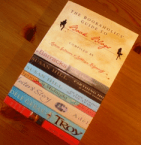 The Bookaholics’ Guide is lovely and when I am finished reading it, I shall post a full review worthy of a book dedicated to praising book reviewers. But for now, though entirely riveted and already 50 pages in – I am also distracted. Why? Because while reading about all these wonderful blogs and their dedication to their reading and writing and reviewing, there is a portion entirely devoted to the discussion of how tragedies always seem to win over comedies. That got my brain thinking back to the lovely Susan Wise Bauer and the list of novels she provides in The Well-Educated Mind
So of course, in my blasted book bouncing fashion, I pick up the book I am currently reading on the list: Invisible Man by Ralph Ellison. I read Chapter One the other day and immediately texted my kindergarten best friend who was an African-American Studies major during her undergrad years, that so far I loved it. (Because unfortunately, I hated reading Native Son by Richard Wright, despite the great skill involved in his story telling, and have been feeling incredibly guilty about it.) Of course, in the midst of being made painfully aware of the sad fact that as a human race we are enraptured by tragedies, I became engrossed in Chapter Two of Invisible Man and nearly died of the overwhelming coincidence.
 *SPOILERS*
If you have not read Invisible Man, I suggest you read no further. Unless, you are of the variety of readers who don’t care about spoilers, and then I may cheerfully say, read on.
Chapter Two includes the lengthy tale of Jim Trueblood, a man who has fathered a child with his wife as well as his own grandchild with his daughter in roughly the same time period. I have not yet read beyond Chapter Two, therefore cannot share with you the relevance to the Invisible Man’s story, or the book as a whole, but I can say that I felt ill after reading it.
Poor, oh poor Jim Trueblood (I say with intense sarcasm), who rolled over on his daughter while sleeping and having an odd dream, inserting his penis into her and *accidentally* fathered her child – to everyone’s horror.
Really?! Really!?
Of course, I must read on to discover the significance of it all. But I really don’t want to.
1. If your daughter is that old, she should not be sleeping between her two parents. I don’t care how poor you are. Put the child on the other side of the mother. That’s just common sense. What teenaged daughter wants to sleep between her two parents anyway?
2. I don’t know if I’m supposed to believe Jim Trueblood at this point or not, but I’m with the protagonist on this one – why the hell did Jim Trueblood get a hundred-dollar bill for knocking up his own daughter!? Its absurd. I have a hard time believing that people behave(d) this way.
3. I have a hard time buying this story in the light of the symbolism it supposedly represents: http://students.cis.uab.edu/archived/dlam/Jim%20Trueblood.html, but I look forward to seeing if the rest of the novel makes these proposals more clear. I’ve a huge soft spot for The Great Gatsby and The Natural, so you can imagine how much I adore symbolism.
 4. So far, the only African-American/ Black (depending on your version of what is politically correct) fiction that I have ever truly appreciated in my entire life has been the young adult Roll of Thunder, Hear My Cry
You see, the thing is, I hate reading a book and feeling like the sole purpose is to make me pity the protagonist. Mostly, because I think pity is the ultimate form of disrespect. Why would I want to read a character that I have no respect for? No matter how under the dog, one should not pity the protagonist nor hate them. One shouldn’t see them as less than themselves. I want to read about a fight for equality with some umph. I want to see them prevail over adversity, not wallow in their plight. The things I disliked about Native Son are the same things I disliked about Elizabeth Gilbert’s Eat, Pray, Love
These are the views the politically correct call me racist over, but I assure you that I have great respect for people of every color, culture, generation, and walk of life. Sometimes, I wish they had a little more respect for themselves. Just remember, never fight the good fight with a plea for pity – its a huge turn off.
Granted, I have only just finished Chapter Two… there is yet more to the story to discover. I hope it lives up to its classic reputation. I don’t want my distaste for unrelated titles to taint my views as I read this work.
10 Year Anniversary Party!
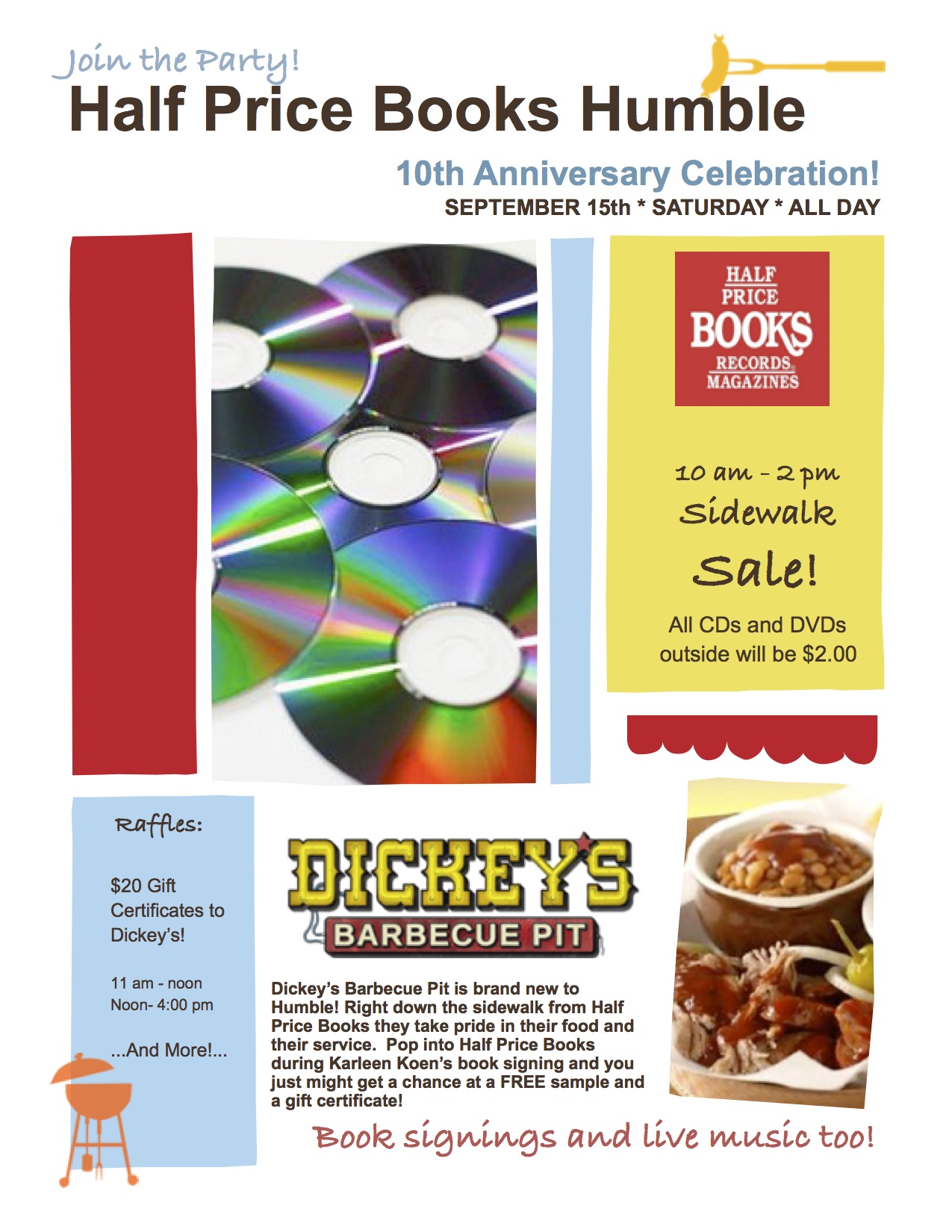
As of September 13th Half Price Books has been opened in the Humble area for 10 years! So on Saturday, September 15th, we’re having a party! Come join the fun… book signings, raffles, barbecue, live music in the evening, what more could you want?

Get Ready for HPB Humble’s 1st Book Club Meeting!
I made and printed little post cards in preparation of the September 3rd Book Club Meeting (8pm-9pm at HPB Humble!). We will be discussing Koen’s Through a Glass Darkly. Feel free to print a copy for yourself.

Kathleen O’Neal and W. Michael Gear
Also…
Eleanor Hibbert, who also writes under the names:
Jean Plaidy
Victoria Holt
Philippa Carr
Eleanor Burford
Elbur Ford
Kathleen Kellow
Anne Percival
Ellalice Tate
Don’t forget we will be meeting the first Monday of the month through out the Fall/Winter 2012. Here’s this season’s reading roster:

My *Sometimes* Weekly Low Down on Kids…
…Books…
 An oldie but a goodie, kiddo picked up my old, ratty copy of Are You My Mother?
Are You My Mother? is fabulous for its repetition of the names of the animals. Two in October, she loves repeating nouns and discovering what things are called. As the little bird searches for his mother (and kiddo, startled says “Mommy? Where’d she go?” as we turn each page), he comes across a hen, a cow, and other animals. I’m very partial to the illustration of the dog featured on the front cover.
…Activities…
A great way to entertain a tactile child learning to count is to take a Tupperware container of dried beans and hand them a small bowl. They’ll spend a solid thirty minutes sorting and resorting the beans from container to container, pouring, touching, and lining them up in rows. If you have time to sit with them, its easy to go through their numbers and show them how to count the beans. Its great fun, and easy to clean up any mess with a broom or a handy household dog.
Also, in our house, we love to dance. I got a Ceremonial and War Dance
That’s it for this week. Tune in next week and I may have some more Weekly Low Downs on Kids somethings to share.






 Anakalian Whims