Parnassus on Wheels – Can I Have One?
 Title: Parnassus on Wheels
Author: Christopher Morley
Publisher: Akadine Press
Length: 160 pages
“[…] When you sell a man a book you don’t sell him just twelve ounces of paper and ink and glue – you sell him a whole new life. Love and friendship and humour and ships at sea by night – there’s all heaven and earth in a book, a real book I mean.”
Parnassus on Wheels is both sweet and clever. It is adorably romantic. After reading this, I want desperately to peddle books from a horse-drawn early 1900s RV. Morley has captured a tale of an adventure that is every book lovers dream: to travel in a cozy carriage with a dog and horse, spreading the love and joy of literature to everyone you meet. What could be better?
Mr. Mifflin is a middle-aged ginger, evangelizing about the religion of books as a way of life, when he meets over-weight Helen McGill. Helen is tired but spunky, she’s been a ‘house-wife’ to her brother for years on the farm they share. Her brother, a famous author doesn’t really treat her as though she’s her own person, and 6,000 loaves of bread into life, she buys Mifflin’s whole operation for $400 on a lark. Of course, everyone thinks Mr. Mifflin is taking advantage of the lady, but in reality he has offered a whole new life, a new way of seeing the world, and an absurd amount of joy.
As a bookseller, this story speaks to me. I ran the literature sections for several years, and I received an intense amount of satisfaction from finding books for my customers. The idea that you could deliver books straight to someone’s doorstep in such a homey but noninvasive manner sounds so enticing and whimsical to me.
Peddlers are well-known concept:
THE PEDDLER’S CARAVAN
[46]
I wish I lived in a caravan,
With a horse to drive like a peddler-man!
Where he comes from nobody knows,
Or where he goes to, but on he goes!
His caravan has windows two,
And a chimney of tin, that the smoke comes through;
He has a wife, with a baby brown,
And they go riding from town to town.
Chairs to mend, and delf to sell!
He clashes the basins like a bell;
Tea trays, baskets ranged in order,
Plates, with alphabets round the border!
The roads are brown, and the sea is green,
But his home is like a bathing-machine;
The world is round, and he can ride,
Rumble and slash, to the other side!
With the peddler-man I should like to roam,
And write a book when I came home;
All the people would read my book,
Just like the Travels of Captain Cook!
—WILLIAM BRIGHTY RANDS.
But a book peddler is a fairly unique idea, and I love Christopher Morley for sharing this idea with the world. Clearly, he didn’t invent the concept, but one wonders if he encountered a caravan such as R. Mifflin’s Traveling Parnassus, or is it merely a dream he had for himself? Parnassus on Wheels was Morley’s first novel, first published in 1917. Mr. Mifflin returns in the book The Haunted Bookshop, a sequel I am strongly looking forward to, but what I find most interesting is that Christopher Morley wrote over 100 novels. Have you heard of any of them? I had not, I was only aware of Morley because he was pressed on me by a fellow bookseller. I rarely come across his work in bookstores, and I have never seen a title of his in any library. I now plan to collect his work more vigorously.
Morley apparently wrote a number of essays and poems as well, and lectured at University. One adorable little factoid is that he married a woman named Helen shortly after studying history in college. I can’t help but wonder how much Helen McGill, of Parnassus on Wheels, resembled his own wife whom he loved.
Have you read anything by Christopher Morley? Please leave comments.
HPB Humble October Meeting Prep
Bill Bryson’s bestselling books include A Walk in the Woods, Notes from a Small Island, In a Sunburned Country, Bryson’s Dictionary of Troublesome Words, A Short History of Nearly Everything, which earned him the 2004 Aventis Prize, and The Life and Times of the Thunderbolt Kid. Bryson lives in England with his wife and children. – from The Official Bill Bryson Website, http://www.randomhouse.com/features/billbryson/about.html
Discussion Topics for October 1st:
- “It must be very frustrating to have a truly unique experience.” – pg. 159 What unique experiences have you had lately?
- There is a Veblen reference on page 151, “conspicuous consumption.” How do you feel about this assessment of America?
- What did you think of Bryson’s description of the south?
- Have you ever stopped to read historical landmarks? Do you know about the historical landmarks here in Humble?
- What was your favorite part of the book? What was your least favorite part of the book?
Below I have included historical landmarks of Humble, TX, taken from the Humble area website: http://www.humblearea.com/history/
|
Humble, Texas Historical Markers Humble Cemetery – Humble (227) This cemetery is believed to be the town of Humble’s oldest. The earliest documented burial is that of Joseph Dunman (1867-1879). Also believed to be buried here in an unmarked grave is Jane Elizabeth Humble, wife of the community’s founder, Pleasant Humble. The first legal record of the cemetery appears in a deed transferring the cemetery property from Jonas Altmont to trustees in 1914. Civil War veteran Houston Young and several World War I veterans are also interred here. This cemetery serves as a reflection of Humble’s pioneer heritage. Humble Lodge No. 979, A.F. & A.M. – Humble (164) Near the turn of the century, the town of Humble was home to many Masons who were members of lodges located in nearby towns. With the help of local Justice of the Peace F. K. Wise, Humble area Masons organized their own lodge in 1908. Humble State Bank president and future Texas Governor Ross Sterling (1875-1949) provided meeting facilities in the bank building which formerly stood at this site. After the bank burned in 1912, the Masons bought the property and built a new lodge hall. The Masons have been active in civic programs over the years. Humble, City of – Humble (164) A pioneer oil boom town. Originated as crossroads community named for settler Pleasant Smith Humble (1835?-1912), who lived here before 1889, hewing his timber into railroad ties, mining gravel from his land, keeping store, and serving as justice of the peace. Neighbors included the Bender, Durdin, Isaacks, Lee, Slaughter, and Williams families. Economic bases were farms and sawmills. The post office opened 1902. In 1904 C. E. Barrett (1866-1926) drilled for oil in this area, securing small production on Moonshine Hill. On Jan. 7, 1905, he brought in the No. 2 Beaty Well which yielded 8,500 barrels a day, opening the great boom. From a village of 700, Humble grew at once into a town of 20,000. Field production– the largest in Texas for the year 1905– was 15,594,923 barrels of oil. The field was named for the town. A group of its operators, including Ross S. Sterling, later (1931-33) governor of Texas, in 1911 incorporated a new oil company named for the field, thus spreading into the annals of world commerce the town’s name. Production from several strata here exceeded the total for fabulous Spindletop by 1946. Known as the greatest salt dome field, Humble still produces and the town for which it was named continued to thrive. Moonshine Hill – Humble (105) Early reports of natural gas seepages in this area were not uncommon in the late 19th century. James Slaughter noticed such natural occurrences near the San Jacinto River in 1887. Several years later, with S. A. Hart, he set up a drilling operation in the area, but it proved unsuccessful. Charles Barrett, a former Huston merchant, also drilled wells here, but found the results limited. In 1904, the Higgins Oil Company brought in a major gas well and the following year, the first successful oil well was drilled. This area, known as the Moonshine Hill section of the great Humble oil field, became the site of a boom town. Within months of the 1905 discovery, the population of the Moonshine Hill settlement increased to 10,000. Early operations associated with the site included the Moonshine Oil Company of Walter Sharp, Ed Prather, and Howard R. Hughes. Although tents comprised most of the early structures, Moonshine Hill eventually included a church, school, postal station, stores, hotels, and saloons. Despite three separate boom eras, the last occurring in 1929, Moonshine Hill declined as a community. Its brief existence, however, had a dramatic impact on the economic development of Humble and Houston. Texas Sesquicentennial 1836 – 1986 First United Methodist Church of Humble – Humble (86) Founded in 1886, Humble was an oil boom town in 1907 when the Rev. J. T. Browning of Houston began conducting Methodist worship services for residents of the area. The services were first held in a building that had housed a bottle factory. In 1908, this church was organized with 37 charter members. The following year, the congregation constructed their first building, a small frame structure later destroyed by fire. Subsequent church facilities have reflected the continued growth of the congregation and community. Texas Sesquicentennial 1836 – 1986 Lambrecht’s Artesian Well – Humble (50) An oil well drilled at this site in 1912 yielded not oil, but free-flowing artesian water. The following year, German native Nick Lambrecht (1855-1920) purchased the property. Lambrecht served as justice of the peace and mayor during Humble’s oil boom days in the early 20th century and in 1904 had installed a water system to meet the needs of the many oil field workers who came to town. Lambrecht’s artesian well was used to supply water to bathhouses and was also piped to nearby homes. In earlier years, water had been hauled to town in barrels on horse-drawn wagons. Texas Sesquicentennial 1836-1986 |
Banned Books Week
One of my favorite novels, Mrs. Dalloway
Yet, people find the book itself and the material in it threatening. I, on the other hand, find it fascinating.
In the comments this week: share your favorite banned books with me.
Challenge this week: read a book from a banned or challenged book list.
Visit DeleteCensorship.org to view lists of banned books.

Articles about Banned Books:
NPR on Grapes of Wrath
The Lord of the Rings Controversy
Bill Bryson, I adore You
 Title: The Lost Continent
Author: Bill Bryson
Publisher:Harper Perennial
Length: 299 pages
I read A Walk in the Woods a year or two ago and I remember thinking, “What a witty, sarcastic, jack-ass – I love him!” The same holds true for one of Bryson’s earlier works, The Lost Continent.
This book is a great travel memoir of a road trip in America, back when it was still glaringly clear that we were The United States of America, each part of our country a very unique place, in the midst of the late 80’s and early 90’s when the lines were getting blurred and we as a nation fell more and more into a federal ‘group-think’ existence.
Being from the south, there are many times when I feel I should be greatly offended by the things Bryson has to stay about my neck of the woods. Three things must be said about my not getting offended 1. We southerners don’t offend easily, we just pat your hand and say ‘Bless Your Heart’ for not understanding us and 2. Bryson is funny and intelligent, and despite a lot of generalizations and false conclusions, many parts of his descriptions are familiar and full of truth. But finally, 3. “The South” and “Texas” don’t always mean the same thing, we are a brand all our own, and mighty proud of it.
Bryson’s version of tourism is wonderful. It has both the comprehension of American ways and not quite being an outsider, as well as the fresh eyes of someone who has been away for so long. His adventures around national landmarks, travels through run of the mill towns, and his uncanny ability to not be duped in one instance and be completely suckered in another is fantastic. He finds himself in both the best and the worst of places. From the smallest hotel room in NY to the cleanest hotel room in New England, Bryson experiences it all, and shares every scurrilous detail.
If you’ve ever stepped foot in any of these places, you can’t help but enjoy his descriptions. If you haven’t yet been there, you find yourself intrigued. If you’ve ever read Conspicuous Consumption, you can’t help but notice how Bryson spells out the concepts Veblen’s concepts with severe imagery. If you’ve never read anything at all, you can at least appreciate his comedic nature and how much his books will make you laugh.
Scentsy pairing: Clean Breeze or Route 66
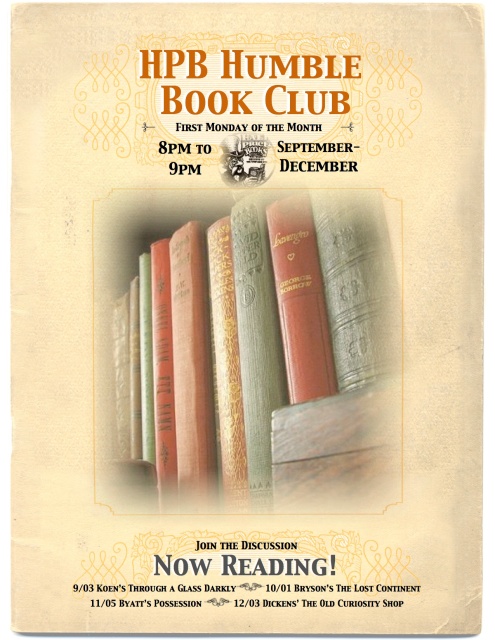
As usual, I’m enjoying Bryson’s work quite a bit and am so excited to get a chance to discuss this book with other people at the Half Price Books Humble Book Club meeting on October 1st. There’s still a few days to find a copy, read it, and pipe in at the meeting.
Weekly Low Down on Kids Books – or, my obsession with water work
 Title: The Pout-Pout Fish in the Big-Big Dark
Author: Deborah Diesen
Illustrator: Dan Hanna
Publisher: Farrar Straus Giroux
Although I hate the title, because I have a severe adversion to anything that even remotely sounds like it *may* be baby talk, I love this book. I picked it up at the library today, despite the title, because I have a soft spot for underwater children’s illustrations. Anything dealing with the ocean in the world of kid lit is right up my alley for whatever reason – it moves me. Just like I loved Memoirs of a Goldfish
My impulse for underwater things goes beyond kid book impulses every now and again. My guest bathroom is beach themed, a common choice, I believe, but part of my decor involves pictures from my honey moon and, yes, more books. The first that comes to mind is: Poseidon’s Steed
Impulses aside, once I read The Pout-Pout Fish in the Big-Big Dark to kiddo today, I was rather pleased. Kiddo was riveted, curled up in my arms, pointing out the fish on the page and colors she recognized, while soothed by the rhythm of the poem. She was in no rush for the story to be over and thoroughly enjoyed each and every page. If you have a toddler, you know how daunting it can be to find a book that your child doesn’t turn the pages ahead of the story for you, impatient for you to finish reading. The Pout-Pout Fish isn’t one to be rushed, and it was quite lovely.
P.S. This is a good title for dealing with older children who are scared of the dark.
A Day With a Klemm
Klemm. When I looked up the meaning of my married name, I found a definition somewhat like this one:
German: from Middle High German klem ‘narrow’, ‘tight’, ‘scarce’, hence a
nickname for a thin or inhibited person, or alternatively a topographic name for
someone living in a narrow, precipitous place, from the Middle High German noun
form klemme ‘constriction’.Read more on FamilyEducation: http://genealogy.familyeducation.com/surname-origin/klemm#ixzz26eR2FcGy
So it should come as no surprise that we have some very interesting daily habits that coincide with being a small, introverted, hobbit-like soul, that does not emerge from the house for days at a time. First of all, we eat like hobbits:
- Breakfast – 7am
- Second breakfast – 9 am
- Elevenses – 11 am
- Lunch – 1 pm
- Afternoon tea – 3pm
- Dinner – 6 pm
- Supper – 9 pm
In between all these meal times is a whole lot of coffee, a morning cleaning ritual, and lots of reading.
I get really into my books and the characters involved. And with that engagement comes an intense need to invite them in my home the same way I would a welcomed but unknown guest. I prepare coffee, make sure we have had our meals and have later meals prepared, clean the house (sweep, mop, vacuum, do the dishes and wipe down counters) and then I am ready to sit down with my future new friends – the lovely people portrayed in books.
So, I’m writing this blog post in between Elevenses and mopping the floor. My coffee is ready (more than ready, I’m on cup two – and my cups are overly large mugs that fit about half a French press in each serving) thinking about Louise de la Baume le Blanc de la Valliere and how we are going to enjoy some afternoon sandwiches together. That’s crazy book nerd talk for: I am going to be reading more of Karleen Koen’s Before Versailles while I munch on chicken salad sandwiches (I’m addicted to HEB’s Rotisserie Chicken Salad) and sip even more coffee.
I do the same thing before I write. Which is probably why I’ve been working on the same novel since I was 14 years old. Karleen said yesterday that it takes her a long time to complete a book, and all I could think was: Thank God, I am not alone, because I am taking forever. If my debut novel is half as good as hers (Through a Glass Darkly) I feel as though I will have accomplished something in life. I just want to finish it, get it in print, and have a completed work that someone – anyone – will remember.
I spend days on end reading and writing and eating with my daughter. It is only for events, planned activities for her benefit, and my random extreme extrovert days that get me out of the house. (One day, my daughter will probably tell you her mother was a bit wacky, as when I take personality tests I come out equally extroverted and introverted depending on the day. Some have misused the term bipolar on me, but I got that checked out and I’m not.) Yesterday I spent the whole day at Half Price Books running around and giving things away… today I will huddle up with Louise and Louis XIV and whoever my daughter interupts me with (LadyBug Girl a constant play friend in our house).
The Importance of a Book Signing
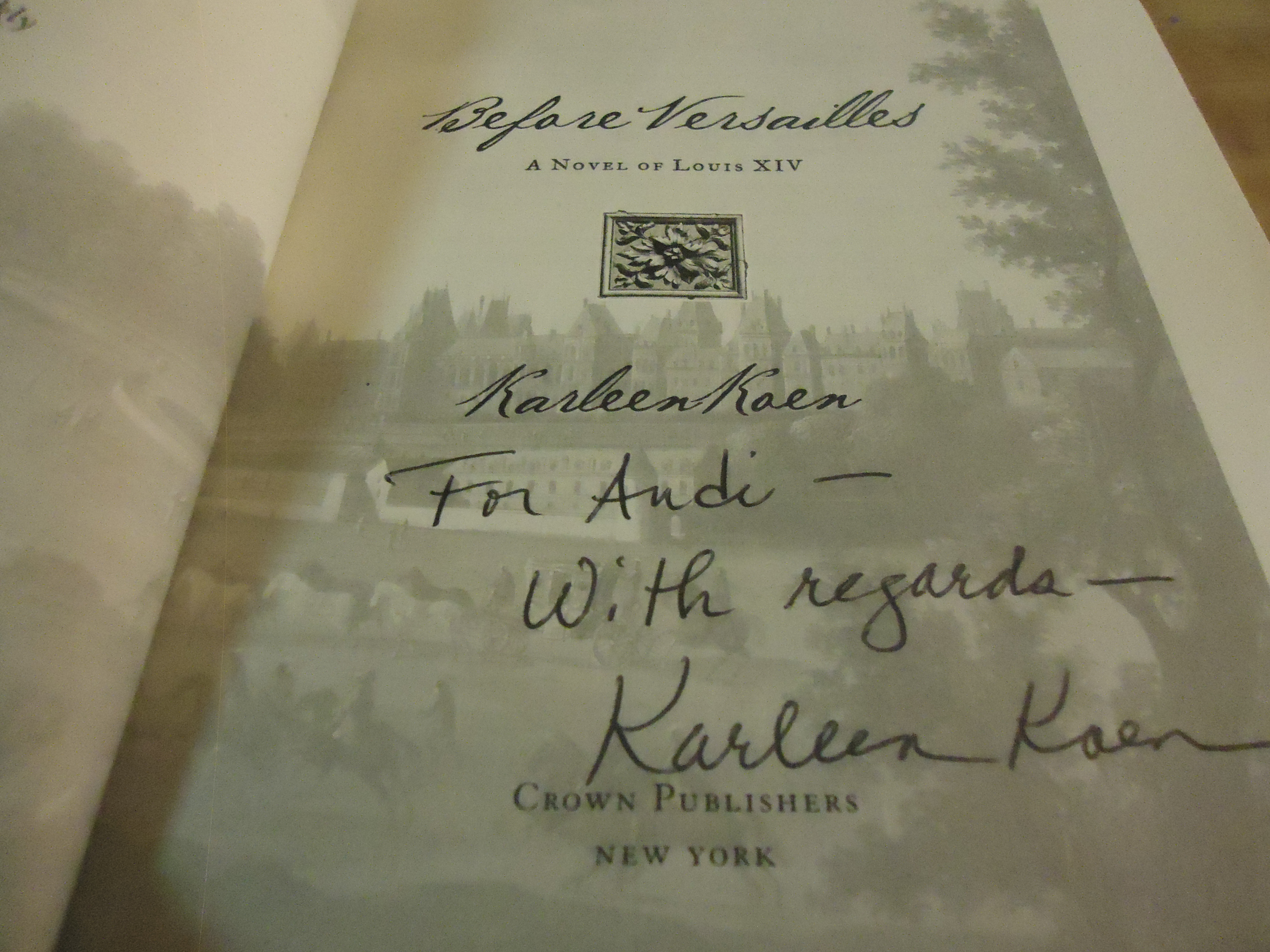 Some people will tell you that book signings are old-fashioned, a thing slowly creeping into the world of publishing past. As both a reader and an event coordinator, I have strongly say that it is not.
As an event coordinator, I’ll tell you that yes, they can be slow. People don’t stop as often as they maybe used to. If it’s an author they are unfamiliar with they have a tendency to be stand offish, uncaring, or nervous. Fix this by offering candy or baked goods, or even a few free books, and you’ve sealed the deal. Like a sales person, all you have to do is get them up to the table. Your merchandise, a friendly face, and their sheer curiosity will do the rest. As an event coordinator I will tell you that you shouldn’t worry if not very many people buy your book that day, that’s not entirely the point of a book signing. The point of a book signing is to get your face, your name, your book titles and book covers lodged in their brain, constantly tickling the edges of their frontal lobes. Every time they see your work, for years to come, they will say in their head: I met him/her, I should buy this. In this day of e-books, many wont buy from you in a brick and mortar store, but will rush home and purchase a kindle edition.
As a reader with severe extrovert tendencies, I will tell you that it is incredibly exciting. Meeting an author, whether you love everything they’ve ever done, or just barely opened the first page of a book, or have never heard of them – to me – is so very exciting. I want to hear their voice and the way they talk, let their real voice intertwine a bit with the inner one I’ve imagined in my head. I want to know a few factoids, a few mannerisms, put their work in a greater perspective. Yesterday, when I met Karleen Koen for the first time, I just wanted to bask in her author-ness, in her bookishness. Of course, I ended up chattering hopelessly because that’s what I do, but my oh my how awesome it was to hang out and listen. It made me want to get home afterward as quickly as possible and finish reading the book that I had meant to finish before the signing. It made me want to buy the other books she has written, and all I can think about this morning is that there is a signed copy of Now Face to Face in hardback sitting on the shelf at the store… and how it needs to be mine.
My goal is to bring more book signings to Half Price Books Humble and one day maybe be as event filled as Murder By the Book in Houston. Book signings are not dead and they should never be dead. If you are an author interested in setting up a book signing, email me at andiklemm@rocketmail.com.
Weekly Low Down on Kids Books – and other things

Title: The Fantastic Flying Books of Mr. Morris Lessmore
Authors: William Joyce and Joe Bluhm
With great reluctance, I turned this book back into the library yesterday on our way to the Miller Outdoor Theatre to see a live *free* production of Cinderella. Cinderella actually has no relevance to this story/review, I just wanted to throw that in there because the whole adventure was pretty awesome, we even rode a train.
“Morris Lessmore loved words.
He loved stories.
He loved books.
But every story has its upsets.”
But not every story is so beautifully written and illustrated. For the last two weeks, kiddo has been getting a daily dose of Mr. Lessmore, not just because I thought it was so fantastic, but because she thought it was pretty awesome too. Flying books!? It doesn’t get much better for that for a kid.
Shamefully, I have to admit that if I hadn’t read this book to my daughter, she may have forever missed out on Humpty Dumpty – merely because I am so busy sharing books with her that I often forget the nursery rhymes. Yet, Humpty Dumpty is alive and well in Mr. Lessmore’s world, so thankfully, that is one she will not miss out on.
Mr. Morris Lessmore is also a good way to introduce a small child to the issues of aging, life, and death. It’s a beautiful story of a man’s life with books, and like all men do, he grows old and passes. Presented with a combination of calm serenity and passion, this story kept in a child’s library could be a little piece of fantasy and reality which their subconscious can cling to forever.

Part way through the very excellent play that I did not want to disrupt, kiddo got the urge to run. Cinderella still going strong in the distance.
Now, I am aware that I teased you a bit with that Cinderella business, so I suppose I cannot leave you hanging. This falls a bit under the When We’re Not Reading parts of my blog, but still encourages literacy and the arts. A.D. Players did a William Glennon play at the Miller Outdoor Theatre in Hermann Park yesterday morning. The weather was perfect as it kept teasing us with rain, but never did. The breeze was blowing, and there are so many things to do around the park that if/when your kiddos get antsy, its easy to take them for a walk or train ride.
To give you a full idea of how awesome these productions are, however, I am going to simply share with you a blurb from the program:
Founded in 1967 by Jeannette Clift George, A.D. Players pioneered a unique style of theater committed to producing plays and programs that uphold human value, offer creativity, and promote literacy and education. The company is one of Houston’s largest resident theater companies, impacting more than nine million people. Annually, the company produces five Mainstage shows and four Children’s Theater shows, and maintains a year-round Theater Arts Academy.
We share our mission with volunteers, community associates, and those who make our work possible through their support. For additional information, visit www.adplayers.org or call 713-526-2721.
Pretty neat, right?
Emma, my introduction to the Viking era
 Title: Emma: The Twice-Crowned Queen
Author: Isabella Strachan
Publisher: Peter Owen Publishers
Length: 192 pgs.
First of all, let me premise this by informing you that like the Catherines/Katherines of Henry VIII’s time, the name Elgiva/Emma runs rampant during the Viking age of England. For instance, the subject of this biography was born Emma but the English chose to call her by the Latin equivalent: Elgiva. Emma was the second wife of the widowed Ethelred, whose first wife’s name was Elgiva. When Ethelred (king of England under the Saxons) dies and his land then conquered by the Danes (while King Swegn ruled), a Dane named Canute (Cnut) came to power. Emma becomes his wife as well, but guess what? He already has a ‘wife’ named… any takers? anyone? anyone? Yep, Elgiva. This makes for some interesting reading, but Strachan eases the issue by always referring to Emma as only Emma and providing a handy-dandy cast list in the front of the book.
When I first heard of Emma, I expected a woman who was cunning and manipulative. Someone with political the intrigue of a Cleopatra or Elizabeth I. I thought I’d be reading about a woman with a deep political agenda, always out-playing others in a real-life chess match. Instead I found a woman who seems to me to have been more adaptive, reactive, a survivor constantly caught between a rock and a hard place. The Twice-Crowned Queen is less of a political master mind and more of a drowning victim always bobbing up to the surface of the water just moments before death.
She was young when she became the bargaining chip in an arranged marriage to King Ethelred. It was a political ploy of others that ensured the Normans and Vikings were kept at bay during a time of imminent war, as both her father and half-brother were Dukes of Normandy with close, friendly ties to the Vikings. After Ethelred dies and England taken over by the Danes, Canute is chosen to be the new King. The problem with this arrangement is that the Church and Cabinet wanted Emma to remain the Queen. It remained good political sense, but Canute already had a wife. Canute had a handfast wife, referred to as Elgiva of Northampton. From what I gather from Strachan, a handfast wife was the Medieval equivalent of a ‘Common-law wife.’ Handfast wives had all the political and societal rights of a true spouse, but were not recognized by the church. Later William the Conqueror’s own mother would turn out to be a Handfast Wife, which was why he was a Duke of Normandy but still got called William the Bastard.
Either way, there was a lot of drama surrounding Emma’s marriage to Canute. He seems to have been completely in love with Elgiva of Northampton and despite promising that Emma would be his only Queen and her children heir to the throne, Elgiva was the only one granted regency rights over her own lands and it was her son Harold that took the throne upon Canute’s death. Emma was again just a political pawn to keep the peace, and in keeping the peace was forced to send her own children (from Ethelred) away to grow up abandoned by their mother while fighting tooth and nail to keep her children by Canute in the running for the throne. There is a poem called Samiramis that I’d like to get my hands on, written by the Normans of the time, that tells their account of the entire incident.
What I initially saw as an intense woman ensuring each of her children had a chance to rule (as her son Harthacnut from Canute and her oldest son Edward from Ethelred both eventually become King, while her daughter was the Queen of Germany), after the biography I feel that most of this was just chance and circumstance. Harthacnut was indeed fought for to be King, but his half-brother Edward the Confessor became King despite his mother. Edward actually stripped Emma of all her political rights as soon as he gained the throne. One of the clenchers for me having been interested in studying her was that she was William the Conqueror’s great-aunt, but he did not seem to have much of a tie to her, he merely showed a bit of respect for his cousins.
I am glad I read the book. Although I am disillusioned about her character, I think she’s still mighty impressive and wonder why she was left out of my education. Reading this biography made me intensely interested in reading additional history on William the Conqueror and his mother Arlette (Herleva). Lady Godiva also makes a cameo appearance, which piqued my interest as well as a man named Olaf Haraldsson. As I always say, the more you read, the more you discover you need to read.
This book would make a great addition to a well-read 11-12 year old’s Medieval history curriculum. It is short, sweet, and informative of not just Emma but a huge piece of history that made the English monarchy what it later became. And I loved it.





 Anakalian Whims