Timothy and the Dragon Defenders, Part Three
A Short Story from the Archives of A.Z.K.R., author of Tales of Porcelain Thrones: Middle School Edition
[To read Timothy’s adventure from the beginning, click here.]
Once the commotion of a moving dragon—scales against underbrush, plodding, heavy, footfalls, claws scratching against pebbles—all came to a halt, Timothy began to actually hear the sounds of the forest around him. A myriad of bird calls, most of which he didn’t recognize and sounded rather otherworldly, filled his ears. The wind rushed through the tops of strange trees and under it all, a distant melody, akin to a flute, danced with the leaves. The melody grew louder and Timothy looked about in curiosity.
“Who’s playing music in the woods?” He wonder aloud. And will I remember what it sounds like when I wake up? Beside him, Galen’s ears twitched in the breeze. Until he saw them move in this way, Timothy had thought they where some kind of developing horns.
Galen looked in each direction before starting down a path to Timothy’s right. It was faint and covered in soft grasses. Orange and white flowers waved, tickling the companion’s ankles as they headed to the ever swelling song. Then the music suddenly stopped, as did Galen, who then looked at Timothy and did the twitch with his shoulders that Timothy had decided to interpret as a human shrug.
The two stood there, wondering what to do next, when a small man half Timothy’s size materialized in front of them. He was a fawn, Timothy saw, but he had very little hair. Timothy’s thoughts flickerd again to Narnia as he laughed.
“I said I have no time for tea!” Timothy said, half to Galen, half to himself.
The fellow’s pointy hat slipped back on his bald head and flopped to the side. He scowled at the boy and his dragon.
“What are you two doing in my forest?” The little man demanded.
“Walking. It’s not like we knew it was yours. Or, I didn’t know.”
Galen burped.
“Are you here to smash my house?” This question was directed at Galen, who in turn, burped.
“What do you think you’re doing alone with a dragon, boy? Twelve year old civilian and taking such blatant sides in the war?”
“No, we don’t smash houses.” Timothy said. Then eyeing Galen, demurred, “I don’t think. How did you know I was twelve?”
The gnome-fawn-whatever he was, looked him up and down. “You look to be Twelve,” he said dismissively, arighting his hat as he did.
“You raised by Clubs?” He asked Galen.
Burp.
“What are Clubs? What war?” demanded Timothy.
“Clubs, my boy, are big, mean, and blue. They belch the foulest smells, as they are known to eat garbage, and they have a habit of smashing things. I was in fear of my house, based on the noise and smell. I tried to warn you away with my flute, but it seems you don’t understand music messages and came nearer instead. Dragons, however, are less foul. This one must have been raised by a Club Clan. They’re known to hoard dragon eggs under threat.”
“What war?” Timothy repeated.
“No time to discuss politics on the outside. Get in before we’re seen and I’ll give you your belated history lessons, and—well—news.”
“Seen?” Timothy looked around, then up.
“Not you, The dragon. They’re an illegal species in Zentop, by order of Lord Lucius of Romodore.”
He glanced at the dragon’s tatooed wing, and said “Come along Galen, son of Clubbers.”
Galen, of course, answered, with a burp.
[To Be Continued…]
Getting to Know Charlotte
A Homeschool Life…
When I was first sold on homeschooling, I was smitten with the classical model. I learned later that most “classical” models being advertised in the United States are actually “neo-classical” in practice. They have taken an essay written by Dorothy L. Sayers on the Trivium and pigeon-holed it into something it wasn’t exactly meant to be. The neo-classical model sort of married the United States educational “ideal” and pushes intense academia early, limits the elementary school years to a lot of memorization (the grammar stage), and taken to the extreme (like anything taken to an extreme), steals joy from students and teachers alike.
If you have followed my blog for the last fifteen years, you might remember me “homeschooling” my toddler. (FYI, pre-school is just parenting, not homeschooling. It’s literally PRE school.) Pressured by a narcissistic ex who demanded that my then three year old be able to read already (it’s not developmentally appropriate to force formal reading lessons on children under six), be able to copy out poems (it’s not developmentally appropriate to force small children to write, look up x-rays of their hand bones), and wanted her to be trained as some government super spy assassin (I am a third degree black belt in Kung Fu, but some people have watched too many movies and have no sense of reality and I used to be married to “some people”). Homeschool regret #1: giving into the pressure of my ex to do formal reading lessons because she was bright and could do it and I was hyperlexic and was reading at age three despite knowing that educational studies have long stated that formal lessons shouldn’t begin until six. Homeschool regret #2: ever handing her a worksheet in kindergarten, which wasn’t often, but still…
The things I am proud of, however, is that despite all this pressure, we always focused on living books above all else and I encouraged verbal narrations for years. I do not regret the neo-classical homeschool co-ops we joined (and left), they held an important role in our lives at the time and I met some cherished and beloved friends there even if I was regularly told: you’re not very classical, you’re too Charlotte Mason. The first time I heard that, I started doing some research…
I learned that Charlotte Mason was very classical, and what calls itself classical these days just isn’t. Honestly, it doesn’t really matter, what matters is that I still very much subscribe to both tactics of education and as my oldest is now in highschool and I have three more children with one creeping up on kindergarten (FYI: kindergarten is also PRE- school), I’ve been doing even more reading and research and want to share my favorite resources… the ones I don’t regret.
First: if you’re new to homeschooling or not loving your current homeschool rhythm, this is my favorite link to send parents: The Five Flavors of Homeschooling. I like to share this link so much, I have gotten restricted on Facebook as a potential scammer, despite not having violated the group rules in any of the places I posted it. Knowing your “flavor” can save you a lot of money on homeschool pursuits, and I definitely feel like (having been a single homeschool mom who wasn’t receiving child support that was owed) Charlotte Mason and Unit Studies are the easiest to accomplish for FREE.
Which brings me to my next two resources: Ambleside Online (not an online school) and Well Educated Heart, two curricula that are totally FREE. Ambleside Online is named “online” so as to not confuse it with the Christian private school based on Charlotte Mason’s philosophy still operating in the UK. It’s a full “scope and sequence” and any time you can’t find a title for free or a price you can afford, you can usually access it on Project Gutenberg or substitute it with something suitable. The focus is having the students read real books and source documents, narrating those books, and embracing the idea that Education is the Science of Relations by making connections to things they have studied and the world around them. Well Educated Heart is very similar, but clusters the material into something like unit studies, despite Charlotte Mason discouraging unit studies (because she wanted the children to make the connection, not have the teacher present the ideas already connected). Well Educated Heart offers their curricula for free and the feature I like most is that the audio files are also available on their site for… wait for it… FREE.
But wait, what is narration? That brings me to my third resource that I like to send people: Episode 7 of Cindy Rollins’s podcast The New Mason Jar. I had already read Karen Glass’s book Know and Tell (as well as Charlotte Mason’s original Home Education series) when I stumbled across the podcast episode and I think the podcast is a more approachable way for people to access the road to narration because (Gasp!) a lot of people don’t want to read the books (it actually drives me nuts, but I kind of get it: people are busy, especially mothers). The beauty of pursuing the art of narration isn’t just in the brain development aspect (which is phenomenal), it’s also the price tag… narration is… you guessed it… FREE. No fancy writing programs, no workbooks checking reading comprehension, no drama. A verbal narration costs nothing but the work of a brain muscle and a listening ear plus time. As the students get older a composition book and pen will do the trick. Charlotte Mason educations are truly thorough and affordable. I still teach essay writing, Charlotte Mason purists say they don’t, but a narration is basically an expository essay written beautifully. I still don’t use curricula to teach essay writing, we use narrations and read a lot of well written essays (and sermons) and writing memoirs. My oldest loved Zen in the Art of Writing by Bradbury (after reading Fahrenheit 451) and Zinsser’s On Writing Well. Her seventh grade year also included Annie Dillard’s Pilgrim at Tinker Creek and Writing Life. I think the inspiration of her favorite authors talking about their writing lives was the most effective writing tutor I could have ever received.
Other things I’m pleased I did, but will definitely do more of with the younger ones:
- Fairy Tales: read all the fairy tales
- Music: classical music, folk songs, sea shanties, hymns… studying music throughout history and enjoying it in passing has done nothing but enrich our lives and our studies. My oldest plays the tin whistle, piano, clarinet, violin, and pretty much any instrument she can get her hands on. She also enjoyed two years of choir.
- Scripture Memory Box
- Poetry: we added a memory box just for poetry and the kids are loving it. Instead of being set up the way it is for the scripture memory box as described in the YouTube video I linked, it only has month tabs and we read a poem every day that month. This is in addition to the poetry we study for language arts.
- Picture Study: I want to be more intentional about this in the future, but currently we just decorate our home with real art. Paintings we find at Goodwill or garage sales plus a few John William Waterhouse prints I have always loved.
- Classical Conversations songs: they’re neo-classical, they’re expensive, but my goodness if you can find the CDs used somewhere or splurge on their overpriced app, the kids love and remember their awful songs! The Timeline song has been an atrocious gift that keeps on giving and I’m so happy it was and is a part of our lives.
This semester (Fall 2025), the oldest and I have been reading Charlotte Mason’s Ourselves. One of the fun things about homeschooling in the teen years is that as they grow and reason and read for themselves they really start to see the light regarding the choices you have made as a parent and educator over the years. Ourselves isn’t her favorite book, she didn’t catch right off the bat that Mason was alluding to Prudentius–She hasn’t read Prudentius. I’m 41 and have only read some of his work and The Fight for Mansoul just happened to be one of them because I’m a ‘buy all the Latin texts I can afford’ junkie.–But she is having thoughtful conversations with me about it and understands the value of it having been assigned. She can describe the Trivium and how it is needed when learning something new… you always start with the grammar stage (memorizing new facts, acquiring basic knowledge on a subject), move to a logic and dialectic stage (when you can understand and reason through the ideas presented in the subject at hand), and finally rest in a state of rhetoric (being able to express the ideas persuasively), and that these stages will be repeated throughout your whole life as you pursue new things to learn because education is a lifetime pursuit. It’s exciting to be here, even though she’s only in 9th grade, only fifteen years old, even though she wanted to start college courses several years ago and won’t be actually starting one until next semester, it is so exciting to be here and the teen years are absolutely my favorite… and I think Charlotte Mason (and more importantly God) has had a lot to do with that.
(As an Amazon affiliate I earn from qualifying purchases.)
Dracula
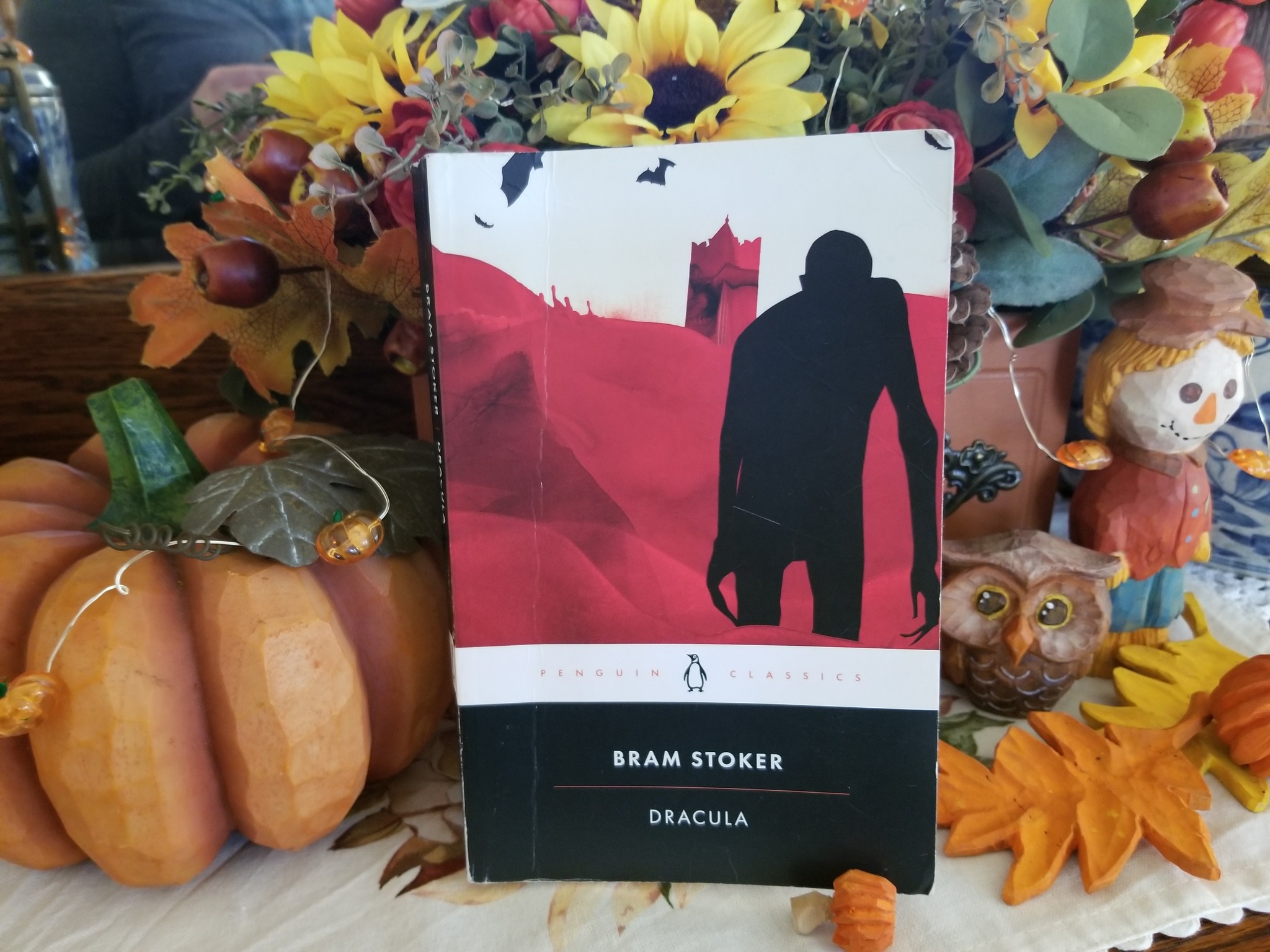
I walked my fifteen year old through Bram Stoker’s Dracula this October. I thought it would be a fun way for a ninth grader to celebrate Halloween. I also thought it would be a neat one to cover with my newly developing book club: The San Salvatore Book Club, primarily made up of my older mentors in my Baptist church. There were gasps of “Are you sure?” and polite “I think I’ll bow out of that one” to which I promptly said, “Why? It’s such a beautiful Christian allegory!”
Side note: I’ve been listening to the Literary Life Podcast with Angelina Stanford for about two years now, caught up on most the episodes and sometimes use them to supplement my home school when I need to be doing something other than teaching literature. My number one complaint to my husband is, “they act like no one knows this and everyone knows this!” to which I am learning every day that, actually, no Angelina Stanford is right: not everyone knows this. I’m not always claiming to have the correct most perfect reads, but I have been shocked to learn I have been reading differently than mainstream society since childhood. So my Angelina Stanford grumbles have ceased now that I know she is operating from the experience of people genuinely not knowing about the material she shares and I’ve been operating under the experience of not sharing because I thought everyone knew. That being the case, my apologies if some of what I share simply sounds like it came from her podcast. It is unintentional, though, yes I listened to her Dracula episodes back in February to make sure when we discussed it in October, I would not have skipped over anything that I assumed “everyone already knew.”
While I was teaching Dracula, I realized I had never written about Dracula on my blog. My blog began, I think, during the height of the Twilight series and I spent so much time focusing on how we shouldn’t be romanticizing vampires with chests that sparkle and misplaced teenage angst, I forgot to write about the roots of vampire lore and my love for Stoker’s classic work, which is in fact a Christian medieval quest to kill a dragon disguised as a techno-thriller. I also realized that I don’t remember what of my essays, stories, and discussions over the years ended up in my journal or my blog, or was relegated only to bookstore employee discussions as we cleaned the store each night. I have spent years reading C. S. Lewis, G. K. Chesterton, George MacDonald, all the classics, yet my blog is mainly limited to home school material and book reviews sent to me by authors and publishers. Therefore, as I begin to teach high school literature to my oldest, I imagine there is a lot of who we are as readers not documented on Anakalian Whims.
To read Dracula well, I think you need a foundation in Genesis, specifically 1:26-4:16. It’s important to read John 1 where the New Testament is clear that Jesus is the Word. It’s important to know a little bit about Jewish and Mesopotamian mythology regarding Lilith, who was a demon and seductress, the disordered first wife of Adam who feeds on children and relishes in child sacrifice as opposed to feeding and nurturing children from her own body as God designed. “Lilitu” was a “night monster.” In my teaching notes, I recommend re-reading the book of Revelation (so you can remember how the bible used imagery of dragons and oceans) and Beowulf. While reading Dracula, you might need to recall stories like Hansel & Gretel, Bluebeard, Homer’s The Odyssey, Dante’s Divine Comedy, Spenser’s The Faerie Queene, and Shakespeare’s Hamlet. It’s easy to enjoy Stoker’s work without these tales fresh on your mind, but it might also be easy to fall victim to Freudian false interpretations if you’re not reading from the framework that Stoker was actually writing during the Gothic revival of the 1800’s. You’ll be limited to the Victorian techno-thriller, which is still awesome, and see all the wrong “imagery” of suppressed sex, which is inaccurate and not awesome.
You have to keep in mind the quote from Devendra Varma: “During the period when the forces of Christianity were nearly spent and materialism had dislodged spiritual values, the Gothic novelists planned their novels with an awareness of the Deity and the consequences of a just fate. The villains learn in due course that the wages of sin is death.”
With that in mind, we enter a world where the monster in the night is indeed an evil to be vanquished, not to be loved for his sparkly chest and undying devotion to trying to get the girl. Traditionally, the villain in these stories is a symbol for Satan, a metaphor for evil itself. We see these villains portrayed as witches, monsters, vampires, and werewolves, who modern literature is now conflating with handsome boys who just need more hugs. Since the dawn of time, human beings have suffered from an evil that must be conquered, and in Stoker’s Dracula we have a group of Christians on a quest to conquer that evil… the “Son of the Dragon” or “Son of the Devil” named Dracula. The best literature will always remind us that the ultimate battle is between the Dragon (the monster) and the Savior (Jesus), and the Savior has already won. That is exactly what makes Dracula one of the best pieces of literature. The monster is the problem, the monster is not the love interest. As C. S. Lewis said, “Who is the witch? The witch is Lilith. The witch is Circe. Every child is born knowing who the witch is.” As Angelina Stanford said, “The monster is not the wounded person, the monster is the [cause of the] wound.”
I don’t want to repeat all the information already available to the public for free on The Literary Life Podcast, but I do want to share some of my favorite parts of the novel that get my skin all tingly when I read them. I’ll try not to repeat too much of what they focus on in the podcast.
In chapter two, we walk through an octagonal room. In Babylonian culture, the eighth realm is the realm of the gods, a realm where for Christians, false gods, fallen angels, and demons congregate. Eight, therefore, is often considered a number affiliated with the occult. Charlemagne’s Aachen Cathedral, where his tomb resides, is an octagonal shape believed to be a mesh of where God meets the secular as it is a circle with straight lines and points. I ask my students what they think Stoker is trying to tell us by Harker walking through an octagonal room as he enters Dracula’s residence, just after a wild carriage ride that resembles a descent into Hades.
Later in this chapter, Dracula throws a mirror out the window. It is absolutely chilling as the mirror in medieval tradition is a symbol of divine truth. It doesn’t matter how many times I read Dracula, the Adversary both literally and figuratively throwing Divine Truth out the window gives me chills every time.
The setting of Whitby, which has a castle or abbey with an extensive graveyard by the sea sets itself up for so much intense imagery and meaning. We have our Gothic trope intermingled with the real history of the Synod of Whitby, where two traditions were ended. Meanwhile Dracula is asking Harker if a man of England can have two solicitors or more? Stoker is tossing around ideas of can man serve two masters? Who will man choose? Dracula is basically asking, how can I trick England into abandoning God and worshiping me? Whitby Harbour had a history of ships crashing, which will offer up opportunities for both Tempest and Rime of the Ancient Mariner allusions.
Stoker offers layer after layer of symbolism with the names and social positions of the characters as well. The podcast talks extensively about the roles of women in Victorian society and how Stoker played with Lucy being the “Light of the West” and “angel of the house” and Mina being the modern woman (I’m not sure if they covered the meaning of her name which sums up to be “Resolute Protection of the Lord”), but my favorite is actually the role of the men in this allegory. We have a fellowship of knights on a quest, all devoted to one woman (Mina), headed off to kill a dragon (Dracula), interwoven with Aristotle’s classical elements: Abraham Van Helsing, the professor (Merlin/ father figure, fire); Arthur Holmwood, the future Lord Gadalming (nobility whose name means “Of God-helm” in the Surrey Kingdom where there is a village called Thursley, near Hammer Pond and Thor’s Stone… King Arthur/ Thor, thunder, or air); John/ Jack Seward, whose name means “Guardian of the Sea,” is a doctor and scientist (a knight on our quest, water); Jonathan Harker, Mina’s husband whose name means “The Lord has Given” (earth); and our fifth man Quincey Morris, a cowboy from Texas (the fifth element) and (spoiler alert) our “Good boy. Brave boy. […] all man.”
From a book review standpoint, Dracula is hands-down a five star book. Above I shared my favorite pieces of a very complex allegory, but there’s so much more to it covered in the series of episodes of the Literary Life Podcast, and even more in my teaching notes, imagery that covers the Eucharist, Anti-Eucharist, Passover, John the Baptist and Anti-John the Baptist imagery. The story is one of wars to fight devils and ends on All Saint’s Day, celebrating rebirth in Christ and the achievement of Heaven. If you’re not seeing these metaphors for yourself when you read please go listen to the podcast episodes so that you can enjoy this beautiful work of fiction (and truth) for yourself.
(As an Amazon affiliate I earn from qualifying purchases.)
The Guardians of Childhood
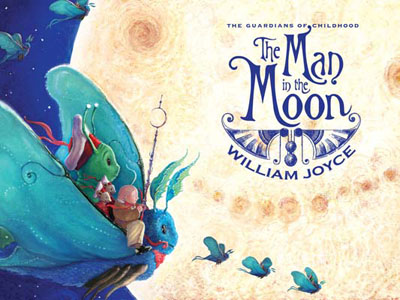 *A Weekly Low Down on Kids Books*
Title: The Man in the Moon
Author: William Joyce
I clearly have an artistic and literary crush on the fabulous writer and illustrator of The Fantastic Flying Books of Mr. Morris Lessmore! William Joyce’s work is simply beautiful, spunky, cozy, and classic.
During story time at Half Price Books in Humble, I was very pleased to discover a pile of The Man in the Moon on the shelf this morning, the first of many in Joyce’s Guardians of Childhood series. It seems as though Joyce’s work, despite being lengthy, is just the remedy for a squirmy, whiny toddler. One look at these gorgeous illustrations and immediately stillness and wonder ensues.
Joyce presents the myths of childhood in a way that a child will understand that they are beautiful dreams to enjoy, a fantasy to embrace. Kids and and adults alike cannot tear their eyes away from the colorful and powerful images he creates, and all are equally riveted by the presenation of the tales.
I am coming to cherish my time reading these books to the kiddo and I cannot wait to acquire the others in this amazing series:

Buy your own collection of Joyce’s Guardians of Childhood today!
A Grimm World
The new season of Grimm starts August 13, 2012; roughly two weeks until round two! Because of this, my husband, who just fell in love with the show via Hulu, has been making me watch season one. I say “making me” as though it is this incredible chore, but in reality, it is a relaxing date-night type activity for us once the kiddo has gone to bed.

The NBC original series portrays the Brothers Grimm as magnificent demon hunters, and the main character their detective descendant. As a Grimm, Nick sees demons for what they are and can catch the bad guys of urban legend with his handy dandy Grimm family heirlooms as well as the help of the police department. It’s CSI meets Van Helsing
So, as we wait for 9pm (kiddo’s bed time) to hit every evening, I have decided to start reading my copy of Grimm’s Fairy Tales
 The stories are mostly terrible. In theory I love mythology and folklore, but what I’m discovering more and more is that I adore lengthy retellings rather than the original short stories. Yet, I’m a serious advocate for source documents. Just as I don’t want to watch the TV show Grimm without reading the original stories – I definitely would be appalled at myself for reading a fancy retelling in the form of a novel without reading the original collection of tales. As in most things, I believe in the principle of it.
I found The Little Farmer to be especially awful. What a deceitful and greedy group of people! And the fact that this horrible little man becomes the sole proprietor of the town and all the riches therein is quite appalling. I enjoy stories with a solid moral, a bigger picture, lessons for life about the merits of goodness. Instead, The Little Farmer breeds selfishness and sociopathic characteristics. The Life Lesson being: the cheaters that are most cunning rule the roost. Of course, this is a valid truth in most societies, but in my perfect story I want there to be inspiration to persevere under the pressure to keep up with the Joneses (or just kill them off if you can’t), and do something great in your life. The Little Farmer may walk off a wealthy man, but he has no friends and he has not lived a fulfilling life. Be proud of hard work, rather than trickery.
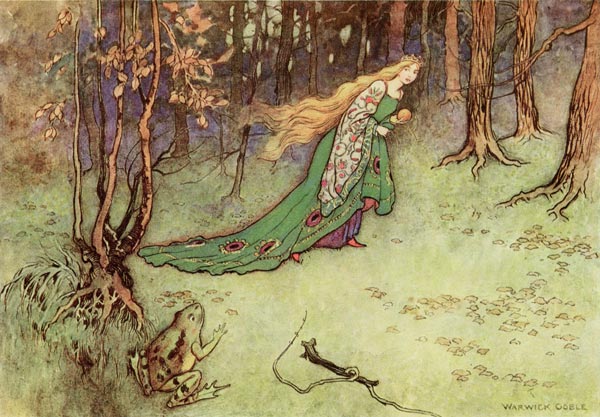 I am not a fan of people getting rewarded for bad deeds or laziness. Just as I cannot get my novel published until I finish writing it (blaming my main character Dani for being elusive and moody when I’m trying to get her life organized), the princess shouldn’t get a Frog Prince to marry when she hasn’t been anything but mean to him.
There are, however, wise stories in the Brothers Grimm, not just the “only people who share are the people who don’t have anything” kind (a real-life adage from my own father). The Nail is the very story which proves one of my old martial arts instructors’ words correct: slow makes fast; or, as the Grimms tell us: Make Haste Slowly. Stories like these, though the horse suffered much for the sake of the warning tale, is what keeps me reading and what reminds me that the kiddo will benefit from growing up with the stories as well.
A Tale to Swoon Over

Claire Danes in the major motion picture of Stardust, based on Neil Gaiman's novel
Neil Gaiman’s Stardust is delightful. A lovely little fairy tale for grown ups, the adventure sucks you through a wall into a magical world of falling stars, unicorns, witches, spells, and flying ships. Gaiman provides all the adults in the room a Faerie romance we can swoon over without re-reading Cinderella and Thumbelina for the hundred-thousandth time. We get a handsome Romeo, a bit of a love triangle, true-love from the stars, and a happy ending (even if it goes out with a limp – literally). Stardust made for a wonderful wintery read by the fireplace this Christmas.






 Anakalian Whims