A Rainy Day With the Olympics

Gabby Douglas, Winner of the U.S. Olympic Team Trials 2012
Bright and early this morning, I went to my best friend’s house to watch the Olympic Trials (old news, we were watching what we missed of the Women’s Gymnastics Team Trials on the DVR). It had been pouring down rain most the night and well into the morning, keeping my sweet baby asleep much longer than usual. So by the time I was heading over for some Olympic goodness, kiddo still cozy in her pajamas, the streets were quite flooded. It was a delightful morning, sipping coffee, hanging out, watching the best athletes in the country do their thing. It set me up for my whole day.
First, while watching Gabby Douglas rock day two and Sarah Finnegan do that fancy beam skill she shares with Terin Humphrey (Click to see the awesome beam skill I’m talking about: Sarah, Terin), I heard a commentator say something that got me pretty curious about Olympic rules and regulations I wasn’t familiar with already. They were talking about how young Sarah was. Young? I thought. Dominque Moceanu was young. This girl is normal… right? Nope, not anymore.
Dominique Moceanu was the youngest to win nationals at 13. She was allowed to compete because she would turn 15 during the Olympic year, which means she was actually 14 during the summer Olympics when the Magnificent Seven awed the world. That was 1996. In 1997 the rules were changed. Instead of gymnasts being required to turn 15 in the Olympic year, the eminent “they” that makes important Olympic rules added an extra year to that requirement, and now girls must be 16 (or turning 16). So Dominique Moceanu will remain the youngest for quite sometime, because it will be impossible for any equally talented 13-year-old to even have the same chances to prove themselves. In addition to that, there are rumors that the age may be increased to 18! I, personally, am not a fan of these rules. Yes, our children should be protected, but I think there is a higher risk of injury for training that intensely after an athlete has peaked. No, I was never an Olympian, but I am very familiar with peaking as an athlete and then things going downhill from there, no matter how hard you train.
Of course, I discovered all this and formed all these opinions today during kiddo’s nap time, while also polishing off my assigned reading for the day:
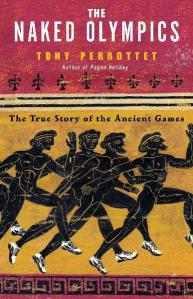 Title: The Naked Olympics
Author: Tony Perrottet
Publisher: Random House
Genre: Sports, Ancient History
Length: 214 pages
Perrottet takes an already fascinating subject and presents it in the form of riveting history. I was surprised how much detail had been discovered regarding the ancient games, and was impressed at how well Perrottet presents it step by step, without leaving anything out. There were so many things included in the games back then, beauty contests, poetry readings; it wasn’t just for athletes, it was an all out ancient world pagan party honoring Zeus and Eros. A lot of this information (though it makes perfect sense and fits right in with what I already knew about the times) was new to me.
I was fascinated by how often names I knew popped up in the commentary… Plato, Socrates, Herodotus… I didn’t expect them at the Olympic games! I also was ignorant of the role the Nazi’s played in our modern view of today’s Olympics, and the lighting of the torch. An interesting tidbit about the Nazis being so fascinated with Sparta kept popping up, along with tales that put shivers up my spine.
Regardless of the Olympic Games origins and history, and how much of it goes against my personal world view and moral standing, I still find the Olympics wonderful. Should you purposely breed Olympians? No. But if someone has the drive and talent and has a passion for it, competing in the Olympics is a beautiful dream and an awesome thing to behold.
Perrottet has done a great job portraying the Olympics for what they are, presenting a well-rounded quick study of the origins of an event which everyone is already familiar. As I plan to educate kiddo classically, I think this would make a fun optional read during the summer games when she hits her teens. I see us doing what we did today, eating tomato, avocado, honey mustard, parmesan cheese sandwiches on toasted wheat, sipping coffee, watching the trials, and doing some research. It could be a fun study/ study break from regular school assignments.
My Classical Re-Education
 As some of you may know, I am a sucker for the classics. I’m also a sucker for lists. In addition to that, I plan to homeschool my daughter. What better books for me then are those of Susan Wise Bauer?
“Using the techniques and systems of classical education, this new guide will give you greater pleasure in what you read, and greater understanding of it.” – from Susan Wise Bauer’s The Well-Educated Mind
I am a college graduate who has had the pleasure of working for a bookstore for some years now and doesn’t want my “education” to end with a Bachelor’s degree in Business. I want to go through Bauer’s list while I pay off my student loans before going back to school. Bauers covers five genres worth of lists of books that people need to read to be fully and classically educated. Many of these a lot of us have already read, and many of these we’ve always heard referenced and talked about reading but have never actually done it.
Lately, in the blog world, I’ve been coming across a Classics Challenge, and was reminded of the fact that there may be others out there who would like access to this list and discussions where other people are reading these books.
For the last few years I have been leisurely strolling through her list provided in The Well Educated Mind:
I am also the admin of a Shelfari Discussion Group called Classical Re-Education and I post reviews and commentary on my reading in that group, links for each book discussion are provided. Of course, I also share my reviews here on my blog.
Cervantes – Don Quixote
http://www.shelfari.com/groups/32384/discussions/89445/Don-Quixote—Cervantes
Bunyan – Pilgrim’s Progress
http://www.shelfari.com/groups/32384/discussions/90600/Pilgrim-s-Progress—Bunyan
Swift – Gulliver’s Travels
http://www.shelfari.com/groups/32384/discussions/91884/Gulliver-s-Travels—Swift
Austen – Pride and Prejudice
http://www.shelfari.com/groups/32384/discussions/96506/Pride-Prejudice—Jane-Austen
Dickens – Oliver Twist
http://www.shelfari.com/groups/32384/discussions/98621/Oliver-Twist—Charles-Dickens
Bronte – Jane Eyre
http://www.shelfari.com/groups/32384/discussions/102210/Jane-Eyre—Charlotte-Bronte
Hawthorne – The Scarlet Letter
http://www.shelfari.com/groups/32384/discussions/104538/The-Scarlet-Letter—Nathaniel-Hawthorne
Melville – Moby Dick
http://www.shelfari.com/groups/32384/discussions/105905/Moby-Dick—Melville
Stowe – Uncle Tom’s Cabin
http://www.shelfari.com/groups/32384/discussions/121736/Uncle-Tom-s-Cabin—Stowe
Flaubert – Madame Bovary
http://www.shelfari.com/groups/32384/discussions/148024/Madame-Bovary—Flaubert
Dostoyevsky – Crime and Punishment
http://www.shelfari.com/groups/32384/discussions/165633/Crime-and-Punishment—Dostoyevsky
Tolstoy – Anna Karenina
http://www.shelfari.com/groups/32384/discussions/212374/Anna-Karenina—Tolstoy
Hardy – The Return of the Native
http://www.shelfari.com/groups/32384/discussions/233628/The-Return-of-the-Native—Thomas-Hardy
James – The Portrait of a Lady
http://www.shelfari.com/groups/32384/discussions/239963/Portrait-of-a-Lady—James
Twain – Huckleberry Finn
http://www.shelfari.com/groups/32384/discussions/319203/Huckleberry-Finn—Mark-Twain
Crane – Red Badge of Courage
http://www.shelfari.com/groups/32384/discussions/319206/Red-Badge-of-Courage—Crane
Conrad – Heart of Darkness
http://www.shelfari.com/groups/32384/discussions/324295/Heart-of-Darkness—Conrad
Wharton – House of Mirth
http://www.shelfari.com/groups/32384/discussions/324297/House-of-Mirth—Wharton
Fitzgerald – The Great Gatsby
http://www.shelfari.com/groups/32384/discussions/324292/The-Great-Gatsby—Fitzgerald
Woolf – Mrs. Dalloway
http://www.shelfari.com/groups/32384/discussions/420041/Mrs-Dalloway—Virginia-Woolf
Kafka – The Trial
http://www.shelfari.com/groups/32384/discussions/435148/The-Trial—Kafka
Wright – Native Son
http://www.shelfari.com/groups/32384/discussions/443717/Native-Son—Wright
Camus – The Stranger
Orwell – 1984
Ellison – Invisible Man
https://anakalianwhims.wordpress.com/2012/09/03/blasted-book-bouncing/
Bellow – Sieze the Day
Garcia Marquez – One Hundred Years of Solitude
Calvino – If on a Winter’s Night a Traveler
Morrison – Song of Solomon
Delillo – White Noise
Byatt – Possession
https://anakalianwhims.wordpress.com/2012/11/04/the-ultimate-possession-a-book-by-byatt/
As you can see, I just recently finished Kafka’s The Trial and will soon be starting The Native Son. I’d love for others to join me.
Have you read any of these lately? Which were your favorites? What would you add to the list if your goal was to walk people through the History of the Novel, as Bauer’s has done?
P.S. Susan Wise Bauer will be lecturing at the Texas Home School Coalition Southwest Convention The Woodlands, Texas, Thursday-Saturday August 2-4.
Napoleon’s Wars
 Title: Napoleon’s Wars
Author: Charles Esdaile
Publisher: Penguin
Length: 622 pages (including appendices and index)
Its amazing to me how history is so often rewritten. Like the American Civil War and the issue of slavery, history textbooks would have you believe that the French Revolutionary Wars were about liberty alone. It’s only when you dig deeper into fascinating works like Esdaile’s that you learn better, just like that moment you discover that the Civil War was about State’s Rights. Esdaile’s book is enlightening, gracefully walking you through power struggles, political schemes, battles, marriages, and all sorts of human conflict. Silly, I know, as there is always political drama behind the scenes of any war, but I was completely unaware.
I blame this on my childhood education as well as my idealist nature, which begs to believe that things are always done for moral principle and meaning. I like to root for the underdog and weep for the wronged. Yet, scholarly study and reality steps in and I discover that Abe Lincoln was not this amazing and caring man elementary schools brain washed us into believing, that the Union was not so kind they fought a war over slavery, rather they were controlling and greedy and wanted to dictate laws on a Federal level rather than celebrate the spirit of our unique existence by allowing States to make their own decisions, much like the war on drugs now. See, even here I see my brain and heart leaning towards the idea that the South were fighting for their rights with ‘free spirits’! Also emotionally driven and not entirely accurate. There’s no winning with me.
 I need work like Esdaile’s in my life, to keep my brain on straight. He writes a beautiful historically accurate reality check, without casting blame or being cruel about the events of our past. He doesn’t bash nor celebrate Napoleon, he just explains the world that surrounded him. I picked this book up to help me wrap my brain around Hugo’s Les Miserables world, as the characters are living in the aftermath of the wars. I needed to comprehend the world at large at that time in order to really understand the characters’ world view, and to help me decide whether or not I even like Valjean! (Stay tuned for further updates on my Les Miserables reading, join my readalongs via the “Readalongs!” page on the right.)
What I found most astounding was the statement by Esdaile that “Napoleon came to power as a peacemaker. “(pg.75) Clearly, I didn’t know much about Napoleon, the history of France, the Revolution, any of it, before reading this book. Before, I always thought of Napoleon as a tyrant with a short man syndrome attitude. But in reading Esdaile’s work, I am reminded that people have to have something going for them to gain that much power. According to this history, it took quite awhile for Napoleon to acquire his ‘demon-like qualities’ and that ‘among the educated classes, he was widely admired.’ “[…] the emperor himself later remarked that the regime was ‘never afraid of him’ and ‘looked on him as a defender of royalism.’ ” So how do we get from there to Hugo’s Les Miserables? Esdaile gives us an answer with a quote from a pamphlet published in 1808:
“Napoleon… may be compared to the vine, a plant that if it is not pruned, throws out its branches in all directions and ends up by taking over everything. He wants peace, but at the same time wishes to dethrone kings… create new monarchies and destroy old republics… to undo the very globe and remake it in accordance with nothing other than his own will.” (pg. 344)
I love history, but I haven’t studied much of it in depth. My interests range through all of time and all over the globe, so at best I know a little of this and a little of that, but nothing thoroughly, nothing well. Prior to this book, if you had mentioned Mustafa, I probably would have said, “Oh, I love the Lion King.” Even that tidbit of ‘knowledge’ is wrong as the Disney cartoon lion’s name is Mufasa, which I didn’t realize until I went browsing for images to use in this blog post!
As a budding amateur historian, I still get excited when my history overlaps. Charles James Fox has a role in this time period of Europe and when I saw his name my heart leaped for joy. Someone I recognize, someone I’ve learned something about! Just last year or so, I read Amanda Foreman’s Georgiana, Duchess of Devonshire, where he had a huge role. As a huge supporter of the French Revolution, I was breathlessly proud of myself and the one little tidbit of something I knew while reading through a few pages of Napoleon’s Wars.
It also means that, even though I already have a book on the subject (but haven’t read it yet), I nearly fell out of my chair when I read that Napoleon went to Egypt (I didn’t realize that he actually went there, I thought maybe he just sent people there the way most rulers do). I’ve had a long-time obsession with Egypt, King Tut exhibits, Archeological Bibles, Nefertiti, Hapshepsut, the whole shebang. Even Amelia Peabody inspires me. So to see that I would have an opportunity to thoroughly study something that so heavily overlaps something I’ve studied, excites me.
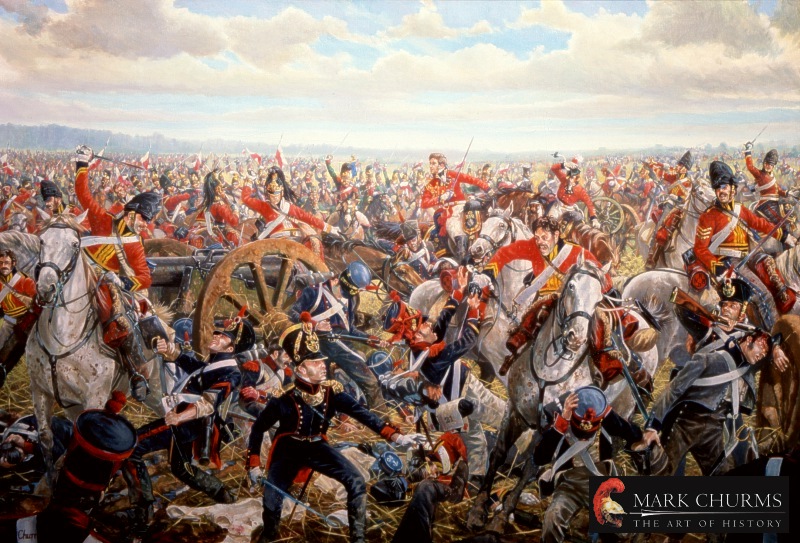 I’ve taken so many notes on this book, its so fascinating (if you’re friends with me on facebook or in real life, you’re probably tired of hearing me rant about how awesome it is). Among my notes are scribblings about how these wars are shockingly worldwide. Why wasn’t this called a World War? I am baffled at how many wars (not just battles, but WARS) were fought, overlapping each other in years and on continents, during this time. Before Napoleon even steps into the picture there’s the 1st and 2nd Coalition Wars (1792-1797, 1798-1802), which I had never heard of because they are always just called the French Revolutionary Wars, which should have given me pause and realization that wars was plural, therefore there was more to the story than just the word “Revolution.” I’m still not 100% clear on how it all works, as more research is needed, because the Revolutionary Wars are dated as 1789-1802. Then, there’s a War between Britain and France during 1803 to 1814, but not the same as the Coalition Wars… Third in 1805, Fourth from 1806-07, Fifth in 1809, and the 6th overlaps the Invasion of Russia from 1812-1814 – but apparently is separate from the War of 1812 which was between the U.S. and Britain. Finally, things wrap up a bit after the War of the Seventh Coalition in 1815. Not to mention, I totally skipped the Peninsular War from 1808- 1814 which was between France and the allied powers of Spain and only ended when the Sixth Coalition defeated Napoleon in 1814. Again, I ask you, why was this never referred to as a World War? Why wasn’t the debate about this being called a World War addressed in school? Why has this whole ordeal always been flippantly glossed over with literature like The Scarlet Pimpernel, Horatio Hornblower, and then wrapped up with Jane Austen and Les Miserables., not that I have a problem with that literature (they are all wonderful and personal favorites of mine). Because I read too much fiction, ok, ok, I get it.
Now, more than ever, I want to know more. I want to take classes at the University of Liverpool where Charles Esdaile teaches. He’s a professor there with a BA and PhD and a FRHistS (Fellow of the Royal Historical Society, I had to look that up, its so cool). But, alas, I am not in Liverpool. Also, I am not in college anymore.
Reading this book made me go do some research that I desperately needed to do. Not just historical research, but personal research. I’ve been wanting, planning, gabbing about going back to school for some time now. But finally, I went to some websites and looked into what that would take. Instead of dreamily telling people I’d like to go back to school and get a second Bachelors from a state school (I currently have a BBA in Marketing and Management: Entrepreneurship) I can now say: I’d like to join the Post-Baccalaureate program at Univeristy of Houston. My first class, when I finally get the finances to go, and the nerve to go up to the school and not worry about the fact that I’d be 10 years older than the traditional students (not that anyone would notice my five foot nothing – I get carded everywhere- self), I’d like my first class to be ANTH 1300: Introduction to Anthropology in the College of Liberal Arts and Social Sciences. There, it’s out there, and you guys are now encouraged to keep me accountable to my dreams.
Until then, I plan to read more books by Esdaile and a number of other historians. Reading this has been a fabulous experience.
A Romance to Last the Ages
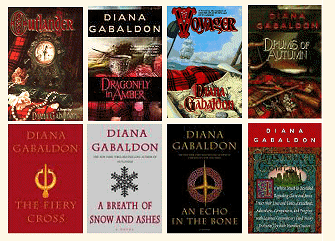 Title: Dragonfly in Amber (second in The Outlander Series
Author: Diana Gabaldon
Publisher: I am reading from A Dell Book, pocket papberback, published in 1992.
Length: 947 pgs
Although the book covers are a bit outdated and have been revamped and republished, The Outlander Series itself will never be outdated… will never get old. Often shelved in the romance sections for its sexual content and love story, its a little more dramatic, a little more fantasy, and has a little more historical detail than your average romance. Gabaldon has written a saga that is a “little more” no matter where you house it in your bookstore.
Where I devoured Outlander (the introductory book of the series, published in the UK as CrossStitch), Dragonfly in Amber I mosied through. I kept it on my nightstand and read 20-30 page here and there, until I finally finished it this morning over breakfast. But not because it wasn’t good.
Jamie and Claire Fraser are the kind of characters you like to let linger with you. By book two you see more of their faults and weaknesses as well as their strengths, and they are less token flat romantic leads strictly enamoured with each other. Still definitely a romance, these books are also clearly about a marriage tried by time travel, war, and witch hunts, and more. There’s a real element to them that traditional romances don’t have, the Outlander Series is all adventure but never fairy tale. Knowing there’s a whole series of nearly 1000 page books, its easy to set it down after a little bit, assured they will be there when you come back.
Of course, the moment you get to the end of one, Gabaldon has teased you with some lingering story line that makes you want to immediately start the next. I recommend having several of the series set aside before you begin so when that moment comes you aren’t left with the deep urge to leave your house and run to the nearest bookstore hoping they have the one you need in stock. Just buy them all up whenever you see them, and toss them (in order) on your TBR pile.
Like Baroness Orczy’s The Scarlet Pimpernel, I think The Outlander Series will be a romance that lasts through the ages.
My Love for Brief Histories
and how aliens should stay on the Tardis
Title: A Brief History of Stonehenge: A Complete History and Archeology of the World’s Most Enigmatic Stone Circle

Found image at PatDollard.com
Author: Aubrey Burl
Publisher: Constable & Robinson
Genre: Non-fiction, Archeology
Length: 368 pages
Although I read mostly fiction, nonfiction (history and science mostly) has a special place in my library and heart. Where I devour stories and riveting tales, I pour over facts and dates. I underline and disparage intelligent books with my amateur notes in the margins. My nonfiction books take a beating my fiction titles can’t even dream of… ink splatters from broken fountain pens, pages become stained and wrinkled from spilled coffee and dog-eared corners. There’s sticky residue from too many post-it notes. Where my fiction books radiate and breathe the word “treasure,” my nonfiction books tiredly whimper “tool.”
My collection of “A Brief History of…” books are prime examples,Stonehengeby Aubrey Burl being the most recent victim of my hunger for knowledge.
“I’m reading about the history ofStonehenge.” – Me
“That’s silly, no one knows the history ofStonehenge, it’s a mystery. The aliens did it.” – My sarcastic sister.
Its moments like these when the dichotomy of my reading habits collide the most often. Where science fiction and fantasy novels are, at times, the highlight of my day, I like these kinds of conjectures to stay in novels. The concepts of the pyramids being mystical,Stonehengebeing magical, and the world being over-ridden by alien beings from other planets make great stories – awesome Dr. Who episodes – but really annoying documentaries.
That guy with the hair on Ancient Aliens, you know who I’m talking about, the one that shows up in every show about everything with his orange face and tan lines around the eyeballs… he totally cracks me up! But I think he’s a nut and I’d much rather sit and read an archeologist’s account of their findings than risk that guy interrupting my research, telling me (yet again) that the aliens did it.
I love how Diana Gabaldon uses Stonehenge-like structures as her premise for time travel in the Outlander series. Its brilliant! But don’t try to convince me that little piece of fun is the real deal, the actual way of the world.
Aubrey Burl has delivered exactly what I want out of my nonfiction reading. It’s a complete and thorough report on every piece of archeological evidence, history, and anthropological speculation (minus the aliens) that has been made over the years. It’s got maps, diagrams, measurements, and so on. From the Druids, to 1500-1800 literature, to the most recent of science experiments, Burl gives me enough information to feel knowledgeable enough to either putStonehengeaside and call myself learned or have a solid basis at which to do additional research and know where to look. And its reader friendly, even if my copy has been treated maliciously by ink and coffee.
Buy Stonehenge by Aubrey Burl
Einstein: His Life and Universe by Walter Isaacson – A Review
 Title: Einstein: His Life and Universe
Author: Walter Isaacson
Publisher: Simon & Schuster
Genre: Non-fiction, Biography, Science
Length: 675 pgs.
Albert Einstein was a prick. Not the description you were expecting? Me neither. We always hear about how brilliant he was, how much he changed humanity and the world of science with his great theories. We always see images of his goofy, yet charmingly wild smile and hair. We don’t see him through the eyes of the family he abandoned.
Isaacson is thorough in his research and the language of his biography of Einstein is easy and accessible. He sheds a lot of light on physics formulas that I had a hard time grasping in my high school science classes. But he also sheds a lot of light on Einstein the not-so-family man.
Not only did he and his wife abandon their first child, a girl who history has nearly erased,
“[Hans Albert, Einstein’s son] had powerfully conflicted attitudes towards his father. That was no surprise. Einstein was intense and compelling and at times charismatic. He was also aloof and distracted and had distanced himself, physically and emotionally, from the boy, who was guarded by a doting mother who felt humiliated.”
Einstein eventually divorced his wife, but not before maintaining an emotional affair with his cousin Elsa. “Companionship without commitment suited him just fine,” Isaacson writes about how Einstein toyed with both women’s heartstrings by alternating his attentions between them. In the end Einstein and Elsa did marry, but not before a questionable letter was written by Elsa’s daughter to a friend that mentioned Einstein’s true love interest was the twenty year old daughter, not the mother.
Isaacson’s presentation of Einstein is a great book for high school science and history students. Anyone trying to understand the genius’s formulas should also understand the history surrounding their creation/discovery. His life is also one to discuss with your teen touchy topics of worldview and the importance of values; world changing discovery vs. the importance of family, political and religious affiliations and observations. Each family’s opinion of Einstein’s life will most likely be different, and its one that should be surveyed and critically analyzed.
Crack in the Edge of the World
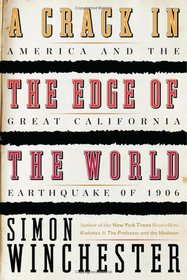
A Book Review
Simon Winchester never fails to fascinate and inform. When I picked up Crack in the Edge of the World, I was surprised to discover that the author I dearly remember for writing The Professor and the Madman (a history of the making of the Oxford English Dictionary) was also a geologist and highly knowledgeable in both language AND the science of rocks – what a foundation! This particular history on the great earthquake of San Fransisco met high expectations of Winchester’s talent compared to his previous work and I recommend this to anyone who likes history, science, or just plain good storytelling.
Georgiana, Duchess of Devonshire
A Review on the biography by Amanda Foreman
For starters, I am baffled by how many people mistake this book for a novel. I have read so many reviews that say it was too historical, too dry for a novel, and that they didn’t get a chance to get into the characters because the story read like a research paper. These people are ridiculous, because it’s a biography and because it was the most fascinating ‘research paper’ I’ve ever read.
I was amazed at how many people Georgiana managed to charm in her life. When you read about all her flaws and mishaps, you expect the world to hate her. I expect that I would have hated her. She constantly gambled, lost all her money, and was continuously lying to everyone around her. She seems silly and a bit hairbrained. But when it comes down to it, everyone that knew her loved her. She set trends, led a political party to greatness, and was a best friend to her children. (Despite the few years she neglected them to go have another child from another man, even her children thought her to be the best mother in the world.)
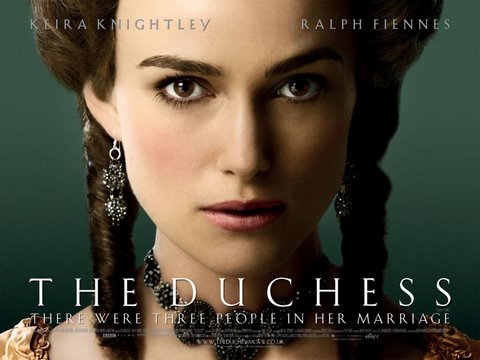
Prior to this biography, I had no idea that she was a great ancestor to the infamous Princess Di. I also found it refreshing to read a biography on royalty that was non-Tudor related. I highly recommend the book, and the movie made after it starring Keira Knightley, although after reading the biography I find the movie a bit deceptive on the character of the Duke.
Gibb’s Christians…
I promised myself I would write more complete reviews this year, keep my blog updated and all that, but after reading Edward Gibb’s Christians and the Fall of Rome I just don’t have a lot to say. I got tired reading it. Despite its short hundred pages I found it difficult to focus on the topic. Gibb spent a lot of the essay comparing Christianity to various mythologies and its a good thing to read and be familiar with differing viewpoints, but I found his writing style tiring and without passion. So I just didn’t care. I will have to re-read it with Ayla when we study the history of Christianity as well as when we cover the Greek and Roman Empire, but I’ll need a good solid pot of coffee in my system to do so. I suppose that’s my review…
Reason for the Season?
I’m not a big fan of Christmas. I hate the consumerism, I hate the blow up creepy Santa Clause’s in people’s yards. Oh, also, I’m a Christian. That being said,
Nothing chaps my hide more than hearing fellow Christians tell me: “Remember the reason for the season!”
The reason for the season, if they looked a bit closer into history was to help aid in the conversion of pagans who already celebrated December 25th, Yule, Mother’s Night, Winter Solstice (whatever you wish to call it) with carnivals, gifts, food, and lots of hooplala. The theory was to keep the month of partying and give the holiday Christian symbolism so that they would not feel such a loss of fun when they converted.
For instance, mistletoe was a plant collected by Druids to ward off witch craft and protect the carrier, pretty much an all around healer. Now, we use it as an excuse to kiss people in doorways. Either way, it has nothing to do with Christianity and everything to do with “Christmas” or Winter Solstice Celebrations.
Now, with all that being said, I don’t mind that Christians today use it to celebrate the birth of Christ. I think the birth of Christ should be celebrated. But don’t tell me to remember the reason for the season when the season existed long before this particular reason. If you want to celebrate the birth of Christ without the consumerism and drunken partying – don’t overlap it on a holiday that was created thousands of years ago for that exact purpose. Pick a different day and celebrate it with all your reasons in tact and no distractions.



 Anakalian Whims