Ramses: The Son of Light by Christian Jacq
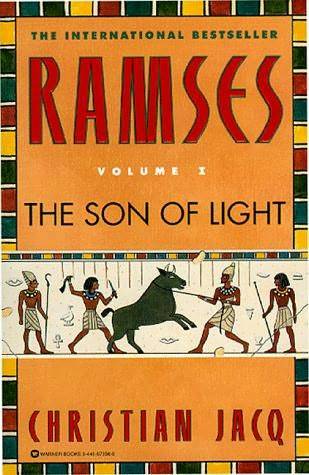 This is a great kick start to the life of Ramses the Great. We are introduced to his throne hungry brother Shaanar, his father Seti, mother Tuya, obnoxious sister Dolora, and his two wives Iset the Fair and Nefartari. Moses is also introduced, which is slightly irksome because the book is written off the old school of thought that Moses was during the time of Ramses the Great due to the mention of the city of Ramses in the scriptures. I believe its highly likely that the name of the city mentioned in the bible was updated by an eager scribe and that the proper date of Moses’ lifespan would place him during the 15th century/18th dynasty about 200 years before Ramses. Generally, I enjoyed the book although I feel much is lost in the translation from the French (Jacq’s writing seems too simplistic and listy), but I am still excited about reading the four remaining books in the series to see how it all plays out from Jacq’s perspective.

A fabulous article on Moses and his placement in history: http://www.biblearchaeology.org/post/2009/02/27/Moses-and-Hatshepsut.aspx
A Russian Study
Have I invited my fellow bloggers and blog-readers to my Russian study?
http://www.shelfari.com/groups/32350/discussions/182887/A-Russian-Study
Welcome to the Russian Study! We hope that everyone interested in Russia, its culture and history, and its literature, will enjoy perusing through and adding to this discussion. Feel free to add your own books to the list or read along with the ones already here below…
* Crime and Punishment – Dosoyevsky (fiction)
* Anna Karenina – Tolstoy (fiction)
* War and Peace – Tolstoy (fiction)
* The Magical Chorus: A History of Russian Culture from Tolstoy to Solzheinitsyn – Volkov (literary criticism, history)
* The Axe and the Icon – Billington (history)
* The Vision Unfulfilled – Thompson (history)
* Fathers and Sons – Turgenev (fiction)
* The Captain’s Daughter & Other Stories – Pushkin (fiction)
* One Day in the Life of Ivan Denisovich – Solzhenitsyn’s (fiction)
* Sofia Petrovna – Lydia Chukovskaya (fiction)
* I think some Robert Alexander historical fiction titles would do well at the end. One is called Rasputin’s Daughter, but he has many.
I have already completed Crime and Punishment, below is my official review:
Good book, well written, yet I could have gone my whole life without having read it and not felt like I missed out much. The final confession felt like the final moment in Moby Dick when the whale actually shows – all I could think was: “its about time.” Its on Bauer’s list of books to read before you die, which I plan to use as curriculum for my kid when I home school, but I’m not sure that I’ll make them read this, unless they are utterly captivated by it and want to – especially with Tolstoy next on the list. I was hoping to be more captivated myself.
Banvard’s Folly A Must Read
 Paul Collins is a genius and I love him. If I have children, they will learn history from this book (as I will home school)… these people will all be included in their lessons from when we’re studying Nathaniel Hawthorne and Emily Dickinson to Thoreau and the Concord Grape. John Banvard will be discussed when learning about art and art history as well as financial wisdom. We will discuss Delia Bacon in relation to the people she corresponded with as well as when we study Shakespeare… along with her, Coates’ adventures as Romeo will be a humorous anecdote to read between plays and the discussion of various acting techniques. This is a fantastic piece of history that I find amazing the world has forgotten. Let’s bring these stories back for the future generations! Thank you Paul Collins for bringing them all back to life in the pages of your book.



 Anakalian Whims
Origins and Thoughts, and Original Thoughts
January 19, 2010 at 5:44 am (JARS, Reviews, The Whim) (book, creationists, darwin, family relationships, fiction, history, intelligent design, irving stone, religion, review, social commentary, the origin, theology, victorian era)
My thoughts on Irving Stone’s The Origin so far… (I’m on Book Ten)
Despite being an enjoyable novel, its astonishing how much humanity is lacking in the description – it has the feel of a 1950’s family sitcom, Leave It to Beaver meets the Darwin family in Victorian England.
I like Irving Stone’s version of things, however. It gives a detailed time line of publications and events. Its a good source to use as an introduction to the study of evolution: names, dates, and important essays, journals and other writings are handed to you chronologically on a silver platter so that you can jot them down and do additional research afterward.
The book is quite clever, actually, sidestepping every controversy and smiling noncommittally.
“They established a routine in which everyone fitted harmoniously,” (from book nine: the Whole Life) seems to be the theme of the book, rather than the development of the theory of evolution. It is full of lines like: “The Manuscript on Volcanic Islands moved along felicitously.” Even through his many illnesses and the death of his two daughters, Charles Darwin seems to have led a very charmed life.
I discussed all this with a member the physical JARS book club, and she pointed out something important that I failed to notice: this is exactly the way a man of the Victorian Age would want his biography written. The Victorian era was a time when the upper class mastered the art of smiling and pretending everything was fine, introducing what my friend described as “that very British attitude of ‘Get Over It and Move On.’ ”
http://rcm.amazon.com/e/cm?lt1=_blank&bc1=000000&IS2=1&bg1=FFFFFF&fc1=000000&lc1=0000FF&t=anakawhims-20&o=1&p=8&l=as4&m=amazon&f=ifr&ref=ss_til&asins=0451168100
Permalink Leave a Comment