Interview with Jason Kristopher
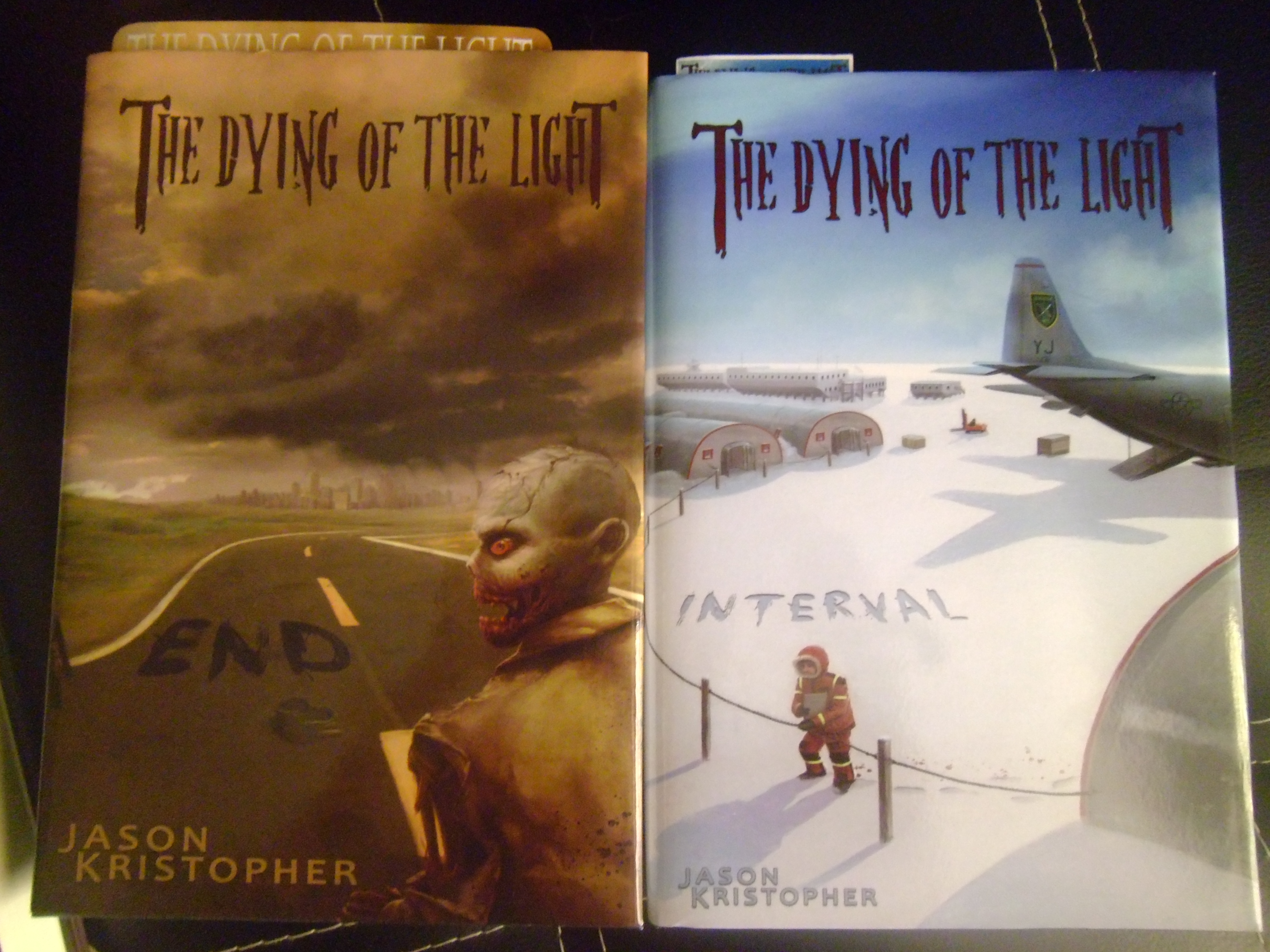 1. Your books (The Dying of the Light
First, a realistic and scientifically-vetted reason for zombies, as in it’s not just supernatural or science fiction ‘hand-waving.’ Second, and this is the key difference, the books aren’t about the zombies. Yes, they have zombies in them, and action and blood and guts and gore, but at its core, The Dying of the Light is a story about people. I always tell potential readers that it could’ve been anything that ended the world: aliens, earthquakes, global warming… none of that matters. This series is about the end of these people’s own personal worlds, and how they deal with what happens during and after, and more importantly, with each other. That’s the real story – the rest is just window-dressing.
2. What inspired you to write zombie novels? Did the characters come to you as products of the apocalypse, or did you drop them into that setting after their inception?
The idea for the story was a mash-up of two different dreams, actually. One about a lone zombie survivor on an island, the other about the end of the world (though I didn’t know at the time what had done it). My writer’s brain smashed them together, and suddenly, there was a zombie apocalypse trilogy. It makes me a bit nervous about the other connections my mind makes, actually…
3. Stephen King says people who don’t read don’t have the tools to write. Who are your favorite authors? Who inspires you to write? Who do you read to gain more writing energy?
 Would it be trite to say Stephen King? His book On Writing is the single best treatise on the craft of authorship that I’ve ever read. As for other fun favorites, I have a ton, but a few that come to mind: Isaac Asimov, Terry Brooks, Jim Butcher, Orson Scott Card, Arthur C. Clarke, Donaldson, Jordan, Koontz, Niven, Pratchett… see what I mean? For inspiration, I look at some of my friends, like George Wright Padgett (Spindown), who wrote one of my personal Top 5 sci-fi books. That is inspiring, to me. I like to re-read some books if I’m having trouble with a book I’m writing, too. For example, I’ll revisit The Hitchhiker’s Guide to the Galaxy series if I’m stumbling over dialogue – even though it’s English slang, Douglas Adams was a master of dialogue.
4. Do you have play lists of mood music you write to? If so, which artists/songs generally make the cut?
If I have music on, it’s generally instrumental – tuneful background noise, basically. The soundtrack to Lord of the Rings, or Last of the Mohicans, that sort of thing. If I’m struggling with a particular type of scene, I’ll find some music that fits that ambiance. For example, my “Car Chase” playlist has Guns N’ Roses, Project Pitchfork, Rihanna, and even Motley Crue. But usually, I like it quiet or very low music when I’m writing; it keeps me focused.
 5. You are not just an author, but the owner of a publishing company: Grey Gecko Press. Tell me a little about that. What made you decide to open such a venture and what are your goals for the company?
I’ve always been business-minded, and when I published my first book, I knew there would be business expenses involved. Originally, I never planned to publish anyone else’s work, but then a friend (author Wayne Basta) asked if I could help him, and Aristeia: Revolutionary Right became the second book published under the Grey Gecko imprint. I found I really enjoyed working with other authors to share great stories, even if they weren’t mine, and I had the ability to do it… so why not? From the beginning, the company has been about treating authors fairly, publishing great books, and doing things the right way, even if that bucks centuries of tradition.
As far as goals… well, I’ve long said that I’d like for Grey Gecko to be ‘the Google of publishing.’ Most people interpret that to mean I want to be rich, when that’s not at all my goal. I want Grey Gecko Press to be huge because it would mean that every author would have a chance at the same kind of success that only a few get now with traditional publishing. Every struggling writer, pounding away at their keyboard (or typewriter, I’m not judging) would know that at least one company would look at their work when it was done, regardless of their past publishing experience – because, at the end of the day, Grey Gecko isn’t about making money: it’s about publishing great books and putting authors first. As you can tell, I’m quite passionate about this endeavor.
6. You’re quite an entrepreneur. What other projects do you have up your sleeve?
I think it’d be gr eat to have a Grey Gecko bookstore, for one thing. For another, we haven’t been able to focus on as much as I’d like with Grey Gecko is giving back to our community. I’ve got some ideas for creating local resources and ‘maker-spaces’ for writers of all types and kinds. When we’re ready, I’d like to take our business model into other fields, as well, including movies, film, and even music. So yeah, a few projects on the horizon!
7. How would you feel about having your books made into a television show or series of movies? Would you want to write your own screenplays? Who would be your ideal director?
One of the comments I have most about my books are that they’re very visual, very cinematic, and I agree! I think they’d make great movies/TV shows, mainly because that’s what I see in my head when I write them. I’m not sure about writing the screenplays myself, although I’d give it a try. There’s a lot about the behind-the-camera part of the film industry that I don’t know, so I’d at least listen to some experts… though naturally I’d want final say. I’d rather not have it made at all than made badly. I’m not sure of all the director’s names on The Walking Dead, but they do such a masterful job with a show that’s so similar in tone, that I’d likely pick one of them, given the choice.
 8. You’ve had booths at Comicpalooza and done numerous book signings with local bookstores. What were those experiences like for you? What are your favorite parts? What are your least favorite parts?
Despite what I may say on Sunday afternoon at a convention, I actually enjoy talking to people about our books. Helping people discover a new book they haven’t heard about, or seeing their excitement at the next volume in a series, or seeing the light of wonder shine in a child’s eyes as I hand them a copy of Greystone Valley is why I do what I do. As far as book signings go, I enjoy them for many of the same reasons; talking to people about my books and getting t hem excited about reading is a blast. What it really comes down to for me, though, is that I’m a storyteller at heart; however I can tell you a story, I’m going to do it. My least favorite part of all these things would be the setup, teardown, and logistics that go into planning them… mainly because I’m lazy! I’d love to show up with a cup of coffee and find everything set and ready to go, but that’s the price you pay for being your own boss, I guess!
9. What other published work have you been a part of? And what can we expect to see from you in the future?
Aside from The Dying of the Light, I’ve also published several short stories, some of which are based in my zombie series, some not. I also contributed one of my favorite short pieces, The Art of Steaming, to the horror anthology A Fancy Dinner Party, along with 9 other Grey Gecko Press authors, and it was also featured in the collection Penny Dreadfuls: Halloween Special. For future work… boy, have I got some ideas for you!
First, I’m finishing The Dying of the Light with the third book, Beginning, due out this winter. Then there’s Under a Cloud-covered Moon, the first in a series about an irascible, anti-hero detective who works for the Seattle Metahuman Crimes Unit, solving crimes by and against ‘metas’ – non-supernatural mutants who’ve been called ‘vampires’ and ‘werewolves’ for centuries by those who had no idea of their true nature. I’ve also got a middle-grade/YA story in mind about a Teddy Bear (because it’s a job, not a toy) named Freddy McPhane, as well as my epic fantasy series of 30 books (no joke), not to mention the 150+ other ideas I have written down. I’m going to be busy!
10. If there is one thing you would want your readers and fans to know about you, what would it be? If you had one request of your readers and fans, what would it be?
I want all my fans and readers to know that I love hearing from them! Whether it’s a quick note, or a detailed letter, I’m always excited to connect with my readers, which is best done through email at jason@jasonkristopher.com.
For a request, I’d request everyone who enjoys the books they read, especially indie books, to leave a review on Amazon, GoodReads, or elsewhere. Short of buying more books, a review is the best way to support indie authors and small press. That and telling all your friends, of course! To find out why reviews are so important, visit my blog: On the Importance of Reviews, or, It’s Just 21 Words!
Interview with Wayne Basta
 I had the pleasure of meeting author Wayne Basta awhile back for a book signing at Half Price Books Humble. He has a three part series published under Grey Gecko Press here in the Houston area. This week, I finally had the pleasure of interviewing him.
1. I haven’t had the pleasure of reading your series. Can you tell us about it?
Aristeia
2. What moved you to start writing science fiction?
I’ve always been a fan of the genre. My father got me into Star Trek and Star Wars at a young age and then followed it up with classic science fiction books like Asimov and Clarke.
3. An interviewer (Sam Weller, of the Paris Review) asked Ray Bradbury if writing science fiction satisfied something that mainstream fiction did not. I’d like to ask you that same question. Do you find that science fiction satisfies something that mainstream fiction cannot – both in yourself as well as in society?
I don’t believe science fiction isn’t mainstream fiction. Look at the biggest blockbuster movies and books and you’ll find lots examples of science fiction. Science fiction certainly satisfies something other genre’s do not, but so does every different genre.
4. When did you start writing? Have you always wanted to write?
The first things I wrote were when I was 9 and we got our first home computer. I dabbled in writing ever sense then, though I didn’t make a serious effort to write a complete novel length story until just a few years ago.
5. When you write, do you have a specific place or environment you like to go? Do you play music (and if so, what music?) or do you prefer the quiet?
I usually write from my laptop at the kitchen table. The chairs are less comfortable than my desk chair so its easier to stay focused. The laptop also can’t run most of my games so that clearly defines this computer a work place and the desktop for play.
I write in silence a lot but depending on the scene I’m working on I might put on music. I’ll often try and match the music to what’s happening in the book. During a heavy battle scene I might play some epic sound tracks from movie battles or if its more subdued a lighter piece.
6. What is the easiest part of the writing process for you? What is the hardest?
The easiest part is the writing itself. Figuring out what I’m going to write, finding the time when there’s no toddler demanding attention, marketing the books, editing the grammar and everything else is hard. But when I know what is going to happen to my characters, the words just flow out with ease.
 7. Who designed your book covers?
I worked with an artist named Oliver Wetter to design the cover. I told him what I had in mind and described the looks of my characters. He then brought them to life. He did an amazing job with each of them.
8. You were recently at a Comicpalooza. What were you doing there? What was that experience like?
I sat on a number of writing panels at Comicpalooza. It’s always great to get to sit down and talk about writing and books with fellow authors and fans of the genre.
9. Do you have any tips or advice on getting published for aspiring authors?
Never give up, never surrender. It’s a hard process to wade through and relies mostly on persistence and dedication to succeeding. Keep trying and keep improving your queries and your writing.
Like Wayne’s page on facebook.
Interview with John Oehler

I love doing author interviews, especially for authors whose work I have read and enjoyed. Please allow me to introduce to you John Oehler. Below is an interview in which he was kind enough to participate.
1. I read Papyrus and Aphrodesia and was riveted by both. You have a knack for mystery and detail, whether historical or well-researched professions like perfuming. What inspired you to write these stories?
The initial idea for Papyrus came to me in 1983 when I was in the Egyptian Museum in Cairo and noticed a potential way for thieves to break in. Over time (by which I mean decades, because I was not yet a serious writer), the story concept expanded tremendously. The theft now occupies only a chapter and a half.
Interested readers can see my original sketch of the break-in route by going to http://johnoehler.com , pulling down Papyrus from the Novels tab, and clicking on Behind the Scenes.
Aphrodesia is another story that took years to mature. I first became interested in fragrances while living in London in the mid-80s. I started collecting perfume samples, perfume books, and articles on the psychology of scent. I wanted to write a story centered on fragrances but couldn’t think of an interesting plot — until I met a master perfumer in Versailles who told me that creating a true aphrodisiac is the Holy Grail of the perfumer’s art. I thought: Bingo! I can make a story out of an aphrodisiac.
As with Papyrus, you can read more about the origin of Aphrodesia on my website. Pull down Aphrodesia from the Novels menu, click on Behind the Scenes, and you’ll see two entries illustrated with photos of the master perfumer and of ISIPCA, the perfume school in Versailles where the story begins.
2. You got an Amazon Breakthrough Novel Award for Papyrus and First Place in the Pacific Northwest Writers Association for Tepui. How did you feel about being recognized so well on these novels? (Also, what’s your secret to success?)
 Papyrus was a semifinalist in the 2009 ABNA competition, ranking in the top 1% out of 10,000 submissions. I was thrilled. At the same time I was disappointed, because the Publishers Weekly reviewer praised everything about the story except for the “downbeat” ending — a major character died. It made me wonder if a more upbeat ending might have advanced Papyrus into the finals. I knew, from critique partners and others who had read the story, that opinion was divided about 50:50 between those who loved the last chapter and those who didn’t. Ultimately I decided to change the ending.
As an aside, I have toyed with the idea of posting the original ending on my website. But beyond those who read this interview, very few people are even aware that the current last chapter was not my first choice.
Winning the PNWA competition was probably the biggest surprise of my writing career. It’s a major contest that attracts lots of agents and editors. I’d entered a thriller titled Tepui and received a hint that it might be a finalist. At the award ceremony, I was sitting at a big round table with my wife and about ten other people as the finalists were read off. When my name was announced as the winner, I blurted, “Are you shitting me?” The whole table laughed.
Perhaps the coolest thing was that this led to a role reversal. Like most unpublished writers, I’d endured years of frustration playing supplicant to the deaf gods of agentdom. Now, suddenly, agents were courting ME.
In the end, the agent I signed with turned out to be a poor choice. Several months into our relationship, she sold a YA fantasy for half a million bucks and a second YA fantasy for a quarter million. She lost interest in thrillers. On the flip side, I lost interest in agents and have been more than happy to self-publish ever since.
Secret to success? I’m certainly not as “successful” as I’d like to be. But I attribute my modicum of popularity to excellent teachers (like Chris Rogers) and critique partners I trust and respect. I strive to create unusual characters, take them to places most readers have never seen before, and keep readers guessing what’s going to happen next. I also try to engage all of the senses, to help readers feel like they are in the story, not just reading it.
3. I’ve posted reviews for Aphrodesia and Papyrus here on my blog, but I haven’t had the pleasure of discovering Tepui. Can you tell us a bit about it?
Tepui is the story of a burn-scarred botanist who treks into the remote Venezuelan highlands in search of a living fossil but stumbles onto something far more astonishing, and deadly.
This story stems from my work and travels in Venezuela and on the history of the region.
4. Tell us about your other writing ventures. What other brilliant ideas have you got up your sleeve? When can we expect to see your next book?
 Tepui will be the next book I publish. I’m currently refining it and hope to get it out by the fall.
I’m not sure what will come after that. I’ve always loved old books and libraries. While visiting a monastery in Prague last Christmas, I spent an hour contemplating their library and especially their locked collection of forbidden tomes. I’d like to set a story in that environment. The idea might sound derivative of The Name of the Rose (one of my all-time favorite stories), but I would set it mainly in modern times.
In a similar vein, I’ve long wanted to write a story set in western Ireland during the Viking raids of the early 900s. It would center on a mixed male-female monastery with a round tower that serves as a repository for volumes rescued from the anti-intellectual book burnings of the Dark Ages. I’m torn between this and the Prague story. I don’t think I can do both, because there’d be too many similarities.
I’ve written parts of several other stories I’d like to expand if I live long enough. One centers on a powder created by an 8th-Century Arab alchemist (a real person) that extends life for centuries, provided you keep taking it. The story opens with the spectacular (true) robbery in 1976 of a bank in Nice, during which thieves spent an entire weekend looting safe deposit boxes in the underground vault. In my twist, the thieves were working for a woman who knew the powder and the alchemist’s formula were in one of the boxes, and that’s all she wanted.
Most of the others involve things like ancient mysteries and labyrinthine puzzles.
5. What got you started in the writing world? Have you always wanted to write or is it a passion you discovered later in life?
In high school I wrote poetry about society’s outcasts, some of which was published in a scholastic magazine. In college I occasionally ghostwrote sonnets for girls who were supposed to write them as a class assignment. Simple rhyming poetry always came easily to me.
What started me writing novels — or trying to — was hubris. In the late 70s and early 80s, I traveled internationally quite a bit and spent my time on planes reading Robert Ludlum
Flash forward several years and I’ve finally finished my first version, a 240,000-word tome I called The Papyrus of Tiye. A friend of mine offers to take it home with him at Thanksgiving and show it to his mother, a vice president at Bantam. P.S. It came back with a note that read, “Tell him to take a creative writing class.”
Exit all traces of hubris, never to return. Enter the long, hard slog of learning to craft stories that OTHER people enjoy reading.
6. Your writing style is truly unique; I’ve never read another quite like you. Who are your favorite authors to read? Who inspires you?
Interesting that you should mention my “style.” I was once told that I don’t have a style. In truth, I don’t think about it when I write. But when I proof a story, I do notice a lot of “habits” that surface on every page.
Modern authors I enjoy reading include Ken Follett, Michael Crichton (before his stories became political), Umberto Eco, Nelson DeMille, Daniel Silva, Trevanian, Frank Herbert, Stieg Larsson, Wilbur Smith, Elizabeth George (her earlier books), and Laura Hillenbrand (a monument to writing beautifully under major adversity). Sadly, several of these authors have left us.
If I had to pick one author who inspires me, it would be Michael Crichton. As a scientist, I like the way he turns science into adventure and often combines that with history. My own stories do the same.
7. Your ‘on location’ scenes in your books are so detailed. Have you traveled to the places you write to describe them so vividly?
What a wonderful compliment. Thank you.
Yes, I’ve traveled to many of the places I describe: Egypt for Papyrus, France for Aphrodesia, Venezuela for Tepui. In fact, I’ve traveled to fifty or sixty countries and lived in six. But there are places in my stories I have not visited. Two examples are Yemen in Aphrodesia and Sudan in Papyrus. For these I used my experiences in Somalia, combined with books and articles I have plus a lot of Internet research.
If you’re going to take a reader to someplace exotic, I believe you have a duty to make that place as real as possible. And not just visually. What does it smell like? What sounds do you hear? How does the food taste? What textures do you feel? Those details help the reader feel “there.”
8. Other than writing, what are your other hobbies and interests?
I read a lot, of course. I love to cook. And my wife and I continue to travel as often as we can. She’s a member of the Mars Science team, which operates and analyzes data from NASA’s Curiosity rover, so our travel opportunities are limited by the rover’s activities. But we manage to get away frequently and always enjoy the foods, wines, art, music, and history of the places we visit.
 Then there’s our Old English Sheepdog, Elfie, who has her own Facebook page (https://www.facebook.com/elfie.oehler) and takes a chunk of my “spare” time.
As to interests, name something, and I’m probably interested. I have files on everything from art, poisons, labyrinths, and magic to ancient and medieval history, symbology, gold, gypsies, and food. Probably I’m most interested in things that influence the way we think and behave, especially early Catholicism, medieval Islam, taboos, superstitions, and the like.
9. If there is one thing you’d want your readers and fans to know about you, what would it be?
My whole reason for writing is to please my readers and make them hungry for more of my work. I want to share with them the excitement of exotic places, the richness (and sometimes terror) of foreign cultures. And (don’t kill me for saying this) I try to educate by painlessly integrating elements of history, art, and science. I love it when readers say, “I never knew that.” And I love it even more when they wonder, Could this really happen?
10. Previously you have participated in book signing events in the Houston area. When (and where) can we expect to see you out and about again?
Nothing scheduled at the moment. But when Tepui comes out, I hope to have several signings. I’ll definitely let you know. Signings offer a unique opportunity to speak personally with potential readers, and I look forward to the next round.
Interview with Jennifer Theriot
 Meet Jennifer Theriot, Texan, CFO, wife, grandmother, and AUTHOR!
1. Describe your book and its inception. What was your muse so to speak
Out of the Box Awakening is a romance novel centered on middle aged lovers and stresses the importance of family and friends. I got the idea to write a book after reading the Fifty Shades of Grey trilogy. I had to read it 3 times to actually get the core of the story.
I took two of my closest friends to dinner one night and over a glass of wine casually mentioned that I was thinking of writing a book about middle-aged lovers. The actually dared me to do it with enthusiasm.
We all agreed that there just weren’t romance novels out there about women like us; hence the dare was accepted and the writing began.
My muse would be Kevin Costner. As soon as I started writing the book, he was hands down Ash Harper in every sense of the word.
2. You’ve written a romance. Is this the genre you prefer to read? What are your favorite titles and authors?
Romance is my favorite genre. I love Maya Banks, Lisa Renee Jones, S.C. Stephens and Cherrie Lynn. I loved all of their books.
3. Writing romantic stories, I find, always invites quite an array of emotions from people in the real world. How have your friends and family reacted to your story content?
For the most part, my friends and family are behind me one hundred percent. My friends have read the book of course but my immediate family (husband and kids) Ehhhh…. no. And truth be known, I don’t think I want them to. There’s some things better left to the unknown.
4. Just like when I read, when I write I find myself drawn to certain characters more than others. Did you have a favorite in your own work?
Oh goodness YES! Todd O’Malley is the tatted up, pierced good-looking rock star that resembles Adam Levine. In the book, he becomes best friends with the main character Olivia. Their relationship as he describes it: “Olivia is like having a mom and a best friend all rolled up into one smoking ass hot chick.” I have to say he’s by far the most colorful and fun character. Ash on the other hand is the Romeo every woman would want in her life. Those two are my dream guysJ
5. Many authors are heavily influenced by their environment when they write. Where is your safe space? Do you have mood music?
My “space” consists of being curled up in my chair with my feet up on the ottoman, Mac Book Air in lap typing away with ear buds in listening to the playlist for my book. I find that I can still spend time with hubby that way and have the best of both worlds.
Music is a huge influence in my writing. I’d wanted to use lyrics from a particular recorded song in my book and quickly discovered the red tape and bureaucracy involved with permission to use. That being said, I wrote my own lyrics and I’m so proud to say, a dear musician friend wrote music to them and recorded it. It’s even on iTunes.
6. What do you find to be the easiest of the writing and editing process? What is the hardest for you?
The easiest is of course the writing. The hardest is during beta reads when the readers come back with their comments. It is probably the most intense part of the process for me. I have an incredible beta reader, who has also become a good friend. She knows my characters like the back of her hand and calls me out when she’s not feeling what she knows I’m trying to say. She and I have had many discussions and she pushes me to emotionally engage the readers with a scene. Her words are “Jen, you know what’s going on and how the characters are feeling….take us there in your words. Make us feel it with you.”
7. Did you learn anything about yourself or the world you live in by writing this book?
Funny you should ask that…. The answer is yes. This journey has made me much more confident about myself as a 59 year old woman who considers herself forever young. I’ve never felt better inside or out. If anything, my main character Olivia has given me the authority to express my feelings in the real world. I’ve talked to a lot of ladies in my age group who like me still enjoy sex, they like date nights with their husbands and significant others. They like to wear sexy lingerie and dress trendy. It’s an incredible feeling and I believe when you feel good about yourself, others can see that.
8. I’ve met a lot of authors with drastically differing views on this… would you ever be interested in a TV or movie deal for your series? If so, how involved would you want to be? (There every step of the way? Or hand it over and let the film people do their thing?)
I could totally see the Out of the Box series being made into a movie…I’ve even got a dream cast put together. Probably every author visualizes his or her book getting made into a movie or TV series.
What a lot of authors probably don’t realize is how much of a long shot that is. A movie/TV series doesn’t just magically appear and the things that go into the making of a series or movie and moreover the likelihood of it actually coming to fruition is daunting. Finding investors to actually take a chance on financing a project like…very difficult!
I would definitely be a hands-on type. It’s my personality. I’ve got to have my hand in every detail which drives me crazy but that’s the way God made me.
 9. You’ve just started participating in book signings and are writing another book. What direction do you see your writing career headed? Where would you like it to head?
I love doing the book signings. At first I was terrified!
I love interacting with people and meeting other authors.
I do plan to continue writing as long as people keep reading my books. I’ve finished the second book, Out of the Box Regifted. It’s currently in editing and I’ve started the 3rd and final book in the series, Out of the Box Everlasting. (The trilogy is called ARE. That way, readers will know what book is first and last in the series because it spells a word)
After Everlasting, I’ll do a book from Todd’s POV and then I’m on to a completely different series. I want to continue to write about middle-aged lovers. I feel there is a market for this. Women my age don’t always want to read about twenty-something characters…
10. Every reader or writer has a favorite bookstore (and if you don’t, please don’t spoil my delusion!). Now is your chance for a shout out! Tell us who you love and what you love about them.
I could sell my soul to Half Price Books! I’ve never gone into one and come out empty handed.
I also like Barnes and Noble.
Something about a good old bookstore just feels right. When you walk down an aisle, if you listen closely enough you can hear the characters in the books whispering “Buy me, buy me!”
Long live the bookstores!

Interview with Comedian Jeff Hodge
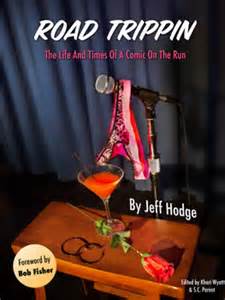
 I’ve had the pleasure of reading Jeff Hodge’s Road Trippin’ over the last few months. I’ve been plucking through, taking my time with this delightful memoir, trying to get to know this comic and his world one day at a time. I’m so excited about this former Houstonian, I was able to talk him into doing an interview with me!
1. Describe your book and its inception. What was your muse so to speak?
My book, “Road Trippin…The Life And Times Of A Comic On The Run,” is pretty much a compilation of short stories of incidents that happened to me back when I was out on the road performing as a young comedian in the early 1990’s. Over the years, I would share these stories with friends and fans and people would suggest that I write a book. I never took it seriously until one day in 2011, a buddy of mine, who is a big Chelsea Handler fan suggested I read her book, “My Horizontal Life”. After reading the book, I said to him, every comic have stories like that. He suggested I write a book and so I did and that is how “Road Trippin…The Life And Times Of A Comic On The Run” came about.
2. Many authors are heavily influenced by their environment when they write. Where is your safe space? Do you have mood music?
I am a night person so most of my writing takes place late at night when everyone is asleep and I am up watching the ID Channel. Usually turn on soft music (I prefer love songs because they help me think better) and just get to pecking away on my laptop.
3. How does writing for the stage differ from writing for a book?
Writing for the stage is different from a book in that when I write for the stage, I get feedback immediately as I perform it. With a book, I have to wait until the book comes out. Some one reads it and then I get their feedback. The long wait time can be tedious and frustrating.
4. What do you find to be the easiest of the writing and editing process? What is the hardest for you? (Both in comedy and for publication.)
To me, the writing process is easiest because I just write the words as they come to me in my head. I hate the editing process because by the time the book is actually published, I have read my book 100 million times from reading and re-reading it making all the edits I need to make! (Hahaha)
 5. Obviously, Road Trippin’ is a memoir and therefore a representation of your life. Is this an accurate representation of your whole life or just the parts that fed into your life as a Comedian?
Road Trippin’ is an accurate representation of just part of my life when I was on the road touring as a comedian back in the early 1990’s. I will be following up Road Trippin’ with more books on other aspects of my life.
6. Did you learn anything about yourself or the world you live in by writing this book (that isn’t included in the book itself)?
Yes. The thing I learned about myself while writing this book is that I have come a long way since I started doing comedy. Sometimes as comedians, we get so focused on defining success as being on a tv show and selling out auditoriums but we lose focus on the journey that we’re on and miss out on a lot of the little things along the way. Writing this book really took me back to venues and places I had performed in earlier in my career that I forgot about after all these years.
7. How have your friends and family reacted to your story content?
My close buddies took the book in stride because they had heard some of the stories in the book over the years. My other friends and family were shocked. They didn’t know one could do all those things on the road as a comedian if you weren’t a star. My mom is still waiting for her copy! (Hahaha)
8. You’re a very different sort of writer than I usually feature on my blog – most are novelists who are passionate for the written word in general. I know you are passionate about comedy and the stage, but are you a reader? What are your favorite books? Your favorite authors?
Yes, I am a reader, but I don’t get to read as much as I would like to. Too busy performing, producing shows, auditioning, writing, etc. I am what you may call a binge reader, I don’t sit down and read all the time, but when I do, I might read 2 or 3 books in one sitting. My favorite kind of books to read are autobiographies, biographies or military or spy thrillers by authors like Tom Clancy.
9. What have you been up to professionally and personally since the publication of this book? What are your future plans?
Since Road Trippin… has been released, I have been actively promoting my book by making appearances at book club meetings, doing interviews and doing shows in the LA area. My future plans include writing a couple follow up books to Road Trippin… that go more in details about my life living in Texas & California.
10. If there is ONE thing you’d want fans to know about you, what would it be?
One thing I want my fans to know about me is that I’m a hard-worker, funny and love to create and entertain.

Interview with Science Fiction Author George Wright Padgett
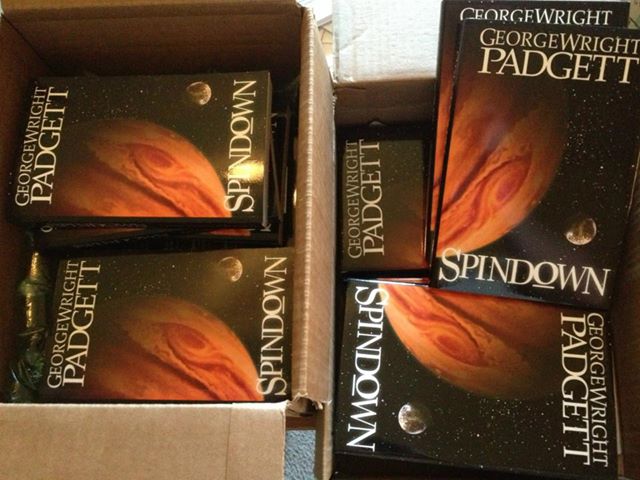
 George Wright Padgett is the author of the science fiction title Spindown
1. Describe your book and its inception. What was your muse, so to speak?
I tend to question things about the world and our place in it. When I started writing Spindown I wanted to explore the age-old topic of nature vs. nurture – Are we born who we are to become, or are we only the byproducts of our experiences? And what does it mean to be free? Believe it or not, I leaned heavily on Golding’s The Lord of the Flies as a study of characters reacting individually and as a tribe with and against each other. I freely admit that the Draad flashlight is a version of the conch shell of authority that is found on the island in his book.
My writing style is that I tend to reverse engineer my stories. I start with the question and then work my way backwards filling in the holes until there’s a logic for why things are as they are.
For example, I decided to start with characters that were blank canvases that I could expose to extreme situations and watch how they reacted to each other and solve problems.
For it to work I had to answer to myself why would these people would not have any emotional experiences and yet be full grown adults? The solution was make them have lives that were severely isolated – keeping them from each other as much as possible and when they were forced to interact with each other they would be drugged into a stupor.
Then the question arises how or who would do this – So by reverse engineering I realized that it must be an ore corporation behind it and to save money from sending people to Jupiter to mine, they use harvested clones to do the labor. That’s just one example of how as I would walk through one door and answer a question, there’d be another waiting behind it. When all of the doors were opened (save the final one) the story was over.
2. Your book has ‘classic science fiction’ all over it. What authors do you read and do you consider them heavy influences on your writing?
I’ve read a tremendous amount from the classic authors Asimov, Clarke, etc. (as a matter of fact, I recently finished Foundation again).
One thing that I’ve always appreciated about those writers is the level of authenticity in their stories. I spent many months building and rebuilding on paper the vast mining compound on Ganymede before I wrote a single word. It required a stupid amount of discipline to resist the urge to dive right in, but my deferred gratification paid off. When it came time to write the story, all that I had to do was to ‘activate’ the characters to run and follow them as if I were an imbedded reporter.
I didn’t set out to write a modern story in the classic sci-fi style; in fact I am humbled to have Spindown even compared to those great works. All that I can attest the results to be my exposure to their styles must have seeped through into my story. I feel like the character in The Amazing Colossal Man who accidentally wanders into a plutonium blast in the desert. The radiation transforms him due to his exposure to it, not through anything that he did. I was exposed to the radiation of many great storytellers.
3. Just like when I read, when I write I find myself enjoying some characters more than others – regardless of their role in the story. Did you have a favorite in Spindown? Who was it? Why?
Wow. It’s too difficult for me to pick just one – so I won’t. (I’ll do my best to avoid spoilers for the uninitiated.) I enjoyed watching Prall 4167 develop throughout the piece. Here’s a guy that is used to being in control, and is faced with his entire world being turned inside out. Readers undoubtedly cast him as a villain, but when you clinically review what he does and why he does things, he sort of makes sense. He’s the most practical one of the escaped clones and never displays a shred of self-doubt. Don’t misunderstand, what he does/allows is reprehensible to say the least, but he doesn’t see himself that way- he is only about one thing: Survival of Prall 4167. Can you blame him? His Machiavellian approach to situations intrigued me to the point that when it was time to assign the characters their suffix numbers, I gave him 4167 (my birthdate of 4/1/67).
Another part that was fun to write was the interactions between Martin and Buck. By the time we meet up with them again, they have been companions for a very long time. They remind me of an old married couple; they bicker with each other, but there’s no mistaking the love that has developed between them over the years.
Ah… then there’s Fowler and Sholve. I enjoyed how Fowler usually has his plans backfire on him or not go exactly how he thought things would work out. Often Sholve has to bail him out in some way. In all, they end up making a good team, with her problem-solving skills and his physical strength. One of my favorite exchanges between them is when they have opposing views on if they should ‘contaminate’ the Setter character with the knowledge of what is actually happening to clones on Marius 516. They come at the situation with polar opposite philosophies, forcing the reader to pick a side- Do we let him go on, and live blindly? Or do we confront him with the truth allowing him to decide for himself what to do?

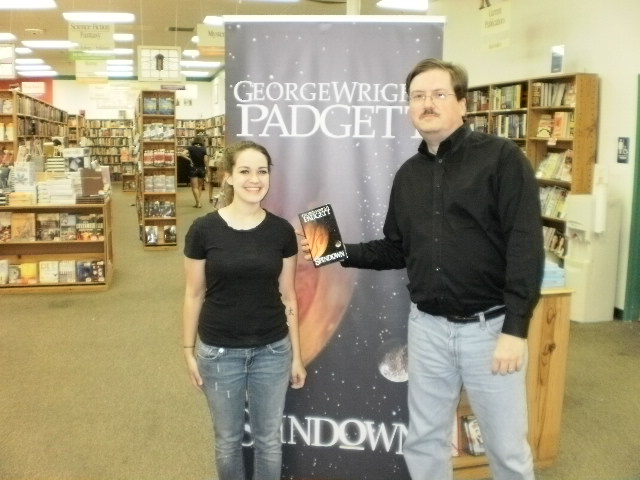
George and Grey Gecko Press at Half Price Books Humble
4. Did you learn anything from writing your book? What was it?
My inability to spell and use proper grammar is far worse than I could have ever imagined (even with spellcheck)
5. Exactly how much research was needed to pull off this level of scientific expertise? What was that process like?
As I mentioned before, I probably spent way too much time on this. I found that my compulsiveness seems to require a ridiculous amount of backstory and detail for whatever I’m working on. An example of this is how an early draft of Spindown had the clones speak a hyper-restrictive tongue called Chone. I developed the entire language removing any ‘hot words’ from their vocabulary. The result would have made Orwell’s writers of NewSpeak blush it was so limiting. It took a month of refining over and over. It was beautiful- and every bit of it ended up on the ‘cutting room floor’. While readers likely will notice the absence of the personal pronoun of ‘us/we’ from the first half of the book, that is the only thing that remained! It became too cumbersome for the clones to speak – a month totally wasted! I also know more about Ganymede than any non-Nasa personnel is allowed.
My habit is to completely immerse myself in the research and the world building of the story. This is fine, but a good writer has to edit out the artifacts that do not advance the story – sorry, Chone language.
Click to visit Grey Gecko Press
6.How did you come across Grey Gecko Press? How has that relationship been for you?
I encountered the owner, Jason Aydelotte at a social gathering of other Houston area writers. He’s the author of the acclaimed Dying of the Light Zombie series. He had just self-published his first novel in the trilogy and his enthusiasm about publishing was contagious. He told the people at the table that he was considering helping others learn how to do what he had done for their stories. Over time, his help and advice transformed into GGP. He left his day job to start Grey Gecko Press for authors who wanted to ‘storm the castle’ of traditional publishing with him. I was fortunate (and maybe crazy enough) to be counted among them. That was ten-thousand books ago. Since then, everyone there has been remarkable. Without Grey Gecko, there would be no Spindown because I likely would not have finished it. Jason’s team was the mid-wife to my book.
7. If Spindown were to be made into a movie, who would you want to tackle it? (JJ Abrams? Joss Whedon? Steven Moffat? Some unknown?)
Sid and Marty Krofft (Google it, kids).
Seriously, I am flattered that so many readers have said that they’d like to see Spindown on the big screen. I love movies, especially sci-fi, and my writing has been influenced by dozens of classic flicks, but at the end of the day, I’m just a storyteller, not a movie producer. It’s fun to think of, but what do I know about any of that? I’d welcome it if someone felt they bring something to the story, but I’ll leave it to the experts.
8. Other than writing, what are your hobbies and talents?
I play jazz piano (under a different stage name), I do graphic design, and am neck-deep in writing the songs and script for a full-length musical.
9. Do you listen to music while you write? If so, what were some of the musical influences you had while writing Spindown?
Music is a very important part of my life, so much a part of it that songs/genres that I listen to when not writing easily distract me when I’m ‘working’. I do this kind of Pavlovian conditioning thing in which there are some classical and ambient selections that I ONLY listen to when writing. It helps to trigger my brain into knowing that ‘It’s time to write’ when this music is played:
Philip Glass – Symphony No. 9, Low Symphony, Heroes Symphony
The soundtrack to ‘Monster’s Ball’
Brian Eno – Music for Airports
Anything from the band Pauseland
and a minimalist band from Austin called ‘Stars of the Lid’
Listen to Philip Glass/No.9 and read any of the chase scenes from Spindown. You’ll find that they match up perfectly.
10. If there was just one thing you would want your readers/ fans to know about you, what would it be?
I’m a big dork. Really I am (my wife and kids will attest to the fact). I don’t allow myself to take my self too seriously, and I will do anything for a laugh (anything). I still feel and view myself as the 4th grader version of myself. Sure, I get to drive a car, I can order wine in a restaurant, and do ‘big people’ stuff like that, but after you pull back all the layers, I am still just as silly, needy, and unreservedly amazed with the universe as I was way back then. And for better or worse, if I haven’t grown up by now, I think that I’m probably stuck this way – and I’m okay with that.

Click to Visit George’s Facebook Page
Interview with Author Rhonda R. Dennis

Author of the Green Bayou Novels
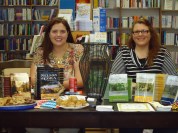
Rhonda on the right at HPB Humble last year.
I met Rhonda R. Dennis while booking her and Melinda McGuire for A Southern Saturday – an event we put on at the Half Price Books in Humble. It featured southern authors, southern goodies, and all around a lot of southern hospitality. We had a blast. Rhonda was friendly, donated a lot of her own books to raffle off to customers, and kept a professional attitude.
Another signing is the works now, with details to follow later. But since I can’t quite have her in the store again just yet, I’ve arranged an interview! (So exciting! As I’ve said before, interviews and guest blogs make me feel like Oprah.)
- Your books are set in Southern Louisiana, and you’re also from there. What were your favorite things about the state when growing up? What are your favorite things about living there now?
First, I want to thank you for having me as a guest! I absolutely love reading your posts.
While growing up, I never gave much thought to how different my culture is to others. I assumed that everyone ate tons of seafood, celebrated Mardi Gras, and had the innate ability to pronounce French names. I started traveling, and realized that was far from true! I love visiting new places and I have a huge appreciation for their traditions, but South Louisiana will always be home to me. It’s definitely a place that everyone should visit at least once.
- Your books are Romantic Suspense/ Mysteries. Is this the genre you typically read as well? What authors or books are on your ‘favorites’ shelf?
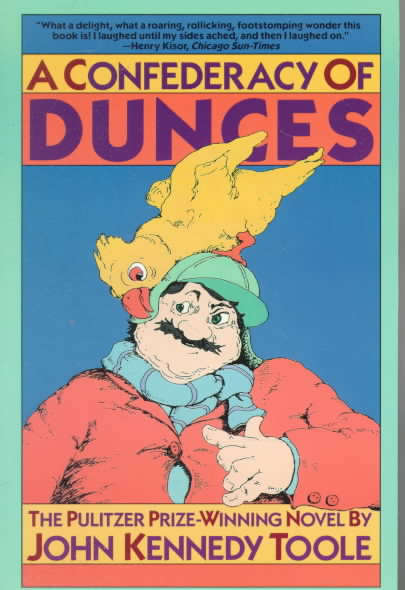 I enjoy most genres. My favorite book is A Confederacy of Dunces
- Do you have play lists of mood music you write to? If so, which artists/songs generally make the cut?
 My music choices are even more eclectic than my reading preferences. Depending on the mood of the scene I’m writing, I will listen to anything from Red Hot Chili Peppers to Bruno Mars. I’ve been listening to a lot of 80’s and 90’s music lately, as well as the Les Miserables soundtrack. A lot of times, I have to turn the music off because I spend more time belting out tunes than getting my story down!
- What do you find to be the easiest part of the writing and editing process? What is the hardest for you?
 The easiest part is coming up with the general direction I want to take the story. Generally, I type a skeleton version then rework it until I’m happy with the manuscript. The hardest part is when I actually put it out there for the public to read. I believe in my stories, my beta readers are generally enthusiastic about the books, but until I get that feedback from the readers, I’m waiting with bated breath. Please leave reviews people!! You have no clue how important they are to authors, not for an ego boost, but for validation that we’re on the right track. J
- When you complete a book and it goes to print, how do you celebrate?
It’s generally a quiet, personal pat on the back kind of thing. Although, the series will be wrapping with book six at the end of the year, so I anticipate a book launch/series finale party for that one.
- I’ve met a lot of authors with drastically differing views on this… would you ever be interested in a TV or movie deal for your series? If so, how involved would you want to be? (There every step of the way? Or hand it over and let the film people do their thing?)
I have so many people tell me that they strongly feel the series needs to be made into a movie/movies. I’m all for it! I’d love to have lots of control over it, but I’m realistic enough to know that that probably won’t be likely. My only wish is that they would do the series justice.
- I’ve read in other interviews that you’ll write this series as long as Emily has stories to tell. Do you have any other projects in mind at this time?
I do have some projects lined up after the last book of The Green Bayou Novels series is released. I want to branch out a little bit. I have plans for a couple of stand-alone novels, as well as a book about local ghost stories.
- You’ve been featured on Melinda McGuire’s Southern Creatives segment of her blog, been involved in joint book signings, and contributed to a project she edited (Rich Fabric) [I’ll link to Rich Fabric]. How did you meet?
 That is one of the wonderful things about technology! We met online! I want to say it was the Goodreads website? Anyway, being that we are both writers of Southern fiction, we instantly bonded, even though our writing styles are quite different. She writes from a historical perspective, whereas my novels are set in modern times. I’m pretty sure she’ll agree that we have a mutual appreciation of each other’s enthusiasm for all things Southern. I’m a definite fan of her work.
- Every reader or writer has a favorite bookstore (and if you don’t, please don’t spoil my delusion!). Now is your chance for a shout out! Tell us who you love and what you love about them.
While I could easily spend loads of time and money in any Barnes and Noble store (or any other major retailer for that matter), I prefer the feel of the small Mom and Pop bookstores. I love walking into a place where you know the staff is there because it’s their passion, not just a job. We had a quaint little bookstore in Morgan City, but unfortunately, it shut down. I continually hope that someone will try to open another one.
I should also mention that we don’t have any Half Price Book branches in Louisiana, but based upon the reactions of my husband and son when I had my joint signing with Melinda McGuire in Humble, we’d be spending lots of time in there, too!
- Outside of writing and Southern Louisiana, what are your passions?
I am very passionate about giving back to others. I’ve donated many copies of my books, t-shirts, and other prizes to raffles and auctions to raise funds for injured or ill persons. My favorite charities revolve around cancer research/children’s charities: St. Jude’s, the Shriner’s Hospitals, American Cancer Society… At this moment, I’m in the process of working something out for our local Relay for Life.
I’m also passionate about treating others the way I would like to be treated, and doing all I can to help make this world a better place for my son to grow up in. I love to promote the good things that are happening around us. I feel that we often get bogged down in the bad news. Just as many wonderful things occur in a day, however, it’s not often considered “newsworthy”.

Rhonda R. Dennis posing for the St.MaryNow Franklin Banner Tribune fifteen months ago. Click on the image to visit the article.
My Life in Literature Meme
 A fun little exercise, taken from Becky’s Book Reviews, as well as A Room of Ones Own.
Using only books you have read this year (2012), answer these questions. Try not to repeat a book title.
Describe yourself: Treasure
How do you feel: Human Happiness
Describe where you currently live: The House of Mirth
If you could go anywhere, where would you go: The Planets
Your favorite form of transportation: The Mystery of the Blue Train
Your best friend is: Voice of Conscience
You and your friends are: Of Mice and Men
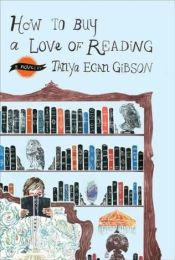 What is the best advice you have to give: How to Buy a Love of Reading
What’s the weather like:City of Ashes
You fear: The Map of Time
Thought for the day: Just Breathe
How I would like to die:Roast Mortem
My soul’s present condition: Dragonfly in Amber
Interview with S. Smith
 I’m excited to share with you all an interview with S. Smith, author of Seed Savers
1. This is quite a political statement, was that your intention?
Not so much. I think it was more about my love of good food. Seed Savers is a love story starring home-grown food. I love food—growing, harvesting, cooking, eating, and sharing it. And I think a lot of people these days maybe are missing out on that. I grew up on a small family farm and we always just ate what we grew, putting the fruit and veggies up for the winter and enjoying the goodness of how much better everything tasted than the “store kind.” Sure, politics obviously comes into the book, but it’s much more than that.
2. I read on your blog that Senate Bill S510, the Food Safety Modernization Act, inspired the story line. But what made you choose to tell the story through the eyes of children for children, instead of writing a piece more geared towards adults?
Actually, although I mention Senate Bill S510 as being the idea behind my story, I believe I wrote Seed Savers prior to hearing about it. I started writing Seed Savers in April of 2010, and most of the internet frenzy on the bill came out after that. I think a friend told me about the bill after reading a draft of my story—it’s hard for me to remember exactly. The inspiration for the book and the reason I wrote for children is covered in the blog titled “How It All Started”(May 2012).
3. There are many documentaries floating around about the habits of companies similarly described in the history of your futuristic world. Have you seen any of them? If so, which ones did you consider the most inspirational or informative? (I’d like to watch them.)
Here in Salem we enjoy the Salem Progressive Film Series, which is a “volunteer organization dedicated to educating and raising awareness of important current events.” They bring in great documentaries and speakers once a month. I have enjoyed going to many of these. I’ve watched movies on water, dirt, food, urban gardening, MONSANTO, etc. As mentioned in the “How It All Started” blog, Food, Inc. truly was a part of the inspiration for my book.
4. You must be a gardener! What are your favorite household ‘crops’? (Mine are lemon balm and rosemary – for the smell, of course.)
Oh my gosh. Well I do live right in the center of town, so I only have a very limited amount of space for my own little garden, but I do love growing tomatoes—I’ve been starting my own from seed for about the last four years—and yes, the fresh herbs are wonderful (cilantro, basil, sage, rosemary, thyme, parsely, dill, oregano….). I also have strawberries, raspberries, blueberries, and one boysenberry bush.
 5. The lupines are a symbol of safety for the children during their flee from oppression to knowledge and fruitfulness (both literally and figuratively). Why the lupine? Does it hold special significance for you?
Well, I think that’s covered in the book. Mt. St. Helens is sort of in our backyard here in Oregon, so we get a lot of coverage about whatever is going on up there. I either heard on t.v. or read somewhere that lupines were the first plant life to come back after the devastation of the volcanic eruption and I jotted it down to use in my book. I still have the scrap of paper on which I wrote it down.
6. Seed Savers is reminiscent of titles like The Giver and Invitation to the Game. Do you often read dystopian society literature? What are your favorites?
The Giver is one of my favorites. I also really love Fahrenheit 451 and The House of the Scorpion.
7. Your book is peppered with verses from the Bible as well as symbols regarding Mother Earth. Do you mind me asking about your religious beliefs? What’s your life’s mission statement? (This is something I find particularly fascinating about writers in general, how C.S. Lewis’ beliefs seeped into The Chronicles of Narnia, the infrastructure of Orson Scott Card’s science fiction and that of Mormonism, and so on…)
“To act justly, love mercy, and walk humbly…” 🙂 I am a Christian, but more importantly, I had to be true to my characters. I didn’t want flat characters, and children at that age often do go to church and have strong beliefs. My two favorite books, Peace Like a River and The Secret Life of Bees, both have spiritual themes running through them. And let’s not forget that Twilight begins with a quote from Genesis.
I certainly hope the book can be viewed for all of its layers and not dismissed on account of some Bible verses.
8. When can we expect Book Two in your series? Have you written the whole series and just timing their releases or are you writing as you go? (I’m dying for the next installment already!)
Thanks! Book two, Lily, will probably be out sometime in August. It is completed and in the editorial process right now. Treasure will be available on Kindle devices soon (in process right now). I have not written the entire series yet, but do have a brief outline. I am currently about one quarter of the way through the first draft of book three.
9. The kids do a lot of traveling as they run away from home to Canada, in the last third of the book. Do you enjoy travel? Have you been to Canada? What are your favorite things about both your hometown and your favorite place to visit?
Is this a spoiler? Yes, I enjoy traveling a lot, but as I get older, I dislike flying more and more. I have been to Canada, but only British Columbia, not Quebec.
Oregon has often been referred to as “the Eden at the end of the Oregon Trail,” and for good reason. It is very green here, and we have gorgeous lakes, rivers, and forests. I live in the Willamette Valley, so when I go to a place without mountains in the horizon, it’s a bit disconcerting.
My favorite place to visit is Logan Pass on the Continental Divide at Glacier National Park in Montana. Even though I live in a valley, I absolutely love standing on the top of high places and looking down. 🙂
10. Is there anything you’d like to share about yourself or your work to your readers and fans that hasn’t already been discussed?
I think Seed Savers is very timely in regard to topics such as the urban garden movement, food deserts, childhood obesity, school gardens, etc. The science teacher at my school (who also has a gardening class) was very much of a help and encouragement to me as I was writing the story. We like the idea of kids having a novel to read in science or gardening class for that literacy tie-in. In regard to my writing process, I don’t always know what my characters are going to do next. They often surprise me as much as they might surprise you (perhaps even more so!) 🙂
Thank you for interview!
Meet Behcet Kaya
 Just last week, I read the debut novel of Behcet Kaya (who goes by Ben). Voice of Conscience
Many reviewers have referred to Voice of Conscience as a Shakespearean Tragedy. Was that your intention?
Not at all. Although I have read Shakespeare extensively, the inspiration for Voice of Conscience was the 1958 movie “The Bravados” starring Gregory Peck, who seeks to avenge the murder of his wife and, in the process, nearly destroys himself.
You were born and raised in Turkey? So was Ramzi. Did you want to write a biographical novel to celebrate your roots and experiences? Or was The Voice of Conscience merely an example of someone writing what they know?
As a first time writer, I wanted to tell a story in a way that would remain in the reader’s mind, a story with the message that vengeance only destroys, and so I wrote the story and based the characters around what I was familiar with. Since most of my readers think this is my biography, I began having doubts as to whether I was a writer or not. In an attempt to find out whether I could write a story completely separate from any of my experiences, I spent two years doing in depth research and completed my second novel, Murder on the Naval Base
Both in your book and in your real life you’ve spent time at the Texas Pancake House in London. As a proud member of the Lone Star State who has never been to England, I have to ask: What’s so Texas about it? Do you know if it is still there? And have you ever spent time in Texas?
The walls of the Texas Pancake house were filled with photographs of scenery of Texas, the booths were large and comfortable, and the portions served were Texas-size. The restaurant specialized in pancakes, and they were so large that most people could not eat more than two. Unfortunately no, it is no longer there. It is now a McDonalds. Yes, I have been to Texas, but only passing through, and I am still amazed with the vastness and beauty of the area, and the fact that it takes more than two days to drive across the entire state.
Other than what you’ve included in your novel what would you like your readers to know about your homeland?
Where do I start? Turkey has 13,000 years of history. Over the centuries, Constantinople, renamed Istanbul in 1923, has been the point where East meets West, the crossroads of many civilizations, and the capital of two grand empires. The Byzantine Empire lasted from the fourth century to the 15th century, when the Ottoman Empire took over, ruling through the end of World War I. Just to name one of our many treasures – in Istanbul, we have one of the greatest houses of worship in both the Christian and Muslim worlds: Hagia Sophia, the Great Church of Constantinople. Built by the Byzantine Emperor Justinian in the early 6th century on the grandest scale possible, it faces Jerusalem. It was later converted into a mosque by the conquering Ottomans and today it’s a museum. Beyond Istanbul, there is Izmir, Konya, Cappadocia, and so many more areas with historical and cultural significance. Our history is rich; the diversity of our landscape is immense; from the Mediterranean to the Black Sea, from Istanbul to the Georgian border. Although Turkey is 90% Muslim, we are NOT an Arab country. Modern Turkey was born in 1923 from the ashes of the old Ottoman Empire and we are proud to be a secular democracy. Our people are friendly and welcoming to more than 31 million tourists a year.

I’m a big foodie and enjoy celebrating good books with a good meal. What’s your favorite Turkish dish?
I have several favorites, all of which are traditional Turkish dishes, including kuru fasulya (white beans with meat), shiskabab with rice pilaf, and siron (very thin bread topped with yogurt, garlic and melted butter).
From what I understand, you’ve been living in the U.S. for years now, after spending time in England. What are your favorite things about the three countries you’ve called home? What made you choose the U.S. for now?
I am proud to say my roots and culture are Turkish, my education and love of learning comes from my schooling in England, and the U.S. is where I feel at home.
Who are your favorite authors? What genre do you prefer to read? Which do you consider your major influence?
My favorite authors are Tolstoy, Dostoyevsky, and Yashar Kemal, and I prefer to read classic literature. Being a Turk, I would have to say Yashar Kemal is my major influence. However, in writing my second novel, Murder on the Naval Base, I did extensive research by reading biographies of prominent naval heroes, and many fiction as well as non-fiction novels about the navy.
How did you come to be published by AuthorHouse? In your future ventures in the publishing world, what would you do differently?
Frustrated at not being able to enlist the help of an agent, I decided to self-publish and AuthorHouse was recommended. I would prefer, in the future, to be represented by a literary agent, and published by one of the major publishing houses.
 You’ve written two books in addition to The Voice of Conscience. Can you tell us a bit about them?
My second book is Murder on the Naval Base, a murder-mystery about a young navy lieutenant falsely accused of the murder of his wife and former best friend. It is currently in publication in e-book form and available for Kindle, Nook, Sony Reader and Apple. My third book, Erin’s Story is still in progress, and it is the sequel to Voice of Conscience. Ramzi’s daughter, Erin, returns to Turkey on a mission of self-discovery, and in the process finds mystery, intrigue, and love.
How would you feel about having your books made into movies?
Thrilled!! I can see Voice of Conscience being made into a three-part movie (movie of the week perhaps?) and preferably produced by the BBC. Murder on the Naval Base, according to Pacific Book Review, “is easily adaptable for a screenplay and an excellent choice for a Hollywood blockbuster.”
For more information on Voice of Conscience, Murder on the Naval Base, Erin’s Story, or Behcet Kaya himself, check out his site: http://www.behcetkaya.com/



 Anakalian Whims