Scoffing No More
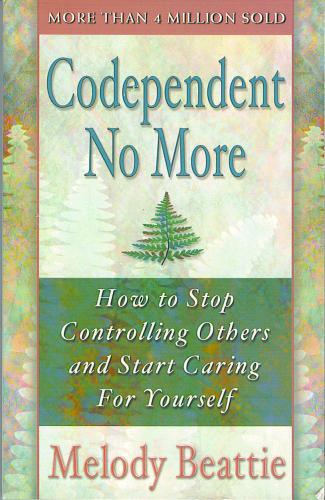 Title: Codependent No More
Author: Melody Beattie
Publisher: Hazelden
Genre: Self Help/ Addiction & Recovery
Length: 250 pages
When I worked in the bookstore full time, shelving, there was a brief few months that I ran the psychology section. I had become territorial over the fiction/literature section – my dream job if I’m to be honest with the world, despite the simplicity that infers – and this was an exercise my boss had to help me let go. To learn something out of my comfort zone. The psychology section was waaaaaaaay out of my comfort zone.
Being raised a Christian, there were some very un-Christ-like biases and stigmas surrounding that section. These biases were mostly self-righteous scoffing. Especially towards titles exactly like Codependent No More. I remember thinking, people should just stop being selfish whores and everything would be fine in the world.
Pretty sure, in hindsight, this was some very codependent thinking.
Whether you are a traditional codependent tied to a substance abuser in some way, an author looking for some insight into people and character development, or simply a breathing human – this book should be read. It opens your eyes to problems you might not know you have. It opens your eyes to problems I’m sure someone you know has – even if that someone is a psycho you wrote off ages ago.
Whatever your situation, whoever your person, this book is about peace. This book is about calming the anxiety and the panic and the anger issues. I wish I had read it much sooner rather than scoffing at it on the shelf.
Still Life
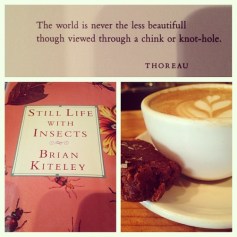 Title: Still Life With Insects
Author: Brian Kiteley
Publisher: Ticknor & Fields
Genre: Fiction
Length: 114 pages
“The narrator in this lovely novel may have set some kind of record for the longest, sweetest, fastest life ever lived. There are books twice as long as this one that do not tell us half as much about life’s wonder.” – Rick Bass
The thoughts I shared on Goodreads:
1. There are more reviews of this book under a misspelling of the author’s name. I have a first edition hardback from 1989 and wanted to honor the by line with the spelling that matched my book. So no, I did not read the e-book, but I do recommend purchasing it if you have an ereader.
2. I love his style. I will re-read this book because I feel like I should think it is amazing, but at this point in time with my first reading, I just liked it a lot. I think my amazement will come with another read through.
3. Something about the story Kiteley chose to tell reminds me of John Banville’s The Sea. The Sea won a Man Booker Prize and Banville is incredible. This should tell you something about Kiteley that (though an great writer in his own right) I will be filing him away on the same side of my brain.
Things I wanted to share here:
1. I’m really pleased with my first edition hardback. It was purchased for me as a gift by the wonderful Miss Golightly who I took shopping at Good Books in the Woods. I thought it was shockingly appropriate that they had so many first editions of Still Life With Insects, given the woodsy vibe of the whole store.
2. I look forward to collecting more of Kiteley’s work and I’d love to take a creative writing class under his teaching. I’ve been an aspiring novelist my whole life. I have my own novella currently out and a publisher wanting my next pieces. I’ve never taken a creative writing class and given the flaws in my novella, I think I would benefit from one greatly.
3. I’d love to re-read this book, as I stated in my Goodreads notation, but I’d love to read it for a book club. I think it would be well served in a group discussion among friends.
The Bridge of San Luis Rey
 Title: The Bridge of San Luis Rey
Author: Thornton Wilder
Illustrator: Jean Charlot
Publisher: Heritage Press
I didn’t care for Wilder’s work. It didn’t capture me. It left me pretty uninterested. I just wasn’t feeling it. I was, however, feeling the edition.
I read from the Heritage Press edition. Beautiful blue cover, fine blue buckram boards with gold. I love reading books on acid free paper and I really enjoyed the color lithographs.
Lithograph illustrations are gorgeous in general and Jean Charlot’s work was the most enjoyable part of this title to me – aside from a few lovely quotes. There’s no denying that Wilder has a way with words.
“She had a new way of fingering a wine-glass, of exchanging an adieu, a new way of entertaining a door that told everything.” – pg. 97
Monday, Half Price Books in Humble will be hosting a book club meeting. It starts at 7:30 pm and we’ll be discussing this title. It’s fairly short, only 137 pages long, and can be read quickly if you’re interested. I’d love to hear from people who are passionate about this title – always curious to know what makes something classic to the world that simply didn’t move me. After all, it won the Pulitzer in 1928.
Little Tiny Novels
 Title: The Newton Letter
Author: John Banville
Publisher: David R. Godine
Genre: Fiction
Length: 81 pages
After publishing my novella (roughly 130 pages long), my editor and I decided to make the sequel to my novella much longer. The publisher wants a full length novel, but in our attempt for length we started to believe that length would equate higher quality.
Reading through drafts we found that for the sake of propelling the story and actually achieving the higher quality work we were looking for, large chunks of filler might have to be scrapped. So I set out to read some great short work, to make myself feel better about not being Kate Morton. And though I am no where near ever going to have the talent of John Banville, Panlo De Santis, John Steinbeck, or William Kennedy, there’s something to be said about reading these and knowing that a finished product is all about quality over quantity.
“When your story is ready for rewrite, cut it to the bone. Get rid of every ounce of excess fat. This is going to hurt; revising a story down to the bare essentials is always a little like murdering children, but it must be done.” – Stephen King, “The Horror Writer Market and the Ten Bears,” November 1973 WD
John Banville makes me crazy jealous. I want his brain in my brain ever so briefly… just long enough to write something amazing. Because everything he touches is amazing. Even just an 80 page bit of story written before I was born reads like his full length prize winners.
The lesson in this for me (because almost every book I read teaches me something) is that while doing these edits for the second edition of my novella, I also need to edit in some breaks between paragraphs. Visually there are some things that don’t flow. I can thank my first edition readers for pointing this out. Even if I pout a little bit, I am so grateful for all the criticism on my first work. I’m pouting that I wasn’t more diligent about catching these things before you read it, not that you caught these things. Anything any reader of mine tells me is something I truly do ponder in great detail.
“The worst advice? ‘Don’t listen to the critics.’ I think that you really ought to listen to the critics, because sometimes they’re telling you something is broken that you can fix.” – Stephen King
I want even my first work to be better. I want my second work to be even better than the first. Whether I achieve the length of a traditional novel or not, I hope the second book achieves the complete story arch of a traditional novel. Hopefully, one day, when I’m old and gray, I can write something I’m happy with. It won’t be John Banville, because I’m not him, but in the meantime I can adore him a lot and work a lot harder.
Like Calligraphy
 Title: Voltaire’s Calligrapher
Author: Pablo De Santis
Publisher: Harper
Genre: Fiction
Length: 149 pages
You know it’s been a rough week when you’ve managed to 1. worry your best friends 2. drive your husband batty 3. inadvertently offend your readers 4. write not one, but two overly pouty blog posts and 5. manage to take a whole week to read 149 pages.
Especially when those 149 pages are so delicious.
Not just delicious, witty and divine.
De Santis doesn’t just write about calligraphy and a master calligrapher. He manages to make his words sound like calligraphy. And his story is woven with the same sly craftiness as runaway ink.
Normally, I would recommend someone read this in one sitting over a cup of the best dark coffee blend they have. I didn’t do that. I spent a week sucking down a chapter at a time – and his chapters are only a page to three at best.
There are castles and print shops, automatons, and poisonous fish… dark corners and forbidden candlelight… Oh my! What terrifying fun! You won’t regret diving into the adventure.
Moonhorse
Weekly Low Down on Kids Books
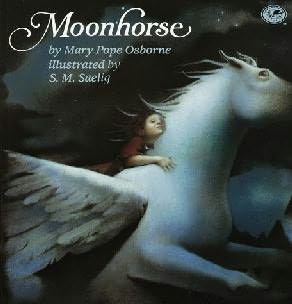
Title: Moonhorse
Author: Mary Pope Osborne
Illustrator: S.M. Sealig
Genre: Children’s Picture Book
I saw this and couldn’t pass it up. Mary Pope Osborne invades my house again! I love her.
I enjoy her complete ability to offer facts and history and in this case astronomy in the form of fiction. To pique a child’s interest in a nonfiction topic with a bit of fantastical fairy tale.
I’m trying to get more detailed and specific when I offer these reviews of my child’s favorite books, but she doesn’t always seem to understand the questions. Or perhaps, I don’t understand the beautiful simplicity of her answers.
Me: “Did you like this book?”
Kiddo: “Yes!”
Me: “What did you like about it?”
Kiddo: “The white!”
Me: “Because the horse is white?”
Kiddo: “With the red.”
The little girl in the illustration is wearing a red dress. I think bits of the story were lost on my three year old today, she was drawing her own pictures and sucking down a cup of milk. I think ultimately, what she may have been trying to tell me, in her distracted three year old way, is that she liked the illustrations and the use of muted color. But I don’t want to put words in her mouth.
If you’re building an astronomy unit study for anyone under ten, this is a nice bedtime story to add to your week. Personally, I wish the poetry of the tale was rhymed more, but I have a natural inclination to the sing-songy way of things.
Stuck in Love
A Movie Review for the Bookish at Heart
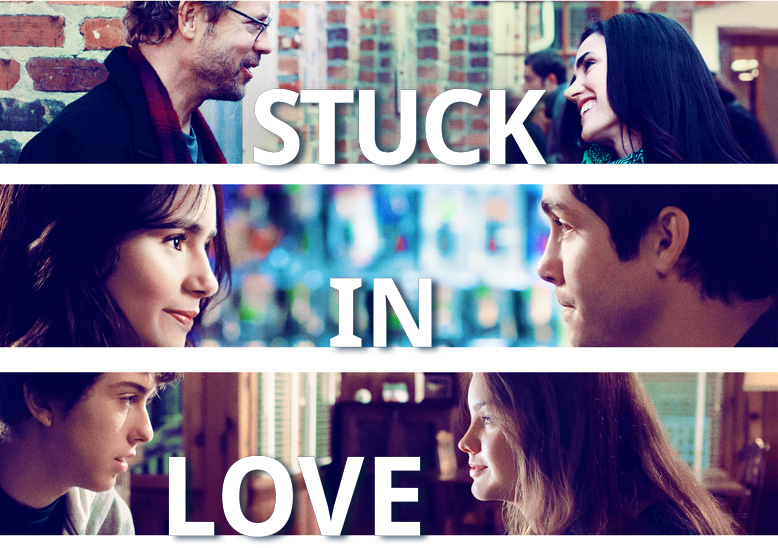 I was watching Stuck in Love, and probably about halfway through it, when my husband walked in and said, “You enjoying your book movie?”
It took me a minute. This movie was about a man who spends three years of his life waiting for his wife to return to him – even though they are divorced and she has married someone else. This movie is about the third year and how he handles the emotional struggles of his two nearly adult children. And yes, I realized after my husband posed the question, this movie is about four writers – lots of book lovers – and has many literary references.
 Greg Kinnear’s character has won two Penn Faulkner Awards. His oldest daughter is 19 and has just published her first novel through Scribner. His younger son, also having been groomed to write his whole life, is a poet and short story writer obsessed with Stephen King. Jennifer Connelly (the ex-wife) can be found reading Joan Didion in bed. Books are tossed around the set like old friends and are active characters in the movie as well, perched on shelves and end tables, strewn across laps at the beach.
I had not noticed until my husband pointed it out. I had not noticed because it was so familiar. I had not noticed because I live with these stacks of souls trapped in bindings all over my house. Sitting at the kitchen table, watching the sun come up with my coffee, I look out at my table… just here, in the kitchen of all places, I have 10 books, a journal, and a day planner, piled around me. You’d think this was a proper writing desk except for the bowl of orange slices and blueberries, my daughter’s play dough bucket, a United States place mat, and a container of markers.
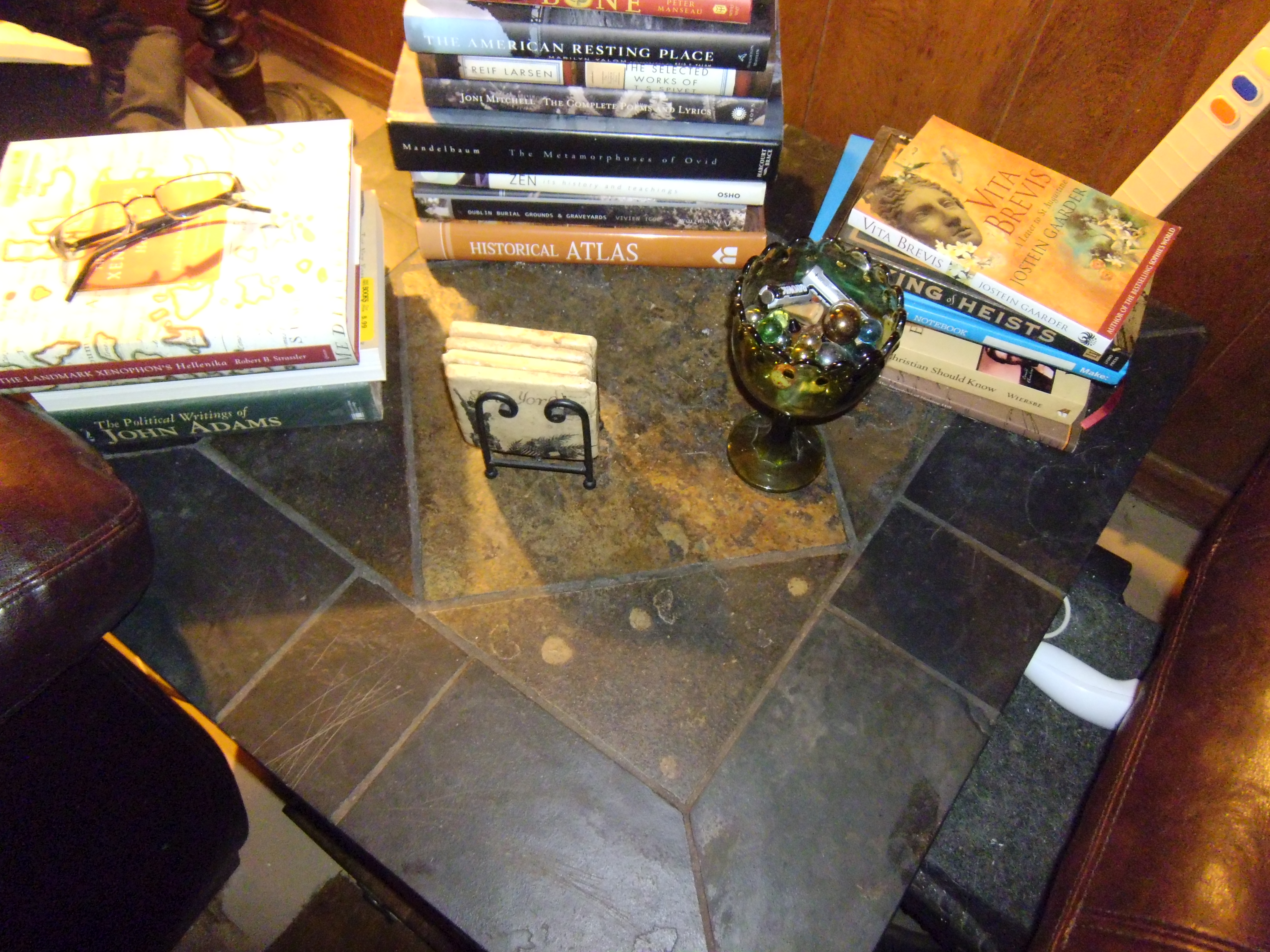 Granted the houses in Stuck in Love are much nicer than my own. Slightly bigger and the bookshelves are proper built-ins made of mahogany or some-such beautiful woodwork. The end tables were no doubt not retrieved from a neighbor’s discard pile. Yes, that black stone tile end table pictured here on the right came out of the trash. There’s absolutely nothing wrong with it and I could care less that it doesn’t match anything else in my house – I shall pile books on it. (Even though I’m supposed to keep all my books in the library and not let them trickle into the rest of the house. Keeping them out of other rooms requires a lot of daily maintenance.)
The people in Stuck in Love aren’t just richer than me, they’re probably much braver than me also. The daughter actually takes creative writing classes in school – whereas I took the safe route and studied marketing. They do what they feel – which results in a lot of really bad decisions. But one thing we do have in common, which I found really refreshing in a secular story, is have a permanence view of marriage. (You don’t find a lot of anyone who shares this worldview, not even among Christians: http://www.sermonaudio.com/sermoninfo.asp?SID=11309913170).
I found a lot of online critics who gave this movie a ‘rotten tomatoes’ rating (the soundtrack, however, gets glowing reviews from everyone). I am not with them (except for the soundtrack lovers). I found it marvelous. It’s a beautiful story about genuine people with a lot of bookish bits. I gave it 5 stars on my Netflix account. I will re-watch it. I will probably compile a list of the character’s books at some point and add them to things to move up my TBR pile (the patriarch can be seen reading Jeffrey Ford as well, but I didn’t catch the title).
 Not just for the book lists, the movie is filled with little quotable quotes, little tidbits for book-nerds and writers. Maybe that’s why I like it so much. That and I love that the dad teaches his kids to journal, that he allows them the privacy to write. I love that writing and reading are treated as means to live by, ways to learn, and how to pinpoint your emotions about your reality.
Something so obvious, that I didn’t catch at first glance and my husband did at a brief glimpse, this is a movie for book people.
Get Me Out of Here

Title: Get Me Out of Here
Author: Rachel Reiland
Genre: Memoir/ Psychology
Length: 447 pages
There was no hope for this book – it is so fascinating and so full of raw heart and soul of a person and her mental illness – my copy is obliterated with underlines and notes in margins. I read all 447 pages in less than a 12 hour period, without shirking my life responsibilities, and gave it a five star rating. I recommend it to anyone trying to understand the inner workings of a mentally ill brain.
“One of the saddest facts isn’t that there is still a child within you but that you’re so ashamed of that child. What’s even sadder is that you have always been ashamed of that child, even when you were one.” – pg. 141
Lacuna
 Title: The Lacuna
Author: Barbara Kingsolver
lacuna
-
n.noun
-
An empty space or a missing part; a gap.
-
A cavity, space, or depression, (Biology) in a bone, containing cartilage or bone cells.
-
: a blank space or a missing part : gap <the evident lacunae in his story — Shirley Hazzard>; also : deficiency 1 <despite all these lacunae, those reforms were a vast improvement — New Republic>
- (Printing, Lithography & Bookbinding) a gap or space, esp in a book or manuscript
- (Architecture) another name for coffer; an ornamental sunken panel in a ceiling or dome
- sheet that forms a distinct (usually flat and rectangular) section or component of something
- hiatus
-
Origin: L, a ditch, hole, pool from lacus: see lake
Barbara Kingsolver’s work embodies and embraces nearly all these definitions in some way or another. It’s really quite brilliant, although not nearly as riveting as the concept itself.
 Whereas The Poisonwood Bible was completely riveting, but I was far less intrigued by the concept. Funny how that happens. I love Kingsolver, I think she’s a genius. She has managed two completely different reading experiences in one career and I only hope that I could accomplish that one day. With Poisonwood Bible, I was captivated by the place, the drama, her ability to tell a story from five completely distinct voices. I could not stop reading, could not wait to get back to the story.
The Lacuna put me to sleep. Honestly. But it’s not a terrible book. To be fair, I was tired – really tired – this week. When I read books like this, I often think of that quote at the end of Fight Club, “You met me at a very strange time in my life,” I want to tell the book. A time when everything simultaneously puts me to sleep and keeps me awake at night. On top of that, I was totally distracted by the concept. I would start reading and instead of getting lost in the story I’d get lost in my thoughts about the story. I’d soak in every nuance of the word lacuna and sit and pick apart every aspect of how that word is tied to MY story – MY life.
“What do you know about love?”
“Nothing, apparently. That it winks on and off like an electric bulb.”
– pg. 184
 Those lines hit me pretty hard. There’s the honest truth of so much about the world right there. At least for me, I see it so truthfully. Love is like a light bulb to me – a choice – you click it on and click it off. You decide to love someone in a moment, or not. I’ve talked about this endlessly in other posts, I’m sure. I think it fascinates me so completely because how I feel and think about love is so unaligned with how those around me feel and think about it. While contemplating this word and this story and this quote I remember noting a conversation with someone I had a little over ten years ago. He had not had a romantic feeling about a girl all day and considered this a triumph. It baffled me, as I had not had a romantic feeling about a person in possibly a month or more. When romantic feelings came to me they always overwhelmed me in their suddenness, the complete surprise of it throws me all the time, because I don’t have them often. I’m not saying romantic thoughts – I love my husband, have loved him for 15 years – but the *feelings* (not the butterflies or the goosebumps as related to physical feelings, but the emotional ones) I don’t have much. Explaining this is difficult and often leaves me faced with strange looks. I consider myself a passionate person who loves deeply and loyally, but have often been told how cold and void of compassion I can be. I understand both descriptions of my personality because when I do feel, it is a strong sense of emptiness. I feel a deep hole in my soul – like a lacuna.
Kingsolver has a way with moving you to re-evaluate your entire existence in one sentence over and over again in a book – in a way that writers strive to do just once in their lives. If I write one excellent sentence that moves someone, I will have considered myself accomplished. So here is another favorite from the beautifully quotable Kingsolver:
“This is what is means to be alone: everyone is connected to everyone else, their bodies are a bright liquid life flowing around you, sharing a single heart that drives them to move altogether. If the shark comes they will all escape, and leave you to be eaten.” – pg. 185
I kept saying the word lacuna over and over in my head. Lacuna, lacuna, lacuna… over and over I let it slip seductively off my mental tongue – while I read, while I did house work, while I slept. I dreamed about it. Not the story, not the setting, but the word. I dreamed about the idea.
“[Y]ou can’t really know the person standing before you, because always there is some missing piece: the birthday like an invisible pinata hanging great and silent over his head, as he stands in his slippers boiling the water for coffee. The scarred, shrunken leg hidden under a green silk dress. A wife and son back in France. Something you never knew. That is the heart of the story.” – pg. 325
I’m a little bit in love with the word, and yes, with the feeling of the word. Thank you Barbara Kingsolver for defining this word oh so eloquently in 507 pages.
I Love Dirt!
 Title: I Love Dirt!
Author: Jennifer Ward
Foreword: Richard Louv, author of Last Child in the Woods
Illustratator: Susie Ghahremani
I popped in at Half Price Books after a long season off from scheduling book signings. Tucked low in my employee cube was a book – this book – with a post it note on it from my boss.
“Andi – I thought you might like because of the woods you live by!”
I did like it, immediately. And bought it with my Christmas money.
The book starts with a riveting foreword about the nature of nature in the United States and how much we have strayed from the outdoors. Interestingly enough, the more we stray from outdoor life, the more children struggle with obesity, ADD and ADHD, as well as depression.
And the more kids spend outdoors?
“A 2005 study by the California Department of Education found that students in schools with nature immersion programs performed 27 percent better in science testing than kids in traditional class settings. Similarly, children who attended outdoor classrooms showed substantially improved test scores, particularly in science. Such research consistently confirms what our great-grandparents instinctively knew to be true, and what we know in our bones and nerves to be right: free-play in natural settings is good for a child’s mental and physical health. The American Academy of Pediatrics agrees, stating in 2007 that free and unstructured play is healthy and essential for children.”
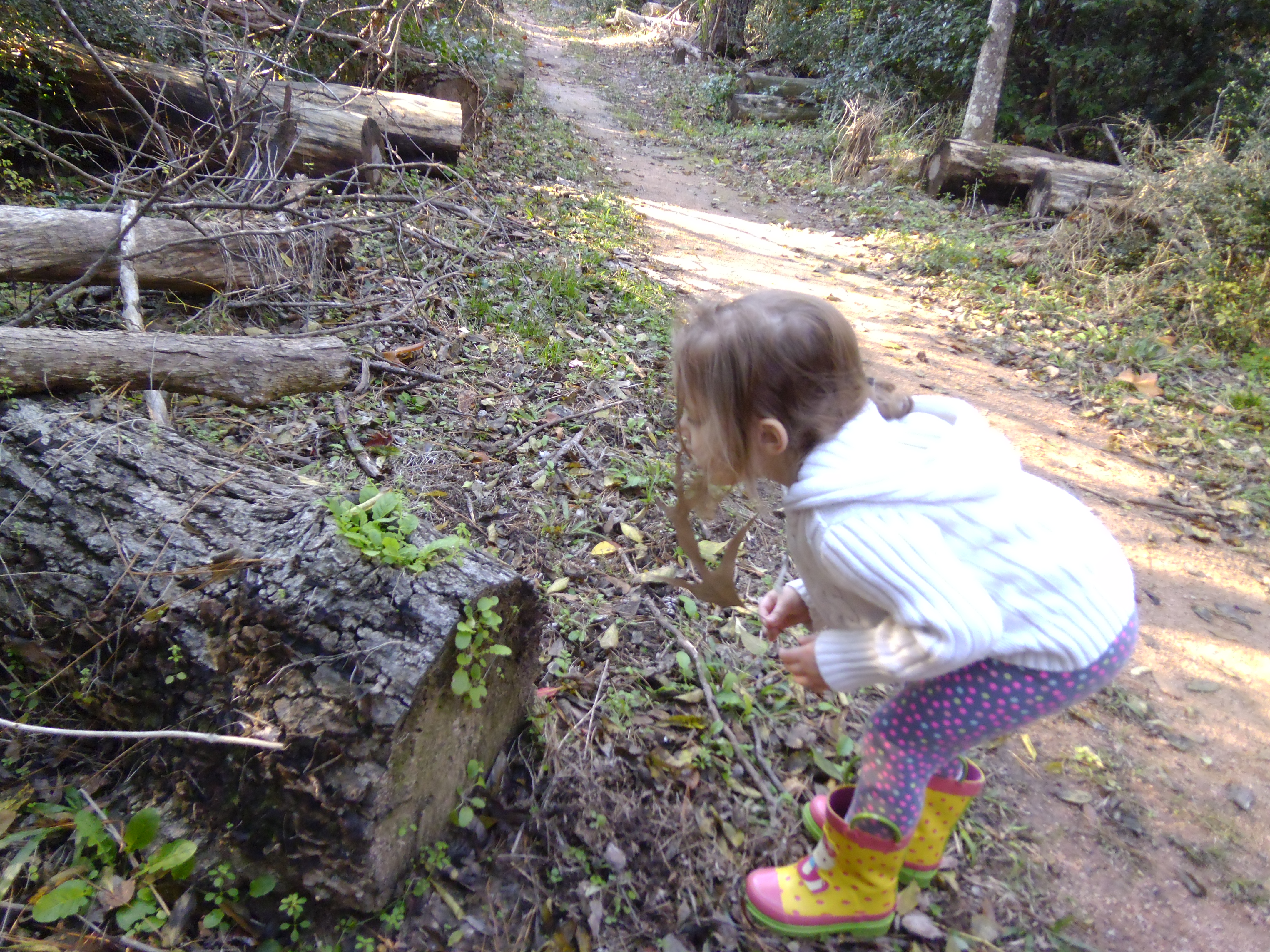 I’m in love with this book. I already do a lot of nature activities with my child – foraging for starters. We play outside at the public park, we walk nature trails, we run, we jump, do cartwheels in the grass, hunt insects and lizards, sword fight with sticks, and sing our ABCs at the tops of our lungs by the creek. As Ward states in her introduction, “There is nothing more joyful and inspiring to watch than children discovering the world around them.”
All of the activities in this book are pretty much cost free. The only one I found that requires any kind of purchase is the bird feeding one, and that’s only if you want to do it big and don’t have spare groceries in your house. The activities are simple, like sprinkling orange peels in your yard or covering pine cones with peanut butter and bird seed to bird watch from inside when it is too cold to be outside.
The book is broken up seasonally, so you can hop in and do something no matter when you pick up the book. Each activity has a prompt or a concept to get your child thinking about the activity and world itself.




 Anakalian Whims