Halloween at Half Price Books
HPB Humble Location
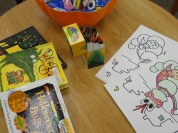 Story time, typically Wednesdays at 10:30 am, was stretched out over the course of 2 hours today (9 am – 11 am) in honor of one of the biggest costume days of the year. Good thing too, because our most interested little patrons came in early.
Equipped with a candy bowl, coloring sheets, crayons, and a few costumed employees who were more than happy to pose for the camera in their book-themed attire, story time commenced bright and early.

There are many versions of Snow White
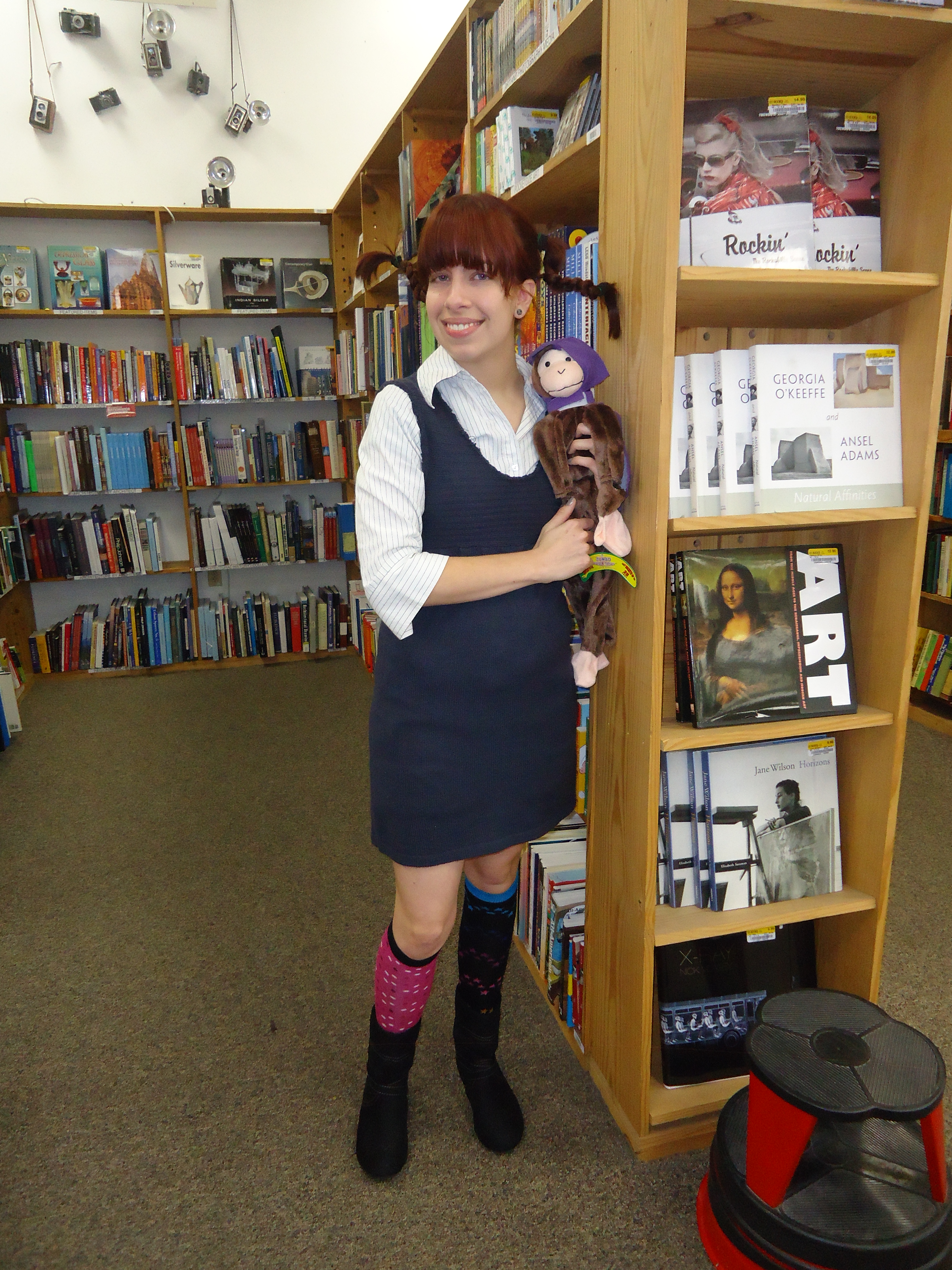
Another bookseller, Veronica, promoted Astrid Lindgren’s young adult character Pippi Longstockings
If you are in the area and missed this bit of fun, be sure to check out Baldwin Boettcher’s Halloween Event this evening at 6:30 pm. Baldwin Boettcher is the public library inside the gates of the Mercer Arboretum off Aldine Westfield. It’s a hidden treasure of a library that often gets passed on the way to the botanical gardens with little thought to the fun things that may be happening indoors. And remember: It is never too late to celebrate your love for a fantastic book character.
If you missed this morning’s story time, and already have plans this evening, here are the books we enjoyed this morning. Maybe you can find copies and read them with your kiddo in the days to come as you sort out their candy haul.
1. A Pop-Up Trick or Treat book called Halloween Bugs
2. A Pull and Poke book called Pat the Beastie
3. And my favorite, a Halloween Adventure called One Spooky Night

When We’re Not Reading – Critical Mass
 As much as I love to read and review books, I’ve really been enjoying finding things to add to my When We’re Not Reading segments. It has forced me to be bold and adventurous in the Houston area, re-visit my attitude from my college years. Which went something like this: It could be fun, Its free, Why not?
This month my best friend invited me to a not-so-little shin dig called Critical Mass. Cyclists all over the world get together in their home cities and take to the streets on the last Friday of the month every month. Hundreds, easily nearly a thousand, people on bikes trekking through downtown together for 20+ miles. It was nothing short of amazing.
I’m not the biggest fan of getting info from Wikipedia, but they do have some interesting tidbits on what Critical Mass is all about: http://en.wikipedia.org/wiki/Critical_Mass.
For some people this event is an agenda to gain respect on the road for cyclists, make a statement, and more. From my bike seat, it was a fantastic rolling party. It was a blast that still managed to create a new appreciation for the world of cyclists, and for my need for headlights, tail-lights, and a helmet. I would also like a bell and basket.

One of the guys taking lots of pictures got one of me!
Last night’s ride was a Halloween ride. There were costumes and all sorts of excitement. In advance, my friend and I had agreed that if we lost each other to simply look for “the hat and the tutu” (two costumed people that were easy to spot and part of our collective mini-group). This is a good plan. If you ride a Critical Mass, whatever you do, don’t stop to look for someone… just keep on rolling and catch up to each other when you catch up to each other.
Many motorists cheered, took pictures, and had a general blast right along with us. However, there were the occasional drivers that got really pissed off that 600 people were holding up traffic as we had to roll through the red lights. I understand that this is technically illegal, and with an individual or a crowd of 2-30, very ill-advised. But with 600 riders, stopping at the red light is far more dangerous than holding up traffic. You wouldn’t ask the Macy’s Day parade to stop at all the red lights, and it is obvious that an event is happening. So if you happen across this group on a Friday night, please be patient and don’t hate; 99% of the people involved in this ride are trying to be as safe and friendly as possible.
Check out this awesome crowd:

Photo taken by of one of the members of the Facebook group for Houston’s Critical Mass during the October 2012 ride as well.
Initially, I was under the impression that it was a 10 mile ride. My husband was convinced that I wouldn’t be able to do it, as owning a bike is something that has only been a part of my recent adult life. I’d never taken the thing farther than around the block a few times (most likely about a mile, 3 miles at best but that could be stretching the truth of reality). Come to find out, it is actually about a 20 mile ride. Someone gps-ed it as we went and came up with this map after the fact: http://www.mapmyride.com/routes/view/149370997. Include our ride to the event and back to the house when we were done and I can safely say without exaggeration that I rode 22 miles.
Needless to say, I’m quite proud of myself. Here we are at the first break… 10.2 miles into the evening:

“Your Review Helped…”
I love getting these emails:
AnakaliaKlemm, a customer just told us your review was helpful to them while shopping on Amazon.
 |
 June 11, 2012
|
Read my review here.
The Guardians of Childhood
 *A Weekly Low Down on Kids Books*
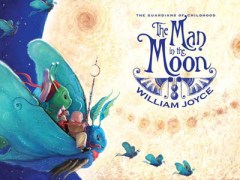
Title: The Man in the Moon
Author: William Joyce
I clearly have an artistic and literary crush on the fabulous writer and illustrator of The Fantastic Flying Books of Mr. Morris Lessmore! William Joyce’s work is simply beautiful, spunky, cozy, and classic.
During story time at Half Price Books in Humble, I was very pleased to discover a pile of The Man in the Moon on the shelf this morning, the first of many in Joyce’s Guardians of Childhood series. It seems as though Joyce’s work, despite being lengthy, is just the remedy for a squirmy, whiny toddler. One look at these gorgeous illustrations and immediately stillness and wonder ensues.
Joyce presents the myths of childhood in a way that a child will understand that they are beautiful dreams to enjoy, a fantasy to embrace. Kids and and adults alike cannot tear their eyes away from the colorful and powerful images he creates, and all are equally riveted by the presenation of the tales.
I am coming to cherish my time reading these books to the kiddo and I cannot wait to acquire the others in this amazing series:

Buy your own collection of Joyce’s Guardians of Childhood today!
The Writer: The Paperback
Planning on self-publishing? I am, so I’m going to keep this guy’s name in my pocket when I start putting the final touches on things.
Weekly Low Down on Kids Books – Previously
 Title:Previously
Authors: Allan Ahlberg and Bruce Ingman
Publisher: Candlewick Press
Kiddo and I closed the book with a happy sigh. *Previously* we had been reading a lovely tale that included every tale.
From Goldilocks to Jack and the Bean Stalk, Jack and Jill to the Gingerbread Boy, Ahlberg and Ingman have brilliantly included all the familiar fairy stories in a unique fashion that teaches a kid the meaning of the word “previously.” How fun!
How did they come up with it, I wonder?
The whole idea is just so clever. The pictures so simple and exciting! The kiddo was riveted and I simply couldn’t wait to see how Ahlberg and Ingman would connect the story dots next.
In contrast to the intelligence it took to write this fabulous little picture book, we also read Ok Go by Carin Berger and were quite unimpressed. The art and design of the book is really cute, but the work as a whole was a bit lost on me, kiddo was pretty uninterested.
Three A.M. – A Short Story
 Original Story by E.B. Jones
I woke up slowly and looked at the clock, it was three in the morning. I can’t remember a single night since my wife and I moved here that I didn’t end up waking up at three in the morning. A train used to always come by at three and blow it’s whistle at the intersection right behind out house. The first time that it happened my wife and I both shot out of bed, scared out of our minds trying to figure out just what the hell was going on. We knew that there was a train track behind our house but we didn’t have any idea that it was going to be going past at three in the morning. The realtor had failed to mention that whenever we were looking at the house.
We’d moved here about six months after we were married because we decided that buying a home was the next logical step in our lives.
“It’s more like an investment,” She would say as she chewed celery and looked at the brochure that the mortgage company had given us. “I mean, right now we’re just throwing money away at that sleazy land lord of ours, and you know real estate always goes up in value.”
“Sounds good,” I would say, sipping my coffee and not trying to be contentious, “But are we really ready to settle down just yet?”
“Well, we were settled down enough to get married.” She laughed.
“You have a point.” I told her.
“Besides,” She would say as she put her hand on mine. “I think we’re ready.”
We both smiled and then spent the rest of the time figuring out the details on how to close, how much we would need for a down payment and everything else. She was much better with the numbers than I was so she took care of most of the details, besides, we both knew that it was really going to be her house.
The next few weeks we spent looking through the real estate ads at all the houses that were for sale.
“Oh, I absolutely love this one!” She would tell me quietly. She had heard that if the realtor knew that we were excited about a place then they would have an easier time convincing the client that it was a good home, despite the obvious flaws.
The realtor could still always tell whenever she was excited though, so I had to be the skeptic and ask questions that might make us look less interested. “I don’t know,” I would say, “I mean, what is the crime rate around here?” I wanted to make sure we weren’t getting something we would regret.
“It’s a lovely neighborhood, low crime, great schools and the neighbors are all just so active in the community.” The realtors always said the same thing, sometimes even in the same exact words and I wondered if there was some sort of script that all realtors had to memorize in order to get their license.
The first time we walked into the house that we would eventually buy in a month and a half my wife couldn’t keep it in. “I just love it!” She blurted out.
And we both told the realtor, “We’ll take it!” The final paperwork was signed and we made the hefty down payment and they handed us the keys.
We drove from the old apartment to the new house with the last of our things and got out, marveling at our first real purchase as a married couple. We stood for at least ten minutes just looking at the front door, then she broke the long silence. “Oh my god, a flower garden here on the front with some bushes would look amazing! I could plant some azalea’s and maybe some small bushes,” and then, “You can put in a nice brick walkway up to the front porch, and then people can walk up to it while we sit on the porch in the spring and sip on tea!”
She was so excited about our new home. I was excited as well, “I can build a shop back here so I can work on things.” I told her. I had no idea what I would work on, I was just an accountant and had never really built or repaired anything in my life, but it seemed like something that a married man would do.
“Oh! What kind of shop!” She would ask me excitedly.
“I don’t know yet, maybe I’ll get a lathe and learn how to do wood carving, like my grandpa did. Or I could just turn the garage into an auto repair place and buy me a hot rod and soup it up!”
She tilted her head and looked at me, “As long as it doesn’t take up my side of the garage.”
After walking around the house and coming up with all of our crazy ideas of shops, gardens, sun rooms, dinner parties, barbeques and even a quickly dismissed idea of beekeeping, we started to unload the car.
Most of the larger or heavy stuff we had hired professional movers to take care of so it didn’t take us very long to get everything into the house. We walked around the three bedroom house and were amazed at just how little possessions we actually owned.
“It’s ok, we can buy new things. Furniture that actually matches so it all looks proper.” I laughed.
“You’re right, and there’s two empty rooms, maybe we could think about starting a family. You know, once we get all settled in.” She said looking at me with a gleam in her eyes.
“Really?” I asked, “You want to try for kids?” I wasn’t sure how I felt about kids. I wasn’t against the idea, I had just never really given it much thought.
“Yeah,” She hesitated, “I mean, if you want too.”
I hesitated myself, then finally, “Of course, I’d love too.”
She slung her arms around me and kissed me and then jumped up in the air and before we realized what was going on we were in bed working on starting up a new family.
That evening we ordered pizza. I think it was mostly so we could invite someone to see our new place, thinking that they would think it was just as spectacular as we thought it was. The pizza delivery boy didn’t seem as excited as we were whenever she told him that we had just moved into the neighborhood.
We ate the pizza and watched our favorite movie together and then decided to go to sleep, it had been a very long day today, and we still had many more boxes to unpack tomorrow.
A few hours later, it happened, the loud screeching of a train screaming through the room like some kind of banshee trying to warn us that the house was haunted. I jumped out of bed and grabbed for something to beat off whatever the noise was that had interrupted our peaceful slumber.
It only took about thirty seconds for us to figure out what was going on but it felt like an eternity. She was holding a fly swatter and I had picked up a cardboard tube that one of her paintings was in. We looked at each other and then we started laughing. Then we got back in bed and both fell asleep to the sound of the train going off in the distance.
The next day we unpacked and laughed some more about the train that night, thinking it was probably just a one time thing. It wasn’t. Every single night at close to three in the morning the train whistle would screech through our room, waking us up every night.
The train whistle wasn’t the reason that she left, but she isn’t here anymore. We never had any children and she never planted that garden. None of the furniture is the same and I’m still driving the same four door sedan that I’ve had for the past six years. The train doesn’t come by anymore, but I still wake up every morning, for just a minute or two, at three in the morning.
Parnassus on Wheels – Can I Have One?
 Title: Parnassus on Wheels
Author: Christopher Morley
Publisher: Akadine Press
Length: 160 pages
“[…] When you sell a man a book you don’t sell him just twelve ounces of paper and ink and glue – you sell him a whole new life. Love and friendship and humour and ships at sea by night – there’s all heaven and earth in a book, a real book I mean.”
Parnassus on Wheels is both sweet and clever. It is adorably romantic. After reading this, I want desperately to peddle books from a horse-drawn early 1900s RV. Morley has captured a tale of an adventure that is every book lovers dream: to travel in a cozy carriage with a dog and horse, spreading the love and joy of literature to everyone you meet. What could be better?
Mr. Mifflin is a middle-aged ginger, evangelizing about the religion of books as a way of life, when he meets over-weight Helen McGill. Helen is tired but spunky, she’s been a ‘house-wife’ to her brother for years on the farm they share. Her brother, a famous author doesn’t really treat her as though she’s her own person, and 6,000 loaves of bread into life, she buys Mifflin’s whole operation for $400 on a lark. Of course, everyone thinks Mr. Mifflin is taking advantage of the lady, but in reality he has offered a whole new life, a new way of seeing the world, and an absurd amount of joy.
As a bookseller, this story speaks to me. I ran the literature sections for several years, and I received an intense amount of satisfaction from finding books for my customers. The idea that you could deliver books straight to someone’s doorstep in such a homey but noninvasive manner sounds so enticing and whimsical to me.
Peddlers are well-known concept:
THE PEDDLER’S CARAVAN
[46]
I wish I lived in a caravan,
With a horse to drive like a peddler-man!
Where he comes from nobody knows,
Or where he goes to, but on he goes!
His caravan has windows two,
And a chimney of tin, that the smoke comes through;
He has a wife, with a baby brown,
And they go riding from town to town.
Chairs to mend, and delf to sell!
He clashes the basins like a bell;
Tea trays, baskets ranged in order,
Plates, with alphabets round the border!
The roads are brown, and the sea is green,
But his home is like a bathing-machine;
The world is round, and he can ride,
Rumble and slash, to the other side!
With the peddler-man I should like to roam,
And write a book when I came home;
All the people would read my book,
Just like the Travels of Captain Cook!
—WILLIAM BRIGHTY RANDS.
But a book peddler is a fairly unique idea, and I love Christopher Morley for sharing this idea with the world. Clearly, he didn’t invent the concept, but one wonders if he encountered a caravan such as R. Mifflin’s Traveling Parnassus, or is it merely a dream he had for himself? Parnassus on Wheels was Morley’s first novel, first published in 1917. Mr. Mifflin returns in the book The Haunted Bookshop, a sequel I am strongly looking forward to, but what I find most interesting is that Christopher Morley wrote over 100 novels. Have you heard of any of them? I had not, I was only aware of Morley because he was pressed on me by a fellow bookseller. I rarely come across his work in bookstores, and I have never seen a title of his in any library. I now plan to collect his work more vigorously.
Morley apparently wrote a number of essays and poems as well, and lectured at University. One adorable little factoid is that he married a woman named Helen shortly after studying history in college. I can’t help but wonder how much Helen McGill, of Parnassus on Wheels, resembled his own wife whom he loved.
Have you read anything by Christopher Morley? Please leave comments.
Great Journeys – Marco Polo
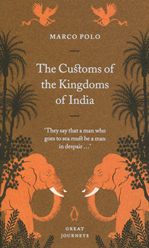 Title: The Customs of the Kingdoms of India
Author: Marco Polo
Publisher: Penguin Books
Length: 86 pages
Inspired by the Great Ideas series, Penguin Books printed a Great Journeys companion series as well. From Herodotus to George Orwell, the series chronicles twenty of the most famous and intriguing adventurers in history. Third in this series is Marco Polo’s journey to South Asia, where he discusses the culture, the economy, the industry, religious practices and more.
I picked this book up for two simples facts: 1. I am collecting all of Penguin Books Great Ideas publications and 2. There are elephants on the front cover. I adore elephants. They are powerful, dignified, trustworthy, humorous, and endearing. Marco Polo’s The Customs of the Kingdoms of India has little do with elephants.  Actually, I’m pretty sure it has absolutely nothing to do with elephants. Of course, that’s not the point, elephants are broadly recognized as a symbol of India/ South Asia, so naturally they would be an image of choice for the front cover of an Indian travel book.
Marco Polo does not go into great detail about how the elephants are used as means of transportation, status symbols, work beasts, and more. He mentions them in passing, but says in the places he visits, they are not indigenous to the area but imported from other islands. He does, however, discuss the art of physiognomy, which immediately made me think of the science fiction piece by Jeffrey Ford called The Physiognomy

Did Marco Polo’s “prettiest hens” look like these?
Apparently, in South Asia, hens represent prosperity, and today you can buy ‘prosperity hens,’ little talismans similar to a rabbit’s foot. Of course, Marco Polo again does not go into detail regarding this, he merely mentions their beauty and moves on. Marco Polo’s writing is that of traveling merchant. He chronicles quick and simple descriptions that would be useful for a businessman, but avoids the great detail of a philosopher or anthropologist. The things that strike his fancy for elaboration are the rituals that would intrigue a vendor, rather than those that would fascinate a theology student. Where he does talk about religion, it seems to be in a political and historically informative way to help you understand a province as a whole, moving quickly to the supplies they live on because of their past. Like a professional trader, he wishes to dwell on the rice, the wheat, and the growth of cotton. Respect for various people groups and villages he encounters is highly dependant on how much they function on industry and marketplaces.
I don’t believe Marco Polo to be much of a writer, and I think his accounts would have benefited from being written while on his voyage. But according to historians, he dictated these adventures of sailing the Indian Ocean later to a fellow inmate in prison. This practice of dictation could have played a role in his style of often informing his reader “I will tell you how” and “I will describe to you,” as well as “let me tell you why” and so on; repetitive and unnecessary phrases that, quite frankly, annoyed me.
Still, this concise 86 page piece is interesting, and a great addition to any young scholar’s library. It would be a wonderful supplement to a world geography study on South Asia for a middle grade student and could open up a lot of dialogue between teachers and students regarding history, religious practices, other cultures, world economies, and more.






 Anakalian Whims